
Archaeometallurgy investigates how societies produced, worked, recycled and used metals through furnaces, ore, slag, crucibles, moulds and metalworking debris. The basic lesson is immediately useful: **not every black, glassy fragment is iron-smelting slag, and recovered slag weight is not the quantity of metal once manufactured**. Both material classification and site formation matter before writing an industrial history.
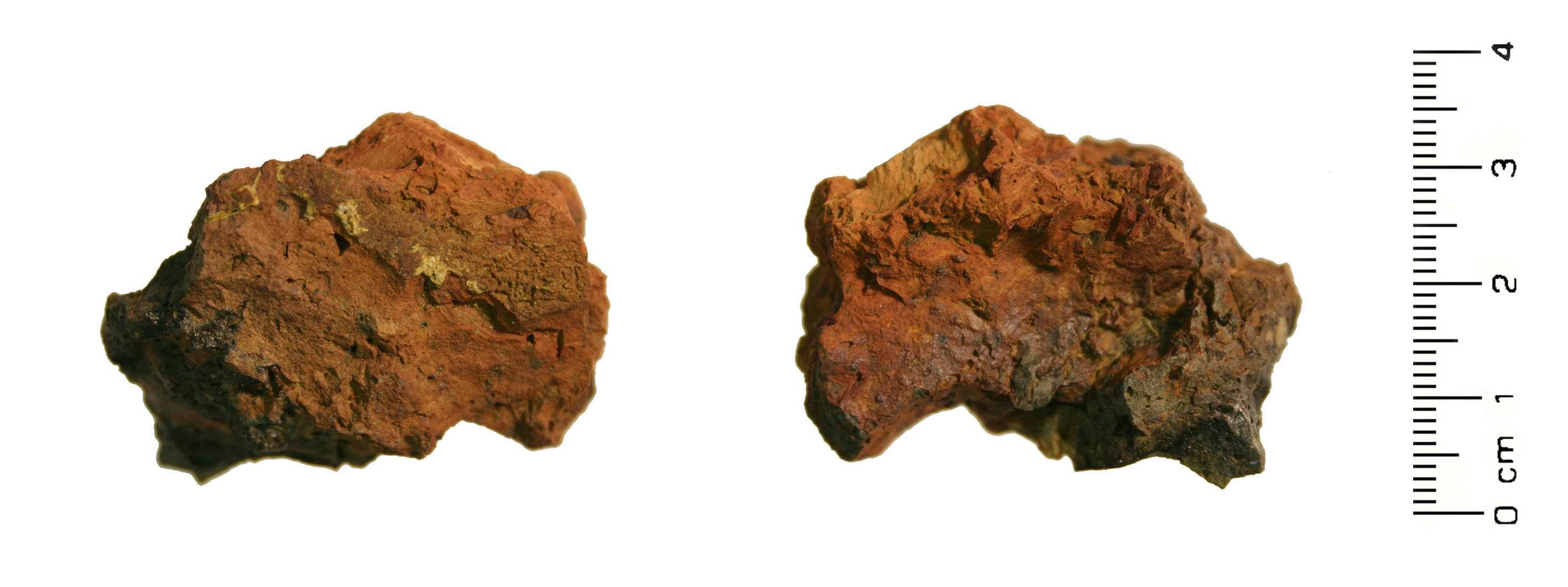
Our original classroom investigation is a fictional Cinder Quay assemblage containing 18 pieces and 6.5 kg of provisionally classified industrial material. Students distinguish possible bloomery slag, smithing waste, technical ceramic and unclassified material and calculate only what the recorded figures support. The featured real image is a Portable Antiquities Scheme bloomery slag fragment, FindID 284407, not a sample from Cinder Quay.
The main evidence standard comes from Historic England’s Archaeometallurgy Guidelines, alongside its materials-science guidance. In the eduKate Gold Standard, the learner identifies a meaningful question, distinguishes observations from interpretations and transfers a method safely to new evidence.


1. Begin with a material problem, not an imagined workshop
At fictitious Cinder Quay, excavators record glassy black fragments, a hollow fired-clay piece and some corroded metal. A pupil concludes that smiths made swords there. Yet dark, vitrified material can be produced by different high-temperature processes, and the fragment’s final location may not be its manufacturing location. Archaeometallurgy studies ores, metal products, slags, crucibles, technical ceramics, furnaces and their depositional contexts to reconstruct historical metal production and working.
First record where each object came from, what it looks like and what specialist analysis might clarify. The Historic England Archaeometallurgy Guidelines approach industrial debris as evidence ranging from microscopic materials to landscapes. The featured Portable Antiquities Scheme FindID 284407 is a real slag example, not a Cinder Quay specimen. A good teacher distinguishes observed material, possible technology and inferred people before constructing a historical narrative.
Back to the chapter index · Next chapter
2. Distinguish ore, fuel, metal, slag and technical ceramic
An ore can supply recoverable metal under a suitable process; a furnace’s fuel and air affect heat and chemical conditions; a bloom or casting product contains metal; slag contains non-metallic phases; and technical ceramics include linings, moulds and tuyères subjected to heat. Their physical characteristics can overlap. A vitrified clay piece might be furnace lining, overheated pottery or another industrial by-product. No single dark colour or glossy surface uniquely establishes iron smelting.
Students receive five fictitious object descriptions and classify each as confirmed, provisional or indeterminate. For each label they state which mineral, textural or archaeological feature supports it. A confident ‘furnace lining’ identification may require evidence of construction, heat gradients or associated slag. The first lesson is to respect uncertainty in a material identification rather than force every object into a metalworking role.
Back to the chapter index · Next chapter
3. Explain primary smelting versus secondary metalworking
Smelting separates metal from an ore, while smithing shapes or consolidates previously produced metal. A place could host both, but it might preserve only forging or repairs. Metal recycling can generate high-temperature residues without any local ore reduction. The manufacturing sequence matters because different tasks create different objects and wastes, with overlapping characteristics that require context and specialist comparison.
Ask students whether a nearby iron bar and a pile of slag prove ore was smelted at Cinder Quay. They do not; the metal may have been imported for forging. To investigate smelting, appropriate furnace remains, ore, compatible slag and industrial setting would help. Historic England’s guidance treats iron production and fabrication separately. Students should be able to distinguish them without being asked to conduct dangerous furnace experiments.
Back to the chapter index · Next chapter
4. Understand iron blooms, bloomery slag and smithing residues
A bloomery can produce a heterogeneous spongy iron bloom and associated slag; subsequent consolidation and forging can generate smithing residues. Tap slags, furnace slags, hearth bottoms and hammer scale may have different forms under particular technologies, but appearance alone does not universally separate them. A plano-convex lump might support a hearth-bottom hypothesis yet still need comparison. One broken slag mass can become many recorded fragments.
Give pupils a process map from ore to bloom to forged bar, then attach the fictitious residues only where evidence permits. The documented experimental iron bloom is a useful separate illustration, not an artefact from Cinder Quay. Students should recognise that the number of slag pieces cannot count smelting fires or metal objects made, and should reserve precise process labels for specimens with appropriate context and analysis.

Back to the chapter index · Next chapter
5. Read tuyères and furnace lining with stratigraphy
A tuyère introduces air into a hearth or furnace in some historic systems. Fired ceramic fragments with a circular opening or heat-altered surfaces may be compatible with such equipment, but a single broken tube does not prove a complete furnace stood exactly at its recovery point. Technical ceramics can be reused or moved with demolished material. Furnace walls may also preserve multiple construction or repair phases.
Use an invented section drawing showing a slag-rich floor near a vitrified lining and a later ditch. Pupils must distinguish a primary process deposit from material displaced during repairs or later levelling. They should say what physical joining, stratigraphic continuity or heat-related association would support a furnace attribution. A convincing industrial reconstruction remains labelled a model until linked to excavated evidence.
Back to the chapter index · Next chapter
6. Distinguish copper-alloy melting and casting from ore reduction
Crucibles, casting moulds, metal prills and spilled droplets can indicate melting or casting copper alloys. Such finds may represent use of already supplied metal rather than primary smelting from ore. Different alloys also have different compositions and technological histories. Green staining is not a chemical analysis, and an artefact’s apparent colour cannot reliably assign a complete alloy recipe or its source.
Offer a hypothetical crucible wall with copper-rich staining and a mould fragment in a separate context. Students identify the processes each might support and what would link them to one production episode. They must not transplant iron-bloomery assumptions into copper-alloy working. The Historic England guide provides separate treatment of copper and iron evidence for exactly this reason.
Back to the chapter index · Next chapter
7. Interpret fuel and furnace atmospheres without a fake thermometer
Temperature, oxygen access, furnace design, ore mineralogy, fuel chemistry and ceramic materials affect the waste that survives. Vesicular glassy material can form under multiple conditions. A dark melted-looking fragment therefore cannot be assigned one exact firing temperature or smelting efficiency from a photograph. Industrial processes may also overlap in their surface appearance, making internal mineral relationships important.
Compare two fictional samples that both appear glossy but have different interior textures and associated finds. Ask which laboratory measurements and field observations would distinguish the causes. A proper answer identifies the uncertainty in process parameters instead of converting appearance into an invented number. Historical metalworking can be explained accessibly without providing hazardous smelting instructions.
Back to the chapter index · Next chapter
8. Use magnetism as a clue, not a unique slag classifier
Some iron-rich slag is magnetic and others weakly responsive; natural magnetic rock and modern steel debris can also respond. A specimen’s magnetic behaviour depends on its phases and metallic components, so a simple ‘magnetic’ label does not prove bloomery smelting, nor does a non-magnetic result exclude metallurgical origin. Collection and storage conditions may matter when metallic iron remains present.
Give three laboratory-card outcomes: responsive, weak response and not assessed. Students should identify what additional mineralogy, microscopy or documented association could help. Do not ask pupils to crush or acid-test suspected industrial material in an ordinary classroom: archaeological residue can be sharp or contaminated. The source interpretation must combine observations rather than rely on one dramatic demonstration.
Back to the chapter index · Next chapter
9. Examine microstructure under appropriate specialist methods
Polished sections and suitable reflected-light microscopy can show phases, pores and metal inclusions in slag or metal. Other techniques may resolve mineral relationships or working history when the sample and study design warrant them. A selected microscopic field represents a tiny part of potentially heterogeneous waste, and its preparation might alter its appearance. A beautiful coloured mineral image is not a complete record of the furnace process.
Use permissioned reference micrographs with scales and explicit methods. Students first describe visible inclusions and boundaries, then compare with a specialist’s interpretation. They should distinguish measured structure from inferred thermal history. Sampling protected objects or preparing metallographic sections belongs to trained laboratories and authorised research projects. The teaching exercise focuses on the logic of comparison and traceability.
Back to the chapter index · Next chapter
10. Use elemental chemistry as corroboration, not instant provenance
Elemental analyses may distinguish metal-rich residues, silicates and other components, but results depend on technique, calibration, source heterogeneity, corrosion and sampling location. Two slags with similar bulk iron and silica contents might still derive from different ores, furnace materials or processes. A surface reading might not represent the specimen’s interior, and minor elements are not automatic identifiers of one mine.
Students compare two fictional lab reports with overlapping elemental ranges but different contexts. They should explain what is securely measured and why geological reference material may be necessary to investigate sourcing. Even a reliable ore association would not establish how a finished bar travelled or which individual craftsman worked it. A careful chemistry interpretation is one part of a broader archaeological model.
Back to the chapter index · Next chapter
11. Quantify recovered finds without inventing production yield
The fictional Cinder Quay assemblage has eighteen pieces totaling 6.5 kg, provisionally grouped into smelting-associated slag, smithing residue, technical ceramic and unclassified material. The share of material assigned to a category is a count or mass property of the recovered collection, not a recovery rate from ore to metal. Some residues may have been removed, recycled, weathered or never collected.
Ask students to calculate 3.6 kg divided by 6.5 kg and label the result accurately: about 55.4% of the **recovered mass**. It does not mean 55.4% of ore became slag or that 3.6 kg of iron was produced. A student’s graph should disclose whether it shows specimen counts or mass, and whether classifications are provisional. Quantitative precision cannot repair an incorrect denominator.
Back to the chapter index · Next chapter
12. Read the landscape and spatial organisation of production
A primary furnace floor, a dumping area, a reused slag foundation and a later disturbed ditch can contain similar industrial material while reflecting different activities. Excavation context is necessary to ask whether production occurred at the findspot or nearby, and whether residues belong to the same period. Even a large dense deposit does not guarantee the industrial installation lies directly beneath it.
Provide a fictitious map with a possible furnace, a slag dump and a later road made from industrial debris. Pupils propose two interpretations and specify what architectural or stratigraphic evidence would differentiate them. A larger metalworking industry might include ore procurement and fuel collection beyond the excavated area, but students must not fill those missing locations with invented workshops.
Back to the chapter index · Next chapter
13. Date the activity through securely associated independent evidence
Slag types often persisted for long periods, and Historic England guidance notes that slag itself generally cannot be directly dated. Related short-lived charcoal, furnace floors suitable for archaeomagnetic work, documented timbers, artefacts and stratigraphy may provide chronological evidence, depending on their association and method limits.
A fictional charcoal fragment from a later ditch lies beside older slag. A student wants to date the metalworking from that charcoal automatically. Ask what would establish the relationship between the fragment’s burning and the original furnace activity. Radiocarbon measurements date carbon history, archaeomagnetic estimates can concern last heating, and artefact comparisons may have broad ranges. Their dates should not be silently merged into one exact workshop year.
Back to the chapter index · Next chapter
14. Interpret labour and industrial history proportionately
A site with metalworking residues may inform questions about technology, fuel demand, craft specialisation, trade and organisation. But the quantity of slag does not reveal exactly how many workers participated, whether they produced weapons or the scale of market distribution. A smelting site and a blacksmith’s working area may also have different social functions. These histories need archaeological and documentary context beyond individual lumps.
Students write one bounded conclusion from the invented assemblage and one exaggerated story to diagnose. ‘Finds may indicate metalworking and perhaps two distinct processing stages’ is different from ‘hundreds of royal blacksmiths made swords for export’. Ask what independent evidence would justify the more ambitious claim. Evidence-based interpretation can remain engaging and optimistic while declining unsupported certainty.
Back to the chapter index · Next chapter
15. Handle industrial waste and heritage protection safely
Metalworking deposits may contain heavy metals, corrosive material, sharp vitrified fragments and fragile furnace remains. Unsanctioned experiments with hot metal, ore smelting, acid or crushing may pose serious risks. Protected archaeological material must be handled under authorisation and suitable specialist storage. Teaching these skills does not require a school to recreate an ancient smelting furnace or expose pupils to unknown substances.
Use museum photographs, authorised replicas and synthetic data tables. Students prepare an archive card containing context, material description, count, mass, methods and safety concerns, and state who would be responsible for specialist examination. The care of apparently humble waste is part of preserving heritage knowledge: a future analyst may extract new information from an object whose value earlier observers misunderstood.
Back to the chapter index · Next chapter
16. Apply the method to a new alloy-workshop packet
The final imaginary excavation contains two ceramic mould fragments, a crucible, small metallic droplets and black debris from several contexts. Students decide which material might indicate casting, which requires chemical confirmation, and which could arise from non-metallurgical heating. They outline a proportionate professional analysis and a source-based dating plan without claiming a whole production industry has been discovered.
A strong answer compares at least two possible process sequences, distinguishes original activity from later deposition and refuses to calculate output from the mass of unidentified debris. The gold standard of teaching Archaeometallurgy is the ability to move from heterogeneous industrial remains to a defensible interpretation while keeping material identification, chronology, source context and historical labour distinct.
Worked industrial-waste classification and mass calculation
All counts, classifications and masses below are fictional. The four categories are provisional and the mass table records what a hypothetical excavation recovered, not any ore-to-metal conversion yield.
| Class | Specimens | Mass | Status |
|---|---|---|---|
| Possible smelting-associated iron slag | 6 | 3.6 kg | Provisional |
| Possible smithing hearth-bottom debris | 4 | 1.4 kg | Provisional |
| Vitrified technical ceramic | 5 | 0.8 kg | Possible furnace material |
| Indeterminate mineral or industrial fragments | 3 | 0.7 kg | No secure process assignment |
| Total | 18 | 6.5 kg | Recovered material |
Calculate: 3.6 ÷ 6.5 × 100 ≈ 55.4%. The result means that about 55.4% of the mass in this **fictional recovered collection** was provisionally labelled smelting-associated slag. It cannot establish the fraction of ore converted to iron, the number of firings or the weight of metal ever produced. The numerator itself may need reclassification.
Case A — similar-looking pieces, different probable processes
Imagine S01 and S02 are both dark and vesicular. S01 came from near an ore-processing installation; S02 lies in a layer containing hammer scale and possible smithing hearth waste. A quick morphological comparison may not distinguish their process origins. The source contexts and appropriate mineralogical analysis are therefore relevant.
Ask pupils to describe what the samples actually share, what their contexts differ on, and what laboratory evidence could test the two interpretations. The goal is to separate visible surface texture from a process label. A credible conclusion may remain provisional until the scientific references are available.
Case B — a black deposit reused in a later building
Fictitious Cinder Quay includes a later foundation filled partly with older industrial debris. A pupil assumes that the foundation itself was an ancient furnace, because slag-like pieces are concentrated inside it. The building’s construction and the original waste’s production are separate events.
Students should explain which stratigraphic observations might demonstrate secondary deposition and what furnace remains would support a primary working location. A dense dump can still establish useful evidence of industry in a wider area without locating a furnace exactly under its present position.
Case C — metal chemistry is useful but cannot name a blacksmith
Two specimens show broadly similar iron and silicate phases. A student attributes both to one named smith and a precise year. Neither chemistry nor a broad mineral match can establish the individual’s identity or the production event. Geological variation, fuel, lining materials and sampling choices can affect residues.
Require one column for measured elements or phases and another for inferred process, source or labour. The two should not be silently merged. Without an identified maker’s independent record, even a good scientific composition analysis supports only a bounded technological or provenance statement.
Case D — the slag looks old but supplies no calendar year
The PAS FindID image has a broad Iron Age-to-medieval description, reflecting how comparable material forms can persist. An invented Cinder Quay deposit contains possible slag and short-lived charcoal in a later intrusion. The pupils must decide whether the charcoal is linked to primary metalworking, not import a date from the reference photograph.
A defensible chronology identifies the carbon’s source and stratigraphic relationship. Archaeomagnetic dating of a suitable furnace floor could address a firing episode; radiocarbon on associated material can address a biological carbon history. Neither automatically dates every mass of waste nearby. The workshop’s age remains an archaeological inference.
Case E — one metal object does not reveal all stages of its making
A fragment of worked iron lies near a possible bloomery slag sample. It might represent forging from imported metal, manufacture at that site or later material movement. Pupils should compare evidence for smelting, forging, object finishing and reuse as distinct stages in a possible operational sequence.
Draw the chain from ore to metal to artefact, then mark where finds provide direct evidence and where steps are hypothetical. Students should not invent the workforce or distribution network to fill the missing boxes. This is the difference between a helpful process model and a sourced industrial history.
Case F — an uncertain category changes every percentage
A later specialist review determines that two specimens provisionally labelled smelting slag were actually vitrified ceramic waste. This changes category counts and masses, but it does not change what excavators physically recovered. Students should revise the table and show which interpretations depend on classification confidence.
A good worksheet retains original observations and the reason for reclassification, so a future researcher can reproduce both versions. The revised percentages become different descriptions of the same collection. This teaches that measurement can be precise even when the categories attached to it require further review.
Case G — field safety is part of quality archaeology
A fictitious student proposes to smash slag and heat the powder to see whether it produces molten metal. That proposal is unsafe and would damage historic material while answering the research question poorly. Metallurgical residues can contain toxic elements and sharp surfaces, and specialised analysis requires approved methods.
Rewrite the learning task using museum photos, archived technical sections and harmless classification cards. The scientific value remains: pupils can compare hypotheses, understand source pathways and propose professional tests without carrying out dangerous procedures. Ethical material care is an essential method skill, not optional decoration.
Four lessons from debris to industrial history
- Lesson 1: describe authentic metalworking waste, ore, metal and fired technical ceramic with source labels and uncertainty.
- Lesson 2: compare smelting, smithing and copper-alloy working and identify the archaeological traces each could produce.
- Lesson 3: calculate the fictitious waste counts and masses, evaluate dating association and avoid interpreting recovered mass as production output.
- Lesson 4: investigate a fresh invented crucible and furnace packet and write a cautious, professionally safe explanation.
Advanced field comparison: the same waste mass can hide different industrial histories
Imagine that a second excavation at Cinder Quay recovers a separate deposit containing another 3.6 kg of possible iron slag. It would be a mistake to assume the two contexts represent equal quantities of smelted iron. One could contain a large intact lump from a single discard event; another could contain dispersed fragments reworked from several older deposits. The mass may reflect excavation coverage and post-depositional movement as much as original production. A metalworking yield calculation would require a process-specific mass balance, reliable ore and slag characterisation, metal extraction assumptions and some defensible estimate of what was lost or removed from the archaeological record. The classroom has none of that information.
Give students two source sheets: one contains a well-excavated primary furnace rake-out with consistent associated material, and the second a road foundation constructed using industrial refuse. Both record the same mass, but the first can provide stronger evidence for the original working context. Ask which additional microscopic, stratigraphic or compositional comparison would distinguish whether the wastes belong to one industrial episode. An excellent answer identifies how a seemingly objective measurement—3.6 kg—changes historical meaning with deposition and classification, while retaining its value as a recorded physical quantity.
Source-level checklist for an archaeological metalworking publication
| Research stage | Evidence to preserve | Unsupported shortcut |
|---|---|---|
| Site formation | Context, stratigraphy, source deposition | All slag marks the original furnace position |
| Material identification | Observed surfaces and specialist mineralogy | Every dark glassy fragment is iron slag |
| Technological stage | Furnaces, ores, tuyères, metal and process residues | Smelting and smithing are identical |
| Quantification | Recovered piece count and mass with definitions | Waste kilograms equal metal-production output |
| Chronology | Securely associated samples and date models | Slag appearance supplies an exact year |
| Social history | Independent evidence for labour and exchange | One deposit identifies workers and trade routes |
Frequently asked questions
Does shiny black slag prove iron smelting?
No. Several processes can produce visually similar materials, and classification requires contextual and scientific evidence.
Does slag mass tell how much metal was made?
Not directly. Recovery, recycling, production technology and source chemistry affect that relationship.
Can slag date an excavation by itself?
Not usually with useful precision. Securely related independent dating and stratigraphy are needed.
Is copper-alloy casting the same as primary ore reduction?
No. Remelting or casting already produced metal is a different process.
Should schools run historic furnaces as ordinary demonstrations?
No. High-temperature work, heavy metals and original archaeological waste require professional safety and heritage controls.
Professional sources and connected eduKate guidance
- Historic England: Archaeometallurgy Guidelines
- Historic England: Archaeometallurgical Material Evidence and Sampling
- Historic England: Materials Science and Industrial Processes
- Historic England: Science for Historic Industries
- PAS: Iron Bloomery Slag, FindID 284407
- Birmingham Museums / Teresa Gilmore Wikimedia Commons Photograph
- Teaching Archaeology
- Teaching Archaeomagnetic Dating
- Teaching Ceramic Petrography
- Teaching Experimental Archaeology
- Teaching Conservation Science
- Gold Standard master hub
The gold standard of teaching Archaeometallurgy is the ability to describe heterogeneous material remains, test rather than assume a working process, and explain the limits of what waste, furnace parts and scientific analyses can establish about historic people.