
Diplomatics is the study of how documents are created, structured, validated, transmitted and evaluated as evidence. It is not the same as international diplomacy. A teacher can use it to show why a convincing seal, an official-looking heading or a later certified copy cannot alone prove that every statement in a document is true.
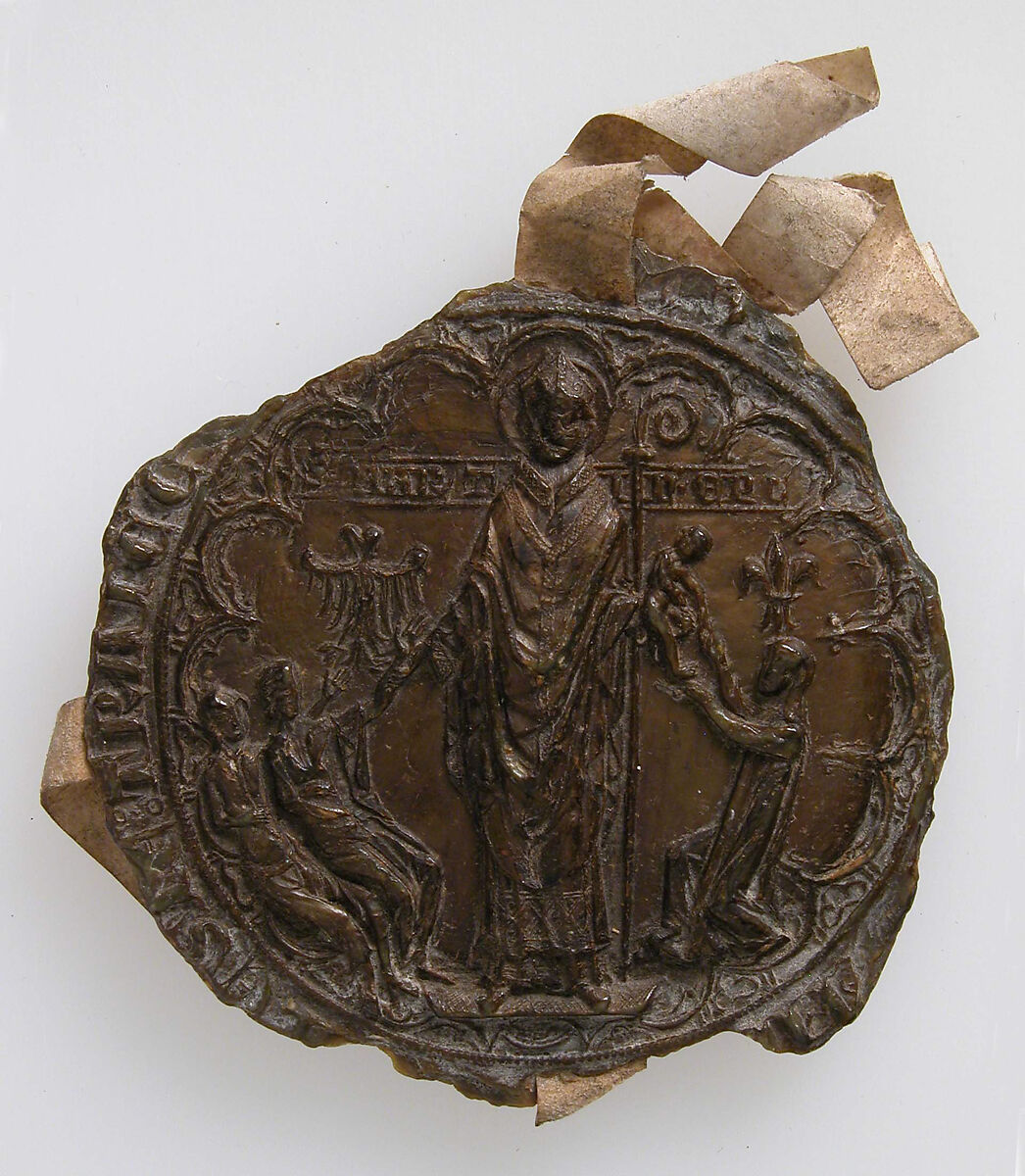
The central example is a fictional 1908 community-reading-room appointment letter and a later 1912 typescript with a differing date. All text, people and transactions in the exercise are invented. The featured image is instead a genuine fourteenth-century Netherlandish wax seal in The Met, an independently documented historical source that is not linked to our fictional record.
The Society of American Archivists’ definition of Diplomatics and the US National Archives’ records guidance provide authoritative principles. EduKate’s Gold Standard hub demands explicit reasoning, transparent evidence and independent evaluation rather than a persuasive-looking answer.
Find the documentary question
Follow the fictional appointment packet or jump to the records issue your students need to resolve. Each chapter links back to the index.
Chapter index
Purpose, authority and documentary form · Chapters 1–5
Validation, copies and material evidence · Chapters 6–10
Corroboration and documentary authenticity · Chapters 11–14
Digital documents and independent assessment · Chapters 15–16
1. Begin with what a document claims to be
A fictional community reading room discovers an appointment letter dated 15 May 1908 and a typed copy prepared in 1912. The copy gives a slightly different day of the month. A learner says one must be a forgery. Another assumes that the older-looking sheet is automatically genuine. A Diplomatics teacher begins by asking what each document purports to be, who supposedly issued it, which parts of the form support that claim and what transmission history is known.
Here Diplomatics means the historical and archival analysis of documents and their forms—not the modern profession of international diplomacy. The Society of American Archivists defines it around creation, form and transmission of records and their relation to creators and represented facts. Our appointment, people and dates are invented, while the featured historic wax seal is a separate public-domain museum object. Students must learn to keep genuine source evidence separate from the pedagogical fiction.
Back to chapter index · Next chapter
2. Distinguish document form from the statement it contains
A document has both content and formal characteristics. Its heading, opening formula, addressee, date, body, closing clause, witness statement or seal may reflect administrative practice. These features can help establish what kind of record it is, but their presence does not prove the factual truth of every sentence. A letter written according to the usual format could still describe a decision inaccurately.
Have pupils identify the function of the fictional letter: it purports to appoint a reading-room caretaker for a period. Then ask which components show that intention and which would demonstrate actual implementation. The appointment statement and evidence that a person subsequently performed the role are different kinds of claim. Diplomatics teaches the relationship between documentary form, creation process and function so a polished-looking page does not become an unexamined authority.
Back to chapter index · Next chapter
3. Identify issuer, recipient and institutional competence
The issuer is the person or body that supposedly created the record within a particular power or responsibility. The named recipient may be the person affected by the transaction or the one to whom the document was directed. In the fictional case, the letter names a programme committee chair. That is not enough to establish that the chair had authority under the committee’s rules to appoint a caretaker.
Ask the class what charter, minutes or policy could demonstrate the chair’s competence to act. Distinguish the signatory from the institution on whose behalf the document claims to speak. A copied signature in a later record does not necessarily show that the original signer approved every word in the copy. The strongest answer identifies the legal or administrative context that makes the document meaningful rather than inferring authority from an impressive title.
Back to chapter index · Next chapter
4. Recognise opening protocol and identification elements
In many historical document types, an initial protocol may identify issuing authority, recipient, invocation or circumstances, though actual forms differ across places, centuries and document types. An archival student should not force every record into one universal medieval charter template. The question is which structural conventions were expected for this particular documentary practice.
Use two fictional forms—a committee appointment letter and a rental receipt—and ask why they open differently. Does the letter identify a committee and appointee? Does the receipt identify payer and payment? The distinction helps students understand documentary function without treating every unusual omission as evidence of falsification. Historical conventions should be researched with suitable contemporary examples rather than imagined from modern business stationery.
Back to chapter index · Next chapter
5. Explain the body as the place where the act is articulated
The body of a record may narrate circumstances, state a decision, define obligations or grant a right. In the reading-room example it could specify that the caretaker may hold the keys during opening hours and report equipment defects. Students should distinguish a descriptive preamble from a clause purporting to authorise a particular action. A later paraphrase that omits conditions may materially change how a historian understands the appointment.
Have learners underline verbs that create or report an obligation and mark any qualifications. Then show an invented copy in which the phrase ‘during opening hours’ is omitted. That change might be a copying mistake or purposeful summary, but it should not be silently treated as identical. Diplomatic reading requires recognising which text components carry the transaction’s operative meaning and how much remains uncertain about actual enforcement.
Back to chapter index · Next chapter
6. Read closing clauses, witnesses and validation carefully
Many formal records end with dates, signatures, seals, witnesses, attestations or validation formulae. Their roles differ: a witness may attest an action, a seal may link the record to an authority, and a later certified copy may receive a new attestation. A teacher should avoid asserting that any ink stamp or wax impression proves authenticity by itself. Counterfeits, reuse, detached seals and later interventions are possible.
Our real image is The Met’s fourteenth-century Netherlandish wax seal impression, object 1981.534.8. It is not attached to the fictional 1908 letter. Ask pupils to describe the figure, inscription and ribbons as far as the museum image shows, and separate that evidence from a hypothesis about which document it once validated. The lesson joins visual and material observation to document history without inventing a false connection.
Back to chapter index · Next chapter
7. Treat dates and place statements as distinct claims
A record can carry a date of issue, a date of the event described and a later copying date. Historical documents may also use calendars and year conventions unfamiliar to a modern reader. A letter issued on one day can describe an appointment beginning on another. Students should distinguish these before placing the item on a timeline.
In our fictional packet, the original letter is dated 15 May 1908, while the later copy displays 18 May 1908. The copy was prepared in 1912. That does not mean the appointment was made in 1912 or that a legal dispute has been decided. Ask what surrounding minutes, dispatch registers or received copies would clarify the difference. The correct teaching move is to record separate date fields, explain the inconsistency and avoid silently altering an original transcription.
Back to chapter index · Next chapter
8. Distinguish originals, copies and certified derivatives
A record may survive in original form, a contemporary duplicate, a later office copy, a photographic reproduction or a digital surrogate. Each has potential evidential value, but its production and custody differ. A certified copy may carry a statement of comparison or authority under specific rules; the certification does not automatically correct every historical error in the original text.
Invite pupils to create a simple relationship diagram linking the fictional 1908 appointment letter, a 1912 typescript and a modern digital scan. The 1912 typescript may include editorial changes or transcription mistakes; the scan captures one particular physical version. Ask students to identify which is being quoted in their essay. This matters especially when a document is available only as a reproduction. A trustworthy description makes source and copy relationships traceable rather than pretending every file is interchangeable.
Back to chapter index · Next chapter
9. Use paper, ink and seal as contextual evidence
Paper quality, watermarks, ink behaviour, writing instruments, binding holes and seal attachment can illuminate a document’s manufacture and transmission. Their examination may require specialists and comparisons with documented material of the period. The appearance of old paper is not proof that its text was created at the same time; an old sheet can be reused, while a modern photograph can accurately represent a much older original.
A safe classroom compares documented photographs or modern teaching facsimiles, not original wax seals that could break. Students note which physical clues are available and what instrument-based study might be needed. They should not perform destructive tests, apply solvents, or lift historic seals. The gold standard is the ability to propose proportionate evidence for a specific question—such as the authenticity of an attachment—without risking damage to the source.
Back to chapter index · Next chapter
10. Explain formulae as conventions, not magical guarantees
Formal phrasing can signal the administrative tradition to which a document belongs. A charter may contain standard terms that recur across many grants, while minutes and receipts follow different routines. Those repetitions can help identify genre and chronology. Yet a copied formula can also appear in a later imitation; conventional wording alone is not sufficient to prove genuine origin.
Give students a fictional pair of appointment letters with similar openings, then ask whether they could have been produced by different clerks following one template. The answer is yes. Next show a letter whose words are unusual and ask whether that must make it false. Not necessarily: local practice, changing rules or an exceptional transaction might explain it. Teach conventions as evidence requiring context and comparison, not a one-step authenticity detector.
Back to chapter index · Next chapter
11. Look for internal consistency while preserving uncertainty
An internal comparison tests whether the dates, named parties, terms and references within a document are coherent. A claimed appointment could cite a committee meeting that supposedly occurred after the letter was issued. That discrepancy deserves investigation, but it might arise from later numbering, a copying error or an actual problem with the claim. One contradiction does not automatically establish who altered the record or why.
Ask learners to mark each internal reference and trace it to an independently dated source if available. If there is no meeting minute, the absence should be reported rather than replaced with an invented text. A compelling explanation keeps possibilities separate until evidence discriminates among them. This makes historical criticism more rigorous than simply calling a document forged or genuine based on its visual style.
Back to chapter index · Next chapter
12. Use external corroboration to test documentary claims
External evidence may include related registers, accounts, seals, correspondence, later administrative actions or records held by other creators. The fictional appointment could be supported by a payroll line, signed acceptance or minutes naming the caretaker. Those sources might still have errors, but together they could help reconstruct the event. A later narrative mentioning the name without a source is not necessarily independent corroboration.
Teach students to create an evidence grid listing each source’s date, creator, relation to the claimed event and degree of independence. Ask which evidence tests the disputed issue date and which only shows that the person worked there later. Source criticism should match evidence to the exact claim. The class is not trying to collect as many favourable quotes as possible; it is learning which records truly increase confidence in a historical conclusion.
Back to chapter index · Next chapter
13. Record provenance and later custody
The source’s chain of custody can influence the ability to assess authenticity. A record held continuously in a creator’s archive may have different strengths and limitations from a loose manuscript purchased long after the alleged event. Custody does not guarantee truth, but documented transfers help users evaluate whether the item is what it claims to be. A missing handover is not proof of fraud.
Have students map how the fictional appointment letter moved from the committee office to a library box, then to a school archive and into a scanned teaching packet. Each step should be attributed only where the invented evidence states it. The SAA Dictionary’s authenticity entry links context, creator and the record’s integrity to evaluation. This chapter bridges Diplomatics and Archival Studies while preserving their different emphases: document form and record context.
Back to chapter index · Next chapter
14. Distinguish an authentic document from a true account
A genuinely issued letter could contain a mistaken date, a misspelled name or a claim later shown to be incorrect. A copy could be faithfully reproduced but have poor evidence of the original’s origin. Historical, diplomatic and legal notions of authenticity can diverge. The Society of American Archivists’ cited discussion explicitly distinguishes diplomatic, legal and historical authenticity.
Use a classroom table with separate questions: Was this issued by the stated creator? Is its form consistent with known practice? Was the record altered? Did the event described really occur? Does it meet relevant legal requirements? Students should not answer all five ‘yes’ because one seal appears genuine. These are different propositions requiring different evidence. This distinction is the defining intellectual payoff of an excellent Diplomatics lesson.
Back to chapter index · Next chapter
15. Connect documentary criticism with born-digital records
Modern electronic records still have creators, functions, templates, signatures, dates and transmission histories. A digital signature can support particular authentication or integrity checks when the underlying process is sound; a typed name at the end of a PDF is not automatically equivalent to a verified cryptographic signature. Metadata, version history, access controls and trusted workflows are relevant to modern diplomatics.
The US National Archives’ electronic signature guidance
Back to chapter index · Next chapter
16. Assess a new documentary packet without repeating the answer
The final problem presents a fictional land-use permission, a later office copy, a memo citing the permission and a photograph of an unrelated seal. Students must identify each document’s function, creator, date, validation features, copying history and unresolved facts. They should not declare the permission valid merely because the seal photograph looks convincing or dismiss it solely because the copy has a typographical error.
An effective learner can produce a one-page diplomatic assessment: what the document purports to record; what structural and external evidence supports that claim; what has been altered, copied or remains unknown; and which authorised sources should be checked next. The gold standard of teaching Diplomatics is methodical scepticism joined to fair interpretation. It protects evidence from both gullibility and reflexive accusations of forgery.
Worked document comparison: mismatch is not automatically fraud
The following is a fictional teaching packet. The seal image used as this article’s featured media is a separate real fourteenth-century artefact and must never be attributed to this constructed case.
| Fictional item | What it reports | Problem to investigate |
|---|---|---|
| Letter attributed to committee, dated 15 May 1908 | Chair appoints a caretaker under specified hours | Issuer’s authority, creation circumstances, signature and original custody |
| Office typescript prepared in 1912 | Similar text, date shown as 18 May 1908 | Whether copyist altered the day or copied from a different version |
| Later payroll list | Person with same name appears later in 1908 | Whether it proves appointment date or only subsequent work |
| Separate Met wax seal, 14th century | Genuine museum accession 1981.534.8 | Unrelated to fictional appointment; cannot validate it |
A careful conclusion distinguishes the dated sources and the kind of claim each can support. The copy discrepancy could indicate an error or distinct version; the historical act’s exact date remains unresolved. An attractive unrelated seal cannot repair the evidential gap.
A second exercise: classify six claims about documentary authenticity
| Observation or claim | Appropriate analytical response |
|---|---|
| The heading names an office | A claim of institutional origin; test competence and production context. |
| A seal is present | Potential validation evidence; establish whether it belongs to this document and is genuine. |
| The copy was typed in 1912 | Date of a derivative, not the underlying 1908 event. |
| The date differs by three days | An inconsistency needing source comparison, not proof of deliberate forgery. |
| The signature matches a known form | Potential support for origin; method and custody still matter. |
| The claim in the letter was true | A historical assertion requiring corroboration beyond form. |
Advanced exercise: assess a document before judging the event
Introduce a second, original fictional packet that differs from the appointment-letter example. A municipal committee claims that a public bench was approved in June 1910. One surviving sheet bears the heading “Authority for Works”, a seal impression, an unsigned financial note and a later photocopy. Students must distinguish a document that purports to authorise a change from evidence that the bench was actually ordered, installed or paid for. The appropriate historical question is not merely “Is the letter official?” but “Which precise action does each surviving record document?”
First ask who produced the sheet and for what procedure. A seal may help demonstrate an office’s connection with an act, but it cannot establish that an individual had authority if relevant regulations assigned that responsibility elsewhere. Next ask whether the date is the committee’s decision date, the issue date or the date a copy was made. Students should record these separately. Then compare the description in the document with the later financial note. A payment reference could suggest implementation without establishing where a bench was installed; a contractor’s delivery note could be stronger for delivery but not for public acceptance. Each conclusion requires a claim-specific evidential route.
| Fictional evidence | Question it helps answer | Limit |
|---|---|---|
| Approved-looking letter, June 1910 | Was an administrative act purportedly recorded? | Origin and competence still need verification |
| Later expense entry for public benches | Was related spending recorded? | May concern another site or quantity |
| Photograph allegedly taken after installation | Does a bench appear in a documented location? | Date, location and attribution require checking |
| Later office copy | How was the earlier record transmitted? | Copy errors and omitted clauses remain possible |
The final task is a short diplomatic report with separate findings for the document’s form, authorising competence, chain of custody, internal consistency and historical reliability. Students must write one sentence they can support and one they cannot yet support. The teacher should reward clear uncertainty, not speculation that a missing record proves fraud. This exercise differs from a legal ruling: it is an evidence-based historical assessment whose findings could guide further archival research but cannot replace the competent authority’s determination of legal effect.
Four lessons from formal evidence to historical judgement
- Lesson 1: classify the fictional letter and identify issuer, recipient, function and documentary form.
- Lesson 2: compare original, later copy, date statements and validation features; record inconsistencies without embellishment.
- Lesson 3: seek independent corroboration and distinguish formal authenticity from factual reliability.
- Lesson 4: evaluate a new digital or historical record packet and write a cautious, traceable assessment.
Advanced practical: reconstruct a document’s complete evidential chain
For the advanced classroom, create an invented two-stage market-grant packet. The first sheet claims that an officer authorised an annual fair at Stone Bridge; the second sheet is an explicitly later register copy with an added note saying that the fair was actually held elsewhere. Add a nineteenth-century antiquarian transcript that silently modernises the place-name. None of these fictitious records is an actual royal grant. Students must compare claims about issuer, recipient, land or market right, date, physical seal, copying and later annotation instead of treating all three sheets as equivalent originals.
Start with documentary form. Ask what institution, if any, the supposed officer served, where its authority came from and whether the text contains the operative action and a supported date. Then examine validation. A drawn wax seal on the training sheet is a visual illustration, not evidence that a historic wax matrix authenticated it. The UK National Archives’ seal research guide explains the real significance of attached seals and their relation to issuers and parent records. A student should be able to state which identification would require an original seal impression or a reliable archival record and which cannot be established from a decorative facsimile.
Next trace the copies. The later register entry may preserve wording attributed to an earlier grant, but it is not automatically the very parchment handed to the original recipient. An antiquarian transcript could introduce normalisation or an editorial error. Students should draw three arrows labelled ‘claimed original’, ‘register copy’ and ‘later modernised transcript’, then record the evidence for every relationship. Where the packet supplies no independent record linking one to another, the arrows must be described as proposed. This is especially important when the latest text looks more readable than the first: legibility is not documentary authenticity.
The advanced conclusion should consider at least two different questions. ‘Is the later register entry a genuine record of the register’s own activity?’ may be answered differently from ‘Did the original grant issue exactly as described?’ A reliable register can preserve a report that contains a factual mistake, and a forged charter may include an accurate description of the nearby bridge. Require the learner to separate authenticity of a source from accuracy of its claims and legal effect. A confident one-word label such as ‘genuine’ is not sufficient where different layers of transmission remain unresolved.
A source-level marking rubric for Diplomatics
| Criterion | What strong student work must demonstrate |
|---|---|
| Issuer and competence | Names the claimed authority, identifies which jurisdiction or period must be checked, and does not invent a power to grant |
| Documentary form | Identifies opening, operative act, validation, witnesses and dating only where supported |
| Material and copying | Separates original, enrolled copy, transcript and modern illustration |
| Conflicting details | Reports variant dates or places and proposes a relevant source check |
| Conclusion | Uses bounded language, notes the remaining uncertainty and identifies who could authoritatively resolve it |
To test transfer, change the source genre from a market grant to a fictional monastery’s confirmation letter. A student who repeats that every valid record must carry the same royal seal has misunderstood the relation between form and institutional context. A stronger learner examines the new issuer, purpose and recordkeeping convention before deciding what constitutes expected evidence. Teachers can build a short assessment where no document is automatically declared false for departing from the wrong genre’s template. This makes diplomatic criticism historically precise rather than a checklist of picturesque medieval features.
Frequently asked questions
Is Diplomatics about negotiating between countries?
No. Here it is an archival and historical discipline focused on the form, creation and authenticity of records.
Does a genuine seal prove every statement is true?
No. It can be relevant to validation but factual reliability is a separate issue.
Is every date mismatch evidence of forgery?
No. Different versions, calendars, administrative steps or copying mistakes may explain a discrepancy.
Can a later copy be useful?
Yes. It can preserve information from a lost original, provided its transmission and limitations are documented.
Does a digital signature automatically settle legal validity?
No. Signature type, workflow, jurisdiction, trust infrastructure and the specific legal question all matter.
Professional archives and documentary criticism sources
- Society of American Archivists: Diplomatics
- SAA: Authenticity
- SAA: Diplomatic versus Legal and Historical Authenticity
- US National Archives: Electronic Signature Technologies
- The Met: Medieval Bishop’s Wax Seal
Related eduKate historical teaching guides
- Teaching Archival Studies | Provenance and Authenticity
- Teaching Paleography | Read Historical Script
- Teaching Epigraphy | Inscribed Material
- Teaching Heraldry | Blazon and Verified Bearers
- Teaching Law | Rules and Legal Reasoning
- The Gold Standard master hub
The gold standard of teaching Diplomatics is a learner who examines documentary form without confusing appearance with authenticity, connects validation to authority, and respects the difference between a genuine record and a true statement. The strongest answer makes uncertainty understandable rather than eliminating it by guesswork.