
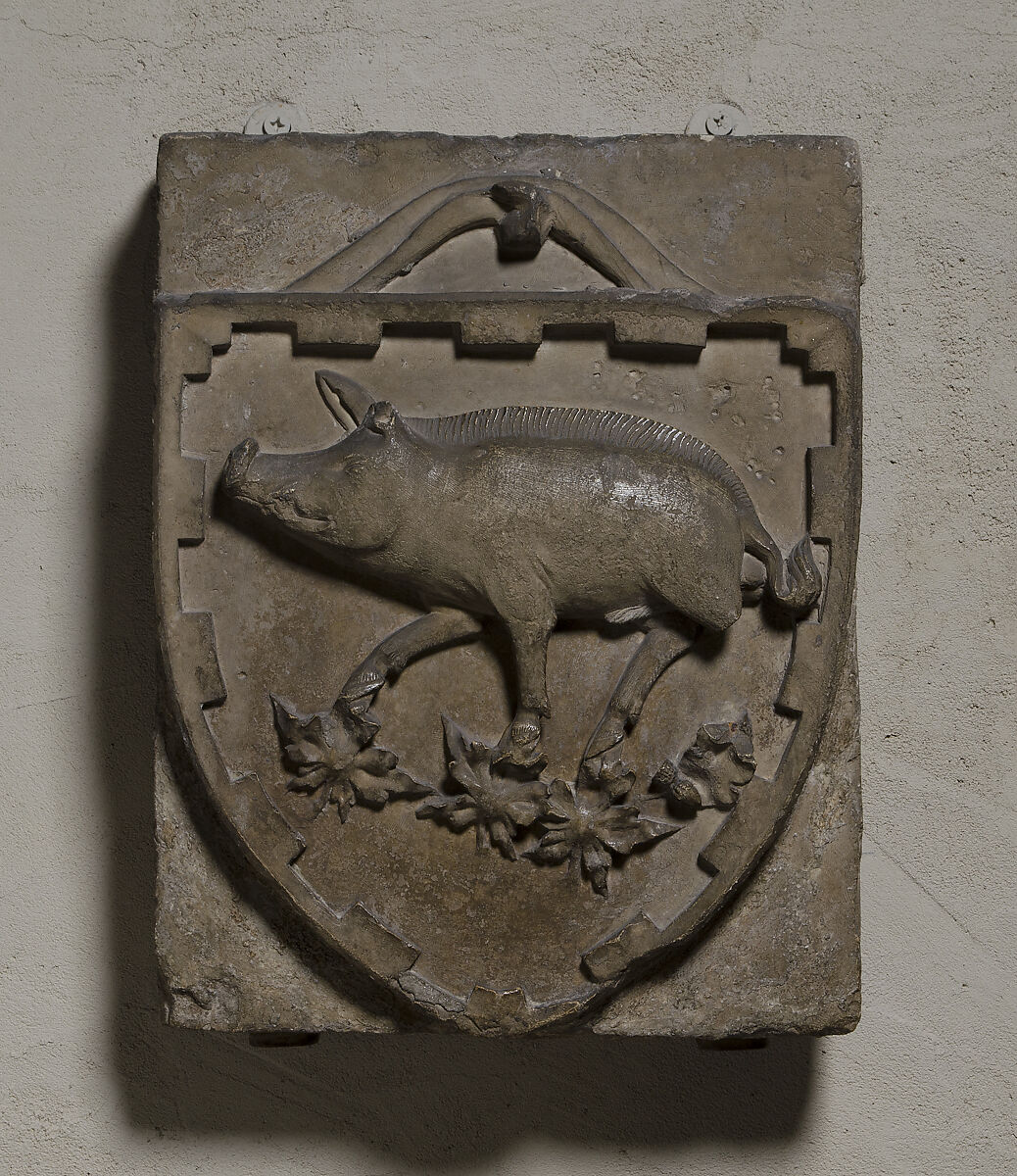
The gold standard of teaching Heraldry combines formal visual literacy with the ability to distinguish a historic object, an authorised armorial design and evidence of family lineage. A shared surname alone is never sufficient proof of an entitlement.
The featured public-domain photograph documents The Met’s French limestone Coat of Arms, not the invented class blazon ‘Argent, an oak tree Vert’. Students learn to keep those sources separate. Official frameworks from the College of Arms and Canadian Heraldic Authority illustrate why jurisdiction and record identity matter.
The eduKate Gold Standard master hub supplies the quality objective: evidence-backed explanations, original activities, purposeful feedback and independent transfer.
1. Start with observable stonework
The featured reference is an early-fourteenth-century French limestone coat of arms at The Metropolitan Museum of Art, object 25.120.128. Learners can describe the carving’s form and present condition, while keeping original pigments, historical bearer and modern descent as questions requiring other evidence. The source is real; our classroom blazon is invented.
The teaching check is to return to the documentary distinction in this chapter. Ask learners to separate a direct visual feature from an assertion made by a catalogue or register and from a personal interpretation. They should explain what additional source would support the contested claim. Then give an unfamiliar shield or record and ask them to repeat the process independently, noting the proper authority, date and rights before stating a conclusion.
2. Surnames are not grants
The College of Arms states that a coat of arms does not belong to everyone who shares a surname. Grants and descent involve identifiable individuals and particular rules. A colourful surname chart is a claim to investigate, not proof of lawful entitlement.
The teaching check is to return to the documentary distinction in this chapter. Ask learners to separate a direct visual feature from an assertion made by a catalogue or register and from a personal interpretation. They should explain what additional source would support the contested claim. Then give an unfamiliar shield or record and ask them to repeat the process independently, noting the proper authority, date and rights before stating a conclusion.
3. Identify the heraldic authority
The Canadian Heraldic Authority and College of Arms serve different jurisdictions. A museum catalogue, official armorial register and commercial website cannot be treated as equally authoritative for grants or family descent. Pupils must identify the institutional setting and date before using its rules.
The teaching check is to return to the documentary distinction in this chapter. Ask learners to separate a direct visual feature from an assertion made by a catalogue or register and from a personal interpretation. They should explain what additional source would support the contested claim. Then give an unfamiliar shield or record and ask them to repeat the process independently, noting the proper authority, date and rights before stating a conclusion.
4. Fields, charges and armorial grammar
A shield has a field and may include geometric divisions, ordinaries and charges. Students should record exactly what they see before suggesting symbolism. A fictional white field with a green oak tree provides a simple introduction to technical structure.
The teaching check is to return to the documentary distinction in this chapter. Ask learners to separate a direct visual feature from an assertion made by a catalogue or register and from a personal interpretation. They should explain what additional source would support the contested claim. Then give an unfamiliar shield or record and ask them to repeat the process independently, noting the proper authority, date and rights before stating a conclusion.
5. Blazon describes the visual design
The constructed description ‘Argent, an oak tree Vert’ specifies a white or silver field and green oak charge. It is not a genuine grant, a source about the museum’s medieval stone or a statement about the bearer’s character. The blazon is a reproducible visual specification.
The teaching check is to return to the documentary distinction in this chapter. Ask learners to separate a direct visual feature from an assertion made by a catalogue or register and from a personal interpretation. They should explain what additional source would support the contested claim. Then give an unfamiliar shield or record and ask them to repeat the process independently, noting the proper authority, date and rights before stating a conclusion.
6. Tinctures are conventions, not RGB readings
Terms including Or, Argent, Gules, Azure, Sable and Vert serve a formal heraldic language. A faded carving may no longer preserve original painted colour. Compare source descriptions with surviving surfaces; do not derive a precise original palette from a monochrome photograph.
The teaching check is to return to the documentary distinction in this chapter. Ask learners to separate a direct visual feature from an assertion made by a catalogue or register and from a personal interpretation. They should explain what additional source would support the contested claim. Then give an unfamiliar shield or record and ask them to repeat the process independently, noting the proper authority, date and rights before stating a conclusion.
7. Distinguish divisions from ordinaries
Per pale, per fess and other divisions structure the field, while fess, pale, chief, bend and chevron can describe ordinaries. Similar-looking graphic treatments are not necessarily the same armorial structure. Students can test the distinction through drawings reconstructed from precise wording.
The teaching check is to return to the documentary distinction in this chapter. Ask learners to separate a direct visual feature from an assertion made by a catalogue or register and from a personal interpretation. They should explain what additional source would support the contested claim. Then give an unfamiliar shield or record and ask them to repeat the process independently, noting the proper authority, date and rights before stating a conclusion.
8. Symbols require historical attribution
Lions, trees, flowers and buildings do not each encode a single universally documented personal virtue. The meaning of a particular charge may be explained in a grant or related record. Compare the Canadian Public Register’s blazon and separately recorded symbolism without transplanting one explanation to another shield.
The teaching check is to return to the documentary distinction in this chapter. Ask learners to separate a direct visual feature from an assertion made by a catalogue or register and from a personal interpretation. They should explain what additional source would support the contested claim. Then give an unfamiliar shield or record and ask them to repeat the process independently, noting the proper authority, date and rights before stating a conclusion.
9. Crests and complete achievements
A crest is a specific element in traditions that distinguish it from the shield. Supporters, motto, helmet and mantling are possible components but are not automatically part of every achievement. The museum’s surviving carving does not authorise students to invent missing elements.
The teaching check is to return to the documentary distinction in this chapter. Ask learners to separate a direct visual feature from an assertion made by a catalogue or register and from a personal interpretation. They should explain what additional source would support the contested claim. Then give an unfamiliar shield or record and ask them to repeat the process independently, noting the proper authority, date and rights before stating a conclusion.
10. Difference, succession and genealogy
Variations of arms may express relationships under particular systems, but similar shields do not establish cousinship. Parent-child links and rules of succession must be independently researched. A missing generation cannot be filled with an attractive heraldic resemblance.
The teaching check is to return to the documentary distinction in this chapter. Ask learners to separate a direct visual feature from an assertion made by a catalogue or register and from a personal interpretation. They should explain what additional source would support the contested claim. Then give an unfamiliar shield or record and ask them to repeat the process independently, noting the proper authority, date and rights before stating a conclusion.
11. Read material evidence across media
Armorial forms may survive in stone, wax, glass, textiles, books and modern registers. Each source preserves different information. A written blazon may document tinctures where a weathered stone no longer does; a later drawing may introduce copying changes.
The teaching check is to return to the documentary distinction in this chapter. Ask learners to separate a direct visual feature from an assertion made by a catalogue or register and from a personal interpretation. They should explain what additional source would support the contested claim. Then give an unfamiliar shield or record and ask them to repeat the process independently, noting the proper authority, date and rights before stating a conclusion.
12. Keep grant and object dates distinct
The first official use of arms, manufacture of a carved object, transfer to a museum and digitisation are different chronological events. A student must not use a scan’s creation date as the date of the underlying armorial grant. Timelines should label unresolved stages clearly.
The teaching check is to return to the documentary distinction in this chapter. Ask learners to separate a direct visual feature from an assertion made by a catalogue or register and from a personal interpretation. They should explain what additional source would support the contested claim. Then give an unfamiliar shield or record and ask them to repeat the process independently, noting the proper authority, date and rights before stating a conclusion.
13. Verify the descent claim
Begin with a documented armiger, then seek evidence for every genealogical relationship needed to connect a claimant. Family stories and online pedigrees may provide leads, but the chain should rest on cited records. Genuine legal entitlement decisions require the appropriate authority.
The teaching check is to return to the documentary distinction in this chapter. Ask learners to separate a direct visual feature from an assertion made by a catalogue or register and from a personal interpretation. They should explain what additional source would support the contested claim. Then give an unfamiliar shield or record and ask them to repeat the process independently, noting the proper authority, date and rights before stating a conclusion.
14. Respect other symbolic traditions
European heraldry is not a universal grammar for Indigenous emblems, clan marks or ceremonial signs. Different traditions have distinct authorities, protocols and meanings. Compare authorised examples without treating visual resemblance as cultural sameness.
The teaching check is to return to the documentary distinction in this chapter. Ask learners to separate a direct visual feature from an assertion made by a catalogue or register and from a personal interpretation. They should explain what additional source would support the contested claim. Then give an unfamiliar shield or record and ask them to repeat the process independently, noting the proper authority, date and rights before stating a conclusion.
15. Check image and design rights
The Met’s public-domain open-access photograph has different reuse conditions from protected designs in modern armorial registers. Seeing an official coat of arms online does not grant permission to reproduce it in a business logo. Students must cite the particular institution and relevant use terms.
The teaching check is to return to the documentary distinction in this chapter. Ask learners to separate a direct visual feature from an assertion made by a catalogue or register and from a personal interpretation. They should explain what additional source would support the contested claim. Then give an unfamiliar shield or record and ask them to repeat the process independently, noting the proper authority, date and rights before stating a conclusion.
16. Prove transfer with unfamiliar evidence
Give learners a fictional shield drawing, a blazon, a dated object record and an unsupported surname claim. They should reconstruct the design and say exactly what each source supports. The strongest answer may decline to identify a bearer until evidence is found.
The teaching check is to return to the documentary distinction in this chapter. Ask learners to separate a direct visual feature from an assertion made by a catalogue or register and from a personal interpretation. They should explain what additional source would support the contested claim. Then give an unfamiliar shield or record and ask them to repeat the process independently, noting the proper authority, date and rights before stating a conclusion.
Comparison table: blazon, bearer and source permissions
This worked comparison separates four kinds of evidence that beginners often collapse: a fictional design description, a real museum artefact, an official armorial record and an unsupported surname chart. The point is not to identify a modern family but to teach what each source can responsibly establish.
| Source type | What it can establish | What remains unproven |
|---|---|---|
| Fictional practice blazon: “Argent, an oak tree Vert” | One green oak tree on a silver or white shield | Historical bearer, grant, meaning, date and inheritance |
| The Met early-fourteenth-century French stone carving, object 25.120.128 | Catalogued material, period, geographic attribution and visible structure | Modern lineage, exact lost paint and identification with the fictional blazon |
| Official heraldic register or letters patent | Recorded bearer, formal design, authority and documented grant or registration | An unproven claimant’s succession simply because names match |
| Commercial surname-and-crest chart | A visual research lead to check | Legal or historic entitlement, creator identity and family link |
The teacher asks students to give one example of a claim that would require another type of evidence. An official blazon may settle the shield’s formal colours while leaving genealogy unresolved; a museum photograph may establish that a carved charge survives without proving its original tincture. If a learner can distinguish those evidential jobs without inventing the missing information, the class has achieved a real heraldic skill.
Teaching connections: follow the evidence across fields
Heraldic research connects naturally to other disciplines, but the overlap should sharpen rather than blur questions. Genealogy investigates verifiable family relationships; Epigraphy reads inscriptions attached to real objects; Diplomatics tests the form and authenticity of documentary evidence; and Manuscript Studies investigates how heraldic images and texts survive on historic pages. Each adds a different kind of proof. None automatically supplies a missing bearer or grant.
Four distinct worked practice cases
1. Object-first observation
Provide a public-domain museum image and a blank three-column sheet: visible object features, facts asserted in a repository catalogue, and unanswered questions. A learner records material, approximate date and provenance only with citations. The teacher then changes the photograph’s crop to show why image evidence alone may be insufficient. Students should explain how a complete object record can prevent errors created by attractive but contextless reproductions.
Student evidence should include a short justification explaining which claims are verified and which require further historical research. The teacher should mark unsupported names or motives as unanswered rather than rewarding a confident guess.
2. Translate formal armorial text
Give the class the fictional blazon ‘Argent, an oak tree Vert’. Students first draw it, then describe the drawing to a second group. Introduce a variation with two oak trees and demand a changed blazon. Ask whether the oak was chosen as a pun, a symbol of endurance or simply because the designer liked it. The answer must remain uncertain without the fictional designer’s statement or an authentic historical source.
Student evidence should include a short justification explaining which claims are verified and which require further historical research. The teacher should mark unsupported names or motives as unanswered rather than rewarding a confident guess.
3. Lineage-evidence challenge
A fictional bearer received arms and a modern person claims descent across four generations. Supply a marriage record and two birth records but omit the document linking the second and third generations. The student should label the missing connection, identify plausible archives to search and avoid writing a continuous pedigree. Adding a similarly coloured crest does not repair an evidential gap. This is how heraldic literacy joins genealogical proof without replacing it.
Student evidence should include a short justification explaining which claims are verified and which require further historical research. The teacher should mark unsupported names or motives as unanswered rather than rewarding a confident guess.
4. Rights and jurisdiction audit
Compare the Met’s public-domain object image with a modern official armorial registration and a decorative commercial crest. Students create a permissions chart showing what may be studied, what can be reproduced and who has authority to clarify use. The public availability of a picture is not a universal licence for the design or the right to bear it. Require learners to distinguish source access, copyright status and armorial entitlement.
Student evidence should include a short justification explaining which claims are verified and which require further historical research. The teacher should mark unsupported names or motives as unanswered rather than rewarding a confident guess.
Four-session teaching sequence
- Session 1: inspect the genuine museum reference and distinguish observation, record and unknown.
- Session 2: practise blazon, tincture and shield structure through invented drawings.
- Session 3: evaluate heraldic authorities, provenance, inheritance records and permissions.
- Session 4: interpret an unfamiliar source packet and write a bounded conclusion.
Worked heraldic evidence matrix: four sources, four different tasks
This classroom table separates technical blazon reading from identifying a historically documented bearer. The first example is fictional; the historic Met carving and modern official registers are distinct real kinds of sources. No source should be made to answer a question it was not designed or preserved to answer.
| Source | Appropriate question | Evidence limit |
|---|---|---|
| Invented Argent, an oak tree Vert | Can a learner draw the specified tinctures and charge? | No historical grant or owner is established |
| The Met Coat of Arms, 25.120.128 | What survives on a French limestone carving dated to the early 14th century? | Does not prove a living claimant’s entitlement |
| Official heraldic grant or register | Which bearer and formal design were recorded under this authority? | Does not link an unrelated namesake to the grantee |
| Genealogical source packet | Are parent-child relationships supported through successive generations? | Does not independently establish the design of a specific grant |
Ask students to annotate an invented family tree with exact source citations, then compare it with an authoritative blazon. An armorial design might be accurately reconstructed even when one parent-child link is missing; conversely, a well-evidenced genealogy can be complete without any verified grant of arms. The assessment should give credit for these precise distinctions and for leaving a claim unresolved. An unsupported join between two separate evidence chains is not a higher-level solution simply because it creates a more exciting historical story.
Frequently asked questions
Can a surname establish entitlement to arms?
No. Appropriate documentary succession and jurisdiction-specific authority are necessary.
Does a blazon prove the bearer’s name?
No. It describes the design; bearer attribution is a separate historical claim.
Do charges always have fixed meanings?
No. Particular symbolism requires contextual evidence.
Can all online emblems be copied?
No. Check the specific rights and rules for the source and proposed use.
Official sources and related teaching
- College of Arms
- College of Arms heraldry FAQ
- Canadian Heraldic Authority
- Canada Public Register
- Met Coat of Arms 25.120.128
- Teaching Epigraphy
- Teaching Genealogy
The standard is a learner who can describe the emblem with precision and decline any historical or personal claim that the evidence does not support.
Advanced teaching laboratory: diagnose four specific heraldic mistakes
Case A — The visually correct shield with an invented bearer
A student receives a class-created drawing, writes an accurate blazon and then adds ‘Arms of the Morgan Family, granted in 1420’. The visual task has been performed successfully, but neither the surname nor the date appears in the supporting source packet. Ask learners to use a two-column proof sheet: design properties supported by the illustration, and identity claims requiring independent documents. The teacher should retain the accurate blazon while crossing neither the student’s artwork nor the student’s enthusiasm out of the lesson; the corrective action is to label the armorial design fictional and the historical attribution unverified.
Make the next task harder without making it less fair. Supply a plausible-looking surname brochure, an official record naming a different person and an unsigned antiquarian note with the same year. Students must rank the sources according to the precise claim being tested. The official record may establish the recipient of its own grant; it may not prove or disprove unrelated relatives. The unsigned note may supply a research lead, but the class must not treat it as a grant. The strongest answer names what the sources establish separately and specifies the missing genealogical evidence.
Case B — A carving has shape but its pigments are gone
Show a monochrome or weathered reproduction of a carved coat of arms with one large animal-shaped charge. The student’s task is to make an observation log: field outline, apparent charge, areas of lost material and any visible inscription. Do not invite the class to guess that the animal was gold or the field blue simply because that combination is fashionable in later graphic collections. Where a historically documented blazon exists, students can use that independent record to discuss possible tinctures; where none exists, the colour remains unresolved.
Next, compare a fictitious modern coloured reconstruction with the museum image. Ask what additional evidence—earlier paintings, archival descriptions, technical condition reports or an authoritative armorial record—would justify each coloured area. The teacher should reward a source-specific explanation rather than the number of details filled in. This case tests the distinction between material survival and armorial abstraction, and reinforces why conservation uncertainty belongs in art-historical interpretation. No pupil should propose cleaning or painting the original carving to make the answer visually clearer.
Case C — Two similar arms, one missing generation
Give learners two fictional armorial documents bearing similar shields and a family story that says their recipients were grandfather and grandson. The documents are dated thirty-five years apart, but the claimed parent-child link in between is missing. Ask pupils to create a timeline with three distinct kinds of information: directly documented persons, proposed relationships and armorial designs. The existence of the designs does not create the absent genealogical record. Students can propose which birth, marriage, inheritance or probate sources might help, subject to the actual jurisdiction and period.
Compare two possible conclusions. ‘The similar shields demonstrate grandfather and grandson’ is unsupported. ‘The two records show comparable heraldic features; a proposed family link remains unverified’ is justified by the packet. If independent genealogical records later establish relationships, the next question becomes whether the particular rules of heraldic succession support the claimant’s interpretation. That prevents the teacher from mixing genealogy with legal entitlement as though they were identical operations. The lesson ends with a written evidence table, not a speculative completed family tree.
Case D — An open photograph and a protected contemporary emblem
Students locate the public-domain Met photograph and an official Canadian armorial design in a publicly searchable register. One learner assumes that both can be freely placed on commercial merchandise because both are visible online. The correction begins by identifying the specific rights statement attached to each resource. The Met’s object photograph is available under its Open Access framework, whereas contemporary armorial use may involve different protections and the Canadian register contains a warning about reproduction without permission.
Ask students to plan two outputs: an educational slide citing the Met photograph and a proposed school identity badge inspired by heraldic forms. In the second case, they should design a new clearly fictional emblem rather than copy someone’s registered arms. The teaching objective is not to practise law without qualification; it is to recognise that source access, image copyright, armorial entitlement and cultural permission are separate questions. A professional or relevant authority must resolve real contested permissions. A well-credited image is the beginning of responsible use, not the end of all checks.
What an advanced student’s final answer should contain
A complete independent response should identify the source and institution, describe the design in appropriately precise language, separate material appearance from reconstructed features, state any documented bearer with a citation, explain the applicable authority and date, and specify the evidence for—or absence of—a family relationship. Where permission to reproduce an emblem is unclear, the learner should record that uncertainty and seek an authorised route rather than assume permission. These requirements can be marked with a small rubric that checks the reasoning, not the elegance of a decorative illustration.