
eduKate · The Gold Standard of Weathering
Find your next learning step
Choose the question closest to your purpose, or follow the guide in order.
Full chapter index · Questions and checks · The Education root
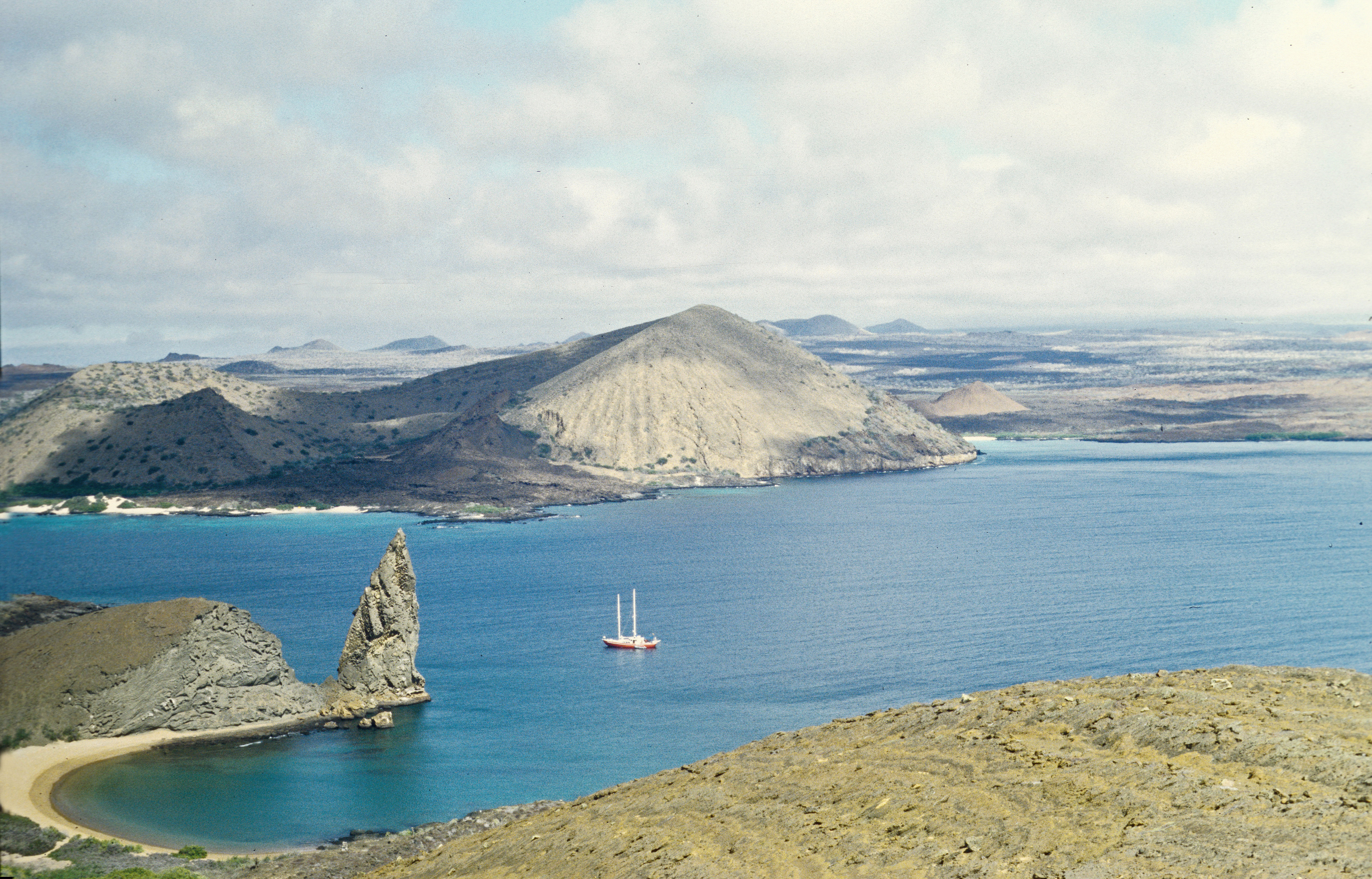
Header: Bartolomé Island and Pinnacle Rock in the Galápagos, photographed in 2002. The landscape introduces geological questions; the photograph alone does not identify which weathering processes formed a particular feature.
The gold standard of weathering is explaining how rock and minerals change at or near Earth’s surface, then checking that explanation against the material, conditions and evidence. The central distinction is simple: breaking down or altering material is not the same question as transporting it somewhere else.
A cracked rock, a rounded boulder and a crumbling stone surface invite different investigations. Start with what is actually visible. Then ask which processes could produce it, what else might explain it and what evidence would help you decide.
This root connects Geology, Petrology, Physical Geography, Earth Science teaching, erosion control and the care of built surfaces. Its worked numbers are fictional teaching examples. They are not a site investigation, a condition survey or instructions to test an unknown material.
Full chapter index
1–4 · Foundations and first explanations
5–8 · Worked cases and connected ideas
9–12 · Interpretation, evidence and transfer
13–15 · Specialists, questions and sources
CHAPTER 1 OF 15 · Understand the processes
1. Separate weathering, erosion and deposition
Weathering concerns the breakdown or chemical alteration of rock and minerals. Erosion concerns removal and transport; deposition concerns material being laid down. They can occur in the same landscape and influence one another without becoming the same process.
Imagine a fragment loosening from a rock surface, moving in flowing water and later coming to rest. The sequence contains several different questions. What loosened it? What carried it? Why did transport stop? Naming each stage makes the explanation more useful.
The National Park Service’s introductory resources distinguish the breakdown of rock from the movement of the resulting particles. The distinction is a starting model, not a demand to place every complicated event into one isolated box.
Try a sentence test. ‘The rock broke apart’ describes a change in the rock. ‘The stream carried the fragments downstream’ describes transport. A strong explanation connects both sentences while keeping the cause and movement visible.
Source reading: National Park Service — Weathering and Erosion · National Park Service — Erosion
Physical or mechanical weathering breaks material into smaller pieces without requiring a change in the chemical identity of its individual minerals. Expansion, contraction and growth within openings can contribute under suitable conditions.
NPS examples include ice growth in cracks and temperature-related changes. Those examples should be attached to the environment where they are plausible. A learner should not invoke repeated freezing merely because frost weathering was the first process remembered.
A crack is an observation, not a complete diagnosis. Its origin could involve weathering, an earlier geological structure or human disturbance. The shape, setting, history and other evidence matter.
For a classroom explanation, choose one mechanism and show its sequence. Mark the initial condition, the applied change and the proposed result. Then name the condition the mechanism requires. This is much stronger than placing a process label next to any photograph containing broken stone.
Source reading: National Park Service — Weathering
Chemical weathering changes at least some of the minerals or their chemical relationships. Dissolution and reactions involving water, acids or oxygen provide familiar routes. Different minerals respond differently; a rock is not one chemically uniform substance.
NPS describes dissolution and other chemical changes, while USGS clay resources explain how weathering can contribute to clay-mineral formation. The products can differ from the starting minerals. Material can also leave in dissolved form rather than remaining as visible fragments.
Appearance alone can mislead. A colour change is worth recording, but it does not identify a unique reaction or establish the rate. Distinguish an observed surface stain from a verified mineralogical explanation.
A useful learning comparison asks two questions: has the material simply been divided, or has its composition changed? In real settings both can happen together. The distinction helps students explain a process before combining processes into a more realistic account.
Source reading: National Park Service — Weathering · USGS — Environmental Characteristics of Clays
An elemental concentration can rise while the retained amount falls. Separating Element Gain from Concentration Changes with an Immobile Reference develops a conserved-reference account, original inventory examples and explicit reference-mobility limits.
CHAPTER 4 OF 15 · Understand the processes
4. Connect living things with the physical and chemical processes
Living organisms can influence the conditions around rock. Roots can interact with existing openings, and biological activity can affect the local chemical environment. Biological involvement is therefore often expressed through physical or chemical pathways rather than a completely separate set of rules.
Do not infer cause simply from proximity. A plant growing beside a crack does not establish that it created the crack. It may have occupied an opening that was already present. Time sequence and other observations are important.
The same caution applies to surface growth on stone. Its presence may be relevant to an investigation, but it is not permission to remove it or apply a treatment. On protected or built surfaces, the appropriate custodian or specialist determines what examination is suitable.
For students, compare two explanations: ‘roots are visible in the opening’ and ‘roots caused the opening’. What would be needed to move from the first statement to the second? This exercise teaches the difference between association and a supported causal account.
A weathering explanation needs both the material and the environment. Mineral composition, openings, exposure, moisture and local conditions can affect what happens. A process plausible for one rock and setting may not explain another.
Petrology helps identify and interpret rocks. Geology places the material in a wider history. Physical Geography follows the relationships between landforms and surface processes. Their separate perspectives become useful when a single photograph is not enough.
Coastal settings add their own conditions. NPS shoreline-weathering resources discuss salt-related processes and the importance of rock properties and local environments. That does not establish that every coastal surface has the same dominant mechanism.
Make a two-column record: what is known about the material, and what is known about its exposure. Put unknowns in both columns. An explanation with explicit gaps is easier to improve than a confident label attached to an unidentified rock.
Source reading: National Park Service — Shoreline Weathering
CHAPTER 6 OF 15 · Read the setting
6. Worked example: fragmentation changes exposed area
Consider a fictional cube with sides of 4 centimetres. Its volume is 4 × 4 × 4 = 64 cubic centimetres. Its external surface area is 6 × 4 × 4 = 96 square centimetres.
Now divide it into eight separate cubes, each with sides of 2 centimetres, and expose every face. Each small cube has volume 8 cubic centimetres and area 24 square centimetres. The eight cubes still total 64 cubic centimetres, but their combined exposed area is 192 square centimetres.
The material volume has not doubled; the exposed surface has. This geometric model helps explain why breaking material apart can alter the area available for interaction with its surroundings.
It does not establish that a real weathering rate will double. Mineral properties, contact with water, transport of reaction products and other conditions remain relevant. If the pieces remain tightly packed, not every new face may be equally accessible. Keep the idealisation attached to the result.
| Idealised quantity | One large cube | Eight separated cubes |
|---|---|---|
| Side length | 4 cm | 2 cm each |
| Combined volume | 64 cm³ | 64 cm³ |
| Total exposed surface | 96 cm² | 192 cm² |
| What changed? | Starting form | More exposed area, same total volume |
To compare measured loss across different specimen sizes and exposure histories, continue with The Gold Standard of Weathering | Comparing Mass Loss Across Unequal Specimens and Exposed Areas.
A separate geometric question asks how much volume lies within an inward rind. Converting Rind Thickness into Altered Volume Without Confusing Mass or Time derives the retained-core calculation, compares unequal stones and pooled volumes, and keeps mass loss and elapsed time separate.
CHAPTER 7 OF 15 · Check the evidence
7. Worked example: count observations before claiming a pattern
A fictional observation sheet contains 40 equally defined surface patches. Twelve are recorded as visibly flaking under the exercise’s rule. The observed proportion is 12 ÷ 40 × 100 = 30 per cent.
A second visit records 18 of the same 40 patches as flaking: 45 per cent. That is an increase of 15 percentage points, not 15 per cent relative to the first proportion. The relative increase in the count is 6 ÷ 12 × 100 = 50 per cent.
Before interpreting deterioration, check whether the patches, recording rule, lighting and observer procedure were comparable. A changed classification method could change the count. So could obscured surfaces or missing records.
The calculation describes the supplied observations. It does not identify the mechanism, determine a structural consequence or establish a long-term rate. A well-written conclusion reports the numerical change and the limits together, then asks what follow-up evidence would answer the actual question.
A classroom experiment can isolate a relationship that is difficult to see in a landscape. It is useful when its materials, conditions, measurements and limitations are understood. It becomes misleading when a quick demonstration is treated as a direct clock for nature.
A soft teaching material is not automatically an equivalent of an unknown natural rock. A deliberately intensified condition is not automatically representative of the environment. Apparent speed in the demonstration does not establish a field rate.
Use activities selected and supervised for the learner’s age, with suitable materials and school procedures. Do not collect from protected sites, apply chemicals to heritage stone or test an unknown surface as an improvised investigation.
An excellent report contains a transfer paragraph: what relationship the model illustrates, which features of the real system it leaves out and what further information would be needed. That paragraph often reveals more understanding than the most polished photograph of the activity.
A growing transport distance can slow a reaction front even when the transport coefficient stays fixed. Why a Diffusion-Limited Front Slows Under Constant Transport Conditions derives a planar teaching model, changes its reaction assumption and explains why a thickness is not a field weathering clock.
Weathering contributes material and chemical changes that can become part of soil and landscape development. The resulting environment also involves transport, organic activity and other processes. Soil is not simply any pile of broken rock.
A landscape’s current appearance records interacting histories. Present conditions may differ from the conditions under which a feature developed. A plausible process operating today does not establish that it alone produced the entire landform.
The Rivers and Physical Geography guides help follow the material beyond the point of breakdown. Erosion control then asks a practical question: how can unwanted movement of soil and sediment be managed in an actual project?
For learners, draw a chain from rock to altered material to transport and deposition, then add the observations available at each stage. Avoid adding a certainty arrow where the record supplies only a possibility. A useful diagram explains the relationship and preserves uncertainty.
CHAPTER 10 OF 15 · Connect to life
10. Distinguish natural change from a maintenance decision
Weathering is an Earth process, but the condition of a building, façade or engineered slope requires its own assessment. A process explanation does not establish whether a particular asset is safe or what repair is appropriate.
The Building Façade Inspection, Building Envelope Engineering and Geotechnical Engineering branches examine different professional responsibilities. They should not be replaced by a general lesson about rock breakdown.
For an ordinary observer, a useful contribution is an accurate report through the responsible channel. Preserve the location and visible concern without approaching unstable ground, removing material or attempting a repair.
In a classroom case, ask students to separate three statements: a surface shows a visible change; a mechanism may explain it; a competent assessment is needed for the consequence. Keeping those levels separate makes scientific knowledge useful without allowing it to overstep its evidence.
CHAPTER 11 OF 15 · Connect to life
11. Build an observation record another person can use
Record the object or location, date, scale, conditions and method. Keep original photographs and distinguish measurements from estimates. A close-up without scale can be interesting while remaining difficult to compare.
When comparing visits, use a defined view and explain important changes in conditions. Do not scratch, mark or sample a surface without the appropriate permission and method. Educational curiosity is not an authorisation to alter a site.
A good annotation separates what is seen, a possible explanation and the evidence still needed. AI may help organise terminology, but it cannot inspect an unseen surface or transform a generated picture into a field observation.
A simple audit question is helpful: could another learner understand what was recorded without being present? If not, improve the context. The point is not to produce more paperwork; it is to preserve the meaning of the evidence.
CHAPTER 12 OF 15 · Connect to life
12. Move from vocabulary to a transferable explanation
Begin with one change and one mechanism. If weathering and erosion are being confused, repair that distinction before adding a long list of process names. A short accurate sequence is a better foundation than a crowded diagram.
Next, compare physical and chemical change, work the cube example and explain why geometry alone does not predict a field rate. Introduce new materials or conditions one at a time so the learner can see what changed.
For extension, examine a supplied observation series or a primary geological resource. Compare alternative explanations and specify the information that would help distinguish them. The linked specialist guides provide deeper routes into rocks, ground, landscapes and built surfaces.
The gold standard of weathering is not spotting the oldest-looking stone. It is understanding how material and environment interact, making a careful observation and knowing how far the explanation can travel.
Use these existing ecosystem guides to deepen the question that matters to you. Their different scopes are deliberate: an introductory root, a specialist method and an operating service do not establish the same things.
Understand rocks and landscapes
The Gold Standard of Geology — The wider geological record.
The Gold Standard of Petrology — Rock composition and interpretation.
The Gold Standard of Physical Geography — Surface processes and landforms.
The Gold Standard of Teaching Earth Science | Read Rocks, Time and Earth Systems — Teaching rocks, time and Earth systems.
Connect weathered ground with engineering
The Gold Standard of Geologists | Rock Records, Ground Truth and Defensible Interpretation — Ground truth and defensible interpretation.
The Gold Standard of Geotechnical Engineering | Ground Uncertainty Managed Before It Moves — Ground uncertainty and site-specific assessment.
The Gold Standard of Erosion Control Engineering | Keeping Soil Out of Waterways — Keeping soil out of waterways.
The Gold Standard of Construction Materials Testing | Representative Samples, Reliable Results and Sound Decisions — Representative samples and reliable materials results.
Follow water and built surfaces
The Gold Standard of Rivers — Processes after material enters a river system.
The Gold Standard of Hydrogeological Engineering | Groundwater Pathways with Evidence — Groundwater pathways and evidence.
The Gold Standard of Building Façade Inspection Services | Competent Assessment, Safer Exteriors and Verified Repair — Competent assessment of building exteriors.
The Gold Standard of Building Envelope Engineering | Weatherproof Comfort and Repairable Façades — Repairable façades and building envelopes.
What is the gold standard of weathering?
An explanation of material change that fits the rock, conditions and evidence, with clear limits.
Is weathering the same as erosion?
No. Breakdown or alteration and removal or transport are different questions, though they can interact.
Does physical weathering require new minerals?
No. Its defining change is physical fragmentation rather than a necessary change in mineral chemistry.
Does a crack prove frost weathering?
No. The setting and other possible causes need examination.
Does more surface area guarantee a proportionate weathering rate?
No. Geometry is one relationship; real rates depend on additional conditions.
Can this guide assess a building or slope?
No. Asset condition and safety require the appropriate competent assessment.
The resources below support the concepts and reading routes. Use current primary information for actual requirements, conditions or editions; the teaching examples in this guide have deliberately stated limits.
National Park Service — Weathering
National Park Service — Weathering and Erosion
USGS — Environmental Characteristics of Clays
National Park Service — Shoreline Weathering
National Park Service — Erosion
Keep the learning usable
Return to The Gold Standard of Education to connect knowledge, explanation and judgment across subjects.
For a concrete Mathematics learning route, explore Secondary 1 Mathematics Tutor Clementi — small-group tutorials. Begin at the first unstable step, make the relationship clear and practise applying it under changed conditions.