
eduKate · The Gold Standard of Water Security
Find your next learning step
Choose the question closest to your purpose, or follow the guide in order.
Full chapter index · Questions and checks · The Education root
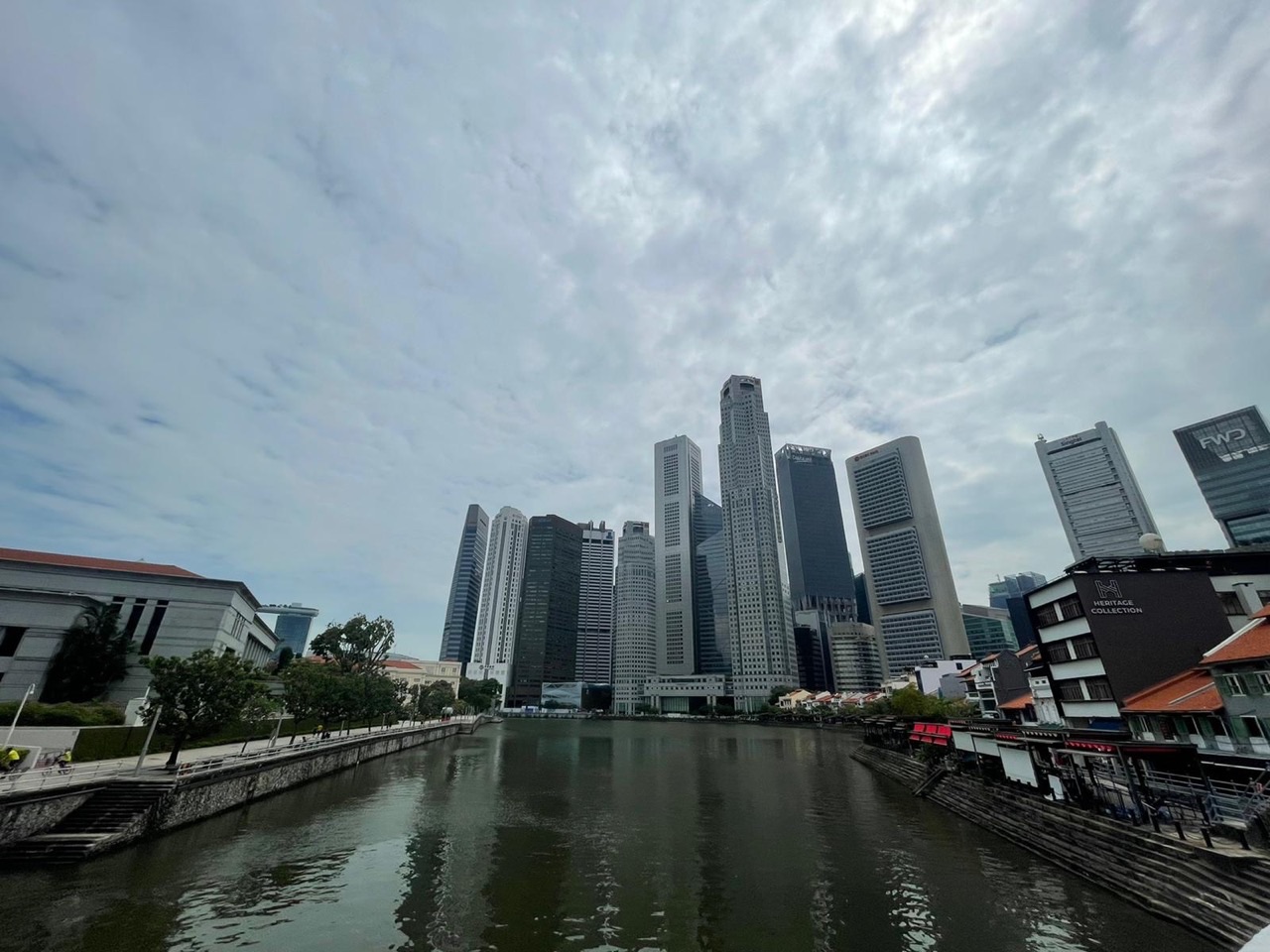
Header: the Singapore River with Parliament House, Boat Quay and the financial district. An urban water landscape introduces the wider system; it is not a photograph of a drinking-water treatment plant.
The gold standard of water security is sustained access to water of the appropriate quantity and quality, supported by dependable systems, responsible decisions and care for the ecosystems involved. Having water somewhere is not the same as having a usable service where and when people need it.
A reservoir, treatment plant or supply contract answers only part of the question. Collection, treatment, distribution, affordability, maintenance and the ability to cope with disruption all influence the experience at the receiving end.
This root focuses on resilience and access. Water explains the wider resource; Water Management covers coordinated stewardship; the specialist engineering guides examine particular systems. The invented numerical cases below explain reasoning, not the adequacy of a real supply or an emergency provision.
Full chapter index
1–4 · Foundations and first explanations
5–8 · Worked cases and connected ideas
9–12 · Interpretation, evidence and transfer
13–15 · Specialists, questions and sources
CHAPTER 1 OF 15 · Define the outcome
1. Define security as an outcome for people and ecosystems
UN-Water’s working definition brings together access, quality, livelihoods, well-being, development, water-related risks and ecosystems. It is broader than a simple inventory of freshwater. That wider lens helps explain why a supply can look impressive on paper while leaving an important need unmet.
Start with the outcome being discussed. Drinking-water access, industrial process water and ecological water needs are different questions. They connect within a shared system, but one result should not quietly stand in for all the others.
Specify whose access is being assessed, in which place and over what period. A national annual figure and a neighbourhood’s interrupted service describe different scales. Both may be useful if their meanings remain clear.
For learners, rewrite a vague claim such as ‘this place has enough water’. Enough for whom, for which use, under which conditions? Asking those questions is the first step from a large number toward an explanation of security.
Source reading: UN-Water — Water Security and the Global Water Agenda
Trace the relevant source, abstraction or collection, treatment, storage, conveyance and receiving point. Some systems have different arrangements, so draw the actual chain rather than assuming that every place follows one template.
Each link answers a question. Is water available? Can it be treated for the intended use? Can it be delivered? Is the service accessible? Can the system keep working when a component is unavailable? A successful upstream component does not settle every downstream question.
The infrastructure also depends on people, information, power, materials and maintenance. These dependencies belong on the map. A backup asset that cannot be operated under the relevant conditions may provide less resilience than its name suggests.
For a classroom map, use supplied information and mark uncertain links. Do not infer buried connections from the appearance of a street. The learning task is to understand the service chain, not to produce an unofficial utility plan.
CHAPTER 3 OF 15 · Build the Mathematics
3. Distinguish stored volume, production rate and delivered service
Volume is an amount, while a flow or production rate describes an amount per time. Cubic metres and cubic metres per day cannot be added as though they represent the same quantity. Time is the bridge between them.
A large storage volume does not establish a particular duration without assumptions about usable volume, inflows, withdrawals and relevant constraints. Likewise, a plant’s stated capacity is not a record of what it delivered throughout a period.
Quality and location matter as well. Water unsuitable for one purpose should not be counted as ready supply for that purpose merely because the volume is known. A quantity needs to stay attached to its condition and intended use.
A useful report gives a value, unit, boundary and period. Students who develop that habit can compare water statistics more intelligently and spot when two apparently competing claims are actually describing different parts of the system.
CHAPTER 4 OF 15 · Build the Mathematics
4. Worked example: calculate a simplified storage duration
Imagine a fictional model with 1,200 cubic metres of usable water in a store and a constant withdrawal of 400 cubic metres per day. Assume no inflow and no other losses or constraints. The simplified duration is 1,200 ÷ 400 = 3 days.
Now keep the same starting volume but increase the hypothetical withdrawal to 600 cubic metres per day. Duration becomes 2 days. The tank did not shrink; the demand changed. That is why a storage claim needs its demand assumption.
These are classroom ratios, not an assessment of an actual reservoir or emergency stock. Real systems have operating levels, changing demand, water-quality considerations, inflows, losses and other requirements. The usable volume itself must be established rather than assumed from a photograph.
Ask students to state the assumption they would change first in a more realistic model. Then introduce one change at a time. The point is not to make the arithmetic complicated; it is to see which part of the situation each calculation represents.
CHAPTER 5 OF 15 · Understand resilience
5. Understand diversification and shared dependencies
Different sources can reduce exposure to some disruptions, but the word different does not establish independence. Ask whether the sources depend on the same power supply, treatment asset, conveyance route or environmental conditions.
In a fictional system, Source A can deliver 600 cubic metres per day and Source B can deliver 400. A demand of 1,000 is met in the simple normal-condition model. If B becomes unavailable and no other condition changes, 600 remains and the model has a 400-cubic-metre daily shortfall.
Adding a third source with a nominal 300-cubic-metre daily output does not answer every question. Can it operate when required? Does it share the dependency causing the disruption? Is its water appropriate and connected to the receiving system?
This is a reasoning exercise, not a real design criterion. A resilience assessment needs defined scenarios and competent analysis. For learners, distinguish the number of named assets from the number of genuinely different ways the service can continue.
For worked comparisons of shared supports, delivery limits and changing deficits, follow The Gold Standard of Water Security | Testing Supply Diversity Against Shared Dependencies.
CHAPTER 6 OF 15 · Understand resilience
6. Use Singapore’s Four National Taps as a system example
PUB identifies Singapore’s Four National Taps as local catchment water, imported water, NEWater and desalinated water. The combination offers a concrete way to discuss sources with different characteristics rather than imagining one giant tap supplying everything.
The official Singapore Water Story and Water Loop resources explain the relationships. Read them as an interconnected system: gathering and treating water, using it, collecting used water and recovering a useful resource. A source label is only the beginning of that explanation.
This guide does not assign current percentage shares, forecast a shortfall or claim that one source removes every vulnerability. Such statements need current data and clearly stated assumptions. The educational value here is understanding the different roles and connections.
A student can make a source comparison using origin, treatment pathway, relevant dependencies and intended uses. Put unknowns in the table rather than filling them with guesses. The completed exercise should make a better question possible, not declare a national system secure from a handful of facts.
Source reading: PUB — Singapore Water Story · PUB — About Us and the Four National Taps · PUB — Singapore’s Water Loop
CHAPTER 7 OF 15 · Understand resilience
7. Keep quality assurance attached to the whole route
Water security includes the relevant quality, not just volume. PUB describes a sampling and monitoring programme from source to tap. The phrase points to a chain of assurance rather than a single reassuring image.
A clear sample or favourable reading for one parameter does not establish every aspect of quality. Interpretation depends on what was tested, how, where, when and for which purpose. The Water Quality Monitoring guide follows that evidence in more detail.
Treatment performance, distribution arrangements and receiving conditions can be separate parts of an assessment. A result at one boundary should not be silently extended to another. Reports should preserve the scope of the measurement.
For learners, use supplied results and practise bounded conclusions. ‘The listed measurement at this point met the exercise’s stated criterion’ is different from ‘all water throughout the system is suitable for every use’. The first can be checked; the second goes far beyond the record.
Source reading: PUB — Water Quality
CHAPTER 8 OF 15 · Examine performance
8. Worked example: reconcile a water balance without inventing a leak
Consider a fictional accounting period. Measured inflow is 1,000 cubic metres, recorded authorised outflow is 850 and measured storage increases by 50. The unallocated difference in this simplified balance is 1,000 − 850 − 50 = 100 cubic metres.
That difference is 10 per cent of the stated inflow. It is a prompt for investigation, not proof that a pipe leaked exactly 100 cubic metres. Measurement uncertainty, record timing, missing authorised uses and other boundary issues need examination.
If the storage change is omitted, the unexplained difference would appear to be 150. The omission changes the answer even though the same physical system is being described. A good balance includes the relevant terms and signs.
For students, identify the accounting boundary before calculating. Then distinguish a measured term from a residual calculated by subtraction. The residual can reveal a problem in the record or system, but it cannot supply its own cause.
| Fictional balance term | Volume |
|---|---|
| Measured inflow | 1,000 m³ |
| Recorded authorised outflow | 850 m³ |
| Increase in storage | 50 m³ |
| Calculated unallocated difference | 100 m³ |
| What it establishes | A balance difference, not a confirmed leak |
CHAPTER 9 OF 15 · Examine performance
9. Read demand management as a service question
Demand management concerns the relationship between use and the service people need. An efficient process can reduce water use while maintaining its purpose; an apparent saving can also reflect reduced activity or an unmet need. The explanation matters.
In a fictional comparison, a facility uses 500 cubic metres for 1,000 units of output, then 480 for 800 units. Total use fell by 4 per cent, but use per output rose from 0.5 to 0.6 cubic metres: a 20 per cent increase. Neither measure should be hidden.
This arithmetic does not establish that output is the only appropriate denominator. A real service may have fixed needs, different products or changed conditions. Choose a meaningful measure before declaring efficiency.
The Industrial Water Reuse and leak-detection branches examine particular routes to better performance. At the root level, ask whether the reported improvement preserves the intended service and whether the comparison uses compatible boundaries.
Keeping Shortfall Evidence Intact When Reporting Periods Change preserves period-specific delivery deficits through changed reporting windows, deriving the cancellation inequality and separating volume, period, duration and storage assumptions.
CHAPTER 10 OF 15 · Examine performance
10. Include access, governance and the environment
A functioning supply has social and institutional dimensions. Responsibility, financing, maintenance and fair access help determine whether infrastructure becomes sustained service. Security should not be described only from the viewpoint of the largest user.
Ecosystems also belong within the picture. A plan to increase one supply needs to consider the relevant water and environmental relationships, rather than treating all water not immediately consumed as available without consequence.
Comparisons between places need context. A global average does not describe every household, and a source available in one geography may not be a practical counterpart elsewhere. Identify the actual constraints before recommending a familiar-looking solution.
For students, map who benefits, who operates, who pays and who is responsible for responding to a failure. The map will not resolve every policy question, but it shows why an engineering diagram alone is not the complete explanation.
Resilience is not only preventing failure. It includes recognising a disruption, communicating through responsible channels, maintaining the appropriate service where possible and verifying recovery. Different events require different arrangements.
The Public Water Supply Interruption Reporting guide examines the information chain around an incident. An accurate location, time and description can support a response. A rumour or an unverified explanation can make the picture less clear.
Follow current instructions from the responsible authority during an actual event. This article does not prescribe storage quantities, treatment methods or a return-to-use decision. Those matters need the current situation and appropriate expertise.
For a classroom scenario, separate detection, response and recovery evidence. A repair recorded as complete may be one important step, but the relevant confirmation of restored service still needs to be identified. The exercise helps students understand continuity without improvising operational instructions.
CHAPTER 12 OF 15 · Examine performance
12. Build a water-security explanation that can be checked
Start with one outcome and one receiving group. Trace the source-to-user chain, keep volume and rate separate, and state the conditions behind the storage example. Repair those foundations before introducing complex scenarios.
Next, compare source dependencies and reconcile a simple balance. Explain why a residual is not a diagnosed leak and why a falling total is not automatically better efficiency. These are practical habits for reading public and organisational claims.
For extension, investigate the relationship between access, quality, demand, ecological needs and recovery. Use primary resources and the specialist branches to deepen the actual question. A large directory becomes useful when the reader knows which question each branch answers.
The gold standard of water security is a dependable relationship between water, people and place over time. Follow the entire service, test its assumptions and make the claim no larger than the evidence supporting it.
Use these existing ecosystem guides to deepen the question that matters to you. Their different scopes are deliberate: an introductory root, a specialist method and an operating service do not establish the same things.
Follow the resource and public service
The Gold Standard of Water — Water across sources, uses and responsibilities.
The Gold Standard Of Water Management — Coordinated water management.
The Gold Standard of Water Resources Engineering | From Catchment to Community — Catchment-to-community engineering.
The Gold Standard of Utilities — The wider utilities service.
Examine source and recovery technologies
The Gold Standard of Desalination Engineering | Seawater to Safe, Dependable Supply — Seawater treatment and dependable supply.
The Gold Standard of Membrane Separation Engineering | Selectivity, Integrity and Useful Output — Separation, integrity and useful output.
The Gold Standard of Industrial Water Reuse Engineering | Fit-for-Process Quality and Verified Savings — Fit-for-process reuse and verifiable savings.
The Gold Standard of PUB Trade Effluent Written Approval Services | Lawful Discharge and Protected Water Reclamation — Protecting the reclamation system at industrial interfaces.
Verify access, quality and continuity
The Gold Standard Of Water Quality Monitoring — The evidence behind quality claims.
The Gold Standard of Public Water Supply Interruption Reporting Services | Accurate Triage and Verified Restoration — Accurate triage and verified restoration.
The Gold Standard of Industrial Water Leak Detection Services | Measured Losses, Accurate Locations and Verifiable Repairs — Measurements behind loss and repair claims.
The Gold Standard of Water Tank Inspection and Cleaning Services | Safe Drinking Water, Licensed Care and Verified Certification — Water-tank care and verified responsibilities.
What is the gold standard of water security?
Sustained access to appropriate quantities and quality, with dependable systems and responsible care for people and ecosystems.
Is water security only about having more reservoirs?
No. Treatment, delivery, access, dependencies, demand and recovery also matter.
Are several sources necessarily independent?
No. They may share infrastructure, power or other dependencies.
Does a water-balance difference prove a leak?
No. It requires investigation of the records, boundaries and physical system.
Does lower total use prove better efficiency?
No. The service, activity level and meaningful denominator must also be understood.
Can this guide determine a real supply’s adequacy?
No. Real assessments require current data, defined requirements and appropriate expertise.
The resources below support the concepts and reading routes. Use current primary information for actual requirements, conditions or editions; the teaching examples in this guide have deliberately stated limits.
UN-Water — Water Security and the Global Water Agenda
PUB — About Us and the Four National Taps
Keep the learning usable
Return to The Gold Standard of Education to connect knowledge, explanation and judgment across subjects.
For a concrete Mathematics learning route, explore Secondary 1 Mathematics Tutor Clementi — small-group tutorials. Begin at the first unstable step, make the relationship clear and practise applying it under changed conditions.