
Bread rises. Milk becomes yoghurt. A microbial vessel produces a measured ingredient. Each event can be called fermentation, but a scientific explanation demands more: which organism acted, which substrate changed, which product formed and what reliable measurements support the claim? Zymology is the study of that transformation, and its gold standard is an explanation that can be tested.
Fermentation is not proved by bubbles alone. A changing optical signal does not necessarily indicate living cell growth; a lower pH does not identify a particular acid; and a theoretical mass yield is not the amount a production run must achieve. The scientific task is to connect biochemical mechanisms, experimental design, material balances and meaningful outcomes.
This 24-chapter root continues The Gold Standard of Education: Learning Transfers into Life and deliberately complements The Gold Standard of Fermentation. The latter introduces the transformation; this guide develops the evidence-based investigation. All worked vessels, concentrations, gas comparisons, time-series measurements and numerical outcomes are original fictional examples and are not instructions for growing or consuming cultures.
Choose a reading route
All teaching chapters are expanded below. Use the route links or the compact chapter index to jump to the part that answers your question.
Chapter index
Define the science · Chapters 1–5
Design fair evidence · Chapters 6–10
Read the measurements · Chapters 11–15
Work the numbers · Chapters 16–20
- Worked example: calculate a theoretical product ceiling
- Worked example: calculate realised mass yield carefully
- Worked example: keep product concentration and productivity apart
- Worked example: interpret a pH difference without claiming a product mass
- Worked example: avoid pseudoreplication in a comparison
Make a justified decision · Chapters 21–24
CHAPTER 1 OF 24 · Define the science
1. Define zymology without changing the meaning of fermentation
Zymology is the scientific study of fermentation, historically associated with brewing and the chemistry of yeast action. It is an older disciplinary term; contemporary research is also described through microbiology, biochemistry, food science and bioprocess engineering. Calling something zymology does not imply a separate biological mechanism from the fermentation already studied in those subjects.
The first distinction is between fermentation as a cellular metabolic process and fermentation as a wider term for cultivation and conversion in a production system. The IUPAC Gold Book records both uses. Cellular fermentation typically describes energy-yielding metabolism with internally balanced electron transfer to organic end products. Industrial fermentation can include culture-based production with oxygen-dependent stages and products.
This article teaches how to investigate and interpret fermentation claims. For the process-centred overview use The Gold Standard of Fermentation. That root explains core transformations; this one asks what evidence could justify an explanation.
CHAPTER 2 OF 24 · Define the science
2. Start with an organism, a substrate and a defined outcome
A useful fermentation question names the living system, the material consumed and the measured product or biological outcome. Yeast turning sugars into ethanol and carbon dioxide is one example; certain lactic acid bacteria converting sugars to acids is another. Both are biochemical transformations, but their pathways, coproducts, environments and verification methods differ.
The phrase ‘microbes make food better’ is too vague for a scientific proposition. Better might mean lower measured pH, a desired texture, a confirmed compound, improved consistency or compliance with a defined product specification. Each outcome needs a matching assay and interpretation.
Build a fictional question: does culture A produce more measured acid than culture B in the same defined substrate and observation window? Before comparing anything, record what ‘acid’ means here—pH, titratable acidity or chemically identified lactate. These quantities cannot be exchanged freely.
CHAPTER 3 OF 24 · Define the science
3. Distinguish biological growth from chemical production
A culture can increase in biomass while forming little target product, or form product after growth has slowed. Growth, enzyme activity and product accumulation therefore need separate measurements. In some systems product formation and growth correlate strongly; in others they are separated by nutrient limitation, stress or regulatory changes.
Optical density, colony counts and dry-cell mass describe different aspects of a culture and can diverge. Optical readings measure light scattering under instrument-specific conditions; they do not directly measure the concentration of a desired chemical or prove that cells remain viable.
Imagine two fictional vessels: one doubles in an optical reading while its target metabolite remains almost unchanged; the other shows little net optical increase while the metabolite rises. The first is not automatically the superior production process. The scientific goal dictates the relevant response.
CHAPTER 4 OF 24 · Define the science
4. Understand the chemistry behind a metabolic pathway
Enzymes channel molecular transformations through sequences of reactions. Substrates are converted, energy carriers are regenerated, and products accumulate depending on organism and conditions. In yeast alcoholic fermentation, the regeneration of NAD+ is integral to sustaining glycolysis when the relevant metabolic situation applies.
Balanced chemical equations represent ideal net transformations. Actual cultures allocate carbon to biomass, side products and other cellular processes. An overall equation is a useful mass-accounting benchmark, not a promise of one hundred percent conversion to the target chemical.
For a deeper explanation of catalysts, read Enzymology, and for reaction-level context read Biochemistry. Zymology connects those mechanisms to experimental questions about what really appears in a measured system.
CHAPTER 5 OF 24 · Define the science
5. Distinguish alcohol, organic-acid and oxygen-linked conversions
Alcoholic and lactic-acid pathways illustrate distinct biochemical balances. Acetic acid bacteria are associated with the oxidation of ethanol to acetic acid under oxygen-requiring conditions; the word ‘vinegar fermentation’ is commonly used in food technology, but that usage should not be silently equated with the strict anaerobic metabolic definition.
Foods can also involve mould-based preparation stages, mixed microbial communities and sequential metabolic steps. A single ingredient name or visible change does not establish which microorganism produced which end product. The FAO discussion of fermented fruits and vegetables describes microbes, substrates, products and enzymatic roles.
Reader challenge: a report claims all fermentation happens only without oxygen, while another calls an oxygen-dependent industrial process fermentation. They may be using different technical senses. State the sense and then test its mechanism rather than arguing from one word.
Evidence table: what a measurement can and cannot claim
| Reported result | Question it can help answer | What it cannot settle alone |
|---|---|---|
| Gas volume rises | Did a collected gas volume change? | Exact gas identity, product purity or food safety |
| pH decreases | Did acid-related chemical activity change? | Mass of a particular acid or validated shelf safety |
| Optical density increases | Did light scattering increase? | Viable organism count or identified target product |
| Target assay shows 22 g/L | What concentration was measured by that method? | Mass produced without reactor-volume and recovery information |
CHAPTER 6 OF 24 · Design fair evidence
6. Treat historical knowledge as evidence with limitations
Fermented foods were made long before microbiologists explained microorganisms and enzymes. Practical traditions contain valuable observations of transformations, preservation and texture. They are not automatically equivalent to controlled, generalisable laboratory experiments, nor should laboratory language erase the craft knowledge that first distinguished reliable processes.
Historical claims require source care. A food’s modern name or modern manufacturing method cannot be projected unchanged into every century of its history. Descriptions of traditional products may combine multiple regional practices and organisms.
The FAO guide to traditional fermented foods and livelihoods documents important classes of food microorganisms and traditional economic roles. Its context also shows why a scientific explanation should identify the actual product, region and process before generalising.
CHAPTER 7 OF 24 · Design fair evidence
7. Define a question before choosing an assay
Zymological research begins with a measurable hypothesis. ‘Does this treatment change fermentation?’ is incomplete until the response variable, comparison group and intended inference are stated. Temperature could affect growth, gas production, enzyme activity, product distribution and even measurement bias in different ways.
An assay that answers whether gas accumulated does not identify every gas or prove safety. Likewise, a pH change cannot prove which chemical acid was made. The instrument should be chosen to answer the scientific claim—not the other way round.
A fictional research plan might ask whether two already-characterised commercial culture formulations yield different concentrations of a named end product under an approved protocol. State the primary outcome and duration, then list supporting observations separately so the conclusion does not shift after seeing the data.
CHAPTER 8 OF 24 · Design fair evidence
8. Choose controls that distinguish biological from physical change
Controls should address credible alternatives to the claimed biological mechanism. A blank for the measurement matrix, instrument checks and an appropriate comparison sample can reveal baseline signals, chemical changes or background effects. The exact control design depends on the research question and safe established protocol.
A comparison is not fair if substrate composition, container geometry, sampling time or analytical calibration differs without accounting for it. A constant recipe does not by itself guarantee identical starting materials or biological histories. Batch effects can masquerade as organism effects.
Consider a fictional assay in which both the investigated culture and a reference medium show an optical change after heating. The observed signal might be a physical property of the sample rather than increased microbial biomass. Replicate evidence and method-specific controls should separate those explanations.
CHAPTER 9 OF 24 · Design fair evidence
9. Understand replicates, repeated readings and experimental units
Three measurements of one vessel are technical repeats; three independently prepared vessels are separate experimental units under an appropriate design. Treating many readings from one unit as independent experiments inflates apparent certainty. Time-series readings from the same vessel are often correlated.
Replicate design should anticipate the type of variation relevant to the claim: instruments, cultures, source lots, preparation days or independent production runs. A claimed general effect across laboratories needs broader evidence than one perfectly smooth line from one batch.
Illustrative case: one vessel is read at ten time points and another vessel at the same ten times. Those are two experimental vessels, not twenty independent fermentations. For general study design see Experimental Design.
CHAPTER 10 OF 24 · Design fair evidence
10. Record the process boundary and material flows
A fermentation vessel is part of a wider process, with incoming materials, gas or liquid streams, generated biomass, product, sampling withdrawals and potentially downstream purification. The balance of these streams affects conversion calculations. Volumes and concentrations can change without an equivalent increase in total product mass.
A measured rise from 8 to 12 g/L may reflect additional product, a reduction in liquid volume, or both. Without the volume at the time of each measurement, concentration alone cannot settle the mass balance. Likewise, a mass measured after concentration should not be compared with a starting substrate mass as though no processing occurred.
Map an original fictional batch across substrate input, reactor output, sampling, recoverable product and discarded streams. Report each mass on a consistent basis. Then connect the process-accounting question with Manufacturing.
CHAPTER 11 OF 24 · Read the measurements
11. Read growth curves without assuming their causes
A curve of optical signal against time may show lag-like, increasing and plateau regions. Such shapes do not prove a single cause. Nutrient limitation, changes in oxygen supply, product inhibition, sample aggregation and optical instrument limitations can all affect what is observed. Report the instrument response before interpreting cellular physiology.
The IUPAC biotechnology definition of specific growth rate relates an increase in biomass or organism number to the amount already present per time. Estimating it from a log-scale curve requires identifying an interval where the assumptions of approximately exponential growth are defensible.
A log graph that looks straight for a short window is evidence for a model over that window, not proof that all later behaviour will follow the same curve. Label excluded observations and avoid extrapolating beyond the observed regime.
CHAPTER 12 OF 24 · Read the measurements
12. Distinguish measurement of acid from interpretation of pH
pH is a logarithmic chemical measurement related to hydrogen-ion activity, not a direct count of grams of lactic acid. Titratable acidity measures the amount of base needed to reach a defined endpoint under a specified test. Two products can have equal pH and different buffering capacities or acid compositions.
Sampling temperature, instrument calibration, electrode suitability and sample composition affect comparability. A reported pH of 4.2 in one vessel is not evidence that an unrelated product is safe or properly fermented. Safety depends on the validated product-specific process and other controls.
For the food example, Yoghurt explores protein gels, pH and acidity in its own context. Its lessons should not be converted into a generic instruction for safely preparing unknown fermented foods.
CHAPTER 13 OF 24 · Read the measurements
13. Choose chemical measurements that identify the target molecule
Gas volume, optical density, pH and mass change are indirect or broad responses. To identify a particular product such as ethanol, lactate or a defined protein, a study needs a validated assay suitable for that compound and sample matrix. Chromatography, spectroscopy and other chemical techniques have distinct selectivity and calibration requirements.
A small instrument peak does not automatically prove identity. Co-elution, interfering compounds, baseline drift, sample preparation and reference standards can alter interpretation. A trustworthy methods section makes explicit what was measured, what calibration supports quantification and what detection limits apply.
The Gold Standard asks the reader to differentiate ‘the reaction may be active’ from ‘the intended product has been identified and quantified’. The first is a hypothesis; the second requires target-specific evidence.
CHAPTER 14 OF 24 · Read the measurements
14. Recognise contamination, mixed communities and ambiguous signals
A culture’s composition can change with time, contamination or intended microbial succession. A mixed community may contribute several metabolic activities; it is rarely justified to attribute a whole-product result to the most familiar named organism without testing. Sequence-based detection of an organism’s DNA alone does not establish viable activity or causation.
Microbiological sampling and strain verification need appropriate containment, approved methods and interpretation. Visible bubbles, sour smells, foam or a pleasing flavour are not validated safety tests. Do not consume unknown cultures or classroom experiments.
The Singapore Food Agency’s home-fermentation guidance explains that unwanted microorganisms and toxins can be serious risks. This article is an evidence guide, not a preservation or production recipe.
CHAPTER 15 OF 24 · Read the measurements
15. Separate scale-up physics from cellular biochemistry
A controlled bench vessel and a much larger industrial reactor differ in mixing distances, heat exchange, gas transfer and spatial variability. Biological mechanisms still matter, but the microorganisms can experience different local conditions inside systems that share the same average setpoint.
A larger reactor’s average dissolved-oxygen reading does not describe every microenvironment. Product distribution and stress may vary across the system. Scale-up demands engineering analysis of transfer and control as well as laboratory demonstrations of pathway potential.
The IUPAC entry for fermenter identifies the control functions of a fermenter. Industrial Biotechnology connects this idea to wider process design and manufacturing decisions.
Evidence table: match the design to the conclusion
| Investigation | Evidence to preserve | Common mistake |
|---|---|---|
| Comparing two culture types | Independent vessels, matching conditions, named product assay | Calling technical rereads independent replications |
| Checking growth | Biomass-related signal and method limits | Equating optical reading with viable cells |
| Estimating yield | Product formed divided by substrate consumed | Dividing by substrate initially charged without checking consumption |
| Judging a food product | Validated safety controls and applicable regulation | Inferring safety from bubbles, taste or pH alone |
CHAPTER 16 OF 24 · Work the numbers
16. Worked example: calculate a theoretical product ceiling
All worked numbers are original fictional teaching values, not laboratory measurements. In the idealised net equation C₆H₁₂O₆ → 2 C₂H₅OH + 2 CO₂, one mole of glucose has mass about 180.16 g and the two moles of ethanol have mass about 92.14 g. The ideal theoretical ethanol mass yield is 92.14 ÷ 180.16 ≈ 0.5114 g ethanol per g glucose.
If an imagined process consumes 200 g glucose, the idealised maximum based on that one net reaction is about 102.3 g ethanol. It is a stoichiometric ceiling under the stated reaction assumption, not a product forecast; biomass, competing pathways and material handling can reduce measured yield.
Check conservation: the paired two moles of carbon dioxide have mass about 88.02 g, and 92.14 + 88.02 = 180.16 g. The carbon and mass accounting agree at the rounding shown. A laboratory gas volume cannot be converted into that mass without suitable pressure, temperature, gas composition and collection corrections.
CHAPTER 17 OF 24 · Work the numbers
17. Worked example: calculate realised mass yield carefully
Suppose a fictional batch consumes 250 g of glucose and the validated product assay reports 100 g ethanol formed on a consistent recovery basis. The observed product-on-substrate yield is 100 ÷ 250 = 0.40 g/g. Relative to the idealised 0.5114 g/g ceiling, the percentage of theoretical is 0.40 ÷ 0.5114 × 100 ≈ 78.2%.
The observed 100 g must represent new product actually formed, not merely total product recovered if ethanol was already present. Similarly, ‘glucose consumed’ must be distinguished from initial glucose charged. Correct arithmetic with the wrong denominator makes a misleading process story.
The IUPAC biotechnology definition of yield frames yield as an amount of cell mass or product relative to consumed material. State the particular numerator and denominator every time.
For a worked separation of growth-associated substrate use from biomass-time maintenance, read Separating Growth Yield from Maintenance Demand in a Substrate Ledger. The original rate, batch and continuous-system examples test parameter identification, conditional bounds and the assumptions behind interpreting a fitted maintenance term.
CHAPTER 18 OF 24 · Work the numbers
18. Worked example: keep product concentration and productivity apart
Imagine an original fictional liquid system with constant working volume and no product initially. Its measured product concentration rises from 18 g/L at hour 6 to 66 g/L at hour 18. The mean increase during that interval is (66 − 18) ÷ (18 − 6) = 4 g/L/hour. This is interval volumetric productivity under the stated fixed-volume assumption.
The final concentration, 66 g/L, is not a rate. The interval value, 4 g/L/hour, does not tell us what happened between every reading or predict a different scale. If process liquid volume changes substantially, the mass formed and net flows must be accounted for before using a simplistic concentration difference.
The IUPAC productivity definition describes product mass per reactor volume and time. Distinguish actual product accumulation from hypothetical maximum yield to avoid conflating three useful but separate metrics.
CHAPTER 19 OF 24 · Work the numbers
19. Worked example: interpret a pH difference without claiming a product mass
Suppose two fictional readings are pH 5.5 and pH 4.5 under comparable measurement conditions. A decrease of one pH unit represents a tenfold change in hydrogen-ion activity by the logarithmic definition. It does not mean the vessel now contains ten times more grams of lactic acid.
Buffering compounds may make two samples with equal pH require very different amounts of titrant. Strong or weak acid species, dissociation equilibria and matrix effects also matter. An acid-quantity claim needs an appropriate acid measurement and chemical model.
Reader check: ‘the pH is 4.5, therefore the product is safe’ is not a scientifically defensible conclusion. A validated process must consider the specific food, hazards, formulation and storage requirements. The Singapore Food Agency’s discussion of novel foods from fermentation likewise distinguishes evidence of production from a complete safety assessment.
CHAPTER 20 OF 24 · Work the numbers
20. Worked example: avoid pseudoreplication in a comparison
Consider four independent fictional experimental vessels for reference culture A, giving measured product concentrations 20, 22, 21 and 23 g/L. Their mean is (20 + 22 + 21 + 23)/4 = 21.5 g/L. Four independent vessels of culture B give 22, 24, 23 and 25 g/L, a mean of 23.5 g/L. The observed difference is 2 g/L.
This calculation describes the sample means; it does not establish statistical significance or causality. A formal inference must address vessel assignment, measurement uncertainty, spread and independence. Measuring each vessel three more times does not create twelve independent cultures.
An honest conclusion might say ‘under the fictional comparison conditions, B averaged 2 g/L higher’ rather than ‘B is universally better’. The difference could be inconsistent with some practical thresholds even if it became statistically detectable in a larger study.
Worked-number audit: reproduce quantities before conclusions
| Original fictional inputs | Computation | Meaning and limit |
|---|---|---|
| Glucose ideal net equation | 2×46.07 ÷ 180.16 = 0.5114 | Theoretical g ethanol per g glucose under one equation |
| 100 g ethanol formed from 250 g glucose consumed | 100 ÷ 250 = 0.40; 0.40/0.5114 ≈ 78.2% | Observed g/g and percent of ideal theory |
| Product 18 to 66 g/L from h6 to h18 | (66−18)/(18−6) = 4 | Mean g/L/hour at constant volume |
| pH 5.5 compared with 4.5 | 10^(5.5−4.5) = 10 | Tenfold difference in hydrogen-ion activity |
| 100-L volume and 10-L/h flow | 10/100 = 0.1 per hour | Dilution rate; nominal residence time 10 hours |
CHAPTER 21 OF 24 · Make a justified decision
21. Worked example: distinguish dilution rate from residence time
Consider an idealised continuously operated fictional reactor with working volume 100 L and equal in- and outflow of 10 L/hour, so volume remains constant. The dilution rate is 10 ÷ 100 = 0.10/hour and its reciprocal hydraulic residence time is 10 hours. These are flow-to-volume relationships, not direct proof of organism growth rate.
The IUPAC definition of dilution rate specifies incoming volumetric flow divided by culture volume in continuous fermentation. Changing to 20 L/hour in the same ideal 100-L volume would double D to 0.20/hour and halve the nominal hydraulic residence time to 5 hours.
This toy calculation is not a design or operating instruction. Real process performance depends on biological stability, feed composition, product formation and control. Do not infer safety or an achievable operating range from a mass-balance identity.
CHAPTER 22 OF 24 · Make a justified decision
22. Audit conclusions that hide behind averages
A batch average may conceal one poor run, instrument drift or large differences across replicates. Present distributions, time windows, missing data and relevant exclusions. An unexplained choice to omit the least favourable observation after analysis can make a weak hypothesis look robust.
Predefine what result will answer the question. Preserve raw values and retain the distinction between exploratory observations and confirmatory evidence. If two measurement methods disagree, the disagreement is an investigative clue: method bias, matrix effects, sample selection and calibration should be evaluated.
The broader principles are developed in Experimental Design and Quality. In zymology, the standard is not a polished productivity chart but an explanation another competent analyst could reproduce.
CHAPTER 23 OF 24 · Make a justified decision
23. Translate measured conversion into food and industrial decisions
Different fermentation applications have different success criteria. A food processor may prioritise verified product identity, consistency, texture and validated hazards; a manufacturer of a purified ingredient may prioritise purity, recovery, trace impurities and process economics. The same organism can require different evidence for different uses.
Precision fermentation and biomass fermentation should not be conflated. In one case living biomass may be the central ingredient; in another a purified molecule produced by a microorganism may be the target. SFA’s novel-food explanation makes this distinction and describes Singapore’s safety-assessment and labelling approach.
The correct decision record connects measured batches to specifications, validation, applicable regulation and source traceability. A successful reaction in a demonstration vessel cannot substitute for approval, food-safety evaluation or verified industrial economics.
CHAPTER 24 OF 24 · Make a justified decision
24. Make the learning transfer into the wider Gold Standard ecosystem
The gold standard of zymology is a reproducible argument linking organism, substrate, pathway, physical conditions, identified product, measurement error and intended use. If one link is weak, the conclusion should name the uncertainty rather than fill it with confident language. This applies beyond fermentation—to chemical reactions, biological experiments, manufacturing, medicine and everyday scientific claims.
Follow the established Fermentation root for the transformation itself; Yeast, Microbiology and Enzymology for the biological actors; Food Science and Yoghurt for product-specific reasoning; and Industrial Biotechnology for larger-scale applications.
Final transfer question: two reports show identical gas-volume curves but different product concentrations. Ask what gas was measured, how it was collected, what target product was assayed, whether volumes changed and how replicate units were selected. That is the habit taught by Learning Transfers into Life.
Connected Gold Standard roots and specialist learning
These links form the study network. They provide separate roots for biological mechanisms, products, experimental reasoning and process decisions, so this page remains a distinct study of how fermentation evidence is assembled.
| Research need | Published Gold Standard routes |
|---|---|
| Understand biochemical transformations | Fermentation · Biochemistry · Enzymology |
| Know the organisms | Yeast · Microbiology |
| Interpret product-specific processes | Food Science · Yoghurt |
| Design an experiment and trust the results | Experimental Design · Quality |
| Build a production system | Industrial Biotechnology · Manufacturing · Sustainability |
| Return to parent framework | Education: Learning Transfers into Life |
Frequently asked questions about zymology
What does zymology mean?
Zymology is the scientific study of fermentation. The term is historical and overlaps modern fermentation microbiology, biochemistry, food science and biotechnology.
Is zymology the same as zymurgy?
The terms are closely related and are often treated as variants, especially in historic and brewing contexts. Modern research titles more often use fermentation science or biotechnology.
Does fermentation always happen without oxygen?
In the strict cellular-metabolic sense, fermentation is an anaerobic energy mechanism. In industrial usage, fermentation also refers more broadly to controlled cultivation and conversion, which can involve oxygen.
Are bubbles evidence that a particular product is safe?
No. Visible activity does not establish organism identity, product composition or safety. Validated food-specific hazard controls and appropriate tests are required.
Does lower pH always mean more lactic acid?
No. pH describes hydrogen-ion activity and is affected by buffering and chemical equilibria. A quantified lactic-acid concentration requires a target-specific method.
What is the difference between yield and productivity?
Yield relates product or biomass formed to substrate or another input. Volumetric productivity relates product formation to reactor volume and time. Concentration is a third distinct quantity.
Can optical density tell me how many viable cells are present?
Not reliably by itself. Optical density is a light-scattering measurement, and viability requires another justified approach.
Where should a beginner read next?
Read the Fermentation root for the process, Microbiology for organisms, Biochemistry and Enzymology for pathways, Food Science for products and Experimental Design for credible comparisons.
Verified science references and onward reading
Source routes reviewed on 23 October 2026. IUPAC entries provide current online versions of formal terminology, while FAO and Singapore Food Agency documents supply institutional background and safety context. All numerical exercises are explicitly invented, and no section prescribes experimental cultivation or home-food production.
Collins Dictionary — Zymology — Dictionary definition and historical usage of the field name.
IUPAC — Fermentation — Distinguishes the metabolic and biotechnology meanings.
IUPAC — Fermenter — Bioreactor and process-control terminology.
IUPAC — Growth Rate — Specific culture-growth-rate definition.
IUPAC — Yield — Product and biomass yields relative to consumed material.
IUPAC — Productivity — Product mass per reactor volume per time.
IUPAC — Dilution Rate — Flow-to-volume definition for a continuous system.
FAO — Fermented Fruits and Vegetables — Microbial products, enzymatic activity and food fermentation concepts.
FAO — Traditional Fermented Foods and Beverages — Broader microbial types and traditional-food contexts.
Singapore Food Agency — New Foods from Fermentation — Biomass and precision-fermentation foods, safety review and labelling.
Singapore Food Agency — Safety of Home Fermentation — Food-hazard and contamination cautions.
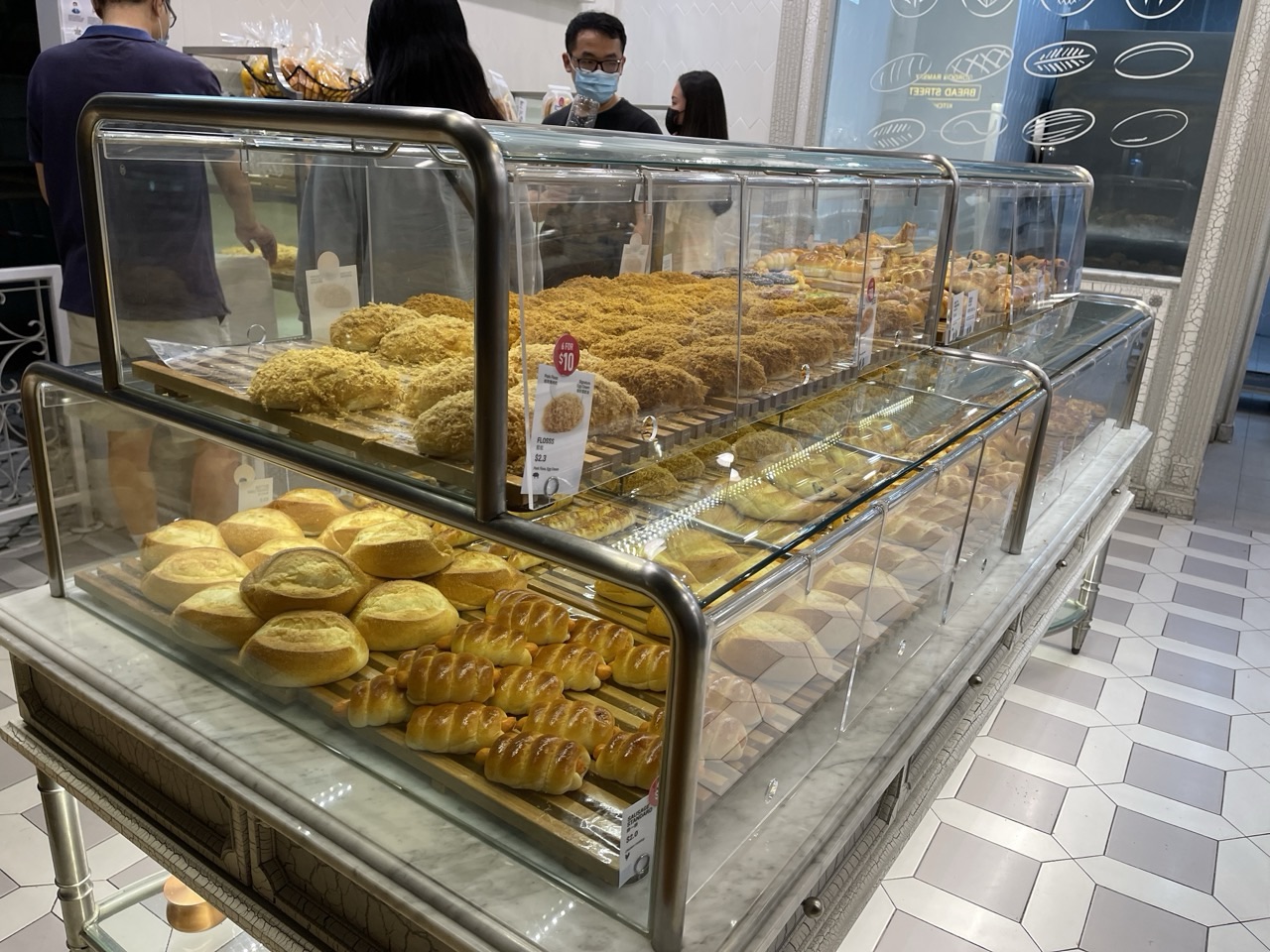
Featured photograph: bakery bread and confectionery displayed for sale, illustrating a familiar use of microbial transformations. It is not a photo of any hypothetical fermentation culture, measured sample or teaching calculation.
To compare product formation when biomass concentration changes, continue with The Gold Standard of Zymology | Separating Specific Productivity from Volumetric Productivity as Biomass Changes. It keeps product concentration, formation rate, reactor volume, biomass basis, yield, recovery and operating interval distinct, including a worked ranking reversal.