
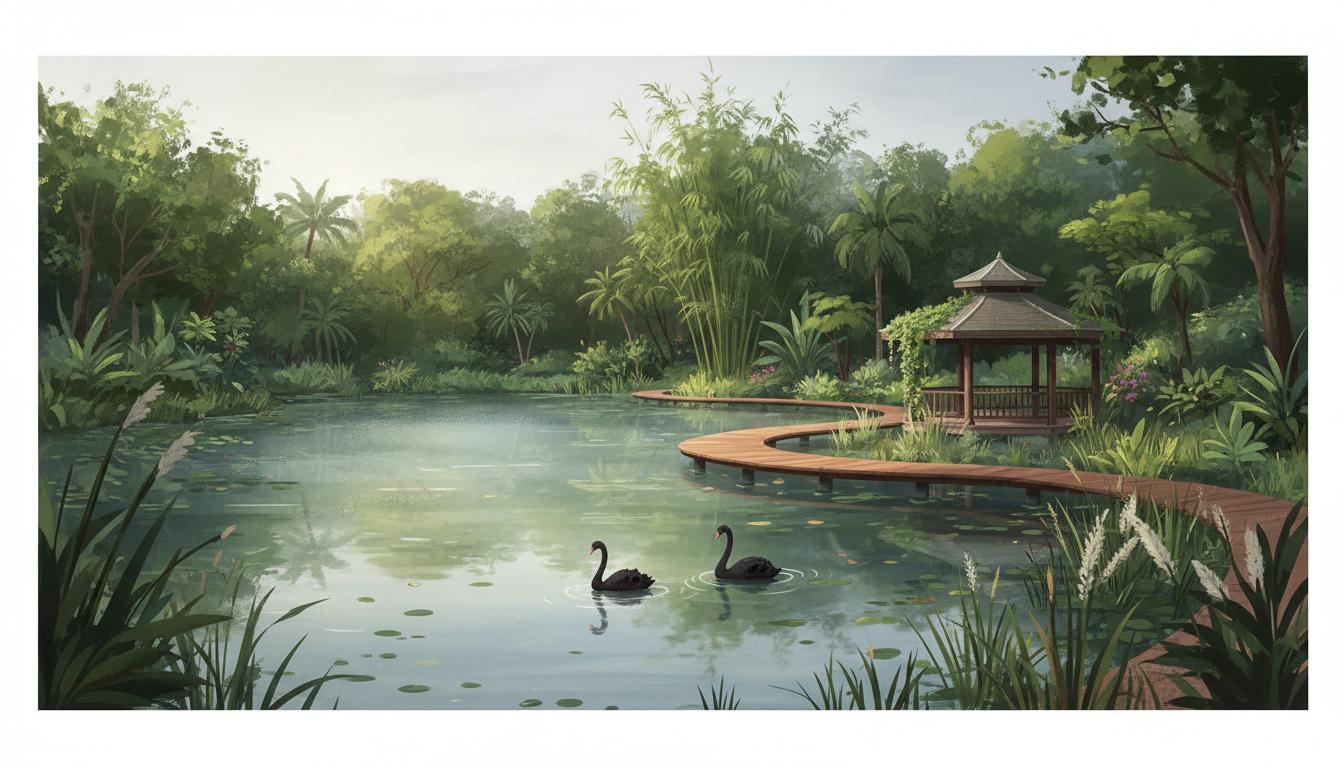
Where is Eco Lake in Singapore Botanic Gardens, and can you see black swans for free? Eco Lake and Eco Garden are public attractions near Bukit Timah Gate in the Singapore Botanic Gardens, best approached from Botanic Gardens MRT (Circle Line and Downtown Line). Admission to the general Gardens is free, with ordinary grounds hours of 5am–midnight. Eco Garden features trees valued for timber, bamboo, spices and ornamental plants, while Eco Lake provides tranquil water, a curved visitor boardwalk and a setting where black swans have been recorded breeding. A swan sighting is never guaranteed: birds move, rest and reproduce on their own schedules, and visitors should not feed or approach them.
For searches such as Eco Lake Singapore Botanic Gardens, Bukit Timah black swans, Eco Garden boardwalk, Botanic Gardens MRT lakeside walk, black swan cygnets Singapore, bamboo gardens, bougainvillea collection, free family nature outing, birdwatching and photo spots near Bukit Timah Gate, the key distinction is location. Eco Lake is not Swan Lake. Eco Lake belongs to the Bukit Timah side, while the older Swan Lake and its ornate Victorian gazebo are in the Tanglin Core at the opposite end of the Gardens. The historic Flight of Swans sculpture is in Swan Lake, not Eco Lake.
Our simplest plan: enter the Gardens through Bukit Timah Gate, follow the current visitor map to Eco Garden and Eco Lake, walk the permitted boardwalk and choose one quiet observation point. Look for waterbirds from a distance, compare the useful tree and bamboo collections, and enjoy the changing reflections without throwing anything into the water. The curved Eco Lake boardwalk and visitor kiosk were completed as an architectural project in 2017. The general public Gardens are free, but the National Orchid Garden remains a separately ticketed attraction elsewhere. Check official visitor notices before the trip.
Eco Lake quick facts
| Question | Answer | Visitor note |
| Eco Lake location | Eco Garden, Bukit Timah Core | Different from Swan Lake at Tanglin |
| Nearest MRT | Botanic Gardens (CC19/DT9) | Walk from Bukit Timah Gate |
| General admission | Free | Orchid Garden is separate and ticketed |
| Grounds opening | 5am–midnight daily | Individual features may have temporary restrictions |
| Boardwalk | Curving Eco Lake visitor boardwalk | Completed with kiosk in 2017 |
| Black swans | Historically recorded on Eco Lake | No guaranteed sighting or cygnets |
| Eco Garden’s botanical purpose | Hardwoods, bamboo, spices and ornamental plants | A collection, not a plant nursery for picking |
| Special plant stop | Bougainvillea collection | Colourful bracts; blooms vary |
| Family visit suggestion | 45–90 minutes | Excludes travel and other gardens |
| Wildlife etiquette | Observe; do not feed | No fishing, swimming or capture |
Contents: lakeside walking and useful plants
- Eco Lake versus Swan Lake
- Bukit Timah Gate and MRT directions
- 2017 boardwalk and quiet viewpoints
- Black swans and responsible photography
- Eco Garden’s economic and ecological collections
- Bougainvillea, timber, bamboo and spices
- Family visit plans, safety and access
- FAQs and official botanical sources
1. Start at the right end of the Gardens
Eco Garden and Eco Lake are near the Gardens’ Bukit Timah Core, accessible by the Downtown Line and Circle Line. The closest useful MRT is Botanic Gardens, which serves Bukit Timah Gate.
The whole park covers around 82 hectares. Entering at Tanglin Gate near Napier MRT is perfectly possible but adds a much longer walk if your sole aim is Eco Lake.
2. Why this garden has two linked names
Eco Garden is the surrounding botanical collection, with trees and plants that have practical and environmental importance. Eco Lake is the freshwater landscape within the same public visitor area.
You can enjoy the calm water without studying plants, but learning what grows nearby adds meaning to the walk. A tree may be valued as timber, a spice, shade or habitat at different times.
3. Eco Lake is not the famous 1866 Swan Lake
Many online guides mix the two. Swan Lake is in the older Tanglin Core, with the Flight of Swans sculpture and a historic gazebo. Eco Lake lies near the Bukit Timah side and is associated with black-swan sightings and its own boardwalk.
Use the named location and the current map before following a photograph. A black swan photograph alone may not reveal which Gardens lake it was taken beside.
4. Free Gardens admission is the starting point
NParks clearly states that entry to the public Singapore Botanic Gardens is free. Only the National Orchid Garden has the separate general admission charges on its visitor information page.
Eco Lake itself should not be presented as a ticketed black-swan attraction or a commercial boat ride. Ordinary walking and observing cost nothing beyond travel or optional food.
5. Opening hours for the broader grounds
The main Gardens normally open from 5am to midnight. The visitor page does not list a separate everyday closing timetable for Eco Lake comparable with the 7pm restrictions for Learning Forest.
Still obey actual gates, weather closures and staff instructions. A general ground schedule does not grant access to a fenced wetland area during maintenance.
6. Allow travel time beyond the MRT exit
Botanic Gardens MRT places you close to Bukit Timah Gate, but reaching a particular lakeside viewpoint involves walking inside the park. Traffic crossings and direction signs can shape the approach.
Do not turn a 30-minute enjoyment estimate into a total trip from another district. Plan the station-to-lake journey, the visit and the return separately.
7. Eco Lake’s boardwalk was designed as public architecture
A Singapore architectural practice documents a 2017 visitor kiosk and curved boardwalk at Eco Lake. The path winds along the water, allowing views through the planting rather than demanding visitors enter the wetland.
The boardwalk is a landscape-design feature as well as a viewing surface. Notice how its curves create alternating glimpses of open water and vegetation.
8. A kiosk does not guarantee a café
The architectural record mentions a visitor kiosk, but that is not proof that a present-day full food service operates at Eco Lake. Kiosks can change purpose, hours or availability.
For a guaranteed meal, use the current Gardens dining page and visit the actual operating tenant. Bring water for an ordinary walk.
9. Why boardwalks protect a lake edge
The water’s edge is often habitat for reeds, invertebrates, waterbirds and soil organisms. A designed boardwalk reduces trampling and allows visitors to appreciate the area without creating new muddy shortcuts.
Use the marked viewing points rather than climbing over rails or standing in planting beds. Conservation works best when many ordinary visitors make small considerate choices.
10. Photograph the reflections without disturbing birds
Calm water may reflect clouds, reeds, trees and a bird’s silhouette. Wind, rain or movement change the texture from minute to minute.
Keep a comfortable distance from swans and other birds. For a closer image, use zoom instead of walking toward a bird until it has to move away.
11. Black swans have been recorded breeding at Eco Lake
A 2024 news report documented four black swan cygnets hatching at Eco Lake. Photographs from earlier years also show black swans using the waters.
These are historical sightings and breeding records. They do not establish that a family of cygnets is present on your chosen date in 2026.
12. Black swans are associated with Western Australia
The black swan, Cygnus atratus, is native to Australia and is known for its dark plumage and often red bill. Individuals at managed gardens may have different local histories from wild Australian populations.
An animal in a public lake is not an invitation to pet it or feed it. Respect its space regardless of whether it has lived near people for years.
13. Black swans may be accompanied by young, or not
Young swans are called cygnets and can look grey or fluffy before adult plumage develops. Parents may be particularly protective during nesting and brooding periods.
If you encounter a family, do not position yourself between adults and young. Move away calmly and let the birds choose their route.
14. Do not feed swans bread
The Gardens prohibit feeding wildlife, including birds, fish and turtles. Human food can harm animal health, attract animals to crowded areas and alter water quality.
The most valuable encounter is one where a bird continues natural feeding and swimming without reacting to your presence. Leave food packed away.
15. A swan is not a tame domestic pet
Even birds accustomed to visitors remain strong animals with territories and stress responses. Children may be tempted to approach because the birds look familiar.
Teach the family to watch from a safe distance and never to touch nests, feathers or eggs. If a bird changes posture or direction to avoid you, give it more room.
16. Other waterbirds may visit
An urban lake can attract birds for resting and foraging, though the exact mix varies. A visitor may see ducks, egrets or smaller birds in vegetation, but any individual species sighting requires observation rather than assumption.
Carry binoculars if you enjoy birdwatching. Do not broadcast calls or throw food to attract wildlife to a camera.
17. Why a calm lake is biologically busy
Beneath the apparently still surface, microorganisms, invertebrates and aquatic plants form part of a living food web. Above it, birds may feed or rest, and the shores support other organisms.
A child’s question about what lives in the water can be a valuable learning moment even without identifying any animal. Avoid sampling or disturbing water without explicit permission.
18. The word ‘eco’ includes useful economic plants
NParks describes Eco Garden as combining economic utility with ecological landscaping, featuring hardwoods, bamboo and spices. The collection shows that botanical science connects natural habitat with materials people use.
Eco Garden’s name is not simply shorthand for an untouched wilderness. It is a designed collection that interprets plant diversity through human uses as well as biological relationships.
19. Timber trees have long life cycles
The nearby timber collection includes valuable hardwood species, some slow-growing and rare. Their usefulness to human societies does not mean the public can collect wood or branches.
Look at trunks, bark and crown form. A long-lived tree invites discussion about why conservation and sustainable forestry require planning beyond a single human season.
20. Dipterocarps are significant Southeast Asian forest trees
NParks notes that the Gardens houses nearly two hundred dipterocarp species, many threatened, and identifies an Eco Garden timber collection as a way to view rare timber trees.
These specimens connect to the ecology of lowland rainforests, where tall dipterocarp trees can dominate canopy structure. A planted specimen remains part of a scientific collection.
21. Bamboo is a grass with an unusual growth form
Tropical bamboo can grow in tall clumps and form hollow or solid culms, depending on the species. It has uses in construction, crafts and other daily activities.
Look at clump spacing and leaf arrangement rather than testing a cane’s strength by bending it. A public collection is not a source of free building material.
22. Spice plants connect the garden to food culture
The official Eco Garden description includes spices among its economic plant themes. Spices have been central to Southeast Asian agriculture, trade, food and cultural identity.
An adult might ask a child to name a familiar spice and then learn what part of the plant it comes from. Never taste unidentified garden material.
23. Bougainvillea is a colourful highlight
The Gardens’ collection page identifies a Bougainvillea Collection in Eco Garden with striking pink, purple, red and other coloured bracts. It records the introduction of bougainvilleas to Singapore through Gardens Director Eric Holttum.
The plants are particularly photogenic when bracts are abundant, but their flowering can vary with growth and weather. An online image is not a guarantee of full bloom.
24. A bract is not the same as a flower petal
The brightly coloured parts most people notice on bougainvillea are modified leaves, or bracts. The flowers themselves are smaller structures within the showy arrangement.
Look carefully rather than assuming every vivid shape is a petal. This simple observation connects ornamental gardening with basic plant morphology.
25. Bougainvillea hybrids show horticultural breeding
The official collection identifies cultivated forms such as Bougainvillea × buttiana ‘Mrs McClean’ and Bougainvillea × spectoglabra ‘Mrs Fraser’. These names reflect taxonomic and horticultural traditions.
You do not need to memorise cultivar names for a pleasant visit. A more useful first step is to compare different growth habits and coloured bracts.
26. Why trees and flowering shrubs belong in one Eco Garden
A collection becomes more meaningful when visitors can compare long-lived hardwoods, rapidly growing bamboo, food-related spices and ornamental cultivars.
Each plant represents a different relationship with human life, from structural timber to landscaping and food. The mix illustrates why economic botany is a broad subject.
27. A 30-minute lake-focused visit
For a short visit, make the lake boardwalk the main objective, pause at a safe viewpoint and walk back through adjacent garden planting.
Thirty minutes is a suggested stop, not an officially measured MRT-to-lake tour. If no birds are present, enjoy the reflections and garden forms rather than searching off-trail.
28. A 60-minute nature-and-plants outing
Start at the lake, take time for quiet birdwatching and examine two or three useful plant collections. A brief rest can help young children or an older visitor enjoy the experience.
The aim is variety without exhaustion. Avoid trying to cover every collection in the entire 82-hectare Gardens in one hour.
29. A 90-minute family morning
A larger family visit can combine Eco Garden, Eco Lake and a nearby appropriate public garden stop. Choose the order by weather and the children’s energy rather than forcing a fixed route.
Allow additional time for a meal and travel. Nearby Jacob Ballas Children’s Garden has specific age and Monday closure rules and should be treated as a separate attraction.
30. The Lake and Jacob Ballas are not interchangeable
Eco Lake is an ordinary nature-viewing area with waterside etiquette. Jacob Ballas Children’s Garden is a dedicated play-and-learning site for children up to 14 years old, with adults normally entering only when accompanying a child.
A family seeking water play should consult Jacob Ballas’ current facilities and notices rather than assuming children may enter Eco Lake.
31. What about a stroller?
Paths and boardwalks provide a more defined walking surface than forest dirt trails, but exact ramps, widths, lifts and interruptions may vary. Check current Gardens accessible routes if this is essential.
Do not assume an entire circular route is fully step-free merely because one segment has a boardwalk. Choose a manageable out-and-back when uncertain.
32. Older visitors can choose a comfortable pace
A calm water view may be rewarding without a long, steep walk. Eco Lake can be enjoyed as a short destination, especially when the group values seated rest and slow observations.
Ensure access from the chosen entrance is appropriate for the visitor’s mobility. Avoid combining several distant Gardens cores purely to maximise attractions.
33. A young child’s lake-safety lesson
Explain that water can be deep, banks can be slippery and fences define safe viewing areas. Children should remain within arm’s reach where risk is present.
Do not let children throw sticks, stones or food into the lake. The habitat is a place for living organisms, not a waterplay facility.
34. A teenager can compare lake and forest ecosystems
A lake has open water, aquatic organisms, shore vegetation and birds, while a forest trail has different light and soil conditions. Ask which organisms depend on both habitats.
Use observation-based statements. It is better to note a bird feeding near the lake than claim every species relies on that waterbody.
35. Birdwatching without a long checklist
Look for three types of movement: something gliding on the water, something flying across it and something moving in shoreline vegetation. The sequence helps visitors notice habitat without knowing every name.
A bird may remain hidden throughout the visit. That unpredictability is part of watching wildlife rather than attending a scheduled animal show.
36. Bring water, not food for the swans
Carry your own water and ordinary essentials. If you bring picnic food for yourself, keep it secured and use appropriate designated places for eating.
Animal feeding creates dependency and nuisance behaviour. Even well-intentioned scraps should not be offered to waterbirds.
37. Heat and humidity matter beside water
The lake is an outdoor tropical setting. Shade changes through the day, and the surrounding grass or boardwalk may become hot or slippery after rain.
Wear comfortable shoes, consider sun protection and shorten the visit during severe heat. A young child or older visitor may need more rest than expected.
38. Thunderstorms are a reason to change plans
A public lake and exposed boardwalk are unsafe places to remain during lightning. Seek substantial shelter and follow the Gardens’ temporary closure notices.
An umbrella is useful for ordinary rain but does not protect against lightning. Do not remain on the deck trying to photograph a storm.
39. Respect the lake after heavy rain
Water levels, bank conditions and footing can change after downpours. A view that looks safe from a photograph may not feel the same on a wet day.
Stay on built paths, avoid crossing roped-off areas and postpone a lakeside photo if surfaces appear unsafe.
40. The visitor kiosk is part of an evolving landscape
The boardwalk and kiosk project shows how public infrastructure can be designed with a sensitive historic botanical setting. Architectural additions help visitors experience nature while limiting informal erosion.
That balance is a useful design lesson. Good public access can support conservation when it guides people away from fragile edges.
41. Eco Garden connects natural science and economics
Botanical gardens have long collected useful plants for study. Singapore’s Gardens helped research crops and horticulture, and modern plant displays continue to show materials that connect environment and livelihood.
A visit to Eco Garden can raise questions about sustainable timber, plant breeding and global crop exchange without becoming a commercial plantation tour.
42. Are the black swans a promised attraction?
No. Historic news reports confirm black swans have lived and bred on Eco Lake, but birds have lifespans, health needs and unpredictable movements. Management conditions also change.
Present swans as a possibility rather than a guaranteed 2026 encounter. If they are absent, there is still plenty of garden and wetland scenery to enjoy.
43. Don’t confuse wildlife photos with live availability
A photograph of cygnets from February 2020 or March 2024 documents those dates. It should not be used as evidence that newly hatched cygnets can be seen this weekend.
Use dated sources responsibly and let each visit be its own experience. The ecological value of the lake does not depend on a photogenic brood.
44. Other plant collections nearby can extend the theme
The Bukit Timah Core also includes Ethnobotany Garden, Foliage Garden, Fragrant Garden, the Centre for Ethnobotany and Seed Bank. Each emphasises a different way to understand plants.
Choose one or two nearby themed stops rather than creating a very long itinerary that a family cannot comfortably complete.
45. Why Eco Lake deserves its own guide
A general Gardens travel list rarely explains the difference between Eco Lake and Swan Lake, the birdwatching etiquette, the boardwalk architecture and the economic-botany collections.
These practical distinctions help visitors choose the correct end of the park and appreciate more than a pretty water photograph.
46. Finish with a moment of observation
Before leaving, compare the lake’s reflections with the plantings along the path. Notice what appears designed and what responds unpredictably to wind, light or wildlife.
The most useful takeaway is that a quiet urban lake can connect natural systems, public design and family recreation without a ticket or staged performance.
47. A return visit may show something completely different
Bougainvillea displays, waterbirds and weather conditions all change. A second visit may reward the same visitor with new details even when they follow the identical path.
Let the ecosystem set its pace. A respectful observation can be more memorable than covering the maximum distance.
Frequently asked questions about Eco Garden and Eco Lake
Is Eco Lake free to visit?
Yes. It is inside the free-entry Singapore Botanic Gardens, not the ticketed National Orchid Garden.
Where is Eco Lake?
In the Eco Garden near Bukit Timah Gate and Botanic Gardens MRT.
Is Eco Lake the same as Swan Lake?
No. Eco Lake is on the Bukit Timah side; Swan Lake and Flight of Swans sculpture are in the Tanglin Core.
Which MRT is closest?
Botanic Gardens MRT on the Circle and Downtown Lines.
What time does Eco Lake open?
The general Gardens open 5am–midnight, but obey any Eco Garden site-specific maintenance or temporary closure notices.
Can I see black swans?
Black swans have been documented breeding at Eco Lake, but current presence is not guaranteed.
Are black swan chicks present in 2026?
Not verified. Records of cygnets in 2020 or 2024 do not establish a present-day brood.
Can children feed the black swans?
No. The Gardens’ wildlife rules prohibit feeding waterbirds and other animals.
What is the Eco Lake boardwalk?
A curved waterside visitor boardwalk created as part of a 2017 architectural project.
Can I walk onto the lake edge?
Stay on approved paths and decks, away from wetland planting and unstable banks.
Can I swim or paddle there?
No. Eco Lake is a managed garden lake for wildlife and scenery, not an authorised water-sports venue.
What is Eco Garden famous for?
Collections of economically useful plants such as timber trees, bamboo, spices and Bougainvillea.
Why is bougainvillea colourful?
Its vivid display comes mainly from modified leaves called bracts rather than large ordinary petals.
Does Bougainvillea bloom year-round?
Tropical conditions permit recurrent flowering, but the exact display varies with cultivar, maintenance and weather.
Are there rare timber trees?
NParks lists valuable timber species, including rare dipterocarps, in its Eco Garden area.
Is bamboo really a grass?
Yes. Bamboos are grasses with distinctive woody culms in many species.
Can I collect fruit or spices?
No. Do not pick living public botanical specimens.
How long should I visit?
About 45–90 minutes can work for a relaxed lake-and-plant walk, excluding transit.
Is this good for toddlers?
Yes for supervised observation on appropriate paths, not waterplay.
Is the boardwalk stroller friendly?
A defined boardwalk can help, but confirm actual ramps and the complete route for a stroller or wheelchair.
Can grandparents enjoy Eco Lake?
Yes, with a suitable accessible route and rest breaks. Choose a short out-and-back if that better meets mobility needs.
Is parking free?
No general free-parking promise applies. The Gardens has paid parking zones; check the correct entrance.
Can I bring a picnic?
Follow the Gardens’ designated visitor rules for food and rubbish, and do not feed wildlife.
Can I bring a dog?
Check current Gardens pet rules and specific restricted zones; animals are not permitted everywhere.
Can I use a drone?
Do not assume aerial photography is permitted; official permits and park restrictions may apply.
Will I see kingfishers?
They may occur at the Gardens, but no particular species can be guaranteed on a visit.
Can I photograph a nesting bird?
Observe from a distance and avoid nesting sites if your presence disturbs adults or chicks.
What if it thunderstorms?
Leave exposed water-edge areas and follow official weather or Gardens closure instructions.
Is the lake a UNESCO World Heritage site?
Eco Lake lies within Singapore Botanic Gardens, the UNESCO-listed cultural landscape.
Is the Victorian gazebo at Eco Lake?
The notable historic Victorian cast-iron gazebo is associated with Swan Lake, not Eco Lake.
What’s the nearest family attraction?
The nearby Bukit Timah Core offers other gardens and Jacob Ballas Children’s Garden with separate age and operating rules.
Where can I see an accurate map?
Use the official Singapore Botanic Gardens visitor map, selecting Eco Lake near Bukit Timah Gate.
What is the most important visitor rule?
Respect wildlife and remain on designated paths, especially at the waterside.
More Bukit Timah garden guides
- Sculptures and other Gardens landmarks
- Ethnobotany and Seed Bank
- Ticketed National Orchid Garden
- Heritage Tree walks
- Free Gardens audio walks
- Free Bukit Timah attractions
Verified botanical and visitor sources
Editorial fact-check: 23 October 2026. The garden collection and free admission are verified through NParks. Reports of black swans and cygnets are historical, not claims of real-time wildlife availability. Opening and parking conditions may change with notices.
- Singapore Botanic Gardens — Eco Garden, Eco Lake, timber trees, bamboo, spices and bougainvilleas
- Singapore Botanic Gardens — Bukit Timah Gate, MRT, admission and general park hours
- Singapore Botanic Gardens — temporary access notices
- Genome Architects’ Eco Lake 2017 boardwalk and visitor kiosk project
- Mothership — historical March 2024 Eco Lake black swan nesting and cygnets
- NParks — observing wildlife without feeding or disturbing animals
- UNESCO — Singapore Botanic Gardens World Heritage listing
- Meteorological Service Singapore — lightning and current weather