
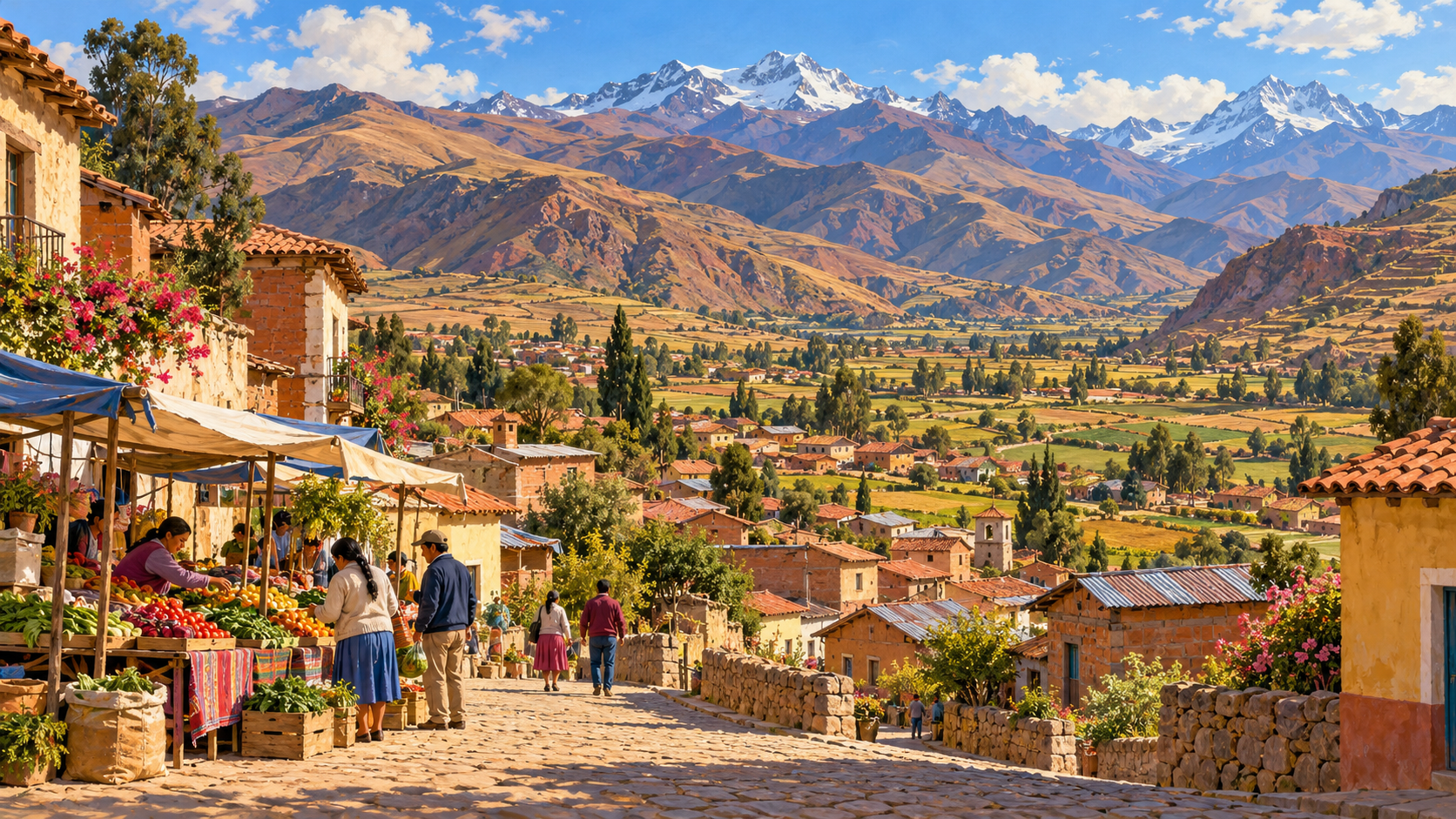
Did you know that Bolivia can take you from a high-altitude salt landscape to carved archaeological rock, historic cities and warm eastern lowlands? Ten places to visit when touring Bolivia are La Paz, Tiwanaku, Lake Titicaca and Copacabana, Salar de Uyuni, Eduardo Avaroa Reserve, Sucre, Potosí, Samaipata, Santa Cruz de la Sierra and Tarija. This Bolivia travel guide brings together cities, individual heritage sites and broad landscapes so you can choose a trip around what you most enjoy: architecture, archaeology, nature, food or everyday urban life.
A useful Bolivia itinerary starts with regional choices. La Paz, Tiwanaku and the Bolivian side of Lake Titicaca form a western chapter. Uyuni and the Eduardo Avaroa landscapes need a separately planned southwest journey; a short salt-flat outing does not automatically include the distant lagoons. Sucre and Potosí make a historic-city pairing. Santa Cruz and Samaipata introduce another regional setting, while Tarija is a southern valley chapter. You do not need all ten Bolivia attractions to have a rich first visit.
Before booking, check current Bolivia travel advice and the exact roads proposed. As checked in October 2026, a state of emergency is in effect and roadblocks can disrupt journeys; UK advice also advises against all but essential travel to Chapare, including specified highway routes. Do not try to cross a roadblock. Several places in this selection are at high altitude, so plan the sequence and exertion carefully, seek appropriate pre-travel health advice and leave room to change the itinerary.
Find your route through Bolivia
Choose a western city, archaeology and lake route; a professionally arranged southwest landscape journey; a Sucre–Potosí heritage chapter; or an eastern trip around Santa Cruz and Samaipata. Tarija adds a different southern valley setting. Confirm every connection before combining regions.
Compare the places · Start exploring · Plan your route · Quick answers · Official sources
Ten places at a glance
| Place | What it offers | Region |
|---|---|---|
| 1. La Paz | A working city whose steep geography shapes everyday movement | Western highlands |
| 2. Tiwanaku | Archaeology that predates the familiar colonial-city story | La Paz Department |
| 3. Lake Titicaca and Copacabana | A highland lake chapter with town life and carefully chosen boat outings | Western Bolivia, beside Peru |
| 4. Salar de Uyuni | An extraordinary salt landscape whose appearance changes with conditions | Southwestern Bolivia |
| 5. Eduardo Avaroa Reserve and the coloured lagoons | A separate southwest chapter of wetlands and highland landscapes | Far southwestern Bolivia |
| 6. Sucre | Historic architecture and an introduction to independence history | South-central Bolivia |
| 7. Potosí | Silver history, urban heritage and a careful look at labour | Southern highlands |
| 8. Samaipata and El Fuerte | A town base for a distinctive carved-rock archaeological site | Santa Cruz Department |
| 9. Santa Cruz de la Sierra | A contemporary eastern-city chapter beyond the highland images | Eastern Bolivia |
| 10. Tarija | A southern valley city and a different food and vineyard chapter | Southern Bolivia |
Open the full reading index
1. La Paz
2. Tiwanaku
3. Lake Titicaca and Copacabana
4. Salar de Uyuni
5. Eduardo Avaroa Reserve and the coloured lagoons
6. Sucre
7. Potosí
8. Samaipata and El Fuerte
9. Santa Cruz de la Sierra
10. Tarija
Planning and regional routes
Frequently asked questions
Official sources and further reading
Understand the changes in landscape before choosing the route
Bolivia rewards curiosity because its places introduce different ways of living with the land. La Paz makes steep urban terrain visible. Tiwanaku opens a much older political and spiritual history. The salt flats and southwest wetlands bring environment into focus, while Sucre and Potosí invite you to connect architecture with the institutions and labour that produced it.
It helps to separate a place from the photograph most often used to represent it. A reflective salt flat depends on conditions. A colonial façade does not tell you whose work supported the city. A town below an archaeological site is not interchangeable with that site. Ask what you want to understand at each stop, then give the answer a place in the programme.
Altitude is also a planning fact, rather than an adventurous label. Do not assume that enthusiasm or general fitness determines how you will feel. Discuss the journey with a qualified professional where needed and with your operator, including the elevation of overnight stops and the demands of planned walks. This guide does not prescribe a medical acclimatisation schedule.
The following ten places are choices across a varied country. They are not an official ranking, and inclusion does not establish that a particular route is appropriate at the time of travel. Use the descriptions to select a manageable region, then verify access, transport and conditions for your actual dates.
La Paz is a fascinating place to start because the city’s geography is immediately part of the experience. Looking across the slopes, you can see that urban movement cannot be understood only as a flat street map. Give yourself a city programme that explains this setting rather than simply chasing a sequence of viewpoints.
A ride on a suitable Mi Teleférico route can help you read that landscape. The cable-car system serves everyday transport, so treat it as a working service rather than a theme-park attraction. Ask about the actual stations, onward connections and current operating arrangements. Avoid obstructing other passengers while photographing the view.
At street level, choose a small area to explore carefully. Public squares, trading spaces and changes in building form can introduce the city’s layered history. A guide can connect what you see with the people and institutions involved. One informed walk often provides more understanding than a vehicle tour with many brief stops.
Markets are useful places to ask about ingredients, materials and daily routines, but they remain workplaces. Keep passageways clear, ask before close photographs and do not assume that an unfamiliar item exists mainly to entertain tourists. A calm explanation is more helpful than sensational stories attached to objects whose meanings you have not yet learned.
Build the first day around what your group can comfortably manage. The city’s altitude and slopes deserve consideration alongside arrival travel. A short walk and an unhurried meal can be a complete introduction. You can leave a longer excursion for a later day if the plan and your circumstances support it.
La Paz also makes a practical western base for Tiwanaku or the Lake Titicaca chapter, subject to confirmed roads and logistics. Keep those outings distinct from the city visit itself. The city has enough substance to deserve time beyond serving as a place where a tour vehicle collects you.
Tiwanaku introduces a different timescale from La Paz’s contemporary life. UNESCO recognises the site as the spiritual and political centre of the Tiwanaku culture. Visit it as the material legacy of a particular society, rather than attaching every impressive ancient structure in the Andes to the Inca.
An informed guide can help you connect stonework, ceremonial spaces and the wider landscape. Ask which features belong to the original archaeological evidence and which reflect reconstruction or later presentation. That distinction lets you appreciate what survives without assuming the current appearance reproduces every aspect of the past.
Focus on a few questions. How were important spaces organised? What can the surviving material tell us about political and spiritual life? What remains uncertain? Archaeology becomes much more engaging when it is presented as an investigation, with evidence and interpretation clearly distinguished.
Do not treat carved stones or structures as props for climbing and posing. Stay on the visitor route and follow the current site rules. Heritage conservation depends partly on ordinary decisions by each group. You can obtain an interesting photograph without adding contact or pressure to a vulnerable feature.
Ask which collections or museum spaces are included and whether they are open on your date. Objects can help explain the site, but a promised museum visit needs confirmation. A guide should describe the programme as it can actually be delivered, rather than repeating an old itinerary unchanged.
Tiwanaku is a western excursion that can complement La Paz or a wider lake-region journey. Confirm the exact road route and allow adequate time on site. Avoid using its proximity on a regional map as a reason to add several distant activities to the same day. Its archaeological subject deserves enough attention to remain memorable.
Lake Titicaca is shared by Bolivia and Peru. This entry concerns a Bolivian-side visit, with Copacabana as a useful town focus. Keep the geography clear when researching: a description of an island or excursion on the Peruvian side is not automatically part of the same local itinerary.
Start by choosing the experience you want. You may prefer time in Copacabana and views of the lake, or a separately arranged boat outing. A shoreline stay does not require every traveller to board a boat, and a boat excursion should not be chosen solely because a famous island name appears in a brochure.
Ask the operator about the vessel, equipment, boarding, route and current conditions. If the trip includes an island walk, find out about the terrain and exertion as well as the water journey. The complete programme matters more than the apparently gentle image of a lake.
Copacabana can introduce town and religious life alongside the scenery. Confirm visitor access at any place of worship and behave according to the rules explained there. A religious landmark has value as a living site, not only as an architectural stop between a hotel and a pier.
The lake landscape is also inhabited and worked. Ask before photographing residents closely, and do not enter private spaces because they appear interesting from a path. A guide can help you understand local activity without turning it into an uninvited performance.
Give this chapter enough time to be more than a departure point for a hurried excursion. A meal, an appropriate walk and a conversation may be among the most enjoyable parts. If you combine it with La Paz or Tiwanaku, check the connections and current route conditions before committing to the sequence.
Salar de Uyuni is a compelling reason to visit Bolivia, but it is worth understanding the landscape before choosing a tour. The famous mirror image occurs when a suitable layer of water reflects the sky. A dry visit offers a different appearance. Neither a month on the calendar nor a promotional photograph guarantees the conditions of your day.
Begin with the scope of the excursion. Is the programme focused on the salar, or is it a longer journey continuing into the southwest? Ask for a map and the overnight locations. A short Uyuni outing and a multi-day itinerary involving remote lagoons are different products with different demands.
Choose an operator who explains the vehicle, driver, communication arrangements and response to changing conditions. The landscape can look wonderfully open while still requiring knowledgeable navigation. Do not interpret the lack of ordinary road markings as an invitation to explore independently without suitable preparation.
Photography can be playful here. Perspective images and reflective scenes are part of the appeal, but keep the guide’s instructions in view. An attractive place for a picture is not automatically an approved driving route or walking area. Let the photograph fit the outing rather than letting the group’s desire for a particular image dictate it.
Ask about the actual conditions of the accommodation and the provisions included in the tour. The label attached to a property cannot answer questions about facilities, heating or the location of an overnight stop. Clear details help you decide whether the programme suits your group.
Give the salar a place in the trip that reflects your interests. A focused outing can be satisfying; a longer landscape journey can reveal more when it is planned properly. Avoid booking extra days merely because an itinerary implies the salt flat alone is an incomplete experience.
PLACE 5 OF 10 · Far southwestern Bolivia
5. Eduardo Avaroa Reserve and the coloured lagoons
The Eduardo Avaroa Reserve introduces a wider landscape chapter beyond the Salar de Uyuni itself. Official Bolivian tourism material connects the reserve with wetlands and the coloured lagoons of the southwest. Think of it as a deliberate remote journey, with its own programme, rather than a quick extra attached to a city outing.
Ask which places the itinerary actually reaches. The names of lagoons, reserves and viewpoints can be combined loosely in marketing. Request the route, overnight stops and expected conditions so you can see what the tour involves. A useful description makes the distances and setting clear.
The landscape’s colours are an invitation to learn about the environment. Ask the guide what shapes the appearance of a particular lagoon and what life it supports. Do not assume that every photograph uses the same light, season or water conditions that you will encounter.
Wildlife requires patient expectations. Flamingos are associated with the region, but an operator should not guarantee a specific scene or close encounter. Observe from an appropriate position, follow local instructions and allow animals to continue their activity. A distant view can still be an excellent one.
The journey may involve high overnight elevations, changing weather and substantial time in a vehicle. Discuss those details in advance, including the group’s health and comfort needs. Seek qualified advice where appropriate. The remoteness is part of the setting, not a reason to leave practical questions unanswered.
Choose this chapter if remote landscapes are central to the trip and you have the time and suitable arrangements. If your visit is shorter or the programme does not fit your needs, concentrate on a salar outing instead. A thoughtful choice between them is more useful than feeling obliged to book the longest available tour.
Sucre offers a strong historic-city chapter, with an urban heritage recognised by UNESCO. Its streets and buildings invite you to notice how local architectural traditions and forms introduced from Europe were brought together. Start with a manageable walk that gives those details room to become visible.
The Casa de la Libertad is a useful focus for the history of independence. Confirm current visitor arrangements and ask for an explanation that connects the institution with the broader story. A historic room gains meaning when you understand what took place there and why it matters.
Religious buildings can add another architectural layer. Choose a few with confirmed access rather than trying to enter every church listed online. Look at materials, courtyards and changes in style. Ask your guide to distinguish the date of a foundation from the dates of later additions.
Do not let the attractive cityscape remove colonial power and labour from the conversation. Ask how Sucre’s institutions were connected with the region, including Potosí. Beautiful architecture is easier to understand when its economic and political context remains visible.
Leave time for contemporary Sucre as well. A meal, a public square and an ordinary walk can connect the historic setting with a city still used by residents. Avoid treating every street as a museum corridor in which daily activity is a distraction.
Sucre can pair well with Potosí as a selected heritage route, subject to verified transport and conditions. Plan the overnight sequence and physical demands rather than assuming that two city names close together in a guide constitute an easy day trip. Give each city its own questions and sufficient time to answer them.
Potosí is a place where a city visit can open a much larger history. UNESCO’s description connects the heritage with silver extraction, industrial infrastructure and the urban setting. The important subject is not wealth alone; it is also the labour and power that made that wealth possible.
Begin with a guided introduction to the historic city and its relationship with Cerro Rico. Ask how mining shaped institutions, buildings and the wider economy. A good explanation connects an impressive façade with the processes behind it, instead of presenting prosperity as an abstract achievement.
A confirmed museum visit can be a useful way to follow the silver story. Ask what is currently accessible and how the collection is interpreted. You do not need to visit an active mine to understand why mining matters to the city.
Mine excursions require a separate, serious decision. Do not treat an operating workplace as a standard recreational attraction suitable for everyone. Ask about hazards, conditions, insurance and whether the activity is appropriate for your circumstances. Declining the excursion still leaves substantial ways to learn about Potosí.
The city’s high-altitude setting also affects the programme. Discuss walking routes and exertion with your operator, and seek appropriate health advice before travel. An unhurried schedule is sensible when the visit combines altitude, slopes and subjects that deserve reflection.
Potosí is most rewarding when you preserve the connection between heritage and people. Ask whose experiences appear in the interpretation and whose are less visible. Paired with Sucre, it can make a rich historic chapter, with enough time to understand the two cities’ relationship rather than simply photographing both.
Samaipata and El Fuerte introduce another archaeological setting from Tiwanaku. UNESCO recognises Fuerte de Samaipata for its important carved rock and related archaeological remains. The site deserves an explanation of its particular history, rather than being treated as another interchangeable ancient ruin.
Keep the town and site distinct in the plan. Samaipata can provide a base and a local stay; El Fuerte is the focused heritage excursion. Ask how you reach it, which routes are open and what the visitor walk involves. A town booking does not automatically settle the practical details of the archaeological visit.
At the site, ask your guide how the different parts relate to one another. What is visible on the rock? How does the surrounding evidence contribute to the interpretation? What is known, and what remains uncertain? These questions encourage a more informative visit than a string of confident stories attached to each feature.
Follow the designated viewing arrangements and do not climb onto fragile carved surfaces. The purpose of access is to let people understand the site while preserving it. A protected surface can remain fascinating from an appropriate position.
Give Samaipata some ordinary time as well. A meal or a short walk can make the visit feel like a stay in a town rather than only a transfer to a monument. Hosted activities should be arranged with consent, and private spaces should remain private.
This chapter can complement Santa Cruz, but the change in terrain and travel conditions needs a realistic itinerary. Confirm the actual route and overnight plan before adding it. Choose Samaipata for a distinct heritage subject and a slower regional stay, not merely because its name is easy to append to an eastern city tour.
Santa Cruz de la Sierra broadens a Bolivia tour beyond the highland photographs that often dominate a first impression. Give the city a programme that explores its contemporary life and eastern setting. It should have a purpose of its own, even when it also serves as a starting point for a regional journey.
Begin with a guided city introduction suited to your interests. You might focus on public spaces, food, cultural institutions or the relationship between older parts of the city and newer development. A short, coherent route is more useful than being driven past numerous buildings without explanation.
Food can be an enjoyable way into regional difference. Ask what is available and how the meal relates to local ingredients and preferences. Avoid expecting a single national dish to explain every part of Bolivia. A country with varied landscapes also offers varied everyday experiences.
If a museum or cultural visit is important to you, confirm it for the intended date. Check the location and programme before setting aside a whole afternoon. A current, specific plan is more dependable than a general statement that the city has many cultural attractions.
The city also illustrates that touring Bolivia is not synonymous with touring the highlands. Notice the changed setting and ask how it influences urban activity. That contrast is useful without turning the region into a simplistic opposite of La Paz.
Santa Cruz and Samaipata can form an eastern itinerary when the verified route suits your time. Do not assume that adding the east to a western trip is a minor adjustment. Confirm the full transfer plan and current conditions, then decide whether a dedicated regional visit would give you a better experience.
Tarija adds a southern valley setting to the selection. Official tourism material connects the region with vineyards and local food traditions, but the city need not be reduced to a wine itinerary. It can be a place for a slower stay, a guided introduction and an enjoyable change in the tour’s rhythm.
Begin by deciding what you want from the regional chapter. A city visit, a food-focused day and a winery outing are different programmes. Ask the operator which towns or properties are included and how the transport is arranged. A broad description of a valley route is not an exact daily plan.
For an adult winery visit, confirm that the property receives visitors and understand the format. A production explanation may interest you as much as a tasting. Arrange appropriate transport and do not drive after drinking. Families and travellers who do not drink can ask for suitable alternatives without feeling excluded from the region.
Give the town its own time. A meal, a walk and a conversation can make the southern chapter feel distinct without needing an elaborate excursion every day. Ask about regional preferences and the ordinary use of public spaces.
If the itinerary extends into surrounding valleys, keep the exact locations clear. Do not assume that everything marketed under the Tarija name lies a short walk from your hotel. Request a route with travel, activity and rest visible, particularly if you are moving on soon afterwards.
Tarija is a choice for travellers who want a southern valley chapter and have room for the additional connection. It does not need to appear in every first Bolivia itinerary. The best reason to include it is that its setting and subjects interest you enough to give them deliberate time.
Plan a trip that fits your time
Choose one or two regional chapters
Start with the region that contains your main interest. A western visit might prioritise La Paz, Tiwanaku and the lake. A southwest journey puts the salar and reserve landscapes first. A historic-city trip gives Sucre and Potosí more attention.
Add the east or Tarija only after looking at the complete transfer plan. These are examples for discussion with an operator, not fixed schedules. A smaller selection can provide more useful time in each place and more flexibility when conditions change.
Keep current road conditions at the centre of the plan
The October 2026 advice describes a state of emergency and possible roadblock disruption. Check the exact roads and current official updates before departure and during the journey. The presence of a destination in a guide does not establish that its connection is available.
Agree with the operator how you would change the route if necessary. Leave suitable margins around important transfers and departure arrangements. Avoid commitments that depend on every road journey proceeding exactly as first advertised.
Plan altitude and exertion together
Discuss overnight elevations and the demands of activities, rather than looking only at destination names. La Paz, the lake region, Potosí and southwest excursions can involve high-altitude conditions.
Seek qualified pre-travel advice for your circumstances and share relevant needs with the operator. Ask for alternatives to demanding walks. This is a practical planning decision; a travel article cannot determine an individual medical schedule or suitability.
Compare landscape tours by what they actually include
For Uyuni and Eduardo Avaroa programmes, request a route map, overnight locations, vehicle arrangements and a clear list of inclusions. Ask how the programme changes with water or weather conditions.
Compare accommodation facilities, group size and guiding language alongside the price. A longer itinerary is not automatically the better one. Choose the tour whose specific demands and subjects fit your interests.
Give history a guide and enough time
At Tiwanaku, Sucre, Potosí and El Fuerte, interpretation changes what the visit can offer. Ask about the guide’s language and the institutions included. Confirm current admissions and access.
Encourage explanations that distinguish evidence, reconstruction and interpretation. For families, discuss how colonial exploitation and mining labour will be introduced appropriately. Those subjects belong in the understanding of the heritage, not outside it.
Confirm requirements and keep the programme comfortable
Check current entry requirements and appropriate travel insurance through official sources. Seek suitable health advice before departure, then pack for the actual locations and activities you have selected.
Include ordinary time for meals, rest and conversations. Keep photography considerate and ask before entering private spaces. A well-planned journey leaves room to enjoy the country without needing every hour to produce another attraction.
Frequently asked questions
Can I visit all ten places on a short Bolivia trip?
A short trip is better built around selected regional chapters. The west, southwest, historic cities, eastern setting and Tarija involve different connections. Ask for realistic travel and overnight arrangements before combining them.
Does a Uyuni tour always include the coloured lagoons?
No. A salar-focused outing and a longer southwest journey have different scopes. Ask whether the itinerary enters Eduardo Avaroa Reserve and request the complete map and overnight plan.
Will I see the mirror effect on the salt flats?
That depends on suitable water and other conditions. A particular date does not guarantee the reflective scene. A dry salar also offers a distinctive landscape, so choose with realistic expectations.
Is Tiwanaku an Inca site?
UNESCO identifies it with the Tiwanaku culture. Do not use the Inca name as a general label for all ancient Andean heritage. A knowledgeable guide can explain the site’s particular history.
Must I enter a mine to appreciate Potosí?
No. A historic-city and confirmed museum programme can explain the silver economy and its human consequences. An active-mine excursion is a separate decision requiring careful consideration of conditions and suitability.
What should I check before booking a Bolivia road itinerary?
Consult current official advice, the exact roads, possible disruption and your operator’s alternative plan. Also discuss high-altitude stays and activity demands. Recheck the information close to travel, rather than relying only on an article’s publication date.
Official sources and further reading
Sources checked in October 2026. Heritage and tourism descriptions explain the places; confirm current transport, admissions, weather and travel advice before making a booking.
Bolivia Travel: official destination directory
La Paz municipal tourism portal
Bolivia Travel: Uyuni and the coloured lagoons
UNESCO: Historic City of Sucre
Tarija municipal tourism and culture
UK government: current Bolivia travel advice
UK government: Bolivia health considerations
Continue exploring
Top 10 Things to Learn When Visiting and Touring Bolivia · Top 10 Things to Do When Visiting and Touring Bolivia