
Where is Bolivia, what is it famous for, and why does it matter? A national portrait needs more than a photograph of high mountains or a salt flat. This guide connects geography with history, communities, public institutions and ordinary life, using dates to make clear what has changed and what remains a lasting feature.
The chapters follow the connections between highland and lowland places, cultural traditions, work, education, health and international relationships. They also examine difficult histories and contemporary economic pressures without treating a single statistic, political episode or cultural image as the whole country.
Bolivia at a glance
- Official name: Plurinational State of Bolivia.
- Region: South America.
- Capital: Sucre; La Paz is the seat of government.
- Land neighbours: Argentina, Brazil, Chile, Paraguay and Peru.
- Coastline: none; Bolivia is landlocked.
- Languages: Spanish and constitutionally recognised Indigenous languages; Law 1658 of 2025 also recognises Bolivian Sign Language as official.
- Currency: boliviano, code BOB.
- Reading date: 20 October 2026 in Singapore. Census results, economic releases and policy claims retain their own reference dates.
The Andean Community’s Bolivia profile distinguishes Sucre from the government seat. Stable geographic and currency details can be cross-checked in the Bolivian Embassy in Japan’s basic country information; its older officeholder and economic entries are not used as current evidence here. The language chapter uses the Constitution directly.
Three distinctions are particularly useful: Sucre and La Paz have different official roles; mineral resources are not the same as commercially recoverable reserves or production; and a national aggregate does not describe every region or household. These distinctions help explain why a country can have considerable resources while still facing difficult development choices.
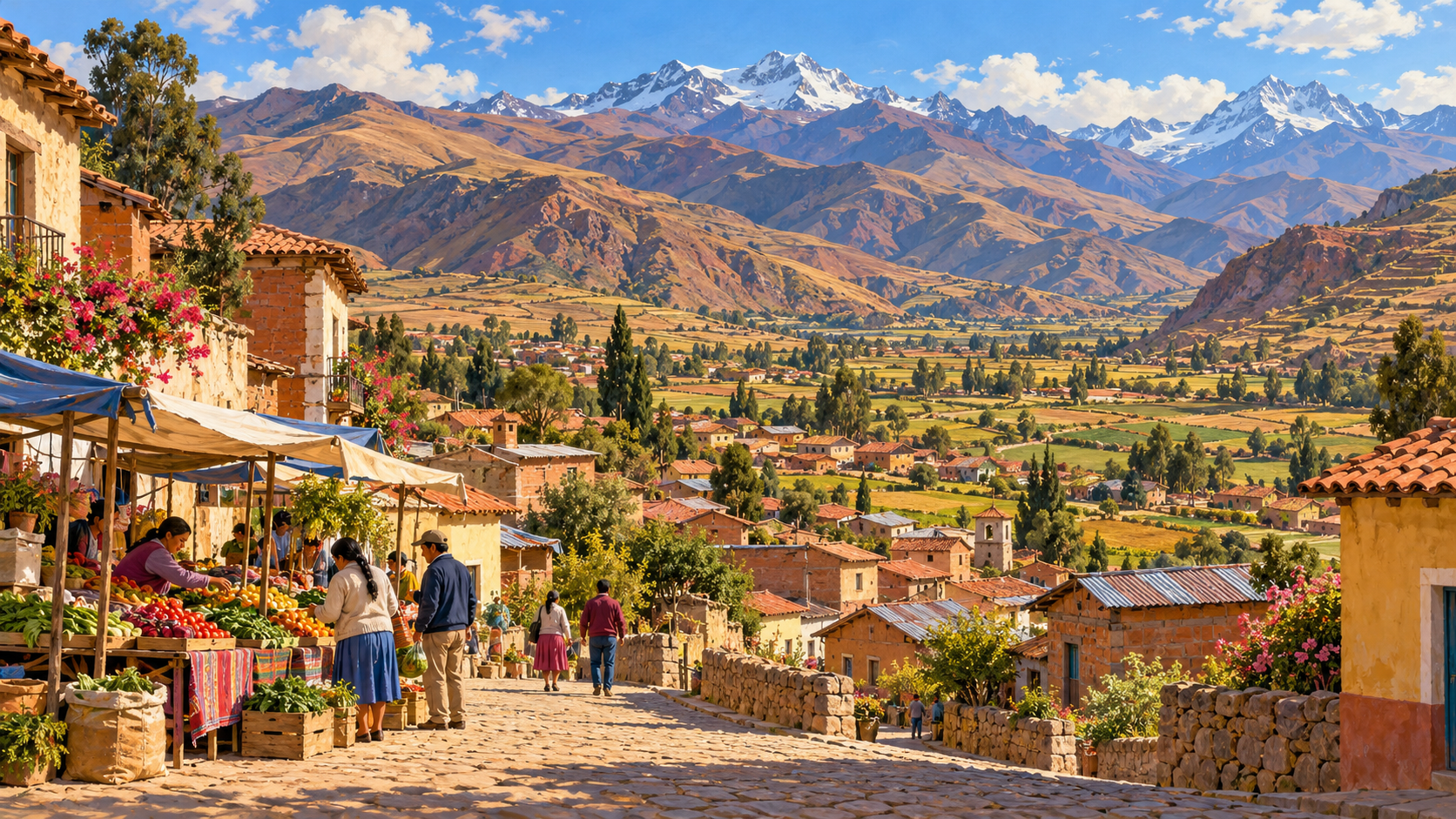
Cover illustration: an original artistic interpretation of Bolivia-inspired Andean towns, mountain valleys and cultivated landscapes, not a literal geographic view.
Choose your route through Bolivia
- 1. Bolivia on the map: borders, capitals and departments
- 2. Landscapes, climate and water
- 3. History: ancient societies, independence and political change
- 4. People, population and languages
- 5. Government and the plurinational state
- 6. Rights, elections and current institutions
- 7. Cities and the geography of urban growth
- 8. Economy: minerals, lithium and the 2026 adjustment
- 9. Trade, regional relations and maritime access
- 10. Infrastructure: roads, railways, electricity and digital links
- 11. Education, languages and routes into adulthood
- 12. Health services and social support
- 13. Homes, work and everyday life
- 14. Food, farming and the shared table
- 15. Arts, festivals and living cultural traditions
- 16. Heritage, conservation and thoughtful tourism
- 17. Sport, recreation and shared experiences
- 18. Environment, water and energy
- 19. Challenges, choices and future possibilities
- 20. What readers should take away about Bolivia
1. Bolivia on the map: borders, capitals and departments
A landlocked country at the centre of South America
Bolivia covers 1,098,581 square kilometres in central South America. It borders Brazil, Peru, Chile, Argentina and Paraguay, linking the Andes with the continent’s tropical interior. Its lack of a coastline makes neighbouring countries important to overseas transport, although landlocked does not mean cut off from world trade. A useful first map should show both the international borders and the great difference between western highlands and eastern lowlands. Straight-line distance alone says little about the time needed to cross mountain passes, river valleys or seasonally difficult roads. Sources: INE: Geographical characteristics of Bolivia.
Sucre is the capital; La Paz is the seat of government
Sucre is Bolivia’s constitutional capital, while La Paz is the seat of government. The Andean Community’s country profile preserves this distinction rather than presenting the two names as interchangeable answers. It explains why a traveller can visit presidential and legislative institutions in La Paz while encountering the national capital’s identity in Sucre. In schoolwork, the clearest short answer is therefore ‘Sucre, with the seat of government in La Paz’. Administrative functions can be distributed between cities; the place where a government works need not be the only place carrying constitutional significance. Sources: Andean Community: Bolivia country profile.
Nine departments provide the administrative map
The nine departments are Beni, Chuquisaca, Cochabamba, La Paz, Oruro, Pando, Potosí, Santa Cruz and Tarija. A department is a territorial unit, not simply its capital city. This matters especially when reading statistics headed La Paz, Cochabamba or Santa Cruz: they may describe a large department containing rural communities as well as an urban centre. Departmental boundaries also cut across physical landscapes. A political map helps locate administrations and electoral territories, whereas a relief map explains elevations and drainage. Both are needed to understand how the country is organised. Sources: INE: Department codes and territorial divisions.
2. Landscapes, climate and water
Altitude and rainfall create contrasting environments
The high Altiplano, inter-Andean valleys and extensive eastern plains give Bolivia sharply different growing conditions and settlement patterns. The World Bank’s country climate study describes the highlands as cold and dry, with large daily temperature changes, while other regions receive much more moisture. Height above sea level modifies the effects of tropical latitude: a sunny highland afternoon can be followed by a cold night. Mountain slopes also influence where moist air rises and rain falls. Consequently, a national temperature or rainfall average is a poor guide to conditions in a particular farming district. Sources: World Bank: Bolivia adaptation and vulnerability study.
Water management connects upstream and downstream communities
Bolivia’s drainage includes the Amazon, La Plata and internal Altiplano systems, with Lake Titicaca and the Desaguadero River in the last group. Bolivia’s water challenges include shortage, excessive flows, erosion, sediment transport and declining water quality. The national watershed programme approaches these as connected problems within catchments. A hillside cleared upstream can increase sediment reaching a downstream intake; a flood may damage irrigation channels even in an area that struggles with dry-season scarcity. Managing a basin therefore involves land use, storage, drainage and cooperation between communities, rather than only building a pipe or reservoir. The programme’s attention to local livelihoods also explains why water decisions are economic and social choices as well as technical engineering tasks. Sources: INE: Geographical characteristics of Bolivia; Water Resources Ministry: National Watershed Plan.
Uyuni records the history of water in a dry landscape
The Salar de Uyuni is the world’s largest salt flat. NASA’s satellite account places it among the high Altiplano’s salt-covered basins, where the balance between water supply and evaporation has shaped a striking landscape. Its bright surface contrasts with cloudier, wetter regions farther north. A shallow layer of water can change the salt flat’s appearance dramatically, but photographs of a mirror-like surface should not be mistaken for a permanent lake. The salar is a useful example of how a place can be extremely dry today while preserving evidence of much larger bodies of water in its geological past. Sources: NASA: Salt Flats, Mountains, and Moisture.
The Gran Chaco broadens the picture beyond mountains and rainforest
Southeastern Bolivia forms part of the Gran Chaco, a cross-border region shared principally with Paraguay and Argentina. UN Environment describes a landscape of dry forest that supports wildlife and human livelihoods. This is an important corrective to maps that reduce South America to the Andes and the Amazon. Dry forests have their own ecological rhythms, and their trees can appear very different between wetter and drier periods. The region also shows why environmental and economic geography overlap: forests provide materials and livelihoods, while expanding livestock and crop production can place pressure on the same land. Sources: UN Environment: Gran Chaco Forest Journey.
3. History: ancient societies, independence and political change
Tiwanaku shows the depth of pre-colonial history
Near Lake Titicaca, Tiwanaku developed into a major political and ceremonial centre long before the modern republic. UNESCO dates its greatest influence to approximately AD 500–900. Monumental stone buildings, planned ceremonial spaces and agricultural innovations demonstrate organisation extending well beyond an isolated collection of ruins. Raised agricultural fields helped communities manage difficult highland conditions. Tiwanaku should not be treated as another name for the later Inca Empire: it represents a distinct historical society. Its remains make clear that engineering, farming and complex political life in this region preceded European conquest by many centuries. Sources: UNESCO: Tiwanaku archaeological site.
Potosí connected colonial wealth with forced labour
Potosí’s Cerro Rico made silver extraction central to Spanish colonial rule. UNESCO’s description links the mines with reservoirs, water-powered mills, processing works and the Royal Mint, showing an integrated industrial system. Silver circulated into wider international markets, while Indigenous workers bore the costs of the compulsory mita labour regime. The city’s grand buildings and workers’ quarters therefore tell different parts of the same story. Studying Potosí only through the wealth it generated misses the coercion that supported production; studying only the mine misses the roads, water systems, settlements and institutions needed to sustain it. Sources: UNESCO: City of Potosí.
Independence was declared on 6 August 1825
The Casa de la Libertad in Sucre preserves the history of the representatives who declared the independence of Upper Peru, also known as Charcas, on 6 August 1825. Its Hall of the Signatories identifies Mariano Serrano as president of the deliberative assembly and drafter of the declaration. The museum also records the proposal to change the new republic’s name from Bolívar to Bolivia. Independence created a sovereign state, but it did not instantly resolve questions about citizenship, land, regional power or participation. Those questions continued to shape later reforms and conflicts within the republic. Sources: Casa de la Libertad: Hall of the Signatories.
The 1952 revolution and 1953 agrarian reform changed citizenship and land
Bolivia’s National Revolution of 1952 brought major changes in political participation and the economy. INRA’s historical assessment highlights universal suffrage, the nationalisation of mines and the agrarian reform that followed in 1953. The land-reform decree was signed at Ucureña on 2 August 1953. These measures connected political rights with control over resources: voting, mine ownership and rural landholding were all part of the new order. Their consequences were uneven and developed over decades. A reform’s enactment is an important milestone, but land distribution, secure titles and effective participation require continuing institutions and implementation. Sources: INRA and Fundación ARU: Agrarian reform in figures.
Democratic restoration in 1982 opened another political era
On 10 October 1982, Hernán Siles Zuazo assumed the presidency as Bolivia returned to democratic government after a long period dominated by military rule. The OAS commemorated this restoration thirty years later as a major institutional turning point. The date helps distinguish the republic’s nineteenth-century independence from the much later recovery of electoral civilian government. Democracy subsequently involved more than periodic presidential contests: parties, social organisations and citizens debated representation and the distribution of public power. Understanding this history helps explain why elections and the independence of public institutions remain emotionally significant political questions. Sources: OAS: Thirty years since Bolivia’s democratic restoration.
4. People, population and languages
The final 2024 census counted 11,365,333 people
Bolivia’s official 2024 census results, released by INE on 28 August 2025, recorded 11,365,333 people. This final figure should replace the preliminary total of 11,312,620 still reproduced in some older summaries. The reference year remains 2024 even though publication came later; it is not an October 2026 population count. INE also describes a shift towards an older age structure, with smaller proportions of children and larger adult and older populations. Population change affects the balance of demand for schools, jobs, housing and support in later life, while a national total alone cannot describe local needs. Sources: INE: Official 2024 census results, released August 2025.
Official multilingualism requires active language support
Spanish and the 36 Indigenous languages named in the Constitution have official status. Law No. 1658, promulgated on 31 October 2025, also recognised Bolivian Sign Language as an official language and established linguistic rights for Deaf people. The Instituto Plurinacional de Estudio de Lenguas y Culturas, or IPELC, supports language study, certification and revitalisation. Its work includes bilingual language nests designed to help children learn from parents and grandparents. Legal recognition and everyday transmission are different challenges: an official language may have a small community of speakers or limited opportunities for use in public services. Bolivia’s language landscape is therefore better understood through families, communities and institutions than through a single label such as ‘Spanish-speaking country’. Sources: IPELC: Indigenous languages and language-revitalisation programmes; Ministry of Health: Bolivian Sign Language recognition.
Indigenous identity includes highland and lowland peoples
Quechua and Aymara communities are prominent in the Andes, but Indigenous Bolivia also includes Chiquitano, Guaraní, Moxeño and many other peoples of the lowlands. IWGIA’s 2026 country account emphasises this diversity and the importance of collective territories. Language, self-identification, community membership and residence are related but different aspects of identity. An Indigenous person living in a city does not cease to be Indigenous, and one broad label cannot stand in for every community’s history or political priorities. Recognising these differences is essential when discussing land, representation or the impacts of development projects. Sources: IWGIA: The Indigenous World 2026, Bolivia.
Afro-Bolivian communities belong in the national portrait
Afro-Bolivian history and contemporary life are part of Bolivia’s diversity. The national Ombudsperson’s rights study examined rural communities in the Yungas of La Paz as well as residents of La Paz, Cochabamba and Santa Cruz. This combination challenges the assumption that a community can be understood through a single rural location. Its members have family, employment and cultural connections across different places. The study also documents the importance of confronting racism and exclusion. A complete account of Bolivia therefore needs to include Afro-Bolivian experiences alongside Indigenous diversity and other strands of the national population. Sources: Defensoría del Pueblo: Afro-Bolivian rights study.
5. Government and the plurinational state
The Constitution defines a plurinational state with four public organs
The 2009 Constitution defines Bolivia as a unitary, plurinational state with decentralisation and autonomies. It recognises representative, participatory and community-based forms of democracy. Public power is organised through legislative, executive, judicial and electoral organs, with separation and coordination among them. ‘Plurinational’ acknowledges the country’s constituent peoples and institutional diversity within one state. It does not mean that Bolivia is several independent countries. These constitutional principles establish the framework; how institutions exercise their powers remains a question of legislation, administration and political practice. Sources: Bolivia: Constitution of 7 February 2009.
The Assembly has two chambers
The Plurinational Legislative Assembly comprises a 130-member Chamber of Deputies and a 36-member Senate. Its parliamentary chambers are in La Paz. The two-chamber structure means that legislation involves institutions with different forms of representation, rather than a single national meeting of representatives. Parliamentary debate also provides a setting for examining executive proposals, public spending and national priorities. The presence of a governing party’s president does not establish that the same party controls every legislative decision. Electoral results and the ability to build agreements in the Assembly must be examined separately. Sources: Chamber of Deputies: Assembly chambers in La Paz.
Rodrigo Paz became president after the 2025 election
As checked on 20 October 2026, Bolivia’s president is Rodrigo Paz Pereira. The Presidency records that he took office on 8 November 2025. The electoral tribunal formally issued credentials to president-elect Paz and vice-president-elect Edmand Lara on 5 November, after the election’s two-round process. These are separate stages: winning an election, receiving formal credentials and assuming office do not occur on the same date. A current country profile should therefore identify Paz rather than continuing to name Luis Arce from an older reference page. Sources: Presidency: Rodrigo Paz Pereira; Electoral Tribunal: Credentials for Paz and Lara.
Indigenous autonomy has practical institutional examples
Charagua Iyambae provides a concrete example of Indigenous self-government. The electoral authority’s account records the formation of its Guaraní autonomous government in January 2017, following earlier votes and the approval of an autonomy statute. Community decision-making and locally established selection procedures are central to this model. Autonomy nevertheless brings practical questions about budgets, administration, public services and coordination with the wider state. It is therefore both a recognition of political rights and an ongoing process of building institutions. Charagua’s experience should not be assumed to describe every Indigenous territory in Bolivia. Sources: OEP: Charagua Iyambae and Indigenous self-government.
6. Rights, elections and current institutions
The 2025 election produced a competitive transition
The European Union’s election-observation mission assessed the 2025 process as broadly credible and transparent. Its final report records Rodrigo Paz’s victory over Jorge Quiroga in the 19 October presidential runoff, following the 17 August general election. It also notes that the PDC needed cooperation with other parties to pass legislation. The mission identified weaknesses involving campaign finance, political violence against women and the use of constitutional litigation in electoral matters. This is a more useful picture than either declaring institutions flawless or treating every contest as predetermined: a credible election can coexist with significant institutional problems. Sources: EU Election Observation Mission: Bolivia 2025 final report.
Judicial elections raised questions about independence and continuity
Bolivia selects senior judicial authorities through a process combining legislative pre-selection and a popular vote. The OAS mission observing the December 2024 elections reported delays, mandate extensions and partial cancellations affecting some posts. These findings concern that particular electoral cycle and should not be presented as a fresh inventory of all court appointments in October 2026. They illustrate a broader institutional challenge: selection rules must support competence, independence and public confidence while ensuring that courts continue working. Voting alone cannot settle questions about candidate screening, political influence or the consistency of judicial procedures. Sources: OAS: Preliminary report on the December 2024 judicial elections.
Accountability for the 2019 violence remains part of the rights debate
In September 2025, the IACHR and UN Human Rights warned that the annulment of proceedings concerning the 2019 Senkata and Sacaba massacres risked impunity. Their statement recalled independent findings of excessive force during joint police and military operations and stressed victims’ access to justice and reparation. This is a dated account of those institutions’ concerns, not a claim that every later legal development has been resolved. The central issue is accountability through fair, independent proceedings. Political disagreement over the wider 2019 crisis does not remove the obligation to investigate serious violations or respect defendants’ due-process rights. Sources: IACHR and UN Human Rights: Senkata and Sacaba accountability.
The 2026 protests exposed tensions between rights and essential services
On 2 June 2026, the IACHR expressed concern about protests, road blockades and their human-rights consequences. It described disrupted supplies of food, fuel and medical necessities, together with reported attacks on journalists and abuses requiring investigation. The Commission affirmed the legitimacy of peaceful protest while calling for dialogue, humanitarian access and strictly limited use of force. These principles address connected rights: people must be able to express grievances, and communities must be able to obtain essential care and supplies. The statement describes the May–June situation and does not establish that the same disruptions persisted unchanged in October. Sources: IACHR: Social conflict and human rights in Bolivia.
7. Cities and the geography of urban growth
La Paz and El Alto form a connected but distinct urban landscape
La Paz occupies a deeply cut highland basin, while neighbouring El Alto spreads across the plateau above it. The municipal metropolitan atlas treats them as distinct municipalities within a wider interconnected region. Their relationship makes elevation a daily urban reality rather than simply a number on a map. Journeys between homes, workplaces and transport interchanges cross changes in slope and altitude. Urban planning consequently involves connections across municipal boundaries, together with the management of land and infrastructure. Calling the whole area ‘La Paz’ can be convenient conversationally, but it can obscure important differences in administration and statistics. Sources: La Paz municipal government: Metropolitan Atlas.
Santa Cruz grew through connections with the eastern lowlands
Santa Cruz de la Sierra offers a different urban setting from the Andean cities. Its municipal history links twentieth-century development with transport connections, including railways towards Brazil and Argentina. The older centre follows a plaza-based grid, while subsequent growth extended well beyond that historic core. The city’s story therefore connects urban expansion with the wider eastern region and its access to markets. When describing its economy or population, the city must be distinguished from Santa Cruz department. A figure for the whole department includes settlements, farms and other activities outside the city itself. Sources: Santa Cruz municipal government: Historical centre and transport connections.
Cochabamba’s metropolitan problems cross municipal boundaries
Cochabamba belongs to the seven-municipality Kanata metropolitan area. Research on its waste-management system shows why a growing urban region cannot be managed as a collection of isolated jurisdictions. Collection services, disposal sites, environmental impacts and the movement of waste connect one municipality with another. The same general coordination problem applies to commuting and other shared services. Metropolitan growth is therefore not just a story of a city becoming larger: it changes which authorities need to cooperate, how infrastructure is financed and who experiences the consequences when a service stops at an administrative boundary. Sources: Original research: Waste management in the Kanata metropolitan area.
Sucre combines civic importance with a distinctive historic centre
Sucre’s historic centre preserves a network of streets, religious buildings and civic spaces associated with its development under Spanish rule. UNESCO highlights the combination of European architectural traditions and local craftsmanship. Its heritage value lies in this urban ensemble rather than in one isolated monument. That makes conservation an everyday planning issue: buildings continue to need maintenance, appropriate uses and services while the city remains inhabited. Sucre’s role in the independence story also gives public spaces an importance beyond their appearance. It is a place where national political memory and the practical life of a contemporary city meet. Sources: UNESCO: Historic City of Sucre.
8. Economy: minerals, lithium and the 2026 adjustment
Mining remains important, but different minerals have different markets
Bolivia produces minerals including zinc, silver, tin, lead, antimony, tungsten and gold. The US Geological Survey’s 2024 country report records substantial production across several of these commodities. This diversity matters because ‘mining’ is not one uniform activity: ores require different processing, buyers and investment, and their prices do not move in exactly the same way. Mining also creates demand for transport, machinery and services. Export earnings nevertheless need to be distinguished from the income reaching workers, communities and government; the value of a shipment alone does not show how its benefits and costs are distributed. Sources: USGS: Bolivia mineral industry, 2024 report.
Declining hydrocarbons contributed to the foreign-currency squeeze
The IMF’s May 2025 assessment linked Bolivia’s economic difficulties to declining natural-gas production, large fiscal deficits and depleted international reserves. It also described shortages of foreign exchange, fuel and other inputs. These conditions help explain how an energy-exporting economy can still struggle to obtain imported products: export revenue, the availability of dollars and the supply of refined fuels are different links in the system. The assessment is evidence about the crisis entering 2025, rather than a current exchange-rate quotation. Subsequent reforms and financing decisions need to be read alongside that earlier diagnosis. Sources: IMF: Bolivia’s 2025 Article IV consultation.
Lithium resources are not the same as reserves or production
The USGS Mineral Commodity Summaries 2026 lists Bolivia with 23 million tonnes of measured and indicated lithium resources. That is a geological resource estimate expressed as lithium content, not a stock of finished battery material and not proof of economically recoverable reserves. The same publication lists larger resource totals for Argentina and the United States, so describing Bolivia as having the world’s largest lithium resources is inaccurate on that source’s current figures. Commercial development depends on extraction technology, costs, infrastructure, financing and environmental conditions. A large underground resource therefore does not automatically produce large annual export earnings. Sources: USGS: Mineral Commodity Summaries 2026, Lithium.
Actual lithium-carbonate output is much smaller than the resource figure
Yacimientos de Litio Bolivianos, the state lithium company, reported 2,462 tonnes of lithium carbonate produced in 2025 against a plan of 3,500 tonnes. Its final accountability report identifies interruptions involving inputs, fuel supplies and maintenance, as well as raw material below design specifications. These are operating results, not estimates of what future plants might eventually produce. Lithium carbonate is also a chemical compound, so its tonnage cannot be directly compared with a resource estimate expressed in tonnes of lithium content. Keeping those units and categories separate is essential to judging progress in the industry. Sources: YLB: Final public accountability report 2025.
September 2026 inflation figures need three different time frames
INE reported that consumer prices rose 0.85% in September 2026 compared with August. The cumulative increase from the start of the year was 3.88%, and the twelve-month increase was 5.70%. These figures answer different questions: the first measures one month, the second the year so far, and the third a full year ending in September. Food and transport changes were among the influences on that month’s result. An inflation slowdown does not mean that earlier price rises have been reversed; it means that the measured price level is increasing at a slower rate over the stated interval. Sources: INE: September 2026 Consumer Price Index.
The October 2026 IMF agreement changed the policy setting
On 2 October 2026, the IMF Executive Board approved a 36-month Extended Fund Facility arrangement for Bolivia of about US$1.9 billion. Approval allowed an immediate disbursement of about US$214 million, with later payments dependent on programme reviews. The programme combines fiscal adjustment, a more market-determined exchange-rate framework, stronger institutions and protection for vulnerable households. It is therefore more than an announcement of potential financing, but approval does not mean every reform has been completed or every promised dollar disbursed. Its effects depend on implementation, public support and how adjustment costs are distributed through the economy. Sources: IMF: Approval of Bolivia’s 36-month EFF arrangement.
9. Trade, regional relations and maritime access
Trade includes food products and imported industrial inputs
INE’s March 2025 trade report identifies natural gas sold to Brazil, zinc, tin, soybean products and Brazil nuts among Bolivia’s exports. The list connects mining and energy with agriculture and food processing. On the import side, the USGS country report identifies China, Brazil and Argentina as the three largest suppliers by value in 2024. These relationships show why overseas markets matter even to products grown far from a port. Producers need dependable logistics, while imported machinery, materials and fuel connect domestic activity with suppliers abroad. Sources: INE: Foreign trade report for March2025; USGS: Bolivia mineral industry, 2024 report.
The Andean Community connects Bolivia with its northwestern neighbours
Bolivia belongs to the Andean Community alongside Colombia, Ecuador and Peru. The organisation traces its integration process to the Cartagena Agreement of 26 May 1969. Its purpose extends beyond having friendly diplomatic relations: members work through shared institutions and regional rules intended to support economic and social integration. For a landlocked country, such arrangements matter to cross-border trade and the practical movement of people and goods. Membership does not remove the need to understand specific customs procedures or current national measures, however. A regional agreement establishes a framework whose implementation still requires functioning institutions. Sources: Andean Community: Membership and integration.
MERCOSUR membership involves a transition into shared rules
Bolivia is also a State Party of MERCOSUR. The bloc records that Bolivia deposited its ratification instrument in July 2024 and has up to four years to incorporate its body of rules. This transition matters: membership is not the same as having immediately completed every tariff and regulatory adjustment. Bolivia’s position links it with the southern trade bloc while it remains part of the Andean Community. The practical value of these relationships depends on compatible arrangements, transport connections and firms’ ability to meet market requirements. Integration creates opportunities, but it also involves technical and administrative work. Sources: MERCOSUR: Member countries and Bolivia’s accession.
Maritime access has a history, a legal framework and practical routes
Bolivia lost its Pacific coastal territory in the War of the Pacific, which began in 1879. The 1904 peace treaty with Chile established the territorial settlement and provided commercial transit arrangements. Sovereign access to a coastline is therefore a different question from using another country’s ports. In 2018, the International Court of Justice found that Chile had not undertaken the legal obligation to negotiate sovereign Pacific access asserted by Bolivia. The Court also made clear that its judgment did not prevent further dialogue. A balanced account should recognise Bolivia’s enduring maritime aspiration, Chile’s legal position and the continuing practical importance of transit cooperation. Sources: International Court of Justice: Bolivia–Chile judgment.
10. Infrastructure: roads, railways, electricity and digital links
A road project includes safeguards as well as pavement
The Santa Cruz road-corridor project between San Ignacio de Velasco and San José de Chiquitos illustrates the scope of transport development. The World Bank describes improvements to an existing corridor through paving, bridges and bypasses. In 2024, its Board approved an action plan after an independent inspection initiated by Chiquitano Indigenous organisations. The lesson is practical: a road’s benefits must be assessed alongside land, consultation and environmental consequences. Engineering design and accountability belong to the same project. Approval of a plan or financing should also be distinguished from confirmation that all construction and remedial commitments have been completed. Sources: World Bank: Santa Cruz road project and accountability action plan.
Railway integration is an ambition that requires completed links
Bolivia’s railway geography has long involved eastern and western networks rather than one seamless cross-country system. CAF’s agreement to finance pre-investment studies for a bioceanic corridor addressed the ambition of connecting internal lines and improving access towards both oceans. Studies are an essential stage because mountain crossings, freight demand, engineering costs and international coordination have to be examined together. They are not evidence that a continuous railway has opened. Descriptions of proposed corridors should therefore name the stage reached: an idea, a feasibility study, financing, construction and an operating service represent very different levels of completion. Sources: CAF: Studies for a bioceanic rail corridor.
Mi Teleférico makes cable transport part of urban life
Mi Teleférico’s colour-coded network is a distinctive element of transport in the La Paz–El Alto urban area. The operator lists ten lines, including the Red, Yellow, Green, Blue and Silver lines. Aerial routes provide another way to connect neighbourhoods in a city region shaped by steep changes in elevation. Their usefulness depends on stations, interchanges and connections with journeys on foot or by road, rather than simply the distance a cabin travels. Maintenance is also part of normal operation. A network map shows the infrastructure, while current service notices are needed to establish whether a particular line is operating. Sources: Mi Teleférico: Network lines.
Electricity requires generation, transmission and local distribution
ENDE participates across Bolivia’s electricity system, from generating power to transporting it over transmission lines and distributing it locally. Its work includes hydroelectric, wind and solar projects as well as rural electrification. These activities solve different problems: a new power station does not by itself connect a remote household, and a distribution line still needs a reliable upstream supply. Project announcements also distinguish planned investment from electricity actually produced. Understanding the system as a chain helps explain why national generation capacity, local access, reliability and the cost of service are separate measures of progress. Sources: ENDE: Electricity generation, transmission and distribution.
Digital connections must become usable services
The telecommunications regulator ATT’s 2024 report shows the importance of fibre technology in fixed internet connections and substantial differences in fixed-service penetration between departments. Mobile and fixed networks also serve different needs. A household sharing a reliable connection for schoolwork or business is not described fully by a national count of subscriptions. Multiple SIM cards, shared devices, affordability, speed and service interruptions all affect what connectivity means in practice. Digital infrastructure is consequently most useful when considered together with electricity, skills and accessible services, so that being within network coverage can translate into meaningful everyday use. Sources: ATT: Telecommunications in Bolivia 2024.
11. Education, languages and routes into adulthood
The school pathway and the meaning of bachillerato
Bolivia’s Law 070, enacted in December 2010, sets out six years of primary education followed by six years of secondary education, after two years of school-based initial education. The law separately recognises three years of non-school initial education involving families and communities. Schooling is compulsory through the bachillerato, and state education is free through higher education. Secondary schooling combines humanistic learning with technical and productive education; the law envisages a Bachiller Técnico Humanístico qualification and progressive technical specialisation. The framework also recognises alternative and special education alongside regular schooling. These distinctions matter when comparing Bolivia with another country: a school-leaving qualification, a vocational award and a university degree represent different stages and purposes. Ministry of Education: Law 070.
Learning through languages and community knowledge
Intracultural, intercultural and plurilingual education is an explicit national policy. The terms connect learning within a community’s culture, exchange between cultures and the use of more than one language. UNICEF’s resource portal describes institutions supporting this work, including the Instituto Plurinacional de Estudio de Lenguas y Culturas, regionalised curricula and learning materials developed with Indigenous specialists. Its Movima resources cover reading, farming, fishing and crafts. The existence of a legal framework and published materials does not establish equal classroom provision everywhere: implementation also requires teachers able to use the relevant languages, suitable resources and sustained support. UNICEF: intercultural and multilingual education.
Getting into school and being able to remain
UNICEF identifies the transition through secondary education as a continuing concern, particularly for adolescents in rural areas and Indigenous communities. Household income and place of residence influence access. This makes education a question of the route to school and the conditions for remaining there, as well as the existence of a classroom. An adolescent’s school experience cannot safely be inferred from national enrolment alone. Learning quality, completion and access measure different things; a child recorded as enrolled may still need learning support, while an older learner may need a flexible route back into education. UNICEF Bolivia: education.
School facilities can remove practical barriers
A concrete example comes from Montero in Santa Cruz. In May 2025, UNICEF reported new accessible, climate-resilient sanitation modules at the Villa Virginia school, within a municipal school-sanitation programme. Such facilities connect education with health, privacy and dignity: a usable toilet and a reliable place to wash are part of a workable school day. Accessibility also means that a child with a disability can use the facilities. This is evidence of a named local intervention, rather than proof of universal provision. Maintenance, cleaning and water supply remain part of the educational investment after construction ends. UNICEF: school sanitation in Montero.
12. Health services and social support
Who the Sistema Único de Salud is designed to cover
Bolivia’s Sistema Único de Salud, or SUS, expanded free public-sector health care under Law 1152 in 2019. Its central eligible group is Bolivians without coverage through the short-term social-security health subsystem, often associated with the health insurance funds known as cajas. Foreign nationals are covered under specified reciprocity arrangements or protected categories in the legislation; this is not an unrestricted promise of free treatment for every visitor. SUS eligibility describes a legal entitlement within a particular system. It should be distinguished from having every medicine, specialist or procedure immediately available at the nearest facility. Health Ministry: SUS eligibility and institutional plan.
An entitlement still needs medicines and functioning services
The Defensoría del Pueblo’s April 2025 inspection of twenty institutional hospital pharmacies across all nine departments provides a practical counterpoint to coverage promises. The sample included eleven public-sector hospitals and nine facilities belonging to the Caja Nacional de Salud; the May report documented medicine-stock shortages. It was an inspection of selected pharmacies, not a statistical census of every Bolivian health centre. Its significance is nevertheless direct: patients need prescriptions to become obtainable treatment. Financing, procurement and stock management therefore belong in any serious account of access, alongside the location of hospitals and the eligibility rules. Defensoría del Pueblo: medicine-stock inspection.
Reaching people beyond the specialist hospital
PAHO’s report on its work in Bolivia during 2025 describes telemedicine kits intended to extend specialist support to rural areas and strengthen first-contact services. It also records the first Plurinational Mental Health Plan, with attention to community care and integration into primary health services. These developments show two different access problems being addressed: distance from expertise and the need to make mental-health support part of ordinary care. Equipment and a plan provide tools for improvement; their usefulness still depends on trained staff, communication between services and patients being able to obtain continuing support. PAHO: Bolivia annual report for 2025.
Support at different stages of family life
Social protection includes programmes with different purposes and eligibility rules. The Health Ministry’s May 2026 account of Bono Juana Azurduy describes payments linked to prenatal checks, institutional birth and postnatal care, followed by health checks for children under two. Renta Dignidad provides old-age support from age sixty, subject to residence, registration and other programme conditions. One programme encourages continued contact with maternal and child health services; the other supports income in later life. Neither should be treated as a complete description of household security: families also depend on earnings, care arrangements and functioning public services. Health Ministry: Bono Juana Azurduy. Pensions authority: Renta Dignidad.
13. Homes, work and everyday life
A home includes the street, drainage and the journey out
The World Bank’s May 2026 account of neighbourhood upgrading describes how La Paz’s steep terrain and limited land have exposed some peripheral homes to landslides and poor connections to services. Its programme combines risk reduction with pedestrian access, public space and community participation. Santa Cruz’s urban challenges involve a different physical setting, including flood risk. These differences resist the idea of one typical Bolivian home. For a resident, a dwelling’s usefulness includes whether rainwater drains safely, children can get out to school and the household can reach employment without an exhausting or unreliable journey. World Bank: neighbourhood upgrading in Bolivia. World Bank: urban resilience programme.
Paid work and the work that supports it
WFP’s 2023–2027 country strategy links women’s economic opportunities with the unequal responsibility for domestic and unpaid care work. It also describes difficulties faced by smallholders in obtaining stable market access, particularly within Indigenous communities. These concerns connect the workplace with the household: time spent caring for children, preparing food or collecting necessities affects the time available for earning and training. A street stall, family enterprise or farm should therefore be understood as part of a wider arrangement of labour and care. Economic participation is not fully captured by whether someone receives a formal monthly salary. WFP: Bolivia country strategic plan.
Rural livelihoods vary across ecological regions
IFAD’s July 2023 announcement of Accesos Rural targeted small producers across the Altiplano, Chaco and valleys, in thirty-five municipalities across Cochabamba, Chuquisaca, La Paz, Potosí and Tarija. Its intended work combined income improvement with resilience to climate change. The geographical spread is important: rural Bolivia is not a single landscape with one crop, one rainy season or one way of organising production. Support that helps a producer obtain water, improve a product or reach buyers must fit local conditions. The announced programme target describes whom it aimed to reach, while achieved coverage and household results require later evaluation. IFAD: rural livelihoods and climate resilience.
Digital life involves more than a connection
AGETIC and UN Women’s 2025 survey briefing examines gender differences in internet access, frequency of use and experiences online. It describes how domestic responsibilities can reduce women’s time for digital activity and how dependence on public connections can create additional difficulties. The distinction between having some access and being able to use a service confidently is useful for understanding daily life. A mobile connection may support study, a small business or contact with relatives, but reliable access, time, skills and safety also matter. National connectivity should not be imagined as an identical experience for every household. AGETIC and UN Women: digital-access survey briefing.
14. Food, farming and the shared table
Highland cooking and the role of preserved ingredients
La Paz’s municipal tourism account identifies chairo as a characteristic local soup and chuño as its defining ingredient. Chuño is made by exposing potatoes to alternating cold nights and strong sunlight, then removing skins and moisture; the dried product can be stored for years. This technique turns the Altiplano’s demanding conditions into a way of preserving food. Chairo combines that inherited ingredient with meat and vegetables, carrying a history of cultural encounter. Its preparation connects household cooking with farming, climate and storage: a preserved crop can remain useful long after its harvest season has passed. La Paz municipality: chairo paceño. DFID: Bolivia’s preserved potatoes.
Quinoa is both a crop and inherited knowledge
FAO traces quinoa’s importance to Andean peoples who maintained its diversity through generations of cultivation. Its uses extend well beyond a fashionable side dish: grain can go into soups, be roasted and ground into flour, or become part of different drinks and prepared foods. Genetic diversity and adaptation to varied growing conditions are central to its agricultural significance. For Bolivia, this connects a globally traded food with the knowledge of producers. The crop’s popularity does not erase questions about cultivation costs, local diets or who receives value from processing and marketing it. FAO: quinoa.
Santa Cruz brings another set of flavours
Santa Cruz’s municipal food guides describe majao, also called majadito, as a rice-based dish made with charque or chicken and served with fried plantain and eggs. Their account of cuñapé describes a cheese-and-starch baked food, commonly enjoyed with coffee, with crisp twice-baked variants also recorded. Together they provide a clear contrast with a highland soup centred on chuño. The point is regional range: the ingredients and textures associated with Santa Cruz should not disappear behind an exclusively Andean picture of Bolivia. Household recipes and individual preferences still vary within the region. Santa Cruz municipality: majao tostao de charque. Santa Cruz municipality: cuñapé.
Food travels with people and national identity
The salteña is a baked empanada with a juicy filling that can include beef or chicken, hard-boiled egg and spices. Its enclosed filling distinguishes the eating experience from a dry pastry or an open sandwich. The food also travels with national identity: in October 2024, Bolivia’s Foreign Ministry reported a cultural and tourism fair in Lima featuring salteñas, high-altitude wines and performances associated with the Carnival of Oruro. The event brought food, drink and performing traditions together. Such presentations introduce visitors to selected aspects of Bolivia, while household cooking and regional recipes remain much wider than any single promotional menu. Bolivian Foreign Ministry: food and culture in Lima. La Paz municipality: salteña.
15. Arts, festivals and living cultural traditions
Oruro: performance, belief and skilled making
The Carnival of Oruro brings together music, dance, masks, textiles and embroidery. UNESCO’s account links its history with Uru sacred practices and their adaptation under Christian forms; the diablada is among its central expressions. Its intangible-heritage recognition concerns a living cultural practice, including the people and skills that sustain it. The procession is therefore only the most visible part of a much wider undertaking. Costume makers, musicians, dancers and organisers contribute different kinds of knowledge. Understanding this labour gives the celebration more depth than treating spectacular clothing as an interchangeable national costume. UNESCO: Carnival of Oruro.
Alasita and the meaning of small objects
During Alasita in La Paz, participants acquire miniature objects associated with hopes for good fortune and with Ekeko, a figure of abundance. UNESCO describes ritual journeys beginning on 24 January, with objects consecrated by Andean ritual specialists or blessed in the Catholic Church. Families pass on the practice by participating together, while miniature-making provides an outlet for craft and creativity. The objects matter because participants give them social and spiritual meaning. A tiny house or another desired possession is not simply a souvenir: its significance comes from aspiration, relationships and the ritual surrounding it. UNESCO: ritual journeys during Alasita.
Yampara music follows relationships with the seasons
Pujllay and Ayarichi are complementary musical and dance traditions of Yampara culture. UNESCO associates Pujllay with the rainy season and Ayarichi with the dry season, describing instruments, dancers, elaborate clothing and community organisation. Weavers’ work is integral to the costumes, while children learn through observation and shared activities. The example brings several forms of knowledge together: rhythm, movement, textile production and seasonal understanding. It also encourages precision in language. Calling the traditions Yampara recognises their community setting; describing them merely as generic Indigenous entertainment would conceal the relationships that give the performances meaning. UNESCO: Pujllay and Ayarichi.
A lowland festival broadens the cultural map
Ichapekene Piesta in San Ignacio de Moxos offers another distinctive cultural setting. UNESCO describes a festival combining Moxeño beliefs and traditions with the story of Saint Ignatius of Loyola. Masked figures, animal imagery, music and dramatic performance connect religious devotion with relationships to the natural world. Placing this celebration alongside Oruro and Yampara traditions prevents the highlands from standing for the whole country. Cultural diversity is also geographical, and communities continue to interpret inherited practices in their own settings. UNESCO’s intangible listings recognise such living practices; they are a different category from protected buildings, archaeological places and natural sites. UNESCO: Ichapekene Piesta.
16. Heritage, conservation and thoughtful tourism
Chiquitos: heritage within inhabited settlements
The Jesuit Missions of the Chiquitos World Heritage property comprises six ensembles: San Francisco Javier, Concepción, Santa Ana, San Miguel, San Rafael and San José. UNESCO describes an architectural meeting of Catholic forms and local traditions, within settlements that retain a living community context. Visitors are therefore encountering places of habitation and worship as well as monuments. Their conservation involves the relationship between buildings, public spaces and continuing use. Naming the six ensembles also avoids a common confusion: the UNESCO property is a defined group, not an automatic designation for every former mission in eastern Bolivia. UNESCO: Jesuit Missions of the Chiquitos.
Samaipata reveals several layers of occupation
Fuerte de Samaipata includes an immense carved rock associated with ceremonial activity and a separate area of administrative and residential remains. UNESCO records pre-Inca occupation, later Inca use and subsequent colonial activity. The name fuerte, or fort, should therefore not narrow the site to a single military function or historical period. Animal representations, channels and other carvings form part of a landscape whose meaning changed through successive occupations. Weathering threatens the rock itself. A visit is most informative when the protected route and interpretation help distinguish what survives, what archaeology supports and what remains uncertain. UNESCO: Fuerte de Samaipata.
Noel Kempff Mercado protects a varied natural landscape
Noel Kempff Mercado National Park, in Santa Cruz department, is recognised as natural World Heritage. Its importance lies partly in the range of habitats: evergreen rainforest, palm forest, gallery forest, wetlands, savannah and cerrado occur within the protected landscape. UNESCO highlights both species diversity and the ecological history of the Huanchaca plateau. This adds an essential lowland dimension to Bolivia’s heritage. Conservation here is concerned with functioning habitats and wildlife populations rather than a monumental building. Responsible nature tourism depends on protecting those ecological relationships, including the places visitors may never see directly. UNESCO: Noel Kempff Mercado National Park.
Qhapaq Ñan connects Bolivia to a wider Andean world
Bolivia shares the Qhapaq Ñan World Heritage property with Argentina, Chile, Colombia, Ecuador and Peru. The inscribed components represent an extensive Andean road system developed by the Incas on earlier foundations. Roads were connected to accommodation, storage, production, communication and religious places; their importance was organisational as well as engineering. UNESCO also emphasises communities that continue to maintain traditions associated with the routes. The transnational designation is a reminder that historical networks cross modern borders. Tourism can make these connections understandable when local custodians, their knowledge and conservation needs remain central to the experience. UNESCO: Qhapaq Ñan, Andean Road System.
17. Sport, recreation and shared experiences
Football has a history beyond the latest result
Bolivia won the South American Championship, now known as the Copa América, as host in 1963. It finished first in the tournament standings, securing the country’s only title in the competition to date. Another home tournament brought a runners-up finish in 1997, when Bolivia reached the final against Brazil in La Paz. CONMEBOL’s historical account also identifies Víctor Agustín Ugarte as Bolivia’s leading scorer in the competition’s history, with eleven goals. These achievements provide several reference points for the national team’s story: a championship, a later final and individual contributions across generations, rather than a record defined by one recent campaign. CONMEBOL: Bolivia’s Copa América history.
The 2026 qualification story has a completed outcome
Bolivia reached the intercontinental play-offs for the 2026 FIFA World Cup, played in Mexico. FIFA’s review records a 2–1 win over Suriname on 26 March in Monterrey. After falling behind, Bolivia equalised through eighteen-year-old substitute Moisés Paniagua, before Miguel Terceros converted a penalty. In the final on 31 March, Paniagua again brought Bolivia level, but Iraq’s Aymen Hussein scored the decisive goal in a 2–1 victory. Bolivia therefore did not qualify for the World Cup. The campaign ended with a defeat after a notable comeback in the preceding match, an outcome distinct from the possibility of qualification described in earlier previews. FIFA: 2026 Play-Off Tournament review.
Racquetball brings another international achievement
At the World Games in Chengdu in August 2025, Bolivia’s Conrrado Moscoso won the men’s singles racquetball title. The event organiser’s final-day account describes his five-game final against Argentina’s Diego García. This is a concrete international achievement in a sport that receives less global attention than football. It also offers a useful correction to judging a country’s sporting life through one national team. Different sports depend on different facilities, coaching networks and opportunities to compete; a prominent individual result can reveal an area of sporting expertise that a general football-centred account would overlook. The World Games: 2025 final-day results.
Local opportunities make recreation part of ordinary life
In July 2026, La Paz’s municipality launched sports schools covering eight disciplines for children and young people, with an intention to continue beyond the school holiday. The announcement connected participation with health, skills and social development. It provides a local example of organised recreation, rather than a nationwide measure of access. A child’s opportunity to practise depends on nearby facilities, suitable times, equipment and a welcoming environment. Elite results are only one part of a sporting culture; regular opportunities to swim, play, train or join a team also shape what leisure means in daily life. La Paz municipality: municipal sports schools.
18. Environment, water and energy
Forest fires and forest loss require careful measurement
NASA described 2024 as an exceptional year of fire activity in Bolivia, with smoke affecting extensive areas. The following year did not resolve the wider forest problem: WRI’s April 2026 analysis placed Bolivia’s 2025 tropical primary-forest loss at its second-highest recorded level. These are related but different measures. A satellite fire detection, an area burned and an area of primary forest lost are not interchangeable statistics. The practical challenge combines fire prevention, land-use decisions and ecosystem protection. Damage can affect wildlife, livelihoods and air quality together, extending well beyond the patch of ground where a fire begins. NASA Earth Observatory: Bolivia’s 2024 fires. WRI: 2025 tropical primary-forest loss.
Lakes connect environmental change with livelihoods
WFP’s November 2022 account from Lake Poopó followed Uru Murato residents whose fishing livelihoods had been disrupted as the lake receded. Some community members had moved away, while support for those remaining included water collection, food production and crafts. Separately, WMO’s report on 2023 water resources recorded exceptionally low levels at Lake Titicaca. These dated observations should not be read as measurements of either lake today. They show why lake change is more than a visual loss: food, income, cultural identity and decisions about remaining in a place can all be affected. WFP: Lake Poopó and Uru Murato livelihoods. WMO: State of Global Water Resources 2023.
Glaciers are part of a water system
A March 2025 policy briefing from University of Sheffield and Newcastle researchers warned about the consequences of shrinking Andean glaciers for water and food security. The region includes Bolivia, but the findings concern the wider Andes rather than a single Bolivian catchment. Mountain ice contributes to water systems used for households, irrigation, livestock, industry and energy. Its retreat therefore creates questions about the timing and reliability of supply, not only the appearance of mountain peaks. Responses need to consider storage, demand, ecosystems and the communities sharing a watershed, while recognising that local conditions differ. University of Sheffield: Andean glaciers and water.
Renewable electricity includes operating plants and plans
ENDE reported delivery of the second phase of the Uyuni solar plant in October 2025, taking its stated installed capacity to 62.5 megawatts. In March 2026 it described a proposed 120-megawatt Chichas solar plant near Tupiza. The two statements have different statuses: one reports an expansion delivered, while the other presents a planned project. Solar development can reduce reliance on gas-fired generation, but capacity is not the same as electricity produced over a year. Connections to the grid, maintenance and the timing of generation also determine how a renewable plant contributes to reliable supply. ENDE: Uyuni solar-plant expansion. ENDE: planned Chichas solar project.
19. Challenges, choices and future possibilities
Economic pressure reaches the harvest and the shopping basket
FAO’s 9 September 2026 brief linked persistent diesel shortages to difficulties using agricultural machinery during the winter harvest and to rising production costs. It also reported stronger chicken prices between March and July, while wheat-flour and rice prices had been lower than a year earlier in the periods assessed, helped by imports. This mixed picture matters. Economic pressure does not mean every food price moves in the same direction. A farmer’s costs, a trader’s transport difficulties and a household’s food bill are connected, but their experiences depend on the product, location and moment being examined. FAO GIEWS: Bolivia food-security brief.
Migration includes settlement as well as movement through
UNICEF reported in November 2025 that changes in neighbouring countries’ migration policies had encouraged some migrant families, particularly Venezuelans, to remain in Bolivia rather than continue onward. Its response in La Paz and El Alto combined food-support vouchers with protection work and assistance connected to education, documentation and livelihoods. This is one part of Bolivia’s migration picture, alongside the internal and outward movements associated with other circumstances. It shows why integration is a practical local issue: a family settling somewhere needs ways to learn, work and obtain services, not simply permission to pass a border. UNICEF: migrant families in La Paz and El Alto.
Lithium development must account for scarce water
A March 2025 study of closed Andean basins in Chile, Argentina and Bolivia examined freshwater inflows and found severe water scarcity across most of the basins studied. It also noted that both evaporation-based processing and direct lithium extraction can require freshwater, with requirements varying by technology and setting. The findings support careful basin-level assessment; they are not a measured water budget for every proposed Bolivian plant. Claims about future lithium output should therefore be read alongside evidence on freshwater, brine, ecosystems and community needs. A promising extraction method does not remove the need to establish its local effects. Communications Earth & Environment: freshwater in Andean closed basins.
Future gains depend on institutions as well as resources
UNDP’s March 2025 policy note on Bolivia’s lithium sector places environmental rights, Indigenous rights and conflict prevention alongside the possibilities of the energy transition. It identifies a gap between legal frameworks and effective enforcement, under pressure from international demand. This makes the development question broader than choosing an extraction technology or announcing investment. Public decisions need credible evidence, understandable responsibilities and meaningful ways for affected communities to participate. The test of progress is whether economic activity can produce lasting public benefit while protecting the conditions on which local livelihoods depend, including water and trust in decision-making. UNDP: anticipatory governance for lithium in Bolivia.
20. What readers should take away about Bolivia
Start with place and people together
A useful understanding of Bolivia holds several settings in view at once: the highlands, valleys, eastern lowlands and the different communities and cities within them. Food, festivals, school languages and livelihoods make those differences tangible. Avoid turning one mountain scene, one dish or one celebration into a portrait of everyone. Instead, ask where an example comes from, who practises it and how its meaning changes between places. This approach makes room for Indigenous knowledge, urban experience, regional traditions and individual choices without treating any of them as a complete national stereotype.
Compare promises with people’s ability to use them
The most revealing questions often concern the step between a commitment and its everyday use. Can a learner follow lessons in an appropriate language? Can an eligible patient obtain the prescribed treatment? Does an energy project already operate, or is it planned? These questions do not dismiss public ambition; they make its practical meaning clearer. They also offer a fair way to compare countries. Laws, buildings and budgets matter, but so do continuity, staffing, maintenance and the experience of the people the system is meant to serve.
Use Bolivia to practise connected thinking
For a student, Bolivia offers rich connections between subjects. A meal can lead to crop diversity and trade; a festival can lead to history, language and skilled work; a lake can lead to climate, livelihoods and migration. Choose one connection and trace it carefully, using a dated example and identifying whose experience it describes. Then ask what evidence would show improvement. The aim is not to remember a country as a list of unusual facts, but to understand how people, places and institutions influence one another in a changing society.
Frequently asked questions about Bolivia
Where is Bolivia?
In South America, adjoining Argentina, Brazil, Chile, Paraguay and Peru. It has no sea coast.
What is the capital of Bolivia?
Sucre is the capital; La Paz is the seat of government. Their roles should be named rather than collapsed into a vague claim of two interchangeable capitals.
Is all of Bolivia high in the mountains?
No. A country overview must include lowlands and valleys as well as the Andes and Altiplano.
What does plurinational mean in the country’s name?
It refers to the constitutional recognition of the country’s multiple nations and peoples. Its institutional meaning should be distinguished from whether every right is fully implemented.
What languages are official?
Spanish and the Indigenous languages listed in the Constitution; Bolivian Sign Language was also recognised as official by Law 1658 in 2025. Legal recognition and implemented access are different questions.
What currency does Bolivia use?
The boliviano, coded BOB. Exchange arrangements and economic conditions require current sources rather than an old reference table.
Are lithium resources the same as lithium production?
No. Geological estimates, economically recoverable reserves, plant capacity and actual output are different measures, often expressed in different units.
Does a lower inflation rate mean prices have returned to old levels?
No. A slower rate of increase is different from a fall in the price level; monthly and twelve-month rates also measure different periods.
Should an early census announcement replace the final results?
No. Preliminary figures and final published census results should be identified separately, using the release and reference dates.
Is every person automatically covered for every health service?
No. SUS eligibility, other social-security coverage, implementation and practical access need to be distinguished.
Does a school-language policy prove identical classroom practice everywhere?
No. Laws, curriculum, teacher preparation and local implementation are different parts of education.
Does a UNESCO designation cover an entire country’s culture?
No. Individual properties and living cultural practices are recognised through separate programmes with specific scopes.
Does a new project announcement mean the infrastructure is operating?
No. Finance, contracts, construction, commissioning and sustained service should be checked separately.
Can one national figure describe every household?
No. Location, employment, age, family circumstances and access to services create substantial differences within national averages.
Can this guide replace travel or professional advice?
No. It is an educational overview. Travel conditions and individual legal, healthcare or financial decisions require current appropriate sources and, where relevant, qualified advice.
Continue reading: Bolivia’s specialist guides
- How Bolivia Works: government, departments, lithium and economy.
- How Education System of Bolivia Works: school stages and assessment.
- How Ministry of Education for Bolivia Works: education responsibilities.
- Schools of Bolivia: institutions and pathways.
- What Is Taught in School | Bolivia: curriculum and learning.
- Tutors of Bolivia: learning support.
- Top 10 Places to Visit in Bolivia: heritage and landscapes.
- Top 10 Things to Eat in Bolivia: food traditions.
Explore the Everything About Countries archive for national overviews and How Countries Work for institutional explanations. The How Singapore Works | Civilisation collection offers another national case study with different circumstances. For the complete alphabetical country directory, use How Countries Work | A–Z Guide.
Understanding Bolivia through its differences and connections
A useful overview keeps different places and experiences visible while explaining what connects them. A school, a mine, a farm, a market and a government institution each reveal a different part of the country.
Reading those parts together requires both curiosity and precision: dates attached to figures, clear definitions and attention to the people affected by policy and economic change. That approach supports cultural appreciation without avoiding difficult questions or turning them into a single national stereotype.
Sources and further evidence
Sources were checked for this edition in October 2026. Each statistical observation, policy statement and historical record retains its own date. Government announcements describe stated programmes; they do not alone establish completed outcomes.
- Ministry of Health: Bolivian Sign Language recognition
- Andean Community: Bolivia country profile
- Bolivian Embassy in Japan’s basic country information
- INE: Geographical characteristics of Bolivia
- INE: Department codes and territorial divisions
- World Bank: Bolivia adaptation and vulnerability study
- Water Resources Ministry: National Watershed Plan
- NASA: Salt Flats, Mountains, and Moisture
- UN Environment: Gran Chaco Forest Journey
- UNESCO: Tiwanaku archaeological site
- UNESCO: City of Potosí
- Casa de la Libertad: Hall of the Signatories
- INRA and Fundación ARU: Agrarian reform in figures
- OAS: Thirty years since Bolivia’s democratic restoration
- INE: Official 2024 census results, released August 2025
- IPELC: Indigenous languages and language-revitalisation programmes
- IWGIA: The Indigenous World 2026, Bolivia
- Defensoría del Pueblo: Afro-Bolivian rights study
- Bolivia: Constitution of 7 February 2009
- Chamber of Deputies: Assembly chambers in La Paz
- Presidency: Rodrigo Paz Pereira
- Electoral Tribunal: Credentials for Paz and Lara
- OEP: Charagua Iyambae and Indigenous self-government
- EU Election Observation Mission: Bolivia 2025 final report
- OAS: Preliminary report on the December 2024 judicial elections
- IACHR and UN Human Rights: Senkata and Sacaba accountability
- IACHR: Social conflict and human rights in Bolivia
- La Paz municipal government: Metropolitan Atlas
- Santa Cruz municipal government: Historical centre and transport connections
- Original research: Waste management in the Kanata metropolitan area
- UNESCO: Historic City of Sucre
- USGS: Bolivia mineral industry, 2024 report
- IMF: Bolivia’s 2025 Article IV consultation
- USGS: Mineral Commodity Summaries 2026, Lithium
- YLB: Final public accountability report 2025
- INE: September 2026 Consumer Price Index
- IMF: Approval of Bolivia’s 36-month EFF arrangement
- INE: Foreign trade report for March2025
- Andean Community: Membership and integration
- MERCOSUR: Member countries and Bolivia’s accession
- International Court of Justice: Bolivia–Chile judgment
- World Bank: Santa Cruz road project and accountability action plan
- CAF: Studies for a bioceanic rail corridor
- Mi Teleférico: Network lines
- ENDE: Electricity generation, transmission and distribution
- ATT: Telecommunications in Bolivia 2024
- Ministry of Education: Law 070
- UNICEF: intercultural and multilingual education
- UNICEF Bolivia: education
- UNICEF: school sanitation in Montero
- Health Ministry: SUS eligibility and institutional plan
- Defensoría del Pueblo: medicine-stock inspection
- PAHO: Bolivia annual report for 2025
- Health Ministry: Bono Juana Azurduy
- Pensions authority: Renta Dignidad
- World Bank: neighbourhood upgrading in Bolivia
- World Bank: urban resilience programme
- WFP: Bolivia country strategic plan
- IFAD: rural livelihoods and climate resilience
- AGETIC and UN Women: digital-access survey briefing
- La Paz municipality: chairo paceño
- DFID: Bolivia’s preserved potatoes
- FAO: quinoa
- Santa Cruz municipality: majao tostao de charque
- Santa Cruz municipality: cuñapé
- Bolivian Foreign Ministry: food and culture in Lima
- La Paz municipality: salteña
- UNESCO: Carnival of Oruro
- UNESCO: ritual journeys during Alasita
- UNESCO: Pujllay and Ayarichi
- UNESCO: Ichapekene Piesta
- UNESCO: Jesuit Missions of the Chiquitos
- UNESCO: Fuerte de Samaipata
- UNESCO: Noel Kempff Mercado National Park
- UNESCO: Qhapaq Ñan, Andean Road System
- CONMEBOL: Bolivia’s Copa América history
- FIFA: 2026 Play-Off Tournament review
- The World Games: 2025 final-day results
- La Paz municipality: municipal sports schools
- NASA Earth Observatory: Bolivia’s 2024 fires
- WRI: 2025 tropical primary-forest loss
- WFP: Lake Poopó and Uru Murato livelihoods
- WMO: State of Global Water Resources 2023
- University of Sheffield: Andean glaciers and water
- ENDE: Uyuni solar-plant expansion
- ENDE: planned Chichas solar project
- FAO GIEWS: Bolivia food-security brief
- UNICEF: migrant families in La Paz and El Alto
- Communications Earth & Environment: freshwater in Andean closed basins
- UNDP: anticipatory governance for lithium in Bolivia