
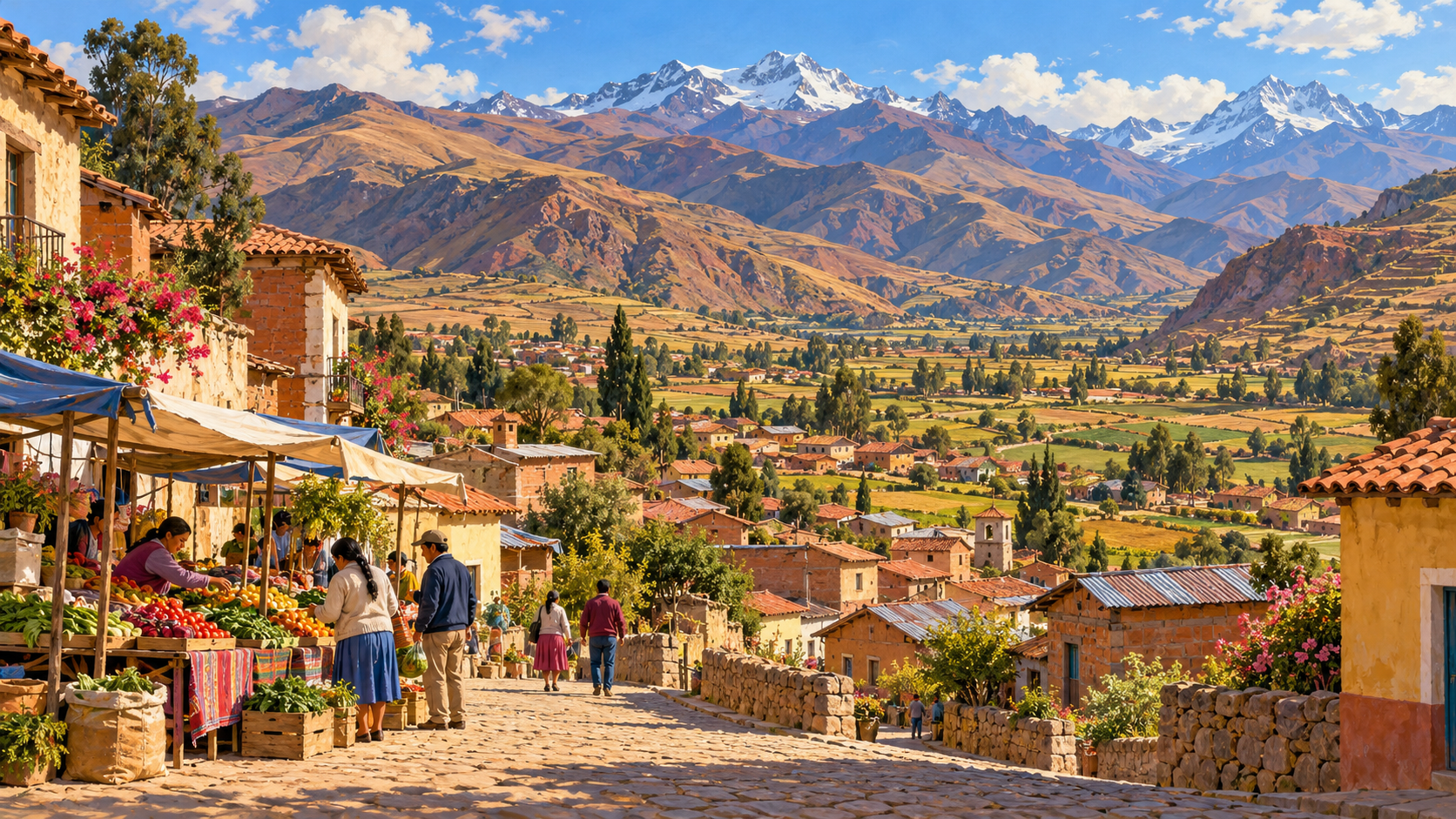
Bolivia becomes more interesting when you look beyond a spectacular photograph and ask what made the scene possible. A salt flat opens a conversation about water and perspective; an archaeological site introduces a much longer history; a woven object reveals knowledge carried through skilled hands. These top 10 things to learn when visiting and touring Bolivia connect geography, culture, history and everyday life in a country learning guide that helps you notice relationships, not simply collect attractions.
For Singapore families exploring educational travel in Bolivia, the most useful starting point is a thoughtful question rather than a crowded itinerary. This Bolivia travel learning guide offers ten substantial lessons, English–Chinese vocabulary and observation ideas for parents and students. Read it before a suitable, professionally arranged visit, or use official resources to explore from home. Bolivia rewards curiosity about how different landscapes, communities and forms of knowledge fit together without becoming one simple national story.
Read before planning: current official Bolivia travel advice reports a state of emergency and advises against all but essential travel to the Chapare region, including specified highway routes. Avoid protests and roadblocks; do not attempt to cross a blockade. Recheck the full advice, entry requirements and local conditions before arrangements. Several lessons below are suitable for remote study. This is not a route plan, an altitude-health guide or a recommendation to enter mines.
Choose your reading route
Read the ten lessons in order, or begin with the part of Bolivia that makes you curious. The short observation tasks are invitations to look closely; they do not require a school worksheet.
Read the landscape · Meet culture and daily life · Connect the bigger story
Full contents · Country learning directory · Travel vocabulary directory
Contents
Read the landscape
Meet culture and daily life
Connect the bigger story
A gentle family learning plan · English–Chinese vocabulary for reading Bolivia · Questions families often ask · Continue the country learning journey
LESSON 1 OF 10
1. Read Bolivia as a country of different elevations and environments
Begin with a map that shows relief rather than only borders. Locate the Andes and the high plateau associated with western Bolivia, then look eastward at the different terrain. Mark La Paz, Sucre, Santa Cruz and the particular places you are studying. A country becomes easier to understand when names occupy a real spatial relationship. It becomes harder when a dramatic mountain photograph quietly stands in for every environment and every community.
The official Bolivia tourism portal provides an introduction to Uyuni and its surrounding landscapes. Use that as one regional example, not a definition of the whole country. A salt-flat account, a city map and a museum collection answer different questions. Put them beside each other and notice what changes: scale, elevation, settlement, vegetation or the kind of historical evidence being presented.
For younger children, draw a conceptual cross-section with high land, lower land and places along the way. Label the sketch as an illustration rather than an accurate surveyed profile. Older students can work with a relief map and its legend. What does the colour represent? Does it show elevation, vegetation or administrative divisions? A map’s appearance can be persuasive even when the reader has misunderstood its key.
Next, connect terrain with an enquiry about movement. A short distance on a flat page does not establish a quick journey across real ground. Ask how a reliable local source describes the relationship between two places. Transport arrangements, road conditions and access require current checks, particularly during disruption. The geographical exercise is about interpreting space, not about designing an independent route through unfamiliar terrain.
Do not let elevation become an explanation for everything. People make choices within institutions, histories and changing economic circumstances. A settlement’s position may prompt a good question about water or connections; it does not tell you how all its residents live. The same caution applies to photographs. A rural image does not prove isolation, and a modern cityscape does not erase older knowledge.
Bring this back to Singapore through representation. Which kinds of distance do you usually notice at home? How would your map-reading habits change if vertical difference became more prominent? The comparison helps a learner recognise a familiar skill in an unfamiliar setting. There is no need to rank one landscape as more interesting or one way of life as more advanced.
Notice and discuss: identify two places and one geographical relationship between them. Explain what the map establishes, what you inferred and what you still need to ask. That three-part answer provides a useful foundation for the next nine lessons.
LESSON 2 OF 10
2. Understand the Salar de Uyuni through water, surfaces and perspective
The Salar de Uyuni is a salt flat, not an ordinary beach or a permanently flooded lake. The official destination account offers a starting point for its landscape and surrounding history. Keep the example specific: conditions vary, and an image taken at one time does not promise the same surface or appearance during another visit. Current access and professional arrangements must be checked separately.
Begin with the photograph itself. Can you see a horizon? Which features help you judge distance? If water covers the surface in the image, compare the reflected scene with the actual objects above it. A child may initially describe the whole picture as sky. Ask what visual clue reveals the boundary between the object and its reflection. This is an approachable way to practise careful seeing.
Then consider forced perspective. Two people at different distances from a camera can appear unexpectedly different in size. The camera records a relationship within the frame; the image does not mean that one person has become enormous. You can demonstrate that principle safely at home with ordinary objects. There is no need to wander away from an approved route or perform a risky pose to make the learning memorable.
Older students can distinguish a physical explanation from a travel promise. An explanation of reflection discusses how light and a surface produce an image. A promise that a visitor will see a perfect mirror on a certain date would require much more information. Write those as separate kinds of claim. This distinction is especially helpful when a destination’s most famous photograph circulates without its season or conditions.
The landscape also invites questions about time. A broad, flat surface can carry a history that is not visible in a single glance. Read the supplied geological interpretation and make a simple sequence from it, clearly attributing the source. Avoid inventing an exact formation date or turning a complicated environmental history into a one-line story merely because that story sounds neat.
Finally, ask what the photograph leaves outside the frame. Who arranged the safe journey? Which communities, workers and facilities support a visitor’s experience? A striking landscape is not an empty stage. A thoughtful account can enjoy its visual beauty while remaining interested in the practical and human relationships around it. That makes the image richer rather than less enjoyable.
Notice and discuss: choose one photograph and describe a visible feature, a physical question and a missing piece of context. If you are studying from home, make a small perspective experiment and explain exactly what changed between the objects and the camera.
UNESCO’s account of Tiwanaku describes a major pre-Hispanic political and spiritual centre near Lake Titicaca. Its surviving monumental stone structures provide evidence of a society with substantial architectural knowledge. This is a useful starting point because it places the site within human history. Calling an unfamiliar achievement mysterious should not become a substitute for learning about the people and work behind it.
Choose one publicly interpreted feature, such as a monumental entrance or a temple complex. Begin by describing what the official photograph or approved viewing area lets you see. Note the arrangement of stones, the relationship between open and enclosed space, or a repeated carved form. Then read the archaeological explanation. Which part of your first description now needs more precise language?
The Gate of the Sun provides an example of why appearance and interpretation must remain distinct. You may describe a carved figure or a pattern you can see. Its identification and historical significance depend on research. Attribute that explanation rather than inventing a story from the image. A visitor’s imagination is valuable for asking questions, but it cannot establish the meaning of an ancient symbol.
A family can make this distinction concrete with three headings: visible evidence, supplied explanation and open question. Under the first, record a feature. Under the second, summarise a short point from the official account in your own words. Under the third, ask what additional evidence would help. This simple structure teaches historical reasoning without requiring a child to master an entire archaeological chronology.
Consider what survives and what does not. A ruin is not a complete preserved city, and a reconstruction drawing is not the same as the surviving material. Look for labels identifying excavation, restoration or interpretation. If a source offers a plan, compare it with a photograph. Each representation reveals something useful, while neither automatically supplies the whole experience of the past.
Respect the site as a protected place. Follow current access, guide and photography rules. Do not climb, touch or move material to make an observation easier. Remote study through official images remains a valid option, especially when altitude or current conditions make a physical visit unsuitable. You can understand a substantial idea without proving your curiosity through unnecessary access.
Notice and discuss: explain one feature using an observation and one attributed archaeological fact. End with a genuine question rather than a dramatic claim. The strongest account helps another reader appreciate the achievement while recognising the limits of a short encounter with it.
Potosí introduces a difficult but important relationship: wealth can be concentrated in a place while the labour producing it carries severe human costs. UNESCO’s City of Potosí account connects Cerro Rico, hydraulic processing, the Royal Mint and the colonial city. It also documents forced labour and unequal living conditions. Read these together rather than separating beautiful buildings from the system that financed them.
Start with a simple production chain: extraction, processing, minting and movement. This is a learning diagram, not an instruction for industrial activity. What changed at each stage? Ore and a coin are not the same object, and money does not appear merely because a valuable material exists underground. Institutions, labour, tools and transport made the transformation possible.
Next, add people to the chain. Who performed the work? Who controlled the material and the resulting wealth? Use the historical source’s language carefully when discussing coercion. Do not describe forced labour as an ordinary voluntary job or soften exploitation into a cheerful story about hard work. Students can understand an uncomfortable distinction when it is explained directly and without sensational detail.
The Casa de la Moneda offers a useful institutional focus through official interpretation and verified visitor information. Rather than treating every coin as a souvenir-like curiosity, ask what a mint does and what authority gives money public meaning. A coin can connect material, design, measurement and power. An authorised image can support the same enquiry if a physical visit is not suitable.
Architecture adds another layer. A richly decorated building and a worker’s neighbourhood may belong to the same economy but represent very different experiences of it. Compare documented examples rather than assuming every surviving façade tells the same story. Ask what kind of evidence would help you understand distribution: working conditions, housing, records of payments or the organisation of the city.
Keep the contemporary boundary clear. This chapter does not recommend entering an active mine. UNESCO’s account raises serious concerns about the mountain’s stability and preservation. A cultural learning objective does not require an underground excursion. Public museum interpretation, documented historical material and a qualified explanation can support a much more appropriate family enquiry.
Bring the lesson to an everyday object at home. A phone, piece of jewellery or building component also has a production chain that may be hard to see from its finished appearance. You are not claiming that its history is identical to Potosí’s. You are practising the habit of asking how value, labour and responsibility connect behind an attractive or useful object.
Notice and discuss: explain one connection between silver and an institution, then add one question about the people who produced the wealth. An account that includes both can admire technical achievement without losing sight of human experience.
The UNESCO account of the Historic City of Sucre explains its architectural blending and the significance of the Casa de la Libertad in Bolivia’s independence history. This makes Sucre a useful place to ask how a city carries several periods at once. A building can remain physically present while its role, interpretation or surrounding public life changes.
Begin with one documented building rather than a list of architectural labels. Look at an entrance, a courtyard, a window arrangement or the relationship between a street and a façade. Describe the feature in ordinary language first. Then use the historical explanation to understand the relevant tradition or period. A precise description is more useful than confidently assigning an unfamiliar style from appearance alone.
City names provide another route into time. A historical source may refer to a place by a name different from the one on a current map. Make a small timeline showing the names and the context supplied by the source. This is not just a spelling exercise. It helps a student notice that public names can record political change, memory and decisions about what a community commemorates.
The Casa de la Libertad introduces civic memory. Ask what an institution chooses to preserve and how it explains the events associated with its building. Distinguish an original document, a later painting, a replica and an interpretive display when the labels identify them. These objects may all be valuable, but they support different kinds of historical statement.
For younger learners, choose a doorway and a public account of its role. How does the explanation change what the doorway means to you? For older learners, compare an architectural photograph with a short historical passage. Which information comes from the image, and which comes from the text? Their relationship is often more revealing than either item considered alone.
Do not assume a preserved centre is a town frozen in the past. People work, study and use services within cities that also attract visitors. Respect private entrances and active institutions. Current opening arrangements should come from the responsible organisation, not from an old article or an attractive photograph that happens to show an accessible door.
Connect the enquiry with a familiar Singapore building whose use or surrounding setting has changed. Compare the questions, not the entire national histories. What is preserved physically? What is remembered through a label? What continues as everyday activity? This offers a practical way to recognise history as an ongoing relationship between evidence and public interpretation.
Notice and discuss: choose one building, one documented historical role and one detail visible today. Write a short account showing how the two kinds of evidence meet. Include a limit: one feature or part of the history that your brief study cannot explain.
Bolivia’s textiles offer a route into material, technique and the knowledge people pass on. The National Museum of Ethnography and Folklore’s digital catalogue provides a documented object associated with Santa Ana de Chipaya. Begin with the specific provenance supplied by a collection. One textile does not represent every community, and a geographical label does not explain every design or use.
Look closely at a publicly documented example. Notice the relationship between repeated forms, colour and structure. Which features can you describe directly? Which require an explanation from the maker, community or museum? Resist the temptation to invent meanings for a pattern because it resembles something familiar. Visual resemblance can inspire a question; it cannot establish a cultural interpretation.
Then distinguish the finished object from the process. A repeated pattern may look simple when completed, while its production demands planning, attention and correction. Ask a suitable demonstrator which decisions come first and which must be adjusted during work. If no demonstration is available, use an official process description rather than guessing the steps from the surface.
For a younger child, fold paper into a repeated arrangement or make a simple alternating pattern with ordinary craft materials at home. Explain that this is a pattern exercise, not a reproduction of a community’s textile practice. The activity develops attention to sequence. It should lead to greater appreciation for the original work, not the claim that the child has mastered the tradition.
Older learners can ask about transmission. How does a person learn the skill? What can be shown in a written instruction, and what may require supervised practice? Consider the difference between naming a technique and performing it reliably. A maker’s judgement can include details that are difficult to notice until someone knowledgeable points them out.
Shopping introduces responsibility. Ask about the maker and material when that information is available, and recognise that a low price does not explain the time and skill involved. Do not pressure someone into a demonstration or photograph. A fair and respectful exchange can itself teach more about work than collecting several objects without understanding any of them.
Notice and discuss: describe one visible pattern relationship and one documented detail about its object. Add a question about how the skill is learned. Your explanation should keep the maker and the particular community in view rather than turning an attractive textile into anonymous national decoration.
UNESCO’s account of the Carnival of Oruro introduces a celebration connected with Oruro’s ceremonial and mining history. A festival becomes more understandable when you ask about its setting, participants and meaning rather than seeing only an energetic procession. A recording provides an accessible starting point, but it represents a selected moment and should be labelled with its source and occasion.
Choose a short authorised recording or an officially explained scene. Notice how music, movement and clothing relate within it. What changes when several performers act together? Describe sequence, rhythm or spacing before attaching a meaning. The relevant interpretation should come from knowledgeable public sources, not from a visitor’s guess about what an unfamiliar costume must symbolise.
Preparation offers another question. A performance presented in public often depends on rehearsal, material work and coordination that the audience does not see. Ask what the organiser or participating group chooses to explain about that preparation. Avoid presenting an imagined behind-the-scenes account as fact. A good question can remain open when the source does not provide the answer.
Families can give each learner a different focus. One follows movement, another notices sound, and another studies how the recording frames the scene. Share the observations before reading the explanation. This allows several kinds of attention to contribute. It also shows that a festival cannot be fully understood by counting costumes or identifying a single memorable photograph.
Keep participation and spectatorship separate. Being able to watch an event does not imply permission to enter a procession, handle clothing or reproduce sacred actions casually. Follow current organiser guidance about access, behaviour and photography. Dates and crowd arrangements require fresh checks; a cultural heritage listing is not a current event calendar or a guarantee of suitable family conditions.
Remote learning is particularly useful here. A child can watch the same segment twice, pausing to notice a relationship that was missed initially. The second viewing often produces a better question. There is no need to turn the experience into a test of how many names the student remembers. A thoughtful explanation of one scene is already a substantial outcome.
Connect the lesson to any performance you know well at home. What work becomes invisible when the audience sees only the finished presentation? The comparison concerns preparation and interpretation, not an assertion that two celebrations share the same meaning. It makes the skill of attentive watching familiar while keeping Oruro’s particular cultural context intact.
Notice and discuss: explain one relationship between two elements in a documented scene, and add one attributed point about its context. End by naming what a short recording cannot tell you. This leaves the event vivid without making it smaller than it is.
Quinoa is more than a fashionable ingredient on an international menu. Japan International Research Center for Agricultural Sciences research material discusses quinoa cultivation in the demanding environment around the Salar de Uyuni and the research questions it raises. That gives a concrete starting point: an ingredient has a growing environment, a history of cultivation and a chain of work before it reaches a plate.
Begin by separating the plant, the harvested material and the prepared food. A photograph of a field answers a different question from a photograph of a cooked meal. Put the two beside each other. What transformation lies between them? Ask a knowledgeable source about growing, harvesting or preparation, and avoid inventing exact local practices from a generic recipe.
The growing environment invites a careful scientific question. The research source discusses salinity and plant responses. Summarise only a small relevant point, then ask what evidence a scientist would need to compare performance under different conditions. This is a lesson about investigation, not a claim that every crop tolerates every harsh environment or that one ingredient has universal health benefits.
Food preparation offers a family-friendly observational route. If an appropriate meal is available, describe texture, temperature and the role of the ingredient within it. Ask about ingredients and preparation, particularly for allergies or dietary requirements. Do not assume that a familiar food name guarantees a familiar recipe. The safest and clearest information comes from the person responsible for the meal.
Older students can think about the word value. A crop may have agricultural, cultural, commercial and personal value, and those are not identical measures. What question would a farmer ask? What might a cook ask? What would a researcher measure? You do not need to impersonate these people or guess their answers. Use the different roles to organise an informed enquiry.
Bring the chain back to Singapore by choosing an ingredient at home. Find where its label says it comes from, then identify one question the label does not answer. The purpose is not to make dinner complicated. It is to notice how much work and knowledge sit behind an object that has become ordinary through familiarity.
Notice and discuss: connect one ingredient with a documented growing context and one preparation question. Avoid health promises and broad claims about national diets. A clear account of one food chain can make a meal more memorable while keeping farmers, researchers and cooks within the story.
The Mi Teleférico network information introduces an urban cable transport system associated with La Paz and El Alto. Approach it as public infrastructure, not only as a scenic ride. A network has routes, connections and users with everyday purposes. The landscape around it becomes more interesting when you ask how movement is organised within a city.
Start with the operator’s map. Identify one line, two stations and an interchange if the current map marks one. Explain the difference between a line and a journey: reaching a destination may involve several links, while the diagram represents those links in a simplified form. Check current service arrangements directly; a saved map is not proof that a particular station or route is operating now.
Then compare the network diagram with a geographical map. A schematic can make connections easy to follow while deliberately reducing distance and terrain detail. A relief map may show the landscape more faithfully but make the service pattern harder to read. Ask which question each representation is designed to answer. This is an excellent exercise for students accustomed to Singapore’s rail diagrams.
If using a suitable, currently operating service under responsible arrangements, observe public use without photographing passengers intrusively. Notice signage, the organisation of an entrance or the information supplied about directions. Those visible features can reveal design decisions. They cannot tell you every passenger’s purpose or establish how convenient the service is for everyone in the city.
Think about the relationship between tourism and daily life. A visitor might value the view, while another user needs a reliable connection to work or school. These different purposes can coexist within the same vehicle. Write a caption that acknowledges the public role rather than presenting the infrastructure as though it exists only for visitors’ enjoyment.
Older learners can frame a transport evaluation. Which evidence would you need to discuss accessibility, journey time or reliability? A single pleasant ride cannot establish all three. You might need published service information, accessible facilities guidance and data gathered over time. Naming the evidence required is more valuable than making an unsupported judgement after one encounter.
Notice and discuss: explain one connection on the network map and compare it with a geographical representation. Add a question about public use. You now have a way to read transport as a practical relationship between place, design and people’s everyday needs.
The ten lessons have moved between landscape, archaeology, industrial history, architecture, textiles, performance, agriculture and public infrastructure. Their value lies in the connections, not in the suggestion that every region shares an identical experience. Bolivia remains larger than a visitor’s selected examples. A thoughtful final account should show that you learned something specific while keeping that wider reality visible.
Choose three examples that belong to different kinds of knowledge. You might connect a salt-flat photograph, a documented textile and an urban network map. What did each require you to notice? The photograph raised a question about perspective; the textile introduced skilled work; the map revealed connections. These are related habits of attention, even though the objects have different contexts and histories.
Next, choose a connection you can actually support. Potosí and Sucre can introduce a question about wealth and institutions when you use their historical accounts carefully. Quinoa research and the Uyuni landscape can introduce a question about growing conditions. A link should explain a relationship, not merely place two famous names in the same sentence.
Keep difficult history within the final reflection. Technical achievement, coercion and unequal access to wealth can appear together in a responsible account. You do not need to choose between admiration and ethical attention. The stronger response asks who benefited, who worked and what evidence explains the difference, without claiming to settle a long history in a travel paragraph.
For a younger learner, create three illustrated cards: something I noticed, something a reliable source explained, and something I still want to understand. An older student can write a short comparison with an attributed fact and a clear limit. Neither task requires an encyclopaedic conclusion. The point is to produce an account another person could follow and trust.
Finally, recognise that travel conditions and cultural understanding are separate responsibilities. Interesting learning material does not establish safe access. Recheck official advice, professional arrangements and personal suitability independently. Where travel is unsuitable, public sources remain worthwhile. Reading carefully from home is not a lesser form of curiosity; it can make the next question more informed.
Notice and discuss: finish the sentence, “My first image of Bolivia changed when…” Support it with two specific examples. Let the conclusion remain open enough for another region, community or source to add something you have not yet encountered.
A gentle family learning plan
Before beginning, let each family member choose one lesson rather than assigning everyone the whole guide. A map-reader might start with elevation, a visually curious child with Uyuni, and a student interested in design with the transport network. Shared reading works better when people have a reason to contribute. The chapter navigation lets you return to the wider sequence afterwards.
During a suitable encounter, keep the task small: one object, one photograph, one public explanation or one map relationship. Avoid turning every meal or walk into a classroom exercise. A good observation can take a few minutes and continue as conversation later. Where current conditions make physical travel unsuitable, use the same approach with an official image or recording.
Afterwards, ask for a changed idea rather than a list of facts. What did the explanation make you notice? What question became clearer? Encourage the child to say when something remains uncertain. Parents can model this by distinguishing their own observation from the source’s historical account. Curiosity becomes more confident when uncertainty is treated as a useful starting point rather than a failure.
Choose one follow-up, such as tracing a crop’s journey or comparing two map types. Keep it proportionate to the original interest. The best outcome is a learner who wants to understand the next detail, not a family that has produced the largest possible notebook.
English–Chinese vocabulary for reading Bolivia
| English | 中文 | Use it in your learning |
|---|---|---|
| elevation | 海拔高度 | Distinguish height from distance on a map. |
| plateau | 高原 | Identify a broad elevated landform. |
| salt flat | 盐沼 | Describe Uyuni without calling it a beach. |
| reflection | 倒影 | Explain what appears on a water-covered surface. |
| perspective | 透视;视角 | Discuss camera position and apparent size. |
| archaeology | 考古学 | Connect Tiwanaku’s material evidence with research. |
| mint | 铸币厂 | Explain an institution that produces coins. |
| forced labour | 强迫劳动 | Name coercion clearly in historical discussion. |
| provenance | 来源;出处 | Identify the documented origin of an object. |
| craftsmanship | 工艺;手艺 | Recognise knowledge within skilled making. |
| cultivation | 栽培 | Follow an ingredient back to agricultural work. |
| infrastructure | 基础设施 | Read transport as part of public life. |
These are English–Chinese learning equivalents, not translations into Bolivia’s languages. Use the words to explain a relationship: “The network diagram shows connections, while the relief map shows elevation.” A complete sentence usually reveals understanding more clearly than a memorised definition on its own.
Questions families often ask
Is this guide an itinerary for visiting Bolivia now?
No. It is a cultural and educational reading route. Current official advice includes regional restrictions and disruption concerns. Suitability, entry requirements, insurance and professionally arranged access need independent checks. Remote study is explicitly included so that a compelling topic does not become pressure to travel or enter an unsuitable setting.
Must children visit every place mentioned?
No. Several examples can be explored through public maps, museum catalogues and recordings. Choose one enquiry that suits the child’s interest and the family’s circumstances. Seeing fewer places with a clearer question can produce a more meaningful account than attempting to cover an entire country.
How should we approach high-altitude destinations?
Treat altitude as a separate health-planning matter. Read official Bolivia health advice and consult a qualified healthcare professional about the actual itinerary and travellers. This article does not provide acclimatisation instructions, medication advice or a guarantee that an activity is suitable.
Can we use these lessons for English writing?
Yes. Ask the learner to write a short description, an attributed explanation and an open question. This structure supports precise vocabulary and clear reasoning. Correct the relationship between evidence and claim before polishing the adjectives; an accurate plain sentence is more useful than an impressive sentence built on a guess.
Continue the country learning journey
Return to the country learning directory. The preceding alphabetical guide is Bhutan, and the next is Bosnia and Herzegovina.
For another reading route, explore the travel vocabulary directory and the World Travel and Luxury Hub. The Shanghai Bund learning feature offers a different urban setting for connecting architecture, material culture and public life. Keep the same thoughtful habit: notice a detail, find its context and explain the relationship clearly.