
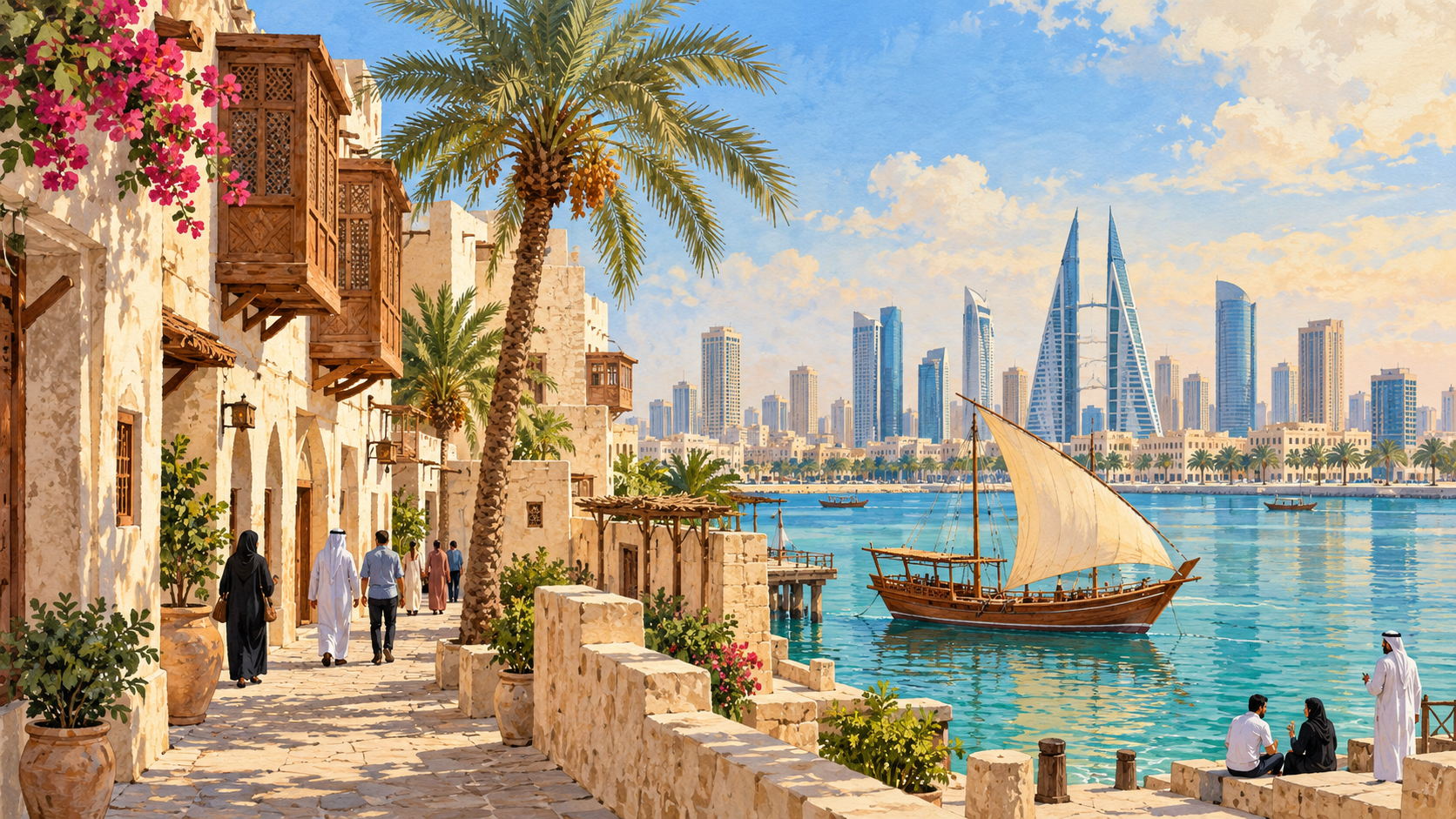
Bahrain is a place where a small island setting opens into a much larger story. The best things to do when visiting and touring Bahrain include its national museum, Bahrain Fort, Muharraq’s pearling heritage, Manama’s souq and experiences that connect archaeology with contemporary life. A thoughtful Bahrain travel itinerary makes time for explanation as well as sightseeing.
For a first Bahrain holiday, a family visit or a reader exploring the Gulf from home, begin with the country’s relationship with the sea. Trade, pearl diving, craft and everyday exchange give the landmarks a human thread. This guide introduces ten experiences and helps you choose a manageable route, with current travel conditions kept firmly in view.
Check current regional advice before booking. As checked on 8 October 2026, UK FCDO no longer advises against all but essential travel to Bahrain, but its current page describes regional tensions, the possibility of further attacks and disruption to flights or airspace. Read the full advice, your own government’s guidance and local updates before deciding on a journey. This article describes experience choices; it does not establish that conditions are suitable for your dates.
eduKateSG · A WORLD WORTH UNDERSTANDING
Find your way through Bahrain
Choose the part you need now, or follow the whole journey at your own pace.
A museum-led introduction is a useful beginning. It gives context for the fort, burial mounds and pearling heritage, while a souq visit and a meal connect the larger history with ordinary life. Select the experiences that interest you and leave space for transport, heat and rest.
| Experience | Choose it for | Planning decision |
|---|---|---|
| Bahrain National Museum | An introduction to history and everyday culture | Choose a few galleries to study carefully |
| Qal’at al-Bahrain | Archaeology and layers of settlement | Pair the site with interpretation |
| Muharraq’s pearling heritage | The relationship between sea and town | Confirm the accessible buildings and route |
| Manama Souq | Trade, craft and street detail | Plan a manageable daytime visit |
| Al-Fateh Grand Mosque | Architecture and cultural learning | Check current visitor times and dress guidance |
| Beit Al Quran | Manuscripts and calligraphy | Confirm museum access directly |
| Dilmun Burial Mounds | Archaeological evidence | Use designated visitor areas |
| Bahrain International Circuit | Contemporary sport and engineering | Check the actual tour or event programme |
| The Tree of Life | A desert landscape pause | Arrange reliable transport and local guidance |
| A Bahraini meal | Food and conversation | Ask about ingredients and local specialities |
These are choices for a trip, not a compulsory checklist. A short stay can focus on cultural experiences around Manama and Muharraq. A southern excursion should be included only when its practical arrangements and current conditions support it.
The national museum is a good place to give the country a timeline and a human scale. Archaeological objects, craft and material connected with everyday life can help you understand what later visits are showing you.
Choose a few galleries rather than trying to absorb every label. One possible focus is how objects reveal trade; another is how tools and household items reflect ordinary routines. Ask what a particular object could establish and what still needs explanation from other evidence.
For children, begin with a concrete task. Find an object made from a familiar material, describe how it might have been used and compare it with something at home. Check the museum’s explanation before turning your first guess into a conclusion.
Allow time to sit, discuss and revisit a detail. A museum afternoon is more useful when it produces one clear connection than when it becomes a long list of rooms completed. Confirm current exhibitions, opening arrangements and accessibility directly before travelling there.
The official Bahrain National Museum introduction gives an overview of its historical and cultural collections. Use the visit to prepare for the archaeological and heritage experiences elsewhere in this guide.
Bahrain Fort is most interesting when you look beyond the outline of the fortification. Qal’at al-Bahrain contains successive layers of settlement, with the visible fort forming part of a much longer archaeological story.
Begin with the site’s interpretation and, where available, an appropriate guided explanation. Ask what belongs to which period, how the site relates to the coast and what the excavated evidence says about trade. The answers give a walk through the remains a clear purpose.
A useful observation exercise is to distinguish what you can see from what the interpretation tells you. A wall is visible; its date and function require evidence. Keeping those kinds of information separate helps both adults and children understand archaeology more accurately.
Follow designated routes and do not climb or handle remains. Consider sun exposure, walking surfaces and the group’s stamina when choosing the visit time. Confirm current access and facilities rather than assuming that an outdoor heritage site has the same arrangements as a museum.
UNESCO’s Qal’at al-Bahrain record explains the site’s importance as an ancient harbour and a centre of Dilmun. It provides cultural context, while current local information should settle the visitor arrangements.
Muharraq’s pearling heritage connects the sea with the buildings and economic life of a town. The interest lies in understanding the network: divers, merchants, households and the work that supported the trade.
Choose a guided or clearly interpreted route that explains those relationships. Ask which buildings are currently accessible and how much of the route the group can comfortably cover. A heritage trail may include outdoor walking and interiors with different access arrangements.
Notice details that suggest use. How does a room organise light and air? What does an entrance say about privacy? How might a building connect domestic life with business? An informed explanation can help you test those observations against the historical record.
Give the experience enough time for the human story. Pearl diving involved labour and risk as well as the value of the finished product. A thoughtful visit considers the people behind the economy instead of treating a pearl as an isolated luxury object.
UNESCO’s Pearling, Testimony of an Island Economy is a useful background source. Confirm the current route with the responsible heritage organisation before turning the record into a walking plan.
A souq visit works well when you choose a manageable area and let the details hold your attention. Bab Al Bahrain provides a familiar point of orientation for exploring the surrounding trading streets, subject to current local guidance.
Pick a theme: textiles, spices, signs, craft or the organisation of shops. You do not have to purchase something at every stop. If a vendor has time, ask one clear question about a product and listen to the answer without turning the encounter into an extended interview.
When shopping, establish what the item is, its price and any relevant documentation. Ask about materials and care, especially for jewellery or products whose value depends on authenticity. A pleasant conversation should sit alongside clear practical decisions.
Seek permission before photographing people or the inside of a shop. Keep doorways and working space clear. If travelling with children, agree on a meeting point and a simple plan for staying together before entering busier streets.
Bahrain Tourism’s short-stay overview includes Manama Souq. Use a daytime visit that fits current conditions, with a meal or seated pause nearby and reliable transport for the return.
A mosque visit can provide a welcoming opportunity to learn about architecture and religious practice when the visitor programme is available. Begin with the mosque’s own guidance and an authorised explanation rather than assuming that all areas are open for sightseeing.
Confirm visitor hours, dress requirements and any changes around prayer or special occasions. A general tourism description cannot settle the arrangements for your particular day. Arrive prepared to follow staff instructions and to adjust the plan if access is unavailable.
During the visit, look at how the building organises space. Where does light enter? How are visitors guided? Which details support the building’s religious purpose? Ask questions respectfully and let the guide decide what is appropriate to explain.
For families, discuss behaviour beforehand. Quiet attention, keeping together and following photography rules make the visit more comfortable for everyone. The goal is understanding a living religious setting, not collecting an unusual interior photograph.
The official short-stay guide introduces Al-Fateh among Bahrain’s cultural experiences. Check the mosque’s current visitor arrangements directly and leave an alternative cultural stop in the plan if needed.
Beit Al Quran offers a different scale of attention. Manuscripts and calligraphy invite you to look at the page: writing, layout, materials and the relationship between text and decoration.
Begin with a few examples and the explanation provided by the institution. Ask how the manuscript was produced, what its provenance is and which details visitors are being invited to notice. You do not need to read the script to appreciate the care involved in making the object.
A useful exercise is to compare two pages. Describe differences in line spacing, shape or decoration, then check the label for the relevant context. Avoid assigning meaning to a design simply because it reminds you of something familiar.
Confirm the museum’s current opening arrangements before organising a day around it. Access to the institution’s different spaces may vary. Follow guidance about photography, display areas and the respectful handling of religious material; exhibits should remain untouched unless an authorised activity says otherwise.
The official Beit Al Quran page introduces its museum and wider functions. Pair the visit with a relaxed discussion afterwards, while the details of the pages are still fresh.
The burial mounds make a striking subject for archaeological learning. Their value comes from the evidence they preserve about an earlier society, not simply from the repeated shapes visible in the landscape.
Read the background before visiting a permitted area or discussing the mounds at the national museum. Ask how archaeologists interpret burial practices and what can be learned from the arrangement, construction and objects associated with the graves.
Keep the language careful. A historical interpretation should be attributed to the relevant research or display. It is better to say that evidence suggests a practice than to invent a complete story about a person whose life is not recorded.
Treat the landscape as a protected archaeological place. Use designated visitor areas and do not walk over, enter or disturb structures. Confirm which site is appropriate for visitors and what interpretation is available. Not every visible mound is an invitation to approach it.
UNESCO’s Dilmun Burial Mounds record provides the current heritage context. It is also useful when reading older tourism material, which may describe an earlier stage in the site’s recognition or management.
The Bahrain International Circuit offers a contemporary chapter around sport, engineering and the organisation of a large venue. Choose a circuit tour or event because it is actually available and interests you, rather than assuming a racing experience operates on any date.
Check the circuit’s own programme. Tours, karting, spectator events and other activities involve different arrangements and eligibility requirements. Confirm what the booking includes, which parts of the venue are accessible and whether the group’s ages and abilities fit the activity.
For a non-driving visitor, the venue can still raise interesting questions. How does an event move spectators? What work happens behind the visible race? How do safety, timing and logistics shape the experience? A suitable tour may help explain those systems.
Prepare for the actual conditions: outdoor exposure, noise, walking and transport can all matter. Ask the provider what to bring and how to reach the correct entrance. Do not rely on a general calendar or a previous year’s event date.
The official circuit website is the place to confirm the current programme. This guide does not promise a Grand Prix date or location; establish the exact event arrangements directly before booking travel around them.
The Tree of Life draws attention because of its setting in the southern desert. A visit can be a quieter landscape experience when it is organised around current conditions, reliable transport and a respectful approach to the tree itself.
Ask a local guide or provider to confirm the appropriate access route. Do not treat a desert landmark as a place for improvised driving or an unsupervised detour. Keep the journey within the confirmed plan and follow current guidance about restricted areas.
Once there, observe the relationship between the tree and its surroundings. Notice scale, shade and the way the landscape changes your sense of distance. A photograph may capture the outline, but a short description can record what the setting helped you understand.
Avoid climbing, damaging the tree or disturbing the ground around it. Carry what you need for exposure and heat, and choose a visit time that suits the group. A short, comfortable stop is preferable to extending an outing beyond everyone’s tolerance.
The official Tree of Life introduction provides location context. Confirm practical arrangements locally and combine the stop with another southern experience only when the route makes sense.
Food brings the larger history back to daily life. Choose a locally focused restaurant or an appropriate food activity and ask which dishes or ingredients the host recommends. Let the conversation begin with the meal rather than with an expectation that one plate must represent the whole country.
Describe allergies and dietary requirements clearly. Ask about ingredients and preparation when the answer matters to you. A translated dish name may not tell you everything you need to know, especially in a set meal or organised experience.
A family can make the meal a simple observation exercise. Describe a texture, identify a flavour and ask how the dish is usually served. Specific language is more useful than declaring every unfamiliar food “amazing”.
Keep the encounter considerate. Staff are working, and a short conversation at a suitable moment will usually be more welcome than a long interview during a busy service. Ask before photographing people, and allow the meal to remain enjoyable.
This is also a good place to connect the day’s visits. What did the museum, souq or pearling route reveal about exchange and everyday life? One thoughtful conversation over food can bring several separate observations into a coherent memory.
A short stay: culture around Manama and Muharraq
A museum visit, selected city experiences and a pearling heritage chapter can make a satisfying short stay. Choose one main cultural visit per day and add smaller stops only when the connections are easy and current conditions support them.
Do not schedule an important visit immediately after arrival without a buffer. Immigration, luggage, transport and rest are part of the journey. A relaxed first meal and an orientation conversation may be enough for the opening day.
A longer stay: add a carefully organised southern chapter
If the trip has more time, investigate the circuit and Tree of Life as separate choices within a confirmed southern route. Check operating arrangements and travel guidance before booking. Leave room for the journey and exposure, not just the time at the attraction.
A driver or guide should be able to explain the exact stops, what is included and how the plan changes if conditions are unsuitable. Avoid a package that promises many attractions without showing how the day will work.
A heritage-reading alternative
You can explore Bahrain from home through museum introductions and UNESCO records. Start with the national museum, read about the fort and pearling economy, then compare the burial mounds’ archaeological evidence. This is a meaningful route when travel is unsuitable or simply outside your plans.
For a wider economic reading thread, eduKateSG’s How Bahrain Got So Rich connects pearls, oil and later industries. Keep the different historical periods distinct as you read.
Keep current advice beside the itinerary
Read the FCDO Bahrain advice, your own government’s guidance and local official updates. Its current regional warning should shape booking flexibility and the decision to travel. Recheck airline information and essential connections close to departure.
A tourism website describes attractions. It does not replace current safety advice or establish that a transport route will remain available. If official conditions change, review the trip before trying to preserve the original schedule.
Confirm entry and transport arrangements
Use official information for your nationality, passport and purpose of visit. Requirements for a direct arrival and a journey through another country may differ. Confirm the complete route instead of assuming that a regional connection is straightforward.
For guided outings, establish pickup, vehicle, entrances, duration and return arrangements. Keep a contact method for the provider and accommodation. If the group separates, agree on meeting points and a plan for delays.
Allow for climate and stamina
Plan outdoor visits using the current forecast and local advice. Carry suitable sun protection and the supplies recommended for your outing. Alternate exposed walking with indoor interpretation and seated pauses when appropriate.
Ask precise accessibility questions: steps, surfaces, distances, toilets and places to sit. An attraction’s general welcome does not describe every part of the visit. Tell the provider what support is required for the actual booking.
Compare complete costs
Accommodation, transfers, meals, admissions, guided visits and appropriate insurance all belong in the budget. Check what a package includes and which activities require separate payment. Compare the experience you will actually receive rather than the headline number of stops.
Respect photography guidance, religious settings and private spaces. A country becomes easier to understand when curiosity is matched by attention to the people who live there.
| English | 中文 | A useful question |
|---|---|---|
| Archaeological layer | 考古层 | Which period does this layer represent? |
| Harbour | 港口 | How did the site connect with sea trade? |
| Pearling heritage | 采珠业遗产 | Which buildings can visitors enter? |
| Manuscript | 手稿 | What does the label explain about this page? |
| Calligraphy | 书法 | May I photograph this display? |
| Burial mound | 古墓丘 | Where is the designated visitor area? |
| Visitor programme | 访客活动安排 | Is a guided visit available today? |
| Circuit tour | 赛车赛道导览 | Which parts of the venue are included? |
| Regional advisory | 地区旅行建议 | Have there been any relevant updates? |
| Included transfer | 已包含的接驳 | Is return transport included? |
These English–Chinese prompts support clear questions. They are not Arabic translations. Practise the complete sentence and check that you understand the practical detail in the answer.
Choose an object or place that reveals a connection. A museum object might suggest trade, a heritage building might connect a household with a business, or a souq product might prompt a question about where it was made.
Write three sentences: what you observed, what the relevant interpretation explained and what you still want to understand. Keep direct observation separate from historical claims. If the guide supplied a fact, record the source while it is fresh.
For families, compare an ancient and a contemporary system. What does a port need to function? What does a large event venue need? The comparison is useful when it identifies concrete tasks without pretending that the two systems are identical.
Continue through the World Travel Vocabulary City Directory and the World City Experiences Directory for more focused language and urban reading.
Can I cover all ten experiences in a stopover?
Choose a smaller number that fits the actual arrival, departure and transfer arrangements. A museum and one well-explained heritage visit can provide a stronger introduction than hurried movement through many sites.
Is the circuit open for every kind of visitor activity?
Activities and events have their own schedules and requirements. Confirm the exact programme directly. Do not assume a tour, karting session or race is available because the venue appears in a country guide.
Can I enter every building on the pearling route?
Check current access with the responsible organisation. A heritage record describes the property; it does not guarantee that every component is open on your chosen day.
Can I use this guide without travelling?
Yes. The museum introductions, UNESCO records and economic reading link provide a useful cultural route from home. That route remains valuable when current conditions do not support a journey.
Sources checked on 8 October 2026 include Bahrain National Museum, Bahrain Tourism’s short-stay guide, Beit Al Quran, the Tree of Life, Bahrain International Circuit, UNESCO records for Qal’at al-Bahrain, pearling heritage and Dilmun Burial Mounds, and current FCDO advice. Recheck practical and official guidance before booking.
Continue to Bangladesh, revisit the Bahamas, or return to the World Country Experiences Directory.