
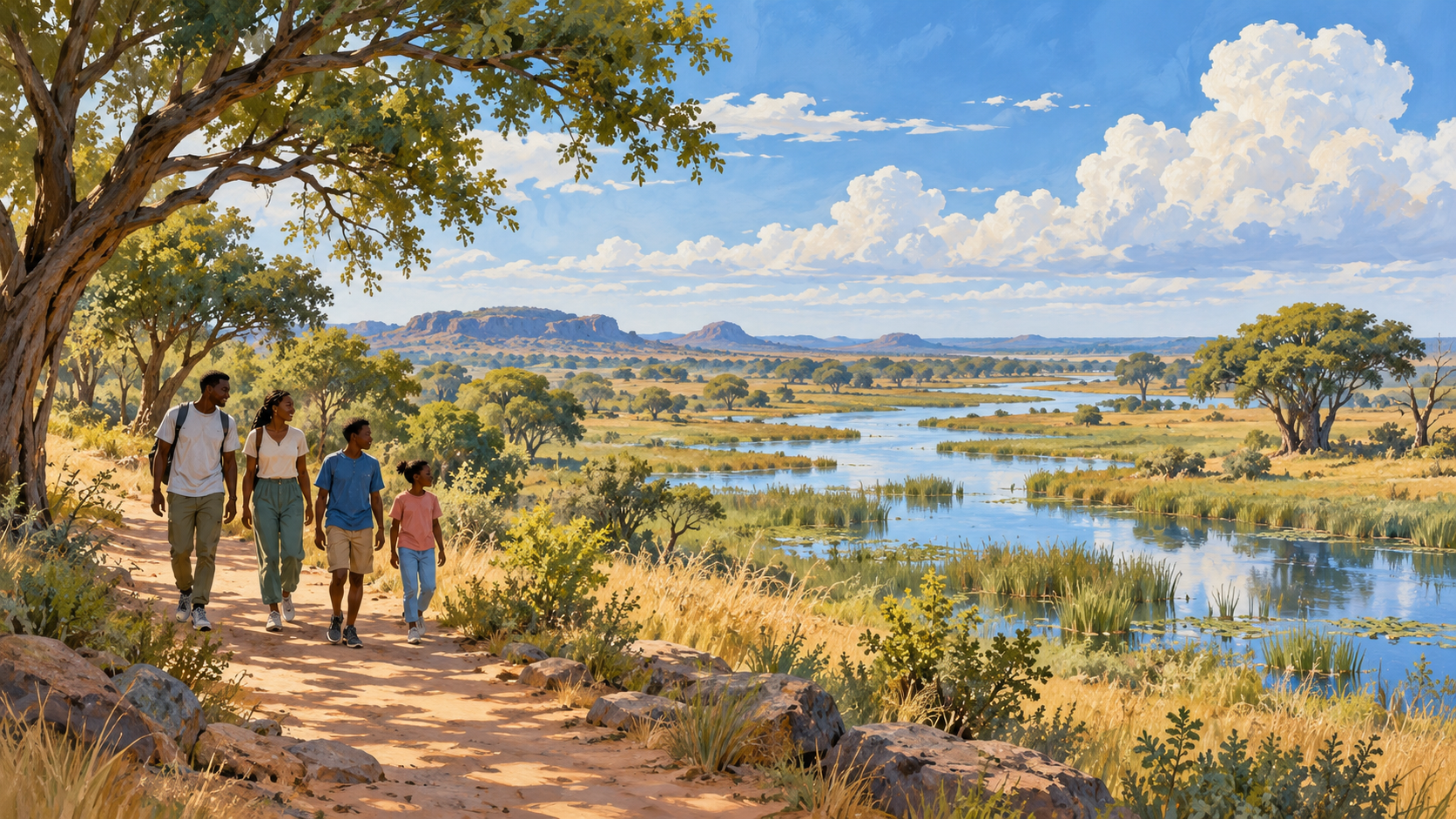
Botswana invites a different kind of travel attention: watching a habitat, listening to a guide and giving a landscape enough time to change in front of you. The best things to do when visiting and touring Botswana include the Okavango Delta, Moremi, Chobe, the Makgadikgadi and Nxai pans, the Central Kalahari, Tsodilo, Gaborone, the Tuli region and locally led craft experiences. A thoughtful Botswana travel itinerary chooses among those chapters rather than treating every reserve as a compulsory stop.
For a first Botswana safari, a family nature holiday or a cultural journey, start with the experience you want. A suitable guided water outing, a vehicle-based wildlife day, a rock-art visit and a maker’s explanation offer different kinds of pleasure. This guide helps you choose ten options, understand their practical demands and build a realistic route around season, budget and the people travelling.
Wildlife and water conditions shape the experience. An animal sighting is never guaranteed, and a camp’s location does not establish that every activity operates throughout the year. Confirm the actual programme with a responsible provider and follow park and guide instructions throughout.
eduKateSG · A WORLD WORTH UNDERSTANDING
Find your way through Botswana
Choose the part you need now, or follow the whole journey at your own pace.
Think in regions and activities. A delta chapter can combine different experiences, while a desert or southern cultural extension needs its own transfers and time.
| Experience | Choose it for | Planning decision |
|---|---|---|
| Okavango Delta | Waterways and habitat | Confirm the actual water-based activity |
| Moremi | Guided wildlife observation | Check the location and access of the camp |
| Chobe | A distinct wildlife and river chapter | Choose the suitable vehicle or boat outing |
| Makgadikgadi pans | Open landscape and seasonal change | Recheck surface and access conditions |
| Nxai Pan | A separate pans experience | Give the visit time rather than a brief detour |
| Central Kalahari | Habitat and remoteness | Arrange full logistical support |
| Tsodilo Hills | Rock art and living cultural context | Use an appropriate local guide |
| Gaborone | Urban life and history | Select a focused visitor programme |
| Tuli region | A southeastern nature chapter | Verify exact reserve and activity arrangements |
| Craft with a maker | Materials and skilled work | Choose an invited, fairly paid visit |
Select experiences that differ in purpose. Two well-chosen camps and a cultural chapter may offer a richer journey than changing accommodation every night to collect reserve names.
The Okavango Delta offers an encounter with water, vegetation and animal life in an inland landscape. Begin with a guide’s explanation of how the habitat works, then choose an activity appropriate to the actual location and conditions.
A mokoro or other guided boat experience can be an option where responsibly operated and suitable. Confirm flotation equipment, boarding, seating, supervision and the level of exposure involved. Do not assume every camp offers the same programme or that a named activity is available on your dates.
Notice smaller relationships: the movement of water, vegetation at an edge, a bird’s use of a perch. A good guide helps you understand those details without needing every moment to produce a large animal photograph.
Keep water observation separate from swimming. Follow all wildlife and safety instructions, remain within the authorised activity and do not reach out to touch animals or plants. If a water outing does not suit your group, ask about a genuinely available alternative before booking the stay. A delta experience should be chosen for what is actually offered.
Moremi Game Reserve provides another way to explore the wider Okavango environment. Choose a responsible guided wildlife programme and establish where the camp or day activity is located, how you reach it and what the booking includes.
Give observation time. Watch behaviour and relationships rather than asking the guide to move immediately whenever a particular animal is absent. A feeding pattern, a track or the use of shade can be more instructive than a hurried list of sightings.
Ask your guide to distinguish a confirmed identification from a possibility. Learning how an observation is made adds depth and prevents a vague glimpse from becoming an overconfident claim in your travel account.
Follow instructions about movement, noise and distance. Stay in the vehicle or designated area when required, and do not create a closer encounter for a photograph. Check the whole experience for your group: vehicle access, drive duration, rest opportunities, camp movement and support. A suitable wildlife day combines patience with practical comfort, leaving you able to enjoy what happens rather than only enduring the schedule.
Chobe can offer a distinct chapter through a suitable vehicle-based or river-based programme. Decide which perspective interests you and ask the provider how the proposed activity operates under current conditions.
For a boat outing, establish boarding, safety equipment, seating and the return arrangement. For a game drive, ask about the actual area, duration and vehicle. A package described simply as a “Chobe safari” may not explain those details.
Let the guide help you read behaviour. Ask why an animal uses a particular part of the landscape, and listen to the answer without expecting every explanation to produce another dramatic encounter. Water, land and wildlife become more comprehensible when connected.
Keep the border journey separate from a domestic activity. Kasane is associated with several regional routes, but visiting another country involves its own current entry, transport and insurance checks. Do not assume an advertised extension is automatically included or suitable. A focused Chobe stay can be satisfying on its own, with time for observation and a relaxed return to your accommodation.
The Makgadikgadi pans offer a striking change from delta waterways. Choose a reputable guided outing that explains the landscape and the current conditions on the exact route you will use.
Begin with scale. Notice the horizon and how few familiar objects there may be for judging distance. Then ask the guide how the landscape changes across conditions and seasons. A pan is not a fixed photographic surface that behaves identically on every visit.
Confirm access shortly before the outing. Wet ground, heat and remoteness can change what is suitable. Do not pressure a driver to enter an unsuitable area because a particular image appeared in a brochure.
Investigate any extra activity separately. A wildlife encounter, overnight arrangement or motorised excursion has its own requirements and impact. Choose responsible providers and leave the environment undisturbed. A quiet, well-interpreted viewing experience may be enough to make this landscape memorable without adding every possible adventure sold alongside it.
Nxai Pan can provide a separate pans chapter where you explore the relationship between open ground, vegetation and wildlife through an appropriate guided visit. Confirm the particular route and current access with the provider.
Give the place a distinct question. How does this setting differ from the other landscape you have already visited? Look at visible changes in cover, surface and the way animals use space, then ask the guide to explain what those differences mean.
Avoid promising a particular wildlife event or sighting to yourself. Seasonal conditions influence opportunities, and the actual year may differ from a general description. Choose the visit for a broader understanding of habitat as well as possible observation.
Check how the excursion fits the route, including travel time, accommodation and support. A quick stop made solely to add another park name may offer little. If your journey already contains several demanding transfers, a longer stay elsewhere could be the better decision. Nxai deserves enough time for its character to become apparent.
The Central Kalahari Game Reserve offers a nature chapter in which remoteness is a central planning consideration. Arrange an appropriate guided programme with clear logistical support rather than treating the destination as an informal driving adventure.
Ask about the full journey: vehicles, fuel, water, accommodation, communications and the response to a breakdown or changed conditions. The difficulty of a remote outing is not measured only by the distance of a walk.
Choose observation over a checklist. A landscape may reveal its interest through vegetation, tracks, light and the guide’s explanation of how life adapts to the environment. A successful visit does not depend on a guaranteed predator encounter.
Follow reserve instructions and respect any community boundaries. Do not turn a living culture into a generic story about the desert. Where a cultural programme is offered, verify who hosts it and what participation has been invited. Give this region its own travel chapter, with enough days and contingency room to make the undertaking suitable for your group.
Tsodilo Hills provide a cultural and rock-art experience that deserves thoughtful interpretation. Arrange an appropriate local guide, confirming the current visitor programme and the particular trail your group will follow.
Ask how the guide distinguishes a visible image, an archaeological interpretation and a living community’s account of the place. Those forms of knowledge can enrich one another without being collapsed into a single simplistic explanation.
Do not touch rock art or leave the authorised route to seek an image. Follow instructions about photography and any culturally sensitive areas. A sacred or significant setting is not simply a collection of objects displayed for unlimited visitor access.
Check heat, walking surfaces, slopes and the availability of rest. Choose the suitable route rather than assuming that every visitor should complete the longest circuit. A clear explanation of one image and its setting can offer more understanding than reaching many panels too quickly to absorb what the guide is saying.
Gaborone offers a chance to include urban life and historical context within a nature-focused journey. Choose a current guided city introduction, museum programme or cultural stop through reliable visitor information.
Give the outing a manageable focus. Ask how a public place, building or institution relates to the city’s development, and look at the way it is used today. A capital is more than the place where a flight arrives.
Keep photography appropriate. Ask before photographing people, and follow the restrictions around government and military installations described in official guidance. An attractive building does not establish that it may be freely recorded.
Leave time for a meal or a locally recommended cultural experience that is actually operating. Confirm transport and the route back to your accommodation. A city chapter can offer a welcome contrast to remote settings, reminding you that a country includes contemporary work and daily life alongside the habitats that attract visitors.
The Tuli region offers a southeastern nature chapter to consider when it fits your journey. Establish the exact reserve, accommodation and activities, because a broad regional name does not describe one uniform visitor programme.
Ask what makes the chosen landscape distinctive and let that question guide the experience. Terrain, vegetation and wildlife relationships can provide a different perspective from the delta or pans without turning the visit into a competition over which reserve produces more sightings.
If a walking activity is proposed, check qualifications, conditions, equipment, supervision and the actual requirements. A guided walk among wildlife is a separate decision from an ordinary nature stroll. Follow the guide’s instructions and choose another activity if the programme does not suit your group.
Confirm the complete transfer, including any border crossing in a wider regional itinerary. Give the visit enough time to justify the journey. Tuli can be a coherent chapter in its own right; it does not need to be added to every northern safari merely because it appears on a national list.
A locally led craft visit can connect materials, skill and livelihoods. Investigate a reputable programme or seller in a town such as Maun or Gaborone, and establish who made the work and whether a demonstration has actually been invited.
Ask about one stage of the process. How is a material prepared, how is a pattern chosen, or what takes the most practice? A specific explanation helps you appreciate the work without requiring the maker to represent every craft tradition in Botswana.
Pay agreed fees fairly and ask before taking photographs. An attractive object or working scene is not permission to record someone. If purchasing, choose a piece whose origin you understand and check materials and relevant export rules.
Avoid protected wildlife products and unclear claims about heritage objects. A good souvenir should be something you can enjoy responsibly and explain accurately. Leave time for the conversation; the visit’s value lies in recognising the person and decisions behind the finished item.
A focused northern journey
Choose an Okavango or Moremi chapter and a suitable Chobe stay, subject to actual transfers and programme availability. Allow several days of observation rather than changing camp whenever another destination name looks appealing.
A landscape-focused extension
Add a carefully planned pans chapter if it provides a distinct experience and fits current conditions. Ask how its transport and support compare with the rest of the route. These are editorial route ideas, not guarantees about air or road operations.
A separate southern or cultural journey
Consider Gaborone, an invited craft programme and a suitable Tuli or other regional nature chapter. Tsodilo and the Central Kalahari require their own location and logistical decisions. Choose one extension well instead of attaching every part of the country to the same short trip.
Book the actual activities
Ask which activities are included, seasonal, optional or unavailable for your dates. Confirm age, ability and mobility requirements with the provider. A camp’s general destination label does not establish that a water outing, walk and vehicle drive are all offered.
Respect wildlife and water rules
Follow park regulations and guide instructions. The official safety guidance warns that wildlife can behave unpredictably and advises against bathing in rivers and lakes. Observe from the authorised activity and do not feed, touch or pursue animals.
Plan complete remote support
Confirm communications, water, fuel and contingency arrangements for remote areas. Recheck roads and weather locally, and arrange appropriate insurance and current health advice for your itinerary. Read official entry requirements for your nationality and any border journey.
Compare costs honestly
Include transfers, accommodation, guide, activities, meals, park charges and any exclusions. Ask about luggage constraints where a small-aircraft transfer is involved and how cancelled travel is handled. A detailed quote is more useful than a headline price without a defined programme.
| English | 中文 | A useful question |
|---|---|---|
| Habitat | 栖息地 | How does this habitat support wildlife? |
| Water level | 水位 | Which activities operate in current conditions? |
| Flotation equipment | 浮力安全设备 | Is suitable equipment available for everyone? |
| Game drive | 野生动物观察车游 | What area and duration does this booking cover? |
| Identification | 辨认 | What evidence confirms this species? |
| Authorised trail | 获准步道 | Which trail is suitable for our group? |
| Rock art | 岩画 | What may visitors approach or photograph? |
| Remote support | 偏远地区支援 | How is a breakdown handled? |
| Maker | 制作者 | Who made this piece? |
| Transfer allowance | 接驳行李限额 | What luggage limit applies to this transfer? |
Use precise questions before booking. They help establish what your group will actually do, rather than what a destination photograph suggests.
Choose one observed behaviour and describe it carefully before adding the guide’s explanation. Record uncertainty where it remains. A clear account of a small observation is more valuable than an impressive species list containing guesses.
Compare two habitats through a visible relationship: water and vegetation, shade and movement, or open ground and distance. Explain how your expectations changed during the visit and which source helped you understand why.
For family reflection, ask which hour everyone would like to repeat. It may be a quiet boat passage or a craft conversation rather than the most dramatic sighting. Continue through the World Travel Vocabulary City Directory and World City Experiences Directory for further reading.
Are wildlife sightings guaranteed?
No. Choose responsible guiding and a habitat you want to understand. Observation remains rewarding without a particular animal appearing.
Does every delta camp offer a mokoro activity?
Do not assume so. Confirm the actual programme, conditions and requirements for your dates before booking.
Can I swim in a river after a boat outing?
Official guidance advises against bathing in rivers and lakes. Follow local instructions and keep swimming separate from wildlife observation.
Is one short trip enough for all ten experiences?
Choose regional chapters. Remote and southern extensions need their own time and logistical support.
Sources checked on 8 October 2026 include the Botswana Tourism Organisation destination directory, its Tsodilo Hills, Makgadikgadi and Nxai pans, Gaborone, Maun and birdwatching introductions, UNESCO’s Okavango Delta record and FCDO safety guidance. Recheck current access, seasonal programmes and individual provider arrangements before travel.
Continue to Brazil, revisit Bosnia and Herzegovina, or return to the World Country Experiences Directory.