
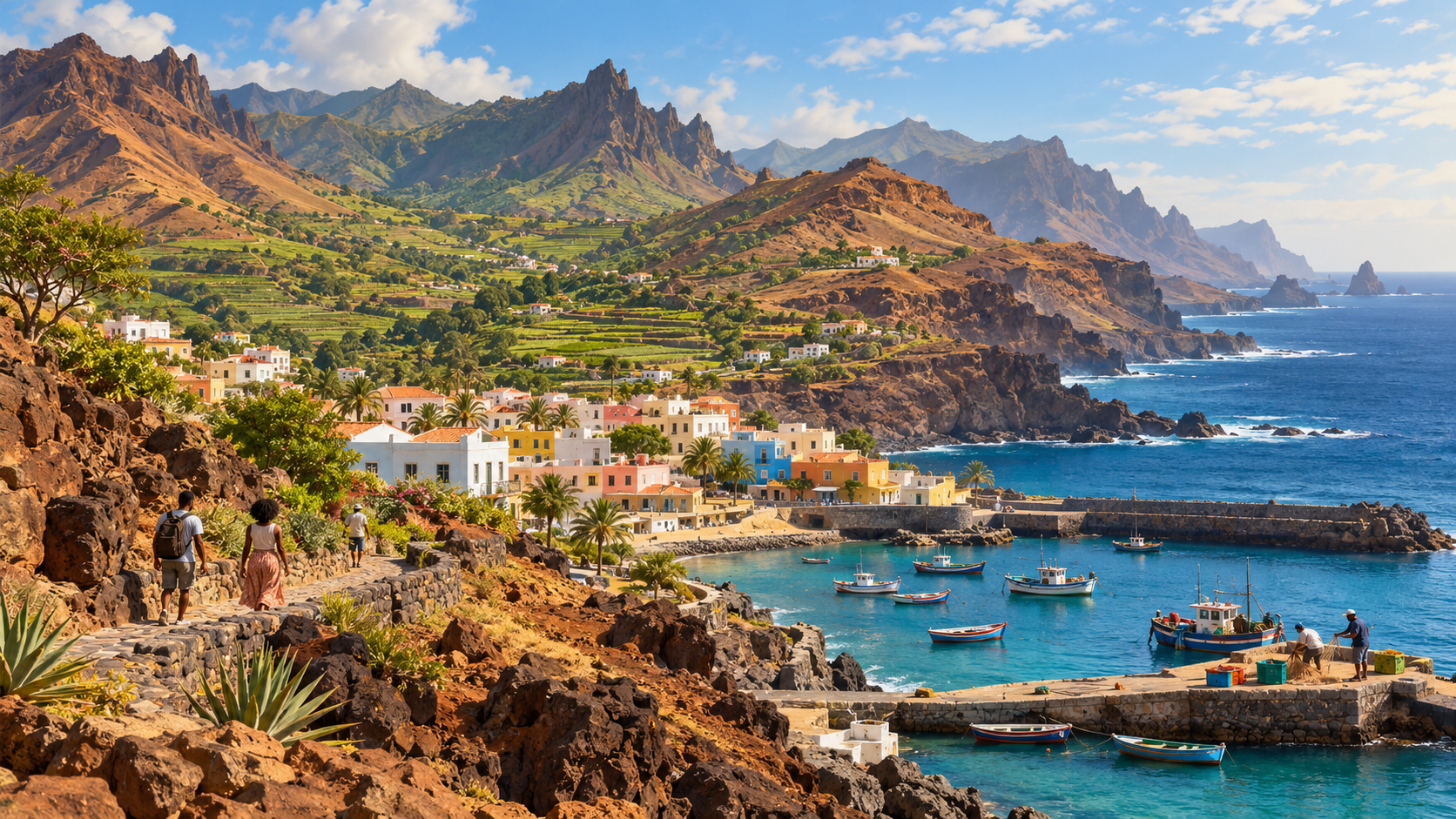
Cabo Verde is not one island holiday repeated ten times. The best things to do when visiting and touring Cabo Verde connect Santiago’s historic places, São Vicente’s music, Santo Antão’s valleys, Sal’s shore and Fogo’s volcanic landscape. Each island gives the journey a different rhythm, and choosing the right combination matters more than trying to collect every name on the map.
This Cabo Verde travel guide brings together ten cultural and outdoor experiences, with first-visit route ideas, family observation prompts and practical island-hopping checks. Also known in English as Cape Verde, the country rewards a stay that leaves room for weather, meals and ordinary conversation. Begin with the experience you want most, then choose the island and connections that can realistically support it.
Before booking: confirm entry requirements, the complete inter-island journey and current sea and walking conditions. A beach photograph is not evidence of safe swimming, and a volcano excursion needs more than enthusiasm. The route suggestions below are planning ideas, not promises of uninterrupted transport.
eduKateSG · A WORLD WORTH UNDERSTANDING
Find your way through Cabo Verde
Choose the part you need now, or follow the whole journey at your own pace.
Choose a main island before adding a second. City and heritage interests point towards Santiago; music and a possible walking extension suggest São Vicente and Santo Antão. Sal or Boa Vista can suit a beach-centred stay, while Fogo needs its own logistical planning.
| Experience | Where to begin | The useful check |
|---|---|---|
| Praia | Santiago | Suitable city route and transport |
| Cidade Velha | Santiago | Heritage interpretation and access |
| Mindelo | São Vicente | Current cultural programme |
| Morna | A credited performance or recording | Performer context and permission |
| Valley walking | Santo Antão | Gradient, footing and return |
| Santa Maria shore | Sal | Lifeguards, flags and sea conditions |
| Salt landscape | Pedra de Lume, Sal | Present access and visitor rules |
| Coast and dunes | Boa Vista | Responsible operator and conditions |
| Volcanic landscape | Fogo | Current guidance and suitability |
| A local meal | Your chosen base | Ingredients and preparation |
You do not need all ten. A comfortable single-island visit is a complete holiday, not an unfinished version of a more ambitious route.
Praia, on Santiago, gives a useful introduction to the country beyond resort imagery. Use the official Santiago guide to orient yourself, then choose a manageable city visit with reliable transport and local advice.
Look at the relationship between streets, public space and the coast. What feels designed for daily errands, and what is aimed at visitors? A city becomes more interesting when you notice both rather than searching only for a “perfect” view.
Ask before photographing traders or entering a working space. Keep belongings secure and avoid turning a market conversation into an unsolicited interview. Your curiosity should not interrupt someone’s livelihood.
A useful family activity is to describe one ordinary scene accurately: movement, colour, sound and purpose. Leave unsupported historical explanations out of the paragraph. The capital is a place where people live, not merely the arrival point for another island.
UNESCO’s Cidade Velha account explains the historic centre of Ribeira Grande on Santiago. Surviving streets, religious buildings, a fortress and the pillory give visible starting points for interpretation, but their beauty should not obscure the history of colonial domination and the trafficking of enslaved people.
Arrange a visit that includes explanation rather than only transport and photo stops. Ask what the evidence establishes about the place and whose experiences are represented. “Historic” is too vague a word when a site carries such difficult human consequences.
Keep behaviour respectful around memorial and religious spaces. For younger children, prepare an age-appropriate explanation of unfairness, coercion and remembrance without graphic detail.
Allow a pause afterwards. You can appreciate architecture while acknowledging the systems of exploitation connected with it. The point is neither to romanticise the past nor to reduce the present-day community to that past.
Mindelo, on São Vicente, offers a city-focused route through the archipelago. The official São Vicente guide introduces its cultural life and association with music. Choose a walk, a cultural stop and a meal rather than trying to fill every hour.
Notice the waterfront and the way public spaces are used. Compare an architectural detail with something happening around it today. A city is more than its façades, and an old building does not explain every modern routine.
Check performance and exhibition dates directly. A festival mentioned in a tourism guide may not coincide with your stay; a venue may operate differently from an older listing.
If you plan to continue to Santo Antão, keep the connection separate from the pleasure of being in Mindelo. Confirm the service and return arrangements rather than treating a ferry as an automatic extension of a city walk.
UNESCO’s morna entry recognises a musical practice deeply connected with Cabo Verdean social life. A listening experience can add emotional depth to your visit, particularly when you know who is performing and what they choose to explain.
At a suitable public performance, listen before reaching for your phone. Ask about recording permission and do not assume a paid ticket transfers rights to the music. Credit performers when sharing material that you are allowed to share.
You need not understand every lyric to notice phrasing, instruments and the relationship between singer and audience. Where a translation or explanation is available, use it rather than inventing a meaning from the mood alone.
Readers at home can watch the credited UNESCO video. Write one sound observation and one question. That is a more useful introduction than treating unfamiliar music as anonymous holiday background.
The Santo Antão guide introduces valleys and walking landscapes, including the Paúl area. The attraction is the combination of terrain, settlement and cultivated land, not simply the chance to announce that you completed a famous trail.
Ask a reputable guide about ascent, descent, exposed sections, shade, footing and pickup arrangements. A walk described as short may still have steep steps or difficult ground. Match the route to the least comfortable member of your group.
Carry appropriate water and equipment and check conditions locally. Do not enter fields or private paths without permission. Agricultural work is not arranged for a visitor’s convenience.
Pause to see how the landscape is used. Which areas are cultivated, built on or left open? Keep the return journey realistic and allow for weather. A gentler walk with time to notice the surroundings can be more rewarding than a demanding route completed in exhaustion.
Santa Maria is a natural starting point for a Sal stay. The official Sal guide introduces the island’s beach and leisure attractions, but sea safety belongs to current local guidance rather than a destination slogan.
Choose a shore outing that suits the conditions. The checked FCDO advice stresses strong currents and unpredictable waves and recommends entering the water only where a lifeguard is on duty. Follow flags and instructions; watching someone else swim does not establish that you can safely do the same.
You can enjoy the coast without swimming. A walk in a suitable public area, a meal and time to watch the changing light can make a satisfying day.
For children, separate “beautiful” from “safe”. Ask them to identify the actual evidence that informs a decision: a flag, a lifeguard’s instruction or a closure sign. That habit is useful far beyond the beach.
Pedra de Lume’s salt landscape provides a different Sal experience from the shore. It appears in the island’s official visitor material and offers a concrete way to connect a place name with a resource and a landscape.
Confirm the current programme, access rules and surfaces involved. Do not assume a photograph of visitors in water proves that bathing is suitable for every person or available on your date. Ask the responsible provider about restrictions and facilities.
Look at boundaries, colour and the way the site is organised. What is visible about the relationship between natural setting and human use? Follow up with an explanation rather than treating your first impression as a technical account of salt production.
Avoid unsupported health claims. A leisure experience is not a medical treatment, and this guide makes no promise about therapeutic benefits. Choose it for curiosity and landscape, with practical suitability checked beforehand.
The official Boa Vista guide offers coast and dune landscapes as a different island choice. Start with an authorised, well-explained programme rather than assuming that a remote beach is a place you can safely explore alone.
Ask about transport, environmental rules and the actual activity. A scenic drive, a walk and a motorised adventure have different demands and insurance implications. Choose the one that fits your interests rather than accepting a bundle you do not want.
Where wildlife viewing is offered, verify the season, permissions and responsible practices. Never expect a guaranteed encounter or agree to handling, chasing or disturbing animals. A photograph is not worth disrupting breeding or nesting.
Respect closed areas and fragile ground. The quieter a landscape appears, the easier it can be to overlook the pressures visitors create. Bring away litter and leave the setting as you found it.
Fogo adds a dramatic geological chapter to the country. The official Fogo guide is useful background, but an active volcano should never be described as universally risk-free because a promotional page uses reassuring language.
Check current local guidance and travel-provider advice before committing. Decide whether you want a landscape visit or a strenuous guided ascent; these are not the same programme. Ask about altitude, loose ground, effort, weather and emergency arrangements.
The landscape also raises questions about how people live with change. A sensitive guide may help explain adaptation without turning somebody’s loss into entertainment. Ask before photographing homes or personal property.
Build flexibility into the island connections. If conditions change, a cancellation is a sensible outcome, not a challenge to find a more adventurous route. No summit, transfer or sea journey is guaranteed by this article.
A meal gives a journey a human scale. Rather than demanding the one “most authentic” dish, ask what is prepared locally and what the kitchen can explain. The islands differ, and an individual plate should not be made to represent everyone in the country.
Try describing texture, seasoning and how the meal is served. If you hear the name of an unfamiliar ingredient, write it down and check the explanation. This creates a more memorable travel note than a repeated claim that everything is delicious.
Explain allergies and dietary requirements clearly. Ingredients, stock and shared preparation surfaces can matter even when a dish looks suitable. Accept uncertainty when a kitchen cannot confidently answer.
Leave time to enjoy the conversation. A good meal does not need to follow an exhausting excursion, and it should not be used as the only buffer between an unreliable connection and an onward flight.
A heritage-first Santiago stay
Choose Praia and a well-explained Cidade Velha visit, with a lighter day between demanding activities. You can add an island landscape outing after checking the exact programme. This is a complete route without a second island.
Music and walking
Combine a São Vicente stay with Santo Antão only when current connections and return arrangements support it. Keep Mindelo’s cultural programme and the walk as separate experiences, and allow a buffer before any international departure.
Beach-centred or volcanic
Choose Sal or Boa Vista for a shore-centred stay, or plan Fogo as a dedicated extension. Do not treat all three as quick stops in the same short holiday. These are editorial groupings, not confirmed timetables.
Check official requirements for your passport and read the current Cape Verde travel advice alongside your own foreign ministry’s guidance. The different country name in that URL refers to Cabo Verde, not a separate destination.
The safety guidance discusses crime precautions, strong sea currents, disrupted sea travel and weather hazards. Follow local instructions, use authorised transport and keep valuables secure. Check every connection directly and leave room for delays.
Ask insurers about the actual activity, including any specialist outdoor or motorised excursion. Obtain qualified travel-health advice where appropriate and understand emergency support. A tourism listing does not certify a guide, vehicle or boat.
Keep claims about opening hours, fares and medical benefits out of your assumptions. Written confirmation of the current programme is more useful than an old price copied into an itinerary. If the practical details do not work, simplify the route.
| English | Chinese | A useful question |
|---|---|---|
| Inter-island connection | 岛际交通衔接 | Is the return service confirmed? |
| Heritage interpretation | 文化遗产解说 | Does the visit include an explanation? |
| Sea conditions | 海况 | What is the current local advice? |
| Lifeguard | 救生员 | Is a lifeguard on duty here? |
| Trail gradient | 步道坡度 | How steep is the descent? |
| Volcanic activity | 火山活动 | What guidance applies today? |
| Recording permission | 录制许可 | May I record the performance? |
| Dietary requirement | 饮食要求 | Can you confirm the ingredients? |
These are learning meanings, not local-language translations. Confirm that you and the provider understand each other before relying on an answer.
Choose one contrast: cultivated valley and arid shore, historical monument and living music, or natural resource and finished product. Write what you saw, then add what a reliable source explained.
For a family, let each person choose one detail and one question. Keep the distinction between personal observation and historical evidence clear, especially at Cidade Velha. A brief, thoughtful note can carry more meaning than a crowded photo album.
Extend the language work through the World Travel Vocabulary Directory if you wish. Learning should enrich the visit, not make every meal feel like a lesson.
Must I visit several islands?
No. A well-chosen single-island stay can be rewarding. Add connections only when they support the experience and available days.
Does a calm-looking beach mean safe swimming?
No. Follow current lifeguard instructions, flags and local warnings.
Is every Santo Antão walk an easy family outing?
No. Check the actual gradient, footing, exposure and return arrangements.
Does this guide promise a Fogo ascent?
No. Conditions, guiding and individual suitability determine whether an excursion is appropriate.
Background comes from Visit Cabo Verde, its linked individual island guides, UNESCO’s Cidade Velha account and the linked morna material. Travel guidance was checked on 8 October 2026 and may change. Current transport, access and activity arrangements require direct confirmation.
Return to the World Country Directory or the City Experiences Directory. Continue alphabetically to Cambodia.