
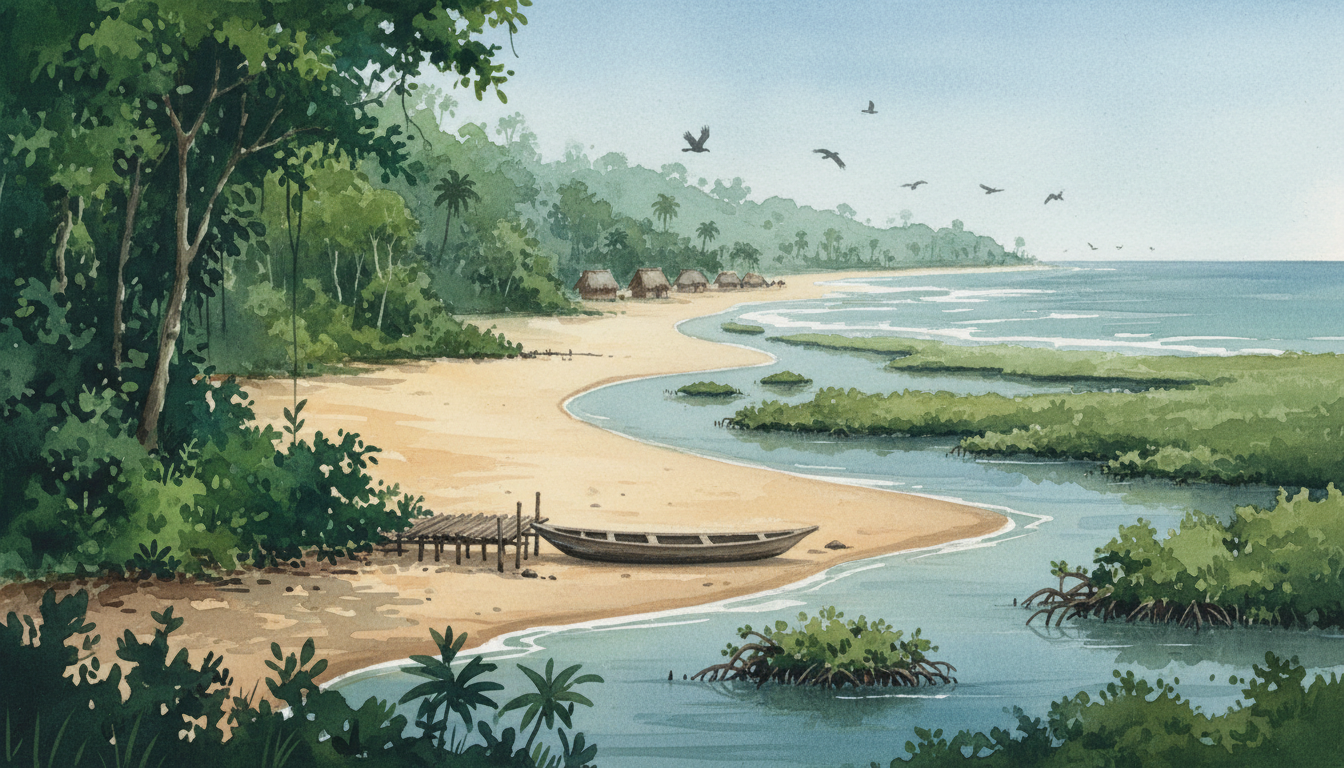
Gabon is an extraordinary country of Atlantic coast, Congo Basin rainforest and wildlife conservation. The best things to do when visiting and touring Gabon include a thoughtful introduction to Libreville, tidal mangrove learning at Akanda, coastal turtle protection at Pongara, and the remote UNESCO landscapes of Lopé-Okanda and Ivindo. Loango, Lambaréné, Port-Gentil, Moukalaba-Doudou and Mayumba offer further chapters, though none should be mistaken for effortless day trips. Gabon rewards travellers who choose one region carefully and ask what makes its nature and culture valuable.
This Gabon travel guide explains ten important experiences and subjects for those researching Gabon tourist attractions, Libreville itinerary ideas, Lopé UNESCO heritage, Ivindo’s waterfalls, Loango forest elephants and responsible gorilla observation. It also sets out visa and health checks, real travel distances and the difference between a protected place and one presently accessible through a qualified operator. A spectacular wildlife image does not guarantee a sighting, and a useful journey begins with respect for local people and park management.
Important travel context, 9 October 2026: The UK FCDO says British passport holders need visas arranged before travel, six months’ passport validity and yellow-fever vaccination certification. It cautions about robbery, isolated beaches after dark, shared taxis, difficult rainy-season roads, and photography of government or military facilities. Confirm nationality-specific entry and health requirements directly before booking.
eduKateSG · A WORLD WORTH UNDERSTANDING
Explore Gabon thoughtfully
Choose a safe cultural, river or protected-forest chapter rather than an exhausting checklist.
Gabon at a glance
Gabon is a Central African country that straddles the equator. Libreville is its Atlantic capital, Port-Gentil is an important maritime and commercial city, and the Ogooué River connects a remarkable series of inland communities and forest environments. Coastal mangrove, lagoon and beach habitat differs significantly from the tropical rainforest, and some protected landscapes include natural savanna.
UNESCO lists exactly two Gabonese World Heritage properties: Lopé-Okanda, inscribed in 2007 as a mixed cultural-natural site, and Ivindo National Park, inscribed in 2021 as natural heritage. Their importance lies in different forms of evidence. Lopé contains both forest–savanna ecology and a long human archaeological record; Ivindo protects nearly intact rainforest, blackwater river systems and waterfalls.
A short visit based in Libreville might include local art and a single managed mangrove or coastal nature experience. A specialist trip to Loango or Lopé needs its own travel days, while Ivindo and Moukalaba-Doudou require very different remote plans. A protected area’s appearance on a map does not guarantee a visitor service, accommodation or safe road access.
Safety and conservation before sightseeing
Current British government advice does not ban leisure travel across Gabon, but it records incidents of robbery, assault and carjacking. Avoid isolated beaches after dark, secure valuable belongings and choose licensed exclusive transport rather than taxis that collect strangers along the route. Political rallies and enhanced identity checks may occur unexpectedly; follow official local instructions and carry required documentation.
Photography of airports, government and military buildings is prohibited. For cultural visits, ask people before taking images of their homes, markets or ceremonies. An attractive viewpoint can overlook sensitive facilities, so a qualified guide’s advice is more important than trying to reproduce an online photograph.
Inland roads may become very difficult in the rainy periods around October to mid-December and mid-February to May. Avoid unfamiliar night drives and assume that remote travel, boat crossings and emergency medical support need advance confirmation. Malaria precautions, the mandatory yellow-fever entry certificate for British travellers, wildlife-distance rules and protected-area permits are separate, essential decisions.
1. Discover Libreville through living culture and the Atlantic waterfront
Begin with an introduction to the capital that makes room for its people. A public waterfront, reputable cultural institution, market or local food experience can reveal how trade and urban life shape Libreville. Do not mistake the city for a mere transit stop before a safari. Its location beside the Atlantic and nearby estuaries helps explain the country’s relationship with both coast and forest.
A locally guided museum or art visit is more useful when you ask about the maker of an object and the community or era it represents. Carving, craft, design and contemporary art should not be compressed into a single anonymous tradition. Learn how modern residents use the city; a good meal and one genuine conversation may be worth more than another hurried photo.
Choose one walk or institution with confirmed access, use trusted transport and remain alert near busy roads or quiet beaches. Even a seemingly attractive public building may be close to a government or military site where photography is prohibited. Prioritise a comfortable, well-informed city day over an ambitious route through unfamiliar neighbourhoods.
Make it worthwhile: Choose one verified cultural venue and a safe, locally informed public walk.
Check before going: Check venue opening, exclusive licensed transport, crime advice and legal photography boundaries.
2. Observe tidal habitats in Akanda National Park
Akanda’s mangroves and intertidal wetlands are important habitats near the capital. Their exposed roots, mudflats and tidal channels help stabilise shorelines and support fish, birds and other coastal life. A quiet mangrove boat ride can be an excellent science lesson because the scenery changes with the water level and the creatures are often easier to hear than to see.
A professional naturalist can interpret nesting, feeding and seasonal patterns without disturbing them. Birdwatching rewards patience, while a protected wetland’s mud and vegetation are not open for arbitrary walking or exploration. Ask why mangrove protection matters to fishing communities and how coastal development affects the ecosystem.
Access depends on park arrangements, safe transport, tides and weather. A natural area being near a city does not mean it operates as a permanently staffed public attraction. Use a credible, authorised guide and decline unsafe or environmentally damaging excursions.
Make it worthwhile: Learn about estuarine life through a properly permitted nature programme.
Check before going: Check tides, operator safety, park rules and weather rather than assuming a boat is available.
3. Learn why Pongara’s beaches matter to sea turtles
Pongara’s coast and estuary are important for marine wildlife, including turtle nesting habitat. It is easy to imagine that an empty beach is available for a sunset expedition. In reality, some areas need to remain quiet and dark so nesting animals can move naturally and their hatchlings have the best chance of survival.
A legitimate conservation-led experience should explain why lights, flash photography, vehicles, loud behaviour and handling animals can cause harm. The animals are not performing for visitors; no nest or sighting can be promised on a particular date. Understanding turtle biology may be more valuable than attempting to obtain a close photograph.
Getting to a beach may involve waterways and a specialist return journey. The FCDO warns about isolated coastal places after dark and maritime security in the Gulf of Guinea. The safer choice may be a daytime, educational visit or no physical access if a protected site is closed.
Make it worthwhile: Join a properly authorised coastal-ecology experience only when conservation rules allow.
Check before going: Verify access, season, transport safety, dark-beach rules and guided permissions.
4. Lambaréné and the Ogooué’s river story
The Ogooué River has shaped Gabon’s trade, transport, ecology and settlements for generations. Lambaréné lies within a remarkable river environment where islands and channels create different ways of living with water. The importance of a river is not limited to its view; it supports livelihoods and connections that are difficult to understand from a map alone.
Albert Schweitzer’s historical hospital work is associated with the area, but any interpretation should give attention to local medical staff, patients and differing perspectives on colonial-era healthcare. Health institutions, whether historic or active, are not automatically public museums. Privacy and permission are essential, and modern community voices deserve the same space as the story of a famous European figure.
Plan a verified cultural stop and an appropriate riverside or boat experience only with reliable arrangements. River access and museum operation must be checked directly, and a scenic channel does not certify that an improvised boat is safe.
Make it worthwhile: Use reliable local interpretation to connect river ecology with cultural and medical history.
Check before going: Confirm opening, visitor permissions, safety equipment, rain conditions and patient privacy.
5. Understand Lopé-Okanda as World Heritage and human history
Lopé-Okanda is Gabon’s UNESCO mixed cultural and natural World Heritage property. The protected landscape is remarkable for the transition between dense rainforest and relict savanna, where scientists can study ecological change and threatened large mammals. The scenery is not simply a backdrop for a wildlife photograph: it is a record of how habitats and species respond over long timescales.
UNESCO documents deep human history along the Ogooué corridor, including settlement sites, iron-working evidence and roughly 1,800 petroglyphs. These traces tell a story of communities, movement, adaptation and contact within Central Africa. An ancient carving is not an object to touch or a location for a selfie; it requires conservation and interpretation grounded in evidence.
Lopé may be a rewarding specialist journey, but the logistics must be confirmed with park staff and reputable operators. Wildlife does not appear on demand, and UNESCO designation does not imply that every archaeological zone is open to visitors. Choose a substantial stay rather than attempting an unverified high-speed day trip.
Make it worthwhile: Give Lopé several days and ask guides to explain the archaeology and savanna–rainforest interface.
Check before going: Check permits, safe ground travel, lodging, authorised trails and wildlife-distance protocols.
6. Read Loango’s rainforest, lagoon and Atlantic shoreline
Loango is known for a striking mixture of coastal forest, beach, savanna and lagoons. Forest elephants and other wildlife use this wider environment, but a photograph of an elephant near the sea does not establish that a visitor will see the same scene. The fascination lies in natural ecological connections rather than a promised animal performance.
Ask a professional guide how animals move through habitat, how freshwater and seawater affect plants, and what conservation staff monitor across seasons. Wildlife interpretation can be rewarding even when the largest mammals remain out of sight. Birds, tracks, changing vegetation and patient observation often provide the strongest scientific lessons.
Loango needs carefully organised access and may involve road or boat transfers. Weather, park permission and operator competence determine what is appropriate. Do not ask guides to pursue wildlife, approach vulnerable animals or drive on beaches that need ecological protection.
Make it worthwhile: Arrange a dedicated Loango conservation journey with credible park and transport support.
Check before going: Verify permits, transfer routes, weather, medical provision and a no-guarantee sightings policy.
7. Discover Port-Gentil as an Atlantic working city
Port-Gentil offers a different urban perspective from Libreville, with an economic history tied closely to maritime activity and the surrounding coastal waterways. The city is not merely an industrial label on a map. Its food, local cultural spaces and relationships with nearby wetlands can help visitors understand how the national coast supports everyday life.
A locally hosted walking or cultural experience can reveal how commerce, fisheries and transport shape the city. Respect private workplaces and secure facilities. A port is not automatically a public sightseeing zone, and photographing industrial or government infrastructure may be restricted. Public food or cultural settings are better places to ask questions and meet the people whose work keeps a city active.
Transport between Port-Gentil and other Gabonese cities requires specific arrangements. Travel can involve air or water routes, and the weather can alter services. Give it a distinct regional chapter rather than treating it as a short road connection.
Make it worthwhile: Combine a confirmed cultural stop with a safe public waterfront or food experience.
Check before going: Check sea or air connections, local security, permitted areas and photography rules.
8. Explore the story of Ivindo’s World Heritage waterfalls
Ivindo National Park entered UNESCO’s World Heritage List in 2021. Its rainforest covers nearly 300,000 hectares and is crossed by blackwater rivers, rapids and dramatic waterfalls. The protected area also contains exceptional aquatic diversity, including fish, plants and forest habitats important to threatened wildlife. UNESCO recognition highlights ecological significance, not an automatic tourist service.
Kongou Falls is famous for its visual drama, but the movement of the river is a serious hazard. Do not treat waterfalls or unknown channels as swimming sites. Research the unusual freshwater communities, old forest and relation between geology and water, and learn why scientific monitoring matters even beyond a visitor’s reach.
An Ivindo visit can be a demanding specialist project. Check approved access and qualified operators directly, including transport, weather, communications and medical evacuation. In the absence of reliable arrangements, the UNESCO documentation still provides an extraordinary opportunity for learning.
Make it worthwhile: Begin with UNESCO’s Ivindo ecology account and travel only with properly confirmed park access.
Check before going: Verify guides, permits, dangerous river conditions, weather and emergency support.
9. Understand gorilla conservation at Moukalaba-Doudou
Moukalaba-Doudou National Park is part of Gabon’s important rainforest conservation landscape and is associated with western lowland gorilla research. These animals are wild, and they should never be presented as attractions that can be approached without restrictions. The scientific and conservation interest includes habitat, disease prevention, monitoring methods and the work of nearby communities.
A gorilla’s environment cannot be understood from an encounter alone. Ask how researchers recognise where groups spend time, what signs reveal human pressure on forests and how residents participate in protecting landscapes. Great apes are susceptible to human infections, so conservation programmes impose strict health and behaviour protocols that take priority over a close photograph.
Research activity does not automatically imply a public tourism programme. Visitors must distinguish older publicity from currently approved access, and no sighting can be guaranteed. If a credible, welfare-led activity is not being offered, reading conservation reports and listening to local voices remains a valuable way to learn.
Make it meaningful: Learn about gorilla protection, habitat and community stewardship through verified conservation sources or properly approved guiding.
Check before going: Confirm permissions, illness-prevention rules, professional support, route security and the actual visitor programme.
10. Discover Mayumba’s sensitive sea turtle coast
Mayumba, in southern Gabon, is associated with coastal conservation and marine turtle nesting landscapes. A nesting beach may look quiet when visitors arrive, yet be vital to the survival of a species during a different part of the day or year. Preserving darkness, intact sand and low levels of disturbance matters more than offering a dramatic night tour.
Learn how tides, local fishing, shoreline change and nesting cycles shape marine conservation. Rangers and coastal communities hold important knowledge about where access should be allowed and where it should be restricted. A visitor should not use flash photography near nesting animals, drive along sensitive beaches or assume every apparently empty stretch of sand is public.
Travel to the area may require specialist transport and careful planning near remote coastlines. An advertised eco-tour from a different year does not prove that an operator, boat or protected area is currently accessible. The ability to cancel a visit that would disturb wildlife is part of responsible travel.
Make it meaningful: Choose conservation-led interpretation or learn about turtle habitat through reputable research if physical access is not approved.
Check before going: Confirm nesting season, park rules, safe coastal access, guides, accommodation and emergency plans.
Choose one sensible Gabon travel chapter
Four to six days: Libreville and one coastal ecosystem
Use Libreville for food, arts and a well-paced urban introduction. Choose either Akanda’s mangrove landscape or an authorised Pongara nature programme according to tides and operators. Leave a reliable return plan and avoid unsafe nighttime shore outings.
A distinct Lopé archaeological and wildlife journey
Spend several days in the Ogooué–Lopé region with proper accommodation and permits. Ask about forest–savanna ecology as well as human settlement and the rock-art record. The site is World Heritage, but not a one-day stop casually attached to a Libreville city break.
Loango as a dedicated conservation expedition
Choose a reputable park-supporting operator and allow weather and travel buffers. Protected forest and coastal habitats deserve an extended visit with no promised elephants, gorillas or other sightings. Confirm transport, medical care and access to the actual areas of the park.
Ivindo or Moukalaba-Doudou as specialist learning
These remote destinations require their own guides, park permissions and safe access assessments. When those are unavailable, explore UNESCO and conservation documentation; this is an informed alternative, not a failure of the itinerary.
Lambaréné and Port-Gentil as river-and-coast chapters
A cultural history itinerary can consider one river or maritime city with verified transport, public access and institutional opening. Do not assume waterways connect visitor attractions by frequent scheduled boats.
Planning around entry, rainforest and transport
Start with the required visa and health guidance. For British passport holders, FCDO advice says the visa should be arranged before departure, the passport should have six months’ validity beyond entry and yellow-fever certification must be shown. Other nationalities need their own official rules. Consult a travel-health professional about malaria and consider the limitations of healthcare in remote areas.
Transport is not one uniform national network. City transfers, unreliable rural roads, coastal boats and air services may have very different safety and operating conditions. The rainy seasons can change whether an inland journey is possible. Build buffer time and keep realistic alternatives rather than booking a chain of inflexible connections.
Protected habitat has rules for good reasons. Follow ranger instructions, never touch or chase wildlife and respect sea turtle nesting closures. Do not request a closer gorilla encounter when ill or insist that a tour deliver a large-mammal photograph. Ask local hosts before photographing people or entering their homes and workspaces.
- Confirm nationality-specific visas, passport validity and yellow-fever requirements.
- Prepare malaria prevention, appropriate insurance and evacuation planning.
- Use trusted exclusive taxis and avoid isolated beaches after dark.
- Do not photograph government, military or airport infrastructure.
- Check rain, remote-road conditions and sea safety.
- Arrange actual park permits and qualified guides before booking transfers.
- Respect animal health, sensitive nesting beaches and community consent.
- Choose connected regions, not every national park in a week.
Twelve useful English–中文 travel words
These bilingual travel words make research and planning easier, but they do not replace local languages, professional wildlife instructions, community permission or current Gabonese law.
| English | 中文 | Important reminder |
|---|---|---|
| forest | 森林 | Habitat must be protected. |
| mangrove | 红树林 | Important for coast and fish. |
| forest elephant | 森林象 | Observe from a safe distance. |
| gorilla | 大猩猩 | Disease prevention matters. |
| waterfall | 瀑布 | Strong currents can be dangerous. |
| petroglyph | 岩刻 | Do not touch ancient art. |
| sea turtle | 海龟 | Nesting sites are sensitive. |
| national park | 国家公园 | Access may be controlled. |
| river | 河流 | Transport needs verified safety. |
| local guide | 当地向导 | Choose authorised professionals. |
| yellow-fever vaccination | 黄热病疫苗接种 | Check official entry rules. |
| rainy season | 雨季 | Inland roads may change quickly. |
A travel notebook that keeps evidence and wonder together
At every destination make two notes: why the place is important, and which conditions make an actual visit appropriate. For Lopé-Okanda the first answer includes archaeology and a forest–savanna interface; for Ivindo it includes aquatic biodiversity and blackwater waterfalls. The second answer requires current park permissions, guiding, transport, health and weather checks. It is a small discipline that prevents a beautiful destination from becoming an unrealistic promise.
Include one named person or community perspective, obtained with permission. A conservation worker, cultural guide, researcher or local craftsperson can help you understand what a photograph leaves out. Give credit, distinguish evidence from opinion, and do not assume that an invitation into one setting grants unlimited access to another. Travel is most worthwhile when curiosity and judgment reinforce each other.
Frequently asked questions
How many UNESCO World Heritage properties does Gabon have?
Two: Lopé-Okanda, inscribed in 2007, and Ivindo National Park, inscribed in 2021.
What is a realistic first-time Gabon itinerary?
Libreville for a cultural introduction with one approved Akanda or Pongara conservation excursion. Remote parks deserve separate journeys.
Can I visit Loango and Ivindo on ordinary day trips?
No. They are separate specialist landscapes with substantial transport, permissions and medical considerations.
Are gorillas, forest elephants or nesting turtles guaranteed?
No. Wild animals behave naturally and observation must respect habitat and welfare rules.
Do travellers need a Gabon visa and yellow-fever proof?
British FCDO guidance says yes to both, with the visa secured before travel. Check the requirements for your own nationality.
Can I explore protected forest without a guide?
Do not assume so. Protected areas may require specific permits, park staff, qualified operators and route safety checks.
Official sources and the next country
UNESCO heritage, Gabonese tourism and current government travel guidance are the appropriate starting points. They do not guarantee that a particular park, road, boat or cultural venue is available on the day you want to visit.
- UNESCO — Gabon’s World Heritage inventory
- UNESCO — Lopé-Okanda
- UNESCO — Ivindo National Park
- Gabon Ministry of Tourism — 2026 visitor circuits
- UK FCDO — Gabon travel advice
- UK FCDO — Gabon passport, visa and yellow-fever guidance
- UK FCDO — Gabon safety, transport and photography
Continue alphabetically: France ← Gabon → Gambia. Return to the World Country Directory, explore the World City Experiences Directory or read the World Travel Hub.