
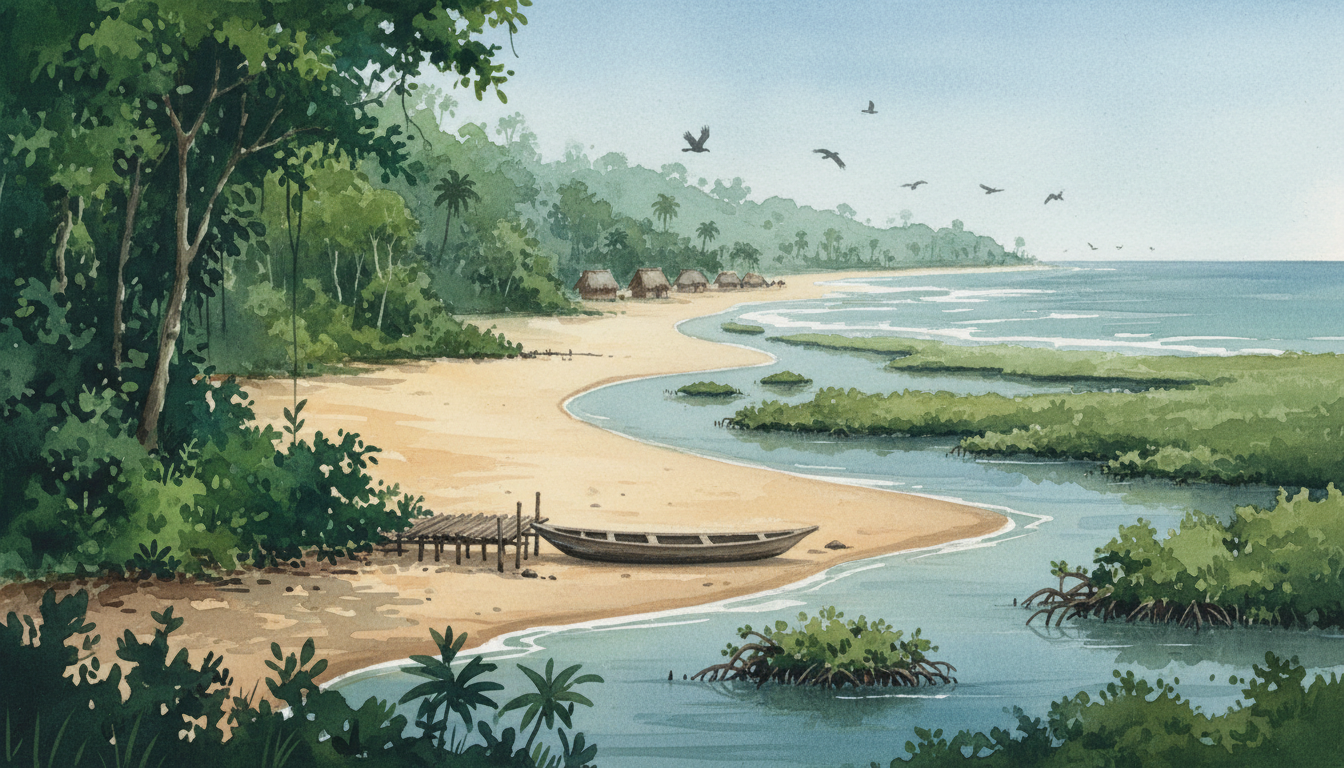
Why is Gabon covered in so much rainforest? Gabon lies in the humid equatorial belt of Central Africa, within the Congo Basin forest region. Its climate and long ecological history have supported extensive tropical forest. Forests cover most of the country: the World Bank’s forest-area indicator places Gabon’s 2024 forest share at roughly 91%, depending on the data definition. Check the dated World Bank series.
How many national parks does Gabon have? The country established a network of 13 national parks in the early 2000s, but a national park is not the same as all forest land. Some forests are managed for timber, some sit in protected areas, and communities live and work within the wider landscape. The World Bank’s 2024 forestry assessment explains that economic and conservation functions must be examined together.
This guide takes readers into the decisions behind the forest: how wildlife is protected, why logging and factories are linked, how carbon value is assessed, and what long-term management requires. It is a focused companion to How Gabon Works | Government, Oil, Rainforests and Public Services and the wider How Countries Work archive.
Gabon rainforest and national parks at a glance
| Question | Quick answer |
|---|---|
| Where is Gabon? | On Central Africa’s Atlantic coast, within the Congo Basin region. |
| How much of the country is forested? | About nine-tenths; the World Bank reports approximately 91% in its 2024 series. |
| How many national parks? | The established national network has 13 parks. |
| What is a UNESCO forest heritage site? | Ivindo National Park, inscribed in 2021; Lopé-Okanda is a separate mixed heritage site. |
| Can forests be used commercially? | Yes, subject to the relevant forest-management rules; protected parks and logging concessions are distinct. |
| What does forest carbon mean? | Carbon held in forest biomass and soils, plus changes in uptake and release over time. |
| Does forest value equal cash paid to government? | No. Ecosystem-service valuation, export earnings and budget revenue are different measures. |
| What is the main policy challenge? | Balancing habitat integrity, livelihoods, legal industry, finance and enforcement. |
1. Why does equatorial geography matter?
A dense rainforest cannot be explained simply by saying ‘there are many trees’. Across much of Gabon, a humid tropical climate and ecological conditions support forest growth. The country’s rivers, varied habitats and long history of land cover help explain the landscape people see today.
The country is not identical from coast to inland mountains. Forest types, wetlands, savanna areas, settlements and protected habitats differ by place. A single green colour on a global land-cover map can hide those differences.
If you study geography, ask three questions: where is moisture available, which habitat occurs in a given location, and what human uses or protections affect it? Those questions are more useful than treating all of Central Africa as one homogeneous forest.
2. How much of Gabon is forest, and can the number change?
The World Bank’s indicator for forest area as a share of land reports approximately 91.4% for Gabon in 2024. That is a dated statistical measure. It should not be confused with the area of primary, undisturbed forest, the number of forest elephants or the share of land inside national parks. The source defines the measured indicator.
Forest-cover totals also depend on the method and year used. A statement that 90% is forest and a statement that one-tenth is protected can both be compatible: the categories refer to different things.
For a classroom calculation, imagine a country with 100 equal squares, 91 of them shaded for forest. Suppose only 11 squares are designated as parks. The remaining green squares do not stop being forest simply because they lie outside the park boundaries. This is a fictional diagram, not Gabon’s cadastral map.
3. What do the 13 national parks protect?
The park network is an important part of Gabon’s conservation system. Parks can protect habitats, ecological processes and species from activities that would otherwise damage them. They also require boundaries, management staff, funding and cooperation with surrounding communities.
The World Bank’s 2024 economic update places the 13 national parks alongside land used for managed forestry and highlights Gabon’s comparatively low recorded deforestation rate over the 2010–2020 period. That historical finding is not a prediction for all future years.
Declaring a place protected does not by itself stop poaching, illegal extraction or land-use disputes. A park is most effective when laws, budgets, monitoring and practical relationships work together.
4. What makes Ivindo National Park special?
Ivindo National Park was placed on UNESCO’s World Heritage List in 2021 for its outstanding natural features, biodiversity and ecological processes. UNESCO describes extensive lowland rainforest and an important river system with waterfalls and rapids. The listed World Heritage property covers 298,758 hectares, with a separately defined buffer zone. The official listing supplies the boundaries and conservation criteria.
Ivindo is not simply a tourist viewpoint. Its forests support species and ecological interactions that need functioning habitats over time. The protected area is managed by Gabon’s National Agency for National Parks, known as ANPN, and supported by multiple partners.
A good learning exercise is to separate the park’s actual ecological objectives from what a visitor can photograph. An impressive waterfall may attract attention, while less visible conservation work determines whether the surrounding ecosystem remains healthy.
5. Is Lopé-Okanda another Ivindo?
No. Gabon’s other UNESCO-listed property is the Ecosystem and Relict Cultural Landscape of Lopé-Okanda, inscribed in 2007 as a mixed natural-and-cultural heritage property. UNESCO’s Gabon country listing distinguishes it from the natural heritage property at Ivindo.
Lopé-Okanda brings archaeology and the history of human movement into the story of forest and savanna mosaics. It illustrates why ‘rainforest country’ does not mean ‘country with no human history until modern cities appeared’.
When comparing the sites, remember that World Heritage status is not one undifferentiated badge. Properties can be inscribed for cultural, natural or mixed significance, with different reasons for their protection.
6. What animals depend on Gabon’s forests?
The forests support species including forest elephants, gorillas, chimpanzees and many other mammals, birds and plants. UNESCO’s Ivindo profile identifies threatened wildlife among the reasons the area’s intact habitat is important. Read its biodiversity description.
Wild animals do not know where a line is drawn on an administrative map. Their food, movement and reproduction depend on ecological conditions that can cross park borders. Protection around a park may therefore matter almost as much as conditions in its core.
It is inaccurate to suggest that seeing an elephant on a photograph proves a whole population is secure. Conservation needs evidence about habitat, threats and trends across time.
7. Why is logging allowed in some forests?
A government can distinguish strict or high-protection zones from forests where regulated timber harvesting is permitted. A concession gives a company a defined permission to manage and harvest under applicable rules; it does not make every tree available for unrestricted cutting.
UNESCO’s Ivindo listing says that selective logging in buffer-zone concessions may be permitted under environmental and social conditions intended to protect the World Heritage property. This is a description of those arrangements, not a claim that logging is harmless everywhere. The site documents the requirements.
Logging can create employment and useful materials while also posing risks to habitat, soil, waterways and biodiversity if poorly managed. The serious question is which activities are allowed, how they are monitored and whether obligations are enforced.
8. Why did Gabon restrict exports of unprocessed logs?
Gabon banned exports of unprocessed logs in 2010 and developed local wood-processing capacity, including activity associated with the Nkok special economic zone. The aim is for more of the value added by processing to occur inside the country instead of exporting all raw materials without further transformation.
The World Bank’s 2024 assessment describes timber as a leading private-sector employer, with about 15,000 jobs reported in the sector and an economic role alongside oil.
Local processing still requires energy, transport, machinery, skilled workers and buyers. A policy saying ‘process wood locally’ does not conjure those things into existence. Its success has to be assessed through the functioning chain from responsibly sourced trees to saleable goods.
9. What is the difference between log exports and processed wood exports?
A raw log is a harvested tree section. Processed products can include sawn timber, veneer and plywood. Different stages create different kinds of work and require different equipment.
Imagine a fictional company sells 100 cubic metres of logs for 50 units of revenue per cubic metre. Its gross revenue is 5,000 units. Another company processes the same material into products worth more, but spends on equipment, labour and energy. The higher selling price is not automatically the same as higher profit.
To evaluate a national strategy, ask how much extra value is created, how much stays in the economy, what it costs to produce, and whether the forest can sustain the harvest rate. A successful factory with unsustainable raw-material sourcing would not be a sustainable outcome.
10. Why does certification matter?
Forest certification schemes can evaluate management against standards addressing ecological, social and operational issues. They are intended to provide a structured assessment rather than an absolute promise that no incident or dispute will ever occur.
UNESCO reported at the time of Ivindo’s 2021 inscription that Gabon had been pursuing certification for relevant surrounding concessions and described the certification status recorded then. That is a dated snapshot and must not be repeated as a claim about the exact number of certified concessions in 2026.
The useful question for a buyer or reader is which operator, concession, certificate, scope and date are involved. A generic logo on an advertisement cannot establish the standing of every company in an industry.
11. How can a forest store carbon?
Trees and forest soils contain carbon. As plants grow, carbon moves into biomass; when material decays, burns or is removed, carbon moves through other parts of the system. A forest can hold a substantial carbon stock while its net annual uptake changes from year to year.
The World Bank’s 2025 Gabon economic update estimated that the value of forest ecosystem services almost doubled between 2000 and 2020, reaching around US$75.1 billion in its accounting, with carbon retention responsible for most of that estimated service value. Read the report’s definition and period.
This is an economic valuation of services, not a cheque written to Gabon’s treasury or the country’s annual timber export earnings. Confusing economic value, the stock of carbon and cash revenue would seriously distort what the report says.
12. Are carbon credits and a healthy forest the same thing?
No. A forest is a biological system. A carbon credit or a results-based climate payment is a financial arrangement based on particular accounting rules, baselines and verification. These can create incentives for conservation, but the existence of a contract is not direct proof that every hectare is healthy.
The World Bank’s 2024 analysis describes Gabon’s participation in forest-related results-based financing, including the Central African Forest Initiative. It distinguishes financing from wider forest management.
A responsible reader should ask what is measured, what would have happened without a project, who verifies the reported change, and how any benefits reach communities or public programmes. Forest integrity cannot be reduced to a single price.
13. Why does the forest matter to people, not just animals?
Forests can support livelihoods, food collection, cultural practices, forest-related work and access to resources. Some communities may benefit from employment in conservation or processing; others may face restrictions or economic disruption. Those effects are not uniform.
UNESCO’s Ivindo management description highlights the need to coordinate protected-area management with partners and funding. Good decisions also require practical discussion of access, enforcement and legitimate needs.
Consider an imaginary village beside a conservation area. A road may make goods and healthcare easier to reach while also increasing access for illegal hunting. Judging it only by the number of kilometres built misses the opposing effects.
14. What does Gabon need to protect the forest in the future?
A credible plan needs clear land-use maps, enforcement, monitoring, secure budgets, education, sustainable business opportunities and relationships with the people who live near the forest. In 2025, international partners described new conservation-finance commitments for Gabon. Proposals and signed commitments should be tracked separately from measured work completed afterward.
For a learning exercise, draw a flowchart: forest condition → management decision → monitoring → reported result → next funding decision. Add a second path for community needs and grievances. It shows how financing and the natural system must communicate.
To compare with a very different kind of national infrastructure, explore the sibling How Singapore Works archive. The shared lesson is that resources become public benefits through rules, people and maintenance—not through geography alone.
Frequently asked questions
Why is Gabon mostly rainforest?
Its humid equatorial setting supports extensive forest ecosystems within the Congo Basin, alongside varied habitats and human land uses.
How much of Gabon is forest?
The World Bank’s 2024 forest-area indicator puts the share at roughly 91.4% of land. Definitions and dates matter.
How many national parks are in Gabon?
Gabon has an established network of 13 national parks, with separate forest areas managed under other arrangements.
What is Ivindo National Park known for?
UNESCO recognises its rainforest biodiversity, ecological processes, river systems and waterfalls; it became a World Heritage site in 2021.
Are all forests in Gabon protected from logging?
No. Protected areas, buffer zones and managed forestry concessions have different requirements. Relevant logging operations need lawful management and oversight.
Why did Gabon ban raw log exports?
The policy encouraged wood processing and greater value addition inside Gabon rather than exporting all harvested timber unprocessed.
Is the value of Gabon’s forest ecosystem services government income?
No. An estimated ecosystem-service value is an economic accounting measure, not automatically revenue collected by the government.
Do conservation plans eliminate all forest threats?
No. Effective management also requires monitoring, enforcement, funding, local participation and continued protection of ecological processes.
Sources and further reading
- World Bank — Gabon forest-area indicator, including 2024 data
- World Bank — Gabon Economic Update 2024, forestry and timber processing
- World Bank — Gabon Economic Update 2025, forest ecosystem value
- UNESCO — Ivindo National Park, World Heritage 2021
- UNESCO — Gabon’s two World Heritage properties
- UNESCO — Lopé-Okanda cultural landscape