
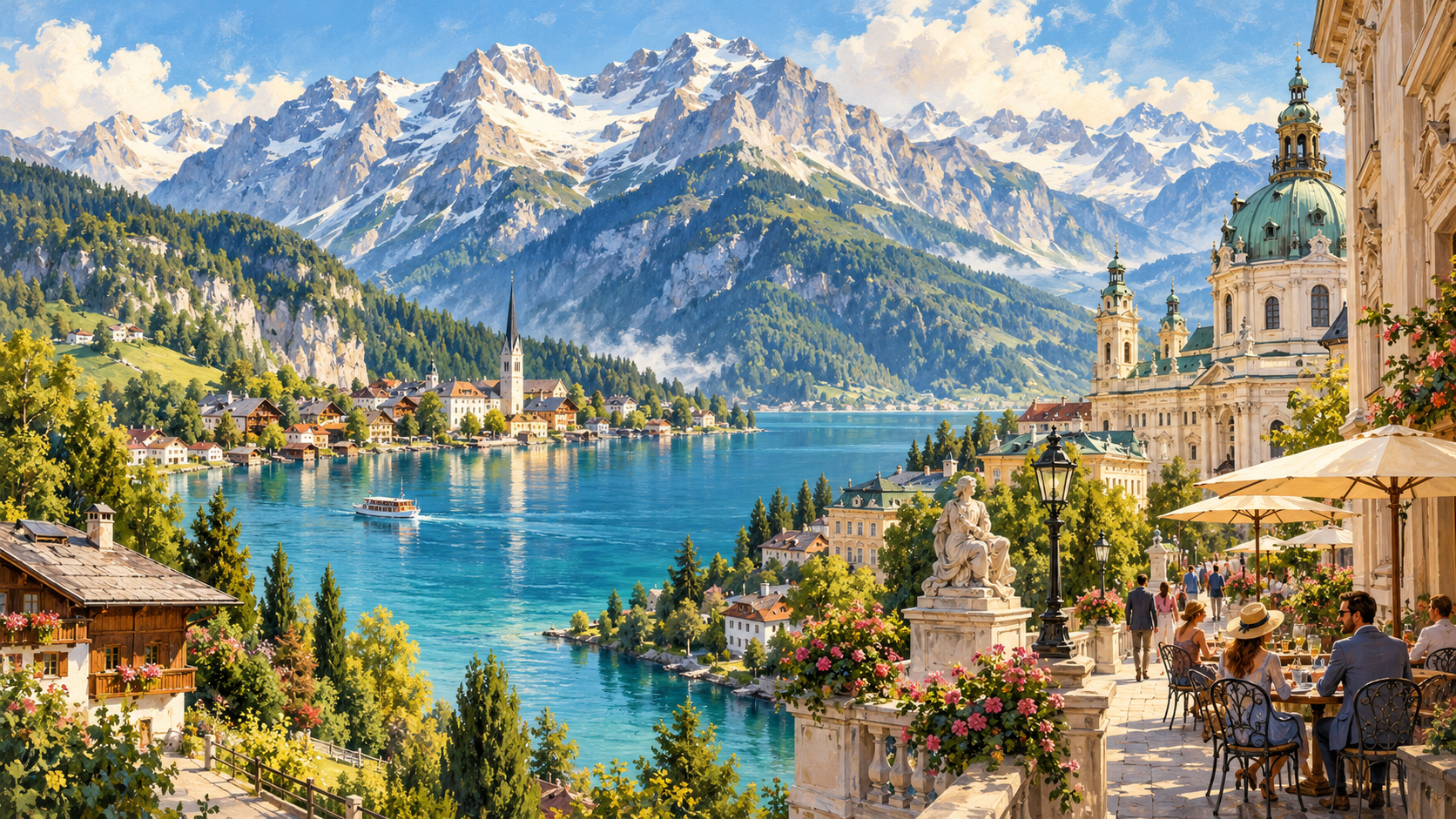
Austria invites you to learn by slowing down: follow a river through a map, look beyond the grand front of a palace, listen carefully during a concert, or notice how a coffeehouse makes room for conversation. These top 10 things to learn when visiting and touring Austria connect Vienna, Salzburg, the Alps, Hallstatt and the Wachau with geography, history, music, food and everyday life. The country becomes much more interesting when a beautiful view is the beginning of a question rather than the end of a visit.
For Singapore families planning educational travel in Austria, a useful country learning guide should explain the links between places instead of offering only a list of attractions. This Austria travel learning guide gives parents and students clear observation tasks, English–Chinese vocabulary and a thoughtful way to read Austrian heritage. You can use it before travelling, choose the sections that fit your actual route, or explore from home through the linked official sources. There is no need to turn a holiday into ten compulsory assignments.
Use these lessons as a companion, not as a complete itinerary or personalised safety advice. Consult current Austria travel advice, official destination information and the relevant operators before booking. Mountain conditions, access, transport and venue programmes must be checked for your dates. A summer photograph does not describe a winter route, and a national tourism page cannot determine whether a particular activity is suitable for your family.
Choose your reading route
Read the ten lessons in order, or begin with the part of Austria that makes you curious. The short observation tasks are invitations to look closely; they do not require a school worksheet.
Read the landscape · Meet culture and daily life · Connect the bigger story
Full contents · Country learning directory · Travel vocabulary directory
Contents
Read the landscape
Meet culture and daily life
Connect the bigger story
A family learning route for Austria · A short comparison notebook for deeper learning · English–Chinese vocabulary for reading Austria · Questions families often ask · Continue your country learning journey
Before choosing attractions, look at a physical map rather than only a city map. Find the Alps and the Danube, then locate Vienna and Salzburg. Notice that land is not a flat surface on which settlements have been scattered at random. Height, valleys and waterways create different possibilities for movement and daily life. The map provides questions about these relationships; it does not prove the answer to every question by itself.
For a Singapore learner, relief is a particularly helpful geographical idea. A familiar city map mainly describes streets and distances. A mountain-region map also asks you to think vertically. Two places may seem close when measured across a page, yet reaching one from the other may involve a route that follows the landscape. Straight-line distance and practical travel distance are different pieces of information.
Try sketching Austria in two layers. First draw a simple outline and place the cities you know. Then add mountains and the river using a reliable map. Discuss how the second layer changes the story. Do you now wonder about valley settlements, crossings or transport corridors? Those are productive questions. Do not claim that every feature explains a modern route without checking the relevant transport information.
The official Austria tourism website is a useful starting point for regional research. Look for descriptions of the particular place you intend to visit, then verify current transport and access directly. Country-level impressions can be misleading. An urban museum day and a mountain excursion belong to the same journey but require quite different preparation and different forms of attention.
Make a small decision table for your family. One column names a place, another states the learning idea, and a third identifies what still needs checking. A Danube-side visit might raise questions about river landscapes; an Alpine destination might raise questions about terrain and season. The purpose is not to squeeze both into a rushed schedule. It is to decide which questions you can realistically explore well.
Notice and discuss: Compare a physical map with a transport map. Find one point where the landscape helps you ask a better question about a route. Explain the difference between what the map shows and what you would need to research before making a travel decision.
Vienna’s historic centre rewards attention to changes in urban form. UNESCO describes a city whose heritage includes medieval, Baroque and nineteenth-century layers, with important cultural associations. Its Historic Centre of Vienna account offers a reliable starting point. The city is not a single period preserved without change; its buildings and public spaces invite you to think about how different generations organised urban life.
Begin with visible differences rather than guessed dates. Compare the width of streets, the scale of facades and the arrangement of open spaces. If a guide or label supplies a period, add it to your notes. Without that information, describe the features precisely. “This street opens into a broad space” is better historical writing than confidently assigning a century from a decorative detail you do not understand.
Ask what a city centre is expected to do. It may support work, residence, worship, administration, trade, performance and tourism at the same time. A visitor often notices the most impressive surfaces while overlooking delivery access, signs, transit and ordinary errands. Bringing those activities into view makes the city more human. Heritage is not simply a polished exterior offered for our admiration.
For older students, think about the tension between preservation and change. Keeping a historic building does not mean keeping every aspect of urban life fixed. People still need useful spaces, maintenance and access. Conversely, the desire for a modern facility does not automatically make every alteration appropriate. You can discuss competing needs without pretending that a short walk qualifies you to settle a planning dispute.
Try writing two accounts of the same view. The first describes what attracts your eye. The second explains how people move and use the space. Read them together. The second may seem less glamorous, yet it often reveals more about the city as a living system. A good travel paragraph can combine both: one strong visual detail and one thoughtful observation about use.
Notice and discuss: Choose a place where contrasting building forms are visible. Sketch the contrast, then ask an official guide or consult a reliable source about the historical relationship. Keep the sketch and the sourced explanation separate so you can see exactly how knowledge improved your first impression.
Schönbrunn is more than a collection of handsome rooms. UNESCO identifies the palace and gardens as an outstanding Baroque ensemble associated with the Habsburg dynasty. Read the Palace and Gardens of Schönbrunn entry to understand the heritage framework. The useful learning question is how architecture, landscape and decoration can make political and social authority visible.
Start with arrangement. A palace directs attention through entrances, axes, sequences and differences of scale. Even before learning the name of a ruler, you can ask who was meant to approach which space and under what conditions. Do not assume that every room had the same level of access or the same purpose. A reliable tour or label can help you connect visible layout with documented use.
Gardens make a related point outdoors. Look at repeated forms and organised views from permitted public routes. Which elements draw the eye forward? Which create symmetry? You do not need to decide immediately whether the design is beautiful. First establish what it does visually. This is a useful mathematical observation as well as an art lesson: repetition, alignment and proportion can be described before they are evaluated.
Then bring labour into the discussion. Grand environments require construction, craft, care and maintenance. A visitor who focuses only on rulers can miss the people whose work made those settings possible. Ask what the interpretation tells you about makers and workers, and where it is silent. Do not fill the gaps with invented stories. Let the absence become a research question rather than an excuse for speculation.
For families, compare a palace with an ordinary home carefully. Both contain spaces for particular activities, but their scale and social roles differ. A child can understand that a room may communicate importance as well as serve a practical function. Older learners can consider how display, ceremony and access shape relationships. These ideas remain relevant when reading contemporary government buildings and corporate spaces.
Notice and discuss: Select one architectural or garden feature and describe how it guides your attention. Add the historical explanation supplied by an official source, if available. Finish with a question about the people who used or maintained it. The result is a richer account than “the palace was very grand”.
A coffeehouse can teach you about culture without a monumental facade. The Austrian Commission for UNESCO includes Viennese coffeehouse culture in Austria’s national inventory of intangible cultural heritage. That national recognition should not be confused with inscription on UNESCO’s international Representative List. The distinction is useful: heritage designations have different scopes, and careful wording matters.
The central question is not which drink a visitor must order. It is how a setting supports particular habits of being together. Look at tables, seating, reading material and the rhythm of service, while remembering that individual establishments differ. A single visit cannot tell you how every Viennese resident spends an afternoon. It can show you how this particular space enables a particular kind of interaction.
Sit, if you choose, and allow enough time to notice. Do people arrive alone or in groups? Are there places that appear suited to conversation and others to quiet reading? Keep observations anonymous and avoid intrusive photography. You are considering the relationship between design and behaviour, not judging strangers or turning their ordinary lives into a performance for your travel journal.
For a student, compare the coffeehouse with a place in Singapore where people linger. Use the same criteria for both: noise, seating, movement, service and the activities people undertake. Avoid the lazy conclusion that one culture is relaxed and another is hurried. Different venues, times and users can produce different experiences within the same city. A well-framed comparison tells you about settings, not the supposed personality of a nation.
The lesson can also improve descriptive vocabulary. Instead of repeating “nice atmosphere”, name what creates your impression. Perhaps conversation remains audible, light falls across a tabletop, or an arrangement gives people room to stay. These are your observations, not universal heritage facts. Their precision makes your writing more convincing because the reader can understand what you mean.
Notice and discuss: Write a short paragraph without using “cosy”, “traditional” or “beautiful”. Describe three concrete features and explain how one affects your experience. Then check whether your explanation is supported by what you actually observed. A cup of coffee is optional; careful attention is the real lesson.
Austria’s musical associations are familiar enough that visitors may recognise names before they recognise sounds. Salzburg’s heritage is closely associated with Mozart, while Vienna offers a rich musical context. UNESCO’s Salzburg account and Vienna account provide starting points. Avoid treating the country as a single composer-themed attraction or assuming every advertised performance provides the same kind of experience.
Begin with listening rather than expertise. Choose a short piece from an official museum or performance resource and listen twice. On the first hearing, describe your impression. On the second, listen for contrast: a change in speed, volume, texture or repeated material. You do not need technical labels to notice a relationship. “The opening idea returned more quietly” can be a perceptive observation if it accurately describes what you heard.
For younger learners, draw a line that rises and falls with the changing energy of the music. Explain that the drawing is a personal response, not the score. Older learners can ask which features support their interpretation. If a section feels tense, what audible change contributes to that feeling? This moves the discussion from “I liked it” towards an explanation without making enjoyment dependent on a test.
If attending a concert, check the actual programme, venue, age guidance, duration and booking conditions. Famous city names do not guarantee that a particular event matches your family’s interests. A smaller or shorter experience may be more suitable than an evening chosen only for prestige. Respect the venue’s rules, including photography and recording restrictions, and prepare children for the expected listening environment.
Music is also a lesson in participation. A performance involves musicians, listeners, a space and conventions about attention. Consider how the room and audience behaviour affect your experience without claiming to understand acoustic design from one visit. If the venue explains its design, compare that information with what you noticed. The question becomes how an event is made possible, not just whether you recognised a melody.
Notice and discuss: After listening, write one sentence about an audible change, one about your response and one question for further learning. Keeping these separate prevents personal feeling from becoming a claim about what the composer intended or what all listeners should hear.
Salzburg is strongly associated with Mozart, but a useful visit also looks at urban space and historical exchange. UNESCO recognises the Historic Centre of the City of Salzburg for its townscape, buildings and cultural significance. Think of the musical association as one doorway into the city, not a substitute for understanding everything else around you.
Start with the relationship between buildings, streets and the surrounding landscape. From permitted public viewpoints, observe how the setting frames the urban scene. Do not turn a distant view into an invitation to attempt an unfamiliar route. A safe, accessible viewpoint can provide enough material for thoughtful comparison. The learning task should suit your actual access and ability rather than drive your choice of activity.
Compare a small street-scale view with a broader city view. At street level, signs, entrances and details dominate attention. From farther away, roofs, larger masses and landscape relationships become clearer. Neither view is the complete truth. The exercise helps a learner understand scale in visual interpretation: changing position changes which relationships become visible.
Then ask about exchange. Heritage often contains influences that crossed political and linguistic boundaries. The task is not to guess an architect’s nationality from a facade. It is to look for a sourced explanation of how people, ideas or techniques moved. When interpretation supplies such a connection, record it. A city can be culturally distinctive while also being shaped through contact with others.
For writing, avoid reducing Salzburg to “a charming old town”. Charm describes your feeling; it does not explain the place. A stronger paragraph identifies a visible arrangement, connects it with a documented historical point, and explains what you learned. You can still enjoy the atmosphere. Precision does not remove pleasure; it gives the reader something concrete to share in that pleasure.
Notice and discuss: Describe the same part of Salzburg from two scales. What disappeared when you moved farther away, and what became clearer? Use the comparison to explain why a postcard view and a slow walk can offer different kinds of knowledge about one city.
Hallstatt is often encountered first as an image of buildings beside water and mountains. UNESCO’s Hallstatt–Dachstein / Salzkammergut Cultural Landscape account connects the region’s heritage with a long history of salt production and the prosperity associated with it. This shifts the question from “Why is the view attractive?” to “What kinds of work helped shape this place?”
A cultural landscape contains relationships between people and their environment. It is not simply nature with a few buildings added. Think about what people needed to extract a resource, move it, live nearby and sustain a settlement. You should not invent a complete economic history from a lakeside view. Instead, use the landscape to form questions and museum or heritage interpretation to investigate them.
Salt provides an accessible starting point because it is familiar in everyday life. Ask what changes when an ordinary substance becomes an important resource. Work, technology, movement and exchange become relevant. The point is not to memorise an exaggerated claim that one resource explains every aspect of a region. It is to recognise that a picturesque setting can have a history of production behind it.
If considering a mine-related visit, verify current access, age conditions, mobility requirements and operator guidance. This learning lesson does not require entering a mine. A museum display or official interpretation may be the better option for your family. Educational value is not measured by how physically demanding an activity is, and a route should never be selected merely to make a journal entry more dramatic.
For older students, compare the tourist image with the historical account. What does the image highlight, and what does it leave out? Boats, workers, tools and movement may be absent from a photograph designed to emphasise stillness. That does not make the image false. It makes it selective. Understanding selection is one of the most transferable skills a travel experience can teach.
Notice and discuss: Put a landscape photograph beside one sourced fact about salt-related heritage. Write a paragraph that brings them into conversation. Explain how knowing about work changes the meaning of the scene, while making clear which details are visible and which come from research.
The Wachau is a Danube landscape whose heritage includes settlements, architecture and agricultural use. UNESCO’s Wachau Cultural Landscape description identifies the stretch between Melk and Krems as a place where these relationships are especially significant. The river is not merely a decorative blue line passing behind attractive towns; it helps you frame questions about movement and landscape organisation.
Begin with position. On a map, locate the river and the named places. During an appropriate visit, compare what the map led you to expect with what you can actually see. Which relationships become obvious from a river-level view, and which require a different vantage point? You do not need to visit every town to learn how maps and views complement each other.
Then look for the meeting of natural form and human arrangement. Fields, slopes, buildings and routes can create a visually coherent scene, yet they have different functions. Describe those functions only where you have evidence. A planted area may prompt a question about agriculture; a historic building may prompt a question about institutions. Avoid assuming that everything visible belongs to one period or one neatly unified plan.
For students, the important word is continuity. A cultural landscape can show long relationships while still containing change. Ask what official interpretation identifies as enduring and what has been altered. Do not mistake a calm appearance for an absence of change. Maintenance, cultivation and daily use are activities, even when a visitor’s photograph makes the scene look timeless.
Any excursion on or beside the river needs current practical checks. Verify schedules, weather, access and operator information for your dates. This article is not a recommendation to take an unfamiliar walking route or a promise that a transport connection will operate. You can study the landscape through maps, official material and accessible public views if the more ambitious plan does not suit your circumstances.
Notice and discuss: Choose three elements in a scene: one linked to landform, one to settlement and one to work. Explain a relationship among them using sourced information where necessary. The exercise encourages a whole-landscape reading instead of a separate list of river, village and vineyard.
Austria’s food culture offers more than a short list of dishes to photograph. The official Austrian food and drink guide introduces familiar dishes such as Wiener Schnitzel and Spätzle alongside regional ingredients and different dining settings. Use this as an invitation to ask about place, preparation and variation, not as a claim that every resident eats in the same way.
A menu is a compact cultural document. It contains names, categories, translations and choices about what to explain. Compare a dish’s original name with its description. What information does the description provide, and what does it leave uncertain? If you need to know ingredients for an allergy or dietary requirement, ask staff directly and seek appropriate professional advice where needed. A heritage description is not an ingredient guarantee.
For younger learners, practise precise description without turning the meal into an examination. Compare texture, temperature or preparation using words that fit the experience. Older learners can consider how a dish is presented to visitors and how the setting shapes their impression. A formal restaurant, casual venue and home-related account may communicate different aspects of food culture. None automatically represents the entire country.
Food also leads to questions about labour. Someone grows, transports, prepares and serves the ingredients. You may not know those stories, but you can ask whether the venue explains sourcing or preparation. Record only what is actually stated. “The menu identifies a regional ingredient” is evidence; “everything here is locally produced” is a much larger claim that needs confirmation.
Compare Austria with Singapore through a shared question rather than a ranking. How does a food name carry a geographical identity? How do people adapt a dish? Which details survive translation? These questions allow both places to remain complex. You are learning how food connects with meaning, not deciding which cuisine deserves a higher score.
Notice and discuss: Choose one menu term and explain its meaning in your own words, using a verified description. Add one observation about the setting and one question about preparation or origin. A short entry built this way can be both deliciously personal and carefully researched.
An Alpine landscape can invite wonder and also require practical restraint. A photograph of an open path does not tell you whether it is accessible today, suitable for your ability or appropriate in the current conditions. Use official Austrian regional information and the relevant local authority or operator. Seek qualified guidance for activities requiring it. This article cannot assess a mountain route’s safety.
The learning question is how season changes the meaning of a place. A path, slope or settlement can support different activities at different times. Rather than deciding that one season is the “real” Alps, ask what each season enables and what responsibilities it introduces. Avoid making weather assumptions from Singapore habits or from a friend’s account of a previous trip.
You can study terrain from an accessible, permitted location. Notice changes in height, the direction of slopes and the relationship between settlement and landform. Where official interpretation identifies a feature, use the correct name. Where it does not, describe the visible arrangement. There is no educational requirement to climb higher, go farther or leave a marked route.
For families, the most valuable conversation may concern a changed plan. Suppose an intended activity is not suitable under current guidance. What alternative preserves the learning goal? A visitor centre, museum, map study or safe public viewpoint can still help you understand the region. Flexibility becomes easier when you know whether the goal is to learn about terrain, experience a particular sport or simply enjoy time together.
Older learners can connect tourism with responsibility without assuming a simple solution to every issue. Visitors, residents, operators and land managers may have different needs. Ask what the local guidance explains about appropriate behaviour and why. Follow it. A respectful visit begins with practical actions, while broader environmental questions require evidence and informed discussion rather than slogans.
Notice and discuss: Record one decision made because of conditions or access information. Explain how the new information changed your plan and what you learned instead. This is a stronger example of thoughtful travel than a story about ignoring advice to complete an ambitious itinerary.
A family learning route for Austria
Choose a small combination that fits your actual journey. A Vienna-focused stay might connect the city layers, Schönbrunn, coffeehouse culture and a suitable musical experience. A Salzburg-area visit can connect urban form, music and nearby regional interpretation. A journey that genuinely includes the Wachau or Hallstatt can add cultural-landscape questions. These are learning combinations, not instructions to cover distant places in a fixed number of days.
Give each learner one question before leaving. A primary student might ask how a palace differs from a home. A secondary student might ask how a resource shapes a landscape, or how a historic centre remains a living city. During the visit, collect a small amount of useful evidence. Afterward, explain what changed in the original question. This produces a clearer account than dozens of loosely labelled photographs.
For a relaxed rhythm, alternate close observation with ordinary enjoyment. A concert does not need to be followed immediately by a written response. A cafe can remain a pleasant cafe. Later, over a conversation, invite each person to name one detail they noticed. Curiosity is often more durable when it feels like an invitation rather than a timetable of compulsory tasks.
A short comparison notebook for deeper learning
Try comparing Vienna and Salzburg through scale rather than prestige. Choose one street scene from each that you encountered legitimately or studied through an official source. What information is visible at pedestrian level? What becomes clearer in a broader view? Keep your conclusions specific to the selected scenes. Two examples can illustrate a question without representing every part of either city.
Next compare Schönbrunn and Hallstatt through work. One may first appear as a setting of power, the other as a picturesque landscape. Ask who made, maintained or used each setting, using the available interpretation. The contrast helps you recognise that heritage can foreground some forms of labour while leaving others less visible. Write the missing questions down instead of inventing their answers.
Finally compare the coffeehouse and concert venue through attention. What behaviour does each setting invite, and which conventions do visitors need to understand? You might think about conversation, quiet, duration and shared space. This is an exercise in reading environments, not a claim that all cafes or all concerts operate alike. The goal is to explain how a particular setting shapes your experience.
English–Chinese vocabulary for reading Austria
| English | 中文 | A useful question |
|---|---|---|
| relief | 地形起伏 | How does height change a map’s meaning? |
| valley | 山谷 | How might terrain affect a route? |
| Danube | 多瑙河 | Which places are connected in this landscape? |
| Baroque | 巴洛克 | Which features are identified by a reliable source? |
| dynasty | 王朝 | How does authority appear in a palace? |
| symmetry | 对称 | What repeats around an axis? |
| coffeehouse | 咖啡馆 | How does the setting support social activity? |
| performance | 演出 | How do musicians, listeners and space interact? |
| cultural landscape | 文化景观 | How are land, work and settlement connected? |
| resource | 资源 | What forms of work develop around it? |
| preservation | 保存/保护 | What is retained, and what changes? |
| interpretation | 解说/诠释 | Who explains the evidence and from what perspective? |
Use these translations as reading support, not as substitutes for precise historical explanation. Make one sentence with a place, a term and evidence. “The gardens show symmetry” becomes more informative when you identify the repeated arrangement you observed. Revisit the sentence at home and see whether you can explain the idea without pointing at the photograph.
Questions families often ask
Is Austria mainly a history-and-music destination for this series?
Those are strong starting points, but the lessons also cover geography, landscapes, food, public space and practical responsibility. Choose the lens that matches your interest. A child fascinated by maps can have an excellent learning experience without memorising a list of composers, while a music-loving student can connect listening with architecture and urban history.
Must we attend a concert to understand Austrian musical culture?
No. Official museum resources, recordings and introductory material can support careful listening from home. If you do attend, choose an experience suited to your family and verify the actual programme. The aim is to hear more thoughtfully, not to purchase a particular kind of cultural status.
Can we use a photograph as historical evidence?
Yes, for what it visibly records, with attention to date, viewpoint and selection. It cannot establish a building’s original purpose or explain all the work behind a landscape by itself. Pair visual observation with reliable interpretation and state clearly which part of your account comes from each.
What should we check before an Alpine activity?
Check current local conditions, access, equipment and ability requirements, operator advice and official travel information. Seek qualified guidance where needed. A learning task never justifies ignoring a closure or attempting an unsuitable route. Changing plans thoughtfully is part of responsible travel, and there are many less demanding ways to study a landscape.
Continue your country learning journey
Return to the country learning directory. The preceding alphabetical guide is Australia, and the next is Azerbaijan. Explore the travel vocabulary city directory for related language learning.
Austria’s most lasting lesson may be that a place can be read at several speeds. A skyline gives an immediate impression; a room, a melody or a conversation rewards slower attention. When you learn to move between those speeds, you begin to see more than attractions. You see relationships between land, work, power, creativity and ordinary life, and you bring those questions home with you.