
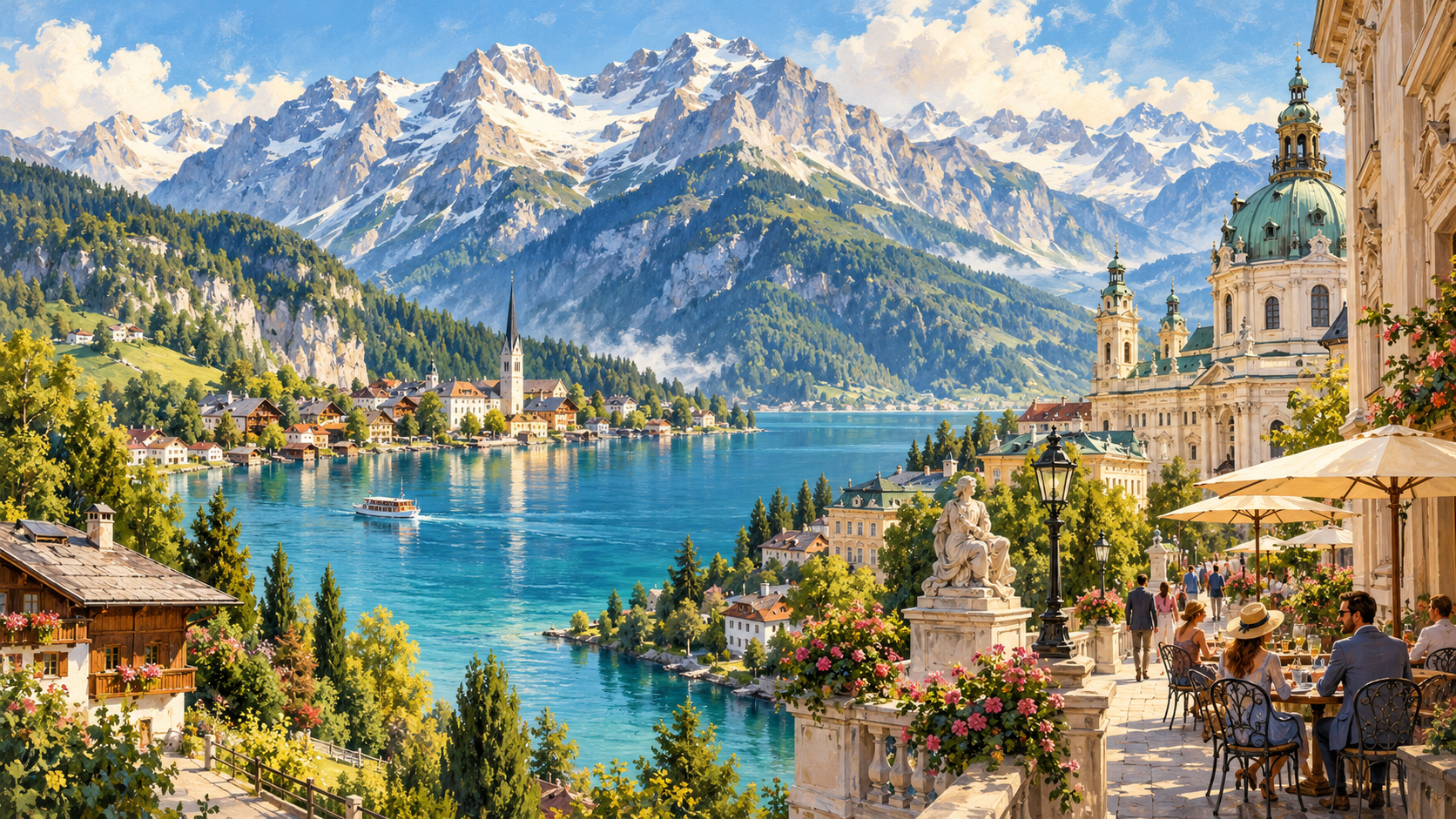
Where is Austria, what is it famous for, and how does this Central European country connect Alpine landscapes with city life and international trade? Austria is a landlocked country whose neighbours are Germany, Czechia, Slovakia, Hungary, Slovenia, Italy, Switzerland and Liechtenstein. Vienna is its capital. Mountains dominate much of the west and south, while the Danube, eastern lowlands and urban corridors give other parts of the country a different character.
Austria is widely associated with classical music, imperial architecture, skiing, coffee houses and Alpine scenery. Its everyday life also depends on manufacturing, services, apprenticeships, public transport, healthcare, farming and cross-border relationships. This guide connects the familiar images with those practical systems, while treating Austria’s imperial history, Nazi period and modern democratic republic as distinct historical settings.
Austria at a glance
- Official name: Republic of Austria; Republik Österreich in German.
- Region: Central Europe.
- Capital: Vienna, or Wien.
- Geography: landlocked; Alpine landscapes in much of the west and south, with the Danube and eastern lowlands also important.
- Neighbours: Germany, Czechia, Slovakia, Hungary, Slovenia, Italy, Switzerland and Liechtenstein.
- Government: federal parliamentary republic with nine federal states.
- Federal states: Burgenland, Carinthia, Lower Austria, Upper Austria, Salzburg, Styria, Tyrol, Vorarlberg and Vienna.
- Main official language: German; recognised minority languages have particular legal and regional contexts.
- Currency: euro, code EUR.
- European Union: member since 1995. EU membership and Austria’s constitutional neutrality need to be understood together rather than treated as opposites.
- Known for: music, architecture, Alpine landscapes, winter sports, engineering, tourism, vocational education and international institutions in Vienna.
- Reading date: 20 October 2026 in Singapore. Statistics retain their own observation dates.
The European Union’s Austria profile corroborates the capital, official language, currency, EU membership and federal structure summarised here.
Three distinctions help throughout this guide: Austria today is not the same territory as the former Habsburg empire; the federal government does not make every local decision; and a national average does not describe every Alpine valley, industrial town or urban household. Austria and Australia are also entirely different countries despite the similarity of their English names.
Cover illustration: an original artistic interpretation of Austrian highlands, lake landscapes and city life, not a literal geographic view.
Choose your route through Austria
- 1. Where Austria is: a landlocked European crossroads
- 2. The Alps, the Danube and contrasting landscapes
- 3. Nine federal states and their capitals
- 4. Population, languages and migration
- 5. Before the republic: early societies and Habsburg history
- 6. Republic, dictatorship, Nazi rule and restored sovereignty
- 7. How Austria is governed, and what neutrality means
- 8. Vienna and everyday life beyond the capital
- 9. The economy: services, manufacturing, trade and tourism
- 10. Farming, forests and natural resources
- 11. Transport: connecting cities across Alpine terrain
- 12. Electricity, water and waste: the systems behind daily comfort
- 13. Education: academic pathways and dual apprenticeships
- 14. Healthcare and social protection: broad coverage, defined entitlements
- 15. Housing, work and the practical shape of everyday life
- 16. Food and regional culture: reading the landscape through a meal
- 17. Music, literature and sport: participation beyond the postcard
- 18. UNESCO and heritage: protecting places that continue to change
- 19. Nature, climate and biodiversity: different habitats, shared pressures
- 20. Austria in the world: European cooperation and international institutions
1. Where Austria is: a landlocked European crossroads
Austria is a landlocked Central European country with Vienna as its capital. It covers roughly 84,000 square kilometres and borders Germany, Czechia, Slovakia, Hungary, Slovenia, Italy, Switzerland and Liechtenstein. Austrian Foreign Ministry: Geography.
Why its position matters
Landlocked does not mean cut off. Austria sits between major European markets, while the Alpine and Danube regions connect it with surrounding countries. The Foreign Ministry identifies trade, shared geographical features, historical relationships and cultural exchange as foundations of these links. This helps explain why an Austrian border is often also a working relationship: firms need customers and suppliers across it, communities share landscapes, and transport routes continue beyond the national map. Austrian Foreign Ministry: Austria’s neighbours.
The Brenner crossing provides a concrete example of geography shaping investment. The Brenner Base Tunnel project connects Innsbruck in Austria with Fortezza in Italy through a low-gradient railway tunnel. Its purpose is easier passenger and freight movement through the Alpine barrier. The project overview describes a 55-kilometre base tunnel, linked to the existing Innsbruck bypass. It is a construction project, so a tunnel breakthrough or completed excavation should not be mistaken for the start of passenger service. Brenner Base Tunnel: project overview.
Read three maps together
To understand Austria, compare a political map, a relief map and a transport map. The political map shows who governs each place. The relief map explains where steep slopes and valleys constrain movement. The transport map shows how people have responded with roads, railways and tunnels. Together, these views answer a more useful question than “Where is Austria?”: why do particular places become meeting points, industrial centres or routes between countries? The same method works for many mountainous countries.
2. The Alps, the Danube and contrasting landscapes
Mountains and settled valleys
The Austrian Alps extend from Vorarlberg in the west towards Lower Austria in the east. The Großglockner, at 3,798 metres, is the country’s highest mountain. Alpine Austria contains high peaks, mountain pastures, wooded slopes and towns connected by valleys. The mountain landscape is therefore also a lived-in landscape. It supports communities and livelihoods, rather than existing only as scenery for skiing or summer walking. A useful distinction is between the summit landscape visitors photograph and the valley landscape where much everyday activity takes place. Austrian National Tourist Office: the Alps.
North of the Danube, parts of Upper and Lower Austria belong to the granite-and-gneiss uplands of the Bohemian Massif. The Vienna and Graz basins offer flatter ground. Western and northern areas have stronger maritime climatic influences; the east is more continental, with elevation creating further local differences. Austrian Foreign Ministry: Geography.
A river with several jobs
About 350 kilometres of the Danube lie in Austria. As an international waterway, the river connects Austrian places with a much larger European river system. It is useful to see a river as a corridor as well as a line on a map. Navigation needs, riverside development, water management and habitat protection all meet along the same channel, making river planning a task of balancing several uses rather than maximising just one. viadonau: Austrian Danube waterway.
East of Vienna, the Donau-Auen National Park protects a substantial surviving floodplain landscape on the way towards the Slovak border. The park’s guidance makes the overlap especially clear: the Danube here is both protected habitat and an international waterway. In Burgenland, the Neusiedler See–Seewinkel landscape offers a different picture: reeds, grassland, shallow water and saline pools at the edge of the Pannonian lowlands. Its importance for migratory birds shows why Austria’s environmental story reaches well beyond alpine wildlife. Donau-Auen National Park: the river landscape. National Parks Austria: Neusiedler See–Seewinkel.
3. Nine federal states and their capitals
Austria consists of nine federal states, commonly called provinces in English and Länder or Bundesländer in German. Each has a capital: Burgenland—Eisenstadt; Carinthia—Klagenfurt; Lower Austria—St Pölten; Upper Austria—Linz; Salzburg—Salzburg; Styria—Graz; Tyrol—Innsbruck; Vorarlberg—Bregenz; and Vienna—Vienna. Vienna has a double role as a federal state and the national capital. These names belong on a political map, while familiar holiday regions may cross administrative boundaries or cover only part of a state. Austrian government: federal provinces and capitals.
Follow the country from west to east
In the west, Vorarlberg links Lake Constance with mountain landscapes, while Tyrol is strongly associated with Alpine valleys and mountain activities. Salzburg combines its historic capital with a wider Alpine hinterland. A national tourist-board rail itinerary connects Bregenz, Innsbruck, Salzburg, Linz and Vienna, giving readers a practical west-to-east framework. Following such a route makes the country easier to picture than memorising nine separate descriptions: cities, lakes and mountain corridors become parts of one connected journey. Austrian National Tourist Office: a cross-country rail route.
Upper Austria combines the Danube, Linz, hills and lake districts. Lower Austria includes vineyards, floodplains and historic sites, while Vienna forms a distinctly urban state. South of this northern corridor, Styria mixes forests, wine-growing landscapes and Graz; Carinthia combines mountains and lakes around its regional centres. Burgenland stretches along Austria’s eastern side and is associated with vineyards, lower hills and Lake Neusiedl. These are starting points for understanding regional character, not claims that every place within a state looks or works the same way. Austrian National Tourist Office: nine provinces.
Why the state level matters
The states are more than tourism labels. They have their own elected legislatures, governments and budgets, and share public responsibilities with the federal level. An Austrian resident therefore encounters several layers of government: municipality, state, national institutions and the European Union. When investigating a local issue, the useful first step is to identify which level is responsible. A national policy can set a broad framework while implementation, services or planning involve state and municipal institutions. Austrian Parliament: the federal state.
4. Population, languages and migration
A dated population picture
Statistics Austria’s final figures put Austria’s population at 9,215,956 on 1 January 2026. Vienna accounted for 2,040,914 residents on that date. These are resident-population figures, not a count of Austrian citizens worldwide. During 2025, population growth was modest: international net migration was positive, while deaths exceeded births. The distinction matters because population change can come from several directions. A growing total does not necessarily mean that more babies are being born. Statistics Austria: final population at 1 January 2026.
At the start of 2026, 20.4% of residents had non-Austrian citizenship. Citizenship is only one way of describing a population. It should not be treated as a direct measure of ethnicity, language, length of residence or belonging. A person may be born in Austria without Austrian citizenship; another may have Austrian citizenship after moving there. Good demographic reading begins by asking what a statistic actually measures before drawing conclusions about the people behind it. Statistics Austria: final population at 1 January 2026.
What “migration background” measures
For its annual household survey, Statistics Austria defines a person with a migration background as someone whose two parents were born abroad. In 2025, this group numbered about 2.554 million people in private households. The first generation consists of people themselves born abroad; the second generation consists of people born in Austria to two foreign-born parents. This survey category is different from foreign citizenship and from foreign birthplace. It also describes private households, so its denominator should not be silently substituted for the entire resident population. Statistics Austria: migration background, 2025.
German and a multilingual society
German is Austria’s state language, with Austrian vocabulary, pronunciation and regional forms contributing to everyday speech. German is a pluricentric language: more than one country has its own established standard variety. Calling all Austrian usage simply “German from Germany” misses that distinction. Austria also has communities using languages such as Turkish, Bosnian, Croatian, Serbian, Polish and Romanian. An official language describes the state’s language framework; it does not mean that every household has the same linguistic life. Austrian Foreign Ministry: German and multilingual Austria.
Austria recognises six autochthonous national ethnic minority groups: Burgenland Croats, Slovenes, Hungarians, Czechs, Slovaks and Roma. Their legal recognition reflects longstanding communities and particular protections. These groups should not be collapsed into a general category of recent immigration. The useful picture is layered: a predominantly German-language public sphere, historic minority languages and a wider range of languages connected with migration and international life. People can participate in several of these layers at once. Federal Chancellery: national ethnic minority groups.
5. Before the republic: early societies and Habsburg history
Salt, trade and the Roman frontier
Austria’s history begins long before the modern state. Research by Vienna’s Natural History Museum shows a developed salt-mining industry at Hallstatt around 1500 BCE. Salt helped preserve food and supported exchange, making an Alpine location economically significant rather than remote. Archaeological evidence is valuable here because it reveals work, tools and material conditions, not just later stories about rulers. Hallstatt’s surviving mine remains also remind us that technological skill and organised labour existed deep in Europe’s prehistoric past. Natural History Museum Vienna: prehistoric Hallstatt.
Under Roman rule, the Danube became an important frontier. Carnuntum, east of present-day Vienna, combined military installations with civilian settlement and trade. Its location connected the Danube frontier with the Amber Road, a route linking areas north and south. This is an early example of a recurring Austrian theme: a place can be a boundary and a connection at the same time. Soldiers, merchants and residents used the same strategic location for different purposes. Roman City Carnuntum: history.
From the Babenbergs to the Habsburgs
The Babenberg dynasty began ruling the eastern march in 976. The name Ostarrîchi appears in a document of 996 and is associated with the later name Österreich. In 1156, Austria became a duchy, and Vienna grew in importance as a centre of rule. These medieval territories did not have the borders or institutions of today’s republic. Treating medieval Austria as if it were the modern country would conceal how much the political map changed through inheritance, warfare and negotiated rights. The World of the Habsburgs: Babenberg Austria.
Habsburg rule developed after Rudolf I defeated his principal rival and invested his sons with Austrian and other duchies in 1282. Over time, the dynasty’s lands extended far beyond the territory of present-day Austria. The essential distinction is between a ruling family, the lands it controlled and the modern nation-state. Habsburg history belongs to many parts of Europe; it cannot be reduced to the story of German-speaking Austria alone. The World of the Habsburgs: Rudolf I.
The Ottoman sieges of Vienna in 1529 and 1683 were major episodes in the city’s history. The later defeat of the besieging forces was followed by a period of architectural expansion. Warfare and courtly display shaped the city together: fortifications, palaces and later urban development belong to the same changing landscape of power. The surviving buildings are therefore evidence of decisions and conflicts, rather than simply an attractive historical backdrop. City of Vienna: the Ottoman sieges.
Empire, diversity and political change
In 1774, Maria Theresa introduced compulsory schooling in the Habsburg hereditary lands. Implementation was gradual because schools and trained teachers were insufficient. The reform is an important milestone, but the decree did not instantly produce universal literacy. In 1848, revolution in Vienna brought down Metternich’s political system and intensified demands for a constitution, freedom from censorship and political participation. Reform from above and pressure from below both shaped the monarchy’s development. The World of the Habsburgs: Maria Theresa’s reforms. The World of the Habsburgs: the battle for a political voice.
In 1804, Franz assumed the title of Emperor of Austria amid the upheavals caused by Napoleon. The Austrian Empire should be distinguished from the Holy Roman Empire, a different political structure with a much longer history. Names that look similar can conceal very different arrangements. For students, it is useful to put “Habsburg dynasty”, “Holy Roman Empire” and “Austrian Empire” on separate lines of a timeline, then ask when and how they overlapped. The World of the Habsburgs: the Austrian Empire.
The Compromise of 1867 reorganised Habsburg rule into Austria-Hungary, with Austrian and Hungarian halves under the same monarch and with shared affairs. The Austrian half itself contained many peoples and historical lands. This arrangement was not a federation of today’s two republics, nor a simple extension of modern Austria. It reflected negotiations over power within a diverse monarchy. Understanding that diversity helps explain why arguments about language, representation and national aspirations became central to late imperial politics. The World of the Habsburgs: the 1867 Compromise.
6. Republic, dictatorship, Nazi rule and restored sovereignty
Democracy did not develop in a straight line
The First Republic was proclaimed on 12 November 1918 as the Habsburg monarchy collapsed at the end of the First World War. A new, much smaller state had to establish political institutions amid exhaustion, hardship and uncertainty about its future. Austria’s Parliament describes an early period of cooperation followed by intensifying conflict. The change was therefore more than replacing an emperor with elected officials: it meant reconstructing public authority after the political and economic world of the monarchy had broken apart. Austrian Parliament: the birth of the republic.
The early republic introduced women’s suffrage and social reforms, but parliamentary democracy was dismantled in 1933 under Chancellor Engelbert Dollfuß. An authoritarian regime followed. This sequence matters: the destruction of Austrian democracy began before Nazi Germany annexed the country. The period should not be presented as an uninterrupted democratic republic lasting until 1938. Knowing the earlier breakdown also helps readers understand why constitutional safeguards require active protection rather than merely being written into law. Austrian Parliament: 1918–1945.
The annexation and responsibility for Nazi crimes
German troops entered Austria on 12 March 1938, and the Nazi annexation, known as the Anschluss, ended Austrian independence. Many people welcomed it; others immediately faced persecution. The Mauthausen Memorial documents both the violence that accompanied the takeover and the participation of numerous Austrians in Nazi mass crimes and the Holocaust. Austria was not simply an external observer of events in Germany. A responsible account must recognise victims, resistance and perpetrators, rather than assigning one uncomplicated role to an entire population. Mauthausen Memorial: the annexation and its prehistory.
Jewish people were systematically persecuted and murdered. Roma and Sinti, disabled people, political opponents and people persecuted for religious reasons were also among those targeted. These were organised crimes of a dictatorship, supported by exclusion, dispossession, coercion and state violence. Naming the persecuted groups matters because broad phrases such as “wartime suffering” can obscure whom the regime deliberately attacked and why. The post-war acknowledgment of Austrian complicity developed slowly and remains important to historical education. Austrian Parliament: 1918–1945.
The Mauthausen concentration-camp system was established in 1938 and expanded into numerous subcamps. Prisoners endured forced labour, starvation, brutality and murder; the memorial estimates that at least 90,000 of roughly 190,000 imprisoned people died. United States forces reached Mauthausen and Gusen on 5 May 1945. These numbers describe the camp system, not the total number of Austrian victims of Nazism or all Nazi victims on Austrian territory. Keeping those categories clear prevents an already devastating history from being distorted. Mauthausen Memorial: concentration-camp history.
1945 and 1955 were different turning points
The republic was re-established through the independence declaration of 27 April 1945. The end of Nazi rule did not immediately restore unrestricted sovereignty: Austria remained under Allied occupation. The State Treaty was signed on 15 May 1955 and entered into force on 27 July. The separate constitutional neutrality law was adopted on 26 October 1955. The treaty itself did not contain a neutrality clause. These dates mark related but distinct developments: democratic restoration, international settlement, withdrawal of occupation forces and Austria’s neutrality commitment. Austrian Parliament: the restoration of the republic. Austrian Parliament: State Treaty and neutrality.
7. How Austria is governed, and what neutrality means
Parliament, government and constitutional limits
Austria is a parliamentary democracy. The National Council has 183 members elected for a five-year legislative period and performs central law-making and scrutiny functions. It can withdraw confidence from the government or individual ministers. The Federal Council represents the states in federal legislation; its members are delegated by state legislatures. Its objections usually delay legislation, although some decisions require its consent. These two chambers have different roles, so describing them as interchangeable would miss how the system works. Austrian Parliament: the National Council. Austrian Parliament: the Federal Council.
The Federal President is the head of state, with a six-year term and constitutional powers including appointments and the certification of federal laws. The government, headed by the chancellor, handles executive political work. Austrian citizens can vote in national elections from age sixteen, subject to the relevant electoral rules. Residence alone does not give every resident the same voting rights: citizenship and the kind of election matter. Democratic participation therefore needs to be described more carefully than “everyone living in Austria votes”. Austrian Federal Presidency: constitutional functions. Austrian government: the right to vote.
Federalism divides responsibilities between national and state institutions. Constitutional government also places limits on public power: laws must be made through prescribed procedures, rights must be protected and government action must have a legal basis. Parliamentary majority support does not by itself permit any action whatsoever. Courts, legal safeguards and accountability are part of democracy, alongside elections. This is especially important when reading a country’s history of democratic breakdown and later reconstruction. Austrian Parliament: constitutional principles.
European membership and the euro
Austria joined the European Union in 1995. It adopted the euro in 1999 as a non-cash currency, with euro banknotes and coins entering use in 2002. Those are different dates for different steps, which explains why accounts sometimes give either year. EU membership connects Austria to shared institutions and rules; the euro connects it to a common currency. Neither means that Austria has ceased to be a sovereign state, and neither makes its federal states separate EU member countries. European Commission: Austria and the euro.
Neutrality is a specific commitment
The 1955 neutrality law commits Austria not to join military alliances and not to allow foreign military bases on its territory. It does not mean Austria has no armed forces, no diplomatic positions or no international obligations. Austria participates in the EU’s Common Foreign and Security Policy, and constitutional provisions address that participation. The practical relationship between neutrality, European cooperation and security policy is therefore more precise than the slogan “Austria never takes sides”. Military neutrality must not be confused with political indifference. Austrian Parliament: the meaning of Austrian neutrality. Austrian Foreign Ministry: foreign policy.
8. Vienna and everyday life beyond the capital
Look beyond the postcard centre
Vienna’s historic centre is only one part of the city. The municipality has twenty-three districts, each with its own history and local character. Reading the city through its districts changes the picture from a collection of famous monuments to a place where people live, work and use public services. A city atlas should therefore connect the centre with neighbourhoods, housing and local institutions. A visitor’s view and a resident’s view overlap, but they answer different questions about the same place. City of Vienna: its 23 districts.
Housing is one important part of Vienna’s urban model. The city distinguishes privately owned rented homes, municipal housing and subsidised cooperative housing. Its published overview, checked in October 2026, describes about 220,000 city-owned flats and 200,000 cooperative flats. Municipal and cooperative homes are not the same ownership category, and access is subject to eligibility conditions. The broader lesson is that housing outcomes depend on institutions and supply arrangements, not only on individual households shopping in a single private rental market. City of Vienna: rented housing types.
Vienna also has an international diplomatic role. The Vienna International Centre opened in 1979 and houses United Nations organisations and related work. This adds another layer to the city alongside the imperial legacy: it is a working location for international cooperation. Historic buildings may dominate a first impression, but contemporary Vienna also includes administration, research, business and institutions whose daily work connects Austria to global issues. United Nations: Vienna International Centre.
Regional centres have their own identities
Linz offers an example of a city that cannot be understood through old architecture alone. The city describes itself as an industrial and technology centre, while media arts and creative activity are also central to its identity. It became a UNESCO City of Media Arts in 2014. Industry and culture can coexist and influence each other; the familiar contrast between a “working city” and a “cultural city” is often too simple to explain how an urban economy develops. City of Linz: industry, technology and culture.
Graz has a pronounced university-city identity, with higher education forming an important part of its social life. Salzburg has a different international focal point: its festival, which began in 1920 and developed a programme of theatre, concerts and opera. These institutions show how regional centres build connections beyond their size. A university brings students and researchers into a city; a festival brings performers, audiences and cultural work. Neither city is merely a smaller version of Vienna. University of Graz: living in a university city. Salzburg Festival: its history.
Smaller communities are equally varied. A commuter settlement, a farming district and a mountain resort can face different choices about housing, jobs and transport. To understand local life, ask where residents work, how they reach schools and services, and whether employment changes with the seasons. These practical questions complement the cultural landmarks and prevent a country portrait from becoming only a visitor’s itinerary.
9. The economy: services, manufacturing, trade and tourism
A diverse economy with changing conditions
Austria combines service activities with substantial manufacturing. Statistics Austria’s September 2026 national-accounts release reports that real GDP grew by 0.7% in 2025, following a revised 0.3% decline in 2024. Nominal GDP in 2025 was €518.2 billion. “Real” growth adjusts for price changes; nominal output does not. The distinction matters when prices are rising, because a larger euro total can reflect higher prices as well as more production. These are dated measurements of economic activity, not forecasts for later years. Statistics Austria: national accounts, September 2026 release.
The 2025 recovery was led mainly by services, while manufacturing also returned to growth. Construction remained weak. A national growth rate therefore hides differences between sectors: conditions for a building firm, software business, hotel or factory can move in different directions. GDP per person is likewise an average production measure, not the salary a typical resident receives. Reading economic statistics carefully means keeping production, household income, prices and employment separate rather than treating one headline number as a complete account of prosperity. Statistics Austria: national accounts, September 2026 release.
Official business statistics separate manufacturing, construction, trade, transport, accommodation, information services, finance and other activities. This classification is useful because “services” is a very broad label. It includes businesses with different skills, wages, equipment and markets. A logistics provider supports the movement of goods; an engineering consultancy supplies specialist knowledge; a hotel serves visitors. Manufacturing also depends on such services, so the two sides of the economy are linked rather than being self-contained worlds. Statistics Austria: structural business statistics.
Trade reaches well beyond the domestic market
Final official figures published in October 2026 put Austria’s 2025 goods exports at €189.69 billion and imports at €197.07 billion. Germany was the largest partner, taking 29.6% of goods exports. Machinery and vehicles formed the largest goods-trade category, and EU members took 68.1% of exports. These figures show close European connections and a strong manufacturing component. They cover goods trade; services and the national-accounts definition of exports should not be mixed into the same total without explanation. Statistics Austria: final 2025 goods trade.
Tourism is large, but count it correctly
Statistics Austria records 157.29 million overnight stays in reporting accommodation establishments during calendar year 2025, alongside 48.17 million arrivals. An arrival is a check-in, not necessarily a unique person: someone using several establishments can be counted more than once. Overnight stays measure nights spent, so a longer trip adds more nights without adding a new person each day. The statistics include domestic and international guests and do not cover every free stay with friends or relatives. These distinctions explain why visitor figures should never be read as population counts. Statistics Austria: arrivals and overnight stays.
10. Farming, forests and natural resources
Match farming to the land
The 2023 Farm Structure Survey counted 101,036 agricultural holdings in Austria, with an average of 25.6 hectares of utilised agricultural land per holding. The broader total of agricultural and forestry holdings was 152,660. Those figures describe different categories: a forestry-only holding belongs in the broader total. Survey definitions and thresholds matter, especially when comparing with older publications. A changing farm count can reflect both real structural change and differences in what the statistical survey includes. Statistics Austria: farm structure, 2023.
Regional farming patterns vary. Statistics Austria’s 2023 classification shows the importance of fodder-based holdings in Alpine states such as Tyrol and Salzburg, while market-crop and permanent-crop farming are more prominent in eastern areas, including Lower Austria and Burgenland. This is a useful connection between physical and economic geography: altitude, terrain and growing conditions influence what farmers can produce. It also explains why one photograph of an Alpine dairy landscape cannot represent all Austrian agriculture. Statistics Austria: types of farming by province.
Organic farming and careful comparisons
The Agriculture Ministry reports 23,942 organic farms in 2024. Under its Integrated Administration and Control System measure, 27.3% of agricultural land was farmed organically that year. This is a defined agricultural-area statistic, not 27.3% of all Austrian territory. Organic production includes grassland, arable crops, orchards and vineyards, with different shares across categories. The important reading habit is to keep the year and denominator attached to the percentage; otherwise a meaningful indicator can become a misleading general claim. Agriculture Ministry: organic farming in 2024.
Forests are a major part of the landscape
The ministry’s 2024 facts-and-figures publication, drawing on the 2017–2022 forest inventory, reports that approximately 48% of Austria is forested, covering just over four million hectares. Styria and Carinthia have particularly high shares of woodland. Forest statistics and farm statistics use different concepts, so their land totals should not simply be added together. Woodland is also more than a timber stock: thinking about it requires attention to land management, habitats and how people use the surrounding landscape. Agriculture Ministry: facts and figures 2024.
Resources, manufacturing and environmental choices
GeoSphere Austria identifies a significant European role for Austrian tungsten, magnesite and talc. Its resource work also covers construction materials and the geological information needed to assess deposits. A mineral deposit is not the same as an operating mine or a commercially proven project, so discovery headlines should be read carefully. Extraction, processing, recycling and environmental protection all belong in the same discussion. Austria’s resource economy is therefore best understood as a set of material flows and decisions, rather than a list of things found underground. GeoSphere Austria: mineral resources.
11. Transport: connecting cities across Alpine terrain
Austrian transport is a useful example of geography shaping everyday decisions. A route that looks short on a flat map may cross a mountain barrier; a longer valley route may be easier to build and operate. The railway network connects urban centres with regional towns and neighbouring countries. ÖBB’s infrastructure maps distinguish routes, stations and electrified sections, reminding us that a transport network is a connected set of services and facilities rather than a collection of isolated lines. (ÖBB-Infrastruktur.)
Railways change the practical map
The Koralm Railway shows how infrastructure can alter the relationship between regions. Passenger operations began on 14 December 2025, following the start of freight operations that November. It strengthened the southern railway connection between Vienna and Carinthia and closed an important gap on the Baltic–Adriatic freight corridor. This is an operating railway in the present-day picture of Austria, rather than a future proposal. Its significance extends beyond the tunnel itself: connecting services and station access determine how widely the benefits reach. (ÖBB report.)
The Brenner Base Tunnel, linking the Innsbruck area with Fortezza in Italy, illustrates a different stage of development. Its low-gradient design is intended to serve both passenger and freight trains across the Alps. Both main tunnel tubes achieved a cross-border breakthrough in July 2026, but excavation milestones are not the same as opening a railway. Track, equipment, safety systems and testing remain essential parts of turning an underground passage into a working transport connection. (Brenner project; BBT SE.)
A usable network needs more than tracks
For daily travel, the connection between trains, buses and city transport matters as much as a fast intercity journey. The annual KlimaTicket Ö brings participating scheduled public transport into one nationwide ticket. Regional versions also exist. Its coverage has exceptions, including various tourist railways and excursion services, so “one ticket” should not be understood as every possible vehicle or attraction. The educational lesson is straightforward: simplifying fares can make a complex network easier to use, while service frequency and the final walk to a destination still matter. (KlimaTicket.)
Road transport faces the same expensive terrain. Austria’s motorway and expressway toll system includes vignettes, while particular Alpine tunnels and crossings use separate section tolls; the section-toll stretches themselves are excluded from the vignette obligation. Travellers should check the actual route and vehicle category rather than assume that one purchase covers everything. At a wider level, roads and railways raise a shared planning question: how can a country move residents, visitors and goods while limiting congestion, noise and pressure on narrow valleys? (ASFINAG.)
12. Electricity, water and waste: the systems behind daily comfort
A reliable home depends on networks that are easy to overlook until something fails. Electricity must reach the socket when it is needed, drinking water must remain safe from source to tap, and discarded materials must be collected and handled. Austria offers useful examples of how natural resources and public systems interact. Mountains provide opportunities, but maintenance, environmental protection and coordination turn those opportunities into dependable services.
Renewable electricity still depends on conditions
Hydropower is central to Austria’s electricity story, alongside expanding solar and other renewable generation. E-Control’s monitoring of 2025 describes a decline in hydropower output during a year with less water, even as installed renewable capacity continued to grow. That distinction matters: the capacity of a power station is not the same as the electricity it produces over a year. Rainfall, river flow, sunshine, demand and the wider electricity network all affect the final balance. A high renewable-electricity share should also not be confused with all energy used for transport, heating and industry. (E-Control.)
Protecting water before it reaches a tap
Vienna draws almost all its drinking water from mountain springs in the Lower Austrian–Styrian Alps. The spring-water mains exploit the difference in altitude to bring water towards the city by gravity, with groundwater available as supplementary supply. Protection of the spring zones is part of the system, not an optional addition. This connects urban life to forests, rock formations and catchments far beyond the city boundary. Vienna is a distinctive example; it should not be taken as a description of every Austrian town’s water supply. (Vienna.)
Returning a container is one step in a longer chain
Austria introduced its single-use beverage-container deposit system in January 2025. Covered PET bottles and metal drinks cans carry a deposit marking, with a €0.25 deposit on eligible containers from 0.1 to 3 litres. They must be returned in a recognisable condition, normally empty and uncrushed with the label intact. The purpose is to collect material cleanly enough for high-quality recycling. A deposit container therefore follows a different route from an unmarked package, and the official guidance matters more than a guess based only on the material. (Recycling Pfand Österreich; BMLUK.)
These examples reveal a common pattern. A service has an upstream resource, a delivery network, rules for users and a system for dealing with interruptions or leftovers. Good environmental performance depends on all four. Returning containers helps collection, but avoiding unnecessary packaging also reduces the amount to handle. Protecting a spring supports water quality, while careful use reduces demand. The strongest comparison between countries asks how these pieces work together rather than looking for a single “green” label.
13. Education: academic pathways and dual apprenticeships
Austria’s education system offers several routes after primary school, so it is better understood as a branching map than one ladder. Compulsory schooling normally begins on 1 September after a child turns six; a sixth birthday on 1 September counts for that year. It lasts nine school years. It applies to children who are long-term residents, regardless of citizenship. The first four years are usually at a Volksschule. Students then move into a Mittelschule or the lower stage of an academic secondary school, the allgemein bildende höhere Schule, commonly shortened to AHS. (Government.)
The next step can be academic or vocational
The ninth school year can be completed through different pathways, including a polytechnic school, an upper academic school or a vocational school. These choices make information and guidance important: two students of the same age may be preparing for different qualifications without either having “left education” in a simple sense. Beyond compulsory school, permanent residents under eighteen generally have a duty to continue education or training until eighteen or successful completion of an eligible further qualification. Training is therefore part of the education picture. (Government; Government.)
Why an apprenticeship is called dual
An apprenticeship combines learning in a company with study at a compulsory vocational school, or Berufsschule. The workplace develops occupational practice; the school adds relevant theory and general education. Depending on the occupation, the apprenticeship usually lasts between two and four years, with three years common. The two settings are meant to reinforce one another. For example, a technical process can be practised with equipment at work and then explained through the underlying calculations, materials or safety principles in class. (Education Ministry.)
Apprenticeships operate through a training contract and an occupational training framework rather than an informal promise to “learn on the job”. They cover technical, commercial and creative fields, with routes to further qualifications. Some learners combine an apprenticeship with preparation for the Matura, the school-leaving qualification associated with access to higher education. This makes it misleading to present vocational education as a permanent dead end. The important questions are what a qualification certifies, which further routes it opens and what support a learner needs. (Government.)
Higher education is also varied
Austria has research universities, universities of the arts, universities of applied sciences, teacher-education institutions and private institutions. These serve different purposes, from academic inquiry to professionally focused study. Admissions, selection procedures and language requirements vary by programme; much teaching is in German, with English-language options also available. For students comparing Austria with Singapore, the useful exercise is to map qualifications and transitions carefully. A familiar-sounding institution name does not guarantee that entry requirements, course structure or professional recognition will match those at home. (OeAD; OeAD.)
14. Healthcare and social protection: broad coverage, defined entitlements
Austria’s healthcare system is built around statutory health insurance and public responsibilities. The Social Affairs Ministry describes coverage as reaching almost the entire resident population. Insurance is organised partly through occupational groups, with provisions such as family co-insurance and voluntary self-insurance. Broad coverage does not mean that every person arriving in Austria immediately receives every service without conditions. Employment, insurance status and the relevant rules still determine how an individual enters and uses the system. (Social Ministry.)
What insurance is intended to provide
Statutory health insurance covers a range of needs, including preventive examinations, medical treatment, medicines and hospital care within the applicable rules. Many services are provided without an additional charge at the point of use, but co-payments and other limits exist. The ministry states that entitlement to necessary covered services is not simply proportional to the amount a person has paid in contributions. This is the principle of pooling risk: a household facing serious illness should not have to finance the entire burden alone. (Social Ministry.)
Healthcare is one part of a wider structure. In its narrower legal sense, Austrian social insurance includes health insurance, statutory pensions and insurance against work-related accidents. Those branches address different risks and should not be treated as interchangeable accounts. A pension entitlement concerns later-life income; accident insurance responds to particular insured risks; health insurance supports treatment. Understanding the category helps explain why different institutions, contributions and procedures appear in the same person’s working life. (Social Ministry.)
Care needs extend beyond a medical appointment
Long-term care is another important part of social protection. Austria’s care allowance is based on assessed need and is independent of income. It is funded from the federal budget and is intended as a contribution towards additional care-related expenses, not a guarantee that all care costs will be reimbursed. This distinction is particularly important for families arranging sustained support. A cash allowance, a visiting service, residential care and help from relatives are different elements of a person’s care arrangements. (Social Ministry.)
Responsibilities are shared across levels of government. Federal institutions oversee major social-insurance and benefit rules, while provinces and local authorities have substantial roles in health services, housing, childcare and social support. The result is a system that combines national entitlements with locally organised provision. For an atlas reader, this explains why a national description cannot answer every practical question about a particular town, hospital or family. Coverage, affordability, nearby services and ease of access are related measures of social protection, but they are not identical. (Social Ministry.)
15. Housing, work and the practical shape of everyday life
Everyday life depends on the fit between a home, a workplace, services and the time available to move between them. A city flat beside frequent public transport creates different options from a home in a mountain valley. Rather than describe one supposedly typical Austrian household, it is more useful to look at the arrangements that shape people’s choices: housing tenure, employment terms, local facilities and family responsibilities.
Vienna’s housing is an important example, not the whole country
Vienna includes private rental housing, city-owned flats and subsidised or co-operative housing. These are distinct categories. A municipal flat belongs to the city; a co-operative flat is run through a housing association and may involve a financing contribution from the tenant. Access to supported housing is subject to eligibility rules rather than automatically available to every new arrival. This makes Vienna valuable for studying housing policy, while also showing why “public housing” is too broad a label unless ownership, funding, allocation and tenancy conditions are explained. (Vienna.)
Settling into a home also brings administrative responsibilities. Moving to a new address in Austria generally requires residence registration within three days. This illustrates a wider point about living abroad: securing accommodation and completing the official move are separate tasks. For an actual relocation, a family would need current guidance on registration, immigration status, insurance, schooling and the terms of its particular tenancy, rather than relying on a country overview as a complete checklist. (Vienna.)
A job is defined by its terms, not only its salary
Employment terms identify matters such as duties, workplace, pay, normal hours and the applicable collective agreement. Austria distinguishes employment relationships from freelance arrangements and contracts for particular work. These categories can carry different rights and responsibilities. A person comparing two offers therefore needs to compare the complete terms, including how the work is organised and which protections apply, not simply the headline monthly payment. (Government.)
Collective agreements play a major role in setting sectoral minimum pay and employment conditions. Holiday and Christmas payments are common, but should not be assumed for every type of work or contract. Gross earnings also differ from the amount received after tax and social-insurance deductions. Austria’s general framework for normal working time is eight hours a day and forty a week, with many collective agreements and working arrangements varying that pattern. An annual comparison of pay, hours and benefits is usually more informative than comparing one payslip. (Government; Government.)
Taken together, these systems show why quality of life cannot be reduced to a national average. A manageable commute, secure housing and predictable working time may matter as much to a household as an increase in income. They also show the connection between individual choices and public planning: where homes, schools and services are located influences how much of the day remains for rest, relationships and participation in community life.
16. Food and regional culture: reading the landscape through a meal
Austrian food is regional, historical and still changing. Vienna’s cuisine draws on connections across Europe, with familiar dishes such as Wiener Schnitzel, Tafelspitz, apple strudel and Sachertorte. Those dishes are useful entry points, but they do not describe everything people eat. The more interesting question is how ingredients, migration, trade, household routines and restaurant traditions have produced particular combinations. A national cuisine is a continuing conversation, rather than a fixed menu shared equally by every resident. (Austria Tourism.)
Regional ingredients reveal different environments
Styrian pumpkin seed oil, Vorarlberg mountain cheeses, Wachau apricots and Tyrolean cured meats point towards different farming and food-processing traditions. These examples help make an atlas map tangible: orchards, mountain pastures and cultivated lowlands support different products. Preparation matters as well as growing conditions. Pressing seeds, ageing cheese or preserving meat adds knowledge and labour to the original ingredient. Regional food therefore connects natural conditions with craft, storage, markets and the decisions made by producers. (Austria Tourism.)
Vorarlberg’s Kässpätzle, also called Käsknöpfle, makes that connection particularly clear. The dish combines small pieces of egg pasta with cheese and fried onions, but the cheese mixture varies. In Montafon, Sura Kees can provide a distinctive flavour; other versions use different combinations of local cheeses. The lesson is not to decide which recipe represents all Austria. It is to notice how neighbouring communities can share a basic form while preserving meaningful differences in ingredients and technique. (Vorarlberg Tourism.)
Culture includes the setting in which food is shared
Viennese coffeehouse culture is recognised in Austria’s national inventory of intangible cultural heritage, where it was inscribed in 2011. Its significance includes the setting for newspapers, conversation, literary exchange and spending time, not just the drink itself. That national inventory is different from the UNESCO World Heritage List of places. A coffeehouse can thus be studied as a social institution: furniture, service, reading and repeated encounters all help create the character of a public space. (Austrian UNESCO.)
Contemporary Austrian food also includes vegetarian traditions and newer plant-based cooking. The national tourism office presents both established dishes and modern approaches, showing that regional identity does not require every kitchen to remain unchanged. For a student, a thoughtful food comparison begins with evidence and avoids turning preferences into national personality traits. Ask what is grown locally, what is imported, which skills are passed on and how people adapt familiar dishes to changing needs. These questions explain much more than a list of famous cakes. (Austria Tourism.)
17. Music, literature and sport: participation beyond the postcard
Austria’s cultural reputation often begins with concert halls and winter mountains. Those images have real foundations, but they are only starting points. Culture is made by performers, writers, audiences, clubs, teachers and volunteers. It includes celebrated institutions and ordinary opportunities to take part. Looking at how these activities are organised helps avoid the idea that every Austrian has the same tastes, talents or leisure habits.
Musical heritage is also a living programme
The Salzburg Festival brings together opera, drama and concerts, with Mozart’s music alongside other established and contemporary works. Its beginnings are associated with the 1920 performance of Jedermann, and its programme draws artists from many countries. A festival is therefore more than a monument to a famous composer. It is an ongoing set of choices about what to perform, who interprets it and how audiences encounter it. Rehearsal, technical production, translation and artistic education all contribute to what eventually appears on stage. (Salzburg Festival.)
Saalfelden’s jazz festival offers a complementary example of musical life. Its 2026 edition brought together Austrian and international performers and explored improvisation in varied settings. Looking at both festivals makes the picture broader: musical culture involves renewing established works and creating new sounds, with different opportunities for audiences to listen and participate. (Saalfelden Tourism.)
Literature can question the society that produces it
Elfriede Jelinek, awarded the Nobel Prize in Literature in 2004, writes across forms including fiction, theatre and poetry. Her work challenges structures of power, including sexism and consumer culture. Peter Handke’s writing offers another example: his Carinthian and Slovene family background, attention to language and interest in places complicate any simple account of national literature. These writers should be read as distinct voices, not as spokespeople for an entire population. Literary recognition also does not require readers to agree with every position an author takes. (Nobel Prize; Nobel Prize.)
Sport combines international events with local access
Innsbruck hosted the Winter Olympic Games in 1964 and 1976, and the reuse of its sporting venues illustrates how an event can leave long-lasting infrastructure. Some facilities also served the 2012 Winter Youth Olympic Games. The useful question is what happens after the broadcast ends: whether facilities remain usable, which groups can access them and how the costs of maintenance are met. Hosting a major event and providing everyday recreation are connected goals, but one does not automatically guarantee the other. (IOC.)
Football provides a different view of participation. The Austrian Football Association describes club pathways and competitions for girls and women, alongside opportunities in mixed youth teams. Such routes show that sporting culture is built through access, coaching and regular practice as well as elite results. A balanced picture of Austria leaves room for different interests and abilities. It asks how a child, adult beginner or experienced participant can find an appropriate place to play, rather than assuming that geography determines everyone’s favourite sport. (ÖFB.)
18. UNESCO and heritage: protecting places that continue to change
As checked in October 2026, UNESCO lists twelve World Heritage properties associated with Austria: eleven cultural and one natural. Several are shared with other countries, so the total should not be read as twelve entirely separate, wholly Austrian monuments. The range includes historic urban areas, cultural landscapes, a working railway, archaeological sites and parts of a transnational beech-forest property. This breadth matters because heritage can preserve evidence of ordinary work and environmental relationships as well as grand architecture. (UNESCO.)
Engineering can become heritage
The Semmering Railway, constructed between 1848 and 1854, is recognised for its early solution to carrying a railway across difficult mountain terrain. Tunnels, viaducts and the route’s relationship with the landscape are central to its value. The line remains in use, making it an example of living infrastructure rather than an abandoned exhibit. Its arrival also encouraged leisure buildings along the route. The heritage story therefore connects engineering, changing accessibility and the development of a surrounding landscape. (UNESCO.)
A cultural landscape is more than a scenic view
The Fertö / Neusiedlersee Cultural Landscape crosses the Austrian–Hungarian border. Its significance includes the long relationship between the lake, settlements, grazing, vineyards and local building traditions. The term “cultural landscape” is useful here: it describes a place shaped through interaction between people and their surroundings. Protecting it requires attention to land use and settlement patterns, not merely preserving one attractive building. A boundary on a political map does not necessarily match the historical or ecological relationships that give a place meaning. (UNESCO.)
Heritage recognition also creates continuing responsibilities. A place must accommodate residents, maintenance, services and change while retaining the qualities for which it was recognised. This can produce difficult choices about new construction, visitor numbers and the use of public space. The right question is not simply whether change should happen. It is what kind of change is compatible with the place, who makes that decision and how the effects are assessed over time.
Vienna shows why current status must be checked
Vienna’s historic centre offers a concrete example. After years on UNESCO’s List of World Heritage in Danger, it was removed from that list in July 2026. The Austrian UNESCO Commission linked the decision to revised planning and a stronger place for heritage in city administration. Removal from the Danger List does not remove the World Heritage designation. It records a change in the assessment of threats and corrective action. Heritage status can change, so older accounts need checking. (Austrian UNESCO; UNESCO decision.)
19. Nature, climate and biodiversity: different habitats, shared pressures
Austria’s natural environment cannot be reduced to high mountains. Its six national parks include the Alpine landscapes of Hohe Tauern, the forested Kalkalpen, the rocky valleys of Gesäuse, the Danube floodplains of Donau-Auen, the Thayatal valley and the wetland and steppe-lake environments of Neusiedler See–Seewinkel. These places support different ecological relationships. A species adapted to an Alpine slope has different requirements from a bird using reed beds during migration or an animal dependent on a floodplain. (National Parks Austria.)
Climate describes a changing background
The 2025 Austrian climate-status report, published in May 2026, recorded a national annual mean temperature of 7.9°C, which was 2.1°C above the 1961–1990 average. It also described 2025 as a notably dry year. The baseline and period are essential parts of those figures: an annual anomaly is not a forecast for every day, and a national mean does not describe every valley. Weather varies from place to place and year to year, while climate analysis looks for patterns across longer records. (GeoSphere Austria.)
Glaciers provide another visible record of change. The Austrian Alpine Club’s 2024/25 monitoring reported continued retreat among the glaciers it observed. Glacier measurements require careful interpretation: a change in the length of a glacier’s front is not the same quantity as a change in its total ice volume. The findings nevertheless show why an apparently permanent mountain feature must be understood as dynamic. Maps, paths and assumptions made during an earlier visit may not remain reliable indefinitely. (Alpine Club.)
Conservation needs connected landscapes
Austria’s Biodiversity Strategy 2030+ links biodiversity protection with wider land-use, climate and environmental policies. Such a strategy expresses goals and planned measures; it is not proof that every habitat or species has already recovered. The practical challenge extends beyond protected-area boundaries. Land management, development and the condition of the spaces between habitats affect whether ecological relationships can continue. Progress therefore needs monitoring as well as commitments, including evidence about the condition of habitats and the pressures acting on them. (BMLUK.)
For an atlas reader, the strongest connection is between nature and everyday systems. A river can support habitats while also carrying water needed by farms, settlements or power generation. A forest can provide timber and recreation while influencing slopes and catchments. These uses can support one another or compete. Understanding the trade-offs requires asking about place, season and scale. “Protect nature” becomes a more useful idea when it is connected to particular habitats, clear responsibilities and evidence of whether an intervention is working.
20. Austria in the world: European cooperation and international institutions
Austria’s importance is partly explained by the connections it maintains beyond its borders. It joined the European Union in 1995, adopted the euro in 1999 and introduced euro notes and coins in 2002. Those dates refer to different steps, which should not be collapsed into a single event. Membership gives Austria a role in shared institutions and decisions, while linking domestic policy to a wider framework of cooperation. (European Commission.)
European membership reaches into ordinary life
Participation in the European Union includes representation in its institutions and the opportunities and rules of the internal market. Austrian citizens also take part in elections to the European Parliament. For students, this offers a useful distinction between national government and joint decision-making: some questions are handled within Austria, while others involve agreements and institutions shared with other states. A country can retain its own political system while accepting responsibilities through a wider organisation. (Foreign Ministry.)
Vienna hosts work with global consequences
The United Nations Office at Vienna is one of the UN’s principal offices. The Vienna International Centre brings together organisations including the International Atomic Energy Agency and the United Nations Industrial Development Organization, alongside the work of the nuclear-test-ban organisation’s Preparatory Commission. UNOV is also closely linked with the UN Office on Drugs and Crime. These institutions make Vienna a place where technical expertise, conferences and diplomacy address problems extending far beyond Austria’s territory. Hosting them is a continuing institutional role, not only a matter of prestige. (UN Vienna.)
Austria’s military neutrality is another part of its international position, but it does not mean withdrawal from international affairs. The 2024 Austrian Security Strategy places neutrality alongside EU membership and explicitly distinguishes it from indifference to violations of international law. Austrian foreign-policy priorities include regional relations, support for Southeast European countries’ European perspective, human rights, the United Nations and cooperation through the OSCE. The country’s commitments therefore need to be understood through specific institutions and policies rather than one slogan. (Security Strategy; Foreign Ministry.)
Research also depends on working across borders
Austria participates in scientific organisations such as CERN, the European Space Agency, EUMETSAT and COST. These links illustrate a form of international influence that is less visible than a summit: researchers contribute to shared equipment, observations and knowledge that no single country could easily produce alone. The same logic helps explain why transport, education, nature protection and diplomacy belong in one country atlas. Each involves decisions within Austria whose effects depend partly on cooperation with others. (Foreign Ministry.)
Austria’s landscapes create possibilities and constraints, while its institutions help organise the response. Its mountain routes, education pathways, public services and cultural places belong to that story. Understanding how they connect means asking who can use them, how they are maintained and how they adapt. Those questions make a country atlas useful beyond national symbols.
Frequently asked questions about Austria
Where is Austria?
Austria is in Central Europe. It has eight neighbours and no coastline.
What is the capital of Austria?
Vienna, known as Wien in German. Vienna is both a city and one of Austria’s nine federal states.
Is Austria the same as Australia?
No. Austria is a landlocked Central European country. Australia is a separate country in the Southern Hemisphere between the Indian and Pacific oceans.
What language is spoken in Austria?
German is the main official language. Austrian varieties of German, regional dialects, recognised minority languages and languages associated with migration all form part of everyday life.
What currency does Austria use?
The euro, coded EUR. Costs and exchange rates change, so this guide does not treat one fixed conversion as current financial information.
How many federal states does Austria have?
Nine: Burgenland, Carinthia, Lower Austria, Upper Austria, Salzburg, Styria, Tyrol, Vorarlberg and Vienna. Their responsibilities form part of Austria’s federal system.
Is all of Austria mountainous?
No. Austria also has lowlands, river valleys and basins, alongside its Alpine landscapes.
Is Austria part of Germany?
No. Austria is a sovereign republic. German is its main official language, but a shared language does not make two countries the same state.
Is Austria a member of the European Union?
Yes, since 1995. Membership affects trade, regulation, mobility and many other policy areas, while national and regional institutions retain their own roles.
What does Austrian neutrality mean?
The constitutional neutrality framework includes limits on military alliances and foreign military bases. It does not mean having no international relationships, no armed forces or no participation in European affairs.
Why is Vienna associated with music?
Its history includes court patronage, public performance, conservatories and important composers and performers. Contemporary musical life is wider than a list of famous classical composers.
What is an apprenticeship in Austria?
A vocational pathway combining practical workplace training with vocational schooling. Entry requirements, duration and qualifications depend on the occupation and programme.
Does Austria provide all healthcare free?
No general statement of that kind is accurate. Social insurance, eligibility, contracted services, private providers and patient charges have different rules. The healthcare chapter explains the broad system, while individual cases need current official advice.
Are all famous Austrian places UNESCO World Heritage properties?
No. Inscribed properties, tentative-list entries and other valued places have different statuses. Some UNESCO inscriptions include locations in more than one country.
Why does Austria matter internationally?
Its position connects European transport and trade routes, while its industries, tourism, research and Vienna-based international institutions give it influence beyond its population size.
Is this guide travel, immigration, legal or medical advice?
It is an educational overview. Individual decisions require current official information and, where appropriate, qualified professional advice. The applicable rules can depend on citizenship, residence, location and date.
Continue reading: Austria’s specialist guides
- How Austria Works: federal government, nine states, transport and economy.
- How Education System of Austria Works: school years, training and Matura.
- How Ministry of Education for Austria Works: governance and education responsibilities.
- Schools of Austria: school types and pathways.
- What Is Taught in School | Austria: curriculum and learning.
- Tutors of Austria: learning support.
- Top 10 Places to Visit When Touring Austria: landscapes and cultural places.
- Top 10 Things to Eat in Austria: regional food traditions.
Explore the Everything About Countries archive for national overviews and How Countries Work for institutional explanations. The How Singapore Works | Civilisation collection offers a contrasting national case study with its own geography and institutions. For the complete alphabetical country directory, use How Countries Work | A–Z Guide.
Austria beyond the postcard
An Alpine landscape, a concert hall and a railway station can each reveal something important about Austria. Mountains shape settlement and energy choices. Cultural institutions preserve and reinterpret inherited traditions. Transport links connect households and businesses to neighbouring regions. None of these works alone.
Understanding Austria means putting those connections beside the country’s difficult historical experiences and its modern democratic institutions. The result is a richer picture than a country defined only by scenery, music or wealth: a society whose everyday life depends on choices about work, public services, responsibility and relationships across borders.
Sources and further evidence
Sources were checked for this edition in October 2026. Each statistical observation, policy statement and historical record retains its own date. Government announcements describe stated programmes; they do not alone establish completed outcomes.
- European Union’s Austria profile
- Austrian Foreign Ministry: Geography
- Austrian Foreign Ministry: Austria’s neighbours
- Brenner project
- Austrian National Tourist Office: the Alps
- viadonau: Austrian Danube waterway
- Donau-Auen National Park: the river landscape
- National Parks Austria: Neusiedler See–Seewinkel
- Austrian government: federal provinces and capitals
- Austrian National Tourist Office: a cross-country rail route
- Austrian National Tourist Office: nine provinces
- Austrian Parliament: the federal state
- Statistics Austria: final population at 1 January 2026
- Statistics Austria: migration background, 2025
- Austrian Foreign Ministry: German and multilingual Austria
- Federal Chancellery: national ethnic minority groups
- Natural History Museum Vienna: prehistoric Hallstatt
- Roman City Carnuntum: history
- The World of the Habsburgs: Babenberg Austria
- The World of the Habsburgs: Rudolf I
- City of Vienna: the Ottoman sieges
- The World of the Habsburgs: Maria Theresa’s reforms
- The World of the Habsburgs: the battle for a political voice
- The World of the Habsburgs: the Austrian Empire
- The World of the Habsburgs: the 1867 Compromise
- Austrian Parliament: the birth of the republic
- Austrian Parliament: 1918–1945
- Mauthausen Memorial: the annexation and its prehistory
- Mauthausen Memorial: concentration-camp history
- Austrian Parliament: the restoration of the republic
- Austrian Parliament: State Treaty and neutrality
- Austrian Parliament: the National Council
- Austrian Parliament: the Federal Council
- Austrian Federal Presidency: constitutional functions
- Austrian government: the right to vote
- Austrian Parliament: constitutional principles
- European Commission
- constitutional neutrality framework
- Foreign Ministry
- City of Vienna: its 23 districts
- Vienna
- United Nations: Vienna International Centre
- City of Linz: industry, technology and culture
- University of Graz: living in a university city
- Salzburg Festival: its history
- Statistics Austria: national accounts, September 2026 release
- Statistics Austria: structural business statistics
- Statistics Austria: final 2025 goods trade
- Statistics Austria: arrivals and overnight stays
- Statistics Austria: farm structure, 2023
- Statistics Austria: types of farming by province
- Agriculture Ministry: organic farming in 2024
- Agriculture Ministry: facts and figures 2024
- GeoSphere Austria: mineral resources
- ÖBB-Infrastruktur
- ÖBB report
- BBT SE
- KlimaTicket
- ASFINAG
- E-Control
- Vienna
- Recycling Pfand Österreich
- BMLUK
- Government
- Government
- Education Ministry
- Government
- OeAD
- OeAD
- Social Ministry
- Social Ministry
- Social Ministry
- Social Ministry
- Vienna
- Government
- Government
- Government
- Austria Tourism
- Austria Tourism
- Vorarlberg Tourism
- Austrian UNESCO
- Austria Tourism
- Salzburg Festival
- Saalfelden Tourism
- Nobel Prize
- Nobel Prize
- IOC
- ÖFB
- UNESCO
- UNESCO
- UNESCO
- Austrian UNESCO
- UNESCO decision
- National Parks Austria
- GeoSphere Austria
- Alpine Club
- BMLUK
- Foreign Ministry
- UN Vienna
- Security Strategy
- Foreign Ministry