
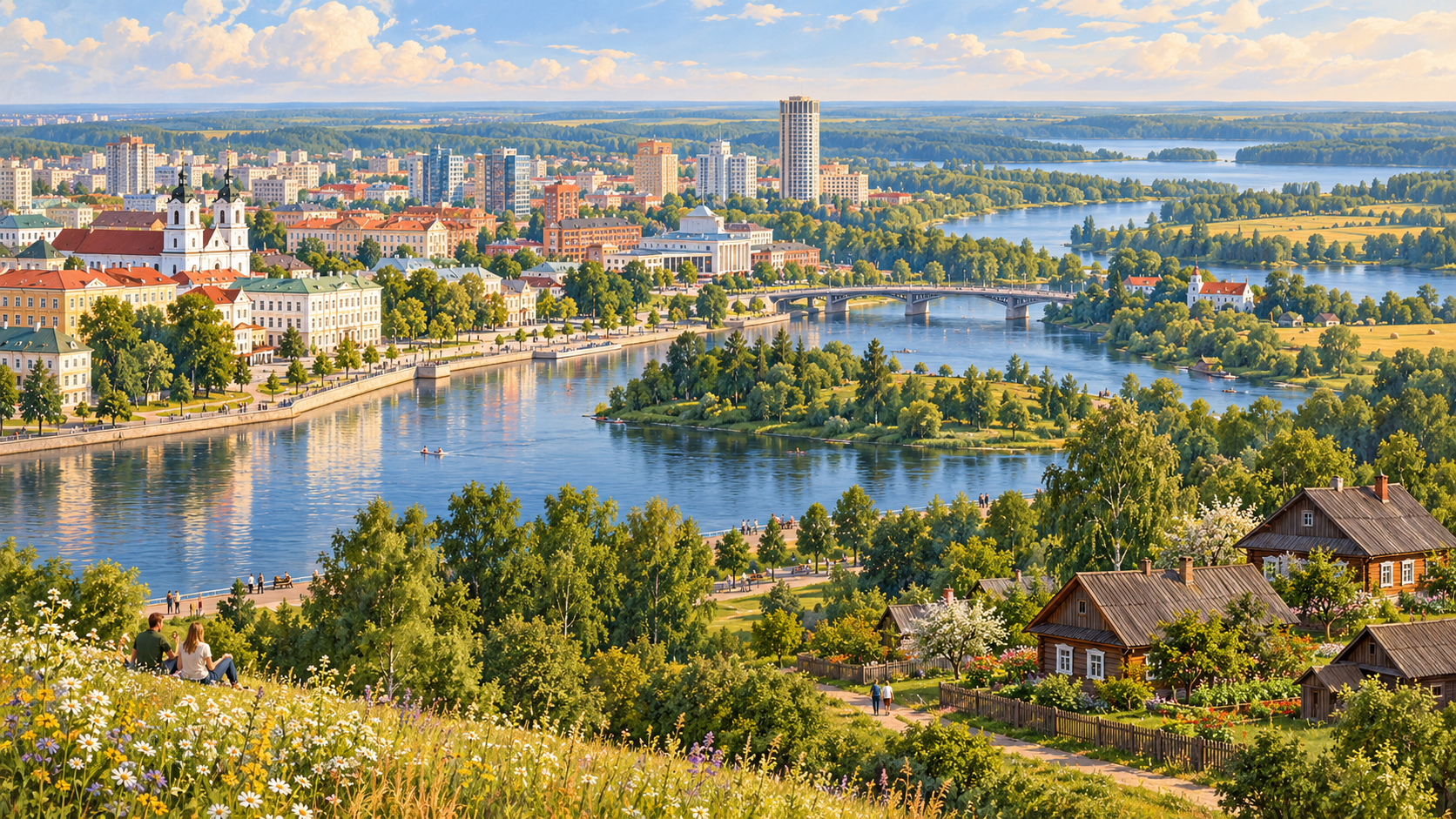
Belarus can be explored thoughtfully through a castle plan, a forest map, a surveying diagram or a recording of living cultural practice. These top 10 things to learn when visiting and touring Belarus connect geography, Mir, Nesvizh, the Struve Geodetic Arc, Białowieża Forest, straw weaving and community traditions in a clear country learning guide. Here, the learning route begins with reliable resources and careful interpretation, allowing curiosity to continue without requiring a journey.
For Singapore families researching Belarus, this educational travel learning guide is designed especially for learning from home. Parents and students can compare architectural layouts, discover why scientific measurement became heritage, and understand craft through English–Chinese vocabulary and short observation tasks. The country is more than a collection of castle photographs: its recognised heritage includes landscapes, technical knowledge, religious practice and skills carried between people. Choose a few questions and let the official sources provide a grounded starting point.
At the source check on 8 October 2026, Singapore time, the UK Foreign, Commonwealth and Development Office advised against all travel to Belarus, including significant arrest risks. This article does not recommend travelling to Belarus or provide an in-person itinerary. Its maps, diagrams, official photographs and recordings support cultural learning from home. Heritage significance does not establish present-day travel suitability; consult your own government’s current advice for any practical decision.
Choose your reading route
Read the ten lessons in order, or begin with the part of Belarus that makes you curious. The short observation tasks are invitations to look closely; they do not require a school worksheet.
Read the landscape · Meet culture and daily life · Connect the bigger story
Full contents · Country learning directory · Travel vocabulary directory
Contents
Read the landscape
Meet culture and daily life
Connect the bigger story
A family learning route from home · A comparison notebook for deeper learning · English–Chinese vocabulary for reading Belarus · Questions families often ask · Continue your country learning journey
Begin with a regional map and locate Belarus within Europe. Then use the UNESCO Belarus World Heritage overview to locate the named heritage subjects in this guide. Keep the maps as learning resources, not as route suggestions. An outline tells you where a place is; it cannot establish whether a border, road or heritage site is accessible or suitable for a visitor today.
This distinction matters especially when cultural research and practical travel conditions point in different directions. A place can have considerable historical value while current advice makes travel unsuitable. The two statements are not contradictory. They answer different questions. A thoughtful reader can appreciate the first without treating it as permission to ignore the second.
For students, compare three kinds of representation. A political map identifies countries and boundaries. A heritage map identifies components selected for their significance. A diagram may explain an architectural or scientific relationship. Each selects information for a purpose. Learning to identify that purpose helps you understand both what a source reveals and what it is not designed to answer.
Try a two-stage sketch from home. First place the heritage names you recognise on a rough outline. Then correct the sketch using reliable maps and label each subject with a learning idea: architecture, measurement, forest ecology or living tradition. Do not turn the diagram into a checklist of destinations. It is a way to organise questions and compare different forms of knowledge.
For Singapore learners, a useful connection is the habit of reading familiar maps critically. At home, local knowledge fills many gaps without you noticing. With an unfamiliar country, those gaps become obvious. Ask which assumptions you would normally make about distance, access or meaning, and which need an appropriate source. The lesson travels well into school research and everyday information checking.
Notice and discuss: Choose one map and state its purpose in a sentence. Name two questions it can help answer and one it cannot. A map used honestly is a powerful learning tool; a map given authority beyond its scope can create false confidence.
UNESCO recognises the Mir Castle Complex for its architectural and historical significance. Study the official account, photographs and available plan from home. Begin with the difference between a striking exterior and an explained building. Towers and walls are visually recognisable, but their history and uses require evidence rather than a story borrowed from a generic idea of a castle.
Look first at arrangement. How do the visible elements relate to one another? Which forms repeat, and where does a larger mass or opening change the composition? Describe those relationships before assigning a purpose. A tower may suggest defence to a novice, but the specific role, period and later alterations should be established by the interpretation of this particular complex.
Next ask about change. Historic buildings can combine construction phases, adaptation and restoration. Do not assume that every surface in a current photograph belongs to one date or that a neat appearance means uninterrupted survival. The official explanation can help you distinguish original development from later treatment. Those distinctions are part of the story, not distractions from the building’s appeal.
For younger learners, draw a simplified silhouette using a small number of shapes. For older learners, compare it with a plan. The silhouette communicates appearance from one direction; the plan explains relationships from another. Neither is the whole building. Explaining their different contributions is a useful skill in both geometry and historical interpretation.
A castle also raises questions about power and people. Who is named in the account, and whose work or daily activity remains less visible? Do not invent the experience of residents, builders or workers to fill the gaps. Record the question and seek another reliable source if needed. An honest partial account can be more meaningful than an elaborate fictional scene presented as history.
Notice and discuss: Select one official photograph and one documented architectural point. Explain how the information changes your reading of the image. Add a question about change or use that the image alone cannot resolve. The exercise moves you from recognition towards interpretation.
LESSON 3 OF 10
3. Use Nesvizh to connect architecture with a wider cultural setting
The Architectural, Residential and Cultural Complex of the Radziwill Family at Nesvizh is recognised by UNESCO for its historical and cultural significance. Its full title is useful: the subject is a complex with several roles, not simply one attractive palace facade. Start with the official explanation and available visual material to understand which components belong to the account.
Ask how a residence can also become part of a larger cultural setting. Architecture may accommodate daily life while also communicating status, supporting institutions or participating in artistic exchange. Use the source for the actual historical relationships. Do not assume that grandeur by itself proves a particular cultural achievement or that every impressive room served the same purpose.
For students, compare the close view with the whole complex. An interior detail may reveal decoration, while a site plan makes connections among spaces clearer. Identify what each source contributes. If interpretation explains a component’s function, add that information with attribution. The exercise teaches you to assemble an account from complementary evidence rather than expecting one photograph to do everything.
Then consider exchange. A culturally significant place may have been shaped through contacts, ideas and skilled work moving between regions. The task is not to infer a maker’s origin from a style you think you recognise. It is to identify the relationships documented by the official account and ask what evidence supports them. Distinctive heritage can emerge through connection as well as local continuity.
For a family discussion, bring labour back into the frame. A complex requires construction, craft, care and maintenance. Which people or practices does the source identify? Which remain questions? Avoid reducing the account entirely to a family’s prestige. The built result depends on human work that deserves attention even when the most memorable image focuses on power or elegance.
Notice and discuss: Choose two officially identified components and explain their relationship. Then write one sentence about a detail that attracted your eye and another about the historical context supplied by the source. Keeping those functions distinct creates a clearer and more trustworthy account.
LESSON 4 OF 10
4. Discover why measurement became heritage in the Struve Geodetic Arc
The Struve Geodetic Arc is a chain of survey points extending across ten countries, with Belarus among them. UNESCO connects the nineteenth-century surveying work with establishing the Earth’s size and shape more accurately. This is a delightful change from the usual heritage expectation: a modest physical marker can belong to a major scientific achievement.
Begin with the word geodetic. It relates to measuring and understanding the Earth. You do not need advanced mathematics to appreciate the central problem: how can carefully made measurements at separate places contribute to knowledge about something much larger than any one observer’s view? The arc makes a relationship between local evidence and large-scale understanding concrete.
Triangulation offers an accessible classroom connection. A simple diagram can show how angles and a measured baseline support the determination of relationships among points. Keep the explanation appropriate to the source and the learner’s mathematics. A paper exercise illustrates a principle; it does not reproduce the accuracy, instruments or extensive work of a historic geodetic survey.
For younger learners, compare a large distance guessed by eye with one investigated through a method. Older learners can ask why repeated measurement, checking and consistency matter. Scientific significance may depend on disciplined accuracy rather than visual spectacle. That is a useful correction to the idea that only large or ornate structures deserve attention.
The cross-border property also teaches cooperation in interpreting heritage. A single point belongs within a wider chain, and the chain crosses modern countries. Do not treat the Belarus components as though they independently explain the entire project. Use the official map to understand the larger arrangement. A small part can be meaningful because of its relationship with other parts.
Notice and discuss: Draw a simple three-point diagram and state exactly what principle it illustrates. Then explain why an official survey point needs the wider project account to become understandable. The exercise connects mathematics, scientific practice and heritage without pretending a classroom sketch replaces specialist work.
UNESCO’s Białowieża Forest account describes a transboundary forest property in Poland and Belarus with major ecological significance, including important European bison habitat. Study the official map and explanation from home. A national border is relevant to administration, but it does not automatically explain the ecological relationships within a forest.
Begin with the difference between scenery and a system. A forest photograph may show trees and light while leaving processes, species relationships and management largely invisible. Ask what the official account explains about the environment’s significance. Do not assume that a beautiful image proves untouched nature, or that a quiet-looking scene contains little ecological activity.
For students, choose one relationship identified by an authoritative source. How does a habitat description connect with the needs of a species or the value of the forest? Keep the scope clear and avoid inventing a full food web from a few familiar animal names. A small, well-supported explanation can provide a strong foundation for further study.
The transboundary setting adds a map-reading lesson. Compare the property map with a political map. Which boundaries refer to the heritage area, and which to countries or other administrative units? They are not interchangeable. Learning to identify boundary purpose helps readers avoid mistaking one type of line for a complete explanation of how a landscape functions or is managed.
Conservation is another distinct question. A designation recognises significance; protection and care require practical arrangements. Use official material to understand what is being conserved and why. This article provides no access route, wildlife-viewing recommendation or permission to enter restricted forest areas. Cultural and ecological learning can proceed through reliable resources while current travel advice remains against a journey.
Notice and discuss: Put an official forest image beside a property map and one sourced ecological point. Explain what each contributes. End with a question the photograph cannot answer. This gives the attractive view a scientific context without demanding more certainty than the evidence supports.
UNESCO recognises Straw Weaving in Belarus: Art, Craft and Skills as intangible cultural heritage. Its account introduces practical and decorative objects, knowledge of materials and craft transmission. The important lesson is that an ordinary-looking material can become a complex form through expertise that is not obvious in a photograph of the finished result.
Start with an officially documented example. Notice how small elements are organised into a larger structure. What repeats? Where does the form change? Use the source’s explanation for technique and material preparation. A viewer may recognise a pattern without understanding how tension, sequence or handling contributes to the result. Observation and process knowledge are complementary.
For younger learners, draw a small visible arrangement from an official image. Older learners can compare practical use with decorative or cultural meaning. Do not assume every straw object has the same function or symbolism. A specific explanation belongs to a specific context, and a general heritage account should not be turned into a universal code for all objects.
Transmission adds a human dimension. Ask how skills are taught and what a novice needs to practise. The source can identify knowledge carried through people, while a demonstration may reveal judgement a written list cannot easily communicate. Avoid presenting craft as effortless tradition. The expertise deserves recognition as work, learning and sustained attention.
You can compare straw weaving with a craft you know at home through one question: what does a finished object conceal about its making? Keep the materials and processes distinct. The point is not to claim the crafts are equivalent but to become more attentive to practical knowledge wherever it appears.
Notice and discuss: Write a caption that identifies the official example, describes one visible structural relationship and adds one attributed process detail. If a maker is not named in the material you used, state that limit. Accurate attribution respects the craft more than inventing a personal story.
LESSON 7 OF 10
7. Learn from tree beekeeping as knowledge linking people and forest
Tree Beekeeping Culture is recognised jointly for Belarus and Poland in UNESCO’s intangible cultural heritage system. The account introduces knowledge and practices associated with bees in tree or log hives in forest areas. This is an opportunity to understand an environmental relationship through human knowledge, not an invitation to copy a specialised practice.
Begin with the difference between an object and a living system. A hive-related image may show a physical arrangement, but the practice also requires understanding conditions and living organisms. Use the official explanation for what practitioners know and do. Do not infer a complete beekeeping method from a short film or treat a heritage resource as practical training.
For students, ask how knowledge can be both environmental and cultural. A practice may involve observation of nature while also carrying social relationships, traditions and meanings. These aspects can connect without becoming identical. A scientific question about bees requires the appropriate evidence; a cultural explanation of a practice requires the relevant practitioners and documentation.
The joint listing also helps you think beyond a simple national container. Shared practice can cross borders while having specific local forms. Do not erase those differences by saying that everything is the same in both countries. Read the source for the relationship it actually describes, and preserve its scope in your account.
For families studying from home, choose a short official film segment and compare it with the written account. What action can you see, and what context comes only from the explanation? Keep questions about tools, safety and participation separate from the cultural learning exercise. This article provides no handling, climbing or beekeeping instructions.
Notice and discuss: Draw a small relationship diagram linking people, knowledge and forest environment using only sourced connections. Then name one point that would require specialist instruction to understand practically. Recognising that boundary lets cultural appreciation remain curious without becoming unsafe imitation.
UNESCO’s Celebration in Honour of the Budslaŭ Icon of Our Lady introduces a religious celebration and pilgrimage tradition. Study its official account and recordings from home. The subject should be approached as meaningful practice for participants, not simply as a colourful event that a visitor might photograph.
Begin with the distinction between watching and participating. A recording can show actions, movement and gathering, but it does not automatically explain what those actions mean to each person. Use the documented interpretation for context and avoid assigning one emotion or belief to everyone visible. A community event can contain individual experiences a public account does not fully capture.
For younger learners, ask how a shared occasion brings people together. Older learners can distinguish religious purpose, communal organisation and cultural transmission. These are related lenses, but none should replace the participants’ faith with a purely touristic description. Respectful learning acknowledges meanings beyond the observer’s own interests.
Look for what the official account says about pilgrimage and the learning of local traditions. Do not turn a recurring description into a current travel programme or claim every practice is performed unchanged each year. Heritage documentation describes significance and continuity; particular circumstances still vary. In this guide, the exercise remains remote and does not encourage travel despite current advice.
Compare with a familiar community or religious occasion through one question, such as how people prepare or how newcomers learn appropriate behaviour. Do not rank traditions or force them into identical forms. The comparison should help you understand the importance of context and respectful attention, including what an outsider should not presume to know.
Notice and discuss: Identify one action in an official recording and the explanation supplied by the source. Then state one aspect of personal meaning you cannot infer by watching. This makes the account more humane and avoids reducing participants to a visible pattern.
LESSON 9 OF 10
9. Understand Juraŭski Karahod through safeguarding and community knowledge
The Spring Rite of Juraŭski Karahod is documented by UNESCO on the List of Intangible Cultural Heritage in Need of Urgent Safeguarding. This is distinct from the Representative List. The designation introduces an important learning question: what happens when a community practice needs support to continue, and who should guide that support?
Start with the official account of the particular community and rite. Avoid turning it into a claim about what all people in Belarus do. Cultural specificity matters. A practice can have significance beyond its local setting while still belonging to identifiable people and circumstances. The wider recognition should make that context clearer, not erase it.
Safeguarding concerns more than saving a recording. A film can preserve an account of a performance, but living practice also involves knowledge, participation and transmission. Read what the source identifies as concerns and measures. Do not invent a solution or assume that promoting the practice to visitors automatically addresses the community’s needs.
For students, compare documentation with continuity. What can an archive retain? What requires people to teach, practise or participate? The two are connected, but they are not the same. This distinction is useful well beyond heritage: a written instruction does not necessarily preserve the ability to carry out a skilled action in context.
An official film offers an appropriate remote learning resource. Watch for one explained action or relationship, then compare it with the written account. Do not recreate a ritual as a classroom performance without understanding and appropriate permission. You can learn respectfully through analysis, discussion and precise attribution without claiming the practice as your own.
Notice and discuss: Explain the difference between documenting a tradition and supporting its continued practice. Use one point from the official account, then identify a question about community priorities. The aim is to understand safeguarding as informed responsibility rather than a slogan about preserving the past.
LESSON 10 OF 10
10. Learn to distinguish heritage recognition, evidence and current access
Belarus’s heritage subjects offer several kinds of recognition: built and natural World Heritage, intangible cultural practice, and a tradition requiring urgent safeguarding. Use the UNESCO World Heritage overview and intangible heritage overview to compare their purposes. None of these designations is a travel-safety assessment or a promise of present access.
This final lesson brings the whole guide together. A castle photograph, survey marker, forest map and craft recording can each provide useful evidence. Their usefulness depends on the question. An image may show arrangement; a written account explains significance; a designation identifies a recognised value; current travel advice addresses practical risks. Confusing those roles can produce an account that sounds confident while answering the wrong question.
For students, make a source table with four columns: source, purpose, supported claim and limit. Choose a small number of examples from the guide. The exercise should not become a paperwork burden. Its value lies in making the relationship between evidence and statement visible. You can then write a short paragraph knowing exactly why its claims are justified.
Pay particular attention to dates and attribution. An archived performance records a particular occasion, not every future event. A heritage account may summarise a historical relationship without supplying every individual experience. A travel-advice page is time-sensitive and must be checked again for any practical decision. Different kinds of information age at different speeds.
Families can use this lesson in ordinary reading too. When a striking image makes a claim feel obvious, ask what the image actually establishes. When a prestigious name appears, ask what that recognition concerns. The goal is not to distrust everything. It is to give each source the right kind of trust and keep curiosity grounded in evidence.
Notice and discuss: Choose one claim from your notes and identify its source, purpose and limit. Revise the sentence if it says more than the source supports. A clearer, narrower statement is often more informative than a dramatic one, and it creates a stronger foundation for the next question.
A family learning route from home
Choose one built-heritage subject, one scientific or natural subject and one living tradition. Mir or Nesvizh can introduce plans and architectural interpretation. The Struve Geodetic Arc or Białowieża Forest adds measurement or ecological relationships. Straw weaving, tree beekeeping, Budslaŭ fest or Juraŭski Karahod introduces knowledge carried through people. All can be explored through official resources without an in-person journey.
Give each learner one question before reading or watching. A primary student might compare visible shapes; a secondary student might examine how a source supports a claim. Afterward, create a small record with expectation, observation, sourced explanation and changed understanding. Drawings, captions and spoken discussion are equally legitimate ways to begin.
Keep practical travel decisions outside the cultural exercise. This guide has not identified a safe route or endorsed visiting Belarus. The current advice against all travel is a material part of its framing. Learning from home is a complete educational choice, not a consolation version that must eventually be validated by reaching the place.
A comparison notebook for deeper learning
Compare Mir and Nesvizh through the relationship between exterior image and plan. Which source helps you understand appearance, and which helps you understand arrangement? Add documented uses only where they are supplied. The exercise reveals how architectural knowledge is assembled while keeping the complexes’ histories distinct.
Compare the Struve arc and tree beekeeping through skilled observation. Both involve knowledge beyond what a casual spectator sees, but their methods, purposes and contexts differ. Ask what training or transmission the sources identify. The common question concerns how people learn to notice accurately, not a claim that scientific surveying and cultural practice are interchangeable.
Compare straw weaving and Juraŭski Karahod through continuity. An object or recording can preserve a result, while continued expertise or participation requires living people. What does the documentation retain, and what must be carried through practice? Use the official accounts to identify the specific relationships rather than inventing a general theory from two examples.
Finally compare the forest property map with the arc map. One represents a natural heritage landscape; the other represents components of a scientific project. Both cross borders, but their lines and symbols have different purposes. Explain those purposes before drawing conclusions. This is a compact exercise in geography, science and source literacy.
English–Chinese vocabulary for reading Belarus
| English | 中文 | A useful learning question |
|---|---|---|
| complex | 建筑群/综合体 | Which components belong to the official account? |
| restoration | 修复 | What is documented about later treatment? |
| geodesy | 大地测量学 | How do local measurements support wider knowledge? |
| triangulation | 三角测量 | What principle does the diagram illustrate? |
| survey point | 测量点 | Why does a small marker need project context? |
| transboundary | 跨国界的 | What kind of boundary does the map show? |
| habitat | 栖息地 | Which ecological relationship is supported? |
| straw weaving | 草编 | How does material become an organised form? |
| tree beekeeping | 树洞养蜂文化 | What specialised knowledge does the source describe? |
| pilgrimage | 朝圣 | How does the account explain participation? |
| safeguarding | 保护与传承 | What supports continued living practice? |
| archive | 档案 | What can documentation retain, and what does it leave out? |
These glosses support English–Chinese reading. They are not a Belarusian or Russian phrasebook, and specialist terms should be understood through their explanations. Use one word in a sentence that identifies a context and provides evidence, then revisit it later to explain the relationship in your own words.
Questions families often ask
Is this article recommending a trip to Belarus?
No. It is framed for learning from home because the official advice checked for this article was against all travel. Cultural significance does not establish present-day travel suitability. The learning route uses maps, official photographs, plans, recordings and heritage accounts rather than an in-person itinerary.
Can a small survey marker really be important heritage?
Yes. Its significance comes from the scientific project and the relationships among points, not from visual size or decoration. The Struve arc offers a useful lesson in disciplined measurement and large-scale understanding. Read the official account to understand the particular marker’s context.
Are all UNESCO heritage lists the same?
No. World Heritage and intangible cultural heritage concern different forms of significance, and intangible heritage lists themselves have different purposes. The urgent-safeguarding designation should not be confused with the Representative List. None certifies current travel access, safety or a product’s authenticity.
How can children learn respectfully from a religious or ritual recording?
Use reliable context, attribute the source and distinguish visible actions from meanings that require explanation. Do not assign one belief or emotion to every participant or turn the practice into an imitation exercise. A thoughtful discussion can recognise significance while admitting what the observer cannot know.
Continue your country learning journey
Return to the country learning directory. The preceding alphabetical guide is Barbados. The next alphabetical guide is Belgium; continue through the directory for Belize, Benin and Bhutan. Explore the travel vocabulary city directory for related language-learning resources.
Belarus’s most useful lesson in this guide is that learning does not depend on physical arrival. A precise map, a well-explained image and an attributed recording can open architecture, science, ecology and cultural practice. When you use each source for what it can genuinely explain, curiosity remains active and responsible. You leave the study session with clearer knowledge and a better question, even while staying at home.