
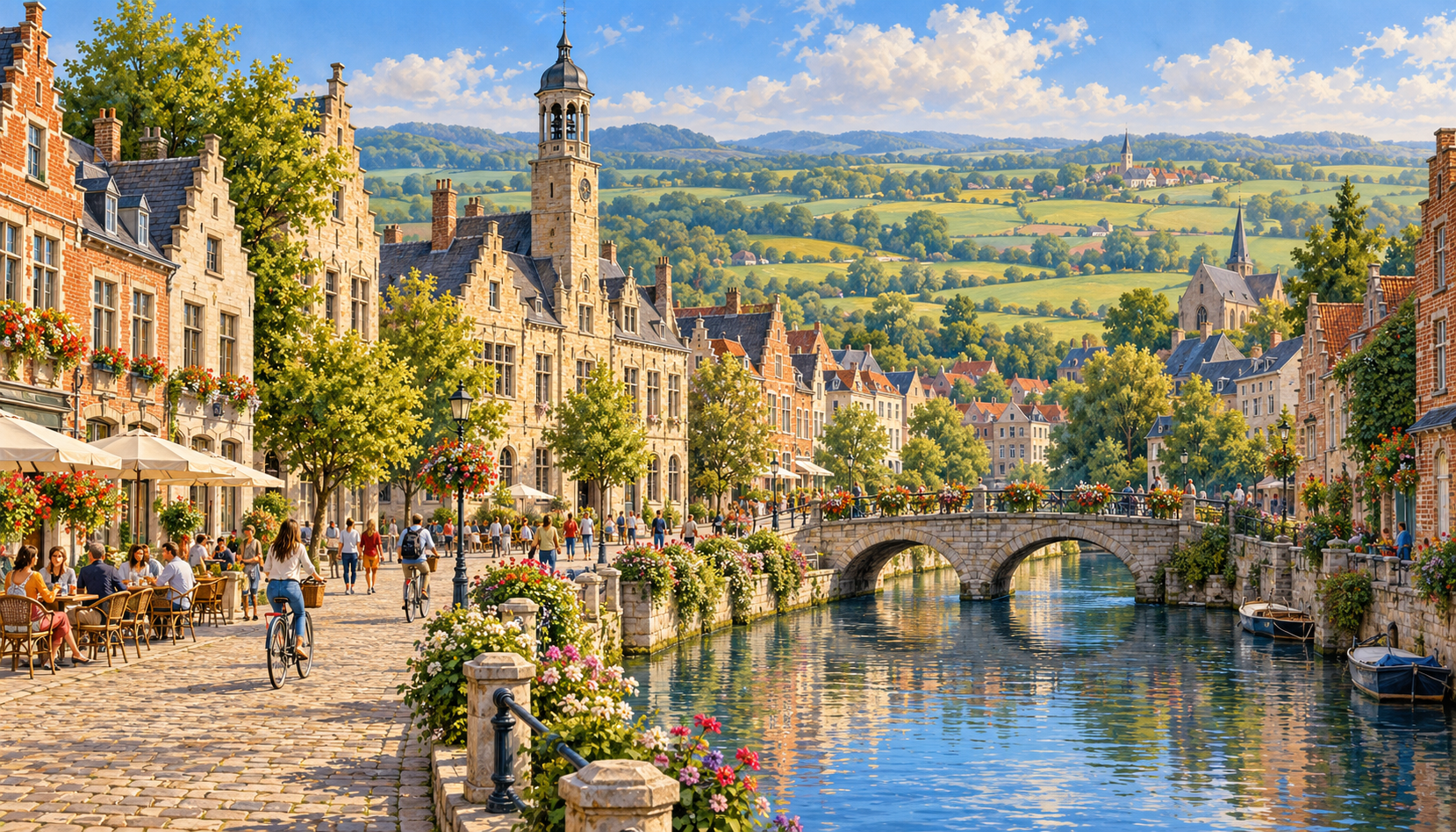
Belgium rewards a visitor who looks beyond the first beautiful square. A bell tower can explain civic power, a printing workshop can reveal how knowledge travelled, and a street sign can open a conversation about language and belonging. These top 10 things to learn when visiting and touring Belgium connect Brussels, Bruges, Antwerp and Wallonia through history, architecture, visual storytelling and everyday life. The country becomes easier to understand when you notice what people built together and why those choices mattered.
For Singapore families planning educational travel in Belgium, a thoughtful question can make a museum or neighbourhood more memorable than another stop on a crowded itinerary. This Belgium travel learning guide offers substantial explanations, gentle observation tasks and English–Chinese vocabulary for parents and students. You can use it before a journey, during suitable cultural visits or while exploring from home. Begin with the subject that interests you, then let one discovery lead naturally to the next.
Check current official Belgium travel advice, entry requirements and venue information before making arrangements. This is a cultural learning guide. It does not supply live transport schedules, opening hours or permission to enter private buildings.
Choose your reading route
Read the ten lessons in order, or begin with the part of Belgium that makes you curious. The short observation tasks are invitations to look closely; they do not require a school worksheet.
Read the landscape · Meet culture and daily life · Connect the bigger story
Full contents · Country learning directory · Travel vocabulary directory
Contents
Read the landscape
Meet culture and daily life
Connect the bigger story
A family learning route for Belgium · English–Chinese vocabulary for reading Belgium · Questions families often ask · Continue your country learning journey
Belgium’s federal government explains that the country has three official languages: Dutch, French and German. Its account of Belgium as a federal state distinguishes language communities from regions. That distinction is a useful first lesson. A language, a territory and an administrative institution can be connected without being the same thing. Reading a map carefully helps you avoid treating the country as one undifferentiated cultural space.
Start with a map showing Brussels, Flanders and Wallonia, then consult the official explanation of the communities. Use two colours in your notes: one for geographical areas and another for language institutions. You are not trying to memorise the entire constitutional structure before breakfast. You are giving yourself enough orientation to understand why a national story may be told through several languages and local perspectives.
A street sign offers a small, practical example. Write down a place name exactly as it appears, then compare it with your map or museum information. You may encounter different forms of a familiar name. Rather than deciding that one must be a mistake, ask which language and context each belongs to. The exercise develops a useful travelling habit: recognise that names carry history, usage and institutional choices.
Language also affects interpretation. An exhibition may offer several versions of a label, and a guide may explain a term that has no neat one-word equivalent in English. Notice what is translated and what is retained. You can learn from that choice without claiming to understand the language fluently. Asking politely how to pronounce a place name often produces a more useful conversation than confidently repeating a guess.
For a Singapore student, compare the question of multilingual public communication rather than assuming the two countries have identical systems. Which languages appear on a particular sign? Who is the intended reader? What does the arrangement help people do? Keep the comparison anchored in actual examples. Shared multilingualism creates an interesting enquiry, while different histories make the answers worth investigating separately.
Notice and discuss: choose one public sign or official page and describe its language choices. Add one fact from the federal explanation and one question about local usage. Your aim is to recognise a relationship between language and public life, not to assign a single identity to every person you meet.
UNESCO’s account of La Grand-Place in Brussels identifies a remarkable ensemble of civic and private buildings. The square offers an inviting way to think about a city as a composition. You can admire one façade, but the larger lesson emerges when you consider how different buildings address the same public space. Architecture here becomes a relationship among owners, institutions, streets and people.
Begin from a suitable public viewing position and trace the outline of the square. Where do streets enter? Which buildings draw your eye first? Which details become clearer when you stop trying to include everything in one photograph? A rough sketch can help. Mark entrances and contrasting façades without pretending that the drawing is a measured architectural plan. The purpose is to slow your attention enough to notice arrangement.
Then consult reliable interpretation for the names and roles of particular buildings. An ornate surface does not tell you automatically whether a building belonged to a civic authority, commercial organisation or private occupant. Once a role is identified, ask how the frontage communicates it. Scale, decoration and position may become evidence in a specific explanation, rather than vague proof that the past was simply grander than the present.
Squares also teach the difference between a historic structure and its current use. People may cross, meet, work, shop or pause in the same space. Describe the activity you actually observe and keep it separate from a historical account. This makes your journal more interesting: it can show both inherited form and present-day life without pretending that the modern scene recreates a particular century.
Parents can turn the exercise into a relaxed conversation. Let each family member select one detail, then share why it caught their eye. Someone may notice a doorway while another notices the view down an adjoining street. There is no need to agree on the best building. Different observations help you understand how a shared setting can support several experiences at once.
Notice and discuss: write a short caption that identifies one building, its documented role and its position within the square. Add a sentence about how you experienced the ensemble. You have moved from collecting a landmark name to explaining how part of a city works visually and socially.
The Historic Centre of Brugge is recognised by UNESCO for its urban and architectural heritage. Brugge and Bruges are names you may encounter for the same city in different language contexts. Its historic streets, public places and cultural associations invite a question more useful than whether the city looks old: how can an inherited urban pattern continue to support a living place?
Choose a small area rather than attempting to read the entire centre at once. On a map, identify a square, a connecting street and a waterway where relevant. During a permitted visit, observe the relationship between them. Does the street open suddenly into a public space? Does a bridge change the view or the route? Describe the connection before reaching for a historical explanation.
The next step is to investigate which parts of the arrangement are documented as historic. A pleasing surface can include restoration, repair and later adaptation. Those processes do not make a place uninteresting. They open another subject: how people decide what to retain and how to care for it. Look for interpretation that distinguishes original fabric, later changes and conservation work instead of assuming that every visible detail belongs to one period.
Art offers a companion route. UNESCO’s account links the city with the painters often called the Flemish Primitives. Use museum interpretation to study a particular work rather than making a claim about an entire artistic movement from a postcard. Where does the painting direct your attention? Which objects or spaces need historical explanation? A single carefully examined image can connect visual skill with the society in which it was made.
For an older learner, compare the city view with an attributed historic image if a museum supplies one. Identify a feature that appears in both and a change you can actually establish. Resist the temptation to fill gaps with nostalgia. A city may preserve important relationships while altering materials, uses or circulation. The interesting story lies in those specific continuities and adjustments.
Notice and discuss: make a two-part note headed “what I can see” and “what the interpretation explains.” Include one urban relationship and one conservation question. This helps you enjoy the atmosphere while also learning something that remains useful after the photograph has become familiar.
The UNESCO property Belfries of Belgium and France recognises towers associated with urban institutions and civic authority. The shared inscription crosses a modern national border. Its useful lesson is that a building type can express a historical relationship across several towns, while each example still belongs to its own local circumstances. Similarity is a starting point for comparison, not a substitute for it.
A tower changes how a town is seen. From a public space, notice where it rises in relation to other buildings. Is it part of a larger complex? Which approaches reveal it clearly? You need not climb it to understand these relationships. A ground-level sketch can show how height establishes a visual reference within an urban setting, without turning a cultural lesson into a physical challenge.
Next, read the interpretation of the particular belfry. Ask which civic functions are documented and how the building served them. A tower can hold several meanings, including communication, authority and public identity, but you should not assign every possible function to every example. A local explanation gives the general idea a precise place and period. Record the distinction between a building type and the history of this building.
The comparison becomes richer if you study two belfries through official material. Use the same questions for both: relationship to the square, associated institution, documented function and changes through time. Avoid ranking them simply by height or decoration. The aim is to see how a shared architectural language could be adapted to different urban needs, resources and historical developments.
For a student, civic power can initially sound abstract. Bring it back to familiar questions. Who made decisions for the town? Where were those decisions represented publicly? How did residents recognise an institution’s presence? You are not claiming that a medieval town operated like a modern school or municipality. You are using an understandable question to approach a different political setting carefully.
Notice and discuss: explain one sourced connection between the tower and urban authority. Then identify a visible feature that helped you remember it. A strong account joins the historical role with the particular building, rather than leaving the tower as a decorative shape against the sky.
UNESCO’s Flemish Béguinages introduces historic communities of beguines and the architectural settings associated with them. These ensembles can include homes, religious buildings and shared spaces. They offer a thoughtful lesson about how an arrangement of buildings supports a form of community life. Begin with the official historical explanation, because the relationship between beguines and religious institutions is more specific than a general label such as convent.
Look at a plan before a visit. How are homes related to paths, open areas and communal buildings? A small diagram can reveal an arrangement that a close photograph misses. When access is permitted, observe transitions between public approach, shared space and individual entrances. Follow current visitor instructions and respect present occupants. Historic significance does not turn someone’s home into a freely accessible exhibit.
The central question is how architecture can support both individual life and collective organisation. You may see separate dwellings within a coherent ensemble. That observation gives you a starting point, but historical sources are needed to explain rules, obligations and social relationships. Do not infer a resident’s freedom, wealth or daily routine from the pleasant appearance of a courtyard.
For younger learners, begin with the difference between a private doorway and a shared path. Older learners can investigate how women organised particular forms of religious and social life in a historical setting. Keep the enquiry tied to the beguinage being studied. The past contains varied experiences, and a broad statement about all women would flatten the subject instead of making it clearer.
This is also a good place to think about quiet visiting. Notice whether your own behaviour fits the setting: speaking softly, avoiding blocked entrances and observing photography guidance. Courtesy becomes part of understanding how shared spaces work. You are using an inherited environment alongside people whose relationship with it may be very different from yours.
Notice and discuss: draw a simple relationship between one dwelling, one shared space and one communal building identified by interpretation. Explain what the arrangement helps you ask about community life. Include one limit: something the plan cannot tell you without further historical evidence.
The UNESCO inscription Major Town Houses of the Architect Victor Horta in Brussels highlights houses important to the development of Art Nouveau. The learning opportunity goes beyond recognising a curved line. Study how a building brings together circulation, materials, light and decoration. An architectural style becomes easier to understand when you can explain what it does within a particular space.
Begin with official images or a properly arranged visit to an accessible example. The inscription contains several houses; it does not guarantee that every property is open to visitors. Check the managing institution’s current arrangements. From the material available, choose one interior relationship, such as a stair and the spaces it connects. Describe the sequence rather than reducing the building to a list of attractive details.
Light is a useful question because it changes experience. Where does illumination enter, and which parts of a room or stair does it reveal? A photograph may help you identify an opening, but it captures a particular moment and exposure. Avoid assuming that the room always looks exactly as pictured. Use architectural interpretation to understand the design, then state your own observation as a specific viewing experience.
Materials offer another route. Where a source identifies metal, glass or another material, ask how its use relates to structure and visual effect. You do not need engineering expertise to notice a relationship, but you should not declare that a decorative element carries a load simply because it appears strong. A guide or reliable account can clarify the difference between support, enclosure and ornament.
For an art-minded student, try drawing one line through several related elements. Does a shape recur in a railing, opening or decorative feature? The exercise trains visual attention without requiring you to copy an entire interior. For a design-minded learner, focus on movement instead: how a person enters, changes level and sees another space. Both approaches can deepen appreciation of the same house.
Notice and discuss: finish the sentence “This design connects…with…” using an observed relationship and a sourced explanation. A statement about light and movement is often more revealing than calling the building elegant, because it gives another reader something specific to imagine and understand.
The Plantin-Moretus House-Workshops-Museum Complex in Antwerp connects printing equipment, domestic spaces, collections and business records. UNESCO’s account makes it a rich setting for learning how knowledge becomes a material object and reaches readers. A book is the result of decisions and work. Studying the workshop helps you see stages that disappear behind a finished page.
Start by choosing one displayed stage of production identified by the museum. It might concern type, a press, paper or editorial work. Describe what the object does according to the interpretation. Do not assume that seeing equipment is the same as understanding its complete operation. The useful first step is to place one tool within a sequence: what must happen before it is used, and what happens afterward?
Then consider the page as an organised space. Look at a permitted example and notice margins, arrangement, lettering and any illustration. How does the page guide attention? Which information is prominent? A historical printed page can be compared with a modern textbook or website through the shared question of readability, while recognising that its materials, audience and production circumstances differ.
The business records add a second dimension. Printing required relationships among workers, authors, suppliers and buyers. Use the museum’s explanation to identify a documented connection rather than imagining a universal story of effortless progress. Making a text reproducible did not automatically determine who could obtain it, understand it or publish competing ideas. Those are historical questions that deserve their own evidence.
For a family activity, create a short page at home. Assign roles for writing, checking, arranging and sharing, then discuss which decisions affected the result. This does not recreate an early modern printing house. It gives learners a modest experience of coordinated publication, making it easier to appreciate why a museum preserves equipment and archives alongside finished books.
Notice and discuss: write a four-step sequence based on the museum’s interpretation, marking any stage you did not observe directly. Add one sentence about the intended reader. You have connected a machine with human work and communication, which is the real story behind an impressive old press.
The Major Mining Sites of Wallonia offers a different view of Belgium from its celebrated squares and town houses. UNESCO recognises a series of sites connected with coal mining and industrial history. These places invite you to keep workers, communities and the organisation of production within the country’s story. A landscape of industry can be as historically revealing as a palace.
Begin with a diagram or museum explanation of the site being studied. Identify which structures served production, movement, administration or domestic life where the source provides those roles. Avoid trying to infer the whole system from a tall structure or a piece of machinery. Industrial equipment often needs interpretation before its relationship to other parts becomes understandable.
The most useful question is who worked within the system and what knowledge the work required. Look for attributed accounts, objects or records that make people visible. A tool may reveal a task, while a testimony may explain an individual’s experience. Those sources contribute differently. Keep a personal account attached to its speaker and circumstances rather than turning it into the experience of every worker.
Students can also explore the relationship between workplace and settlement. Where interpretation identifies housing or communal facilities, ask how they relate spatially to the industrial site. This does not justify assuming that every family’s life followed one pattern. It helps you investigate the ways production could shape surroundings, movement and daily routines beyond the immediate place of work.
Conservation creates another layer. A former industrial structure may now support education or cultural visiting. Ask what is retained, how it is explained and which parts require protection. Repurposing can make a site accessible while changing its function. The result should be understood as a present-day interpretation of industrial history, not as a working environment frozen at one moment.
Notice and discuss: select one machine or building and connect it with a documented task and a human question. Then write one difference between its historical role and its present use. This gives your account a clear thread from material evidence to labour, community and public memory.
Brussels’ Comic Art Museum permanent exhibitions provide an official starting point for exploring Belgian comics. The subject is more than a collection of familiar characters. A comic uses images, words, sequence and the spaces between panels to make a reader follow events. Learning how that works can change the way a student reads both art and narrative.
Choose a page available for public viewing and read it once for the story. Then return to it slowly. What does the first panel establish? How does the next panel alter time, viewpoint or action? Where do words add information that the image does not supply? You do not need to reproduce the artwork in your journal. A written description of two panels can demonstrate the relationship clearly.
Pay attention to what the reader supplies between panels. The page may show an action beginning and then its consequence, leaving you to infer the intervening moment. That inference is part of reading. It is different from inventing an unsupported historical fact: the narrative invites you to connect depicted events within its own structure. Discuss which clues made your interpretation possible.
Translation adds a companion question. If the exhibition presents language versions, notice whether a joke, sound effect or speech bubble changes. Do not assume that a literal translation would produce the same reading experience. Space, rhythm and cultural reference can matter. This makes comics a friendly route into the serious subject of how meaning is carried across languages and formats.
At home, draw a simple three-panel story about a small travel discovery. Keep the event ordinary: noticing a sign, asking a question, understanding a place name. Decide what each panel contributes. The activity is not a contest in drawing skill. It helps you recognise the authorial choices behind a page that may initially seem effortless or purely entertaining.
Notice and discuss: explain one change between two panels and how it affected your understanding. Attribute the work according to the exhibition. A precise observation about sequence respects the artist’s craft and gives you a technique you can use in your own writing, presentations and visual communication.
Belgium’s lessons become especially rewarding when you connect two subjects without forcing them into the same story. A belfry and a printed book both raise questions about communication, but they served different purposes. A beguinage and a mining settlement both invite enquiry about community, but their histories and institutions differ. Comparison works best when the shared question is clear and the differences remain visible.
Choose two examples you have actually studied. Write the question first: how is authority represented, how does information reach people, or how does a place organise shared life? Then make a short table with evidence for each. One side might use a building plan while the other uses a page or an object label. Identify the source type so that unlike evidence is not silently treated as interchangeable.
The next step is to explain the relationship in ordinary language. Try a paragraph with three moves: introduce the shared question, describe the first example, and show how the second changes or extends your understanding. Avoid a sweeping claim such as “Belgium has always valued community.” That statement is too broad for two observations. A narrower account is often more interesting because it shows what you really learned.
For younger learners, comparison can begin with a visible feature: two entrances, two ways of arranging text, or two public spaces. Older learners can add historical context and the limits of the comparison. Family members need not select the same pair. One person may connect comics with printing, another urban squares with belfries. Sharing those choices gives the journey several thoughtful endings.
This final exercise also helps you decide what to investigate next. Perhaps the language lesson left a question about local names, or industrial heritage made you curious about a worker’s account. Keep that question beside the source you would consult. A good learning guide should leave you with a clearer enquiry, not the impression that ten chapters have completed the history of a country.
Notice and discuss: write one comparison using two named examples and one shared question. Finish with a difference that matters. When you can explain both the connection and its limit, you have built an account that is memorable, fair and useful to another curious reader.
A family learning route for Belgium
Choose a manageable cluster that fits your actual itinerary and current venue access. In Brussels, language, the Grand-Place, an accessible Art Nouveau interpretation and comics can create a coherent learning route. In Antwerp, printing offers a substantial subject in its own right. Bruges and Wallonia add different questions about urban continuity and industrial history. These are learning combinations, not a promise that all visits can be completed in one day.
Before an encounter, give each learner one small role. One person can identify a place name, another notice an arrangement, and another read the source explanation. During the visit, allow time for enjoyment and unexpected interest. A child who becomes fascinated by a press should not have to abandon that curiosity merely because the family planned to discuss something else.
Afterward, make a shared page with three entries: a detail, an explanation and a question. The detail might be a stair, a panel sequence or an entrance to a square. The explanation should come from reliable interpretation. The question is what you would still like to understand. This simple format gives the visit a lasting shape without turning a holiday into an assessment.
At home, return to one image or note a week later. Can the learner still explain the relationship? If the memory is only a name, revisit the source and add context. If the account has become clearer, notice that progress. Learning through travel often develops after the journey, when a particular place can be connected with something encountered in a book, class or conversation.
English–Chinese vocabulary for reading Belgium
| English | 中文 | A useful learning question |
|---|---|---|
| multilingual | 多语言的 | Which languages serve this public setting? |
| federal state | 联邦国家 | Which institutions does the official explanation distinguish? |
| façade | 建筑立面 | How does a frontage address a shared space? |
| urban ensemble | 城市建筑群 | How do several buildings work together? |
| belfry | 钟楼 | What civic role is documented here? |
| beguinage | 贝居安女修会社区 | How are individual and communal spaces arranged? |
| circulation | 动线/通行组织 | How does a person move through the building? |
| Art Nouveau | 新艺术风格 | How do material, line and space relate? |
| typesetting | 排字 | Which stage of producing a page does it support? |
| archive | 档案 | What can a record establish about work? |
| industrial heritage | 工业遗产 | Whose tasks and experiences are represented? |
| visual narrative | 视觉叙事 | What changes between these two panels? |
Use the Chinese glosses to support conceptual understanding. They are not translations into Belgium’s local languages. Build a sentence around a particular example rather than learning the term alone: a word such as circulation becomes meaningful when you can explain a real sequence of spaces.
Questions families often ask
Must we visit every place in the guide?
No. Ten lessons provide choices, not a compulsory itinerary. One well-understood museum or urban setting can support several questions. Select according to interest, access and the time available. A relaxed visit that leaves you with a clear explanation is often more satisfying than several hurried stops that produce only a list of names and photographs.
How much historical knowledge should a child have beforehand?
Enough to recognise the subject and ask one question is a good start. A young learner can notice a doorway, page or tower before mastering dates and institutions. Add context through reliable interpretation during and after the encounter. Older students can investigate the evidence more deeply, but the family does not need to study a full national history before enjoying the country.
Can we learn about architecture when an interior is closed?
Yes. Public exterior views, official plans and museum resources can support a focused architectural question. State whether your knowledge came from a visit or from research. Do not enter restricted spaces or imply that an inscription guarantees access. A documented plan may explain a relationship more clearly than a brief visit, especially when the interior requires specialist interpretation.
What makes a useful travel journal?
A useful journal preserves a relationship you can explain. Record the place, the particular detail, the source and your response. Keep observation separate from researched knowledge, while allowing them to inform each other. You do not need polished prose on every page. A rough sketch with an accurate caption can become a stronger memory aid than a beautifully written but unspecific paragraph.
Continue your country learning journey
Return to the country learning directory to choose another guide. The preceding alphabetical article is Belarus, framed for learning from home, and the next is Belize. Use the World City Travel Vocabulary Directory for companion language learning, or the World Travel & Luxury Hub to explore the wider project.
Belgium’s lasting lesson is that meaning often lies between things: a building and its square, a tool and its worker, a language and its public setting, a picture and the next panel. Once those relationships become visible, familiar travel subjects acquire depth. You bring home a way of reading places that can make the next country, museum or ordinary neighbourhood just as interesting.