
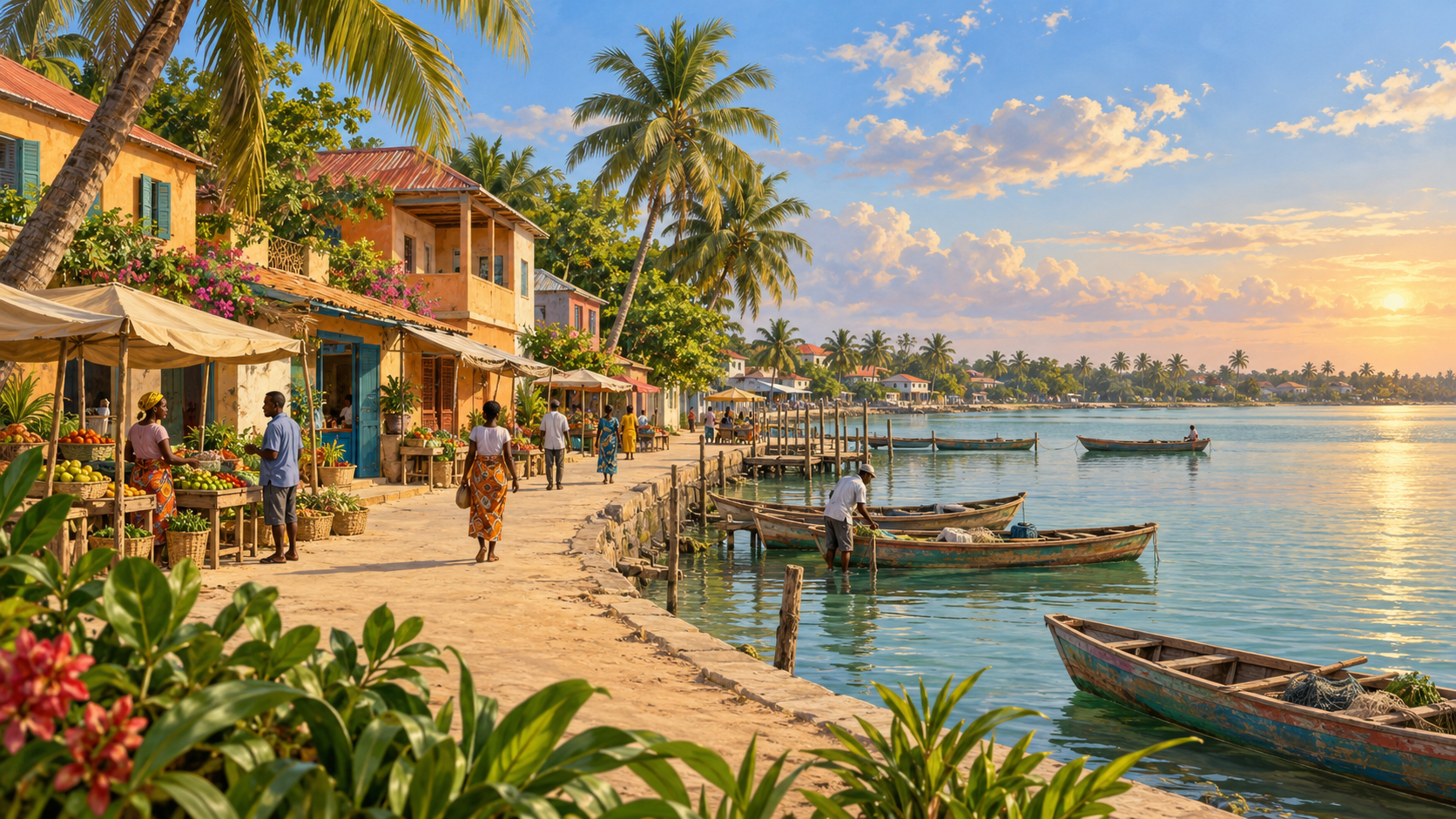
Benin invites a visitor to connect impressive places with the people, histories and practices that give them meaning. Abomey’s palaces open questions about royal authority, Ganvié makes water part of everyday urban life, and Ouidah asks for careful attention to memory and living culture. These top 10 things to learn when visiting and touring Benin bring geography, architecture, craftsmanship, spiritual traditions and contemporary art into a clear country learning guide. The most rewarding discovery is often the relationship behind a detail you first noticed only for its appearance.
For Singapore families interested in educational travel in Benin, thoughtful preparation helps turn an encounter into understanding. This Benin travel learning guide offers ten substantial lessons, English–Chinese vocabulary and conversational observation tasks for parents and students. Use the official resources to research suitable cultural visits or study from home. Different parts of the country require different practical judgements, and some subjects below are explicitly remote learning topics because cultural significance does not establish present-day travel suitability.
At the source check on 8 October 2026, Singapore time, FCDO Benin travel advice advised against all travel to Parc du W, Pendjari and specified border areas, and against all but essential travel to other specified areas, including the remaining parts of Alibori and Atacora. Read its current map and full guidance alongside your government’s advice. The northern architecture and W-Arly-Pendjari lessons here are for learning from home, not an itinerary recommendation.
Choose your reading route
Read the ten lessons in order, or begin with the part of Benin that makes you curious. The short observation tasks are invitations to look closely; they do not require a school worksheet.
Read the landscape · Meet culture and daily life · Connect the bigger story
Full contents · Country learning directory · Travel vocabulary directory
Contents
Read the landscape
Meet culture and daily life
Connect the bigger story
A family learning route for Benin · English–Chinese vocabulary for reading Benin · Questions families often ask · Continue your country learning journey
Start with a country map and locate Cotonou, Porto-Novo, Ouidah, Abomey and Ganvié. Then identify the northern subjects that appear in UNESCO resources and official travel warnings. The official Benin tourism overview introduces several cultural and geographical routes. Your first task is to understand where the subjects belong, while keeping their significance separate from the question of whether travel there is appropriate.
A useful research map contains more than a collection of destination dots. Label each place with one enquiry: public art, political history, water-based settlement, memorial interpretation or craftsmanship. This connects a location with a purpose. It also helps you avoid trying to put every interesting subject into one journey. A coherent learning route may include remote research and a few suitable cultural encounters rather than a long list of movements.
Check the map’s scale and legend before drawing conclusions. A line on a national map can hide local conditions and the arrangements needed to travel. The map can locate a relationship, but it cannot grant access or tell you that a road, boat journey or border area is suitable. Keep a separate planning note for current official advice and professional local guidance instead of blending those judgements into the heritage map.
For younger learners, draw a simple outline and add a few named subjects. Older students can compare a tourism map with a heritage-property map and a current advice map. Ask what each is designed to communicate. Their boundaries may describe different things: a cultural property, an administrative area or a risk zone. Understanding that difference is a substantial lesson in reading information responsibly.
The Singapore comparison can begin with how you organise familiar places by purpose. A museum, a port and a residential neighbourhood answer different questions even when they appear close on a map. Use that familiar habit to approach Benin, then let local sources explain the particular histories. Comparison should make you more attentive to difference rather than assume that every coastal city works in the same way.
Notice and discuss: place three named subjects beside three learning questions and their sources. Mark any subject that should be studied remotely under current advice. Your map now shows a thoughtful research plan, with cultural curiosity and practical judgement each doing their proper job.
UNESCO’s Royal Palaces of Abomey introduces the palace heritage associated with the historic Kingdom of Dahomey. The site offers a way to investigate how architecture, symbols and material objects can communicate royal power. Begin with the historical account rather than assuming that an impressive compound explains itself. A palace is a setting for institutions and relationships, not merely a large residence.
Use an official plan or authorised interpretation to identify the parts being presented. Which spaces or structures are connected with particular rulers or functions? Record the explanation precisely. A visitor may see walls and courtyards, but the identification of their historical roles comes from knowledge beyond appearance. Keeping that distinction clear makes your account more substantial and avoids inventing a royal routine from a pleasing view.
Symbols require particular care. If the interpretation identifies an emblem or relief, ask whose association it carries and what the source explains about it. Do not treat every animal or shape as a freely decodable national symbol. Meanings can belong to a ruler, an event or a particular historical context. A clear attributed explanation is more useful than a dramatic guess that sounds convincing to someone unfamiliar with the subject.
For a student, the palace also raises questions about what public history chooses to preserve. Which objects, structures and accounts are available? How are changes and conservation explained? You can appreciate craft and architectural achievement while still asking about the people governed, employed or affected by royal institutions. Historical power should not become an uncomplicated story of splendour simply because the visible remains are compelling.
Families can focus on one documented relationship: an object and a ruler, a space and a function, or a building and a conservation issue. There is no need to memorise a complete sequence of reigns during a brief encounter. A small accurate connection gives the subject a firm starting point and leaves room to investigate the wider political history through reliable reading afterward.
Notice and discuss: write a caption identifying one feature, its sourced association and the question it helps you ask about authority. Add something the feature cannot establish by itself. This respects the historical evidence and makes the palace more meaningful than a photograph labelled only with its name.
The official Ouidah city guide presents the city as both a place of living spiritual traditions and a setting of memory connected with the slave trade. Its memorial subjects require a different kind of attention from a casual sightseeing checklist. Begin by recognising that the history concerns people whose freedom and lives were violently taken, as well as the institutions and networks involved.
Research the interpretation before a suitable visit or remote study. Identify the named memorial or route and the history it is intended to present. A present-day monument commemorates an event or process; it is not automatically an unchanged object from that historical moment. Ask what is original evidence, what is later commemoration and what explanation connects them. This distinction helps you understand how societies remember difficult histories publicly.
Use clear language when writing. “Enslaved people” keeps the people visible rather than turning their condition into their entire identity. Avoid invented first-person scenes, fictional quotations or emotional details presented as documentary fact. A sober account can be powerful without pretending to know an individual’s thoughts where no testimony has been supplied. The source’s evidence should determine the claims you make.
For children, choose an age-appropriate explanation and allow questions to guide the pace. A younger learner may begin with the injustice of taking away someone’s freedom. Older students can examine power, trade, memory and the way historical responsibility is represented. Parents do not need to turn the encounter into a lecture, but they should not soften it into an adventurous story of travel or exchange.
Photography and journal tasks should fit the setting. A commemorative space calls for attention to local instructions and the people present. You may choose to make no photograph at all and instead record what the interpretation helped you understand. The value of the encounter lies in thoughtful learning, not in producing an image that makes suffering into a dramatic background.
Notice and discuss: identify the memorial’s stated purpose, one historically grounded point and one question about public remembrance. Keep personal response separate from documented knowledge. A strong note can acknowledge sadness or discomfort while remaining accurate about what the source actually establishes.
The official Ganvié destination account introduces a lakeside settlement on Lake Nokoué, with buildings and movement closely related to water. The useful lesson is how an environment becomes part of everyday organisation. Begin with the named place and its local interpretation, rather than reducing it to a picturesque label or assuming that a visitor’s boat view reveals every part of residents’ lives.
Study a map or official images first. Notice the relationship between structures, open water and routes of movement. What questions does the arrangement raise about arriving, exchanging goods or maintaining a building? These are enquiries for reliable interpretation and willing local experts. A photograph can show an arrangement but cannot establish household routines, ownership or the full economic circumstances of a community.
If undertaking a suitable authorised visit, treat the setting as a lived place. Ask about photography, avoid intrusive images of residents and respect the guide’s boundaries. A home or workplace does not become a stage because a boat can pass nearby. Courtesy improves learning by recognising that your encounter is brief while other people’s relationship with the place is ongoing and much more complex.
For younger learners, compare one movement they know well with a movement explained here. How does a person get from one place to another in this particular setting? Older learners can ask how infrastructure and services are organised, using current local sources. Keep the comparison precise. Water-based settlement does not justify assuming that all residents share the same occupation or face identical challenges.
The architecture can also raise a question about adaptation. Which features does the interpretation connect with the environment? Where does repair or maintenance enter the account? Do not conclude that a visually striking arrangement is either effortlessly harmonious or inherently deficient. The useful story concerns practical knowledge and decisions, and those are best explained by the people and institutions familiar with the setting.
Notice and discuss: draw one relationship between a building and a route of movement, using an official map or permitted observation. Add the local explanation and one unanswered question. You have shifted from seeing an unusual view to asking how a particular place supports everyday life.
The official Porto-Novo city guide identifies Benin’s political capital and highlights Afro-Brazilian heritage, façades and the Grand Mosque’s architectural connections. These subjects offer a useful way to think about movement and adaptation. A building can carry influences across places while serving a distinct local role. Similar appearance becomes meaningful only when a reliable historical explanation supports the connection.
Choose one named building or a small group of façades from the official material. Describe shape, arrangement and relationship to the street before interpreting origin. What is visible from a public position? Which details require specialist explanation? You do not need to enter a religious building to begin the architectural question. Check current access and behaviour guidance before any visit, and respect worshippers and restricted spaces.
The Afro-Brazilian connection should be studied as a history of people, not simply decorative borrowing. Ask what the interpretation explains about the movement of communities and the making of local architecture. Avoid inventing a builder’s biography or assuming that every similar façade has the same origin. A specific sourced connection is more illuminating than a broad statement that an entire city looks like somewhere else.
For students, compare function and form. A building may use an architectural vocabulary associated with another context while meeting the needs of its own users. This opens an interesting design question: what is retained, adapted or reinterpreted? The answer requires documentation, but noticing the question can change the way you read urban environments at home as well as abroad.
A family activity can focus on an entrance, window or roofline identified in the source. Each learner selects a detail and describes it without reaching immediately for praise. Then add the historical point that helps explain it. Precision is enjoyable: a building becomes easier to remember when you can say what caught your attention and how the explanation altered your understanding.
Notice and discuss: connect one visible feature with one documented cultural relationship. Add the building’s identified role and a limit to your inference. The result should explain something about this place, rather than using resemblance as proof that two cities or communities share an identical history.
The official Heritage and Traditions guide presents Vodun among Benin’s living cultural and spiritual subjects. Approach it through local interpretation and legitimate public resources, with the same respect you would bring to a religious setting anywhere. Popular stereotypes are a poor starting point. The purpose is to understand what practitioners and knowledgeable institutions choose to explain, not to pursue an imagined spectacle.
Begin with terminology. Which spelling and terms does the local source use? What does it identify about the particular place or practice? A short explanation of one setting is more useful than pretending that a single visit can summarise a complex religious world. Keep the source’s scope visible. An account of a public cultural presentation may differ from an explanation intended for a sacred or restricted context.
Permissions are part of the subject. Ask before photographing people, objects or activities, and follow the host’s instructions about where visitors may stand or enter. Some knowledge may not be offered publicly. Respecting that boundary is not a failure to learn. It is an understanding that the people involved have authority over how their lives and practices are encountered and represented.
For children, begin with an ordinary principle: people may understand and honour the world in ways that are unfamiliar to us, and we can listen without mocking or pretending to participate. Older students can investigate the relationship between public interpretation, heritage and religious practice. Keep curiosity separate from judgement about what another person’s belief should mean.
If a guide explains an object or action, record the explanation with attribution. Avoid assigning supernatural claims of your own or turning a person’s belief into a statement you present as universally established fact. You can write “the guide explained that…” accurately and respectfully. That phrasing keeps the speaker, context and kind of knowledge visible while allowing readers to understand what you learned.
Notice and discuss: choose one term or subject explained by an authorised source and state its context. Add a question about appropriate visitor behaviour. The strongest outcome is a clearer, less stereotyped understanding, with recognition that a public introduction opens a subject rather than giving unrestricted access to it.
UNESCO’s Oral heritage of Gèlèdè connects masks, dance, chants and Yoruba-Nago cultural knowledge in a multinational inscription involving Benin, Nigeria and Togo. This is intangible heritage: its significance lies in living practice and transmission, not merely in an object displayed behind glass. A mask can be striking, but it should not be detached from the knowledge and relationships that give it context.
Begin with an attributed public recording or a knowledgeable explanation of an appropriate presentation. Notice how several forms contribute. What is visible, what is audible and what requires verbal interpretation? A dance movement, a carved form and a chant may be encountered together, yet your understanding of each may differ. Record those differences instead of presenting a single confident meaning for everything you see.
The multinational inscription offers a careful geographical lesson. Heritage can be practised across present-day borders. That does not mean every community presents it identically or that all cultural contexts are interchangeable. Use the UNESCO account for the shared framework, then consult local interpretation for a particular example. A broad designation and a specific encounter answer related but different questions.
For a younger learner, focus on one observed relationship, such as a change in movement alongside a sound. Older students can investigate how knowledge is taught and how a public presentation relates to ongoing practice, where reliable sources discuss it. Avoid assuming that a recording explains the entire tradition. It gives you a selected view, made for a particular purpose and audience.
Credit performers and interpreters when information is available, and follow recording guidance. Cultural practitioners should not disappear behind phrases such as colourful entertainment. Their work involves knowledge, preparation and judgement. The enjoyable part of the lesson is learning to notice that skill, while allowing the source to explain historical and social meanings that a visitor cannot infer independently.
Notice and discuss: describe one relationship among visual, musical or verbal elements, then add an attributed contextual point. State whether you learned through a recording, reading or an invited encounter. This keeps the living practice at the centre and avoids presenting a brief glimpse as a complete cultural account.
The official indigo trail introduction in Ouidah provides a starting point for researching textile craftsmanship. A finished blue cloth can draw attention immediately, but its deeper lesson concerns choices in making. Ask how a particular workshop explains material, pattern, sequence and finishing. The object becomes more interesting when the skilled work behind its appearance is visible.
At a legitimate demonstration, identify the stage being shown. Which preparation has already happened, and what follows? A visitor may see only a short part of the process. Mark that limit in your notes. You can understand the role of one action without claiming to have witnessed the entire production sequence or to know how every maker works.
Pattern offers a useful visual question. Where the host explains a technique, ask how it produces the relationship between coloured and uncoloured areas. Describe the actual explanation rather than guessing from the finished design. Do not reach into materials, use tools or touch unfinished work without permission. A workshop is a place of skilled activity, and visitor participation should follow the maker’s arrangements.
For students, ask how judgement enters the process. Timing, handling and consistency may matter in ways that are not visible in a static photograph. The maker can explain which decisions affect the result. This is a good lesson in practical expertise: knowing a sequence of verbs is not the same as being able to achieve a reliable outcome in unfamiliar circumstances.
If considering a purchase, ask about maker, material and care. A sales setting does not automatically establish local manufacture or the intended use of an item. You can appreciate the demonstration without buying anything. The learning goal is to recognise a specific practice and credit the knowledge involved, rather than using a souvenir as proof of a supposedly authentic encounter.
Notice and discuss: record one action, its explained purpose and a question about a stage you did not observe. Add a precise description of a finished feature. This connects process and appearance, allowing the cloth to remain a beautiful object while also becoming evidence of practical knowledge.
Two UNESCO subjects introduce northern landscapes through different kinds of heritage. Koutammakou, the Land of the Batammariba concerns a cultural landscape shared by Benin and Togo. The W-Arly-Pendjari Complex concerns protected natural areas across Benin, Burkina Faso and Niger. Under the official Benin advice checked for this guide, these northern subjects are remote learning topics. Do not treat this chapter as encouragement to visit areas covered by travel warnings.
For Koutammakou, begin with UNESCO’s map and images. Identify how the official account relates architecture, settlement and environment. Choose one building feature explained by the source and ask how it belongs within a wider landscape. Do not infer a household’s full routine from a photograph or assume that every building is a museum. The remote exercise can respect lived places while developing a substantial architectural question.
For W-Arly-Pendjari, change the question to habitat and protection. Which components does UNESCO identify, and what makes the property a connected conservation subject? A map can show a protected network across borders. It cannot establish safe access, current management conditions or a wildlife sighting. Cultural and ecological value should remain clearly distinguished from practical suitability for travel.
The comparison is useful because both subjects extend beyond one country, yet they have different purposes and evidence. One account may explain a cultural landscape through buildings and practices; the other may explain ecosystems and conservation. Ask what each designation recognises. Do not make UNESCO status into a universal label that erases the particular reason a property matters.
For a student, create two small research cards. Each contains the property’s name, participating countries, a sourced point and an unanswered question. Mark both as researched from home. This honest format can be shared or revisited without suggesting personal experience. It also models a valuable habit: changing the method of learning when travel circumstances make an in-person encounter inappropriate.
Notice and discuss: explain one difference between cultural-landscape interpretation and natural-area conservation, using these named sources. Add a sentence about why heritage recognition cannot settle a travel decision. You can admire and study important places while respecting the limits of current access and advice.
Benin’s present-day artistic life deserves attention alongside palaces and living traditions. The official Arts, Culture and Creativity guide introduces public art and galleries, while the Fondation Zinsou provides a direct institutional route into exhibitions and cultural resources. Check current programmes before planning a visit. A past exhibition announcement documents a past event; it does not establish what is available today.
Choose one work whose artist and title are identified. Look before reading the explanation. What do you notice about scale, material, arrangement or viewpoint? Then consult the label or artist’s account. The interpretation may sharpen, complicate or change your initial response. You do not have to abandon a personal reaction, but you should distinguish it from the maker’s stated intention or a curator’s contextual explanation.
Contemporary art can connect with history without being reduced to a heritage illustration. Ask which relationship the work actually establishes. A material, image or title may raise a question about memory, identity or the present, but the source should guide the specific interpretation. Avoid assuming that an artist must speak for an entire country or represent one fixed national tradition.
For younger learners, select a detail and describe how it affects the experience of the work. Older students can compare two interpretations: their own response and the institution’s explanation. Where do they meet, and where do they differ? That comparison develops careful reading and allows art to remain open to enquiry without making every unsupported guess equally authoritative.
Public art adds a spatial question. Where is the work encountered, and how does its setting affect attention? Describe the actual relationship you can observe or establish through official images. A wall, square or gallery supports different ways of looking. The present-day setting belongs in the account, keeping Benin visible as a place of ongoing choices and creativity rather than a country defined only by inherited subjects.
Notice and discuss: write a short response naming the artist where available, one observed feature and one attributed contextual point. Finish with a question the work raised. You now have an ending that honours contemporary people making new contributions to the country’s cultural conversation.
A family learning route for Benin
Build a small, suitable learning combination only after checking current official advice and local arrangements. Southern cultural subjects may connect history, architecture and craftsmanship, but this guide does not determine whether a particular journey is appropriate for your circumstances. Northern architecture and W-Arly-Pendjari should remain remote research topics under the advice identified above. A cultural article is a source of questions, not a substitute for practical clearance.
A history-focused sequence can begin with Abomey’s interpretation and continue through careful research into Ouidah’s memorial subjects. A design-focused sequence can connect Porto-Novo architecture, Ganvié’s spatial organisation and an authorised craft explanation. Contemporary art offers a different route through visual reading. Choose the cluster that interests the family rather than attempting to make every chapter part of one itinerary.
Prepare each learner for the kind of encounter. At a memorial, thoughtful attention matters more than a playful task. In a workshop, ask about one stage and follow the maker’s instructions. In a religious setting, learn visitor boundaries before looking for a photograph. In an exhibition, credit the artist and distinguish observation from interpretation. The consistent habit is curiosity fitted to the people and place.
At home, create a shared page with a map, an attributed explanation and one question. Let each person choose a different subject if they wish. A family can learn together without producing identical notes. The aim is a clearer relationship and a fairer account, with enough openness to keep learning after the first introduction.
English–Chinese vocabulary for reading Benin
| English | 中文 | A useful learning question |
|---|---|---|
| royal authority | 王权 | How is power represented in this feature? |
| emblem | 象征标志 | Whose association does the source identify? |
| memorial | 纪念场所/纪念碑 | What history is being commemorated? |
| enslaved people | 被奴役的人 | How does the account keep people visible? |
| lakeside settlement | 湖上/湖畔聚落 | How does water relate to daily organisation? |
| façade | 建筑立面 | Which historical connection is documented? |
| Afro-Brazilian heritage | 非洲裔巴西文化遗产 | What movement and adaptation does the source explain? |
| living tradition | 活态传统 | Who practises and transmits the knowledge? |
| intangible heritage | 非物质文化遗产 | What matters beyond the material object? |
| indigo dyeing | 靛蓝染色 | Which stage and judgement are demonstrated? |
| cultural landscape | 文化景观 | How are buildings and environment connected? |
| contemporary art | 当代艺术 | What new question does this work raise? |
These glosses support English–Chinese readers. They are not local-language translations or permission to label a practice without understanding it. Use a term beside a named example and its source. A clear sentence is more valuable than an impressive word detached from context.
Questions families often ask
Does a UNESCO inscription mean a place is suitable to visit?
No. It recognises particular heritage value. Travel suitability depends on current advice, conditions, access and individual circumstances. Benin’s northern subjects make that distinction especially important. Study the official cultural and conservation resources from home where travel warnings apply. You can develop a substantial understanding without treating recognition as permission or suggesting that research requires a journey.
How should we introduce difficult history to children?
Use accurate, age-appropriate language and allow questions to guide the pace. Keep the people affected visible and avoid turning suffering into spectacle or imaginative adventure. A younger learner can begin with freedom and injustice; an older student can investigate institutions and public memory. Reliable interpretation and a calm family conversation help the subject remain serious without overwhelming the learner.
Can we learn about a religious tradition without participating?
Yes. Public resources and invited explanations can support understanding. Learn the boundaries of the particular setting and respect what is not offered to visitors. Do not assume that attendance, photography or participation is automatically appropriate. A thoughtful introduction can leave you with clearer terminology and fewer stereotypes, while recognising that complex practices require continued learning and local expertise.
What makes a respectful cultural account?
Name the place, credit the source or person, describe the particular encounter and keep claims within its scope. Separate observation, interpretation and personal response. Avoid asking one practitioner to represent everyone, or presenting contemporary people as unchanged figures from the past. A precise account gives readers something real to understand and leaves room for experiences different from your own.
Continue your country learning journey
Return to the country learning directory. The preceding alphabetical guide is Belize, and the next is Bhutan. Use the World City Travel Vocabulary Directory for companion language learning and the World Travel & Luxury Hub for the wider project.
Benin’s lasting lesson is to keep people within the picture. Buildings carry histories, objects depend on interpretation, and living practices belong to those who know and sustain them. When you make those relationships clear, the country becomes more than a sequence of striking views. It becomes a set of thoughtful questions that can deepen your understanding of history, creativity and everyday life.