
Where is Benin, what is it famous for, and how do its history, landscapes and institutions connect? A country overview needs to look beyond a few familiar cultural images. This guide follows the connections between places, people, historical memory and everyday services, while keeping changing political and economic claims tied to their dates.
The chapters bring together coastal and inland life, histories of kingdoms and colonial rule, the legacies of enslavement, contemporary cultural practice, agriculture, trade, education and public institutions. Cultural richness and difficult history belong in the same account. Neither should be used to conceal the other.
Benin at a glance
- Official name: Republic of Benin.
- Region: West Africa.
- Capital: Porto-Novo; Cotonou is the seat of government and a major economic centre.
- Land neighbours: Togo, Burkina Faso, Niger and Nigeria.
- Southern coast: the Atlantic Ocean.
- Official language: French; many other languages are used in daily life.
- Currency: West African CFA franc, code XOF.
- Independence: 1 August 1960, under the name Dahomey.
- Reading date: 20 October 2026 in Singapore. Statistical observations, legal changes and policy claims keep their own dates.
The official Benin country overview supports these basic geographic and historical reference points. The detailed chapters use more specific sources for constitutional changes, public services, historical interpretation and economic evidence.
Three distinctions help: the modern country is not identical to every historical polity associated with its name; official recognition or a legal promise is not the same as implementation; and a cultural or natural heritage site is not, by itself, evidence about current travel conditions. Those distinctions make the country easier to understand without reducing it to a slogan.
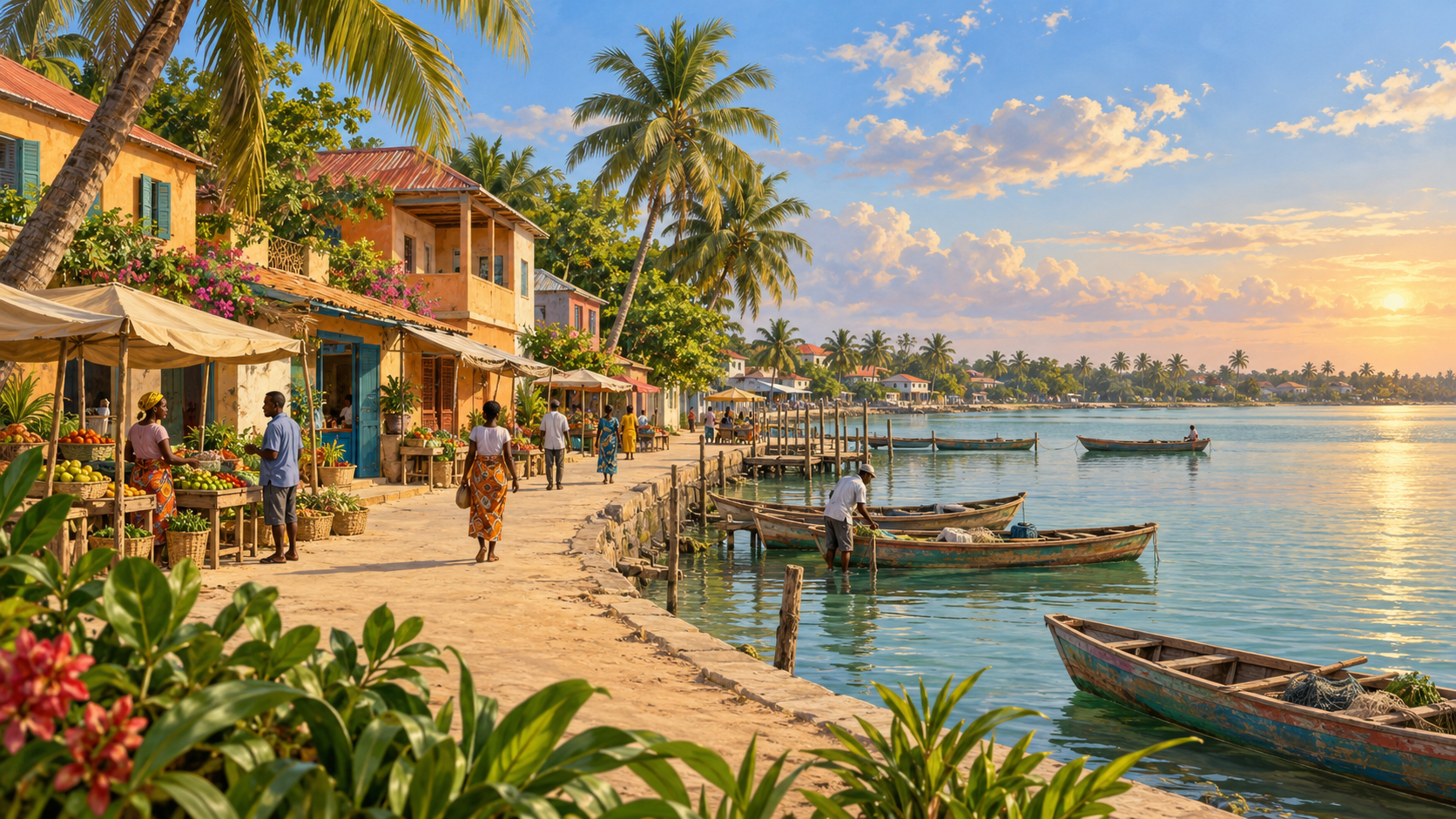
Cover illustration: an original artistic interpretation of Benin-inspired coastal communities, lagoon scenery and everyday urban life, not a literal geographic view.
Choose your route through Benin
- 1. Benin on the map: a West African country with an Atlantic coast
- 2. Landscapes, seasonal rainfall and the movement of water
- 3. Kingdoms, enslavement, colonial rule and independence
- 4. People, population records and a multilingual society
- 5. Government and the institutional changes of 2026
- 6. Rights, public scrutiny and contemporary security pressures
- 7. Cities and the connections between them
- 8. Farming, industry and the changing economy
- 9. Trade, currency and regional relationships
- 10. Infrastructure: power, transport and digital connections
- 11. Education, examinations and routes into adulthood
- 12. Health services and social support
- 13. Homes, neighbourhoods and everyday work
- 14. Food, ingredients and the work behind a meal
- 15. Living religion, languages and creative expression
- 16. Heritage places, museums and responsible interpretation
- 17. Sport, recreation and opportunities to participate
- 18. Wetlands, coastal resilience and the energy transition
- 19. Challenges and choices shaping the future
- 20. Reader takeaways: connecting the country’s stories
1. Benin on the map: a West African country with an Atlantic coast
Four neighbours and a narrow Atlantic frontage
Benin lies in West Africa, with Nigeria to the east, Togo to the west, Burkina Faso to the north-west and Niger to the north. Its southern edge meets the Atlantic Ocean. The country stretches roughly 700 kilometres from south to north, while its coast is much shorter. This long shape places coastal towns, central farming areas and northern border communities within one state but in different geographical settings. The northern neighbour Niger and the eastern neighbour Nigeria are separate countries; the River Niger is a third geographical reference that should be labelled separately on a map. Sources: Government of Benin: Geography.
A river boundary is also a legal boundary
The northern frontier illustrates how physical and political geography interact. In its judgment of 12 July 2005, the International Court of Justice determined the Benin–Niger boundary in the Niger and Mékrou river sectors and assigned river islands accordingly. In the Niger sector, much of the boundary follows the principal navigable channel, with specified exceptions; in the Mékrou sector, it follows the river's median line. A river drawn as a single blue stroke can conceal channels, islands and bridges whose jurisdiction matters to the people who live, farm and trade nearby. Sources: International Court of Justice: Benin–Niger frontier judgment.
Porto-Novo is the capital; Cotonou concentrates major functions
Porto-Novo is Benin's official capital. Cotonou is the principal commercial centre and accommodates major national executive and administrative functions. The government's national spatial agenda explicitly recognises this difference between Porto-Novo's capital status and the concentration of decision-making facilities in Cotonou. These cities are therefore not interchangeable answers to a capital-city question. One identifies the country's formal capital; the other helps explain where much everyday government and commercial activity is concentrated. This arrangement also means that an institutional address should be checked rather than inferred from the word 'capital' alone. Sources: Government of Benin: National spatial agenda.
The country and the historic Kingdom of Benin are different
The Republic of Benin should not be confused with the historic Kingdom of Benin, whose royal centre is in present-day Nigeria. The Metropolitan Museum's Edo collection identifies that kingdom with a dynasty, court traditions and the title oba. This distinction becomes especially important when reading about the 'Benin Bronzes': that name concerns the Edo kingdom and its artistic heritage, rather than automatically identifying objects from the modern republic. Dahomey, Abomey and the contemporary Republic of Benin belong to a different, neighbouring historical geography, although the wider region has many longstanding connections. Sources: Metropolitan Museum of Art: Head of an oba, Edo peoples; British Museum: Benin plaque collection record.
2. Landscapes, seasonal rainfall and the movement of water
Coastal sediments, plateaus and the Atacora
Benin's terrain includes a low coastal zone, a broad interior plateau and the Atacora uplands in the north-west. Its geology helps explain why these places differ. The British Geological Survey's national synthesis maps extensive old crystalline basement rocks, including gneiss and granite, alongside sedimentary formations and river deposits. Atacora formations include quartzite and schist. This is not a country dominated by one continuous mountain chain: substantial areas are comparatively low or gently elevated. The geological map is also practical evidence, because rock type and weathering influence soils, groundwater storage and the siting of wells. Sources: British Geological Survey: Hydrogeology of Benin.
Rainfall has different seasonal rhythms
The national climate-services proposal prepared in 2025 describes a southern climate with two rainy periods, separated by a shorter drier interval, and a northern regime with one main rainy season. The centre forms a transition between them. In the south, the longer rains broadly occupy April to July, with another wetter period around September to November. These are climatic patterns, not appointments kept by every year's weather. Planting conditions depend on the actual arrival, distribution and ending of rain, while a brief dry spell within the wet season can matter as much as an annual rainfall total. Sources: FNEC and Météo-Bénin: 2025 climate-services concept note.
A shared basin connects Benin and Togo
The Mono basin extends across Togo and Benin. Benin's water ministry describes a basin of approximately 24,300 square kilometres, most of it in Togo, and presents the Mono Basin Authority as a framework for cooperation. A basin includes the land draining towards a river system, not just the river channel visible on a map. Rainfall and land use upstream can influence water downstream, while irrigation, settlements and other uses draw on the same connected resource. The basin therefore provides a concrete example of why water management has to cross national and local administrative boundaries. Sources: Ministry of Water and Mines: Mono Basin Authority.
Water below ground needs its own observations
Groundwater is another important part of Benin's physical geography. The water ministry's account of national monitoring describes observation boreholes in coastal sedimentary formations, the interior basement zone and northern basins. Instruments called piezometers measure groundwater levels, allowing changes to be followed through time. This monitoring is different from counting water-supply pumps: an observation point measures the resource, while a working well extracts it. The ministry also records attention to water quality and coastal saltwater intrusion. An apparently reliable well cannot be understood fully without considering recharge, nearby abstraction and the quality of the water stored below ground. Sources: Ministry of Water and Mines: Groundwater monitoring.
3. Kingdoms, enslavement, colonial rule and independence
Dahomey was one powerful state within a wider region
The Kingdom of Dahomey, also written Danhomè or Danxomè, developed around Abomey and became a major power in the seventeenth to nineteenth centuries. Its royal institutions, military organisation and court arts formed part of a wider landscape of African states. The Metropolitan Museum's account describes Dahomey's relationship with Oyo, including a period of tributary dependence, and the importance of royal symbolism and Vodun beliefs. Modern national boundaries should not be projected backwards onto these relationships. Studying Dahomey means following changing alliances, conquest and exchange, while recognising that its rulers did not represent every community in today's Benin. Sources: Metropolitan Museum of Art: Arts of Africa, Dahomey.
Enslavement must remain visible in the historical account
Dahomey's military expansion included the capture and sale of people into the Atlantic slave trade. The Met's study of a Fon ornament explains that rulers incorporated some conquered people into their realm and sold others, while maintaining armies of both men and women. European and other Atlantic traders provided markets for human captives. Royal artistry and political sophistication do not cancel this history of coercion. Equally, the people who were enslaved should not disappear behind a story told only through kings, traders or forts. Their forced displacement belongs at the centre of the region's Atlantic history. Sources: Metropolitan Museum of Art: Fon bird ornament and Dahomey history.
French conquest produced a larger colonial territory
The National Archives date the creation of the colony of Dahomey and Dependencies to the French decree of 22 June 1894, after military conquest and agreements with other kingdoms. King Béhanzin's defeat and deportation were part of that colonial takeover. The colony's name did not mean that every area within its boundaries had previously belonged to the Kingdom of Dahomey. Colonial administration gathered different communities and political histories into a new territorial framework. Its surviving records are valuable evidence, but their categories also reflect the priorities of a ruling administration that exercised power over the people it recorded. Sources: National Archives of Benin: Colonial archival collections.
Independence was followed by political instability
Dahomey became independent on 1 August 1960, with Hubert Maga as its first president. Independence did not immediately produce a settled constitutional order. The National Archives organise the subsequent record around the early sovereign period, the revolutionary period beginning with Mathieu Kérékou's seizure of power on 26 October 1972, and the later democratic period. The early years included successive coups and a rotating presidential council. In the revolutionary era the country adopted the name People's Republic of Benin. These changes affected public institutions and political freedoms as well as the names printed on official documents. Sources: National Archives of Benin: Post-independence collections.
The 1990 National Conference changed the political direction
The National Conference held in Cotonou from 19 to 28 February 1990 brought together representatives of different parts of society during a severe political and economic crisis. It opened a transition away from the one-party Marxist-Leninist system. A new constitution was adopted later that year, and the 1991 presidential election brought Nicéphore Soglo to office. The transition became an important reference point in Benin's public life. It should be studied as a particular historical achievement, alongside the continuing need to examine later electoral rules, political participation and the actual protection of rights. Sources: Government of Benin: Political history.
Restitution asks who owns and interprets the past
In 2021 France returned 26 royal objects to Benin after a special legal process. French official accounts identify them as objects taken from Abomey's royal palaces following the fighting of 1892; the ownership transfer took place on 9 November 2021. Restitution concerns possession, colonial violence and the authority to tell an object's story. It does not resolve every question about other collections or whose experiences a royal display should foreground. Abomey's Royal Palaces have been on UNESCO's World Heritage List since 1985. The heritage site and the returned movable objects are related but distinct. Sources: France Diplomatie: Return of cultural goods; UNESCO: Royal Palaces of Abomey; France Diplomatie: France–Benin cultural relations.
4. People, population records and a multilingual society
A census count must keep its census date
Benin's fourth population and housing census, RGPH4, counted 10,008,749 people in 2013. It remains an important historical statistical baseline, rather than a current population total. Its sociocultural classifications record communities including Fon, Adja, Yoruba, Bariba, Dendi, Peul and others. These are census categories, not tidy boundaries around people's identities or abilities. They also do not tell us every language a person can speak. Reading such results responsibly means retaining the year, the definitions and the distinction between an individual's identity and the broad groups used to organise a national statistical table. Sources: INStaD: Final results of the 2013 population census; INStaD: RGPH4 sociocultural findings.
Recent population estimates answer a different question
The World Bank's country profile gives a population of about 14.5 million for 2024. That figure and the 2013 census count should not be placed side by side as if they were measurements made in the same year by the same method. Estimates update the population picture between enumerations using demographic information and assumptions. For planning, the national total is only a beginning: the number and location of children, working-age adults and older residents influence the services required. A country can have a growing total population while different localities experience very different pressures. Sources: World Bank: Benin country overview.
French operates within a multilingual country
French is the official language, but Benin's daily linguistic life includes many African languages. The Organisation internationale de la Francophonie's language study identifies Fon, Yoruba and Bariba among the languages used for wider communication, alongside languages such as Gun, Ayizo, Gen and Ditamari. A person's home language, market language and language of official paperwork may differ. It is therefore misleading to describe the country as if every resident uses French in the same way. Multilingualism is part of how people maintain family relationships, trade across communities and take part in public life. Sources: Organisation internationale de la Francophonie: Languages in Benin.
Civil registration makes people visible to institutions
Population statistics and civil registration do related but different work. A census describes a population at a particular time; birth, marriage and death registration create individual legal records. UNFPA's Benin work on civil registration has involved local authorities and several sectors because access to an identity document affects dealings with public services and institutions. A registration campaign should not be confused with a new national census. This distinction is especially useful when reading reports about identification systems: issuing documents, estimating population and counting residents are separate activities, even when information from one helps improve another. Sources: UNFPA Benin: Identity and civil registration.
5. Government and the institutional changes of 2026
The presidency changed in May 2026
As of 20 October 2026, Benin's president is Romuald Wadagni. The Constitutional Court records that he took the presidential oath in Cotonou on 24 May 2026 after the presidential election of 12 April. Mariam Chabi Talata was elected as his running mate for the vice-presidency. Patrice Talon's presidency therefore belongs to the preceding administration, rather than the current office-holder entry. This is a useful case of why a country guide must check an inauguration as well as an election: an election result and the moment a new president takes office are different events. Sources: Constitutional Court: Romuald Wadagni takes the presidential oath; Constitutional Court: final presidential results, 23 April 2026.
A revised constitution and a new Senate
Constitutional Law 2025-20, promulgated on 17 December 2025, revised presidential terms to seven years, renewable once, and established a Parliament comprising the National Assembly and Senate. The Senate's members were installed on 30 July 2026; its leadership was elected on 6 August, with former president Patrice Talon becoming Senate president. These changes make older descriptions of a single-chamber Parliament or five-year presidential terms outdated. The founding 1990 Constitution remains a central historical reference, but the current institutional structure has to be read with its later amendments and the steps that put them into effect. Sources: Government of Benin: Constitutional Law 2025-20; National Assembly: Senate installation and leadership election.
The 2026 Assembly result narrowed parliamentary representation
The Constitutional Court validated the legislative election of 11 January 2026 in its decision of 19 January. Its seat allocation gave 60 seats to Union Progressiste le Renouveau and 49 to Bloc Républicain, filling the National Assembly's 109 seats. Other parties consequently had no seats in that allocation. An electoral result describes the composition of the chamber; assessing the openness of political competition also requires looking at eligibility, endorsements, thresholds and opportunities to organise. Keeping these questions separate avoids treating either a large seat majority or a formal election calendar as a complete measure of democratic participation. Sources: Constitutional Court: January 2026 legislative results.
National government and local administration have different scales
Benin's decentralisation ministry identifies 12 departments and 77 communes. Communes provide a local level through which places organise public responsibilities and cooperate with partners. These units should not be confused with cities: a commune can include a town together with surrounding settlements and land. Departmental and communal maps answer questions about administration, while river basins, urban commuting areas and language regions answer different questions. This matters when comparing statistics. A figure labelled with a familiar city name may refer to its administrative territory rather than only its densely built-up urban centre. Sources: Ministry of Decentralisation: Local cooperation platform.
6. Rights, public scrutiny and contemporary security pressures
Rights require institutions as well as constitutional promises
The 1990 Constitution sets out rights and freedoms and recognises the African Charter on Human and Peoples' Rights within the constitutional framework. It includes protections concerning equality, personal liberty, expression and association. Those provisions provide standards against which government action can be examined. A legal guarantee does not by itself establish that every person can exercise it without obstruction. For students reading a country profile, it is useful to distinguish the written right, the institution responsible for enforcing it and the evidence about what happened in a particular case. Each answers a different question. Sources: Government of Benin: Constitution of 11 December 1990.
Journalism and public criticism face documented scrutiny
In a communication dated 13 October 2025, UN human-rights experts raised concerns about journalist and human-rights defender Hugues Comlan Sossoukpè. The communication described allegations concerning his removal from Côte d'Ivoire, detention and prosecution in Benin, and a possible connection to his journalism and criticism of the government. These are the concerns and allegations recorded by UN special procedures, rather than a court judgment adopted here as settled fact. They nevertheless belong in an account of current institutions because freedom of expression is tested through the treatment of particular journalists, critics and defendants. Sources: UN special procedures: Communication BEN 1/2025.
Security responses must avoid collective blame
A further UN communication, dated 14 May 2026, raised concerns about intercommunal tensions, violence and protection risks affecting Peul communities in Ségbana, in Alibori, and more broadly in northern Benin. The experts linked these concerns to perceived associations between those communities and terrorist groups. The distinction is essential: membership of an ethnic community is not evidence that a person belongs to an armed group. Public security and the protection of civilians have to be considered together, including the rights of people facing suspicion, displacement or discrimination. The communication records allegations requiring examination, not collective guilt. Sources: UN special procedures: Communication BEN 1/2026.
Northern insecurity also has a displacement dimension
UNHCR's January–June 2026 factsheet reports that insecurity in the Sahel and northern Nigeria increased pressure on Benin's borders, while spillover insecurity also caused internal displacement. By June, it recorded about 85,200 displaced people in Benin, including approximately 42,000 refugees and asylum-seekers. The categories matter: a refugee crosses an international border, whereas an internally displaced person remains within their own country. These are June figures, not a claim about the exact total on 20 October. They indicate pressures on protection, livelihoods and host communities without implying that conditions are identical throughout the country. Sources: UNHCR: Benin factsheet, January–June 2026.
7. Cities and the connections between them
Cotonou links a constrained site to a wider economy
Cotonou occupies a coastal strip between Lake Nokoué and the Atlantic. The government's city history connects its development to maritime commerce, the port and the Dantokpa trading area. The physical setting helps explain why its growth has consequences beyond the municipal boundary: housing, commuting and commercial activity connect it with neighbouring communes. Cotonou is also a meeting place for people from many parts of Benin and the region. Understanding the city therefore means looking at both its waterside location and its networks of markets, roads and settlements, rather than treating the administrative outline as the whole urban system. Sources: Government of Benin: Cotonou city profile.
Porto-Novo carries several layers of urban history
Porto-Novo stands in south-eastern Benin near the Nigerian border and a lagoon environment. Its official municipal profile describes a city whose architecture and historical sites reflect African institutions, European contacts and Afro-Brazilian connections. Buildings, religious sites and former royal spaces preserve different parts of this history. No single architectural style represents everyone who has lived there. As the national capital and a city with its own residential and commercial life, Porto-Novo should be understood both as a place where institutions operate and as an inhabited urban landscape whose residents continue to adapt older spaces. Sources: Ministry of Decentralisation: Porto-Novo.
Parakou anchors connections to the interior
Parakou, in Borgou, is a major inland centre linked to the north–south road network. The government's 2020 city profile presents it as a cosmopolitan commercial crossroads and records its Kobourou historical identity. Its position gives the city a different role from the coastal port: it connects movement through the interior with surrounding communities and regional markets. Historical railway infrastructure and an airport also appear in that profile, but their existence should not be taken as proof of a current passenger timetable. For a contemporary atlas, settlement roles and verified transport operations remain separate kinds of information. Sources: Government of Benin: Parakou city profile.
The Grand Nokoué is being planned across commune boundaries
On 7 October 2026, the Council of Ministers described a Grand-Nokoué development pole covering Abomey-Calavi, Cotonou, Ouidah, Porto-Novo and Sèmè-Kpodji. Its announced timetable placed the installation of governance bodies and initial diagnostic work in October–December 2026, followed by further planning in 2027. These are implementation stages, not evidence that all proposed investments already exist. The grouping is significant because urban transport, employment, waste management and land development can connect several communes. Planning for that connected area requires coordination across boundaries while retaining accountability for the needs of individual neighbourhoods and settlements. Sources: Council of Ministers: Territorial development poles.
8. Farming, industry and the changing economy
Strong output growth is a dated economic finding
The World Bank's June 2026 Global Economic Prospects tables put Benin's real GDP growth at 7.5 per cent in 2024 and estimate 8.1 per cent for 2025. They forecast 7.0 per cent for 2026. The last figure is a projection, not a completed full-year result. Real GDP measures the changing volume of economic output after adjusting for prices. It does not show that every household's income rose at the same rate, nor how gains were distributed across regions or occupations. Those questions require additional evidence on employment, earnings, prices and living conditions. Sources: World Bank: Global Economic Prospects, June 2026, Sub-Saharan Africa.
Agriculture combines many small holdings and activities
The national agricultural census results presented on 25 January 2022 counted 915,423 agricultural holdings, with an average area of 3.3 hectares. The release reported that fewer than four per cent of holdings were irrigated and also recorded households engaged in livestock and fishing. These are census findings from that statistical exercise, not updated 2026 counts. They help explain why agriculture cannot be reduced to a single export crop. Farm size, access to water, storage, equipment and routes to market all shape production. A household may combine different activities rather than depend on one field or one commodity alone. Sources: Government of Benin: National agricultural census results.
Processing aims to retain more value inside the country
The Glo-Djigbé Industrial Zone, or GDIZ, is a partnership between Benin and ARISE IIP. The operator describes an industrial platform near Cotonou focused on processing local products, including cotton, cashew and soya, with textile activities extending from spinning towards garment production. Processing changes the economic chain: raw material becomes an input for manufacturing, logistics, maintenance and specialised services. The operator's description establishes the intended industrial model, but is not an independent measure of national employment gains. Such outcomes need to be checked against production, employment and export evidence rather than promotional targets alone. Sources: ARISE IIP: Glo-Djigbé Industrial Zone.
Public revenue and infrastructure are part of the growth story
The IMF's 2026 programme review reports improvements in tax collection, including customs valuation and the digitalisation of core tax processes. It also identifies trade, industrial development and infrastructure among the factors shaping Benin's economic outlook. Public revenue matters because roads and other services require funding beyond their initial construction. Borrowing can bring investment forward, but also creates repayment obligations. The review's discussion of regional security and trade risks shows why an economy's growth path is conditional: external demand, border conditions and the performance of public institutions can change the resources available for development. Sources: IMF: Benin seventh programme reviews, Country Report26/86.
9. Trade, currency and regional relationships
The port serves markets beyond Benin
The Port of Cotonou functions as a transit gateway for inland markets as well as Benin's own imports and exports. The port authority maintains representation in Niger and Burkina Faso to assist customers using the Beninese corridor. A shipment crossing the port is therefore not necessarily a product made or consumed in Benin. This distinction helps explain transit trade: port handling, forwarding, transport and related services can generate activity even when the goods have another final destination. The commercial relationship depends on the whole journey, including border procedures and inland connections, rather than the quay alone. Sources: Port Autonome de Cotonou: Hinterland.
Nigeria is an important neighbour in the trading system
The IMF's 2023 governance diagnostic describes substantial flows between Benin and Nigeria that are undeclared or incorrectly declared to customs. It links these patterns to differences in import restrictions and to logistical and administrative conditions. The report is a dated structural account, rather than a measurement of every transaction in 2026. It helps explain why formal customs data may not capture the whole relationship between neighbouring markets. Informal trade also needs careful language: small-scale cross-border commerce, undeclared activity and organised fraud are not interchangeable descriptions, even though some transactions may overlap these categories. Sources: IMF: Benin Governance Diagnostic, Country Report23/191.
A shared currency links monetary institutions
Benin uses the West African CFA franc within the regional monetary system served by the Banque Centrale des États de l'Afrique de l'Ouest, or BCEAO. The central bank is shared by eight member states. Its reference table for 19 October 2026 lists one euro at 655.957 CFA francs. That institutional exchange-rate relationship is different from the fees or effective price a customer may face in a particular transaction. Sharing a currency reduces one kind of barrier among participating economies, but it does not make their tax systems, production structures, public finances or living costs identical. Sources: BCEAO: The common central bank; BCEAO: Reference exchange rates.
Regional memberships must be checked against current lists
Benin remains a member of the Economic Community of West African States, or ECOWAS. The organisation's current membership page lists 12 countries, including Benin and its coastal neighbours Nigeria and Togo. Older descriptions of a 15-member organisation should not be copied automatically into a 2026 guide. Regional organisations and physical regions are different things: a country remains geographically West African regardless of whether its institutional membership changes. For Benin, this distinction is practical because cooperation on movement, trade and infrastructure involves relationships that may continue to matter even when the region's political arrangements change. Sources: ECOWAS: Current member states.
10. Infrastructure: power, transport and digital connections
A stronger electricity network is different from universal access
The Millennium Challenge Corporation's report on the power compact completed in June 2023 records construction or rehabilitation of 19 substations and 898 kilometres of power lines, together with a national dispatch centre. It describes a tripling of grid capacity measured by high- and medium-voltage transformer capacity. That is a network measure, not a claim that electricity generation tripled or that every household gained a connection. The dispatch centre improves the ability to supervise the system. The broader challenge includes reliable supply, maintenance, affordability and connections that actually reach the places where people and businesses need them. Sources: Millennium Challenge Corporation:2023 completed compact results.
Digital infrastructure needs regional and domestic connections
In March 2026, the World Bank approved a regional digital integration operation covering Benin, Liberia and Sierra Leone. The announced 137 million US dollars covered the three-country programme, not Benin alone. Its aims include stronger broadband infrastructure, a better business environment and cross-border digital services. Approval and target numbers should not be presented as completed connections. A useful way to understand the programme is to separate the network from its use: cables and equipment provide capacity, while affordability, skills, dependable electricity and accessible services affect whether people and firms can benefit from that capacity. Sources: World Bank: Regional digital integration programme.
Urban transport links homes, work and public services
The World Bank approved 200 million US dollars for the Grand-Nokoué Sustainable Urban Mobility Project in May 2025. The programme concerns a safer, more reliable and less polluting transport system in Benin's major southern urban area. The approval should be read as a commitment to a programme, rather than proof that a completed new network is operating. Urban mobility includes the full journey between home and a destination: access to transport, waiting, transfers and the final stretch all matter. Its importance extends beyond traffic speed to the practical ability to reach jobs, education and everyday services. Sources: World Bank: Grand-Nokoué urban mobility financing.
The Abidjan–Lagos corridor is still a development process
Benin is one of five countries participating in the Abidjan–Lagos development corridor, alongside Côte d'Ivoire, Ghana, Nigeria and Togo. ECOWAS reports that the corridor management authority's inaugural board meeting took place in Lagos on 11–12 June 2026. The authority is intended to oversee the development and management of the cross-border corridor. This institutional milestone is not the same as completion of the proposed highway. It shows how large transport projects require agreements, financing and coordination among several states, alongside engineering. For Benin, the east–west corridor complements the north–south connections between the port and inland markets. Sources: ECOWAS: Abidjan–Lagos corridor authority inaugural board.
11. Education, examinations and routes into adulthood
Following the school stages
Benin’s conventional school sequence comprises six primary years, four years of lower secondary education and three of upper secondary education. The CEP, BEPC and baccalaureate mark different stages along that route. French remains central to the formal system, but language reform deserves careful dating. In a 2020 government interview, the primary-education minister described English teaching as a pilot in selected schools, with expansion envisaged. That historical announcement does not establish nationwide English instruction in 2026. Language policy involves teacher preparation, learning materials and continuity between classes, alongside decisions about what appears on a curriculum. Higher Education Ministry: school-system structure. Government: primary-education reforms and English pilot.
Examination names need a year attached
The 2026 examination season illustrates the sequence without providing a permanent annual calendar. The primary ministry scheduled the CEP’s written, oral and sports components for 1–4 June. The BEPC opened on 8 June, and the main baccalaureate examinations began on 15 June. These are separate qualifications, rather than interchangeable versions of one school-leaving test. The baccalaureate connects secondary study with access to higher education. Examination announcements also show the organisational work behind assessment: centres, invigilation, candidate preparation and coordination across ministries. A date copied from an older session should never be presented as the next examination date. Primary Education Ministry: CEP 2026. Secondary Education Ministry: BEPC 2026 launch. Higher Education Ministry: baccalaureate 2026 launch.
Keeping girls in learning
The national programme for accelerating girls’ education and well-being, published by UNICEF in 2024, treats attendance as part of a wider life course. Its priorities include bringing out-of-school girls into learning, helping vulnerable pupils remain in school, developing life skills and supporting the transition towards employment. This connects classroom achievement with protection, health information and family circumstances. A place on a school register alone cannot reveal whether a learner participates consistently or completes a qualification. The programme describes an intended response to these barriers; its publication should not be mistaken for evidence that every intended beneficiary has already received support. UNICEF and education authorities: girls’ education programme.
Practical qualifications offer another route
Public vocational centres provide pathways alongside the academic sequence. The government’s 2026–2027 intake notice covered thirteen centres, including locations such as Abomey, Djougou and Nikki, and identified craft qualifications through the CQM and professional qualifications through the CQP. The notice differentiated entry conditions for the two routes rather than treating all applicants alike. This matters when interpreting the phrase vocational education: practical experience, previous schooling and selection requirements can lead into different programmes. The broader educational question is how a learner’s abilities become recognised skills. A qualification can make workshop learning more visible, while the availability of instructors, equipment and suitable placements determines the experience behind it. Government: public vocational-centre intake 2026–2027.
12. Health services and social support
ARCH connects several forms of protection
ARCH, Benin’s programme for strengthening human capital, brings health insurance together with artisan training, credit and pension insurance. The National Agency for Social Protection presents these as linked responses to vulnerability: illness can interrupt work, while insecure earnings can make health expenses harder to absorb. Its programme design distinguishes people living in extreme poverty from other groups and provides different levels of public support. This is a useful way to understand the policy’s breadth, but a programme description is not an enrolment count. Health protection depends on identification, functioning services and actual access as well as the existence of an insurance framework. ANPS: ARCH programme design.
Geographical rollout and eligibility are different
ARCH’s expansion across departments does not mean every resident receives the same free care. An ANPS warning issued in June 2025 said that services then covered people identified as extremely poor, through public facilities and specified faith-based providers. Decree 2025-672 subsequently set out premium-sharing rules: full state support for the extreme-poverty category, half for the non-extreme-poverty category, and an employer contribution of at least 80% for the basic package of employees concerned. These provisions describe different eligibility and financing arrangements. They do not, by themselves, demonstrate that every person covered by the legal framework has been registered or successfully used a service. ANPS: health-insurance rollout notice. Government: decree 2025-672 on health insurance.
Prevention depends on delivery systems
Malaria vaccination offers a concrete example of health-system development. WHO’s May 2025 review reported that nearly 100,000 children had received at least one dose during the first year of introduction in sixteen pilot health zones. A first dose, a completed vaccination schedule and nationwide programme coverage are different measures. The review placed vaccination within broader malaria control, rather than treating it as the only response. For understanding public services, the important chain runs from procurement and storage to trained staff, community communication and return visits. A national health initiative reaches families through these repeated, local interactions. WHO: first year of malaria vaccination in Benin.
Social support also works through families
UNICEF’s account of Cash+Care Faaba in 2024–2025 describes support for girls aged nine to fifteen and their families in northern Benin. Cash transfers were combined with community work intended to sustain education and reduce child marriage. The account also records practical delivery difficulties, including problems associated with telephone SIM cards used for transfers. These details make social protection tangible: an announced payment must still reach the correct household, and money alone does not settle every social pressure. The programme’s combination of financial assistance and dialogue illustrates why education, family welfare and child protection often need coordinated responses. UNICEF: Cash+Care Faaba in 2024–2025.
13. Homes, neighbourhoods and everyday work
Ganvié is a lived settlement
At Ganvié on Lake Nokoué, houses on stilts and movement by canoe form part of a working settlement. Benin’s tourism authority describes schools, markets, places of worship and fishing activity within this waterside environment. The visual distinctiveness should not obscure ordinary responsibilities: learning, earning, maintaining homes and moving between neighbours. Buildings and transport make sense in relation to the surrounding water, rather than as isolated architectural curiosities. Reading Ganvié through its everyday functions also changes the questions one asks. How do supplies arrive, where do children learn, and how are shared spaces maintained? Residents’ lives extend beyond the photograph. Benin Tourism: Ganvié.
Drainage changes the experience of home
A World Bank account from May 2025 describes how stormwater works changed life in vulnerable Cotonou neighbourhoods. Drains, improved streets and retention basins were connected to residents’ ability to move around, reach businesses and use the spaces outside their homes. Such infrastructure is therefore part of domestic life, even when it lies beyond a front door. A road that remains usable after rain can affect a shopkeeper’s trading day and a household’s movements. The project account concerns particular neighbourhoods and reported improvements; it does not establish that flooding has disappeared throughout Cotonou or that maintenance will happen automatically. World Bank: drainage and neighbourhood life in Cotonou.
Markets organise relationships as well as trade
Markets connect sellers, suppliers, transport workers and customers through recurring journeys and familiar trading relationships. In March 2026, the government explained a planned reorganisation involving the relocation of traders towards Tokpa Yôyô, including shops, stands and associated services. The announcement is evidence of a transition process, rather than proof that every announced opening or move happened on schedule. For daily life, the implications extend beyond the appearance of a new building. A change of trading location can alter the routes through which customers find a seller, the way stock arrives and the practical organisation of a working day. Government: market relocation and Tokpa Yôyô.
A workshop can also be a classroom
The ILO’s 2020 study of Benin distinguishes traditional workshop apprenticeship from dual training that combines an enterprise with a vocational centre. It describes the CQM as a means of recognising craft skills and the CQP route as linking practical work with organised instruction. The study also identifies gaps between formal arrangements and conditions on the ground, including funding and training quality. This helps explain why a workshop can have several roles at once: production site, learning space and setting for relationships between experienced and newer workers. Recognising those roles requires attention to the quality and fairness of learning, as well as its economic value. ILO: apprenticeships in Benin and neighbouring countries.
14. Food, ingredients and the work behind a meal
Amiwo carries flavour and memory
In UN Tourism’s Benin gastronomy feature, chef Georgiana Viou presents amiwo as a corn-based preparation associated with tomato sauce and often served with chicken. Her account links the dish with ceremonial settings and the Afro-Brazilian culinary heritage of Ouidah. This is one named pathway into Beninese food, rather than a recipe that represents every household. Ingredients, occasions and family practices give dishes different meanings. A meal can therefore reveal several histories at once: the cultivation of a staple, the movement of techniques between communities and the decisions of a cook adapting familiar flavours for a particular gathering. UN Tourism: Georgiana Viou on Beninese gastronomy.
Gari reveals the knowledge in processing
Gari is made from cassava, but its character depends on processing rather than the crop name alone. A study of production in Benin, published through the agricultural research organisation CIRAD, examined differences among traditional processes and the resulting products. Fermentation and subsequent processing influence qualities such as acidity, texture and particle size. This turns a familiar staple into a useful food-science example: people develop practical knowledge about materials, timing and the qualities customers expect. Recognising that expertise also draws attention to the work between farm and meal. Processing is an important stage of food production, with its own skills and demands. CIRAD: research on gari production in Benin.
A market shows the range behind a menu
The tourism authority’s account of Ganhi market in Cotonou places fruits and vegetables alongside the ingredients used in dishes such as amiwo and gari foto. The market is a useful starting point for understanding choice: cooks assemble meals from what is available, affordable and appropriate to the occasion. Seasonal fruit, vegetables and spices contribute different textures and flavours, connecting culinary choices with the produce on the stalls. Following ingredients through a market also keeps food connected to sellers and suppliers. It avoids reducing a cuisine to a short list of famous dishes, while leaving room for variation between cooks, seasons and household routines. Benin Tourism: Ganhi market and cooking.
School meals link farms and classrooms
School feeding connects food policy with the school day. WFP reports that the national programme expanded from 31% to 75% of public primary schools between 2017 and 2024, reaching more than 1.4 million children. Management transferred to the national food and nutrition agency in September 2024, with WFP continuing technical support. The programme also increased its use of locally produced food, linking meals with farmer organisations supplying crops such as maize, rice and beans. These figures describe the reported programme period, not universal coverage in 2026. Procurement, preparation and reliable delivery all matter alongside the number of participating schools. World Food Programme: Benin school meals.
15. Living religion, languages and creative expression
Vodun belongs to lived experience
Vodun encompasses beliefs, social practices and relationships with ancestors, deities and the natural world. UNESCO’s description emphasises ways of living and community participation, helping readers move beyond sensational images borrowed from entertainment. Ouidah’s Vodun Days on 8–10 January 2026 combined public rituals and concerts. Such a festival cannot stand for every practitioner’s experience or belief. UNESCO’s 2025–2026 assistance concerned preparation of a nomination with community involvement; it was not itself an inscription. Respectful interpretation begins by distinguishing what practitioners describe, what a public presentation shows and what an outside observer assumes. Those distinctions preserve both religious complexity and people’s agency. UNESCO: Vodun beliefs, practices and ways of living. Government: Vodun Days 2026 retrospective.
Gelede joins performance with social memory
The oral heritage of Gelede, shared by communities in Benin, Nigeria and Togo, appears on UNESCO’s Representative List of intangible cultural heritage. It combines carved masks, dance and songs in Yoruba, transmitting historical and mythical knowledge while recognising women’s social and spiritual importance. UNESCO associates performances with occasions including harvests and significant community events. The heritage was inscribed in 2008, following its earlier proclamation in 2001. Its value lies in the relationships between performers, makers and audiences, not only in an individual mask. A museum object can preserve material craftsmanship, while performance keeps words, movement and social meanings in circulation. UNESCO: oral heritage of Gelede.
Language diversity enters the digital world
Local languages also shape contemporary technological work. ITU’s 2025 African broadband report describes Benin’s experiments with language technologies, including natural-language processing and video dubbing associated with the 2024 SENIA innovation event. These examples connect cultural expression with practical questions about who can understand digital content and who can contribute to it. A demonstration or hackathon is an early development stage, not evidence that a reliable service reaches every speaker. The longer task involves usable tools, good language data and attention to meaning. Digital inclusion is therefore partly linguistic: access is less useful when the content cannot communicate clearly with its intended audience. ITU: African broadband report, Benin language-technology case.
Artists speak to international audiences
Angélique Kidjo’s career links Beninese music with a global public, while her UNICEF ambassadorship, begun in 2002, connects that visibility with advocacy for children and girls’ education. Contemporary visual art offers another route into international conversation. Benin’s 2024 Venice Biennale pavilion presented work by Chloé Quenum, Moufouli Bello, Ishola Akpo and Romuald Hazoumè. These examples show individual creators working across different forms and audiences. Their work should be approached as authored expression, with particular ideas and choices, rather than as a single national voice. A country’s creative life includes disagreement, experimentation and reinterpretation as well as inherited forms. UNICEF: Angélique Kidjo. Culture Ministry: Benin’s Venice Biennale pavilion.
16. Heritage places, museums and responsible interpretation
Abomey’s palaces preserve material knowledge
The Royal Palaces of Abomey, inscribed on the World Heritage List in 1985, bring together architecture, political memory and craftsmanship. UNESCO highlights their earthen construction, courtyards and distinctive bas-reliefs. Conservation involves more than keeping a recognisable outline: materials, decorative techniques and the meanings attached to spaces require continuing attention. The site also retains relationships with royal families and ritual practices. This makes Abomey an example of heritage with both physical and living dimensions. Reading a wall or courtyard can illuminate how authority was represented, while conservation raises questions about whose knowledge is needed to sustain that evidence. UNESCO: Royal Palaces of Abomey.
Koutammakou is a cultural landscape
Koutammakou, the Land of the Batammariba, extends across Togo and Benin. The World Heritage property first inscribed in Togo in 2004 was extended into Benin in 2023. Its earthen tower-houses belong to a wider landscape of settlements, fields, woodland and places with ritual significance. Separating the buildings from that setting would miss much of what UNESCO recognises. Architecture here connects with household organisation, land use, craft knowledge and spiritual relationships. The designation therefore concerns a living cultural landscape, not an abandoned collection of monuments. Conservation must engage with how communities inhabit and maintain the place over time. UNESCO: Koutammakou, the Land of the Batammariba.
Protected areas have ecological and human contexts
The W-Arly-Pendjari Complex is a transboundary World Heritage property shared by Benin, Burkina Faso and Niger. UNESCO identifies its savannah and associated habitats as important for wildlife, including large mammals. Conservation also operates within a difficult regional security context. African Parks’ account of W describes attacks and pressures associated with armed groups, alongside efforts to protect biodiversity and work with surrounding communities. A heritage designation does not establish current visitor access or security conditions. For a country study, the central point is that ecological stewardship, local livelihoods and regional stability interact; protected-area boundaries cannot isolate nature from surrounding human pressures. UNESCO: W-Arly-Pendjari Complex. African Parks: W conservation and security pressures.
Returned objects and new museums have different timelines
The transfer of twenty-six royal treasures from France to Benin in 2021 was a restitution event. Museum development is a separate process: a November 2025 government report described construction work at the International Vodun Museum in Porto-Novo, rather than announcing its opening. These dates should not be collapsed into a claim that every planned institution is already operating. Heritage significance also extends beyond inscription. Ouidah and Ganvié are important places in national cultural interpretation, but they are not named inscribed properties on Benin’s World Heritage list. Reading the precise status of a place helps separate cultural importance, international recognition and practical institutional development. Culture Ministry: transfer of 26 royal treasures. Government: International Vodun Museum construction visit. UNESCO: Benin’s inscribed World Heritage properties.
17. Sport, recreation and opportunities to participate
Football development involves people and facilities
FIFA’s March 2024 account of football development in Benin linked infrastructure with coaching, refereeing and education. It described a northern training centre already constructed with FIFA support, while a women’s centre in Lokossa remained a proposed next step in that report. This distinction matters: a planned facility is not the same as a functioning programme. The wider story is how young players gain opportunities to learn, practise and progress. A pitch needs instructors, organised activity and links with education if it is to support development. Results on a scoreboard reveal only one part of that system. FIFA: football development in Benin.
Noélie Yarigo’s medal has a precise context
Noélie Yarigo won bronze in the women’s 800 metres at the 2024 World Athletics Indoor Championships in Glasgow. The final’s record places her behind gold medallist Tsige Duguma and silver medallist Jemma Reekie. Naming the event accurately matters: this was a world indoor championship medal, not an Olympic medal. It also provides a wider view of Beninese sporting achievement than football alone. Middle-distance racing brings together pace judgement, positioning and endurance in a short competitive window. A result records one exceptional performance, while the story behind an athlete’s progress calls for attention to preparation and sustained opportunity. Scottish Athletics: Glasgow 2024 women’s 800 metres final.
Women’s beach handball reached a regional milestone
Benin’s women won the inaugural African Nations Beach Handball Championship in Lomé in April 2026. The International Handball Federation reports that the final against Togo was decided by a shoot-out, and that the result secured qualification for the subsequent world championship in Croatia. An African title and qualification for another tournament are separate achievements; neither establishes the outcome of that later event. The result broadens the sporting picture by drawing attention to women’s team competition beyond the most internationally familiar sports. It also shows how regional championships create pathways through which national teams can reach wider competition. IHF: Benin women win African beach-handball title.
School competition widens the picture
The fifth national school championship opened in Aplahoué in June 2025 with 1,488 athletes from ninety-three public and private schools, according to the government’s event report. Its programme included football, basketball, handball, volleyball and athletics, with three-on-three basketball also featured. These are participation figures for one organised event, not a count of everyone who plays sport in Benin. They nevertheless reveal a broader structure beneath elite competition: schools, teachers, teams and local preparation. For understanding leisure and opportunity, it is useful to consider who has time, space and support to participate regularly, alongside who eventually wins a national title. Government: fifth national school championship.
18. Wetlands, coastal resilience and the energy transition
Wetlands are part of the inhabited landscape
Benin’s Ramsar profile records four designated wetlands of international importance. They include southern lake and river systems associated with the Ouémé, Porto-Novo and Lake Nokoué, as well as northern protected landscapes. Ramsar recognition concerns wetland conservation and wise use; it is a different international framework from UNESCO’s World Heritage List. These places matter to a country study because water, habitats and human activities occupy the same landscape. A designation provides a basis for stewardship, but cannot by itself prevent pollution, damaging land use or changes in water conditions. Understanding protection requires looking at management and pressures as well as boundaries. Ramsar Convention: Benin country profile.
Coastal protection combines different kinds of work
The West Africa Coastal Areas programme’s account of a December 2024 field mission describes work in Benin that combined engineered coastal defences with ecosystem restoration. The itinerary included structures around Grand-Popo and mangrove-related activity at Togbin Adounko. These approaches address different aspects of resilience: built works respond to the movement of waves and sediment, while habitat restoration supports the coastal environment. Their presence does not establish that every settlement is protected or that erosion has ended. The regional programme also highlights why neighbouring coastlines need coordinated attention. Interventions and maintenance must be considered within a connected coastal system, rather than as isolated construction sites. WACA: coastal-resilience work in Benin and Togo.
Off-grid electricity offers a measured case study
MCC’s January 2024 interim evaluation of Benin’s off-grid electricity project reported more than 36,000 new connections, mainly through solar home systems, against a target of 66,000. The project covered the 2017–2023 period, so these are project results rather than a current national access rate. The evaluation also described difficulties with mini-grid approvals, co-financing and agreements. This is a useful example of progress and remaining gaps appearing in the same evidence. Solar equipment can extend electricity service beyond existing networks, but delivery depends on institutional arrangements and viable implementation. A target should remain visibly separate from the connections actually reported. MCC: interim evaluation of off-grid electricity access.
The latest climate commitment looks towards 2035
Benin’s NDC 3.0, submitted to the UN climate system in June 2026, sets out climate commitments for 2026–2035. It addresses emissions across areas including energy, agriculture, forests and land use, alongside adaptation priorities such as water, health and coastal resilience. Mitigation concerns limiting the causes of climate change; adaptation concerns coping with its effects. The document distinguishes measures the country intends to undertake unconditionally from those depending on additional support. These are commitments and planned actions, not a record of reductions already achieved. Evaluating progress requires later implementation and outcome evidence, with consistent dates, baselines and sector definitions. UNFCCC: Benin NDC 3.0.
19. Challenges and choices shaping the future
Employment policy must connect training with work
In June 2025, the World Bank approved additional financing for Benin’s Youth Inclusion Project, supporting the Azôli programme and young people with little or no formal education. The announcement envisaged training about 60,500 people in the expanded programme, while separately reporting more than 48,000 beneficiaries from earlier project activity. Those are different measures: planned participants and previous beneficiaries. The project also links employment services with businesses and agricultural value chains. Its central challenge is the connection between learning and livelihoods. Training provision has greater meaning when people can use acquired skills in work that offers sustained opportunities, rather than merely completing a course. World Bank: Youth Inclusion Project additional financing.
Displacement puts pressure on shared services
UNHCR’s Benin operations page describes how insecurity spilling over from the central Sahel affects northern communities, contributing to displacement and placing additional pressure on already limited services. Its response combines protection monitoring, emergency assistance and work intended to strengthen social cohesion. This makes the issue broader than a border-security headline. People who move need continuity in daily life, while host communities also require functioning services and opportunities. A durable response therefore involves both immediate protection and the capacity of local systems. Population totals change quickly, so the page’s older numerical snapshot should not be treated as an October 2026 count. UNHCR: Benin operations and community support.
Digital capability needs a human foundation
Benin launched the Smart Africa Digital Academy initiative through a government partnership agreement in September 2022. The official account reported that initial training in cybersecurity and artificial intelligence had begun. Its five intervention areas ranged from introductory ICT and science-related learning to specialist training and capacity-building for policymakers. Those first courses established activity, without demonstrating nationwide reach or employment outcomes. The useful questions concern participation, teaching quality and the application of learning afterwards. Digital capability includes the people who design services, those who administer them and those expected to use them. Infrastructure becomes more valuable when these different users can work confidently and effectively. Government: Smart Africa Digital Academy launch.
Vision 2060 sets a direction to assess
The government’s Vision Benin 2060, publicly launched in February 2026, presents a long-term direction organised around peace, good governance, prosperity, and cultural and international influence. The horizon coincides with the centenary of independence. This is a statement of the country the framework seeks to help build, rather than a prediction that its objectives will inevitably be achieved. Its value as a planning document depends on the connection between long-range ambitions and decisions made in shorter periods. Schools, services, employment and environmental management provide concrete places to examine that connection. Progress needs evidence that can be compared over time, alongside continued public discussion of priorities. Government: Vision Benin 2060.
20. Reader takeaways: connecting the country’s stories
Build an ordinary-day map
To bring these chapters together, choose one setting already discussed and map the services that make an ordinary day possible. Begin with a home, then connect it to learning, work, food, water and social support. For each connection, identify the people and arrangements that keep it functioning. Avoid inventing a typical household whose experience stands for everyone. Instead, ask which parts of your map would change for a different location, age group or occupation. This exercise turns separate headings into a system of relationships and reveals where further evidence is needed before making claims about everyday life.
Separate promises, delivery and outcomes
Choose one programme from the article and write three short statements: what was proposed, what was delivered and what changed for participants. Leave a statement blank if the evidence does not establish it. Then add the date, location and population covered by each supported claim. This simple method prevents an opening ceremony from becoming proof of sustained service, or a participation figure from becoming proof of improved well-being. It also allows a fairer judgement of progress: a programme can deliver something valuable while still missing its target. Good comparison preserves both the achievement and the unresolved question.
Read culture through its makers and communities
Select a dish, performance, artwork or heritage place discussed here. Consider the difference between describing its visible form and explaining the relationships that give it meaning. Who makes it, maintains it, performs it or passes on the knowledge involved? Whose account would help you understand it better? A short country article cannot substitute for those voices, but it can make room for them by naming creators and communities accurately. The same approach helps avoid treating a religious practice as entertainment or a living settlement as scenery. Cultural understanding grows when curiosity is paired with careful attention to context.
Compare countries without flattening them
A useful comparison with Singapore or another country begins with a precise question rather than a ranking of entire societies. Compare the organisation of school meals, the recognition of practical skills or the relationship between housing and water, for example. Use equivalent dates and definitions, and distinguish a local project from a national system. Then ask what each case reveals about the problem being addressed and the choices available. The strongest takeaway is not a memorised catalogue of facts. It is the ability to connect evidence, place and human experience, while recognising how much any single description leaves to explore.
Frequently asked questions about Benin
Where is Benin?
In West Africa, with an Atlantic coast and land borders with Togo, Burkina Faso, Niger and Nigeria.
What is the capital of Benin?
Porto-Novo is the official capital. Cotonou has distinct government and economic functions.
Is Benin the same as Benin City in Nigeria?
No. The modern Republic of Benin and Benin City in Nigeria are different places. Historical names should be read with their geographical and chronological context.
What is the official language?
French. An official language does not describe every household conversation or the country’s linguistic diversity.
What currency does Benin use?
The West African CFA franc, coded XOF. A shared currency does not make national prices or economic circumstances identical.
When did Benin become independent?
On 1 August 1960, as Dahomey. Earlier histories and the later change of name belong to different stages of the national story.
Does one account of Dahomey explain all Beninese history?
No. Different communities, regions and historical relationships need their own context.
Should Vodun be understood through entertainment stereotypes?
No. Religious practice and cultural heritage should be approached respectfully, with attention to participants, history and contemporary life.
Does a UNESCO nomination mean inscription?
No. Preparing or submitting a nomination is different from being inscribed. A defined heritage property and a living cultural practice also belong to different UNESCO categories.
Does restitution mean every museum project is already open?
No. Returning objects, planning a museum, constructing it and opening it to the public are separate developments.
Is a health-insurance law proof that every service is free?
No. Eligibility, enrolment, implementation, benefits and possible contributions require separate evidence.
Does an education pilot operate in every school?
Not necessarily. A pilot, an announced reform and a nationwide implemented programme are different stages.
Can one census number be presented as today’s population?
No. Census results, projections and other estimates must carry their reference dates and methods.
Does economic growth show that every household benefits equally?
No. National output, employment, prices, access to services and household welfare describe different outcomes.
Is this guide current travel or professional advice?
It is an educational overview. Travel conditions and individual legal, healthcare or financial questions need current appropriate sources and, where relevant, qualified advice.
Continue reading: Benin’s specialist guides
- How Benin Works: government, departments, the port and economy.
- How Education System of Benin Works: school stages and assessment.
- How Ministry of Education for Benin Works: education responsibilities.
- Schools of Benin: institutions and pathways.
- What Is Taught in School | Benin: curriculum and learning.
- Tutors of Benin: learning support.
- Top 10 Places to Visit in Benin: heritage and landscapes, not current travel-risk advice.
- Top 10 Things to Eat in Benin: food traditions.
Explore the Everything About Countries archive for national overviews and How Countries Work for institutional explanations. The How Singapore Works | Civilisation collection offers another national case study with different circumstances.
Understanding Benin through people and places
A useful country portrait connects public institutions to ordinary experience without assuming that every household encounters them in the same way. It also gives historical memory space alongside contemporary work, learning and cultural creativity.
The aim is to keep both detail and perspective: a date attached to a statistic, a clear distinction between a programme and its results, and recognition that different communities have different experiences. That approach makes room for appreciation, scrutiny and further learning at the same time.
Sources and further evidence
Sources were checked for this edition in October 2026. Each statistical observation, policy statement and historical record retains its own date. Government announcements describe stated programmes; they do not alone establish completed outcomes.
- official Benin country overview
- Government of Benin: Geography
- International Court of Justice: Benin–Niger frontier judgment
- Government of Benin: National spatial agenda
- Metropolitan Museum of Art: Head of an oba, Edo peoples
- British Museum: Benin plaque collection record
- British Geological Survey: Hydrogeology of Benin
- FNEC and Météo-Bénin: 2025 climate-services concept note
- Ministry of Water and Mines: Mono Basin Authority
- Ministry of Water and Mines: Groundwater monitoring
- Metropolitan Museum of Art: Arts of Africa, Dahomey
- Metropolitan Museum of Art: Fon bird ornament and Dahomey history
- National Archives of Benin: Colonial archival collections
- National Archives of Benin: Post-independence collections
- Government of Benin: Political history
- France Diplomatie: Return of cultural goods
- UNESCO: Royal Palaces of Abomey
- France Diplomatie: France–Benin cultural relations
- INStaD: Final results of the 2013 population census
- INStaD: RGPH4 sociocultural findings
- World Bank: Benin country overview
- Organisation internationale de la Francophonie: Languages in Benin
- UNFPA Benin: Identity and civil registration
- Constitutional Court: Romuald Wadagni takes the presidential oath
- Constitutional Court: final presidential results, 23 April 2026
- Government of Benin: Constitutional Law 2025-20
- National Assembly: Senate installation and leadership election
- Constitutional Court: January 2026 legislative results
- Ministry of Decentralisation: Local cooperation platform
- Government of Benin: Constitution of 11 December 1990
- UN special procedures: Communication BEN 1/2025
- UN special procedures: Communication BEN 1/2026
- UNHCR: Benin factsheet, January–June 2026
- Government of Benin: Cotonou city profile
- Ministry of Decentralisation: Porto-Novo
- Government of Benin: Parakou city profile
- Council of Ministers: Territorial development poles
- World Bank: Global Economic Prospects, June 2026, Sub-Saharan Africa
- Government of Benin: National agricultural census results
- ARISE IIP: Glo-Djigbé Industrial Zone
- IMF: Benin seventh programme reviews, Country Report26/86
- Port Autonome de Cotonou: Hinterland
- IMF: Benin Governance Diagnostic, Country Report23/191
- BCEAO: The common central bank
- BCEAO: Reference exchange rates
- ECOWAS: Current member states
- Millennium Challenge Corporation:2023 completed compact results
- World Bank: Regional digital integration programme
- World Bank: Grand-Nokoué urban mobility financing
- ECOWAS: Abidjan–Lagos corridor authority inaugural board
- Higher Education Ministry: school-system structure
- Government: primary-education reforms and English pilot
- Primary Education Ministry: CEP 2026
- Secondary Education Ministry: BEPC 2026 launch
- Higher Education Ministry: baccalaureate 2026 launch
- UNICEF and education authorities: girls’ education programme
- Government: public vocational-centre intake 2026–2027
- ANPS: ARCH programme design
- ANPS: health-insurance rollout notice
- Government: decree 2025-672 on health insurance
- WHO: first year of malaria vaccination in Benin
- UNICEF: Cash+Care Faaba in 2024–2025
- Benin Tourism: Ganvié
- World Bank: drainage and neighbourhood life in Cotonou
- Government: market relocation and Tokpa Yôyô
- ILO: apprenticeships in Benin and neighbouring countries
- UN Tourism: Georgiana Viou on Beninese gastronomy
- CIRAD: research on gari production in Benin
- Benin Tourism: Ganhi market and cooking
- World Food Programme: Benin school meals
- UNESCO: Vodun beliefs, practices and ways of living
- Government: Vodun Days 2026 retrospective
- UNESCO: oral heritage of Gelede
- ITU: African broadband report, Benin language-technology case
- UNICEF: Angélique Kidjo
- Culture Ministry: Benin’s Venice Biennale pavilion
- UNESCO: Royal Palaces of Abomey
- UNESCO: Koutammakou, the Land of the Batammariba
- UNESCO: W-Arly-Pendjari Complex
- African Parks: W conservation and security pressures
- Culture Ministry: transfer of 26 royal treasures
- Government: International Vodun Museum construction visit
- UNESCO: Benin’s inscribed World Heritage properties
- FIFA: football development in Benin
- Scottish Athletics: Glasgow 2024 women’s 800 metres final
- IHF: Benin women win African beach-handball title
- Government: fifth national school championship
- Ramsar Convention: Benin country profile
- WACA: coastal-resilience work in Benin and Togo
- MCC: interim evaluation of off-grid electricity access
- UNFCCC: Benin NDC 3.0
- World Bank: Youth Inclusion Project additional financing
- UNHCR: Benin operations and community support
- Government: Smart Africa Digital Academy launch
- Government: Vision Benin 2060