
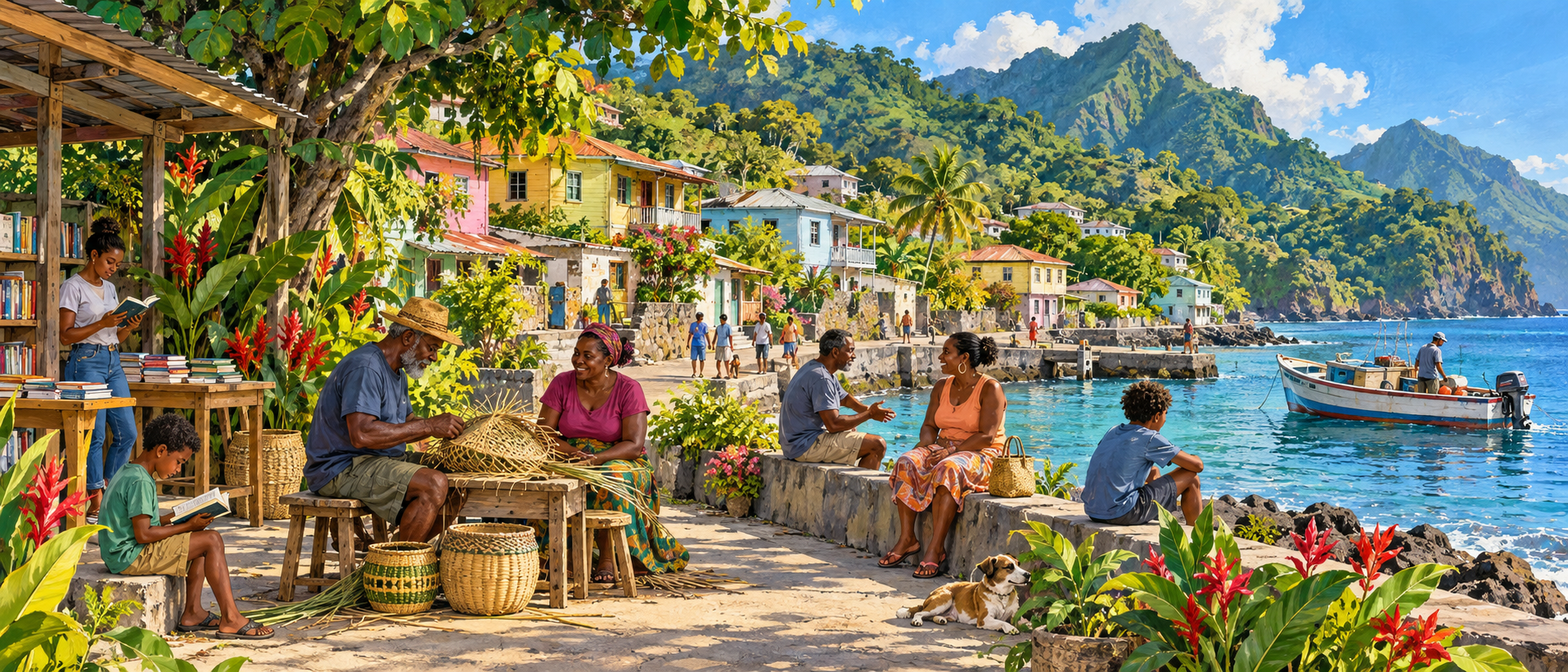
Dominica invites a wonderful change in how we look at the Caribbean. Instead of beginning with a beach, begin with the mountains: rainforest covers volcanic slopes, water falls through steep valleys, and an extraordinary hot lake reminds us that the island is still geologically active. Kalinago communities, old coastal fortifications and everyday Creole culture add human stories that a waterfall photograph could never explain. These top 10 things to learn when visiting and touring Dominica connect nature, culture and history through ten thoughtful questions.
For Singapore families researching Dominica travel, Morne Trois Pitons National Park, the Kalinago Territory, conservation and Caribbean island learning, these lessons show what makes the Commonwealth of Dominica distinct from the Dominican Republic. We explore its UNESCO World Heritage property, three tentative heritage candidates, river and marine systems, historic resistance, Indigenous craft and community identity. Clear sources, English–Chinese vocabulary and relaxed family tasks make this Dominica learning guide useful during a responsibly organised visit or at home.
Travel and environmental care — 9 October 2026: Check current official travel advice for Dominica. The Caribbean hurricane season normally runs June to November, and heavy rain, flash flooding, landslides, river changes and volcanic hazards can affect access. Do not treat a Boiling Lake photo as safe hiking advice, approach geothermal water, swim in an unassessed current, or disturb protected marine areas. Confirm local permits, guides and weather notices separately. World Heritage and Tentative List status are not safety endorsements.
Choose your learning route
Start with geography, natural science or a human story. The ten lessons can be enjoyed independently, and remote learning is appropriate whenever weather or access makes visiting unsuitable. Contents · Family route · Vocabulary · Country directory
Contents
- Distinguish Dominica from the Dominican Republic on a map
- Read Morne Trois Pitons as a natural World Heritage landscape
- Treat Boiling Lake as a geothermal lesson, not an ordinary swimming lake
- Study Morne Diablotin’s parrots and conservation status precisely
- Understand Scott’s Head as marine ecology and potential heritage
- Learn the history of Fort Shirley and the soldiers’ resistance
- Recognise Kalinago communities as living custodians of culture
- Understand the Waitukubuli National Trail as a map of rivers and people
- Read hurricane recovery as conservation and community resilience
- Enjoy Creole language, festival and food without making everyone one voice
Start with the two names. The Commonwealth of Dominica is an independent island country in the Lesser Antilles, lying between Martinique and Guadeloupe. The Dominican Republic occupies part of the much larger island of Hispaniola, hundreds of kilometres away. Their names can be confused in online search results, yet their geography, institutions and local history are distinct.
Dominica is volcanic and mountainous, with rivers running down steep slopes toward the sea. The small island’s relief creates short but environmentally varied journeys. A political map shows the boundary and capital Roseau; a relief map reveals why the centre looks nothing like an imagined flat Caribbean resort.
Dominica’s tourism ministry calls it the Nature Island, a useful introduction so long as it remains a slogan rather than a complete explanation. Every protected landscape is also linked with residents, history, roads, water and decisions about how resources are used. A photograph showing no person does not prove an area has no human connections.
Compare two maps of the Caribbean and mark Roseau, Morne Trois Pitons and the island’s east coast. Then locate Santo Domingo in the Dominican Republic. An accurate map is the first defence against mistaking one country’s UNESCO heritage, languages or entry rules for another’s.
For family learning, write one distinction about location, another about scale and a third about the sources needed to understand culture. You can enjoy this exercise without turning every named valley into an excursion, particularly during severe weather.
Notice and discuss: How does exact geography prevent false conclusions about a place? Family activity: Compare Dominica and the Dominican Republic, preserving both countries’ separate identities. Use an attributed fact and distinguish it from a personal impression.
Explore the source: Distinguish Dominica from the Dominican Republic on a map. The source provides context and does not replace live park rules, weather updates or community permissions.
Morne Trois Pitons National Park was inscribed on the UNESCO World Heritage List in 1997. UNESCO describes a mountainous interior of rainforest, steep volcanic peaks, narrow valleys, freshwater lakes, hot springs and fumaroles. The park covers roughly 6,857 hectares and protects a particularly unusual concentration of natural features.
The scientific story is a relationship, not an inventory. Rainfall supports forest and waterways, while volcanic geology contributes hot springs, steam vents and particular landforms. A rich ecosystem can coexist with physical hazards that cannot be inferred from a scenic image.
UNESCO highlights the park’s biodiversity within the Lesser Antilles. But species lists do not promise sightings or imply that the same animal occurs at every elevation. The forest must be studied through habitats, monitoring and ecological connections, not just a collection of dramatic wildlife portraits.
Protection requires management of visitors, roads, trails and the surrounding environment. UNESCO’s account discusses risks including hurricanes, invasive species and other pressures. A World Heritage inscription marks natural value; it does not stop erosion, heavy rain or the need for ongoing conservation.
Sketch four connected elements: rain, forest, river and volcanic rock. Add one verified detail from the UNESCO description and a question about long-term management. Understanding the relationships can be the achievement, whether you are studying remotely or using an authorised observation point.
Notice and discuss: Why is this more than a collection of waterfalls and volcanic peaks? Family activity: Explain how geology, rain and habitats interact within one protected landscape. Use an attributed fact and distinguish it from a personal impression.
Explore the source: Read Morne Trois Pitons as a natural World Heritage landscape. The source provides context and does not replace live park rules, weather updates or community permissions.
LESSON 3 OF 10
3. Treat Boiling Lake as a geothermal lesson, not an ordinary swimming lake
Dominica’s famous Boiling Lake lies within Morne Trois Pitons National Park. UNESCO identifies it among the property’s spectacular volcanic features, along with fumaroles and hot springs. It can be examined as part of an active hydrothermal system, where water, heat and subsurface geology interact.
The important difference is between seeing a photograph and understanding a hazard. Steam, changing water levels and thermal activity can make a landscape unstable and dangerous. A pale-blue appearance does not tell a viewer the water temperature, the surrounding ground’s strength or the conditions on a particular day.
Volcanic heat is not a steady appliance whose behaviour a traveller can predict from a previous visit. Rainfall, gas movement and geological changes may alter surface conditions. Scientific monitoring and qualified local advice, rather than an online travel anecdote, are needed to assess current access.
UNESCO’s broader natural description helps explain why volcanic and rainforest features occur together. The island’s great rainfall feeds many rivers and lakes while geological heat creates unusual hot-water features. They belong to different physical processes within the same landscape.
Make a diagram with rainfall, groundwater, heated rock, rising water and steam, clearly labelling it a simplified model. Do not use this chapter as walking directions, attempt an unguided approach or enter geothermal water. A home-based geology explanation is a complete learning result.
Notice and discuss: How can rainwater and geothermal heat produce an unusual lake? Family activity: Distinguish a simplified scientific model from current field safety information. Use an attributed fact and distinguish it from a personal impression.
Explore the source: Treat Boiling Lake as a geothermal lesson, not an ordinary swimming lake. The source provides context and does not replace live park rules, weather updates or community permissions.
LESSON 4 OF 10
4. Study Morne Diablotin’s parrots and conservation status precisely
Morne Diablotin National Park in northwestern Dominica appears on UNESCO’s World Heritage Tentative List, submitted in 2015. It is not one of the country’s inscribed World Heritage properties. UNESCO’s state proposal explains that this protected forest includes Dominica’s highest mountain and important habitats for endangered endemic parrots.
Two birds particularly associated with Dominica are the imperial amazon, also called the sisserou, and the red-necked amazon, or jaco. Their preservation depends on habitat, scientific monitoring and protective work rather than simply restricting visitors’ photographs. Species of high cultural value can remain vulnerable to storms and environmental disturbance.
The 2015 tentative description discusses vegetation types, water catchments and research into breeding biology. These are public educational clues about ecological systems, but an older account is not a guarantee of current animal populations or the opening status of individual trails.
A tentative nomination expresses a state’s interest in seeking recognition for a property. It is not equivalent to the 1997 inscription of Morne Trois Pitons. That difference is especially important when travel sites use the word ‘UNESCO’ without identifying the exact programme.
Draw two separate cards, one for each national park, naming the 1997 inscribed property and the 2015 tentative one. Then connect forest habitat with water and birds. This makes accurate conservation learning possible without disturbing a rare animal.
Notice and discuss: What is the difference between ecological importance and a completed UNESCO inscription? Family activity: Make a two-property comparison showing both the heritage status and conservation subject. Use an attributed fact and distinguish it from a personal impression.
Explore the source: Study Morne Diablotin’s parrots and conservation status precisely. The source provides context and does not replace live park rules, weather updates or community permissions.
The Soufriere–Scott’s Head Marine Reserve appears on Dominica’s UNESCO World Heritage Tentative List, submitted in 2015. The protected coastal setting lies toward the southwest of the island and includes waters near Soufrière and Scott’s Head. UNESCO’s state proposal discusses the marine habitats and the history of the headland.
The underwater environment invites scientific questions about corals, fish, marine vegetation and the relationship between a volcanic island and its coastal waters. A photograph of turquoise sea cannot show the ecological health of a reef or tell you if conditions are appropriate for entering it.
The same headland has historical evidence connected with European competition for Caribbean maritime routes. Coastal defensive structures testify to the importance of sea approaches, but they also belong to a larger account of colonial power and work.
UNESCO records local conservation efforts and the potential importance of a natural World Heritage nomination. That does not turn the marine reserve into an already inscribed property. Protected access rules, weather, currents and the presence of sensitive habitats are separate practical concerns.
Compare a coastline map with one official ecological description. Identify which part of the story belongs to geological setting, which to living habitats and which to human history. Do not propose touching coral, approaching marine animals or entering restricted water.
Notice and discuss: How can one headland carry maritime history and ecological value? Family activity: Connect coast, coral habitat and historic defence without confusing their different kinds of evidence. Use an attributed fact and distinguish it from a personal impression.
Explore the source: Understand Scott’s Head as marine ecology and potential heritage. The source provides context and does not replace live park rules, weather updates or community permissions.
Fort Shirley, within Cabrits National Park, is on Dominica’s UNESCO World Heritage Tentative List. The state proposal describes a fortification complex developed under British and French colonial control, with ramparts, batteries, barracks and other facilities linked with defence of Prince Rupert’s Bay.
The fort is not merely an attractive ruin. Its construction and maintenance were tied to colonial power, skilled labour and the economic networks of Caribbean plantations. An honest historical explanation considers why the fort was built, what it protected and who performed the work.
UNESCO’s submission identifies an important 1802 revolt involving soldiers of the 8th West India Regiment, including formerly enslaved African men serving in the colonial military. The event helps open a difficult question about military service, coercion, freedom and resistance. The state proposal links the mutiny with later changes to the status of enslaved soldiers.
A careful reader distinguishes that documented event from broad claims about the abolition of slavery throughout the empire, which followed a different chronology. The 1807 developments concerning military status were not the same as the 1833 Slavery Abolition Act. Precise terms matter when explaining history to families.
Study the officially described rooms or historic plan, naming one defensive use and one human story. The heritage deserves a respectful account of the men involved, not theatrical language or invented quotations. Current visitor arrangements need separate confirmation.
Notice and discuss: How can a defensive building also be a place for learning about injustice and resistance? Family activity: Make a short timeline that keeps the 1802 revolt distinct from later colonial emancipation laws. Use an attributed fact and distinguish it from a personal impression.
Explore the source: Learn the history of Fort Shirley and the soldiers’ resistance. The source provides context and does not replace live park rules, weather updates or community permissions.
The Kalinago are Dominica’s Indigenous people, and the Kalinago Territory on the island’s eastern side is associated with continuing community life, skills and institutions. Dominica’s official tourism material describes basket weaving, canoe making, wood carving and other crafts that have particular meanings for their bearers.
Living Indigenous heritage should not be presented as a remnant of a civilisation that vanished. Kalinago people have modern experiences, choices, work and aspirations alongside connections with ancestral knowledge. The language used to describe communities should put their present-day agency before a romantic image of the distant past.
Craft knowledge often includes selecting materials, making careful measurements and teaching younger learners. A woven basket is both an object and the result of the maker’s practice. An outsider cannot know the meaning of every pattern simply by looking at it.
Permission and reciprocity matter. Where community-led cultural experiences are publicly offered, use the explanations and rules supplied by Kalinago practitioners. Do not treat private homes, ceremony or personal lives as exhibits. If travel is not possible, published community and institutional accounts offer a respectful alternative.
Try drawing two columns, visible craft and transmitted skill. Add a question about the maker and what you cannot infer from a tourist photograph. The exercise makes a valuable distinction between appreciating culture and claiming knowledge you have not been given.
Notice and discuss: What makes Indigenous culture a living, changing practice rather than only an archaeological subject? Family activity: Keep the names and voices of community custodians attached to every cultural explanation. Use an attributed fact and distinguish it from a personal impression.
Explore the source: Recognise Kalinago communities as living custodians of culture. The source provides context and does not replace live park rules, weather updates or community permissions.
LESSON 8 OF 10
8. Understand the Waitukubuli National Trail as a map of rivers and people
The Waitukubuli National Trail stretches along Dominica and is described by its administrators as a 184-kilometre network of fourteen segments. The name Waitukubuli is associated with the island’s Kalinago heritage and helps connect cultural naming with a distinctive mountainous environment.
This guide treats the trail as geographical evidence, not a promise that fourteen stages are suitable for tourists in October 2026. Steep slopes, rainfall, river crossings, land management and local settlements are part of why creating and maintaining an island-spanning route requires work.
A trail map can help readers see changes in elevation and the relationship between inland communities and coastal places. But printed paths do not tell you whether bridges, signs or surfaces have been damaged by a recent storm, or whether a stretch is currently open.
The presence of an organised trail also raises social questions about stewardship and learning. Communities, park officials, maintenance staff and visitors have roles in supporting responsible use. A place’s cultural name should be explained through knowledgeable sources rather than treated only as a marketable slogan.
At home, compare a relief map with the trail’s broad route and write which geographical challenges are visible. If physical walking is ever considered, obtain current local information, appropriate permits and professional advice. This chapter does not offer a walkable route.
Notice and discuss: What does a trail map reveal about an island’s terrain, and what must a current local authority tell you? Family activity: Separate permanent geographical relationships from changeable access and safety conditions. Use an attributed fact and distinguish it from a personal impression.
Explore the source: Understand the Waitukubuli National Trail as a map of rivers and people. The source provides context and does not replace live park rules, weather updates or community permissions.
Dominica’s climate gives the island enormous rainfall and lush vegetation, but tropical storms and hurricanes can also affect homes, roads, forests and shorelines. FCDO travel advice explains that the Atlantic hurricane season normally runs from June to November and that weather can change abruptly.
Nature tourism images often present a beautiful environment as a permanent condition. An island’s conservation story includes change: tree damage, erosion, river floods, coastal impacts and the long work of recovery. Disturbance does not make a landscape less worthy of ecological study.
Community resilience is also a subject of learning. Government agencies, neighbourhood groups, researchers and residents must respond to changing environmental conditions and decide how to maintain infrastructure and protected areas. Avoid making grand claims about the results of a recovery programme from one news photograph.
A home-based enquiry can compare a dated satellite or park photograph with current institutional explanations, noting exactly when the images were taken. Distinguish a landscape change you can observe from causes that require scientific evidence.
Finish with two linked questions: how can habitats recover after a storm, and what does a community need to recover alongside them? It is a way to see people and natural systems together without turning an emergency into a scenic travel anecdote.
Notice and discuss: Why should conservation and family planning take extreme weather seriously rather than treating it as an afterthought? Family activity: Write one environmental and one social responsibility associated with hurricane preparedness. Use an attributed fact and distinguish it from a personal impression.
Explore the source: Read hurricane recovery as conservation and community resilience. The source provides context and does not replace live park rules, weather updates or community permissions.
LESSON 10 OF 10
10. Enjoy Creole language, festival and food without making everyone one voice
Dominica’s culture includes Dominican Creole, or Kwéyòl, alongside English, and traditions influenced by Indigenous, African and European histories. Its music, language and everyday food are not identical to those of the neighbouring Dominican Republic. Naming the country and the local context precisely is essential.
The island’s Creole heritage may be encountered through songs, festivals and ordinary conversation. A written translation can convey the topic of a phrase but may not preserve its rhythm or local nuance. Do not invent pronunciation or assume that every resident speaks in exactly the same way.
Foods featuring ground provisions, root crops, bananas, fish and local preparations can be enjoyed in many different settings. No single recipe represents every household. Ask the cook or a trusted local source about ingredients, the occasion and specific version rather than attaching one universal label to all Dominican meals.
Dominica’s cultural events involve organisers, musicians, craftspeople and families. A public festival is different from a private or sacred occasion; photography and recording should respect consent. You can appreciate rhythm, dance and costume without treating community practice as something created only for outsiders.
End your learning journey by connecting an Indigenous craft, a volcanic landscape and a Creole cultural practice. The country becomes understandable not through one slogan but through the people and environments that maintain those relationships.
Notice and discuss: Why does a cultural practice need its named community and real-life setting? Family activity: Make a bilingual concept card with one environment, one craft and one form of communication. Use an attributed fact and distinguish it from a personal impression.
Explore the source: Enjoy Creole language, festival and food without making everyone one voice. The source provides context and does not replace live park rules, weather updates or community permissions.
A gentle family learning route
Begin with a map and one question about the island’s volcanic landscape. Ask what rain, rivers and heat have to do with the world above ground. Explain the relationship using UNESCO’s natural heritage description rather than a risky trip to a geothermal feature.
On another day, compare that environmental story with Fort Shirley or a Kalinago craft. The physical evidence of a fort and the transmitted knowledge of a living community call for different forms of interpretation. Be precise about the people and historical power relationships involved.
Read the official hurricane guidance and discuss why a beautiful natural island needs careful storm preparedness. An international heritage designation is not a guarantee about today’s weather, road conditions or access.
Finish with a family learning note naming one natural process, one human history and one living cultural practice. Each should include an attributable source and an honest unanswered question. One thoughtful connection is enough.
English–Chinese vocabulary for understanding Dominica
These are conceptual English–Chinese learning equivalents, not translations into Kwéyòl or Kalinago language. Exact local names should remain attached to the people and places they describe.
| English | 中文 | Learning connection |
|---|---|---|
| volcanic landscape | 火山地貌 | Identify an environmental process. |
| hydrothermal system | 水热系统 | Name a heritage designation precisely. |
| rainforest watershed | 雨林集水区 | Respect a community’s knowledge. |
| biosphere habitat | 生物圈生境 | Check present-day safety separately. |
| World Heritage inscription | 世界遗产列入名录 | Identify an environmental process. |
| tentative heritage proposal | 世界遗产预备申报 | Name a heritage designation precisely. |
| coastal conservation | 海岸保护 | Respect a community’s knowledge. |
| colonial fortification | 殖民时期防御工事 | Check present-day safety separately. |
| historical resistance | 历史反抗 | Identify an environmental process. |
| Indigenous craftsmanship | 原住民工艺 | Name a heritage designation precisely. |
| community stewardship | 社区守护 | Respect a community’s knowledge. |
| hurricane resilience | 飓风韧性 | Check present-day safety separately. |
Questions families often ask
Is Dominica the same country as the Dominican Republic?
No. Dominica is an independent island in the Lesser Antilles, while the Dominican Republic is on Hispaniola. Their places, historical experiences and travel requirements differ.
How many UNESCO World Heritage properties does Dominica have?
One: Morne Trois Pitons National Park, a natural property inscribed in 1997.
Are Fort Shirley and Morne Diablotin also inscribed World Heritage?
No. Fort Shirley, Morne Diablotin National Park and the Soufriere–Scott’s Head Marine Reserve are on Dominica’s 2015 Tentative List, a different status.
Can a family walk to Boiling Lake without checking current access?
No. Geothermal hazards and changeable weather require up-to-date official information. This guide deliberately provides an explanation of the physical process rather than directions.
Is Kalinago heritage a thing only of the past?
No. Kalinago people are a living Indigenous community with present-day institutions, crafts and responsibilities. Community-led interpretation should guide any cultural account.
Are the Chinese words translations of Dominica’s Kwéyòl?
No. They are conceptual English–Chinese equivalents for learning, not a local-language phrasebook.
Continue the country learning journey
Return to the World Country Learning Directory. The preceding alphabetical guide is Djibouti. Continue with Dominican Republic, Ecuador and Egypt when published.
Use the Travel Vocabulary Directory and World Travel Hub to connect this island learning with other countries and cultures.