
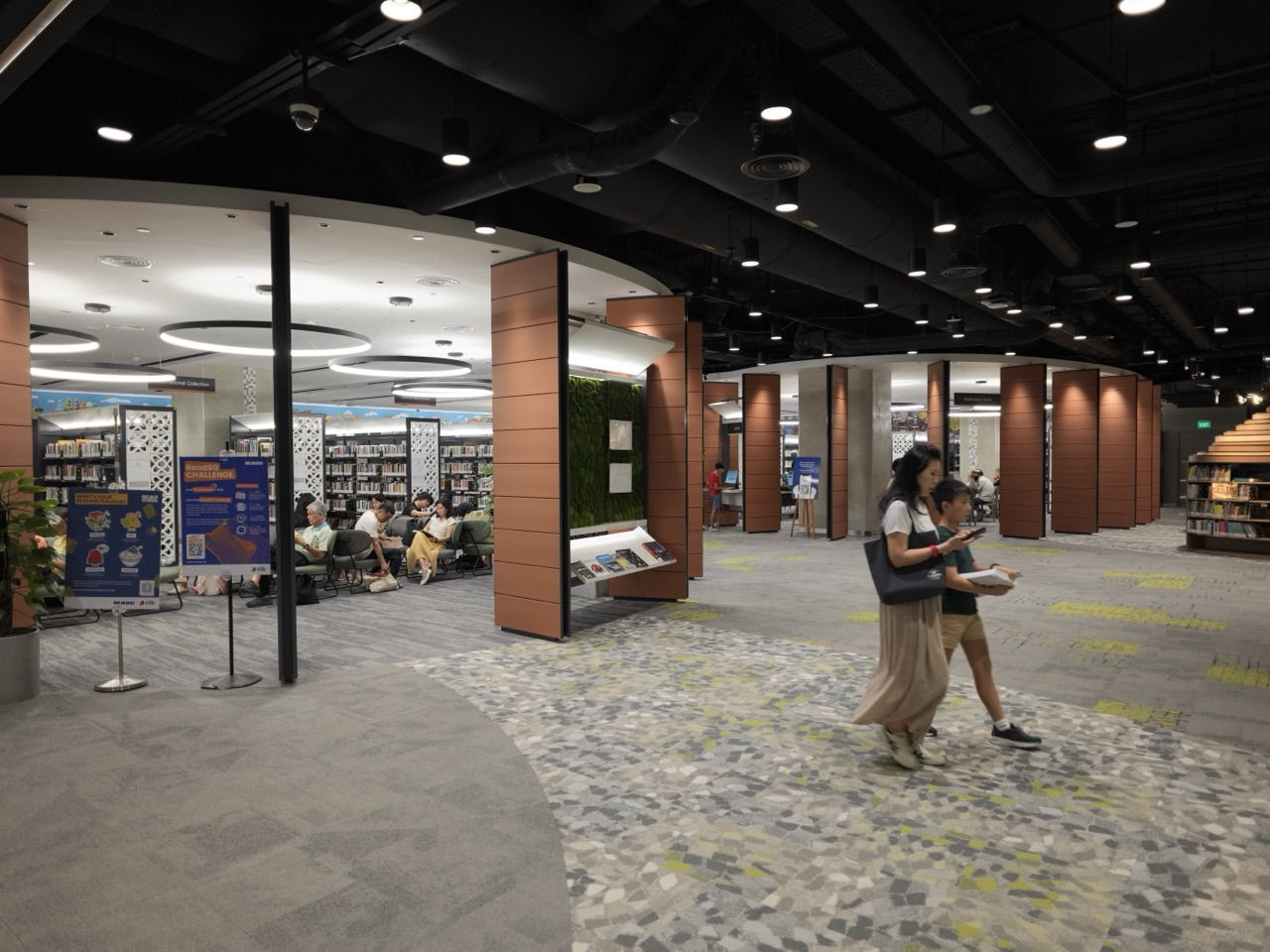
Visit a public library in Singapore: ask clearly, find a book, borrow correctly
“Where can I find this book?” “Is it available to borrow?” “When must I return it?” Those three questions turn a first visit to a library in Singapore into a useful journey. The most important skill is not using complicated English. It is being able to ask clearly, find the correct resource, understand what your account allows, and leave with the right next step.
Did you know that a catalogue listing, a call number, a reservation and a completed loan are four different things? The National Library Board (NLB) has physical libraries, digital services and special self-service locations. Knowing the difference helps readers avoid a wasted journey, an incorrect borrowing assumption or confusion over a return date.
This guide teaches twenty practical English expressions used when visiting a Singapore public library, with aligned Simplified Chinese, Hindi and Russian editions. Our short dialogue scenes and worked visits are fictional teaching examples, not transcripts of actual staff or guarantees of available books, fees, places or programmes. For current eligibility, opening hours and loans, rely on the specific official NLB service information.
English · 简体中文 · हिन्दी · Русский: English · 简体中文 · हिन्दी · Русский
Quick answer · 20 terms · Before visiting · Definitions · 10 dialogues · Worked examples · Compare words · Practice · FAQs · Sources · Next

The quick answer: using a Singapore public library
Check the correct branch and opening hours, identify whether you wish to browse, borrow, study or attend an activity, and confirm any membership requirement. Search the catalogue, check format, location and availability, then use the call number or ask for help. Complete the official borrowing transaction if taking items home, record your due dates and verify renewals or returns. Use official NLB channels for fees, digital services and events.
A good first question is ‘Can I read here, or do I need to check this book out?’ The next questions depend on the account, edition, branch and purpose. Treat an appointment, reservation, catalogue result and confirmed loan as distinct states.
The 20 most useful library expressions at a glance
‘Top 20’ means a selected set of twenty practical expressions for this situation, not a measured frequency ranking of Singapore speech. English words are kept aligned across all four editions.
| Expression | What it helps you understand |
|---|---|
| 1. Public library / branch | A public library provides reading and information resources for the community; a branch is one location within the wider NLB network. |
| 2. Opening hours / holiday hours | Opening hours are the times when a particular library normally admits visitors; holiday hours may differ on public holidays and some eves. |
| 3. Membership / eligibility | Library membership is an account arrangement for eligible users; eligibility determines which membership types and privileges may apply. |
| 4. Library card / NLB eCard | A library card identifies a reader account for supported transactions. The NLB eCard is a digital form used in supported services. |
| 5. myLibrary username / account | The myLibrary username is an account identifier for NLB’s supported online library services. |
| 6. Library catalogue / search | A library catalogue records and helps readers discover material by title, author, subject and other details. |
| 7. Call number / shelf location | A call number is a code used to organise and locate a physical library item; shelf location identifies its section or position. |
| 8. Availability / on loan | Availability describes a material’s current status; on loan means a particular copy has already been borrowed. |
| 9. Librarian / enquiry desk | A librarian helps people discover resources and navigate the collection; an enquiry desk is a service point available at some locations. |
| 10. Children’s / Mother Tongue books | The children’s collection contains material for younger readers. Mother Tongue collections support reading in languages such as Chinese, Malay and Tamil. |
| 11. Borrow / check out | Borrow means take a library item under the loan conditions; check out is the transaction recording that loan. |
| 12. Due date / borrowing limit | Due date is the return deadline; borrowing limit, or loan quota, is the number of items permitted under the relevant account or service. |
| 13. Renew / extend a loan | Renew means extend a borrowing period if NLB’s current conditions permit it. |
| 14. Reserve / place a hold | Reserve or place a hold means request a copy through a formal reservation mechanism, subject to availability and rules. |
| 15. Reservation pickup / locker | Reservation pickup is collecting an item when the system says it is ready; some locations use reservation lockers. |
| 16. Return / bookdrop | Return means hand borrowed material back; a bookdrop is a designated return facility for eligible items. |
| 17. Overdue charge / lost item | Overdue means kept beyond the due date. Lost or damaged materials may entail separate obligations. |
| 18. eBook / audiobook / NLB Mobile | An eBook is for digital reading; an audiobook is a spoken recording. NLB Mobile and supported platforms help members find digital resources. |
| 19. Reading space / WiFi | Reading spaces and WiFi support study where facilities are available. NLB describes Wireless@SG access at its libraries. |
| 20. Library programme / registration | A library programme is a talk, storytime, reading club or learning activity. Registration is signing up when the event requires it. |
Five decisions before you leave home, borrow or study
Plan the visit before travelling
Start with the NLB location finder, not a generic claim that all public libraries work alike. Check the branch, day and services you need. A mall library, a conventional branch and a special Grab-n-Go node can differ in access, hours and what facilities are present.
A useful question is ‘Is this branch open today, and can it handle my specific request?’ Do not confuse an evening library event with general building access.
Choose the right kind of visit
Someone who wants to read quietly may need only access to a suitable reading area. A reader taking a physical book home needs a recognised borrowing transaction, and a participant joining a workshop may need registration.
Ask ‘Am I browsing, borrowing, studying or attending a programme?’ The same building does not mean the conditions are identical.
Find the book as an item, not just a title
Search for the author or title, check edition, format, status and branch, then note the call number. A book may be on loan locally and available elsewhere, or may exist as an eBook with different access arrangements.
A result in the catalogue is evidence that a record exists. It is not, by itself, proof that the book will be waiting on the shelf.
Record the borrowing and return
If you borrow, use the supported borrowing machine or app and check the account. Record due dates accurately, ask whether renewal is possible, and locate a valid bookdrop. If a reservation is needed, check the fee and collection process.
Borrowing, reserving, collecting and returning are separate steps. Clear records reduce mistakes and unnecessary overdue charges.
Use the library respectfully and keep learning
Find suitable reading space, follow posted etiquette, and ask for accessibility or technology assistance if necessary. NLB’s digital collections, children’s books, Mother Tongue reading and programmes can expand a visit into an ongoing habit.
Do not treat every seat as a reserved study room or assume any activity is automatically open without registering.
Twenty expressions with speaking examples and mistakes to avoid
1. Public library / branch
What it means: A public library provides reading and information resources for the community; a branch is one location within the wider NLB network.
Why it matters: Identify the exact branch rather than assuming every mall library, regional library or self-service node uses identical entry arrangements. Visiting to browse is not the same as obtaining a loan.
Say this in English: “Which public library branch is nearest to this neighbourhood?”
Then ask: “Where can I check the exact address and facilities?”
Avoid this mistake: The word public does not mean every service is free or that every location has the same equipment, opening hours or borrowing rules.
Switch language for this exact word: 简体中文 01 · हिन्दी 01 · Русский 01
Transfer exercise: replace the example with a real title or branch, and ask what evidence would confirm the answer.
2. Opening hours / holiday hours
What it means: Opening hours are the times when a particular library normally admits visitors; holiday hours may differ on public holidays and some eves.
Why it matters: Check the official branch page for the date of your visit. A bookdrop or reservation locker can have separate access hours, especially inside a building with its own opening times.
Say this in English: “What time does this library close today, and what about public holidays?”
Then ask: “Is the bookdrop open when the main library is closed?”
Avoid this mistake: Do not say every Singapore library closes at the same hour or that every return box works twenty-four hours a day.
Switch language for this exact word: 简体中文 02 · हिन्दी 02 · Русский 02
Transfer exercise: replace the example with a real title or branch, and ask what evidence would confirm the answer.
3. Membership / eligibility
What it means: Library membership is an account arrangement for eligible users; eligibility determines which membership types and privileges may apply.
Why it matters: Check current rules for your residency or other relevant circumstances through NLB. Reading at a public branch and checking a physical book out for use at home are separate actions.
Say this in English: “Do I need NLB membership to borrow this book?”
Then ask: “How do I check the membership conditions for my situation?”
Avoid this mistake: Do not promise identical borrowing privileges or membership fees to every tourist, resident and visitor.
Switch language for this exact word: 简体中文 03 · हिन्दी 03 · Русский 03
Transfer exercise: replace the example with a real title or branch, and ask what evidence would confirm the answer.
4. Library card / NLB eCard
What it means: A library card identifies a reader account for supported transactions. The NLB eCard is a digital form used in supported services.
Why it matters: Check whether the particular branch, station or special node accepts the eCard, another library-compliant card or a designated access method. Follow NLB’s official process for a lost card.
Say this in English: “Can I use my NLB eCard at this borrowing station?”
Then ask: “What official identification does this location accept?”
Avoid this mistake: A screenshot from an unknown person is not proof of valid membership; do not share passwords or one-time codes.
Switch language for this exact word: 简体中文 04 · हिन्दी 04 · Русский 04
Transfer exercise: replace the example with a real title or branch, and ask what evidence would confirm the answer.
5. myLibrary username / account
What it means: The myLibrary username is an account identifier for NLB’s supported online library services.
Why it matters: Use NLB’s own account-recovery or sign-in channel and sign out after using a shared computer. Your account can display loans and related notices.
Say this in English: “I cannot remember my myLibrary username. Where can I recover it?”
Then ask: “Can you show me the official sign-in or account help page?”
Avoid this mistake: A username is not a shelf number or book barcode. Never reveal your password or OTP to someone offering unexpected help.
Switch language for this exact word: 简体中文 05 · हिन्दी 05 · Русский 05
Transfer exercise: replace the example with a real title or branch, and ask what evidence would confirm the answer.
6. Library catalogue / search
What it means: A library catalogue records and helps readers discover material by title, author, subject and other details.
Why it matters: Search the exact title if known, or start with an informative topic and narrow results. Check format, edition and branch before travelling.
Say this in English: “How can I search the catalogue for books about Singapore history?”
Then ask: “Can I search by author, title, subject or language?”
Avoid this mistake: A catalogue record does not mean a physical copy is on your nearest shelf or that every eBook can be downloaded immediately.
Switch language for this exact word: 简体中文 06 · हिन्दी 06 · Русский 06
Transfer exercise: replace the example with a real title or branch, and ask what evidence would confirm the answer.
7. Call number / shelf location
What it means: A call number is a code used to organise and locate a physical library item; shelf location identifies its section or position.
Why it matters: Copy the full call number, verify the correct branch and section, and ask a librarian if it is not where expected.
Say this in English: “The catalogue gives a call number. Which shelf should I go to?”
Then ask: “Is it in the children’s section or on another floor?”
Avoid this mistake: A call number is not a book price, ISBN, borrowing quota or your library account ID.
Switch language for this exact word: 简体中文 07 · हिन्दी 07 · Русский 07
Transfer exercise: replace the example with a real title or branch, and ask what evidence would confirm the answer.
8. Availability / on loan
What it means: Availability describes a material’s current status; on loan means a particular copy has already been borrowed.
Why it matters: Check whether the listing refers to a printed copy, reference material or electronic edition, and which branch holds it.
Say this in English: “This book is on loan. Is another copy currently available?”
Then ask: “Can I check the precise edition and branch?”
Avoid this mistake: A status marked available is not a guaranteed reservation. Another visitor can borrow the item before you arrive.
Switch language for this exact word: 简体中文 08 · हिन्दी 08 · Русский 08
Transfer exercise: replace the example with a real title or branch, and ask what evidence would confirm the answer.
9. Librarian / enquiry desk
What it means: A librarian helps people discover resources and navigate the collection; an enquiry desk is a service point available at some locations.
Why it matters: Name the reader’s age or reading level, interest and preferred language. That helps the librarian suggest more relevant titles.
Say this in English: “Could a librarian recommend an illustrated beginner’s book for a child?”
Then ask: “Is there an enquiry desk or another official help channel?”
Avoid this mistake: A librarian cannot guarantee every title is available, and a self-service node may not have a staffed desk.
Switch language for this exact word: 简体中文 09 · हिन्दी 09 · Русский 09
Transfer exercise: replace the example with a real title or branch, and ask what evidence would confirm the answer.
10. Children’s / Mother Tongue books
What it means: The children’s collection contains material for younger readers. Mother Tongue collections support reading in languages such as Chinese, Malay and Tamil.
Why it matters: Ask about age, difficulty, subject and format. NLB encourages reading across languages and genres, but holdings vary by location.
Say this in English: “Where can I find children’s books in Chinese, Malay or Tamil?”
Then ask: “Could you suggest an age-appropriate reading level?”
Avoid this mistake: Do not assume every language, title or children’s event is present at every library.
Switch language for this exact word: 简体中文 10 · हिन्दी 10 · Русский 10
Transfer exercise: replace the example with a real title or branch, and ask what evidence would confirm the answer.
11. Borrow / check out
What it means: Borrow means take a library item under the loan conditions; check out is the transaction recording that loan.
Why it matters: Use the designated borrowing machine or a supported NLB Mobile function, then verify the due date in your account.
Say this in English: “How do I check out this book at the borrowing station?”
Then ask: “Can I verify that the item appears on my loan record?”
Avoid this mistake: Removing a book from the shelf, scanning its cover or walking through the exit is not a completed checkout.
Switch language for this exact word: 简体中文 11 · हिन्दी 11 · Русский 11
Transfer exercise: replace the example with a real title or branch, and ask what evidence would confirm the answer.
12. Due date / borrowing limit
What it means: Due date is the return deadline; borrowing limit, or loan quota, is the number of items permitted under the relevant account or service.
Why it matters: Check both values in the actual NLB account. Physical books, electronic collections and special programmes may have different terms or restrictions.
Say this in English: “What is the due date, and how many books may I borrow?”
Then ask: “Do different formats have different loan periods or limits?”
Avoid this mistake: Do not state one fixed loan count or universal number of days for all members and formats.
Switch language for this exact word: 简体中文 12 · हिन्दी 12 · Русский 12
Transfer exercise: replace the example with a real title or branch, and ask what evidence would confirm the answer.
13. Renew / extend a loan
What it means: Renew means extend a borrowing period if NLB’s current conditions permit it.
Why it matters: Request renewal through the supported official channel and verify that the due date actually changes.
Say this in English: “Can I renew this book before it becomes overdue?”
Then ask: “Where can I confirm the new due date?”
Avoid this mistake: A visible renew button does not mean every item qualifies. Reservations and special loans may prevent renewal.
Switch language for this exact word: 简体中文 13 · हिन्दी 13 · Русский 13
Transfer exercise: replace the example with a real title or branch, and ask what evidence would confirm the answer.
14. Reserve / place a hold
What it means: Reserve or place a hold means request a copy through a formal reservation mechanism, subject to availability and rules.
Why it matters: Check the exact edition, any fee, pickup branch and notice before submitting. The official account should show the request’s status.
Say this in English: “The book is on loan. Can I place a hold on a copy?”
Then ask: “What is the fee, collection point and notification process, if any?”
Avoid this mistake: A submitted hold is not proof that the book is already ready for collection.
Switch language for this exact word: 简体中文 14 · हिन्दी 14 · Русский 14
Transfer exercise: replace the example with a real title or branch, and ask what evidence would confirm the answer.
15. Reservation pickup / locker
What it means: Reservation pickup is collecting an item when the system says it is ready; some locations use reservation lockers.
Why it matters: Read the official pickup notice for location, time limit and any required checkout step. A locker inside a mall can follow that building’s access hours.
Say this in English: “My reservation is ready. Where do I collect it?”
Then ask: “Do I need to use a locker code, card or borrowing machine?”
Avoid this mistake: A ready-for-collection message and a completed loan are not always the same transaction.
Switch language for this exact word: 简体中文 15 · हिन्दी 15 · Русский 15
Transfer exercise: replace the example with a real title or branch, and ask what evidence would confirm the answer.
16. Return / bookdrop
What it means: Return means hand borrowed material back; a bookdrop is a designated return facility for eligible items.
Why it matters: Check the location, accessibility and whether the material is suitable for that drop. Review your account after returning.
Say this in English: “Where is the bookdrop for returning borrowed books?”
Then ask: “How can I verify that my return was recorded?”
Avoid this mistake: Leaving books on an unattended table outside a closed library is not necessarily a valid return.
Switch language for this exact word: 简体中文 16 · हिन्दी 16 · Русский 16
Transfer exercise: replace the example with a real title or branch, and ask what evidence would confirm the answer.
17. Overdue charge / lost item
What it means: Overdue means kept beyond the due date. Lost or damaged materials may entail separate obligations.
Why it matters: Use NLB’s official payment channels and retain proof of payment. NLB warns that outstanding charges can restrict borrowing.
Say this in English: “My book is overdue. How do I check and pay the official charge?”
Then ask: “What should I do if the library item is lost or damaged?”
Avoid this mistake: Do not trust unsolicited messages asking you to pay an unverified QR code or share an OTP.
Switch language for this exact word: 简体中文 17 · हिन्दी 17 · Русский 17
Transfer exercise: replace the example with a real title or branch, and ask what evidence would confirm the answer.
18. eBook / audiobook / NLB Mobile
What it means: An eBook is for digital reading; an audiobook is a spoken recording. NLB Mobile and supported platforms help members find digital resources.
Why it matters: Search by title and format. Some resources use Libby or a separate provider, and availability may be subject to digital loan conditions.
Say this in English: “Is there an eBook or audiobook edition that I can borrow?”
Then ask: “Which NLB app or approved platform supports this title?”
Avoid this mistake: A catalogue record does not guarantee immediate free digital access to every title.
Switch language for this exact word: 简体中文 18 · हिन्दी 18 · Русский 18
Transfer exercise: replace the example with a real title or branch, and ask what evidence would confirm the answer.
19. Reading space / WiFi
What it means: Reading spaces and WiFi support study where facilities are available. NLB describes Wireless@SG access at its libraries.
Why it matters: Ask what seating, computer, room-booking and accessibility arrangements this branch actually provides.
Say this in English: “Is there a quiet reading space and Wireless@SG at this branch?”
Then ask: “Does a study room require a reservation?”
Avoid this mistake: A free chair is not automatically a reserved room, and public WiFi should not be treated as a private network.
Switch language for this exact word: 简体中文 19 · हिन्दी 19 · Русский 19
Transfer exercise: replace the example with a real title or branch, and ask what evidence would confirm the answer.
20. Library programme / registration
What it means: A library programme is a talk, storytime, reading club or learning activity. Registration is signing up when the event requires it.
Why it matters: Check today’s official event listing, audience, language, accessibility and whether spaces remain. NLB encourages broad and shared reading.
Say this in English: “Is there a storytelling session or reading programme for children this weekend?”
Then ask: “Is advance registration required, and what ages is it for?”
Avoid this mistake: Normal entry to the library does not guarantee a seat at a limited-capacity workshop.
Switch language for this exact word: 简体中文 20 · हिन्दी 20 · Русский 20
Transfer exercise: replace the example with a real title or branch, and ask what evidence would confirm the answer.
Ten realistic library conversations to practise
The dialogues below are invented learning scenes. Read one role aloud, switch roles and use a different book or request. No exchange is a transcript from an actual NLB branch.
1. Finding the right branch
Visitor: Is there an NLB public library near this MRT station?
Staff: Please check the library finder for the closest branch and its actual opening hours.
Visitor: Thank you. I will check the branch page before travelling.
What to learn: A nearby library is not automatically open or equipped for the same service.
简体中文 01 · हिन्दी 01 · Русский 01
2. Asking about borrowing eligibility
Visitor: I would like to take this book home. Do I need a library membership?
Staff: The borrowing arrangement depends on your current eligibility and account type.
Visitor: Could you show me the official membership information for my situation?
What to learn: Browsing and borrowing are different rights.
简体中文 02 · हिन्दी 02 · Русский 02
3. Searching the catalogue
Reader: I want a beginner’s book about Singapore history. How should I search?
Librarian: Start with a title or subject and check the results for the right edition.
Reader: How can I see which branch has a copy?
What to learn: A useful search ends with a specific holding and location.
简体中文 03 · हिन्दी 03 · Русский 03
4. Following the call number
Reader: The catalogue shows a call number. Where is that shelf?
Librarian: Check the section and shelving code, then look in the corresponding area.
Reader: If the book is not there, may I return for help?
What to learn: The shelf code is not the due date or the ISBN.
简体中文 04 · हिन्दी 04 · Русский 04
5. Understanding on loan
Reader: This book says ‘on loan’. Is there another available copy?
Librarian: You can check other holdings and the current reservation options.
Reader: Could you show me the correct edition and possible collection point?
What to learn: Availability and a confirmed reservation are different states.
简体中文 05 · हिन्दी 05 · Русский 05
6. Borrowing properly
Reader: How do I check out these two books?
Staff: Please use the approved borrowing service and then check your account.
Reader: Can I verify their due dates before I leave?
What to learn: Picking up a book is not a completed loan transaction.
简体中文 06 · हिन्दी 06 · Русский 06
7. Renewing the book
Reader: My book is due soon. Can I renew it?
Staff: Renewal eligibility depends on the item and your account status.
Reader: I will check whether the new due date actually appears.
What to learn: Renewal must succeed; it cannot be assumed.
简体中文 07 · हिन्दी 07 · Русский 07
8. Returning at a bookdrop
Reader: Does the bookdrop operate when this branch is closed?
Staff: The exact return point and access hours are listed for that location.
Reader: I will use an approved point and check my account afterwards.
What to learn: Do not leave borrowed books outside a locked door.
简体中文 08 · हिन्दी 08 · Русский 08
9. Choosing a digital title
Student: Is there an audiobook instead of the printed edition?
Staff: Search the NLB digital resources for that title and format.
Student: Which supported app will let me borrow and listen to it?
What to learn: A print title and its digital version can have separate availability.
简体中文 09 · हिन्दी 09 · Русский 09
10. Joining a reading activity
Parent: Is there a storytelling session for primary-school children?
Staff: Please check the current programme page and any registration requirements.
Parent: I will confirm the age group, language and venue before attending.
What to learn: A public library visit does not guarantee a place at a workshop.
简体中文 10 · हिन्दी 10 · Русский 10
Three worked Singapore library visits, with clear outcomes
Worked case A — A parent and a new reader
A parent wants a short Chinese-language illustrated book for a child who is gaining confidence. Instead of asking for ‘anything good’, the parent searches by age, language and a subject the child enjoys. The parent checks the library branch, call number and whether a suitable copy is available. If they want to borrow it, they verify the child’s account arrangement and complete checkout.
Worked phrase: Practice message: ‘Could you help us find a beginner-friendly Chinese-language book about animals for a child? Please show us the correct shelf and how to check whether it may be borrowed.’
Worked case B — A learner needs a specific book
A student finds a catalogue record for a history title but the local copy is on loan. Searching only by the title did not complete the task. The student checks another holding, the edition and the appropriate reservation procedure and fee before making a decision. If a digital version exists, its access and loan conditions are evaluated separately.
Worked phrase: Practice message: ‘The printed copy at my branch is on loan. Is there an available edition at another library or a digital format I may access under my membership? If I reserve it, where would I collect it?’
Worked case C — A first-time borrower manages dates
A visitor borrows two eligible books through an approved station and then sees the due dates in their library account. Later, one book may be eligible for renewal and another might be reserved by someone else. The visitor checks the live renewal result instead of assuming both periods were extended, finds an approved bookdrop and verifies that the final return is recorded.
Worked phrase: Practice message: ‘I have two books on my account. Could you explain which one may be renewed, which due date applies to each, and where I can return the other book safely?’
Six pairs of library words that are easy to confuse
Use the eduKate Fencing Method: put two easily confused words side by side. Explain how their meanings differ, say one new sentence for each, then retrieve the distinction without looking.
1. Catalogue result versus shelf availability
A catalogue result says a record matches your search. Shelf availability describes the status of a physical copy. Use the branch and edition before deciding whether to travel.
2. Call number versus ISBN
A call number helps locate a library item in a shelving system; ISBN identifies an edition in publishing. Neither one tells you the member’s due date.
3. Borrowing versus browsing
Browsing or reading on-site may involve different conditions from completing a checkout and taking the book away. A library visit does not create a loan.
4. Due date versus loan quota
The due date answers ‘when must I return this?’ The loan quota answers ‘how many may I have?’ Never treat the number of books as a number of days.
5. Renewal versus reservation
Renewal attempts to extend your current loan where allowed. Reservation requests access to an item, often when it is unavailable. A successful renewal and a pending hold are different outcomes.
6. Ready for collection versus already borrowed
Ready for collection means the reserved item can be picked up according to the notice. It does not always mean the final loan transaction is complete. Check the designated process.
Five-minute practice and an answer check
- Minute 1 — Recall five words without the table: catalogue, call number, available, borrow, due date.
- Minute 2 — Explain why a title in the catalogue is not necessarily a book on the shelf. Include the words ‘branch’ and ‘on loan’.
- Minute 3 — Practise asking whether a book can be borrowed and how to find its return date. Then distinguish browsing from checkout.
- Minute 4 — Say one correct question about renewing and another about reserving. Explain which one applies to a book you already hold.
- Minute 5 — Write a three-line library enquiry containing the exact book or topic, preferred location and whether you want an eBook or physical item.
Answer check: Answer check: a call number helps locate a book; a due date is a deadline, not a quota; an on-loan item is not immediately available; a successful checkout must be recorded; and a reservation request is not the same as collection readiness. Revisit words 6, 7, 8, 11, 12 and 14 if those distinctions remain uncertain.
Ten questions about borrowing and using a library in Singapore
1. Can I enter a public library in Singapore without being a borrowing member?
Ordinary browsing arrangements and borrowing privileges are not necessarily identical. Some specialised self-service nodes have their own entry methods. Check the exact library and purpose before visiting.
2. Does every NLB public library open at the same time?
No. Branches and special locations publish their own hours, and public holidays or temporary works can change them. Use the official branch page for the date.
3. How do I find a specific book?
Search the catalogue by title, author or topic, choose the correct edition and branch, check current status, then note the call number or ask a librarian.
4. What is the difference between a call number and an ISBN?
The call number identifies a shelving location or classification; an ISBN identifies a publication edition. They serve different purposes.
5. How many books can I borrow and for how long?
That depends on the current membership and item type. Consult your account for the actual quota and due dates; do not rely on a blanket number.
6. May I automatically renew every book?
No. Eligibility varies by format, account status and other reservations or special programme conditions. Verify that the renewal actually succeeded.
7. Can I borrow an eBook or audiobook through my NLB account?
Eligible members may use supported NLB digital collections, including the NLB Mobile ecosystem and services such as Libby. Check the title, format and current app instructions.
8. Where should I return a library book?
Use an approved bookdrop or another return method for the particular item. Confirm the branch’s actual access hours and then check your account.
9. How do I pay an overdue or lost-item charge?
NLB publishes official account and payment options. Check the charge through the official system rather than a surprising text message or unfamiliar QR code.
10. Does a public-library event require registration?
Some activities have limited places, age or language conditions, or registration requirements. Check the current event listing; ordinary library entry is not the same as enrolment.
NLB sources, limits and further reading in eduKate
The Singapore-specific claims are grounded in NLB’s own location, catalogue, account, Mobile, payment and special-library resources, plus the National Reading Movement. Official opening hours, loan entitlements and policies can change. The related eduKate guides below address deeper library systems and digital reading; this four-language lesson focuses on conversational vocabulary and reliable next actions.
- NLB | Library locations and branch opening information
- NLB | Public-library network and digital services
- NLB | Search the public catalogue
- NLB | Mobile app and digital reading
- NLB | Charges and official payment channels
- NLB | Wireless@SG at libraries
- NLB | OneSearch access and research FAQ
- NLB | Grab-n-Go libraries and special entry conditions
- National Reading Movement | Read More, Read Widely, Read Together
Related eduKate learning guides
- How Do Public Libraries Work in Singapore?
- Libby for Students — eBooks, Audiobooks and NLB
- How to Use a Library | Research and Digital Resources
- Singapore Vocabulary | Public Libraries and Shared Reading
Check the latest NLB service terms before relying on a fee, membership category, opening hour or loan length. Linking to NLB does not imply that NLB endorses eduKate; the examples are educational rather than official instructions.
Continue your Singapore everyday vocabulary
Using a Laundromat or Laundry Service · Making and Changing an Appointment · Vocabulary Learning Hub
English · 简体中文 · हिन्दी · Русский: English · 简体中文 · हिन्दी · Русский
Vocabulary becomes a useful tool when it lets a reader move from a vague thought—’I want a book’—to a successful action: find the right copy, ask the right question, borrow properly, and return on time. The reader can then use the library not as a one-off destination but as a lifelong learning resource.