
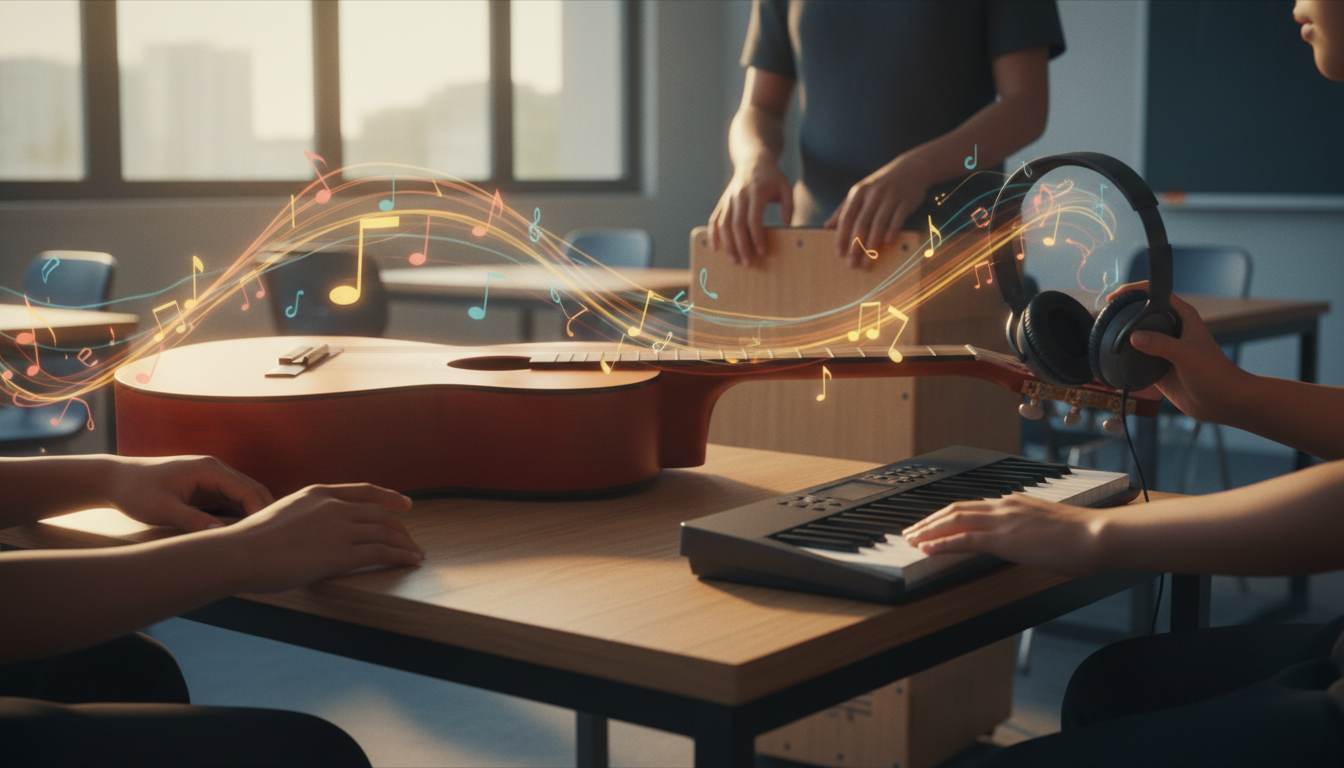
Secondary 2 Music vocabulary gives Singapore students a practical language for describing what they hear, controlling rhythm, creating melodies, working in groups and reflecting on a performance. These 200 selected terms cover listening, tempo, pitch, dynamics, timbre, harmony, form, notation, digital composition and musical cultures. Start with the list below, then use the worked examples to make the words audible and meaningful.
This is an independent eduKateSG glossary, not a prescribed MOE list of 200 examination words. Singapore’s 2023 Music syllabus for Primary and Lower Secondary includes the interrelated processes of Listening, Creating and Performing. Schools offer different projects and instruments within their teaching programmes. Lower-secondary Music is a common-curriculum experience, not a national Secondary 2 G1/G2/G3 examination paper. Some advanced words in the list provide useful extension beyond what a particular class may require.
Quick route:
- Words 1–40: listening, beat, tempo and rhythm.
- Words 41–80: melody, pitch, dynamics and expression.
- Words 81–140: instruments, texture, harmony and form.
- Words 141–200: notation, creating music with technology and performing together.
- Below: original rhythm examples, common errors, listening exercises, a four-week routine and parent-friendly answers.
Top 200 Secondary 2 Music vocabulary words and meanings
1. Listening: how to describe what you hear — words 1–20
Choose a term and test it by listening, tapping, singing, describing or changing a short original musical idea. Knowing the definition is the beginning; the sound is the test.
- active listening — Paying deliberate attention to the musical features rather than simply hearing sound.
- aural perception — Recognising and interpreting musical information through listening.
- sound — A vibration that travels through a medium and can be heard.
- silence — An intentional or unfilled interval without musical sound.
- musical phrase — A segment of music that forms a recognisable thought.
- motif — A short musical idea that recurs or develops.
- gesture — A brief characteristic pattern of sound or musical movement.
- contrast — An audible difference between two musical passages.
- repetition — The return of a recognisable sound, rhythm or idea.
- variation — A changed version of previously heard musical material.
- response — A phrase or gesture that answers an earlier musical idea.
- layer — One of several simultaneous sound parts.
- foreground — The part of music attracting the strongest attention at a moment.
- background — Accompanying sound supporting the foreground.
- balance — The relative audibility of parts in an ensemble or mix.
- blend — The degree to which separate voices or instruments sound unified.
- intensity — The perceived strength or energy of musical sound.
- character — The overall expressive quality or style of a musical passage.
- musical evidence — A specific audible feature supporting a description or interpretation.
- listening journal — Notes recording what was heard, noticed, questioned and learned.
2. Beat, tempo, rhythm and metre — words 21–40
Choose a term and test it by listening, tapping, singing, describing or changing a short original musical idea. Knowing the definition is the beginning; the sound is the test.
- beat — A regular underlying pulse that listeners can follow.
- pulse — A recurring sense of steady time underlying a passage.
- tempo — The speed of the underlying beat.
- metronome — A device or app producing regular clicks at a selected tempo.
- beats per minute — A numerical indication of beat rate, often abbreviated BPM.
- rhythm — The pattern of sound lengths and silences over time.
- duration — The amount of time a sound or rest lasts.
- meter — The organisation of beats into recurring stronger and weaker groupings.
- duple metre — An organisation of beats into groups of two.
- triple metre — An organisation of beats into groups of three.
- quadruple metre — An organisation of beats into groups of four.
- simple metre — A metre whose beats typically divide into two equal parts.
- compound metre — A metre whose beats typically divide into three equal parts.
- downbeat — The first beat of a measure, often felt as a strong point.
- offbeat — A rhythmic position between or away from expected stronger beats.
- syncopation — Emphasis placed where it is less expected in the metric pattern.
- ostinato — A short rhythmic or melodic idea repeated persistently.
- polyrhythm — Two or more contrasting rhythmic patterns sounding together.
- subdivision — Dividing a beat into smaller equal or otherwise organised parts.
- rubato — Flexible timing that stretches or compresses the beat expressively.
3. Pitch, melody and interval relationships — words 41–60
Choose a term and test it by listening, tapping, singing, describing or changing a short original musical idea. Knowing the definition is the beginning; the sound is the test.
- pitch — The perceived highness or lowness of a musical sound.
- melody — A recognisable sequence of pitches organised through time.
- note — A symbol or sound with a particular pitch and duration.
- interval — The distance between two pitches.
- unison — Two or more notes sounding at the same pitch.
- octave — An interval spanning a pitch class at twice or half the frequency.
- stepwise motion — Melodic movement between adjacent notes of a scale.
- leap — Melodic movement over a larger interval than a neighbouring step.
- ascending — Moving from a lower pitch towards a higher one.
- descending — Moving from a higher pitch towards a lower one.
- range — The distance from the lowest to the highest pitch in a part.
- register — A low, middle or high region of an instrument or voice.
- scale — An ordered collection of pitches forming a tonal resource.
- major scale — A common seven-note scale following a specified whole-and-half-step pattern.
- natural minor scale — A seven-note minor pattern with its conventional interval order.
- pentatonic scale — A scale using five pitch classes within the octave.
- chromatic scale — A scale proceeding by successive semitone steps.
- solfege — Syllables such as do, re and mi used to support pitch learning.
- tonic — The pitch functioning as a tonal home in a particular key.
- key — A tonal framework centred on a tonic with a characteristic collection of pitches.
4. Dynamics, expression, tempo changes and articulation — words 61–80
Choose a term and test it by listening, tapping, singing, describing or changing a short original musical idea. Knowing the definition is the beginning; the sound is the test.
- dynamics — The changing loudness or softness of musical sound.
- piano dynamic — A notation marking a soft dynamic level.
- forte dynamic — A notation marking a loud dynamic level.
- mezzo piano — An instruction generally indicating moderately soft playing.
- mezzo forte — An instruction generally indicating moderately loud playing.
- crescendo — A gradual increase in loudness.
- diminuendo — A gradual decrease in loudness.
- accent — Extra emphasis on a particular note or attack.
- staccato — Articulation that separates notes with shortened sound.
- legato — Smoothly connected notes with minimal separation.
- tenuto — A marking asking for a note to be sustained or given its full value.
- marcato — Articulation making a note or passage strongly marked.
- articulation — The way individual notes are begun, connected and ended.
- phrasing — Shaping connected musical ideas into expressive units.
- expression — How choices of sound and timing communicate feeling or meaning.
- timbre change — A deliberate shift in sound colour during a passage.
- accelerando — A gradual increase in speed.
- ritardando — A gradual slowing of tempo.
- fermata — A notation indicating a note or rest should be held beyond its usual duration.
- interpretation — A performer’s reasoned choices about how to present a musical work.
5. Timbre, instrument families and ensembles — words 81–100
Choose a term and test it by listening, tapping, singing, describing or changing a short original musical idea. Knowing the definition is the beginning; the sound is the test.
- timbre — The distinctive tone colour that helps distinguish sound sources.
- acoustic instrument — An instrument producing sound primarily through physical vibration.
- electronic instrument — An instrument whose sounding mechanism or control uses electronics.
- percussion — Instruments sounded by striking, shaking or scraping.
- string instrument — An instrument with vibrating strings as a principal sound source.
- woodwind — An instrument family using air columns, often reeds or edge-blown mouthpieces.
- brass — Wind instruments typically played by vibrating the lips against a mouthpiece.
- keyboard — An arrangement of keys used to control musical pitches.
- guitar — A plucked or strummed string instrument common in many traditions.
- cajón — A box-shaped percussion instrument played by striking its surfaces.
- ukulele — A small string instrument often used for chord accompaniment.
- piano — A keyboard instrument whose strings are struck by hammers.
- violin — A high-register bowed string instrument.
- flute — A wind instrument usually sounded by directing air across an opening.
- recorder — An internal-duct flute used widely in music education.
- drum kit — A group of drums and cymbals arranged for one player.
- voice — The human sound source used for singing, chanting and other expression.
- solo — A passage performed by one featured voice or instrument.
- ensemble — A group of performers making music together.
- orchestra — A large ensemble often organised into strings, winds, brass and percussion.
6. Harmony, texture and tonality — words 101–120
Choose a term and test it by listening, tapping, singing, describing or changing a short original musical idea. Knowing the definition is the beginning; the sound is the test.
- harmony — The relationship of pitches sounding simultaneously or through harmonic movement.
- chord — A group of pitches heard together as a harmonic unit.
- triad — A chord formed from three pitch classes usually arranged in thirds.
- root — The fundamental pitch that gives a chord its name.
- chord progression — A sequence of chords forming a harmonic pattern.
- tonality — The organisation of pitches around a tonal centre.
- major tonality — A tonal system with a major-key framework.
- minor tonality — A tonal system with a minor-key framework.
- consonance — A relatively stable or blended relationship of notes in a given context.
- dissonance — A comparatively tense or unstable sound relationship in a given context.
- resolution — A movement from perceived harmonic tension towards relative stability.
- cadence — A musical ending or pause shaped by melodic and harmonic movement.
- drone — A sustained or repeated pitch supporting another musical part.
- pedal tone — A sustained or repeated note beneath changing musical activity.
- texture — The way simultaneous musical parts relate to one another.
- monophonic — A musical texture consisting of one melodic line without separate accompaniment.
- homophonic — A texture featuring a main melody with chordal or similar accompaniment.
- polyphonic — A texture with two or more relatively independent melodic lines.
- heterophonic — A texture with simultaneous variations of broadly the same melody.
- counterpoint — The technique of combining musically independent melodic lines.
7. Form, structure and musical development — words 121–140
Choose a term and test it by listening, tapping, singing, describing or changing a short original musical idea. Knowing the definition is the beginning; the sound is the test.
- form — The overall organisation of a piece into sections and relationships.
- section — A recognisable part of a musical work.
- introduction — An opening preparing the listener for the main material.
- verse — A recurring song section that often uses changing lyrics.
- chorus — A recurring song section often carrying a memorable hook or refrain.
- bridge — A contrasting section connecting or refreshing other song sections.
- refrain — A recognisable line or passage repeated at intervals.
- coda — An added ending section bringing a piece to a close.
- binary form — A two-part structure often described as A–B.
- ternary form — A three-part structure often described as A–B–A.
- rondo form — A structure with a returning section separated by contrasting episodes.
- theme — A recognisable musical idea developed across a passage or work.
- theme and variations — A form presenting a theme and altered versions of it.
- call and response — A pattern where one musical idea is answered by another.
- imitation — A musical idea repeated by a different part or voice.
- sequence — A melodic or harmonic pattern repeated at another pitch level.
- transition — Material connecting two musical ideas or sections.
- climax — A point of especially high musical energy or expressive emphasis.
- reprise — A return of material heard earlier.
- ending — A passage that concludes the performance or recording.
8. Notation, symbols and reading a score — words 141–160
Choose a term and test it by listening, tapping, singing, describing or changing a short original musical idea. Knowing the definition is the beginning; the sound is the test.
- notation — A system of symbols used to represent musical information.
- staff — Five horizontal lines used in standard Western music notation.
- clef — A symbol identifying pitch positions on a staff.
- treble clef — A clef commonly used for higher-pitched parts.
- bass clef — A clef commonly used for lower-pitched parts.
- time signature — A symbol describing beat grouping and the note value used for counting.
- key signature — Sharps or flats placed near the clef to indicate a tonal framework.
- bar line — A vertical line dividing notation into measures.
- measure — A segment of notated music between bar lines.
- whole note — A conventional note value equal to four quarter-note durations.
- half note — A conventional note value equal to two quarter-note durations.
- quarter note — A conventional note value equal to one quarter of a whole-note duration.
- eighth note — A conventional note value half as long as a quarter note.
- rest — A notation symbol indicating a duration of silence.
- dotted note — A note whose dot adds half its original written duration.
- tie — A curved mark joining same-pitch notes into a sustained duration.
- slur — A curved marking indicating connected phrasing or articulation.
- sharp — A symbol raising a notated pitch by a semitone in standard use.
- flat — A symbol lowering a notated pitch by a semitone in standard use.
- natural sign — A symbol cancelling a relevant sharp or flat alteration.
9. Creating, arranging and digital music making — words 161–180
Choose a term and test it by listening, tapping, singing, describing or changing a short original musical idea. Knowing the definition is the beginning; the sound is the test.
- composition — The process or result of creating an original musical work.
- improvisation — Making musical choices spontaneously during performance.
- arrangement — A version of music adapted for particular instruments or performers.
- instrumentation — The instruments selected for a piece or arrangement.
- orchestration — The distribution of musical material among instruments.
- accompaniment — Supporting music played under a principal part.
- backing track — Recorded supporting material used alongside a performer.
- loop — A repeated short section of recorded or programmed sound.
- sample — A recorded sound reused within a new musical setting.
- sequencer — Software or hardware arranging musical events in time.
- digital audio workstation — Software for recording, arranging, editing and mixing audio.
- MIDI — A digital protocol for representing and controlling musical performance events.
- audio track — A timeline lane containing recorded sound material.
- software instrument — A virtual sound source controlled through musical input.
- quantisation — Adjusting recorded events towards selected rhythmic grid positions.
- recording — Capturing a musical performance or sound for later use.
- editing — Changing the timing, length or content of recorded or programmed material.
- mixing — Adjusting the levels and qualities of recorded sound parts.
- export — Saving a completed audio or project output to a usable file format.
- revision — Changing musical decisions after listening, feedback or rehearsal.
10. Performance, collaboration and musical culture — words 181–200
Choose a term and test it by listening, tapping, singing, describing or changing a short original musical idea. Knowing the definition is the beginning; the sound is the test.
- rehearsal — Planned practice to improve a performance.
- ensemble cue — A visual or audible signal coordinating a group of performers.
- count-in — A short indication of beats before music begins.
- entrance — The point at which a performer or part starts sounding.
- cutoff — A coordinated stop of a note or passage.
- intonation — Accuracy of pitch in relation to the intended notes or ensemble.
- timing — Placing notes and rests at the intended moments.
- musicianship — The connected skills of listening, creating and performing music.
- stage presence — How a performer communicates and engages an audience.
- audience etiquette — Behaviour showing respect for performers and other listeners.
- soundcheck — A test of levels and equipment before a performance.
- feedback session — A discussion identifying strengths and possible improvements.
- collaboration — Musicians working together towards a common result.
- repertoire — A collection of works a performer or ensemble can perform.
- genre — A broad category of music recognised through shared conventions.
- tradition — Musical practices passed through a community over time.
- cultural context — The social and historical setting shaping musical meaning.
- identity — Connections between music and a person’s or community’s sense of belonging.
- community music — Music-making organised around shared social participation.
- performing arts — Creative arts presented through live or recorded performance.
How to learn Music with words, ears and practical choices
Music is sometimes treated as if a student either “has talent” or does not. That view misses most of the learning. A learner can improve at keeping a beat, hearing a change in pitch, recognising a repeated pattern, supporting an ensemble and explaining why an arrangement feels different after a change. These are skills that can be practised and observed. Vocabulary helps students name what they hear so that feedback becomes useful rather than vague.
The Ministry of Education’s 2023 syllabus connects Listening, Creating and Performing. Listening gives the student information. Creating turns musical choices into ideas. Performing tests timing, expression, communication and collaboration. The three processes inform one another: a student may hear a strong rhythmic contrast, try it in an original pattern and discover during performance that the group needs a clearer count-in.
The experience also extends beyond lessons. Singapore students encounter music in public ceremonies, community celebrations, games, films, advertisements, places of worship and local concerts. The same sound may have a different meaning depending on its social context. Music vocabulary should therefore support cultural curiosity rather than imply that one tradition is the only correct way to organise sound.
Worked example 1 — Beat is not the same as rhythm
Clap or tap a steady pulse while speaking the phrase “Take the bus, then walk home.” The pulse can continue evenly underneath the natural syllables, even though the words have different lengths. The steady underlying motion is the beat. The particular arrangement of long and short sounds is the rhythm. Students often use these words as synonyms, but the distinction helps explain how a drummer can maintain time while another part plays varied patterns.
Now tap a four-beat cycle: one, two, three, four. Place a strong clap on one, then a softer clap on three. Next, move the second clap between beats two and three. The underlying pulse has not changed, but the pattern of emphasis has. This introduces the idea of syncopation without asking students to memorise a complicated definition before hearing the effect.
A metronome can help maintain a regular beat, but it is a tool, not the purpose of music. A student who performs rigidly in time yet ignores a piece’s expressive phrasing may be accurate in one respect and unconvincing in another. Music education develops control and purposeful variation.
Worked example 2 — Tempo, metre and subdivision
Consider two short original rhythms played at the same tempo. One groups the beats in twos; the other groups them in threes. The speed is the same, but the grouping can change the sense of movement. That difference belongs to metre, not necessarily tempo. A student’s description should therefore avoid saying “the second rhythm is faster” when the beats per minute did not change.
Subdivision concerns how a beat is divided. A steady quarter-note pulse could be split into two equal eighth-note units in a simple context, or into three equal parts when the musical framework calls for a triplet or compound grouping. A student can demonstrate this through clapping, vocal syllables or a classroom percussion instrument. The aim is to feel the difference before worrying about formal notation.
Accelerando means gradually increasing tempo, whereas crescendo means gradually increasing loudness. The two may appear together but are not the same instruction. Ask the student to clap a rhythm while getting louder without getting faster, then repeat while getting faster without getting louder. The exercise isolates the concept in a memorable way.
Worked example 3 — Why pitch, volume and timbre differ
Play one note on a keyboard and sing or hum the same pitch where comfortable. The two sounds may have approximately the same fundamental pitch but very different timbres. Now play a higher note on the keyboard at the same volume. The perceived highness changes, but that is not the same as loudness. Lastly, play the original note more softly. Three independent choices have been demonstrated: pitch, timbre and dynamics.
In an ensemble, a guitar and a recorder can play the same melodic line while remaining recognisable because their tone colours differ. A student describing an excerpt should be able to distinguish “the melody moves higher”, “the music becomes louder” and “another instrument enters”. Those are different audible facts. Strong listening answers name the relevant one rather than relying on the all-purpose phrase “the sound gets stronger”.
Worked example 4 — Melody, motif and variation
Invent a simple four-note melodic idea such as ascending stepwise motion followed by one downward leap. Repeat it once without change, then make the second version quieter or alter its final pitch. The recurring short idea is a motif; the changed return is a variation. A melody is a larger organised line that can contain one or more motifs. Students should not label every isolated note a motif unless it forms an identifiable musical idea.
When writing a short original melody, begin with a manageable pitch range. Choose a starting note, create a phrase and then answer it with a second phrase. Listen to how the second phrase relates to the first: does it repeat, contrast, develop or resolve? There is no requirement to borrow a recognisable melody from an existing song. Original short exercises make the structure easier to hear and avoid confusion about authorship.
Worked example 5 — Dynamics and expression are decisions, not decorations
A student may see the word crescendo and believe it means “play a loud note at the end”. In fact, a crescendo is a gradual increase in loudness across time. Begin an original five-note phrase softly and let its energy grow naturally towards the final note. Compare that with a phrase played at the same loudness throughout. Ask which version better suits a chosen feeling or story.
Articulation is another tool. Short separated notes can create lightness or urgency; smoothly connected notes can support flow. Yet the meaning depends on the passage and style. Staccato does not always mean “happy”, and legato does not always mean “sad”. A convincing description should point to the actual pattern of notes, tempo and instrumentation as evidence for the claimed effect.
Worked example 6 — Hear musical texture rather than counting instruments
Imagine a single unaccompanied melody sung by a class. The texture is broadly monophonic. Add a keyboard playing supporting chords beneath the principal tune and the texture becomes more like homophonic music. If two independent melodic lines are developed at the same time, polyphonic texture may be the more useful description.
The number of performers does not, by itself, determine the texture. Twenty students singing the same melody in unison can still produce a single melodic line. One performer playing a keyboard might create multiple simultaneous parts. Describe how the lines relate, not simply how many people are present.
Heterophony is a useful extension: two performers present related versions of the same melody at once. This can occur within different musical traditions. The more advanced label should be used only when the audible relationship warrants it; students need not force every unfamiliar sound into a Western classical category.
Worked example 7 — Form helps listeners remember the shape of a piece
Listen to an original short work arranged as A–B–A. The opening section presents a distinctive idea, the middle section changes it, and the first idea returns. This is a simple ternary model. A different work might use A–B, or a recurring A section separated by several contrasting episodes. Musical form is about relationships and returns, not only the letters written on a worksheet.
Students can represent form with coloured paper strips, movement or a diagram. If an opening rhythm returns after a contrasting section, mark the return. Then ask what makes it recognisable: pitch pattern, rhythm, instrumentation, or some combination. A visual map can be useful, but the final test is hearing the recurring material.
A popular song’s verse, chorus and bridge are useful examples of functional sections. Their specific forms vary widely. Not every repeated catchy passage is a chorus, and not every transition is a bridge. Observe what the section actually does in the song before naming it.
Worked example 8 — Reading notation without treating it as the whole of music
In standard Western notation, the staff, clef and note positions help represent pitch, while note shapes and rests represent duration. A time signature gives information about beat grouping and the note value used as a counting unit. A key signature signals a tonal framework, although some music uses scales and traditions that cannot be described well by the usual key-centred system.
Consider a short measure in 4/4 with four quarter notes. One full measure is accounted for by four quarter-note beats. Replace two of those notes with four eighth notes, and the total written duration still fits. A student should understand the duration relation rather than only counting how many note symbols appear.
Music is also learned by ear, imitation, movement and community practice. Some traditions do not rely primarily on Western staff notation. A strong learner can use written symbols where suitable while respecting other ways people transmit and remember music.
Worked example 9 — Creating a 20-second soundscape
A soundscape is an organised collection of sounds suggesting a place, action or atmosphere. Imagine a school corridor before an assembly. Instead of copying a film soundtrack, students can record safe original sounds: distant footsteps, a pencil tapping, a bag zip and a short hummed motif. Arrange these sounds to move from a busy atmosphere towards silence when the imagined assembly begins.
The composition plan should identify the foreground sound, background layer, timing and intended climax. In a digital audio workstation, the learner can adjust track volumes, trim accidental noise, and test whether the transitions feel natural. Explain why the final version differs from the first. An effective evaluation might say: “I lowered the footsteps so that the announcement-like rhythm could be heard more clearly.”
When working with recordings, obtain appropriate permission before recording people and follow school rules about privacy and copyright. Use original or properly licensed sounds. The assignment does not need a professional studio or expensive software to show clear musical thinking.
Worked example 10 — Playing together is a form of communication
A group has a guitarist, a keyboard player, a cajón player and a singer. A common problem is not a lack of notes but a lack of coordination. Who starts the first beat? What signal tells the group to enter after an introduction? Where should the dynamic level fall so that the sung words can be heard? These are questions of rehearsal, cues, balance and listening.
Begin a rehearsal by agreeing on a shared count-in and an ending cue. Practise a short original eight-bar pattern until the group can start and stop together. Then ask each member to give one specific piece of feedback. “The cajón enters one beat too early after the pause” is actionable; “You played badly” is not. The same respectful feedback habit helps students in other collaborative subjects.
Successful performance does not require every student to be the loudest or most visible person. A supportive accompaniment part may demand careful timing and musical judgement. A good ensemble makes room for several contributions and recognises the people whose work holds the group together.
Music and Singapore’s cultural landscape
Singapore provides students with opportunities to encounter musical traditions and contemporary practices from many communities. A school music programme might include local songs, instrumental ensembles, theatre, film soundtracks or popular music. Students should listen with curiosity, identify what they can actually hear and research cultural context before drawing conclusions about meaning.
At a performance, notice how the musicians communicate with the audience, how instruments are organised, and how the music is shaped by its setting. A community celebration and a formal concert may ask listeners to behave differently. Neither setting is automatically the single correct model for all music. Vocabulary such as genre, tradition, repertoire and audience etiquette helps students understand those differences.
MOE’s Music syllabus also describes a Performing Arts-Based Learning experience at the lower-secondary stage, connecting classroom learning with performing arts practitioners and venues. Schools select arrangements appropriate to their students. The educational point is not simply attending a show; it is making a connection between what students encounter, hear, perform and understand.
Ten commonly confused Music terms
- Beat / rhythm: steady pulse versus the pattern of note and rest durations.
- Tempo / dynamics: speed versus loudness.
- Pitch / timbre: perceived highness versus sound colour.
- Motif / melody: a short idea versus a more extended organised pitch line.
- Harmony / texture: pitch relationships versus the organisation of simultaneous parts.
- Monophonic / solo: one musical line versus one featured performer.
- Crescendo / accelerando: louder over time versus faster over time.
- Repetition / variation: a recognisable return versus a modified return.
- Composition / arrangement: creating a work versus adapting existing material for a new presentation.
- Accuracy / expression: playing intended events correctly versus shaping their musical meaning.
A four-week Secondary 2 Music vocabulary learning plan
Week 1 — Listening and beat
Choose terms 1–40. Listen to short examples supplied by school or play original patterns. Tap the pulse and describe where the rhythm departs from it. Identify a repeated motif, a contrast and a change in intensity. Practise a short listening journal: “I heard…”, “The evidence is…”, “It changed when…”. This trains the student to describe actual sound rather than general feelings alone.
Week 2 — Pitch, expression and the sound source
Review terms 41–100. Try an original four-note melody at two pitch levels and three dynamic shapes. Compare two instruments, noticing timbre. Let the student explain one difference without using “loud”, “high” and “fast” as interchangeable adjectives. If a particular exercise strains the voice, lower the pitch or use a comfortable instrument instead.
Week 3 — Structure, notation and creating
Use terms 101–180 selectively. Map a piece into sections, read a short rhythmic pattern and make an original soundscape or instrumental phrase. The goal is a clear musical idea, not sophisticated software. Record or describe one revision after listening to the first attempt. Save the learning notes, not only the final audio.
Week 4 — Perform, collaborate and reflect
Choose terms 181–200 and any previous weak terms. Rehearse a short group or solo performance, explaining a count-in, entry, ending and one dynamic contrast. Ask for specific feedback and revise one aspect. Test vocabulary without the list: the student should identify a term through sound or demonstrate it, not merely recite the wording.
How parents can help without music lessons at home
Ask “What did you notice about the rhythm?”, “How did the music change?”, “Which instrument or sound entered?”, “What were you trying to express?”, and “What did you improve after listening back?” Families do not need advanced instrumental knowledge to ask these questions. The student’s answer should point to a real sound or decision.
Practice can be short and enjoyable. A five-minute listening comparison can train attention more effectively than a long session of copying definitions. If the student becomes frustrated with notation, connect the written symbol to a clapped, spoken or played example and then return to the page. Music should remain a space for expression, collaboration and curiosity.
Frequently asked questions
Are these 200 official MOE Secondary 2 Music examination words?
No. They are a curated eduKateSG glossary, including extension terms. Refer to the school’s current assignments and the official syllabus for actual expectations.
Is Music a national G1/G2/G3 examination in Secondary 2?
Lower-secondary common-curriculum Music is not a national SEC subject examination at Secondary 2. Upper-secondary music options have different arrangements.
Must my child read staff notation to enjoy or make music?
No. Notation is useful in many contexts, while listening, imitation, movement and other traditions also support learning. Follow the requirements of the particular task.
What is the difference between tempo and rhythm?
Tempo is the speed of the beat. Rhythm is the particular pattern of sound durations and silences.
Can students use digital music software?
Where school rules allow, digital tools can help students create, arrange and reflect. Original work and appropriate use of source material remain important.
What if my child struggles to sing in tune?
Start within a comfortable range, compare small pitch steps, listen carefully and use supportive feedback. Avoid treating one performance as a fixed measure of ability.
How do we judge a group performance fairly?
Consider preparation, timing, responsiveness, listening, musical decisions and appropriate contribution, not simply which student is loudest.
Why does Singapore Music education include cultural context?
Music is shaped by communities and experiences. Listening to different traditions helps students appreciate musical practices and viewpoints beyond their own.
Official sources and next reading
MOE 2023 Music syllabus for Primary and Lower Secondary; Methodist Girls’ School: Lower Secondary Music programme; Esplanade – Theatres on the Bay for Singapore performing-arts experiences. These are references for music learning, not sources of a compulsory 200-term test list.
Explore related eduKateSG learning through the Vocabulary Mastery Hub, Secondary 2 Art vocabulary and Secondary 2 English vocabulary for explanation and oral discussion. Music blends attention, expression and communication that transfer to many other experiences.