
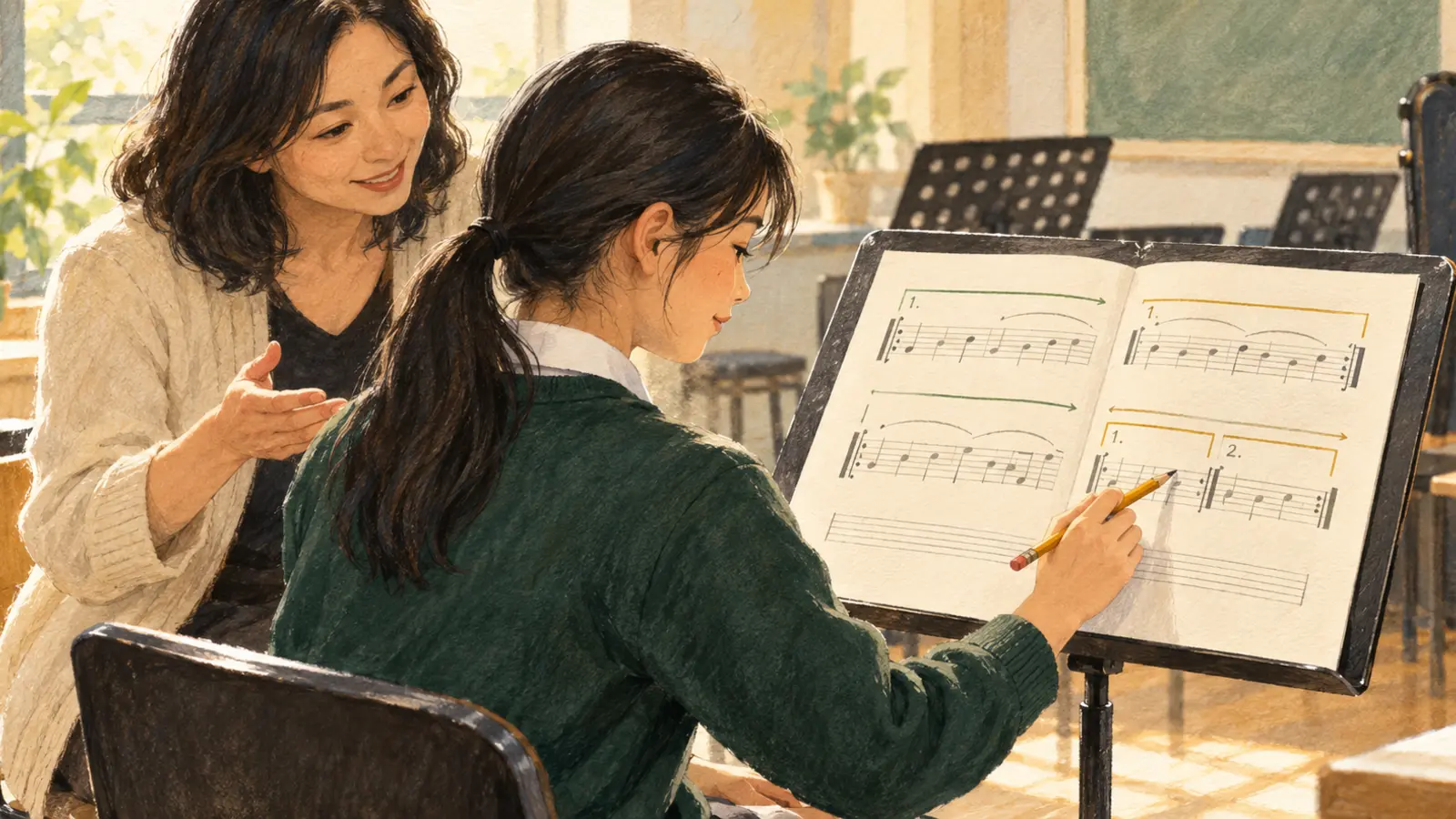
Did you know a musical idea can sound beautifully played but feel completely wrong for the scene it accompanies? A fast drum pattern can turn a quiet reunion into something frantic. A pause at the right instant can make an audience pay attention without adding a note.
That is why G1 Music is not simply a test of how many instruments a student can play. Listening, creating, performing and explaining musical decisions belong together. This reader-friendly PG1 guide focuses on listening and film cues, using small examples that parents can discuss without specialist equipment.
Posting Group 1 (PG1) is the grouping used at secondary school admission. It is not the name of a Music examination. SEAB lists G1 Music K128 for the 2027 Singapore-Cambridge Secondary Education Certificate. The student’s school provision and actual registered subject level determine which syllabus applies.
The 2027 G1 Music syllabus and its assessment summary were reviewed on 25 October 2026. All music scenes below are fictional practice tasks, not an official exam brief or assessed music production.
The quick answer
- 2027 school-candidate subject: G1 Music, syllabus K128, a local subject listed under the SEC.
- Paper 1: a one-hour listening examination worth 40%, split into multiple-choice and short-answer listening tasks.
- Paper 2: supervised Creating and Performing coursework worth 60% across two tasks, with five months and 30 hours of supervision specified.
- Task 1 is a song or instrumental arrangement including a live-performed part; it represents 40% of the overall grade.
- Task 2 is an original 30-second instrumental film/TV cue with a supporting note; it represents 20% of the overall grade.
- The listening syllabus spans popular music from 2000 onwards, Western classical programme music, music for film and television, and Malay, Chinese and Indian musical traditions in Singapore.
PG1, G1 and the exact qualification: do not mix them up
PG1 is a secondary entry Posting Group; G1 is the level of a particular taught subject. For 2027, SEAB lists Music K128 as a G1 local subject within the Singapore-Cambridge SEC. That statement does not establish that every secondary school offers the subject or that a student’s original PG1 label determines every subject level later taken.
This distinction matters for parents reviewing grades, subject combinations and later admission requirements. Never assume a skill-based qualification can simply be inserted into an SEC academic aggregate. Ask the school and the receiving institution which results are recognised for the intended route.
How the official 2027 assessment works
- The written listening paper contributes 40% and takes one hour. Part A includes 20 one-mark multiple-choice questions using eight to ten short recorded extracts; Part B includes 12 to 16 one-word or short-answer questions using four to six extracts.
- The coursework is 60%. Task 1 combines creation, arrangement, production and performance. Task 2 requires an original instrumental 30-second music cue matched to one of the supplied video contexts, plus a supporting explanation.
- Coursework takes place with direct school Music teacher supervision and the syllabus’s stated time limits. The examination authority specifies requirements for original files, sound, audio production and submissions; do not rely on a generic home-produced demonstration as assessed work.
- Listening genres carry distinct cultural contexts and vocabulary. Understanding purpose, instrumentation, rhythm, dynamics, texture and arrangement matters more than memorising unconnected artist names.
- Music technology has a genuine role in the syllabus, but it cannot replace listening judgment and live performance where those are assessed. An appropriate audio workstation is a tool, not the musical explanation.
The official PDF—not a generic internet summary—controls the current subject’s assessed content, weightings and examination instructions. The 2027 document should be checked again against any later amendments and the student’s actual school registration.
Why the subject can be useful in real life
Music gives learners a way to listen more attentively, make purposeful creative choices and understand how sound carries culture and meaning. A good explanation names the evidence rather than stopping at an opinion.
Learn from first principles
- Start with purpose: before choosing a note, ask what the music needs the listener or viewer to notice. Is the scene calm, tense, triumphant, mysterious or undecided?
- Listen for tempo. At a steady 120 beats per minute, each beat occupies half a second. A fixed 30-second span therefore includes 60 beats.
- Identify pulse and meter separately. At 4/4 and 120 beats per minute, four beats occupy two seconds; a 30-second passage contains 15 full bars, provided tempo and meter stay constant.
- Distinguish rhythm from melody. Rhythm is the organisation of durations and accents; melody is the pattern of pitched notes. Both may be present, but a musical effect can be built using texture, dynamics and silence.
- Observe instrumentation and timbre. A soft piano or sustained strings can create a different impression from busy percussion. The meaning is contextual; there is no universal ‘sad instrument’.
- Use dynamics intentionally. A gradual crescendo can prepare a turning point; a sudden drop in volume can redirect attention.
- Listen for texture. One solo line leaves space, while many overlapping parts can increase density. More tracks do not automatically mean better expression.
- Connect the music to the image’s timing. A cue that resolves several seconds before the visual event might create unintended meaning.
- Make the writing honest. State what the listener heard, which choice you made and why the evidence supports your explanation.
- Always use appropriate licensed or original material for publication and submissions; credit relevant sources and follow school rules about permitted samples or arrangements.
Did you know? A 30-second scene contains a complete music-design problem
Imagine a fictional animation: a student boards a bus, realises a notebook has been left behind, worries for a moment, then sees the bus driver lift it into view. This is only an independent learning illustration.
The story has three stages. Seconds 0–8 show an ordinary journey. Seconds 8–20 reveal uncertainty. Seconds 20–30 show relief. Music can support these stages without narrating every motion.
Suppose the practice task uses a constant 120 beats per minute and 4/4 meter. That makes each bar two seconds long. In the opening eight seconds, the learner has four bars; in the twelve-second middle, six bars; and in the final ten seconds, five bars.
The first four bars might use a simple two-note motif with restrained accompaniment. The next six might introduce a light rhythmic pulse, wider pitch movement or an uneasy harmonic colour as tension develops.
In the final five bars, the motif may return in a warmer register or with a calmer accompaniment. Whether the result works must be judged by listening alongside the visual scene, not by the arithmetic alone.
A rough production log can state: ‘I reduced the percussion on the last image because the resolution needed more space.’ This is stronger than ‘I added lots of instruments because the ending is happy.’
The counted-bar plan assumes the scene begins exactly on a beat and its music uses a constant tempo. Real film music can use changes of tempo, silence, pickups and non-bar-aligned events. A student should explain any such departure rather than force the image into an artificial grid.
The official K128 Task 2 involves a 30-second instrumental cue for a given film or TV video context selected from those supplied in the assessment. The fictional bus scene is not that official material and cannot be submitted as if it were.
What happens when the problem changes?
Change the middle event: instead of a lost notebook, the student spots a friend through the window. The exact same anxious cue may become inappropriate. Revisit purpose before changing the instrumentation.
Change the final image: the notebook remains lost. A triumphant ending might falsely suggest resolution. Discuss what the final phrase should communicate.
Change the pulse from 120 to 100 beats per minute while keeping a 30-second duration. There are now 50 beats, not 60, so the neat fifteen-bar 4/4 plan no longer fits unchanged.
Change the audience: a gentle primary-school animation might call for a different intensity from a suspense drama. Musical suitability involves intention, context and listening evidence.
Ask the student to say when a listening judgment is subjective and when a beat-count calculation has a checkable mathematical answer.
The vocabulary worth understanding
Cover each definition and ask the learner to create a fresh example. Knowing a word in isolation is not the same as using it in an unfamiliar context.
- Pulse: a recurring felt beat; a piece can have a steady pulse with an irregular surface rhythm.
- Tempo: the speed of the pulse, often measured in beats per minute (BPM).
- Meter: a pattern of grouping beats, such as four beats per bar in 4/4.
- Rhythm: the organisation of durations and accents.
- Melody: an identifiable succession of pitches.
- Motif: a short recognisable musical idea that can return and be transformed.
- Harmony: how notes combine simultaneously and support a melody.
- Timbre: the quality that distinguishes instrumental or vocal sounds.
- Texture: how musical parts are layered, such as solo melody versus dense accompaniment.
- Dynamics: the loudness levels and changes throughout music.
- Articulation: how notes are connected, separated or accented.
- Musical cue: a timed piece of music used to support an event or visual scene.
- Arrangement: the creative selection and organisation of musical material for performance or production.
- Production: the recording, editing, mixing and rendering decisions used to realise music.
- Supporting note: a concise explanation of decisions and relevance to the given context.
Frequent misconceptions and how to spot them
- Treating instrumental skill as a substitute for attentive listening across different styles.
- Counting bars correctly but failing to synchronise key changes in musical meaning with the visual context.
- Adding every available track instead of selecting a texture that supports the scene.
- Confusing tempo with dynamics: faster is not necessarily louder.
- Assuming film music must be very dramatic, even when silence or a sparse texture works better.
- Copying an existing soundtrack and presenting it as an original music cue.
- Describing music only as ‘good’ or ‘nice’ without using audible evidence.
- Memorising culturally diverse genre labels without respectfully listening to their context and features.
- Focusing on the 60% coursework and neglecting the 40% listening paper.
The learning progression: repair, stabilise, transfer, extend
- Repair: clap a steady pulse and distinguish pulse from rhythmic variation.
- Stabilise: identify whether a short clip changes tempo, dynamics, timbre or texture, and describe what was heard.
- Transfer: explain how one short musical motif could support two different fictional scenes through changed arrangement.
- Extend: create a 30-second timeline on paper, predict where musical changes belong and justify those choices against the viewer’s experience.
Each stage should be assessed with a different example. If the child succeeds only while looking at the teacher’s original demonstration, more independent explanation is needed.
Seven short activities for parents and tutors
These are flexible practice suggestions, not a demand for seven extra homework sessions. Adapt to school responsibilities, readiness and teacher guidance.
- Day 1: listen to two contrasting short lawful recordings and describe pulse and instrumentation.
- Day 2: count a fixed meter with clapping and calculate bars at one constant tempo.
- Day 3: identify whether emotion changes came from dynamics, texture or pitch.
- Day 4: sketch a three-stage fictional scene with start, tension and resolution.
- Day 5: choose a small motif and outline two alternative arrangements in words or a permitted practice tool.
- Day 6: listen again and explain one change using evidence rather than taste alone.
- Day 7: give a short independent presentation on what changed, why and what would make the explanation stronger.
How to teach without taking over the task
- First ask the learner to make a prediction in ordinary language. This surfaces hidden assumptions that are easily disguised by copying an answer key.
- Show one small worked example with every important step visible, and ask the child to explain which decision mattered most.
- Change a single condition and ask the student to revise the response. Transfer to a new situation is stronger evidence than repeating the same exercise.
- Record the first uncertain step and repair it. Ten repetitions of an incorrect method do not make the underlying idea correct.
- Space the practice across short sessions and revisit it after a delay. Protect time for schoolwork, play, rest and other commitments.
- Keep informal practice and assessed submissions separate. Parents and tutors may support understanding but must not manufacture school-authenticated work.
Secondary 1 to Secondary 4 roadmap
- Secondary 1: strengthen pulse, simple rhythm, attentive listening and vocabulary for discussing sound.
- Secondary 2: listen across musical cultures and practise small original arrangements and reflection.
- Secondary 3: follow the actual offered subject level, expand musicianship and music technology skills appropriately.
- Secondary 4: align listening, coursework, authenticity and supervised performance preparation with the correct K128 examination instructions.
Education Pathway for ITE, Polytechnic, JC and University
Singapore’s post-secondary options change according to the examination cohort and admission intake. MOE has announced the Post-Secondary Admissions Exercise from 2028 for eligible SEC holders. Participation in an exercise does not guarantee course eligibility or a place.
ITE and Higher Nitec
After secondary school, qualifying learners can seek suitable ITE Higher Nitec routes under the admission criteria for their intake. The 2028 framework distinguishes entry conditions at G1 and G2 subject levels; a single music or applied subject result cannot by itself establish eligibility. The student’s full subject profile and the specific course requirements remain essential.
Polytechnic diplomas
Direct diploma admission is governed by published qualifying subject combinations, grades, aggregates and course prerequisites. Other learners may pursue an eligible ITE-to-polytechnic progression route after earning a relevant Higher Nitec. A technical interest developed in school does not guarantee a matching diploma place.
Junior College and Millennia Institute
These are academic routes requiring a qualifying full set of recognised results, including appropriate G3 subjects where specified. The announced JC L1R4 changes from 2028 do not imply that a single G1 result, an original PG1 posting or a joint applied-subject certificate replaces required G3 subject results.
University
Entry normally comes after a recognised pre-university or diploma qualification and programme-specific selection. Some university programmes require additional subject prerequisites or portfolio demonstrations. The journey can be possible over multiple steps, but it is not a promise at Secondary 1 or Secondary 4.
For this SEC subject, check the complete subject-level profile, grades and any stated prerequisites. Do not treat one G1 elective or interest in the arts as sufficient evidence for admission to a particular destination.
A parent checklist before choosing resources or a pathway
- Identify the student’s current secondary school and the actual subject offered there.
- Confirm whether the relevant 2027 syllabus is an SEC subject or a separate joint MOE–ITE applied qualification.
- Read the official paper weights and preparation requirements before buying materials.
- Ask which school activities are supervised and how authentic assessed work must be completed.
- Diagnose one concrete weakness and build the next short, independent practice step.
- Keep future course targets flexible and check the relevant intake-specific MOE, ITE, polytechnic, JC/MI or university rules.
- Never substitute an unofficially invented paper, project or portfolio for an authentic SEAB or MOE–ITE assessed task.
Frequently asked questions
Is PG1 Music the official subject title?
No. PG1 is an admissions posting group; the 2027 SEC subject is G1 Music K128 where offered and registered.
Is all of Music assessment written?
No. Paper 1 listening is 40%, while supervised creating and performing coursework makes up 60%.
Does Task 2 require a complete song?
The 2027 K128 Task 2 specifically uses an original instrumental 30-second cue for a supplied film or television context, with a supporting note.
Can a parent or AI service produce the assessed music cue?
The student’s assessed work must be authentic under school supervision. Teaching and independent demonstrations should remain separate from what the student must personally create.
Does taking Music guarantee a diploma or university in the arts?
No. Relevant qualifications, prerequisites and sometimes auditions or portfolios govern later admission.
Official documents and related eduKateSG reading
SEAB — 2027 G1 school-candidate subject list and applicable subject codes
Official 2027 Music K128 examination syllabus (PDF)
SEAB — Singapore-Cambridge SEC information
MOE — Full Subject-Based Banding explained
MOE — Post-Secondary Admissions Exercise and qualifications
What is PG1? Posting Group versus actual subject level
What is PG1 Music? The full parent guide
Related subject learning guide
eduKateSG small-group learning standard — foundations, diagnostic checks and transfer
One helpful question for tonight
Which musical change did you actually hear, what effect did it have, and what would change if the scene were different?
Let the learner explain before supplying the answer. Small, verifiable improvements create a firmer educational foundation than memorising a promising pathway label.