
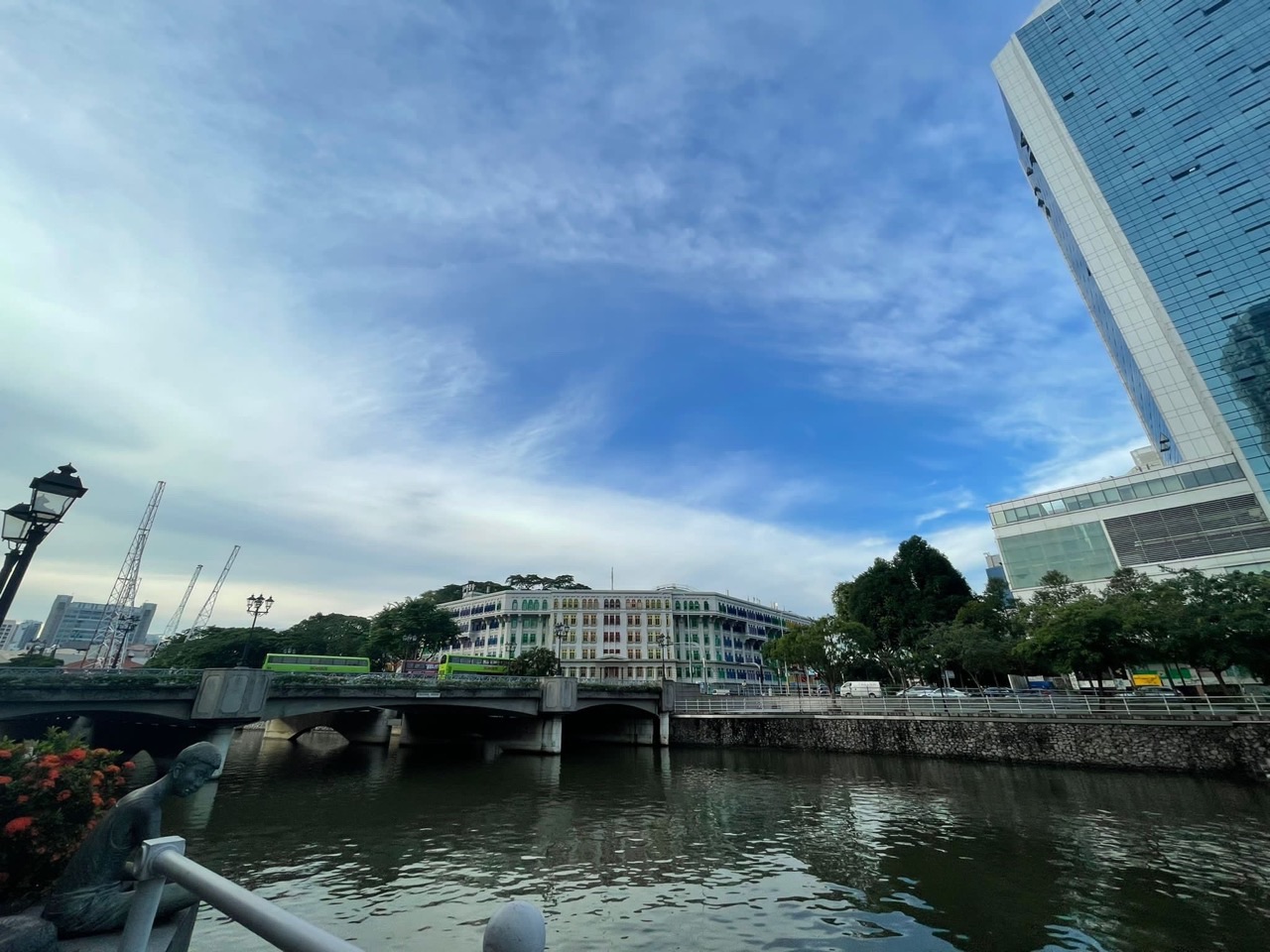
Along the Singapore River, a family can move from Boat Quay’s conserved shophouses to Clarke Quay’s warehouses and on toward Robertson Quay. Those places are connected by the same waterway but have different histories and uses. Children face a comparable challenge when school questions connect old knowledge in unfamiliar ways: knowing the topic is not always enough to decide what to do first.
Families looking for tuition around Singapore River need to distinguish Primary English, Mathematics and Science support from PSLE or Secondary G1/G2/G3 preparation. A child may calculate accurately against the wrong total, quote a passage without explaining its meaning or memorise a scientific process without applying it to a changed condition. These are different learning problems that should lead to different lessons.
URA identifies Singapore River as a distinct planning area with three subzones—Boat Quay, Clarke Quay and Robertson Quay. It is not identical to River Valley, Downtown Core or the nearby Museum district. A parent travelling from work near a quay may not be starting from the same place as the child leaving school after CCA.
This guide helps parents choose a teaching approach based on real schoolwork and a sustainable weekly journey. The aim is a learner who can recognise the right relationship, explain the reasoning and use the knowledge independently after the tutor is no longer present.
First, which part of the Singapore River do you actually mean?
URA’s Singapore River planning-area guidelines identify a 3-kilometre river corridor divided into Boat Quay, Clarke Quay and Robertson Quay. The areas are connected by the riverfront promenade, but they do not serve exactly the same activities or have identical school-day routes.
Boat Quay is predominantly commercial, near the city’s business core. Clarke Quay includes conserved warehouses, entertainment and mixed uses. Robertson Quay lies farther upstream with waterfront residences, hotels and cultural facilities. A child who lives around Robertson Quay may not begin the journey near an adult’s office at Boat Quay.
The Singapore River Planning Area is also distinct from River Valley, Downtown Core and Museum in formal planning terms, even though the neighbourhoods meet at streets and bridges. A local tuition guide should not imply that a classroom near one quay is equally convenient from another or from a pupil’s school elsewhere.
Before booking, ask for the exact teaching address, normal lesson day and the travel route from the child’s actual school or CCA. The eduKateSG premium three-student reference describes its teaching venue at 8 Fourth Avenue near Sixth Avenue MRT in Bukit Timah. This Singapore River guide does not claim separate branches along the quays.
What the river’s trading history can teach about changing context
URA’s Singapore River history and placemaking guide explains the river’s role in Singapore’s early trading life and how the riverfront was subsequently cleaned, conserved and reimagined. The clean-up was completed in 1987, and former warehouses and shophouses found new purposes. The same physical buildings can be understood differently depending on which period is being discussed.
Children face a smaller but similar challenge in school: an equation, paragraph or scientific process appears in a new context. The student must recognise what information remains relevant and what has changed rather than merely reproduce a familiar answer.
Consider a hypothetical Mathematics problem about goods being transferred between two stores. The original ratio describes quantities before the transfer; a new ratio describes the outcome afterward. A pupil who overlooks the change can use correct arithmetic and still answer a different question.
In English, a historical account may distinguish what happened from how a writer interprets it. In Science, changed experimental conditions can affect the observed result. These are subject-specific methods, but all benefit from the habit of checking exactly what the current question says.
One river, three quays, several different homework evenings
A family living around Robertson Quay may be able to take a short walk by the river after dinner, while a parent working near Boat Quay may only reach home after travelling across town. A pupil may attend school in another planning area entirely. A single broad label does not tell a tutor when the child can realistically study.
Draw the week from the student’s perspective. Include dismissal, CCA, transport, a proper meal and ordinary homework. Then place tuition only where there is enough attention to participate and enough time afterward to revisit the taught idea.
An adult’s convenient workplace route may be different from the best learning journey. Parents should not assume that tuition near the business district is suitable because it lies near their own daily commute. A child exhausted by travel may understand less and retain less.
Weekday and weekend sessions each have advantages and disadvantages. The right time allows the pupil to retrieve the concept after a day or two and attempt a changed problem later in the week, rather than merely attend a lesson and forget it.
The first academic question is not “How many more pages?”
A student may bring home a marked Mathematics paper with a disappointing total. It is tempting to respond by buying another assessment book. But the same mark can hide a missing concept, question-reading error, unsuitable model, calculation slip or checking failure.
Ask the learner to explain the first uncertain question without showing the model answer. What did it demand? Which information seemed important? Why did the pupil choose that equation? An honest initial attempt gives the tutor more information than a perfectly copied correction.
In English, a pupil can know all the words in a passage but provide an inference unsupported by the text. In Science, a process may be named correctly without explaining how the relevant condition caused the result. More memorisation may not address either gap.
Write one objective that can be observed later: choose the right reference whole, explain a quotation’s implication, or connect an experimental variable to a causal mechanism. Good tuition is easier to evaluate when everybody knows exactly what should become more independent.
Can a child with good grades choose to study without tuition?
Yes. A pupil who understands school lessons, reads thoughtfully and manages homework independently may not need another formal academic class. Reading, conversations, hobbies and time outdoors can contribute meaningfully to a child’s growth without generating more marked worksheets.
One unexpectedly poor paper does not automatically change that answer. Ask whether it reflected unfamiliar wording, a difficult topic, tiredness or a persistent misunderstanding. A few examples of ordinary schoolwork may reveal a more precise and limited issue.
Tuition becomes valuable when a meaningful misconception continues despite classroom teaching and manageable independent practice. A tutor can then explain an idea differently, diagnose errors and offer suitable variations that the learner could not easily design alone.
Agree on a review date. If the pupil can maintain progress independently after a period of support, the amount of tuition can be reduced. The objective is growing ability, not perpetual attendance.
Primary 1: language and numbers should be places to explore
A Primary 1 child may be able to pronounce words without understanding the story, or count quickly without grasping how equal groups work. Extra speed will not automatically solve those foundations. Learning should begin with quantities and meanings the pupil can describe.
Use counters, drawings and number lines in Mathematics. Invite the learner to show how several parts combine into a whole and why addition or subtraction represents the situation. In English, read a story and discuss what a character did and why.
A parent may occasionally use a fictional story about a riverboat or market stall as context, but the core task should still be age-appropriate and mathematically accurate. The child needs to understand numbers and language, not a detailed lesson in Singapore’s historic trade.
Formal tuition is not compulsory at this stage. Where school learning is secure, conversation, books, play and simple number games may be more valuable. A tutor is useful when the child has a genuine, persistent need and can benefit from patient attention.
Primary 2: the explanation belongs to the pupil
As children become fluent, adults may focus on the speed of a correct answer. But a child who cannot explain why a method works may struggle when the same concept appears in a changed story. One useful intervention is asking for another representation.
A Mathematics problem could be shown through objects, a drawing and a number sentence. The pupil should explain how all three represent the same relationship. In English, ask which detail in a passage supports a simple inference rather than accepting a guess.
After a worked example, give the child a variation and time to think before supplying the next hint. The error is useful because it reveals whether the underlying concept has become clear.
The aim is a learner who understands more than the answer sheet and becomes increasingly willing to attempt an unfamiliar problem. That confidence can develop alongside ordinary reading and family conversation.
Primary 3: which information is actually relevant?
A Primary 3 word problem may contain several quantities without saying which operation to use. A pupil who knows multiplication and division can still hesitate because the question now requires interpretation and method choice.
Teach a starting routine: read the demand, identify relevant numbers, describe what must be found and choose a representation. A bar model is helpful only when every part can be explained in terms of the problem. After modelling one example, ask the child to choose a method in another.
English comprehension increasingly requires implied meaning, while Science introduces systematic observation and explanation. The student needs to distinguish information that supports the conclusion from extra detail that may be interesting but not relevant.
A correct independent start deserves recognition even when a later computation is imperfect. The pupil is learning how to choose a path through the question, a skill that becomes more important as subjects grow complex.
Primary 4: track a change in the story, not merely the numbers
Primary 4 problems sometimes describe one situation, then a transfer or change, and finally ask about the new quantities. A student can apply an initial ratio too long and answer correctly for the wrong moment.
Ask the learner to represent the initial and final states separately when necessary. Identify what remained constant and what changed. The diagram should explain the relationships rather than simply resemble a familiar worksheet.
A reading passage can undergo a similar shift when a later sentence changes the writer’s attitude. In Science, one experimental condition may differ between two observations. These are not identical subject tasks, but they reward attention to the present evidence.
A tutor should vary a question after demonstrating it, changing the story while preserving the principle. The student who can still choose the appropriate method has developed knowledge that travels beyond the original example.
Primary 5: older fractions continue supporting new questions
Primary 5 is often when independent method choice becomes harder. Fractions, ratios and percentages interact more frequently, English inference demands greater precision and Science answers need a complete causal relationship rather than isolated facts.
A learner who can calculate a percentage but cannot identify the correct whole needs conceptual teaching. An English answer with accurate quotations but missing interpretation needs evidence-based reasoning. A Science response naming a process without applying it needs a different kind of practice.
The tutor should find the earliest foundational link that affects many current questions. Explain it, test an independent attempt, change the context and return after several days. Repeated drills help build fluency once the concept is understood but do not necessarily repair an incorrect underlying model.
Parents can prepare for PSLE seriously while keeping the week manageable. Sleep, reading and time with family remain valuable. The purpose of tuition is to make learning clearer and more sustainable, not crowd every day with more tasks.
Primary 6 and PSLE: what did the last paper reveal?
Full PSLE papers help students practise stamina, time allocation and mixed-topic demands. But a completed paper followed by copied corrections is not enough if the same misconception keeps returning.
Separate Mathematics interpretation from representation, conceptual knowledge, calculation and checking. In English, distinguish an unsupported inference from inaccurate language. In Science, a missing causal link differs from forgotten facts. Each type should lead to its own next task.
A pupil unable to begin an unfamiliar ratio problem needs concept work before more speed training. Another who solves accurately but works slowly may need staged timed sets and a different checking strategy. Those students should not receive the same tuition merely because both are Primary 6.
For related subject routes, the site’s Secondary 1 Science Tuition | Singapore River and Secondary 1 Geography Tuition | Singapore River guides illustrate how learning demands continue changing after PSLE.
English: reading a historical place requires evidence and interpretation
The river’s preserved warehouses and shophouses offer a useful context for discussing what a text states and what a reader infers. The URA account of Robertson Quay explains how upstream tidal land was reclaimed and godowns developed as trade expanded. That is historical source information, not merely a picturesque story invented for composition.
A tutor can teach the pupil to distinguish facts supported by the source from inferences that require justification. If a question asks why a passage suggests a character’s feeling, quoting a relevant line is only the first part. The student must explain what the words imply.
Composition involves different skills: coherent events, paragraph organisation, accurate sentences and suitable tone. A child’s creative ideas should not automatically be replaced by an adult’s polished version. Feedback is more useful when the student can revise the next draft independently.
Walking through the riverside district or reading its history can enrich language, but neither substitutes for curriculum-appropriate comprehension practice. Enjoyable reading and targeted tutoring serve complementary purposes.
Mathematics: a trade story is useful only when quantities are clear
Imagine a hypothetical problem in which two warehouses hold 60 crates and 80 crates. If 10 crates are transferred from the second to the first, the totals become 70 and 70. The combined number remains 140, and the ratio changes from 3:4 to 1:1. The example teaches how a transfer changes a relationship without changing the overall total.
A tutor should ask which quantities describe the initial state and which belong to the final state. A diagram can make the transfer visible, but the pupil needs to explain why every segment represents something in the question.
For percentage change, suppose a quantity rises from 80 to 100. The increase is 20, or 25% of the original 80. Dividing by the new 100 gives 20%, a different reference comparison. The arithmetic is not the problem; the meaning of the whole is.
Historical river trade is a stimulating context, but exercises should be clearly marked as fictional rather than claims about actual warehouse quantities. Good Mathematics connects meaningful representations to dependable calculation, varied application and checking.
Science: the river’s clean-up is history, not a shortcut to experiments
URA’s account of Singapore River notes that a major clean-up was completed in 1987, followed by urban conservation and revitalisation. That story can inspire interest in water quality and environmental systems, but it does not mean that an observation made during a present-day walk is a controlled water-quality measurement.
In school Science, pupils need to identify what was changed in an experiment, what was measured and what other conditions were held constant. A student should explain why that comparison supports the conclusion instead of merely stating that a surface looked cleaner or dirtier.
A familiar example is condensation on a cold glass. The pupil must link water vapour in surrounding air, cooling near the glass and the formation of liquid droplets. Naming the process is not the same as explaining why the observation occurred.
A tutor can change the experimental condition and ask for a prediction. The child who applies the scientific principle accurately in a new setting has developed more than a memorised sentence.
Robertson Quay parents and Boat Quay workers may make different tuition choices
The three river quays are connected, but the family circumstances around each may be very different. Boat Quay lies close to an intensely commercial district, Clarke Quay supports mixed residential and entertainment uses, and Robertson Quay includes residences and hotels. A parent’s workplace is not necessarily near the child’s school.
A family living around Robertson Quay might prefer a short trip after school, but that option depends on where the child actually finishes the day. Another parent may commute through Boat Quay and assume a central-city tutor is convenient, although the pupil would need several transfers to reach them.
Calculate the full weekday journey from the student’s actual starting point. Include CCA, waiting, food and the return home. Then identify whether the child can retrieve an idea without notes within a day or two, and try a changed application later. A tuition session is one part of the learning process, not its entirety.
Convenience is therefore more than proximity to a famous quay. A class with excellent teaching but an exhausting journey may be less useful than one fitting the child’s attention and revision routine. Confirm the venue, fee, timing and actual curriculum directly.
A useful reading skill: what can and cannot be inferred from a heritage sign
Suppose a child reads an information panel saying that a building once served as a warehouse and now contains a restaurant. The facts support a conclusion that the building’s use has changed. They do not by themselves prove exactly how every worker lived or felt in the earlier period.
This distinction is central to English comprehension. A pupil may notice a sentence that seems relevant and then leap to an interpretation not supported by the text. A tutor should help the learner identify which words directly establish the claim and which conclusions still require further evidence.
One exercise might provide two competing inferences. The student chooses the one better supported by the passage and explains why. The answer becomes an argument grounded in text, not a guess dressed in polished vocabulary.
The historical setting makes the example memorable, but the teacher must still practise the relevant school syllabus. A walk along the river does not automatically provide the precise inference and writing practice that assessment questions demand.
Secondary 1: the child needs a new way of organising learning
Secondary school introduces more teachers, separate deadlines, new forms of academic independence and increasingly abstract work. A child who achieved a good PSLE result can still take time to adapt, especially if commuting or household routines are changing at the same time.
Algebra depends on earlier understanding of fractions, equality and negative numbers. English requires clearer evidence-based interpretation and more complex composition. Science asks for increasingly precise mechanisms, measurements and experimental reasoning. The tutor should identify the older concept that currently limits application.
Teach a repeatable starting routine: read the demand, select relevant information, choose a representation, attempt and check. The adult can model the process, but the student should gradually make the initial decisions without prompts.
Parents can support a short weekly review and invite the learner to name one area of uncertainty. The ability to choose what to revise is a part of growing academic responsibility, not just better organisation of worksheets.
G1, G2 and G3: a tutor must know the actual subject level
Full Subject-Based Banding allows eligible students to offer Secondary subjects at different G1, G2 or G3 levels according to their school arrangements. A child might need help with one subject at G2 while pursuing another at G3. One overall label is not sufficient for deciding which worksheets are appropriate.
SEAB confirms that the Singapore-Cambridge Secondary Education Certificate (SEC) begins in 2027, replacing the former N(T), N(A) and O-Level examination qualifications. Candidates take subjects at their respective levels, and the SEC reflects those levels.
A tutor should check the relevant official school-candidate syllabus, the school’s topic sequence and the student’s actual independent work. Questions far beyond readiness can create unnecessary frustration, while endlessly easy material offers little growth.
G1, G2 and G3 describe current subject demand, not a complete picture of a child’s capabilities or future. Good tutoring respects uneven strengths and provides appropriate challenge in each discipline.
Upper Secondary: recognise methods inside unfamiliar combinations
In Secondary 3 and 4, students may know how to perform a procedure when the worksheet explicitly names it but hesitate when the same procedure appears inside a mixed question. This is particularly visible in algebra and Additional Mathematics, where choosing the next transformation is part of the skill.
A tutor should identify whether the difficulty is missing content, unreliable algebraic manipulation or uncertainty about method selection. A pupil who repeatedly makes sign errors needs the foundation repaired rather than more difficult mixed papers before that step is dependable.
Strong learners may be ready to compare two approaches, justify a shortcut or identify a faulty proof. Those tasks develop depth without assuming every ambitious child must accelerate into a future syllabus.
The principle extends to English and Science: choose the right evidence or mechanism based on the question’s actual conditions. A teacher should deliberately include changed tasks so the pupil cannot simply follow a familiar chapter heading.
Additional Mathematics: the shortest route may lead backward first
Consider a Secondary 3 pupil who understands the broad idea behind quadratic functions but repeatedly struggles with factorisation. The current chapter appears difficult because an older algebraic transformation is unstable. A tutor who only assigns more quadratic papers may reproduce the problem.
Return to the earliest failed step and explain why the correct transformation is valid. Have the learner perform it in different expressions, identify when factorisation is useful and verify the answer. Only then return to more demanding applications.
For confident students, extension can involve comparing methods for solving the same equation, explaining how the graph connects to its algebraic form and spotting a statement that would be true only under particular conditions.
Additional Mathematics is an offered subject, not compulsory for every Secondary student. Parents should confirm the actual school syllabus and foundational readiness before placing a pupil in an advanced class.
What a three-student tutorial should deliver
The published eduKateSG reference describes premium tutorials of up to three students, generally around one and a half hours weekly. A well-matched small group can allow inspection of every pupil’s working and immediate follow-up questions about their reasoning.
The benefit is not guaranteed by having three chairs. A quiet student can still copy the tutor’s answer without independently selecting a method. Ask how learners are matched for subject level, how participation is encouraged and how the teacher responds when one pupil needs another explanation.
An effective session may begin with retrieval of an older concept, introduce a clear relationship and then give each learner an independent attempt. A changed example can reveal whether the child can recognise the principle outside the first demonstration.
Individual tuition can suit highly specific needs; larger structured classes can support self-directed learners. The correct choice is the format in which the child receives feedback that makes the next independent attempt more capable.
What if a pupil only works when an adult sits beside them?
Some children have pages of neat, correct homework and still struggle in school assessments. At home, a parent or tutor may be announcing the first step before the child has considered it. The completed work conceals dependence on the helper’s decisions.
A practical intervention is to pause. Let the learner read the question, describe its demand and attempt the first representation alone. If stuck, ask a smaller diagnostic question such as which amount is the whole, which phrase supplies evidence or what experiment condition changed.
Reduce assistance across several varied tasks. The child should gradually move from needing a prompt to identifying the next action independently. A tutor who notices the exact prompt that unlocks progress can choose the next teaching step more precisely.
Parents can support this by allowing time for a genuine attempt before correcting. The goal is not to withhold necessary help, but to give the student’s own thinking the chance to become visible and stronger.
A river has a direction, and so should a revision plan
Students sometimes revise by opening a random assessment book and completing whichever pages look familiar. That creates activity but may not address the prerequisite causing repeated mistakes. A targeted plan should have a clear starting point and a reason for every next step.
Begin with a representative error: an incorrect reference whole, unsupported inference or missing Science mechanism. Teach the underlying relationship and then provide a changed problem. Record whether the child still requires a hint or can begin independently.
Return after several days. Retrieval helps determine whether the idea survives beyond the original explanation. If the student cannot recall it, the tutor may need spaced review or a clearer representation rather than acceleration into new content.
When the skill becomes secure, choose the next challenge: mixed-topic application, timed fluency or deeper reasoning. The revision plan flows from evidence of learning instead of merely moving chapter by chapter without checking continuity.
A short error log can prevent the same mistake from returning
A correction notebook is most useful when it describes a mistaken decision and a better one. The label “careless” can hide a misread condition, wrong model, calculation slip or an English interpretation unsupported by evidence.
Write one sentence about what went wrong and another about the better approach. Then choose a new problem that tests the same principle several days later. The student should explain why the correction works rather than simply copy a model answer.
If the old mistake is caught independently, the correction has become a meaningful habit. If it returns, the tutor may need to revisit the earlier concept or show another representation.
Make room for positive observations, such as “I checked whether my answer fit the whole” or “I noticed the quotation did not support that inference.” Those are signs of growing academic judgement even before the next grade changes.
Riverfront culture can enrich learning without becoming an extra exam
URA describes the Singapore River as a living area with conserved buildings, residences, workplaces and cultural activity. A relaxed family walk can spark conversations about trade, change and how historical buildings are used today. That background knowledge can be valuable.
It should not become another compulsory school lesson every time a child steps outside. Reading a sign or asking a question about a bridge can be enjoyable and informative without assessment marks attached. Formal tutoring has a different job: addressing a specific skill that schoolwork shows is insecure.
For English, a historical panel might offer practice distinguishing direct evidence from interpretation. For Maths, a clearly fictional quantity problem could teach transfers and ratios. For Science, a discussion could distinguish observation from a testable explanation.
These examples should remain truthful about what is documented and what is hypothetical. An education rich in curiosity and accurate source use serves the pupil better than presenting invented history or speculative Science as facts.
The practical difference between tuition near a quay and tuition for a quay
A website may write an article for families associated with Boat Quay, Clarke Quay or Robertson Quay without operating a physical classroom at those locations. That distinction matters for parents trying to arrange a school-day pickup.
Ask the provider for the actual lesson address and current availability, rather than infer a branch from a page title. Check the child’s school, CCA location and after-class homework. A parent commuting to the city centre may have a route that differs greatly from the student’s journey.
For the eduKateSG programme, the published premium tutorial reference is located in Bukit Timah near Sixth Avenue MRT, not at each waterfront locality. A family may still decide the teaching is worth the journey, but it should be a deliberate choice.
The right session combines curriculum fit, active feedback, appropriate pace and a journey the child can sustain. A conveniently named class that does not address the student’s actual misconception is not a good educational investment.
Three illustrative Singapore River pupils, three different next steps
A fictional Primary 3 learner living near Robertson Quay reads confidently but guesses at implied meaning in comprehension. Their next tuition lesson might focus on selecting exact evidence and explaining the connection, rather than memorising advanced adjectives.
A fictional Primary 6 pupil whose parent works near Boat Quay solves routine Mathematics correctly but misrepresents a changing ratio. A tutor could teach before-and-after quantities and changed applications before introducing more timed papers.
A fictional Secondary 2 pupil whose family travels through Clarke Quay remembers Science definitions but struggles with controlled experiments. Their lesson might focus on variables, explanations and predictions in a changed condition.
These examples are not descriptions of actual residents or schools. They show why the family journey helps determine practical fit, while the pupil’s own schoolwork should determine what the tutor teaches.
What parents should know after the first month
Begin the programme with one school question the learner cannot complete independently and a specific target. The tutor should explain the concept, observe a new attempt, vary the task and revisit the skill after a delay.
Look for the ability to select a suitable model, provide better evidence in English, explain a scientific mechanism or catch an old mistake without being prompted. These are measurable changes in working that may precede a change in total examination marks.
Ask for concise feedback: the current learning priority, one observed improvement and one small practice task. A report listing only completed page counts does not reveal whether the pupil can retrieve or transfer knowledge.
At the review point, decide whether foundation repair should continue, whether the learner needs a new level of challenge or whether support can be reduced. A tutoring programme should remain responsive to evidence of independent progress.
What a first independent attempt can tell a busy city parent
A parent commuting through the city may have only a short window with the child between school, dinner and bedtime. That does not make the time useless. One carefully chosen question can reveal whether a concept learnt during tuition has become available without the tutor choosing the first step.
Ask the pupil to explain what the question wants before calculating or writing. Then allow a brief independent attempt. In Mathematics, notice whether quantities are represented meaningfully. In English, ask which quotation supports the interpretation. In Science, ask what process accounts for the given conditions. The child’s reasoning is more informative than the number of questions completed.
If the learner cannot begin, offer the smallest helpful prompt and remember what it was. Perhaps the pupil needed the original whole identified or a contrast word highlighted. Share that observation with the tutor so the next session can address the actual missing decision rather than assign an unrelated practice pack.
Return to the idea several days later through a changed question. The student who now recognises the method and checks the answer independently has made meaningful progress. Parents can support this without becoming another full-time tutor, leaving room for reading, sleep and ordinary family conversation.
Questions Singapore River parents frequently ask
Is Singapore River the same planning area as River Valley? No. Singapore River includes Boat, Clarke and Robertson Quay as its three subzones, while River Valley is distinct.
Does eduKateSG operate branches at the three quays? This guide makes no such claim. The benchmark teaching venue is at 8 Fourth Avenue near Sixth Avenue MRT in Bukit Timah.
Is tuition near Boat Quay convenient for a family at Robertson Quay? Not necessarily. Check the full route from the child’s actual school or CCA.
Should every child with good grades take tuition? No. Strong independent learning may make additional formal classes unnecessary.
What if the child follows a worked example but fails a new question? Recognition and method selection are different skills. Practise varied tasks with progressively fewer prompts.
Is Primary 1 tuition compulsory? No. It should address a meaningful need with age-appropriate teaching.
Can English tuition improve comprehension inference? Yes, when it teaches evidence selection and explicit interpretation rather than vocabulary alone.
Why do Mathematics errors return after drills? The reference whole, model or prerequisite may remain misunderstood.
How should Science open-ended answers improve? Connect the stated conditions with a relevant scientific mechanism and the observed result.
How many PSLE papers should be done? There is no universal number; targeted correction and retrieval matter alongside timing.
Do G1, G2 and G3 subjects use the same worksheets? No. Materials should match the actual offered subject level and readiness.
When does the SEC begin? In 2027, according to SEAB.
Is Additional Mathematics for all students? No. It is an offered subject requiring suitable foundations.
Are three-pupil classes always best? Not universally. Class match, participation and feedback matter.
How quickly should marks improve? Timelines vary. Better reasoning and fewer hints can be early evidence of progress.
Can tuition be reduced after a child improves? Yes. Sustained independent learning is a positive outcome.
What should parents bring to consultation? Marked work, homework, actual subject levels and a realistic timetable.
Help your child move forward without losing the foundations
The Singapore River’s story is about change, conservation and new uses. A child’s education also involves connecting what has been learned before with new tasks, preserving useful foundations while learning to make better independent decisions.
For related guides, read Tutors and Tuition in Singapore River, Tuition | River Valley and Tuition | Downtown Core. These address different learning and locality questions.
Choose one clear academic need, a tutor who can explain the diagnosis and a routine with time for independent practice and rest. Celebrate the day your child can identify the right first step without being shown it.
Families interested in eduKateSG premium small-group tuition can request a parent–student consultation to discuss actual schoolwork and confirm current teaching venue, class availability and subject fit. The long-term aim is an increasingly capable learner who knows how to continue.