
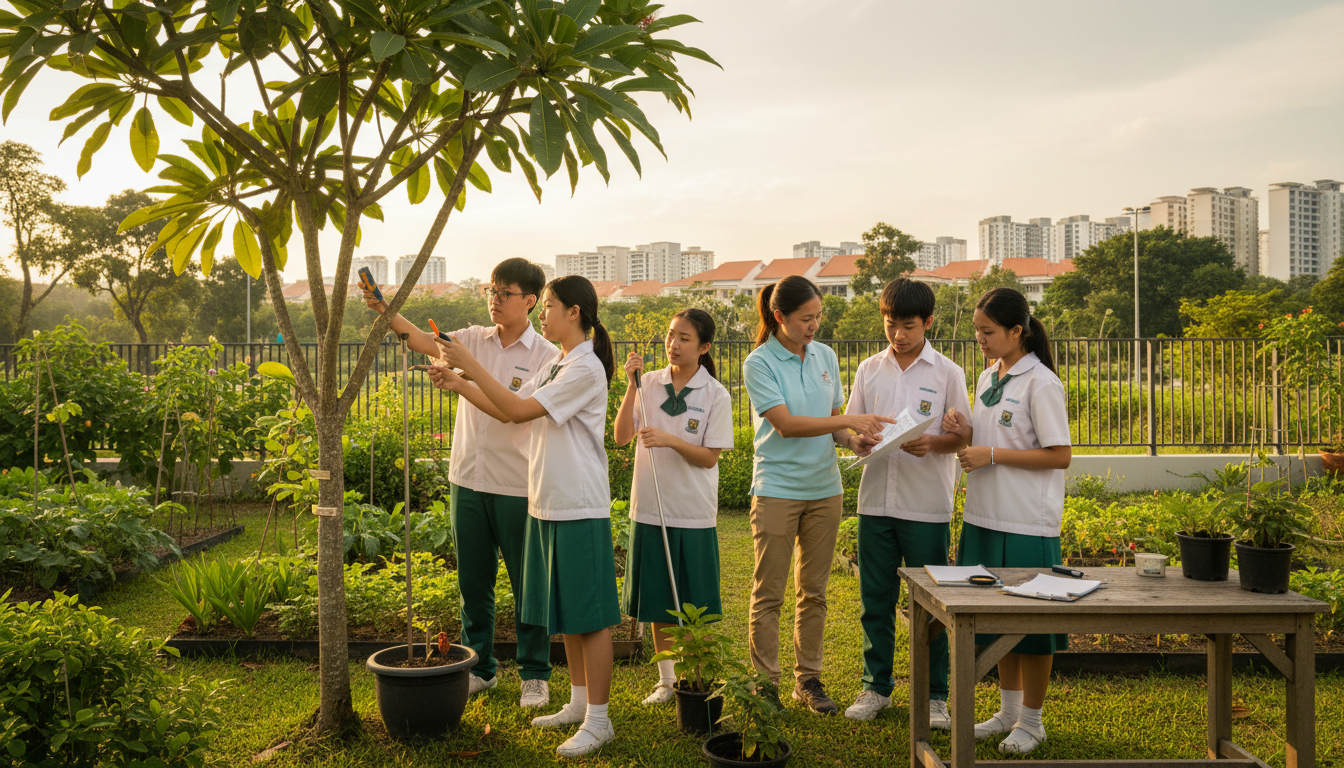
Education for Sustainable Development (ESD) helps learners understand connected environmental, social and economic challenges, examine evidence and make informed decisions about more sustainable futures. It is broader than teaching children to recycle or asking them to plant a tree. Good ESD combines accurate Science and Humanities knowledge with ethical reasoning, realistic participation, discussion of trade-offs and opportunities to evaluate the results of an action. UNESCO places ESD within its global 2030 education framework.
This guide explains what ESD means, how it relates to the United Nations Sustainable Development Goals, what UNESCO’s 2026 guidance adds and how Singapore schools can connect sustainability with Science, Mathematics, Geography, English, Values in Action and school culture. It includes examples that are safe and achievable, questions for families considering school programmes, evidence limitations, and a four-week learning plan. The goal is thoughtful understanding, not anxiety or claims that a single classroom project can solve a planetary problem.
- Knowledge: learn accurate concepts about climate, biodiversity, resources, society and economic choices.
- Reasoning: compare evidence, recognise uncertainty and evaluate who benefits or bears costs.
- Agency: choose appropriate and safe actions within the learner’s real ability and authority.
- Whole-school approach: align teaching, facilities, operations and community relationships rather than rely on one annual campaign.
- Assessment: examine understanding and justified decisions, not only counts of recycling bins or attractive posters.
Find the answer you need
- What is Education for Sustainable Development in plain English?
- What UNESCO says ESD means
- What the Sustainable Development Goals have to do with education
- Environmental, social and economic sustainability
- ESD is broader than environmental education
- What the ESD for 2030 roadmap established
- What UNESCO added in September 2026
- A whole-institution approach: beyond the classroom poster
- The difference between a sustainability slogan and knowledge
- Climate science in the classroom
- Climate mitigation versus adaptation
- Biodiversity and ecological systems
- Water as a sustainability learning theme
- Energy and electricity: understand units first
- Waste management and the problem with easy metrics
- Consumption, repair and material choices
- Sustainable cities and transport
- Singapore’s Eco Stewardship Programme
- ESD in Primary Science
- ESD in Secondary Science
- ESD in Mathematics
- ESD in Geography
- ESD in Economics and General Paper
- ESD in English and communication
- Critical thinking without false equivalence
- Socio-emotional learning and sustainable futures
- Participation: what can pupils reasonably do?
- Values in Action and sustainability
- What systems thinking adds
- UNESCO’s 2026 view of ESD assessment
- Assessment: measure understanding, not just enthusiasm
- The hidden curriculum of school sustainability
- Greenwashing: claims students should learn to question
- ESD and employment in changing industries
- Parents evaluating a sustainability programme
- A fictional case: Alicia and the recycling contest
- A fictional case: Ben’s school energy chart
- A fictional case: Mira and the school garden
- A four-week education-for-sustainability routine
- Common myths about ESD
- The final ESD question: does the learner understand more?
- Frequently asked questions
- Sources and next reading
What is Education for Sustainable Development in plain English?
A Secondary student investigates how energy is used in a school building. The class learns what electricity consumption measures, compares appropriately sourced data and identifies factors that affect demand. Students discuss possible changes, costs and limitations without pretending that one week of observation proves the entire building’s environmental impact. This is a potentially meaningful ESD task.
Education for Sustainable Development connects academic understanding with responsible judgement about long-term wellbeing. It does not require every child to become an environmental campaigner or treat every issue as morally simple. The teacher provides subject knowledge, demonstrates how to evaluate evidence and gives students a realistic decision. The educational outcome is a more capable learner, not only a slogan about protecting the future.
What UNESCO says ESD means
UNESCO’s 2026 explanation of Education for Sustainable Development defines it as helping people make informed decisions and take action on problems involving the wellbeing of societies and the planet. It addresses areas such as climate change, biodiversity loss, resource overuse and inequality. UNESCO describes cognitive, socio-emotional and behavioural dimensions of learning.
These dimensions do not mean every ESD lesson must combine an exam, counselling and community action. They remind educators that understanding issues, relating to others and choosing actions are distinct but connected. A learner may accurately explain greenhouse gases while needing support to evaluate policy choices. Another may enthusiastically recycle but misunderstand the evidence. Good education should teach the relevant knowledge and assess the intended outcome separately.
What the Sustainable Development Goals have to do with education
The United Nations Sustainable Development Goals (SDGs) are a set of 17 global goals addressing challenges including poverty, health, education, inequality, cities, resource use, biodiversity and climate change. ESD is particularly connected with SDG 4.7, which calls for knowledge and skills related to sustainable development, global citizenship and other areas.
An ESD lesson need not memorise all 17 goal names before investigating a real issue. A Geography teacher might explain the trade-offs of transport options, while a Science class examines reliable evidence about a resource. Students should understand that policy choices often affect multiple goals. The exercise becomes stronger when learners can explain a relationship rather than only display colourful SDG icons.
Environmental, social and economic sustainability
Sustainability is often presented through interconnected environmental, social and economic considerations. A proposed energy-saving measure may reduce consumption but require investment. A public-space redesign may benefit one group while making access harder for another. A workplace transition may change the skills that people need.
These considerations should not be treated as three boxes that can be solved by a single easy formula. Educators can teach students to identify who is affected, what evidence is available and which assumptions deserve testing. The aim is a thoughtful understanding of trade-offs and uncertainty. Children should not be told that every problem has one perfectly costless solution.
ESD is broader than environmental education
Environmental education frequently focuses on ecosystems, pollution, climate, biodiversity and human relationships with the environment. ESD includes these subjects while also addressing social inclusion, economic choices and responsible collective action. The two areas overlap, and different institutions use the language in varying ways.
Parents should look at the actual learning goal rather than argue over programme labels. An activity about waste may teach environmental science, data handling and civic responsibility. If students merely decorate recycling posters, its educational value is more limited. The important question is what knowledge and judgement the learner gained and whether they can apply it to another situation.
What the ESD for 2030 roadmap established
UNESCO’s Education for Sustainable Development: A Roadmap sets out five priority action areas: policy, learning environments, educator capacities, youth engagement and local-level action. The roadmap is part of ESD for 2030, intended to support progress across the Sustainable Development Goals.
These areas indicate why a school sustainability programme needs more than a yearly assembly. Teachers require appropriate resources and subject expertise. School practices should reinforce what lessons explain. Young people need meaningful participation within safe boundaries. Communities provide contexts for learning and action. The roadmap is a strategic framework, not proof that a particular local project achieved a measurable environmental improvement.
What UNESCO added in September 2026
On 17 September 2026 UNESCO launched three new guidance tools addressing whole-institution approaches, pedagogies and competencies, and assessment of ESD. The resources draw on action research and testing across 41 learning institutions in 10 countries, with the aim of helping educators and systems move from isolated activities to coherent practice.
These are guidance tools and examples, not proof that the same method will work identically in Singapore or every school. Their relevance is practical: define the outcomes, design suitable learning tasks and check both understanding and institutional practice. Parents can use the questions behind the tools when reviewing whether a school’s programme is truly educational.
A whole-institution approach: beyond the classroom poster
UNESCO’s 2026 whole-institution guidance describes aligning sustainability across teaching, school operations, governance, community engagement and organisational culture. A school can teach energy conservation while reviewing its own facility practices, but any proposed change should be evaluated for actual impact and safety.
The approach should not turn pupils into unpaid building managers or expect one teacher to control every institutional decision. School leaders retain responsibility for budgets, maintenance and safety. Students can investigate suitable questions and participate meaningfully with adult support. A whole-institution strategy becomes credible when educational intentions, operations and evidence reinforce one another.
The difference between a sustainability slogan and knowledge
A poster stating ‘save the planet’ may express a worthy concern but does not teach how electricity use is measured or why a particular resource choice matters. Students need concepts such as energy, emissions, biodiversity, consumption, opportunity cost and uncertainty. These can be taught in age-appropriate ways across subjects.
An educator can introduce relevant facts, model a simple calculation and ask learners to interpret the result. A changed problem tests whether they have learned more than the slogan. Students should also recognise that a popular action may have limited effects or unintended consequences. Good ESD avoids both empty optimism and fatalistic alarm.
Climate science in the classroom
Climate education should teach the scientific basis of relevant phenomena accurately and distinguish long-term climate trends from individual weather events. Students need to understand the role of evidence, measurement, models and uncertainty. The depth of explanation should fit the learner’s age and curriculum.
A safe classroom task might compare observations of surface temperatures under different shade conditions and discuss why this small experiment does not establish the full causes of climate change. Teachers should use reliable climate sources and avoid overclaiming. The scientific reasoning matters more than whether students produce a dramatic display.
Climate mitigation versus adaptation
Mitigation aims to reduce the drivers of climate change, such as greenhouse-gas emissions. Adaptation involves adjusting to its consequences and managing risks. The terms are related but not interchangeable. A school may explore energy-use choices as one example of mitigation and heat-safety planning as one example of adaptation.
Students should examine who makes decisions, what data are needed and which interventions are within the school’s authority. An individual child cannot be expected to design a citywide climate-resilience plan or guarantee an emissions reduction. ESD can still teach the distinction clearly through age-appropriate evidence and realistic cases.
Biodiversity and ecological systems
Biodiversity education concerns the variety of life and relationships among organisms and ecosystems. Students may observe a school garden, compare suitable records of different habitats or examine credible information about how conditions affect species. A teacher can connect observations with concepts such as food webs and habitat requirements.
One afternoon of counting visible insects cannot prove the entire ecological health of a location. Weather, time of day, observer skill and other variables matter. Students should learn to state limitations and design a better investigation. The educational result is accurate ecological reasoning, not a claim that a small school project conclusively assessed regional biodiversity.
Water as a sustainability learning theme
Water provides a rich subject for learning about supply, treatment, consumption, systems and resilience. A Singapore class might study publicly available information about water use and examine why measurement units and demand patterns matter. The topic can connect Science, Mathematics, Geography and civic decision-making.
Students should not construct or test unsafe drinking-water systems at home. A tabletop model may illustrate filtration or flow, but it cannot certify that water is safe to consume. Teachers can explain how simplified demonstrations differ from real infrastructure and professional standards. ESD should develop sound judgement about the limits of classroom experience.
Energy and electricity: understand units first
An activity about school electricity use can teach students to distinguish power from energy and to understand units such as kilowatt-hours. Without these foundations, a chart of consumption may look informative while remaining misunderstood. Teachers can start with simple examples and reliable published data.
Students can compare appropriately normalised quantities and ask what conditions affected the numbers. They should not assume that one appliance or person caused all variation. Decisions about school facilities require authorised professionals. The classroom goal is understanding measurement and thoughtful options, not producing an engineering recommendation without adequate evidence.
Waste management and the problem with easy metrics
Schools often measure sustainability participation through recycling collections or poster competitions. These can support awareness, but counting items placed in a bin does not automatically establish a net environmental benefit. Contamination, collection practices and the wider lifecycle of materials matter.
A more educational task asks which materials are accepted locally, how the system operates and what outcome is being measured. Students can use verified guidance from the relevant environmental authority and explain the limitations of their observations. The aim is evidence-based habits rather than a simplistic contest over which class fills the most bins.
Consumption, repair and material choices
Students may explore why a product’s durability, maintenance and replacement cycle affect its resource use. Buying a new product labelled green is not always the same as reducing environmental impact. The correct choice depends on the item, use, available evidence and disposal or repair options.
Teachers can provide fictional comparison data and ask learners which claim is supported. A child might compare lifespan and material quantities without pretending to conduct a complete professional lifecycle assessment. ESD strengthens reasoning about real trade-offs when it avoids advertising-style slogans and demands clear assumptions.
Sustainable cities and transport
Urban sustainability includes housing, public spaces, transport, accessibility, energy and community wellbeing. Singapore provides many local examples, but students should avoid assuming every infrastructure decision can be assessed from a short school walk. Different users have different needs and trade-offs matter.
A Geography class can examine official plans or published maps and ask how choices affect movement, land use and access. The teacher should identify the scope and age of the information and distinguish proposed projects from completed facilities. A useful result is a reasoned comparison, not unsupported claims about precise traffic or travel-time changes.
Singapore’s Eco Stewardship Programme
Singapore MOE has described the Eco Stewardship Programme as part of schools’ efforts to nurture environmental stewardship. Earlier Committee of Supply materials identify educational and institutional sustainability initiatives, while actual school activities vary by programme and year.
Parents can consult current MOE and school websites to understand local implementation. A school may organise garden projects, energy learning or community activities. Ask what students learn, which actions are supervised and how teachers evaluate progress. A national programme name should not be treated as a guarantee that every school runs the same projects or achieves an identical result.
ESD in Primary Science
Primary pupils may investigate safe everyday phenomena connected with water, plants, materials or energy. The teacher can guide observations, teach relevant vocabulary and explain how to make a fair comparison. Children can then describe their results and consider a related question.
An activity should fit the actual school syllabus and development stage. Young students are not expected to solve national climate policy, and they should not be exposed to dangerous experiments. The goal is accurate foundational understanding and curiosity. Good ESD at this level avoids fear-based messaging and emphasises appropriate, concrete learning.
ESD in Secondary Science
Secondary students can investigate physical processes and data with greater conceptual depth. A class might compare energy-related quantities, model aspects of an ecosystem or evaluate an experimental design. Teachers should make the scientific assumptions clear and check what evidence supports the conclusion.
An attractive model is not a substitute for understanding. Students should be able to explain why the measurements matter, what variables change and what the model leaves out. A changed task helps test transfer. The strongest outcomes involve correct scientific reasoning and informed judgement rather than unqualified claims about the real-world impact of a small demonstration.
ESD in Mathematics
Mathematics supports sustainability learning by helping students compare quantities, interpret rates, examine uncertainty and scrutinise misleading graphs. A learner might compare two fictional electricity-use scenarios while checking the unit and reference period. That task develops mathematical reasoning beyond memorised procedures.
Teachers should not choose numbers solely to force a predetermined moral conclusion. Give credible assumptions, identify missing information and discuss why a graph can mislead. A high-quality Mathematics lesson preserves accuracy even when the context has social importance. Students should leave with transferable quantitative skills, not just an opinion about which colour of chart is preferable.
ESD in Geography
Geography can examine the relationships among people, places, resources and environments. Students may investigate urban heat, water management, land use or sustainability trade-offs using maps and suitable data. The teacher needs to explain the spatial scale, source dates and contextual factors that make a claim plausible.
A single neighbourhood observation does not represent every location. Learners should distinguish conditions they directly measured from wider claims requiring more evidence. An independent task might ask students to compare two locations and justify what further information is needed. ESD strengthens geographical reasoning when local relevance does not replace methodological care.
ESD in Economics and General Paper
JC Economics and General Paper can provide opportunities to analyse environmental externalities, incentives, inequality, growth and policy trade-offs. Students should distinguish normative choices from empirical claims and consider evidence on different groups. A well-reasoned argument explains mechanisms and limitations rather than collecting impressive statistics.
Teachers should avoid promising that one sustainability theme will answer every essay question. The learner needs relevant academic knowledge and an ability to apply it to the prompt. A different policy case can reveal whether the underlying reasoning transfers. Sustainability is a useful subject context when it deepens understanding of economic and civic concepts.
ESD in English and communication
English lessons can help students evaluate claims, compare sources and write clearly about real concerns. A student might analyse how an advertisement describes a product as eco-friendly and ask what evidence the statement actually provides. The writing objective could be a reasoned critique or an accurate explanation to a particular audience.
The teacher should maintain standards for vocabulary, reasoning and source use. An emotionally persuasive slogan is not automatically a sound argument. Students can practise constructing a claim with relevant evidence and a reasonable limitation. The same skill transfers to many topics beyond environmental education.
Critical thinking without false equivalence
Sustainability questions may involve uncertainty about the best intervention, but that does not mean all scientific claims have equal evidential support. A teacher should distinguish well-established findings from genuinely contested details, such as the relative effectiveness or distributional effects of particular measures.
Students can learn to ask where evidence comes from, which population or context it covers and what remains unknown. A classroom debate should not reward confident misinformation as though it were simply another perspective. Intellectual openness means willingness to reconsider a claim when credible evidence changes, not refusal to recognise established knowledge.
Socio-emotional learning and sustainable futures
ESD sometimes involves empathy with people affected by environmental or social challenges. Students can consider how a proposal might affect households, workers or communities differently. The educational task is to understand perspectives and consequences without requiring children to disclose private fears or adopt a particular emotional response.
Children may need reassurance that large-scale problems have institutions and adult responsibilities behind them. ESD should avoid overwhelming young learners with threats they cannot control. Teachers can connect a difficult topic with realistic knowledge, social participation and age-appropriate agency. Emotional safety and honest factual teaching should reinforce one another.
Participation: what can pupils reasonably do?
Students may take part in supervised school projects, community activities or local research. Useful participation begins with an actual learning goal, realistic boundaries and appropriate consent or supervision. An activity can be worthwhile even when its measurable environmental impact is small.
Adults should not claim that a single afternoon of litter collection has solved a national waste problem. Instead, discuss what the class observed, how collection is organised and which larger systems are involved. Responsible participation combines practical action with accurate understanding of what the action can and cannot accomplish.
Values in Action and sustainability
Values in Action can connect school learning with community priorities. A project may explore local needs related to accessibility, resources or environmental stewardship. Students should first understand the partner’s actual request and avoid treating community members as props for a school promotional video.
Reflection can ask whether the activity was useful, which assumptions were wrong and what would be different next time. The programme should protect participant dignity and privacy. A count of service hours does not itself demonstrate systems thinking or ethical judgement. Teaching should make those capabilities explicit.
What systems thinking adds
Systems thinking considers relationships among different parts of a problem. A decision to reduce waste may influence procurement, costs, user habits and collection systems. An educator can help students map important connections while recognising that simplified diagrams may omit significant factors.
Students should not be asked to produce impossible predictions from a small model. They can identify potential unintended consequences and questions requiring further evidence. The goal is better reasoning about interconnected choices, not claiming that every system can be fully understood in a short classroom exercise.
UNESCO’s 2026 view of ESD assessment
UNESCO’s October 2026 policy paper on ESD assessment calls attention to the need for assessment approaches that capture relevant knowledge, competencies and action rather than relying entirely on narrow recall tasks. The paper draws in part on work across 41 institutions in 10 countries.
This does not imply that factual tests should be abandoned. Students still need reliable knowledge of climate, materials, systems and social processes. A good programme may combine accurate concept checks with a changed problem or reasoned evaluation of a realistic decision. Different outcomes should be measured appropriately rather than collapsed into one sustainability score.
Assessment: measure understanding, not just enthusiasm
A student who joins every school gardening activity may still misunderstand the Science of ecosystems. Another who writes a careful analysis but cannot participate in one field activity may nevertheless demonstrate strong understanding. Attendance and enthusiasm provide some information, but they do not assess every educational objective.
Define the learning target first. For data literacy, ask the pupil to interpret another table. For ethical reasoning, ask which stakeholders are affected and what trade-offs matter. For scientific understanding, inspect the mechanism and evidence. Assessment should be fair, accessible and connected to the actual knowledge or skill being taught.
The hidden curriculum of school sustainability
Students learn from what institutions do, not only what they teach. A school may encourage responsible consumption while routinely discarding reusable materials without explanation. Another may involve pupils in transparent discussion about realistic budget or operational constraints. These daily practices communicate values and expectations.
The Hidden Curriculum guide explores how unstated messages shape learning. Schools should avoid portraying every operational decision as simple or perfect. A responsible culture models evidence, constraints and willingness to improve. Leaders retain responsibility for infrastructure and safety while students can engage in appropriate inquiry.
Greenwashing: claims students should learn to question
Greenwashing occurs when environmental claims mislead audiences about a product, practice or organisation. A company may highlight one attractive feature while omitting significant lifecycle effects. Students should learn to inspect the exact claim, identify the supporting evidence and ask whether important context is missing.
A classroom can use fictional advertisements or properly sourced public examples to avoid unsupported accusations about a real company. Learners should distinguish marketing language from verified performance and know that complex environmental evaluations require suitable expertise. The objective is careful information literacy, not automatic suspicion of every sustainability claim.
ESD and employment in changing industries
Some industries are changing in response to energy, resource and environmental demands. Learners may need technical knowledge, data skills, communication and appropriate qualifications for particular roles. Education for Sustainable Development can broaden awareness of these connections without promising that every green-themed course guarantees employment.
Adults and older students should check actual programme recognition, occupational standards and career requirements. A short workshop on climate concepts is not automatically an engineering qualification. School projects can spark interest, while formal study and supervised practice build specialised competence. The link between learning and work should be explained honestly.
Parents evaluating a sustainability programme
Ask what the learner is meant to understand, which evidence or concepts are taught, what practical activities are supervised and how outcomes are checked. A credible programme should distinguish knowledge from participation and explain why the chosen task is suitable for the student’s age.
Also ask about accessibility, time, cost and whether equipment is necessary. Families should not feel compelled to buy expensive kits or enrol in unrelated environmental courses simply to demonstrate that a child is future-ready. One thoughtful local observation combined with accurate teaching may provide more learning than a lavishly staged event.
A fictional case: Alicia and the recycling contest
Alicia’s class competes to collect the most recyclable material. At first she assumes that more items in the collection bin always means the strongest environmental benefit. Her teacher asks what materials the local collection system accepts and how contamination can affect the result.
The class revises the task to record information carefully and discuss what its measurements actually show. The children learn about evidence and system limits rather than simply maximising a visible count. This fictional example does not claim a measurable environmental improvement; it illustrates how a cheerful activity can become a more rigorous learning experience.
A fictional case: Ben’s school energy chart
Ben makes a graph of a fictional school’s weekly energy use but forgets that different weeks had different numbers of operating days. His teacher explains why raw totals may be misleading without suitable context. Ben compares the data using more relevant assumptions and identifies questions the information cannot answer.
He then interprets a changed chart independently. The mathematical learning concerns units, comparisons and fair reasoning. The case does not claim that Ben has audited a real building or recommended an authorised operational change. ESD becomes useful when it builds capability that transfers beyond the sustainability theme.
A fictional case: Mira and the school garden
Mira observes that plants in one part of the school garden grow differently from those in another. She initially concludes that sunlight is the only cause. Her teacher asks whether water, soil and other conditions were also different, and helps her design a fairer comparison.
The child learns how to distinguish observation from an explanation and how to state limitations. Later she applies the same principle to a new Science context. The fictional example shows why sustainability activities should teach scientific methods rather than encourage confident conclusions from inadequate evidence.
A four-week education-for-sustainability routine
Week 1 — Learn the idea. Choose a manageable, age-appropriate topic such as water use, material lifecycles or school-garden conditions. Identify reliable information and teach the relevant vocabulary. Ask the learner to describe what is known and what is uncertain before planning an activity.
Week 2 — Investigate a safe question. Use credible published data or an appropriate supervised observation. Record units, conditions and limitations. Avoid hazardous experiments or unauthorised access to school infrastructure. Keep the task small enough for the learner to understand and explain.
Week 3 — Compare choices. Ask what evidence supports a possible action, who might be affected and which trade-offs matter. Use a changed example to test understanding. Discuss what decisions belong to adults or authorised institutions rather than implying the child is responsible for solving every systemic issue.
Week 4 — Evaluate and reflect. Check whether the learner can explain a concept, interpret another source and state a justified limitation independently. Review one worthwhile next learning question. This is a family or classroom study plan, not a professional environmental assessment or a guarantee of measurable impact.
Common myths about ESD
Myth: ESD is only recycling. Correction: it integrates scientific, social and economic reasoning. Myth: a school with many green posters necessarily teaches sustainability well. Correction: examine learning and operations. Myth: one classroom experiment can prove a national climate conclusion. Correction: respect evidence limits.
Myth: every environmental decision has no costs. Correction: teach trade-offs and different stakeholders. Myth: children must personally fix global problems. Correction: support realistic agency and adult responsibility. Myth: activism alone proves knowledge. Correction: assess understanding, evaluation and appropriate action separately.
The final ESD question: does the learner understand more?
Education for Sustainable Development should help people grasp relevant systems, assess information and choose proportionate responses to real challenges. It is strongest when grounded in accurate subject knowledge and a fair opportunity for students to ask questions. It need not be dramatic to be useful.
A child who can interpret a new graph, explain an environmental mechanism and recognise the limits of a proposed action has learned something valuable. Schools can build that capability through responsible teaching and a coherent culture. The purpose is not environmental performance theatre; it is informed and constructive participation in a changing world.
Frequently asked questions
What is Education for Sustainable Development?
An approach that teaches knowledge, reasoning, values and action related to long-term environmental, social and economic wellbeing.
Is ESD the same as environmental education?
They overlap, but ESD also addresses social inclusion, economic choices and how systems connect.
What is UNESCO’s ESD for 2030?
A framework and roadmap supporting sustainability-related education through policy, learning environments, educator capacity, youth engagement and local action.
What changed in UNESCO’s 2026 guidance?
Three tools introduced whole-institution approaches, pedagogies and competencies, and assessment principles for sustainability learning.
Does ESD mean teaching students political opinions?
It should teach accurate evidence, ethical reasoning and trade-offs, not replace critical thinking with slogans.
How can Primary pupils learn sustainability?
Through safe, age-appropriate observations, correct vocabulary, simple data comparisons and discussion of realistic choices.
How can JC students connect ESD with Economics?
By evaluating externalities, incentives, uncertainty, trade-offs and affected groups with suitable evidence.
What is a whole-institution approach?
Aligning teaching, operations, school culture, governance and community relationships rather than relying on isolated campaigns.
Do recycling contests prove environmental impact?
No. Participation metrics may not reflect actual environmental outcomes; students should examine accepted materials, systems and limitations.
How can parents assess an ESD programme?
Ask what concept is taught, which evidence is used, what students independently demonstrate and how safety and access are protected.
Sources and next reading
Authoritative UNESCO sources: ESD: What You Need to Know (updated July 2026); ESD for 2030 Roadmap; September 2026 ESD Guidance Tools; Whole-Institution Approach (September 2026); and Rethinking ESD Assessment (October 2026). For Singapore, see MOE and the current school sustainability programmes. UNESCO guidance does not independently validate a particular school project.
Further eduKate reading: Education Hub, Experiential Learning, Inquiry-Based Learning, Critical Thinking, and Holistic Education. Choose the topic that develops the learner’s actual knowledge rather than adding another superficial activity.