
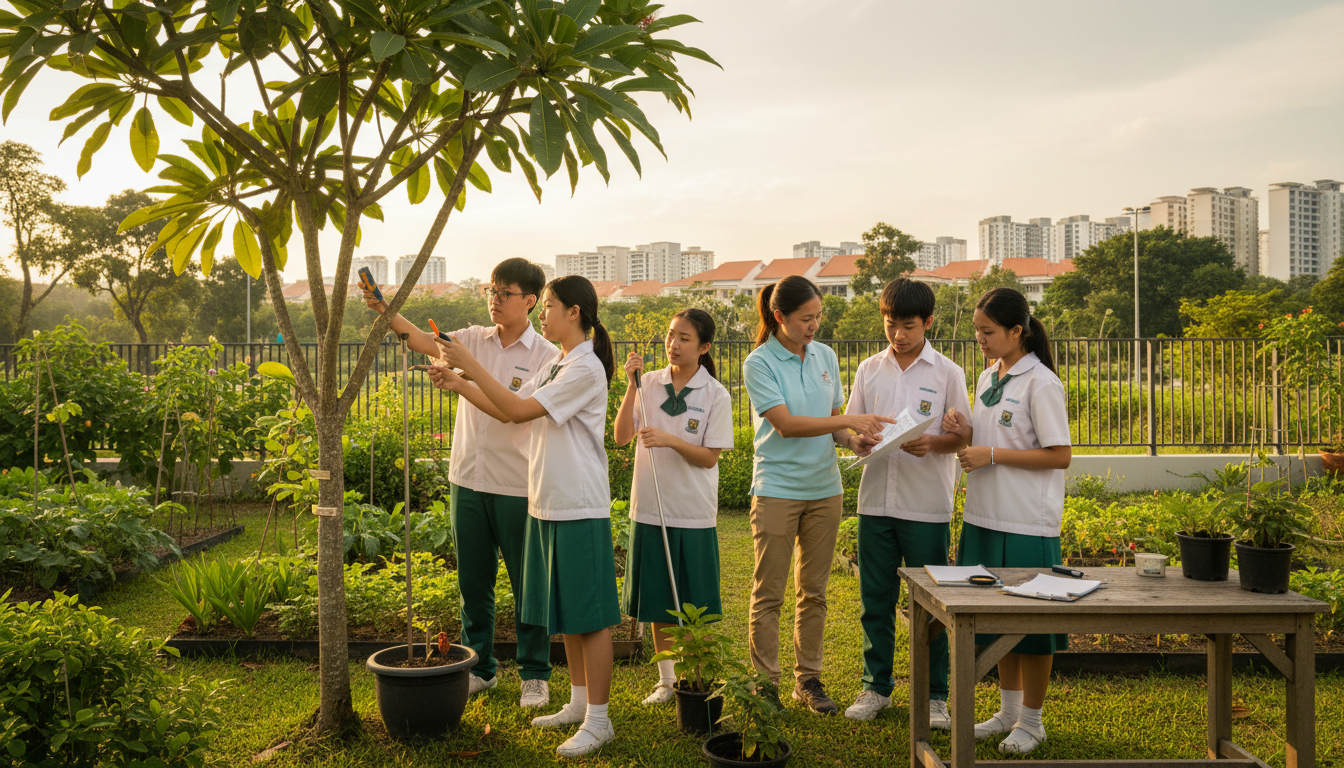
Education for Sustainable Development (ESD) develops the knowledge, judgement and abilities needed to understand environmental, social and economic challenges and respond responsibly. It is broader than a recycling campaign or a lesson about climate change. Learners can investigate water systems, biodiversity, urban heat, resources and social fairness while practising scientific reasoning, systems thinking and evidence-based communication. An effective programme must connect accurate learning with feasible action rather than place responsibility for global problems onto children.
This Singapore parent and teacher guide explains UNESCO’s ESD for 2030, the 2024 green-curriculum guidance and September 2026 assessment resources. It shows how sustainability can connect with Science, Geography, Mathematics, English, General Paper and Values in Action without making unsupported environmental claims. It also explains how to assess student learning and school projects, recognise trade-offs, prevent greenwashing and plan a safe four-week investigation. The aim is informed capability, not another collection of posters and certificates.
- Knowledge: understand environmental, social and economic relationships using reliable evidence.
- Systems thinking: notice interactions, feedback loops, uncertainty and possible unintended effects.
- Care and responsibility: consider people affected, fairness, safety and practical constraints.
- Assessment: measure actual understanding, reasoning and responsible action, not simply campaign participation.
- Practical step: choose one small, safe question and investigate it carefully before claiming an outcome.
Find the answer you need
- What is Education for Sustainable Development in plain English?
- UNESCO’s definition of ESD
- ESD compared with environmental education
- How the Sustainable Development Goals fit
- The five priorities in UNESCO’s ESD for 2030 roadmap
- What UNESCO’s greening curriculum guidance adds
- What changed with UNESCO’s September 2026 resources
- Why systems thinking is essential
- Knowledge of cause and effect
- Climate literacy and scientific timescales
- Mitigation and adaptation are different
- Biodiversity and ecological understanding
- Water and the Singapore context
- Urban heat in a school compound
- Food systems and connected decisions
- Waste audits rather than empty campaigns
- Electricity, energy and the importance of units
- Transport and sustainability
- Economic trade-offs and sustainability
- Fairness and social inclusion
- What responsibility can reasonably fall on children?
- Managing climate worry in classrooms
- How sustainability connects with Primary Science
- Secondary Science and data quality
- Geography and spatial scale
- Mathematics and trustworthy graphs
- English and General Paper: arguing responsibly
- Art and Design: strong visuals need truthful claims
- Values in Action and community partnerships
- The whole-institution approach
- The Green School Quality Standard
- How the 2026 ESD assessment tool changes the discussion
- Assessing individual learning in a group project
- What greenwashing looks like in school projects
- Choosing safe and ethical student projects
- What parents can do at home
- A fictional student case: Alicia investigates shade
- A fictional student case: Ben examines food waste
- Four-week ESD learning routine
- Common myths about sustainability education
- What meaningful progress looks like
- Frequently asked questions
- Sources and further reading
What is Education for Sustainable Development in plain English?
A student investigates why one part of the school compound feels hotter than another. They compare shade, surface material and measurement conditions before discussing possible reasons. They also consider how school design affects people who use the space. The lesson connects Science with real human decisions without requiring the student to become a professional urban planner.
Education for Sustainable Development is the deliberate teaching of knowledge and judgement for such interconnected questions. It asks what is happening, which evidence supports an explanation, who may be affected and what responsible action would be feasible. The central educational result is an improved ability to reason and decide, not a claim that one classroom project has solved climate change.
UNESCO’s definition of ESD
UNESCO’s 2026 overview of Education for Sustainable Development describes learning across cognitive, social-emotional and behavioural dimensions. It includes understanding complex issues, cooperating with people and developing a capacity for informed individual and collective action.
Students should learn relevant facts and methods, not merely become more enthusiastic about sustainability. A child who can recite a slogan but cannot distinguish climate from weather needs a clearer scientific explanation. Another who understands the science may need support considering economic or social consequences. ESD is strongest when each dimension has a meaningful learning goal and appropriate evidence.
ESD compared with environmental education
Environmental education often focuses on ecosystems, resource use, human environmental impacts and responsible stewardship. ESD includes these issues while explicitly considering social and economic contexts such as equity, cost, public institutions and the trade-offs involved in practical decisions.
The approaches overlap, and a programme need not choose one label exclusively. A water-conservation lesson may include the physical water cycle, the engineering of supply, household affordability and public behaviour. The teacher should introduce these connections in a developmentally suitable sequence. Breadth does not mean asking a Primary pupil to analyse an entire global economy before understanding water as a resource.
How the Sustainable Development Goals fit
The United Nations Sustainable Development Goals provide a broad international framework including education, health, water, energy, cities and environmental protection. They can help schools connect local topics with wider concerns and recognise that progress in one area may influence another.
However, memorising the colours and names of 17 goals is not equivalent to sustainability competence. A student examining clean water should learn the relevant scientific and social relationships. The framework can inform the question, but the lesson must still teach accurate content and provide a chance to apply it. Good education does not mistake an icon chart for a complete curriculum.
The five priorities in UNESCO’s ESD for 2030 roadmap
UNESCO’s ESD for 2030 roadmap describes five areas: advancing policy, transforming learning environments, developing educator capacity, empowering youth and accelerating action at local levels. The areas recognise that responsibility is shared across institutions and communities.
This is important for families because children cannot individually fix global systems. Schools need teachers with appropriate expertise, operational support and meaningful partnerships. Student participation should be safe, realistic and connected to learning. A class can investigate a local problem while understanding that larger policy and engineering decisions involve qualified adults and public institutions.
What UNESCO’s greening curriculum guidance adds
UNESCO’s Greening Every Curriculum guidance, first released in 2024 and updated in June 2026, sets principles and age-related learning outcomes for climate and sustainability education. Its themes include high-quality content, action orientation, fairness and relevance to learners’ contexts.
The guidance encourages countries and schools to connect curriculum, teacher preparation and assessment. It is not a claim that every institution displaying a green logo meets a common performance threshold. Parents can ask what was actually taught, what the student can explain and whether the proposed action is supported by evidence. A high-quality curriculum turns a broad theme into teachable relationships.
What changed with UNESCO’s September 2026 resources
On 17 September 2026, UNESCO introduced three practical ESD guidance tools addressing whole-institution approaches, sustainability pedagogy and assessment. These resources drew on action research and experience across 41 educational institutions in ten countries.
They help educators connect institutional operations with the learning experience, rather than running isolated annual events. The documents are frameworks for adaptation; they are not a verified scorecard of individual Singapore schools. Schools should apply their principles with local knowledge, sound teaching and honest monitoring. A new publication cannot by itself demonstrate that a school’s sustainability programme is effective.
Why systems thinking is essential
Systems thinking considers how different parts influence one another across time. Urban heat, for example, relates to buildings, shade, surfaces, airflow, energy use and human activity. Changing one feature may affect other conditions or create unintended consequences. Students need a way to explore these connections carefully.
Begin with a manageable model instead of an enormous chart filled with arrows. Ask which causal relationship is supported, what variables are uncertain and where additional evidence is needed. A good systems-thinking task helps learners choose more appropriate questions. A complicated-looking diagram is not proof that the student understands the system.
Knowledge of cause and effect
Students may notice that two conditions change together and assume one caused the other. In a school-garden investigation, they might find that plants in shade are taller but overlook differences in watering, soil or planting time. A classroom project should make these alternative explanations visible.
Teach the distinction between observation, correlation and causal reasoning at an age-appropriate level. Learners can record which conditions were comparable and identify limits in the evidence. This discipline makes sustainability projects more credible. An attractive conclusion is not necessarily a correct one, and uncertainty can be an important learning result.
Climate literacy and scientific timescales
Climate education should explain the distinction between weather and long-term climate, how relevant measurements are collected and what scientific models represent. Students may encounter the greenhouse effect, emissions, temperature trends and the role of human activity at different academic levels.
Teachers should not use one unusually hot or cool afternoon as proof of an entire climate trend. They can show why long periods and appropriate datasets matter while discussing local observations as examples of shorter-term conditions. Accurate explanations give learners tools for interpreting claims in the news without turning every daily weather change into an unsupported conclusion.
Mitigation and adaptation are different
Climate mitigation concerns reducing or avoiding greenhouse-gas emissions or strengthening relevant sinks. Adaptation concerns adjusting to impacts and reducing vulnerability. Both may matter in a real response, but they answer different questions and often involve different evidence or timescales.
A class can compare an energy-efficiency measure with shade that helps people cope with heat. These examples introduce the difference without claiming one school project solves a citywide problem. Teachers should explain the assumptions and constraints of each proposal. Distinguishing mitigation from adaptation improves the quality of discussions and stops students from treating every green action as interchangeable.
Biodiversity and ecological understanding
Biodiversity lessons can examine habitats, species interactions, ecological processes and human impacts. A supervised observation in a school garden may involve identifying a few familiar plants or observing how different conditions affect growth. Students can practise recording evidence and asking useful questions.
Such a short survey cannot establish the health of an entire ecosystem. Children should not collect protected wildlife, enter hazardous areas or disturb habitats for a project. Teachers can model responsible observation and explain sampling limits. Learning the concept of biodiversity is more important than assembling the largest possible species checklist from one brief outing.
Water and the Singapore context
Singapore’s water system offers a meaningful setting for considering resource constraints, infrastructure, conservation and public decisions. Schools can connect relevant Science and Geography knowledge with everyday questions about water use and management.
Students need to distinguish simplified classroom models from actual technical systems. A paper or sand filter built in class does not make water safe to drink. Teachers should use official sources for real public-water facts and avoid exaggerated engineering claims. A safe model can illustrate a concept while the teacher explains which conditions it cannot represent.
Urban heat in a school compound
A teacher may guide students to compare temperatures on shaded and unshaded surfaces under safe conditions. The exercise can introduce measurement, units and hypotheses about heat absorption. Learners can also consider why different campus spaces are more comfortable for various users.
The comparison must account for time, equipment and other relevant conditions. A difference observed at one point cannot be generalised without further evidence. The educational success lies in accurate recording, cautious reasoning and identifying a better next test. Students should not be asked to perform professional building assessments or unsafe outdoor work.
Food systems and connected decisions
Food production and consumption involve land, water, transport, affordability, nutrition, waste and cultural practices. Teachers can use a simplified example to show how an environmental question connects with social and economic considerations.
A responsible lesson avoids declaring one food choice universally superior without considering how it was produced and what criteria are used. Students should not be encouraged to shame classmates for their family meals or income. Use respectful discussion and evidence-based comparisons. A school food project is an opportunity to learn about systems, not an invitation to rank households morally.
Waste audits rather than empty campaigns
A recycling campaign may produce attractive posters and participation photographs but little evidence about changed waste patterns. Students can learn to ask what outcome matters and how it could be measured safely. A supervised, appropriately hygienic audit may be more informative than counting slogans.
Teachers should protect student privacy, define comparable categories and avoid making unsupported claims from a small dataset. Adults remain responsible for school facilities and operational decisions. The point is learning how to investigate a real question and report the result honestly. An unsuccessful campaign can still produce educational insight if the reasons are analysed.
Electricity, energy and the importance of units
Energy education can introduce electricity use, power, efficiency and the difference between watts and kilowatt-hours. A learner interpreting a bill or appliance specification needs to know what the numbers describe. Confusing a rate with a total can produce a polished but invalid comparison.
Use fictional or appropriately authorised data for practice. Students can compare carefully defined scenarios and discuss assumptions. They should not handle electrical installations or attempt hazardous experiments. The educational target is accurate reasoning from units and quantities. A simple school activity is not a professional energy audit.
Transport and sustainability
Transport choices involve energy, land use, accessibility, travel time and the needs of different people. A class can compare hypothetical scenarios using appropriate data rather than assuming that one mode is best for every individual or journey.
Students should consider the limits of their comparison and avoid inventing actual travel times or emissions figures. A responsible discussion may recognise that a person with mobility needs faces different constraints from another commuter. Teachers can use transport as a context for Mathematics, Geography and social reasoning without presenting a classroom recommendation as official policy.
Economic trade-offs and sustainability
Projects often involve costs and benefits that are distributed across people and time. A material may have a lower purchase price but different maintenance requirements. A school might consider energy savings alongside initial costs, safety and practical feasibility.
Students should learn to define criteria and compare quantities honestly. A small hypothetical calculation can help demonstrate trade-offs without becoming a complete cost-benefit assessment. Do not claim that a low initial price always makes a decision unsustainable or that a green label automatically justifies an unlimited budget. Economics provides useful tools for disciplined judgement.
Fairness and social inclusion
Environmental issues and responses affect people with different resources and circumstances. Some families have limited time or money to adopt a preferred practice, and some people need accessible transport or infrastructure. ESD should help students consider these realities rather than assume every household can make identical choices.
Teachers can use fictional or published examples without asking students to reveal sensitive family conditions. Discuss whose needs are represented and which assumptions may be incomplete. The aim is empathy linked to reasoned decisions. Fairness can be considered rigorously without turning a classroom activity into personal blame.
What responsibility can reasonably fall on children?
Children can learn to make appropriate choices and participate in safe community activities, but they are not responsible for resolving problems requiring national policy, engineering or industry action. A lesson that exaggerates their personal responsibility can create fear or guilt without improving understanding.
Educators can explain the role of institutions, families, businesses and governments while identifying modest opportunities for student involvement. The child should understand that a small action can be useful within limits. The educational objective is informed agency, not the illusion that global outcomes depend solely on one pupil’s daily behaviour.
Managing climate worry in classrooms
Some students feel anxious or overwhelmed after hearing about environmental changes. Teachers should present accurate, age-appropriate information and create space for respectful questions. Unsupported catastrophe language is not required for rigorous education.
Adults can distinguish problems that need collective responses from actions children can safely take. They should avoid promising that all challenges will disappear soon, but also avoid treating pupils as powerless. Practical projects, reliable sources and an understanding of public institutions can provide perspective. When distress is serious or persistent, appropriate support may be necessary.
How sustainability connects with Primary Science
Primary learners can investigate safe questions about plants, material properties, shadows or water through appropriate observation. The teacher first identifies the relevant Science concept and provides any prerequisite vocabulary and method. Students may then compare conditions and describe what happened.
Not every hands-on experiment is a sustainability lesson, and a sustainability theme cannot replace accurate Science. Ask whether students can identify an important relationship and apply it to a changed example. A child who simply enjoyed the activity may still need the correct concept explained. The goal is a strong scientific foundation.
Secondary Science and data quality
Older students can analyse variables, measurement consistency, uncertainty and the strength of conclusions. A school project about heating or plant growth can provide material for such reasoning, provided it uses safe, suitable methods.
Teach learners to report measurements honestly even when results differ from predictions. An unexpected result may reveal a design weakness or an important question. It should not be edited to create a more persuasive green narrative. Students can build scientific judgement through careful correction and a changed task.
Geography and spatial scale
Geography connects environmental and human processes across places and scales. Students may compare maps, land-use information or published data about different neighbourhoods. The teacher can ask how scale, time and source definitions influence interpretation.
A conclusion from one small study location cannot automatically be applied to an entire city. Students should distinguish patterns, plausible explanations and unsupported claims. Good Geography teaching makes the relevant concepts precise while encouraging questions about people and environments. It is well suited to systems thinking when subject standards remain clear.
Mathematics and trustworthy graphs
Mathematics can support sustainability through rates, percentages, measurement, estimation and statistical interpretation. A class might analyse fictional electricity data and compare changes over time. The learner needs to understand which quantity is the baseline and what each axis or unit represents.
A graph with an inappropriate scale can exaggerate a difference, and a percentage without a clear denominator can mislead. Teachers should show students how to inspect representations, calculate carefully and explain limitations. This is valuable mathematical learning independent of the environmental theme used.
English and General Paper: arguing responsibly
English and General Paper lessons can use sustainability topics to teach evaluation of evidence, audience awareness and reasoned argument. Students should define claims, cite real sources where required and consider counterarguments rather than memorising dramatic quotations.
A persuasive essay does not become academically strong simply by taking a popular stance. The writer needs accurate examples and an explanation of relevance. Teachers should correct unsupported generalisations and help students recognise genuine policy trade-offs. The learning target is disciplined communication, not performance of an approved opinion.
Art and Design: strong visuals need truthful claims
Art, design and drama can help learners communicate ideas, investigate material choices and imagine possible futures. A striking poster or model may reach an audience effectively and create worthwhile creative opportunities.
However, aesthetic impact and environmental effect are different questions. A student can produce an excellent visual design without proving that the represented technology works. Teachers should value both honest factual claims and appropriate artistic expression. Where real-world implementation is proposed, professional standards and safety must be considered separately.
Values in Action and community partnerships
Values in Action may provide opportunities for students to work with community organisations and reflect on sustainability concerns. A meaningful project begins by understanding the partner’s actual needs and clarifying which actions students can perform safely.
Photographs and hours completed do not establish the quality of the contribution. Learners can discuss what was attempted, what changed and what remains uncertain. Schools should avoid treating people or neighbourhoods as props for an impressive portfolio. Respectful partnership and honest evaluation are central learning outcomes.
The whole-institution approach
UNESCO’s guidance considers not only classroom content but also leadership, facilities, operations and community relationships. A school teaching resource conservation might examine whether its own routines provide credible opportunities for students to connect ideas with observable practices.
Operational decisions belong to responsible adults and institutions, not individual pupils. Leaders can share appropriate data, explain constraints and invite age-appropriate learning. This is stronger than asking children to campaign while providing no way to examine whether an action has any effect. A coherent institutional approach connects values with actual practice.
The Green School Quality Standard
UNESCO’s Green School Quality Standard identifies governance, facilities and operations, teaching and learning, and community engagement as connected areas. It provides a common framework for thinking about schoolwide sustainability.
It does not mean that a single garden, recycling station or green badge proves a school is environmentally excellent in every dimension. Families should ask what the institution actually measures and how it responds to problems. A useful school sustainability report describes the scope and limitations of its claims, not just attractive images.
How the 2026 ESD assessment tool changes the discussion
UNESCO’s Assessing Learning in Education for Sustainable Development, issued in September 2026, offers a framework for describing, appraising, redesigning and evaluating assessment. It recognises that sustainability competencies involve systems reasoning, ethical judgement, collaboration and action as well as knowledge.
This is valuable because a standard quiz can check terminology but may not show whether a student can weigh trade-offs responsibly. Teachers need a mix of suitable tasks and feedback aligned with intended outcomes. No single portfolio, survey or poster can demonstrate every dimension of learning. Assess the capability that was actually taught.
Assessing individual learning in a group project
A team may produce an excellent sustainability presentation while some members contribute little to its reasoning. Group success is not proof that each pupil understands the data or systems involved. Teachers can give learners meaningful roles and ask for short individual explanations.
For example, every student might analyse one claim, identify a limitation and propose a changed question. This allows constructive collaboration without hiding gaps. Evaluation should be developmentally appropriate and respect access needs. The aim is to know what students learned, not merely reward a polished final performance.
What greenwashing looks like in school projects
Greenwashing is presenting a product, organisation or action as more environmentally beneficial than the evidence supports. A student might claim a small garden project offset a precise quantity of emissions without calculating or verifying the figure. Good intentions do not make an unsupported number reliable.
Teachers can require clear distinctions between a goal, an activity and a measured outcome. A proposed intervention is not yet implemented; a classroom model is not a full environmental assessment. Students can be proud of their project while acknowledging uncertainty. Learning to communicate limits is a core information-literacy skill.
Choosing safe and ethical student projects
Projects should be appropriate to the students’ age, supervision and available expertise. Safe observations, reading public reports or analysing fictional data can teach valuable skills. Hazardous electrical work, handling dangerous substances or modifying public infrastructure should not be attempted as informal student projects.
Schools should consider permissions, privacy and accessibility before collecting data or engaging the community. Adults are responsible for risk management and professional decisions. A narrowly scoped investigation often offers more learning than a grand proposal that cannot be safely or credibly evaluated.
What parents can do at home
Families can discuss water, electricity, local shade, transport and food using ordinary experiences. A parent may ask what a unit on a bill represents or why two safe materials behave differently. The conversation becomes educational when it clarifies a real concept and the child can use it later.
No expensive kit or household transformation is necessary to begin. Avoid sharing private family information in unapproved school projects and do not turn every choice into a moral test. A warm, precise discussion about one relevant idea can be more useful than another pile of green worksheets.
A fictional student case: Alicia investigates shade
Alicia observes that one part of her school garden feels cooler. With teacher supervision, she measures conditions at comparable times and records the differences. Her first claim that all shaded spaces are cooler in every condition is too broad for the evidence.
The teacher helps her state the result accurately and identify variables that might matter. Alicia then considers a different surface and explains how she would make a fair comparison. This fictional example demonstrates improved scientific reasoning, not a citywide heat assessment or guaranteed engineering solution.
A fictional student case: Ben examines food waste
Ben wants his school to reduce food waste. Instead of immediately blaming classmates, his group asks what information would help understand the issue. They develop an appropriate, safe and respectful observation plan under adult supervision using anonymised quantities.
After the activity they examine which changes are actually supported by the data and what remains uncertain. The project teaches systems reasoning, fairness and communication. It does not provide a universal prescription for every household. The scenario is fictional but illustrates why observation should come before confident claims.
Four-week ESD learning routine
Week 1 — Define the question. Select one safe, specific topic connected to a real curriculum goal, such as material absorption, shade or interpreting a resource-use graph. Teach essential vocabulary and identify what learners already understand. Avoid beginning with an overwhelming global problem.
Week 2 — Observe and record. Use appropriate measurement or reliable published data. Record conditions, quantities and limitations, and distinguish direct observation from interpretation. Follow relevant school safety and privacy procedures. Do not invent results to create a satisfying story.
Week 3 — Explain and compare. Connect the evidence with scientific and social concepts. Consider at least one alternative explanation or trade-off. Provide direct teaching if the relevant knowledge is missing. Ask each learner to explain a conclusion in their own words.
Week 4 — Transfer and evaluate. Present a changed example and ask what knowledge applies, what additional data would be required and what action is proportionate. Compare with week one and choose the next learning question. This is an educational exercise, not professional environmental certification.
Common myths about sustainability education
Myth: ESD means telling children to recycle. Correction: it develops connected environmental, social and economic reasoning. Myth: a poster proves competence. Correction: evaluate individual understanding and evidence. Myth: all green choices lack trade-offs. Correction: consider cost, access and unintended effects.
Myth: children must solve major climate problems alone. Correction: responsibility is shared across institutions. Myth: a school garden automatically meets global standards. Correction: inspect teaching and institutional practice. Myth: ESD belongs only to Science. Correction: multiple subjects contribute while retaining their academic requirements.
What meaningful progress looks like
A student who completes a good ESD lesson should be able to explain a relevant system, use appropriate evidence, recognise uncertainty and compare possible responses responsibly. They may also participate in a safe, realistic action under adult guidance. These are capabilities worth evaluating over time.
Education for sustainability should deepen learning rather than replace it with fear or public relations. Schools and families can support curiosity and informed participation without exaggerating outcomes. The practical achievement is a learner who can reason accurately about complex relationships and knows when further expertise or information is needed.
Frequently asked questions
What is Education for Sustainable Development?
An approach that builds knowledge, skills and values for informed decisions about environmental, social and economic sustainability.
How does ESD differ from environmental education?
ESD includes environmental understanding while explicitly examining economic, social and ethical relationships.
What is ESD for 2030?
UNESCO’s framework focusing on policy, learning environments, educator capacity, youth and local action.
What is the UNESCO green curriculum guidance?
A set of principles and age-related learning outcomes for climate and sustainability education, issued in 2024.
What did UNESCO add in September 2026?
New guidance on whole-institution approaches, sustainability teaching and assessing student learning.
How can Primary students study sustainability?
Through accurate, safe observations, age-appropriate explanations and simple comparisons involving local materials, plants or water.
How does ESD apply to Mathematics?
It can give relevant contexts for units, rates, percentages, graphs and careful interpretation of data.
Does a recycling campaign prove learning?
Not by itself. Teachers should assess the concepts, evidence and what each student can explain.
Can ESD involve climate anxiety?
Yes. Adults should provide accurate, age-appropriate information and realistic agency without blaming children for global problems.
How should schools assess ESD?
Match tasks and feedback to actual goals such as subject knowledge, systems thinking, ethics and participation, while checking individual understanding.
Sources and further reading
Official sources: UNESCO: What You Need to Know About ESD; ESD for 2030 Roadmap; UNESCO: Greening Every Curriculum; Green School Quality Standard; Assessing Learning in ESD, September 2026. These are frameworks for education, not evaluations or guarantees for a particular Singapore school.
Continue with eduKate’s Education Hub, Holistic Education, Experiential Learning, Inquiry-Based Learning and Critical Thinking. A useful sustainability lesson develops more accurate reasoning, not just more activities.