
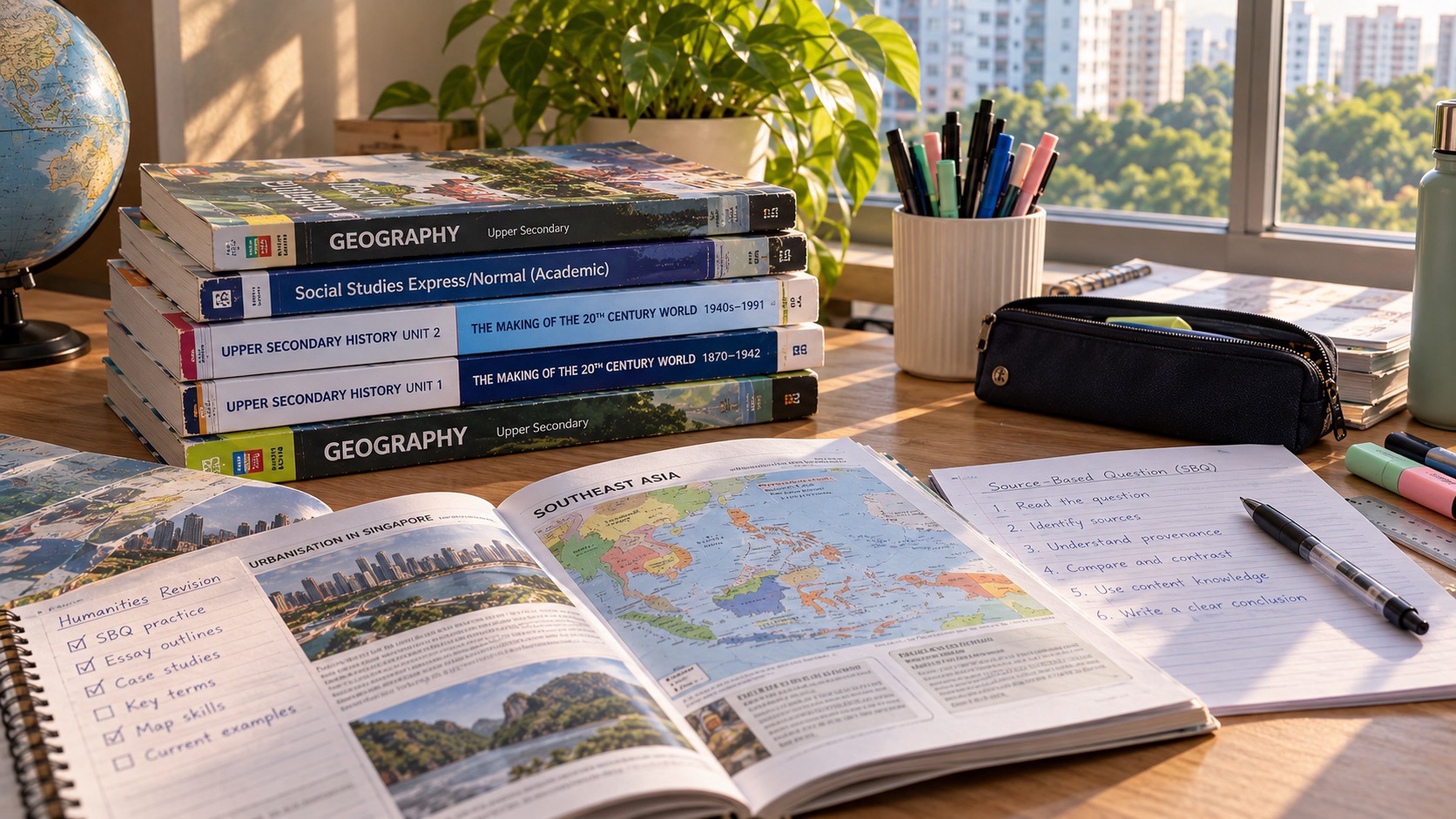
G2 Humanities (Social Studies, Geography) is syllabus K229 for the 2027 Singapore-Cambridge Secondary Education Certificate (SEC). There are two compulsory papers, each worth 50 marks and 50% of the overall subject result. Social Studies is 1 hour 45 minutes; Geography is 1 hour 45 minutes. This subject teaches students to interpret evidence and explain their ideas responsibly. It may support future learning and career interests, but taking a particular G2 subject does not guarantee entry to a course or job. Start by understanding which examination the child is actually taking and the skills required.
The immediate practical advice is to separate the two halves. A student who struggles to evaluate Social Studies sources needs a different lesson from one who struggles with Geography reasoning. Both can improve through smaller independent tasks followed by clear feedback. The official SEAB K229 syllabus is the examination authority; the worked scenarios in this guide are original teaching illustrations, not predicted examination questions.
Jump to a chapter:
The 2027 assessment format at a glance
| Feature | K229 requirement |
| Combined subject | G2 Humanities (Social Studies, Geography) |
| Paper 1 | Social Studies: 1 hour 45 minutes, 50 marks, 50% |
| Paper 1 Section A | Compulsory source-based case study, 35 marks |
| Paper 1 Section B | Two compulsory structured-response questions, 7 + 8 marks |
| Social Studies response format | Hard-copy question booklet and digital typed-answer booklet |
| Paper 2 | Geography: 1 hour 45 minutes, 50 marks, 50% |
| Paper 2 detailed format | Compulsory Question 1 in Geography in Everyday Life (25 marks); choose Question 2 on Climate (25 marks) or Question 3 on Tectonics (25 marks). An approved calculator may be used. |
| Official reference | 2027 SEAB K229 PDF |
The official 2027 G2 subject directory lists separate codes for Social Studies with Geography (K229), History (K230) and Literature in English (K231). These combinations are not interchangeable with standalone subjects. Families should confirm the school’s actual offering and the student’s subject code. The same name Geography can appear in a different SEC syllabus, with different paper rules.
What Social Studies contributes to every G2 Humanities combination
1. Social Studies: citizenship and governance
The syllabus explores citizens and government working for the good of society. Students learn that priorities, interests and the distribution of costs can differ. An explanation should identify affected groups and relevant trade-offs, not assume all people share one view. An original practice discussion could consider access and safety around a shared public space. Ask what information the participants need before making a judgement.
2. Social Studies: a diverse society
Students examine different identities, common spaces, social cohesion, stereotypes and different responses to diversity. The appropriate approach is respectful and evidence-based. A fictional school programme may have participants with different mobility needs or schedules. A fair explanation acknowledges their experiences and practical constraints without suggesting any community is inferior to another.
3. Social Studies: globalisation
Globalisation involves cross-border connections and the economic opportunities and vulnerabilities that follow. Technology, transport and multinational businesses are relevant factors. Imagine a small shop using an imported component. More choice could help production, while a disrupted supply chain might create difficulties. Do not declare globalisation universally good or bad without discussing who is affected and how.
4. Social Studies: the source-based component
The compulsory case study carries 35 marks. Students must read the sources for claims, inference, comparison, bias, reliability and relevant evidence as demanded by questions. A statement reflecting one person’s experience may be useful for a particular issue without proving what every person thinks. Ask what a source shows, what remains uncertain and what independent material might help evaluate it.
5. Social Studies: two structured responses
Section B comprises two compulsory questions worth 7 and 8 marks. One asks for a reasoned recommendation or explanation of a single cause in Singapore’s context; the other asks students to explain two factors or perspectives. Students should follow the specific wording rather than memorise one elaborate response to use everywhere. Clear explanation with relevant examples is more valuable than repetition.
6. What the digital answer booklet means
For 2027 G2 Social Studies, the syllabus describes a hard-copy question paper and a digital answer booklet in which responses are typed. Candidates should follow examination arrangements and practise typing enough to express their ideas comfortably, but typing quickly without accurate reasoning is no substitute for responding to the sources. Use the school’s authorised practice arrangements.
7. One original Social Studies case
A fictional residents’ group wants to improve a walkway used by students and older residents. Some participants propose more shade and resting places. Others ask about access for maintenance vehicles, cost and environmental impacts. A student survey reflects the views of participating pupils but not automatically the whole neighbourhood. This exercise is invented for teaching, not a report about a real public consultation.
8. How to evaluate the case fairly
Identify what each fictional source contributes and where its reach ends. A parent group may offer evidence of accessibility needs; a maintenance notice may discuss costs; a survey may indicate student preferences. Rather than choosing a favourite source blindly, ask which is useful for which question and whether more evidence is necessary. Fairness means taking relevant concerns seriously without inventing identical interests.
9. A practical improvement loop
After writing an answer, compare it with the question’s command word and the cited evidence. Was the claim directly supported or only plausible? Is one stakeholder treated as representative of everyone? If a paragraph is unclear, repair a specific sentence and then answer a related but different question. The goal is evidence-based reasoning that transfers to new issues.
What Geography contributes to this particular course
Students learn how neighbourhoods work, geographical methods, sustainable development, weather and climate, climate change and action, plate tectonics, earthquakes, volcanoes and disaster risk. Paper 2 begins with a compulsory everyday-geography question and offers the choice between Climate and Tectonics. The subject brings scientific evidence and human decision-making together.
1. Everyday geography
Geography explores relationships between people, places and nature. A neighbourhood is an environment with social and physical features, not just a location on a map. Students should identify whose needs are involved and what the physical features can actually explain.
2. Sustainability in a built-up neighbourhood
Urban spaces offer choices between recreation, movement, conservation and infrastructure. Compare environmental, social and economic considerations without promising a perfectly cost-free solution.
3. Ecosystem services
Trees, ponds and parks may contribute shade, flood mitigation, recreation or habitat. The precise contribution depends on context; do not invent numerical benefits without observations or credible research.
4. Geographical methods
Ask an answerable question, define a study area, choose a sampling method and plan what to measure. A convenient sample may be useful but is not automatically representative.
5. Graphs and maps
Choose bars for category comparisons, lines for ordered time patterns and scatter plots for possible associations. Label axes, scale, orientation and data sources where relevant.
6. Weather and climate
A hot or wet day describes short-term conditions; climate uses longer-term patterns. A classroom fieldwork result should not be presented as proof of global warming.
7. Climate change
Connect physical drivers and natural changes to impacts on people without assuming every region or community experiences the same risk.
8. Climate action
Separate mitigation from adaptation and consider who benefits, what resources are required and how a measure’s effects might be evaluated.
9. Plate tectonics
Use plate movements and boundary diagrams to explain the geographical distribution of many earthquakes and volcanoes, without claiming every hazard occurs in one identical way.
10. Disaster risk management
Distinguish physical hazard from exposure, vulnerability and preparedness. Risk reduction can help while rarely eliminating uncertainty completely.
The actual Geography Paper 2 examination
Compulsory Question 1 in Geography in Everyday Life (25 marks); choose Question 2 on Climate (25 marks) or Question 3 on Tectonics (25 marks). An approved calculator may be used.
The published duration is 1 hour 45 minutes and the weighting is 50%. Revision should follow the real K229 requirements rather than importing an older syllabus or a G3 question. Practise accurate untimed responses before adding full examination time constraints. A confident candidate knows what must be answered and what can be chosen, where the format offers choices.
Original worked example: a school neighbourhood with two walking paths, one partly shaded by trees and one exposed to the sun
Here is a fictional teaching scenario concerning a school neighbourhood with two walking paths, one partly shaded by trees and one exposed to the sun. It can help students practise shade, local comfort, access and the limits of a one-day observation. It is not a source from an actual examination or a claim that a specific topic will appear in 2027. The first task is to describe the issue precisely enough to ask an answerable question. Then identify what evidence or textual details would be needed to justify a conclusion.
In a hypothetical fieldwork task, students inspect two safe walking routes at similar times. Route A has shade at four of five selected points; route B has shade at two of five. That means 80% and 40% of sampled points have shade, not necessarily 80% and 40% of each entire route’s length. A student must describe the sampling method and avoid pretending a one-day shade comparison proves a long-term climate change trend.
Consider a suitable bar chart for the observed proportions and label both axes. Then discuss how time of day, weather, route length and selection of points might affect interpretation. A useful recommendation can consider shade, maintenance and pedestrian access rather than declaring one route universally superior. This links geographical methods with careful decision-making.
A simple eight-week reading and revision plan
This is a teaching suggestion, not an official timetable. Use manageable independent tasks, compare answers with the stated demand and correct one specific error before repeating in a fresh context.
- Week 1: Confirm K229 and diagnose one Social Studies source question and one Geography question.
- Week 2: Study citizenship and governance and practise a seven-mark-style reasoned explanation.
- Week 3: Study diversity and try an eight-mark-style two-factor response with clear distinctions.
- Week 4: Study globalisation and evaluate two sources for their claims, perspective and limits.
- Week 5: Review two distinct Geography topics or skills from the official syllabus.
- Week 6: Complete a shorter timed source or text/data question and record the specific cause of each error.
- Week 7: Attempt another original Geography problem in a changed setting without looking at a model.
- Week 8: Practise selecting or completing the correct Paper 2 sections, then review the remaining gaps.
Questions families often ask
Are both halves compulsory?
Yes. Social Studies and Geography each carry 50% and are both part of the published K229 syllabus.
Does the second paper last as long as Social Studies?
Not necessarily. Social Studies lasts 1 hour 45 minutes; the published Geography paper lasts 1 hour 45 minutes.
Are all G2 Humanities syllabuses identical?
No. K229, K230 and K231 have different Paper 2 disciplines and specific requirements.
Is Social Studies a typed examination?
The syllabus specifies a hard-copy question paper and a digital answer booklet for typed responses. Follow school e-examination practice instructions.
How can a student improve without memorising model essays?
Use a small diagnostic, review evidence and explanation, correct one error and attempt a fresh problem independently.
Does this subject guarantee a post-secondary place?
No. Future routes have published programme-specific rules and depend on the student’s overall results and other eligibility criteria.
What if a school does not offer this combination?
Confirm actual school subject offerings and combinations. A national syllabus listing does not guarantee a class or entry at every school.
Is tuition essential?
No. It may be useful for an identified learning gap, but first review teacher feedback and the student’s actual understanding.
What is the best starting point for a parent?
Ask the child to explain the paper structure and demonstrate one independent answer with accurate supporting evidence.
Can a G2 result be combined with subjects at other levels?
The SEC records subject-level results, with further routes governed by current formal admissions requirements. Ask the school about the student’s own profile.
Future learning and work: an optimistic, accurate perspective
Interests in Geography can connect with education, communication, research and other fields in which thoughtful reading and evidence matter. This does not automatically qualify a candidate for professional work. Students can also keep unrelated interests in science, mathematics, technology or the arts. The practical next step is to examine the actual courses that appeal to the learner and identify their entry requirements.
From the first 2027 SEC cohort, post-secondary applications are affected by the 2028 arrangements. Entry criteria can differ by programme and institution. Use current MOE and institutional guidance, not a general claim that one particular G2 Humanities subject either opens every door or closes them all.
Skills clinic 1: A local shade survey
Shade can vary within a single walking route and with the time of day. The central learning task is to distinguish the subject concept from a convenient phrase memorised for a familiar worksheet. Explain the relationship or mechanism in ordinary language before giving a polished examination answer. A strong response stays within the syllabus, uses relevant evidence and tells the reader why the selected information matters.
Original practice: Compare five safe observation points on two routes at matching times, counting shaded points rather than guessing entire route coverage. Begin with a narrowly defined question and ask what facts can be established from the given setting. Identify which additional observation, passage detail or historical source would be useful. Then write a concise explanation using the concepts from Geography rather than relying on assumptions about the wider world.
Check the limit: Five chosen points cannot establish the percentage of a route’s total length that is shaded. After the first attempt, change a relevant detail of the example and ask the learner to answer independently. This reveals whether the underlying idea transfers. The repair is complete only when the student can explain the corrected reasoning in a fresh context.
Skills clinic 2: Describing urban microclimates
Built structures, vegetation and surfaces can affect local conditions. In Geography, recognising a term is only the beginning. The student must know when and why it applies. Work from an accessible example towards more demanding material, and distinguish what has been directly observed from what needs interpretation. Relevant evidence should be proportionate to the claim made.
Try this independent task: Sketch a possible study of shaded and unshaded spaces, noting measurement conditions and uncertainties. First state what the question asks, then organise the useful facts or textual information. Write a short account connecting the starting situation to the resulting decision or process. If several factors are involved, explain their different roles instead of producing an unstructured list.
Common misunderstanding: A local weather observation does not establish a decades-long climate trend. Mark the precise step where reasoning becomes unsupported. Correct it using a fresh piece of evidence, and repeat a smaller version a few days later. This is more useful than copying an entire model answer with no understanding.
Skills clinic 3: Sampling users fairly
Convenience, quota, simple random and stratified sampling create different kinds of coverage. A reliable student should be able to teach the idea back without reading a definition from the page. Begin with a short explanation that includes the necessary conditions, then show why those conditions matter in a particular example. This helps the skill survive when the actual question uses unfamiliar wording.
Applied example: Plan how a neighbourhood survey could reach both school-age and older users of a shared path. Invite the learner to identify one relevant comparison or cause-and-effect relationship. If a conclusion depends on an assumption, name it. Where the information is incomplete, use cautious language rather than inventing facts merely to sound certain. That is an important habit in Geography.
Before moving on, remember: A large group of classmates alone may not represent everyone who uses the space. The next exercise should alter the task or source while preserving the underlying principle. A candidate who can repeat the method correctly on changed material is showing more durable improvement than one who has memorised a single response.
Skills clinic 4: Quantitative and qualitative methods
Counts and percentages can answer different questions from interviews and mental maps. The central learning task is to distinguish the subject concept from a convenient phrase memorised for a familiar worksheet. Explain the relationship or mechanism in ordinary language before giving a polished examination answer. A strong response stays within the syllabus, uses relevant evidence and tells the reader why the selected information matters.
Original practice: Write one question about how many people use a path and another about why they choose it. Begin with a narrowly defined question and ask what facts can be established from the given setting. Identify which additional observation, passage detail or historical source would be useful. Then write a concise explanation using the concepts from Geography rather than relying on assumptions about the wider world.
Check the limit: An individual interview cannot show the prevalence of a view across an entire estate. After the first attempt, change a relevant detail of the example and ask the learner to answer independently. This reveals whether the underlying idea transfers. The repair is complete only when the student can explain the corrected reasoning in a fresh context.
Skills clinic 5: Graph selection
Bar, line and scatter displays communicate different relationships. In Geography, recognising a term is only the beginning. The student must know when and why it applies. Work from an accessible example towards more demanding material, and distinguish what has been directly observed from what needs interpretation. Relevant evidence should be proportionate to the claim made.
Try this independent task: Use bars for selected route categories and a line chart for readings across ordered times. First state what the question asks, then organise the useful facts or textual information. Write a short account connecting the starting situation to the resulting decision or process. If several factors are involved, explain their different roles instead of producing an unstructured list.
Common misunderstanding: A visually attractive chart without clear axes or units is not a reliable explanation. Mark the precise step where reasoning becomes unsupported. Correct it using a fresh piece of evidence, and repeat a smaller version a few days later. This is more useful than copying an entire model answer with no understanding.
Skills clinic 6: Correlation and causation
An observed association between shade and comfort may involve other conditions. A reliable student should be able to teach the idea back without reading a definition from the page. Begin with a short explanation that includes the necessary conditions, then show why those conditions matter in a particular example. This helps the skill survive when the actual question uses unfamiliar wording.
Applied example: List other variables, such as breeze, humidity, traffic noise and participant selection. Invite the learner to identify one relevant comparison or cause-and-effect relationship. If a conclusion depends on an assumption, name it. Where the information is incomplete, use cautious language rather than inventing facts merely to sound certain. That is an important habit in Geography.
Before moving on, remember: A scatter-plot trend does not isolate one cause by itself. The next exercise should alter the task or source while preserving the underlying principle. A candidate who can repeat the method correctly on changed material is showing more durable improvement than one who has memorised a single response.
Skills clinic 7: Ecosystem services
Urban greenery may deliver regulating, provisioning, cultural and supporting services. The central learning task is to distinguish the subject concept from a convenient phrase memorised for a familiar worksheet. Explain the relationship or mechanism in ordinary language before giving a polished examination answer. A strong response stays within the syllabus, uses relevant evidence and tells the reader why the selected information matters.
Original practice: Compare a tree’s observed shade with less directly measurable effects on ecological functions. Begin with a narrowly defined question and ask what facts can be established from the given setting. Identify which additional observation, passage detail or historical source would be useful. Then write a concise explanation using the concepts from Geography rather than relying on assumptions about the wider world.
Check the limit: Do not invent precise pollution-removal numbers from one photograph. After the first attempt, change a relevant detail of the example and ask the learner to answer independently. This reveals whether the underlying idea transfers. The repair is complete only when the student can explain the corrected reasoning in a fresh context.
Skills clinic 8: Urban sustainability
Social, economic and environmental objectives may compete within the same space. In Geography, recognising a term is only the beginning. The student must know when and why it applies. Work from an accessible example towards more demanding material, and distinguish what has been directly observed from what needs interpretation. Relevant evidence should be proportionate to the claim made.
Try this independent task: Evaluate a community garden proposal against pedestrian access, upkeep and ecological value. First state what the question asks, then organise the useful facts or textual information. Write a short account connecting the starting situation to the resulting decision or process. If several factors are involved, explain their different roles instead of producing an unstructured list.
Common misunderstanding: A proposal can have benefits and genuine constraints at the same time. Mark the precise step where reasoning becomes unsupported. Correct it using a fresh piece of evidence, and repeat a smaller version a few days later. This is more useful than copying an entire model answer with no understanding.
Skills clinic 9: Fire, traffic and air pollution hazards
An urban hazard must be understood through its possible consequences and exposure. A reliable student should be able to teach the idea back without reading a definition from the page. Begin with a short explanation that includes the necessary conditions, then show why those conditions matter in a particular example. This helps the skill survive when the actual question uses unfamiliar wording.
Applied example: Describe a safe fictional route audit without requiring students to enter hazardous locations. Invite the learner to identify one relevant comparison or cause-and-effect relationship. If a conclusion depends on an assumption, name it. Where the information is incomplete, use cautious language rather than inventing facts merely to sound certain. That is an important habit in Geography.
Before moving on, remember: A risk assessment is not proof an accident will occur. The next exercise should alter the task or source while preserving the underlying principle. A candidate who can repeat the method correctly on changed material is showing more durable improvement than one who has memorised a single response.
Skills clinic 10: Weather compared with climate
Weather concerns present conditions; climate refers to longer-term patterns. The central learning task is to distinguish the subject concept from a convenient phrase memorised for a familiar worksheet. Explain the relationship or mechanism in ordinary language before giving a polished examination answer. A strong response stays within the syllabus, uses relevant evidence and tells the reader why the selected information matters.
Original practice: Contrast one afternoon’s temperature with the evidence required for a multi-decade trend. Begin with a narrowly defined question and ask what facts can be established from the given setting. Identify which additional observation, passage detail or historical source would be useful. Then write a concise explanation using the concepts from Geography rather than relying on assumptions about the wider world.
Check the limit: One unusually hot or wet day cannot establish an entire climate pattern. After the first attempt, change a relevant detail of the example and ask the learner to answer independently. This reveals whether the underlying idea transfers. The repair is complete only when the student can explain the corrected reasoning in a fresh context.
Skills clinic 11: Climate impacts on people
Physical changes interact with local resources, geography and exposure. In Geography, recognising a term is only the beginning. The student must know when and why it applies. Work from an accessible example towards more demanding material, and distinguish what has been directly observed from what needs interpretation. Relevant evidence should be proportionate to the claim made.
Try this independent task: Compare hypothetical coastal and inland communities with different vulnerabilities. First state what the question asks, then organise the useful facts or textual information. Write a short account connecting the starting situation to the resulting decision or process. If several factors are involved, explain their different roles instead of producing an unstructured list.
Common misunderstanding: Not all communities face the same consequences or capacity to respond. Mark the precise step where reasoning becomes unsupported. Correct it using a fresh piece of evidence, and repeat a smaller version a few days later. This is more useful than copying an entire model answer with no understanding.
Skills clinic 12: Adaptation and mitigation
Climate adaptation reduces exposure; mitigation targets contributors to change. A reliable student should be able to teach the idea back without reading a definition from the page. Begin with a short explanation that includes the necessary conditions, then show why those conditions matter in a particular example. This helps the skill survive when the actual question uses unfamiliar wording.
Applied example: Compare shaded waiting areas with energy-efficiency measures and name the intended outcomes. Invite the learner to identify one relevant comparison or cause-and-effect relationship. If a conclusion depends on an assumption, name it. Where the information is incomplete, use cautious language rather than inventing facts merely to sound certain. That is an important habit in Geography.
Before moving on, remember: A project may serve several aims, but those effects should be explained rather than assumed. The next exercise should alter the task or source while preserving the underlying principle. A candidate who can repeat the method correctly on changed material is showing more durable improvement than one who has memorised a single response.
Skills clinic 13: Plate movement
Convergent, divergent and transform boundaries involve different motion. The central learning task is to distinguish the subject concept from a convenient phrase memorised for a familiar worksheet. Explain the relationship or mechanism in ordinary language before giving a polished examination answer. A strong response stays within the syllabus, uses relevant evidence and tells the reader why the selected information matters.
Original practice: Interpret arrows in three simplified plate cross-sections before naming processes. Begin with a narrowly defined question and ask what facts can be established from the given setting. Identify which additional observation, passage detail or historical source would be useful. Then write a concise explanation using the concepts from Geography rather than relying on assumptions about the wider world.
Check the limit: A diagram is a simplified model of real geology. After the first attempt, change a relevant detail of the example and ask the learner to answer independently. This reveals whether the underlying idea transfers. The repair is complete only when the student can explain the corrected reasoning in a fresh context.
Skills clinic 14: Earthquakes and volcanoes
Tectonic processes help explain many natural hazards and landforms. In Geography, recognising a term is only the beginning. The student must know when and why it applies. Work from an accessible example towards more demanding material, and distinguish what has been directly observed from what needs interpretation. Relevant evidence should be proportionate to the claim made.
Try this independent task: Connect a boundary type to a plausible phenomenon while acknowledging variation. First state what the question asks, then organise the useful facts or textual information. Write a short account connecting the starting situation to the resulting decision or process. If several factors are involved, explain their different roles instead of producing an unstructured list.
Common misunderstanding: Not every earthquake occurs in an identical tectonic setting. Mark the precise step where reasoning becomes unsupported. Correct it using a fresh piece of evidence, and repeat a smaller version a few days later. This is more useful than copying an entire model answer with no understanding.
Skills clinic 15: Disaster risk management
Hazard, exposure, vulnerability and response capacity shape outcomes. A reliable student should be able to teach the idea back without reading a definition from the page. Begin with a short explanation that includes the necessary conditions, then show why those conditions matter in a particular example. This helps the skill survive when the actual question uses unfamiliar wording.
Applied example: Compare two fictional towns with different preparedness and access routes. Invite the learner to identify one relevant comparison or cause-and-effect relationship. If a conclusion depends on an assumption, name it. Where the information is incomplete, use cautious language rather than inventing facts merely to sound certain. That is an important habit in Geography.
Before moving on, remember: Preparedness can reduce risks without eliminating all danger. The next exercise should alter the task or source while preserving the underlying principle. A candidate who can repeat the method correctly on changed material is showing more durable improvement than one who has memorised a single response.
Skills clinic 16: Mandatory geography question
The everyday-geography 25-mark Question 1 is compulsory in K229. The central learning task is to distinguish the subject concept from a convenient phrase memorised for a familiar worksheet. Explain the relationship or mechanism in ordinary language before giving a polished examination answer. A strong response stays within the syllabus, uses relevant evidence and tells the reader why the selected information matters.
Original practice: Prepare examples of maps, sustainability reasoning and data collection before optional revision. Begin with a narrowly defined question and ask what facts can be established from the given setting. Identify which additional observation, passage detail or historical source would be useful. Then write a concise explanation using the concepts from Geography rather than relying on assumptions about the wider world.
Check the limit: Skipping the compulsory half of the Geography paper creates an avoidable weakness. After the first attempt, change a relevant detail of the example and ask the learner to answer independently. This reveals whether the underlying idea transfers. The repair is complete only when the student can explain the corrected reasoning in a fresh context.
Skills clinic 17: Climate or Tectonics choice
K229 Section B gives a 25-mark choice, with a six-mark judgement task. In Geography, recognising a term is only the beginning. The student must know when and why it applies. Work from an accessible example towards more demanding material, and distinguish what has been directly observed from what needs interpretation. Relevant evidence should be proportionate to the claim made.
Try this independent task: Practise assessing both options before deciding which is best answerable. First state what the question asks, then organise the useful facts or textual information. Write a short account connecting the starting situation to the resulting decision or process. If several factors are involved, explain their different roles instead of producing an unstructured list.
Common misunderstanding: Choosing only by the chapter title ignores the actual data and evaluation demands. Mark the precise step where reasoning becomes unsupported. Correct it using a fresh piece of evidence, and repeat a smaller version a few days later. This is more useful than copying an entire model answer with no understanding.
Skills clinic 18: Environmental pathways
Fieldwork and evidence-based reasoning may support later environmental or spatial studies. A reliable student should be able to teach the idea back without reading a definition from the page. Begin with a short explanation that includes the necessary conditions, then show why those conditions matter in a particular example. This helps the skill survive when the actual question uses unfamiliar wording.
Applied example: Compare official course syllabuses, entry requirements and actual work tasks. Invite the learner to identify one relevant comparison or cause-and-effect relationship. If a conclusion depends on an assumption, name it. Where the information is incomplete, use cautious language rather than inventing facts merely to sound certain. That is an important habit in Geography.
Before moving on, remember: A G2 Geography result alone does not qualify a student for a technical profession. The next exercise should alter the task or source while preserving the underlying principle. A candidate who can repeat the method correctly on changed material is showing more durable improvement than one who has memorised a single response.
A parent and teacher discussion for the next assessment
Ask the student to show one independent answer from each compulsory paper. For Social Studies, identify the claim, supporting source and any limitation. For Geography, identify the discipline-specific method used and the stage that still needs teaching. Set one practical goal, arrange a reasonable opportunity to attempt a new question and compare the result with the starting point. This avoids treating every difficulty as a motivation problem or every improvement as merely a longer answer.
A helpful conversation recognises that future routes depend on the full set of subjects and the actual entry requirements of programmes available after the SEC. No student should be promised a particular occupation or admission based on a single syllabus. Focus on informed subject choice, steady progress and making room for genuine interests that may change during the secondary years.
First-principles progress for G2 Humanities (Social Studies, Geography)
A first-principles method corrects the first uncertain reasoning step rather than assigning more of the same tasks. In K229, Give one short Social Studies source describing a resident’s preference and one simple Geography graph about a neighbourhood. Ask what each piece of evidence can establish. The first may reveal a viewpoint, while the second reports a measured pattern under a sampling method. A student who treats them as identical evidence needs help with methods, not more memorised conclusions.
The Fencing Method: keep interpretations within evidence
The Fencing Method distinguishes what a source asserts from what it proves and what a sample measures from a claim about every resident. K229 also requires recognising that the compulsory Geography in Everyday Life question and the Climate-or-Tectonics choice ask different kinds of preparation.
Imagine a fictional resident saying a shaded route is always preferred, while a small fieldwork table records shade at four of five selected points. The table establishes 80% shade in that point sample, not preference for all walkers or shade along 80% of the route’s total length. The two sources may inform a recommendation but neither alone settles it.
Three learning routes: repair, stabilise, extend
- Repair: Repair source claim versus inference and map/graph interpretation in short separate tasks. Teach the compulsory everyday-geography concepts before moving to the paper choice.
- Stabilise: Maintain both 50% halves. Practise Social Studies source comparison, a structured two-factor response and geographical explanations supported by maps, variables and data.
- Extend: Compare stakeholder evidence with a feasible geographical investigation, then judge a climate or tectonic-risk response by its mechanism, trade-offs and actual limitations.
A focused ninety-minute teaching sequence
Ten minutes of topic retrieval, fifteen of evidence explanation, twenty of guided social-source and geographic-data work, twenty of independent comparison, fifteen of timed decision-making and ten of error review.
The goal is a new answer justified independently. This example demonstrates how a focused lesson might be organised, not a promise about class availability or examination outcomes.
What parents and students should bring to a consultation
Bring a Social Studies source case study and one Geography data/judgement response. Ask whether the difficulty lies in provenance, sampling, the physical process or evaluated conclusion. The actual subject is K229, not standalone Geography K226.
For Social Studies–Geography, test interpretation of a stakeholder source and of a fieldwork graph separately. One reports a viewpoint, the other represents observations under specified conditions; neither automatically proves a universal conclusion. For a more detailed explanation of diagnosis, first principles and independent learning, see eduKate’s approach to learning. SEAB and school documents determine the actual subject and assessment requirements.
Practise the actual question skills in K229
Different weaknesses require different teaching. The compulsory Social Studies source case study asks students to compare evidence and justify a judgement. The Geography elective also tests an Everyday Geography question involving maps, fieldwork methods and sustainable development. Use the focused learning tasks below to practise the part that is actually causing difficulty.
- Ten-mark Social Studies Question 5: evidence from multiple sources
- Compulsory G2 Geography Question 1: Everyday Geography and fieldwork methods
Official sources and connected eduKate articles
- Official SEAB K229 2027 syllabus
- SEAB 2027 G2 syllabus list
- SEC official overview
- What G2 means in SEC
- G2 Geography earlier guide
- G2 and G3 Social Studies comparison
- Choosing Secondary 3 subjects
- Full SBB and 2028 pathway roadmap
- eduKate’s approach to learning
- G2 History K230 companion guide
- G2 Literature in English K231 companion guide
Source note: Official examinations and syllabus content above follow the 2027 K229 document. Fictional worked situations, practice plans and pathway examples are independent educational explanations, not leaked or predicted questions.
Continue exploring eduKate’s 2027 SEC syllabus guides: 2027 SEC G1/G2/G3 all-subject syllabus directory. Confirm the student’s actual registered code before choosing learning materials or checking future course eligibility.