
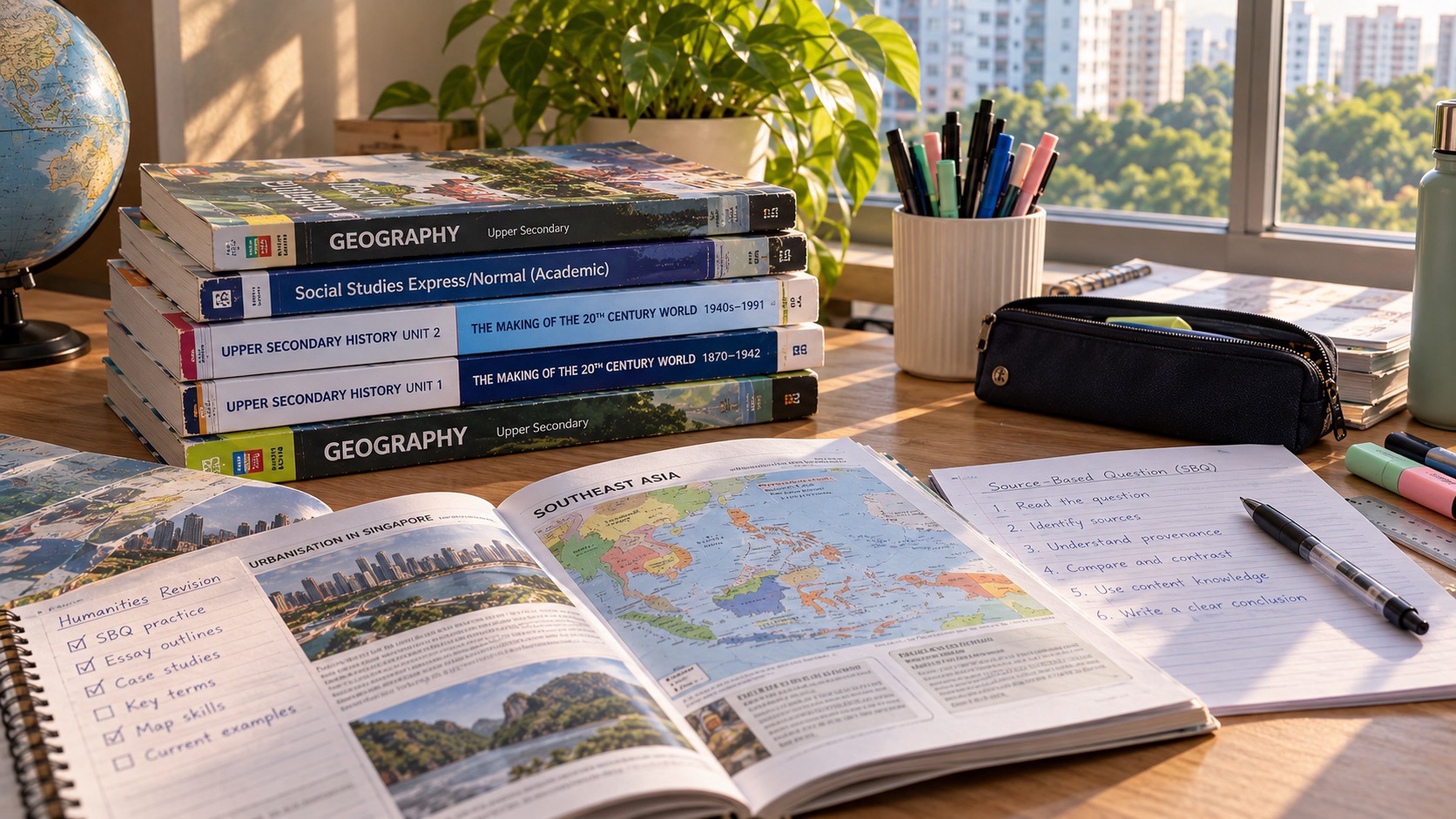
Did you know two routes through the same Singapore neighbourhood may feel different even when their distances look similar on a map? One might have shade and safe crossings; the other could be shorter but more exposed to afternoon heat. The interesting geographical question is not simply ‘which route is shorter?’ but ‘which observations help us understand why people experience these places differently?’
For parents searching ‘PG1 Geography’, there is a crucial distinction. Posting Group 1 (PG1) is the Secondary 1 admission grouping. G1 Geography learning happens as an exposure module within MOE’s lower-secondary G1 Humanities programme. It is not a standalone 2027 Singapore-Cambridge SEC G1 Geography examination.
Here is what Geography exposure teaches, how students can get better at maps and reasoning, what higher-level examined Geography subjects actually exist, and which qualification checkpoints govern ITE, polytechnic, JC/MI and eventual university pathways.
This parent–student guide uses official MOE and SEAB information reviewed on 24 October 2026. Check the student’s actual school provision, future examination year and admission intake before making a subject-selection decision.
The 60-second answer
- PG1 refers to Secondary 1 admission; it does not automatically decide the G-level of every future subject.
- Lower-secondary G1 Humanities includes Social Studies and Humanities Exposure Modules in Geography, History and Literature in English.
- 2027 SEC G1 does not include a standalone national Geography paper or subject code.
- In the 2027 SEC, G2 standalone Geography is K226 and G3 standalone Geography is K329.
- The 2027 combined subjects are G2 Humanities (Social Studies, Geography) K229 and G3 Humanities (Social Studies, Geography) K335.
- Future routes depend on actual subject-level results, full qualifications and the specific destination’s admissions criteria, not on the original Posting Group.
First, PG1 is not the same as a G1 Geography SEC paper
Under Full Subject-Based Banding, students are posted to secondary school through a Posting Group. Subjects may be taken at General 1, General 2 or General 3 where the learner is eligible and the school offers them. The posting group is therefore a starting arrangement, not an academic destiny.
MOE’s lower-secondary G1 Humanities syllabus combines Social Studies with shorter Humanities Exposure Modules (HEMs) in Geography, History and Literature in English. These give a learner opportunities to examine everyday places, changes over time and people’s experiences before deciding which areas to explore more deeply.
G1 Humanities is non-examinable at national Singapore-Cambridge SEC level. Teachers can still assess and give feedback on pupil work through appropriate school-based tasks and classroom activities. Parents should not search for a fictitious 2027 ‘SEC G1 Geography Paper 1’.
From Secondary 2, some learners may qualify to offer more demanding Humanities subjects such as G2 Geography. The school’s aptitude and interest criteria and current subject provision matter. Success in one exposure activity does not guarantee a level change.
The 2027 SEC lists named G2 and G3 Geography pathways; the specific subject name, K-code and examination requirements need to be confirmed. Standalone Geography and Social Studies–Geography combined Humanities are not interchangeable.
What Geography really helps a learner notice
Geography examines the relationships between people, places and environments. Even a familiar neighbourhood can raise useful questions. Why does one public space have trees and another mainly paved surfaces? Why are some facilities located near transport interchanges? How might different users experience the same route?
Young learners should become comfortable describing what they can actually see. A map shows location and scale, not automatically the reasons that an authority selected a site. A photograph shows a particular view at a particular time, not every condition a neighbourhood experiences across a year.
Weather, surface features, land use, transport and people’s needs may interact. But the right explanation relies on evidence. A student must be able to say ‘the data suggest’ when the data support a possibility and ‘we need to check’ when information is missing.
Geography uses numeracy too. A rainfall graph labelled in millimetres and a temperature graph labelled in degrees Celsius answer different questions. A map’s scale affects distance estimates, and a change between two photographs may reflect camera angle rather than true environmental change.
A learner who builds these habits can later make more reasoned choices about environment, sustainability, human movement and planning, whether or not they eventually sit a national Geography examination.
Eight practical geography skills
- Read a basic map using its title, legend, direction and scale.
- Identify natural and human-made features in a familiar environment.
- Distinguish a geographic observation from a possible explanation.
- Read a labelled table or graph, checking units before comparing values.
- Ask where a pattern occurs and whether the available evidence covers the whole area.
- Consider how different people experience or use the same place.
- Recognise that one photograph or anecdote cannot establish a lasting trend.
- Explain a conclusion with evidence, an appropriate limitation and one follow-up question.
Did you know? A worked example using two walking routes
Imagine an invented school activity about two routes between a library and a bus stop. Route A is shorter but has little shade at the time students normally walk. Route B is longer and passes under trees and a sheltered linkway. This is an illustrative comparison, not a claim about any actual location.
Start by drawing a map with a clear starting point, destination, legend and route labels. Ask the learner to identify what ‘better’ could mean. Less walking time, greater comfort, safer crossings and accessibility are not identical objectives.
Next list what could be checked safely: approximate distance, whether paths remain continuous, where road crossings occur and whether the route is shaded at the relevant time. A noon photograph does not necessarily show conditions at 4 pm.
Now ask about users. A person carrying heavy bags may prefer the shorter route. A parent walking with a young child may put more weight on safe crossings. Someone sensitive to heat may value shelter. The purpose is not to guess which group is ‘right’, but to connect a choice to stated needs.
A stronger response says: ‘Route B may offer a more sheltered walk at the observed time, but it is longer and we should check crossing safety and accessibility.’ A weaker response merely says ‘Route B has more trees, so it is always best.’
Extend the task by removing the model answer and changing the destination or the time of day. Can the child still identify conditions and constraints independently? That transfer is a more useful indicator of understanding than memorising one diagram.
How G1 Geography exposure differs from 2027 G2 and G3 examinations
G1 Geography is part of the Humanities Exposure Modules, a non-examinable component of lower-secondary G1 Humanities. School tasks introduce important geographic questions without the full content and assessment demands of a national Geography examination.
By contrast, the official 2027 SEAB G2 school-candidate list names standalone Geography K226 and Humanities (Social Studies, Geography) K229. The G3 list names Geography K329 and Humanities (Social Studies, Geography) K335.
At G2 or G3, the actual examination format and syllabus content depend on whether a learner takes a standalone Geography subject or an eligible combined Humanities course. The family’s first check should be the correct title and K-code, followed by the named syllabus and the school’s current subject combination.
Changing to a more demanding Geography subject level requires school decisions based on its published criteria, the pupil’s evidence of readiness and subject availability. MOE’s Full SBB provision is designed to allow eligible subject flexibility, not to turn every positive G1 result into an automatic G2 offer.
A student may enjoy observing natural and built environments without choosing upper-secondary Geography. The exposure still has educational value; the next course needs to fit interests, strengths and real formal requirements.
Six common gaps and practical repairs
- A pupil describes a photograph but never explains place or spatial pattern. Repair: ask ‘where, compared with what, and why might it matter?’
- A student claims all flooding is caused by heavy rain alone. Repair: discuss what evidence about land surface, drainage and local rainfall would be needed.
- A child compares numbers with different units or dates. Repair: label every value and standardise where appropriate.
- A map symbol is ignored or interpreted as an object it does not represent. Repair: read the legend aloud before answering.
- The student produces a generic sustainability slogan with no local evidence. Repair: identify one real trade-off and the people or environment affected.
- A parent assumes G1 Geography is a national SEC paper. Repair: use the MOE G1 Humanities curriculum for present learning and the SEAB G2/G3 directories for any later examined route.
An independent learning routine that does not rely on worksheets alone
Begin with one ordinary setting that the student can picture, such as a school entrance, park, shopping street or sheltered walkway. Ask for a factual description before a causal theory.
Introduce one geographic tool at a time: a sketch map, a simple table or a graph. Model how to read its title, units and limits. Then offer a new example in which the same tool works differently.
Separate claims into observation, inference and information still needed. Encourage the child to say when a conclusion cannot yet be established. That is a sign of careful thinking, not an incomplete answer.
Use spaced review: revisit the same idea after a day or two with a changed location. Reduce adult hints until the pupil can explain the reasoning independently.
Record the first uncertain step rather than assigning broad labels about ability. Is the difficulty a map legend, vocabulary, units, identifying a pattern or writing a justified conclusion? Fix that specific link.
From Secondary 1 to Secondary 4
- Secondary 1: practise describing places, reading basic maps and recognising human–environment relationships.
- Secondary 2: develop comparisons between places, evidence-based explanation and self-checking; ask the school about any eligible higher-level Humanities offering.
- Secondary 3: if Geography is offered at G2 or G3, begin work on the exact syllabus, content and assessment skills for the selected standalone or combined subject.
- Secondary 4: prepare from the relevant SEAB examination-year code and map the full subject-level results to the next post-secondary application.
Education pathway: ITE, Polytechnic, JC and University
Did you know a later university ambition and direct entry to a particular diploma after SEC are different questions? The pupil’s route is governed by formal qualifications at each stage, not by one early Geography lesson or by the word PG1.
MOE has announced the Post-Secondary Admissions Exercise from 2028 for the main results-based routes to eligible ITE, polytechnic and JC/MI programmes. Eligibility differs across destinations and courses. Older stream-based assumptions should not be copied directly into a new SEC plan.
1. ITE Higher Nitec and practical progression
Geographic thinking can be useful when exploring practical interests such as travel, the built environment, logistics, environment-related services or facility operations. Actual Higher Nitec course admission depends on the complete recognised SEC results, programme rules and vacancies.
A student with a qualifying ITE programme may later seek relevant diploma progression if they meet the destination’s academic criteria. The school-based G1 Geography exposure module is not itself an admission credential.
2. Polytechnic diploma: direct and later progression
Potentially related polytechnic interests include tourism, environmental studies, design, transport, planning-related fields or business. Specific programmes can have important English, Mathematics or Science prerequisites unrelated to whether the child likes Geography.
Direct diploma eligibility requires the relevant G2/G3 SEC results and course requirements under the actual intake rules. Another route can be a recognised Higher Nitec qualification followed by eligible diploma progression. Neither is guaranteed by PG1 status.
3. Junior College and Millennia Institute
The announced 2028 JC L1R4 framework requires qualifying G3 subject-level results. The student must meet the actual aggregate and other entry conditions; a G1 Humanities Exposure Module has no standalone national examination grade to substitute for those requirements.
At the same time, the Secondary 1 PG1 label is not a lifelong bar. Families should speak with the school about evidence-based subject-level progression if pre-university study is an appropriate longer-term goal.
4. University: a later qualification checkpoint
Degrees connected to geography, environmental studies, urban planning, social sciences or other fields may become possible after appropriate qualifying diplomas or pre-university study. The receiving institution will decide on prerequisites and admission selection.
The sensible current target is to help the child describe, compare and reason independently. A university ambition can guide choices, but it is not a promise attached to any single G1 classroom experience.
A realistic one-week PG1 Geography learning plan
- Monday: make a sketch map of an imaginary school area, including a simple legend.
- Tuesday: label three physical and three human-made features in a safely observed familiar place.
- Wednesday: read a short climate or travel chart and explain one pattern using the proper units.
- Thursday: compare two hypothetical walking routes and identify a meaningful trade-off.
- Friday: study a photograph and separate what is visible from what is assumed.
- Weekend: explain a different place-based problem without notes using where, why, evidence and limitation.
What parents should track
Use four columns: task attempted, first uncertain decision, correction the student made and date for the next independent check. One precise note is better than saying a child is ‘bad at Geography’.
After a month, ask the pupil to explain a changed example without prompting. If the family is considering a more demanding Humanities offering, seek the school’s advice about the child’s actual progress, eligibility and available subject combinations.
Frequently asked questions
Is there a 2027 SEC G1 Geography examination?
No. At G1 the lower-secondary exposure module is part of school-based Humanities, not a standalone SEC G1 paper.
What does a G1 student learn in Geography?
Students explore people, places, everyday geographical phenomena and human–environment relationships, developing observation, map-reading and evidence-based thinking.
Can a PG1 child eventually take G2 Geography?
Possibly. Subject-level adjustment depends on the school’s offerings, aptitude and readiness criteria; it is not automatic.
Which are the 2027 G2 and G3 standalone Geography codes?
K226 is G2 Geography and K329 is G3 Geography for school candidates in 2027.
Is combined Social Studies–Geography the same as standalone Geography?
No. G2 Humanities (Social Studies, Geography) is K229 and G3 is K335, separately specified national examination subjects.
Does G1 Geography need unsafe outdoor experiments?
No. Use suitable maps, photos, charts and safe observations. Follow teacher instructions and never collect data in hazardous or restricted places.
Can PG1 lead eventually to university study?
Potentially, through recognised qualifications and satisfying course-specific requirements. No single early subject module guarantees admission.
Where to verify the curriculum and admissions rules
MOE’s 2024 lower-secondary G1 Humanities syllabus explains Social Studies and the Geography, History and Literature exposure modules. SEAB’s 2027 G1, G2 and G3 pages list which subjects are actually examined nationally.
MOE’s 2028 Post-Secondary Admissions Exercise guidance and the particular receiving institution’s current criteria are the appropriate references for future ITE, polytechnic, JC and other application decisions.
MOE — 2024 lower-secondary G1 Humanities syllabus (official PDF)
SEAB — 2027 SEC G1 list, which does not include standalone Geography
SEAB — 2027 SEC G2 Geography K226 and Humanities Geography K229
SEAB — 2027 SEC G3 Geography K329 and Humanities Geography K335
MOE school — Full SBB Humanities subject-level progression and readiness
MOE — Post-Secondary Admissions Exercise from 2028
MOE — 2026 announcements on post-secondary pathways
ITE — Higher Nitec academic progression
Continue reading on eduKateSG
What is PG1 Humanities? Social Studies and Humanities Exposure Modules
What is Posting Group 1? PG1 and G1/G2/G3 explained
What Is G1 Geography? Humanities Exposure Modules explained
Can a G1 student take G2 Geography or History in Secondary 2?
Geography: MOE and SEAB national subject progression
G2 Geography syllabus and examination route
PG1, PG2 and PG3: post-secondary education pathways
What is PG1 Social Studies? Understanding people and perspectives
What is PG1 History? How historical inquiry differs
One good question to ask tonight
Ask your child: ‘Where does this pattern occur, what makes this place different, and what could we check before deciding why?’ The aim is not to memorise an answer but to make the reasoning visible, improve one skill and then try again independently.