
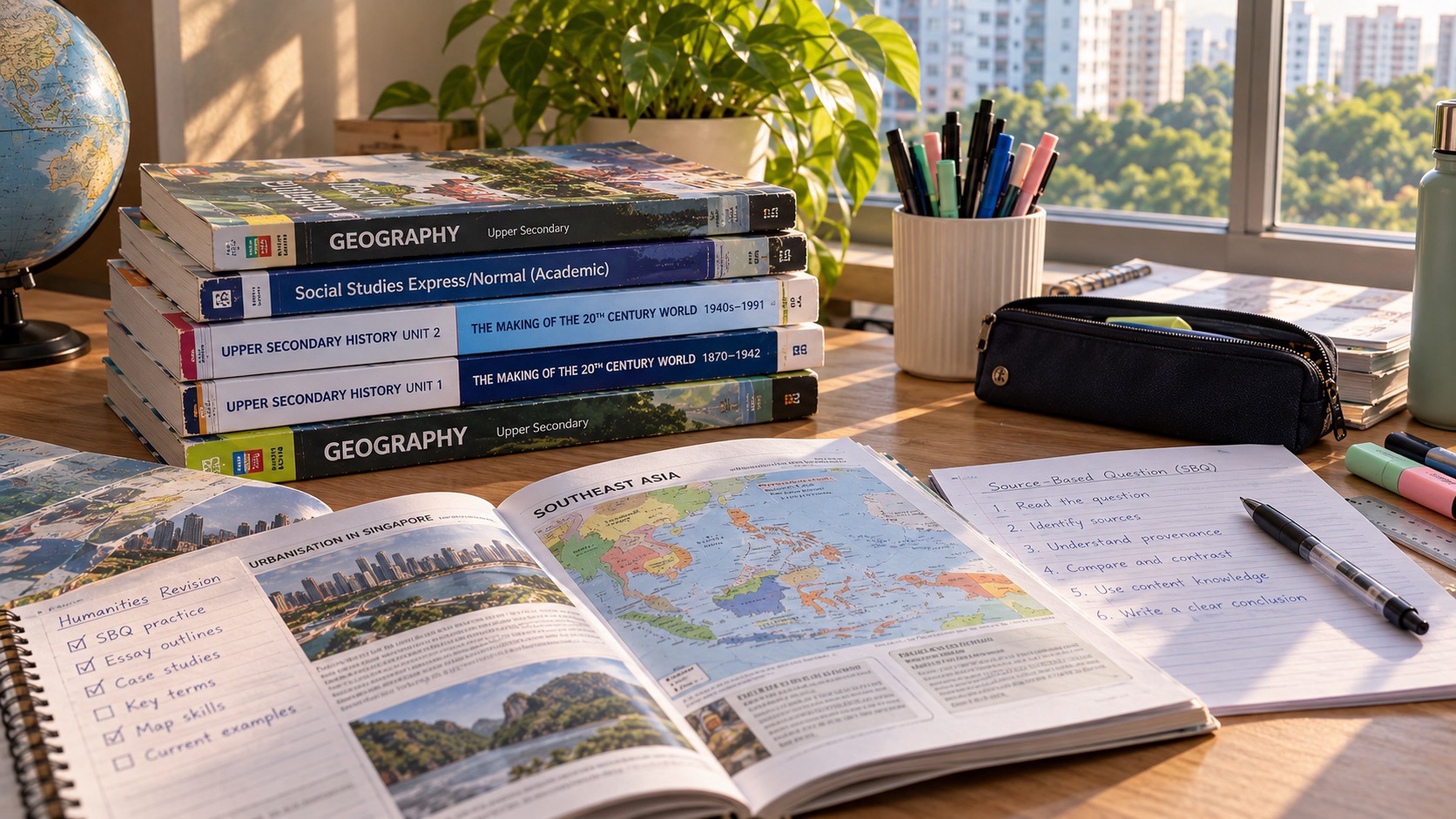
Did you know a plan to add shade near a school can be examined from two different angles? Geography asks where the hot areas are, which spaces people use and what observations support a design. Social Studies asks how to choose fairly when a project helps some users more than others, and public funds are limited.
That is the appeal of combined Humanities (Social Studies, Geography). It brings civic judgement and the study of places into a single examination subject. The skills overlap, but the questions and evidence differ.
For Singapore parents searching ‘PG1 Humanities (Social Studies, Geography)’, the key is to distinguish the student’s entry Posting Group from their actual subject level. The 2027 SEC G3 syllabus is K335, and the corresponding G2 combined course is K229. There is no national G1 version simply called PG1 Geography.
Independent Singapore parent–student guide, reviewed 24 October 2026 against the official 2027 SEC syllabuses and MOE’s 2028 Post-Secondary Admissions Exercise. All teaching scenarios below are fictional, not past exam questions. Always check the student’s actual cohort, offered combination and examination registration.
The 60-second answer
- PG1 is an admission group, not an examination subject; G2 combined Humanities (Social Studies, Geography) is K229 for 2027.
- The 2027 SEC G3 combined Humanities (Social Studies, Geography) code is K335, distinct from standalone G3 Geography K329.
- The G3 K335 has Social Studies Paper 1 for 1 hour 45 minutes and Geography Paper 2 for 1 hour 45 minutes; each is 50 marks and 50%.
- Social Studies examines source evaluation, citizenship and governance, diversity, and globalisation.
- Geography includes compulsory Geography in Everyday Life and Tourism questions, then a choice between Climate or Tectonics in the final section.
- For 2027 G3 K335 Geography, candidates answer Q1 (14 marks), Q2 (18 marks) and either Q3 or Q4 (18 marks). An approved calculator may be used for Geography Paper 2.
- A PG1 learner’s eventual course options depend on actual subject-level eligibility and the full SEC profile, not on an assumed Humanities outcome.
First, the PG1 posting group and the national Humanities syllabus are different
Posting Group 1 (PG1) describes how a student was admitted to Secondary 1. It is not the name or level of a national Humanities exam. Under Full Subject-Based Banding, students may take approved academic subjects at their appropriate G1, G2 or G3 level, while meeting pupils from other posting groups in shared form classes.
At lower secondary, G1 Humanities includes Social Studies and introductory Humanities Exposure Modules in Geography, History and Literature in English. These school-based lessons are not separately examined as a national G1 SEC Combined Humanities subject.
From 2027, the Singapore-Cambridge Secondary Education Certificate (SEC) records the actual subject and level entered. The combined Humanities options with Social Studies begin at G2 for Geography, History and Literature in English, and the relevant combined G3 options are separate subject codes. A PG1 pupil is not automatically registered for G3.
A combined Humanities paper gives ONE national Humanities grade, not separate results for Social Studies and its companion component. In the 2027 G3 combinations covered here, both components are compulsory and each counts for 50%. Parents and students must confirm the specific K-code, since changing the second component means changing the examined syllabus.
Offering a G3 combination can depend on student readiness, school provision, approved subject-level arrangements and the school’s timetable. A national syllabus existing online does not oblige every secondary school to offer it.
Why Humanities (Social Studies, Geography) is useful
Geography is not just memorising country names. It asks how people and environments are connected, why patterns differ across places, and whether a proposed response is supported by observations.
The Geography in Everyday Life cluster introduces thinking geographically, sustainable development and methods. Asking why one part of a street floods more often than another can lead to an investigation of elevation, drainage, surfaces, rainfall data and the limitations of available measurements.
Tourism looks at activity, development and sustainable decisions. More visitors can bring income while also creating crowding or environmental pressures. A reasoned answer needs to distinguish which benefits, costs and stakeholders are relevant.
Climate learning investigates weather and climate, climate change and climate action. A photograph of a hot afternoon does not by itself establish a long-term climate trend. Students should relate a claim to appropriate timescale, measurements and processes.
Tectonics explores plate processes, earthquakes, volcanoes and disaster risk management. A hazard is not identical to the vulnerability of a particular community. Building standards, preparedness and exposure can influence how serious an event’s consequences are.
Social Studies complements these questions by asking whose needs matter and how decisions are justified. The strongest answers use evidence while recognising that resources, priorities and uncertainty differ.
Eight core skills behind this Humanities combination
- Read and interpret a map, fieldwork observation, graph or geographical description accurately.
- Differentiate a geographical pattern from a claim about what caused the pattern.
- Relate an observed local issue to people, places and environmental conditions.
- Describe tourism’s advantages and consequences for different stakeholders.
- Distinguish weather from long-term climate and explain the significance of timescale.
- Explain a hazard and separate the physical event from the social factors affecting risk.
- Evaluate a Social Studies source’s message, purpose, context and usefulness.
- Construct a reasoned response that compares feasible decisions rather than making a simple slogan.
The exact 2027 G3 K335 examination
The 2027 G3 K335 qualification is ONE combined Humanities result, with both Social Studies and Geography compulsory. Paper 1 Social Studies is 1 hour 45 minutes, 50 marks and 50%; Paper 2 Geography is also 1 hour 45 minutes, 50 marks and 50%.
In Social Studies, the 35-mark source-based case study is supported by a 15-mark structured-response component. Strong candidates use sources critically and explain issues using appropriate substantive knowledge instead of relying on an unsupported personal view.
The Geography component tests four clusters, but candidates answer a specified pattern of questions: Geography in Everyday Life Question 1 is compulsory and worth 14 marks; Tourism Question 2 is compulsory and worth 18 marks; the final 18 marks come from choosing either a Climate question or a Tectonics question.
This is an examination choice, not a reason to neglect all understanding of a topic too early. Schools determine their teaching approach and when pupils should specialise their revision; use the actual examination year and 2027 syllabus structure to plan.
The approved calculator rule for G3 K335 Geography Paper 2 does not mean the subject is mainly arithmetic. The harder reasoning usually connects evidence, context and an appropriate assessment of choices.
The standalone G3 Geography K329 has a different examination structure and topic balance, including its own requirements. Do not use a K329 practice book as if every section automatically applies to combined K335.
The G2 combined Humanities Geography paper K229 is also a different assessed level. Social Studies is embedded within the combined subject at the chosen level; there is no way to take ‘G2 Social Studies with G3 Geography’ as a made-up single K-code.
Social Studies: a common half with its own evidence standards
Social Studies studies citizenship and governance, living in a diverse society, and being part of a globalised world. It asks students to consider competing needs, sources of information and the consequences of decisions affecting people.
A source-based case study requires more than quoting a sentence that agrees with a viewpoint. A student should identify who produced a source, its purpose, what it shows directly, how it compares with other evidence and which conclusion the available information can reasonably support.
Structured responses go beyond retelling textbook paragraphs. Strong explanations use accurately understood knowledge, explain a causal connection or stakeholder perspective and reach a defensible judgement when the question requires one.
A claim can be partly accurate and still omit important context. For example, a survey stating that ‘most residents support a proposal’ must be read alongside its sample, what was actually asked and which groups might not have been reached. Responsible judgement follows the evidence, not merely the loudest conclusion.
The three Social Studies issues matter across all four combined Humanities options, but the companion subject introduces its own assessment habits. Revising only the Social Studies half will leave half of the combined grade unprepared.
Did you know? A worked example worth discussing
Imagine a fictional neighbourhood proposal to put a shaded pedestrian walkway between a community library and a school. The district has a limited budget, and planners can only improve one section this year. This is an original educational scenario, not an actual government project or SEC examination extract.
The Geography starting point is an observation question. Which route attracts the most users and what conditions make the walk uncomfortable? Students could consider a map of foot traffic, shade at different times and the distribution of alternative routes.
Next they distinguish evidence from assumption. A count taken one morning might not represent weekends or after-school hours. A photograph during heavy rain cannot establish the conditions during a typical sunny day. A good geographical explanation acknowledges that uncertainty.
Social Studies then introduces a stakeholder decision. Some residents value a route used by older people, while another group wants the school crossing prioritised. Neither group’s preference automatically settles what would produce the most equitable benefit.
The student can create two options, state the trade-offs and identify what additional information would matter. A conclusion such as ‘improve Route A because three observations suggest heavier use, but obtain an afternoon count before finalising’ is more defensible than ‘everyone obviously wants Route A’.
Finally, change one condition: suppose new data shows Route B serves people with mobility difficulties. The learner revises the judgement using the new evidence. Being prepared to update a conclusion is a sign of understanding rather than weakness.
Six mistakes and targeted repairs
- A map pattern is accurately described but no causal relationship is explained: add a mechanism supported by relevant evidence.
- A tourism essay counts only revenue and ignores local or ecological costs: identify stakeholders, scale and trade-offs.
- Weather on one day is called climate change: check timescale and longer-term data before drawing conclusions.
- A hazard is equated with disaster damage: consider exposure, vulnerability, preparedness and consequences separately.
- A Social Studies claim repeats one viewpoint without comparison: check the source’s purpose, corroboration and limits.
- The student revises standalone Geography K329 instead of the actual K335 paper structure: use the exact examination code and specified question pattern.
A practice routine that encourages independent thinking
Start with a short task actually relevant to the child’s level: a map, original literary passage, source or historic question. Ask what it literally shows before requesting interpretation.
Have the learner identify the first uncertain step: source provenance, subject content, data reading, quotation selection or the reasoning connecting evidence with a claim. Do not treat every problem as a shortage of memorised facts.
Demonstrate one repair and then remove the hint. For example, ask the student to point to one exact phrase or data pattern and explain its relevance.
Change the question or evidence slightly after a delay. A pupil who can respond independently to a fresh situation has a more transferable skill than one who repeats the original model answer.
Use teacher feedback and the actual SEC exam syllabus to decide how much timed practice is appropriate. A child’s Posting Group is not a reason to pressure them into an unapproved, mismatched subject.
From Secondary 1 to Secondary 4
- Secondary 1: use common Humanities exposure to recognise everyday geographical questions, maps and different civic perspectives.
- Secondary 2: practise sources, small fieldwork observations and explanations of real-world trade-offs at the school’s appropriate level.
- Secondary 3: verify a G2 K229 or G3 K335 subject offering and practise both combined halves under the correct syllabus.
- Secondary 4: prepare the actual Geography choice questions and Social Studies requirements, then map the formal SEC results to the next course.
Education Pathway for ITE, Polytechnic, JC and University
Did you know that ‘could this child eventually attend university?’ and ‘will one Humanities grade qualify the child directly for a particular polytechnic course?’ are different questions? One is a long-term possibility that depends on building a series of qualifications; the other is answered by the target course’s exact entry rules.
MOE has announced the Post-Secondary Admissions Exercise (PSE) from 2028, bringing together the main results-based entry applications to JC/MI, polytechnic and ITE. The application process does not make all destinations interchangeable.
1. ITE Higher Nitec: a recognised skills-based next step
ITE Higher Nitec: eligible students can apply to courses whose recognised SEC subject levels and grades satisfy the specific requirements. Humanities skills may help with communication, customer service, community understanding and problem solving, but one combined Humanities grade does not independently guarantee any Higher Nitec placement.
2. Polytechnic diplomas and qualifying academic results
Polytechnic diploma: eligible direct entry depends on the full SEC subject aggregate, the proper levels, course prerequisites and any additional selection. MOE’s planned 2028 framework allows a qualifying G2 subject in the fifth position of the specified direct-entry aggregate; the other required subjects and grades must still be satisfied. An appropriate Higher Nitec progression route may be another possibility.
3. Junior College and Millennia Institute
JC/MI: the announced 2028 JC L1R4 scheme uses qualifying G3 examination subjects, with further rules about the recognised subjects and language conditions. MI has its own updated requirements. PG1 is not a permanent barrier to attempting eligible qualifications, but a G1 school Humanities lesson or a single combined result cannot replace a complete qualifying profile.
4. University study as a later qualification checkpoint
University: students who later earn a suitable qualifying pre-university qualification or diploma may apply for degrees in many fields, subject to grades, prerequisites and selection. Humanities can develop evidence-led thinking that travels across routes, yet neither the original posting group nor a G3 Humanities result guarantees university admission.
A six-step weekly learning plan
- Day 1: identify the precise subject K-code and the two compulsory components.
- Day 2: attempt one small Social Studies source question, explaining the information’s origin, claim and limitation.
- Day 3: practise one companion-subject skill using a short unfamiliar question.
- Day 4: revise an answer by linking a piece of evidence to a clearly stated conclusion.
- Day 5: try a changed question without notes and note the first gap.
- Weekend: compare the new answer with the older one and plan one targeted improvement with the school’s feedback.
Four school and family conversations worth having
- Ask the school which actual syllabus code is offered and registered, rather than relying on a timetable that merely says ‘Humanities’.
- Ask the student to demonstrate one independent source inference and one independent companion-subject response, then explain the evidence used.
- Ask the teacher whether the first issue is understanding a question, selecting evidence, recognising subject content, writing an explanation or evaluating conflicting claims.
- For a named future JC, diploma or Higher Nitec course, check the entire recognised qualification profile, not only the Humanities paper or the learner’s original Posting Group.
What parents can record in a short learning notebook
A simple learning log helps. Record the question, what the student first understood, one overlooked detail, the student’s own correction and a date to retry the same skill on unfamiliar evidence.
Do not let a parent, tutor or automated service write assessed coursework or school submissions in place of the learner. Support comprehension, practice and authentic independent explanations.
A small accurate improvement matters more than a thick stack of mechanically memorised material. At the next subject-choice checkpoint, use the teacher’s evidence of readiness and the current school’s offering criteria.
Frequently asked questions
Is PG1 Humanities (Social Studies, Geography) a national G1 examination?
No. PG1 is the entry posting group. For 2027, the combined examined subject is G2 K229 or G3 K335, depending on the candidate’s actual eligibility and registration.
Are Geography and Social Studies two separate grades in K335?
No. They are compulsory, equally weighted components of one combined Humanities grade.
Do I study standalone Geography K329 if I offer K335?
They are separate subjects with different examination structures. Use the correct syllabus for the school’s registered entry.
Can students choose between Climate and Tectonics?
The 2027 G3 K335 Geography Paper 2 requires Questions 1 and 2, plus either Question 3 on Climate or Question 4 on Tectonics.
Can a calculator be used in Geography Paper 2?
Yes, the 2027 G3 K335 syllabus allows an approved calculator for its Geography paper.
Does a strong Geography result alone guarantee a Polytechnic diploma?
No. The complete formal subject-and-grade entry requirements of the chosen diploma apply.
Can an original PG1 pupil eventually offer G3 Geography?
Potentially, under relevant subject-level rules, school offerings and demonstrated readiness; no automatic entitlement is implied.
Where to verify this syllabus and admissions guidance
The SEAB G3 school-candidate directory lists the actual 2027 combined Humanities subject code K335. Its published syllabus specifies exact paper timing, compulsory questions, choices and source or text requirements. The G2 directory shows any other valid combined Humanities option at its own level.
Use MOE Full SBB guidance for subject-level opportunities and school provision, and the current PSE or destination-specific criteria for JC, MI, polytechnic and ITE. One national subject listing is not proof that every student may register for it.
All learning activities described here are illustrative and should not replace assigned work or actual exam documents. The child should develop independent explanations rather than copy a model without understanding.
SEAB — 2027 G3 Humanities (Social Studies, Geography) K335
MOE–SEAB — official 2027 combined Humanities K335 full syllabus PDF
SEAB — 2027 G2 subject choices, including K229
SEAB — 2027 G1 school-candidate subjects (no combined Humanities paper)
SEAB — Singapore-Cambridge Secondary Education Certificate overview
MOE — Full Subject-Based Banding secondary-school experience
MOE — Post-Secondary Admissions Exercise from 2028
MOE — 2026 education and pathway announcements
ITE — academic progression after Higher Nitec
Continue reading on eduKateSG
What is PG1? Posting Group and G1/G2/G3 syllabus distinctions
What is PG1 Humanities? Lower-secondary exposure and choices
What is PG1 Social Studies? Civic understanding without an invented G1 national paper
2027 SEC Humanities: Social Studies with Geography, History or Literature?
Complete 2027 SEAB syllabus and subject-code directory
PG1 to JC, Polytechnic, ITE and University pathways
G3 K335: detailed 2027 Social Studies and companion syllabus
PG2 Humanities (Social Studies, Geography): compare G2 and G3 levels
PG3 Humanities (Social Studies, Geography): G3 admission and syllabus guidance
Explore the companion discipline separately from combined Humanities
Secondary 1 Mathematics Tutor Clementi | Small Groups Tutorials — foundational independent learning
One good question to ask tonight
Ask your child: ‘What does this map actually show, what might explain the pattern, and which information would you check before deciding what to do?’ A clear evidence-based answer in an unfamiliar example is a better starting point than assuming one grade or posting label determines the future.