
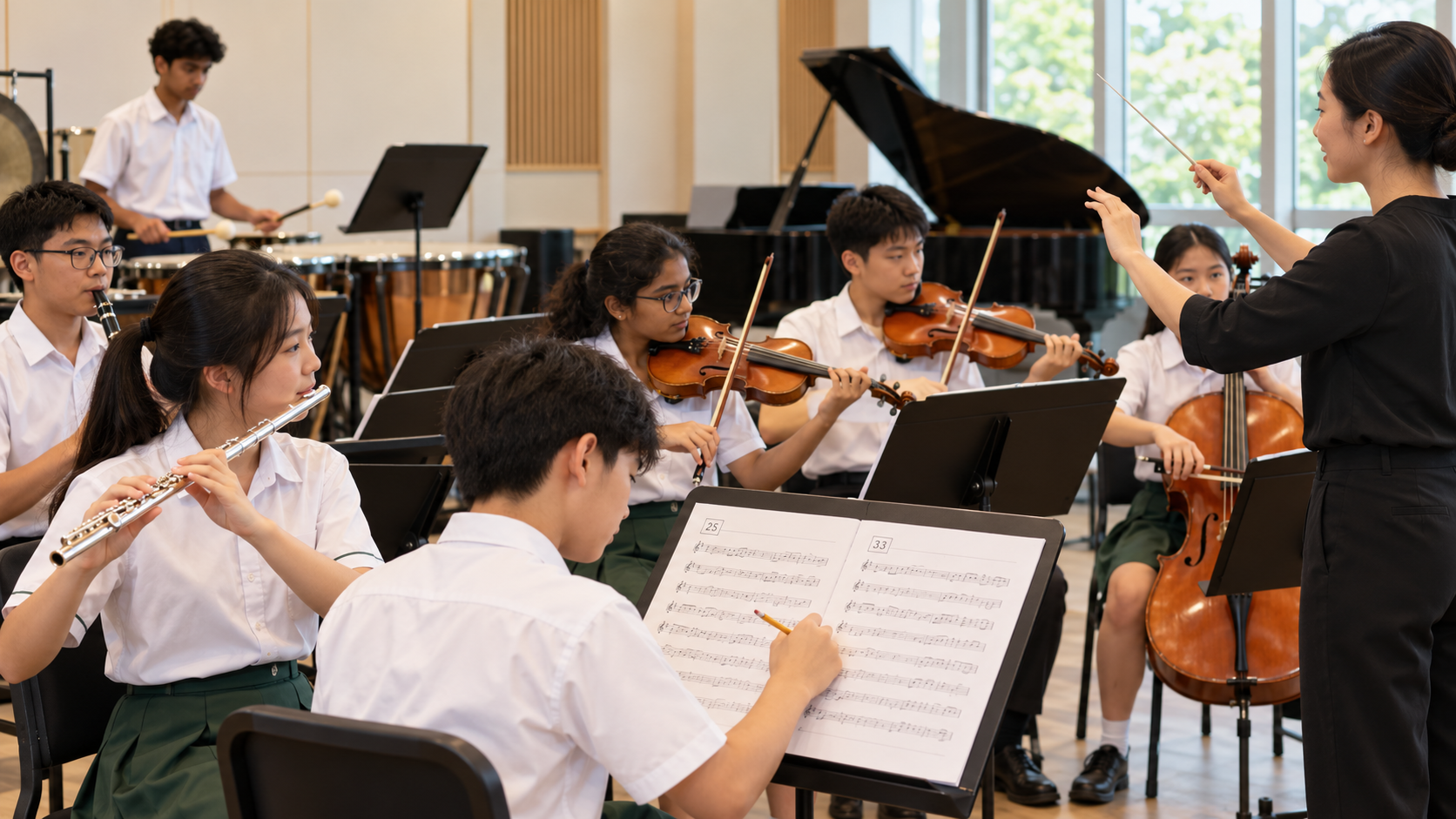
After PSLE results, parents of children who enjoy erhu, pipa, dizi, violin, cello, guitar or playing music with others should first check their official PSLE Score and eligible PG1, PG2 or PG3 Posting Group. Then compare schools’ actual Chinese Orchestra, String Ensemble and Guitar Ensemble CCAs. Bedok South Secondary describes a Chinese Orchestra that welcomes pupils with and without previous experience; North Vista Secondary’s String Ensemble also explicitly welcomes beginners; St. Margaret’s School (Secondary) has a String Ensemble; Changkat Changi Secondary offers a Chinese String Ensemble; while Dunman Secondary and Chua Chu Kang Secondary publish very different guitar-ensemble approaches. These are distinct musical groups and admission to a school does not guarantee a specific instrument or selected performance role.
Use MOE SchoolFinder and current school CCA pages to compare beginner teaching, instrument assignment, weekly section rehearsals, school-provided instruments, learning costs, repertoire, travel and everyday academic fit. Dunman’s Guitar Ensemble uses Niibori instrumentation with different guitar sizes, while Bedok South’s Chinese Orchestra combines Chinese wind, plucked and bowed strings with cello, double bass and percussion. National Junior College’s Integrated Programme DSA selection separately lists Guitar, String Ensemble and Chinese Orchestra talent areas with instrument-related criteria and a CCA commitment; those are formal entry rules, not universal requirements for ordinary school CCA participation. Rank six genuine eligible school choices, including realistic historical COP alternatives.
- Confirm the S1 Option Form, overall PSLE Score and selected Posting Group first.
- Distinguish Chinese Orchestra, Western String Ensemble, Chinese String Ensemble and Guitar Ensemble.
- Bedok South and North Vista explicitly welcome students without extensive previous playing experience.
- Check instrument assignment, ordinary beginner lessons and selected performance opportunities.
- Compare Bedok South, North Vista, St Margaret’s, Changkat Changi, Dunman, Chua Chu Kang and Junyuan.
- Ask about instrument availability, maintenance, music reading, practice rooms and costs.
- Separate normal CCA membership from IP/DSA talent auditions and later examined Music.
- Rank six suitable eligible schools in actual preference order using historical COPs cautiously.
Definition lock: these ensembles are not interchangeable
A Chinese Orchestra often includes Chinese wind, bowed and plucked string instruments and percussion; a Western String Ensemble usually focuses on instruments such as violin, viola, cello and double bass; a Guitar Ensemble uses different guitars or guitar parts. A Chinese String Ensemble may have its own specific instrument mix and programme structure. None should be assumed identical simply because they all produce instrumental music.
Parents should ask which sounds and styles appeal to the child. A pupil fascinated by the erhu may not want a Western String Ensemble, while another may enjoy the collaborative guitar sound more than a large Chinese Orchestra. Accurate programme information prevents disappointment after posting.
Parent action: Identify the child’s actual instrument and ensemble preference.
Posting Group is not a music audition result
PG1, PG2 and PG3 facilitate academic school admission under Full Subject-Based Banding. They do not measure rhythm, finger coordination, musical understanding or creativity. Individual G1, G2 and G3 subject levels refer to academic learning demand rather than CCA skill. Pupils from different entry routes can benefit from suitable ensemble teaching.
Start with the official S1 Option Form and find eligible schools. A private instrument certificate does not automatically bypass normal posting rules. A successful formal DSA-Sec allocation has its own commitment and must be considered separately from ordinary CCA selection. The school still needs to support the child’s full academic timetable.
Parent action: Verify academic eligibility and music opportunities independently.
Bedok South’s Chinese Orchestra welcomes beginners
Bedok South Secondary’s August 2026 Chinese Orchestra page states that pupils with or without prior musical experience can develop instrumental skills through structured training. It describes an ensemble incorporating dizi, sheng, suona, ruan, liuqin, pipa, yangqin and erhu, together with instruments including cello and double bass and a mixed-culture percussion section.
This is an example of a broad orchestra with several different musical roles. Ask which instruments are available to new members and whether the student can express a preference. The published repertoire and awards reflect the school programme but do not guarantee that every entrant is assigned the instrument they wanted.
Parent action: Ask Bedok South how it introduces and allocates beginners across the instrument groups.
North Vista’s String Ensemble is beginner-friendly
North Vista Secondary’s July 2026 String Ensemble page explicitly welcomes interested students regardless of prior experience, provided they are willing to learn and practise. Its published schedule includes Wednesday afternoon and Friday early-afternoon sessions. The programme emphasises learning together and providing opportunities for ensemble performance.
Parents should ask which string instruments are currently taught and whether new members receive school instruments or need personal equipment. A welcoming description does not guarantee unlimited places or an immediate place in a public concert. The daily journey after a Friday session may differ from the rest of the week.
Parent action: Check beginner teaching, instrument allocation and current weekday timing at North Vista.
St Margaret’s offers another String Ensemble
St. Margaret’s School (Secondary)’s July 2026 page describes a String Ensemble with Monday and Friday sessions across different school spaces. It also records past Singapore Youth Festival achievements, reflecting the orchestra’s performance history. The published schedule is a useful starting point for family planning.
Ask what first-year members are taught, which instruments the group currently uses and whether admission requires a trial or prior experience. Public awards belong to past cohorts rather than promising a new student individual success. A child should enjoy participating even if they are not selected for a particular concert.
Parent action: Verify first-year membership and training venues rather than relying only on award results.
Changkat Changi teaches Chinese String Ensemble
Changkat Changi Secondary’s July 2026 Chinese String Ensemble page describes Tuesday and Thursday section and combined rehearsals, music-theory lessons for newcomers and school or community performances. The school’s current photos include bowed string instruments and show pupils learning within an ensemble context.
Parents should not assume this group is identical to a full Chinese Orchestra or a Western violin ensemble. Ask what instruments are offered and how beginners are introduced to the school’s music tradition. The programme’s two long afternoon sessions should also be considered in the weekly timetable.
Parent action: Ask Changkat Changi about its exact instrument mix and first-year theory programme.
Dunman’s Guitar Ensemble uses unusual orchestral instrumentation
Dunman Secondary’s June 2026 Guitar Ensemble page describes Niibori instrumentation, using a broad range of guitar types such as soprano, alto, prime, bass and contrabass guitars to create an orchestral sound. The programme differs from a simple after-school group in which everyone plays the same acoustic guitar part.
Ask whether the child will be assigned a particular guitar type, whether instruments are supplied and what musical foundations are expected. A pupil who enjoys playing six-string guitar alone may discover a new kind of collaboration in this ensemble. The school should explain the beginner pathway rather than promise the preferred instrument immediately.
Parent action: Ask how Dunman’s guitar parts are allocated and taught.
Chua Chu Kang offers a dedicated Guitar Ensemble
Chua Chu Kang Secondary’s August 2026 Guitar Ensemble page describes an ensemble founded in 2011, with Wednesday and Friday training, school performances and past Singapore Youth Festival participation. It emphasises friendships, musical skill and exposure to different performance styles.
Ask what new members learn during regular sessions and whether they need any prior guitar experience. The existence of former awards does not establish that the pupil will be selected for every event. A supportive ensemble should help students develop techniques while contributing to the group.
Parent action: Compare ordinary beginner coaching and selected performances at Chua Chu Kang.
Junyuan’s Guitar Ensemble emphasises joyful participation
Junyuan Secondary’s current Guitar Ensemble page lists Tuesday and Thursday training and describes school and community performances. It states that musical enjoyment and teamwork remain important alongside participation in events such as the Singapore Youth Festival. That can appeal to families who want a sustainable musical interest, not only intensive competition preparation.
Parents should ask whether newcomers receive school-supplied instruments and how the instructors support varied experience levels. A pupil may enjoy guitar but need time to learn finger placement, rhythm and listening with an ensemble. A regular rehearsal programme matters more than one past public show.
Parent action: Confirm Junyuan’s actual beginner expectations and current training timetable.
NJC Integrated Programme DSA has separate talent rules
National Junior College’s published Integrated Programme DSA selection criteria list Guitar Ensemble, String Ensemble and Chinese Orchestra as distinct talent areas, with instrument proficiency, aural ability and musicianship among the criteria. The published programme also describes a four-year CCA commitment for selected participants.
These formal selection requirements should not be confused with ordinary CCA entry at another school, including those that explicitly welcome beginners. A final successful DSA allocation generally carries the school’s commitment; a child without such an allocation must use the eligible ordinary posting process where applicable. No one should infer that a private music certificate automatically secures a place.
Parent action: Separate formal NJC IP admission from mainstream CCA membership.
A Chinese Orchestra has different instrument families
Chinese orchestras may include bowed strings such as erhu, plucked instruments such as pipa or ruan, Chinese wind instruments such as dizi and sheng, and percussion. Bedok South’s published description also mentions cello and double bass, illustrating that a school orchestra’s exact mix can be wider than a simple list of traditional Chinese instruments.
Ask which sections the school actually maintains and how new pupils are assigned. A student who wants to play erhu should not assume every Chinese music CCA has a place on that instrument. The musical roles of different families can make ensemble work rewarding even when a pupil explores an unfamiliar sound.
Parent action: Ask which instrument families new members can realistically join.
Western strings involve different playing roles
A String Ensemble may include violins carrying a melody, violas or lower strings supporting harmony and cellos or double basses providing other musical lines. The actual instrument allocation depends on the school’s programme and resources. A pupil who enjoys solo violin may still need to learn how to blend with a larger group.
Ask whether the school introduces the instruments to beginners and how section leaders help members. A child might discover that playing a lower part is musically meaningful, not inferior to taking the melody. Parents should not make preferred instrument status the only measure of a good match.
Parent action: Ask what instruments the school provides and how each contributes to the ensemble.
A Guitar Ensemble is not identical to an individual guitar class
An individual guitar lesson might focus on playing songs or technical exercises alone, while an ensemble requires reading and listening across multiple parts. Dunman’s Niibori approach makes the distinction especially clear, as it uses different guitar sizes for different musical functions.
Ask whether the child enjoys coordinating with peers and following a conductor or ensemble leader. A pupil who prefers solo songwriting could still benefit from a group but may want different opportunities. A sensible school choice recognises how the child’s interests and the actual teaching fit together.
Parent action: Distinguish ensemble music from solo guitar and digital songwriting.
Chinese String Ensemble is not always a full Orchestra
Changkat Changi’s Chinese String Ensemble focuses on a particular group of instruments, with theory and section practice under its school arrangements. A full Chinese Orchestra may include separate wind, percussion and plucked string sections. Families should not treat the names as interchangeable when investigating a preferred instrument.
Ask the club what members actually play and whether there is scope for selected performances with other groups. A school may have fewer instrument types but provide excellent instruction and a strong community. Precision about the group matters more than the broad label of Chinese instrumental music.
Parent action: Ask for the actual current instrument list and beginner allocation.
Music reading and listening must grow together
A new instrumentalist may need help understanding notes, rhythm, dynamics and following a conductor. Some schools offer theory lessons for beginners, as Changkat Changi explicitly describes. Others may combine section practice with full-ensemble rehearsal. The aim is making meaningful music, not simply learning to press or finger the correct notes.
Ask how a pupil without formal music lessons is supported. A child can learn to listen for their part and understand why it fits with the whole group. The most expensive instrument does not make the student musically prepared; careful teaching and practice do.
Parent action: Ask what music-reading or listening skill the first term will develop.
Sectionals help beginners before full-ensemble work
An ensemble may rehearse in smaller sections to practise passages and then combine everyone for group music. A student might play correctly alone yet find it difficult to maintain timing or balance when several other sections enter. Learning to adjust is part of the educational experience.
Ask how sectionals are taught and whether instructors and older student leaders provide constructive help. A welcoming environment lets beginners ask questions without embarrassment. Parents should judge regular practice opportunities more than the sophistication of one senior performance.
Parent action: Ask what changes when the pupil moves from sectional practice to full ensemble.
Instrument care is part of responsible music education
Strings, woodwinds, plucked instruments and percussion require different approved handling and maintenance. A pupil may use school-owned equipment that must be stored carefully or transported under instructions. Parents should not assume that a child will take every instrument home or that one cleaning method suits all.
Ask which resources are school-provided and what the student must do to maintain them. A young musician can develop independence through learning how to care for shared materials. Avoid buying instruments or specialist supplies until the receiving school confirms assignment and requirements.
Parent action: Obtain the current equipment, storage and care instructions.
Ensemble history and competition medals are not guarantees
Many school music pages list past Singapore Youth Festival certificates and concert appearances. These demonstrate prior participation but cannot guarantee that a new entrant performs in the next selected concert or achieves the same recognition. A child may spend time learning foundational skills before representing the school publicly.
Ask what regular members practise and how performance roles are assigned. A good music programme supports progress, friendship and authentic enjoyment even when a pupil is not selected for an external event. Trophy counts should not be the only reason to rank a school.
Parent action: Compare ordinary training and selected awards independently.
Beginner access differs from school to school
North Vista and Bedok South explicitly describe welcoming pupils who lack previous musical experience, while some specialised auditions require demonstrated instrument proficiency. These routes should not be conflated. An interested child may be ready for an introductory CCA but not a formal talent admission, and that is a reasonable distinction.
Ask the actual school whether it provides first-year beginner instruction, how students are selected and whether all applicants can join. Parents should not purchase expensive private coaching solely from an assumption that every ensemble member already holds external graded certificates.
Parent action: Compare published novice-friendly pathways with any formal audition requirements.
Instrument assignment may depend on orchestra balance
A school ensemble needs a suitable mix of instruments and parts, so teachers may consider availability, physical readiness, musical interest and the current group’s needs when assigning newcomers. A child who strongly prefers violin or pipa may be offered a different instrument, especially if places are limited.
Ask whether pupils can express preferences and what happens when the first choice is unavailable. A new instrument can become an exciting discovery when appropriate coaching is provided. The child should not interpret a lower string or supporting part as a lesser musical role.
Parent action: Discuss realistic instrument options and the importance of each section before school posting.
Music technology is not identical to ensemble training
A pupil who enjoys digital songwriting or audio editing may not necessarily want to practise erhu, violin or guitar in a group. Ensemble education focuses heavily on musicianship, listening and coordination with other live players. Recording and producing music introduce other tools and decisions.
Ask the child whether the main interest is performing in a group or creating recorded pieces. Some schools offer both through different lessons, but that combination must be verified. A famous Chinese Orchestra does not guarantee advanced studio access, and a modern Guitar Ensemble is not automatically a digital production club.
Parent action: Distinguish instrumental performance from audio production and songwriting.
Regular practice and sectionals require time
Changkat Changi, St Margaret’s, North Vista and Chua Chu Kang publish multi-day rehearsal schedules. A young student may also need additional practice to develop instrumental technique. Parents should ask how much is school-directed and how much must happen independently before promising any extra lessons.
A sustainable routine includes academic homework, food, sleep and friendships as well as music. A child may happily practise for several hours, while another needs help maintaining a manageable schedule. The school’s actual requirements and family circumstances determine what works.
Parent action: Compare an ordinary school day, ensemble day and possible home-practice time.
Performance seasons can change the rehearsal schedule
Ensembles may prepare for school events, celebrations, Singapore Youth Festival or selected concert opportunities. These can require additional practices beyond the ordinary CCA timetable, especially when several instrumental sections need to coordinate. Past programmes do not guarantee identical schedules for 2027.
Ask what previous years’ peak periods looked like and how parents are informed of extra rehearsals. A meaningful performance can be rewarding, but a pupil still needs rest and academic support. The family should choose with realistic expectations rather than rely on one published weekly time.
Parent action: Check how major-event preparation affects the term calendar.
Instrument maintenance and hygiene have separate rules
Plucked strings, bowed strings, wind instruments and percussion need different approved care. Some equipment may be used by more than one pupil, and appropriate hygiene and storage procedures matter. A family should not improvise cleaning agents or repairs without guidance from the school’s music staff.
Ask what supplies are required and which resources the school maintains. A novice who learns careful handling is developing responsibility alongside musical skills. Parents should avoid buying costly accessories before the instrument assignment has been confirmed.
Parent action: Request the actual instrument’s care instructions from the instructor.
Concert clothing and materials can add expense
Instrumental ensembles may require particular concert attire, music folders, maintenance supplies or travel to performance venues. Schools might provide some resources while families obtain others. These arrangements vary and should not be estimated from a senior pupil’s photograph.
Ask for the current list of compulsory and optional items and any support available through school channels. Musical participation need not become a contest in household spending. Keep ordinary schoolbooks, meals, transport and uniforms in the budget alongside CCA requirements.
Parent action: Verify real costs before purchasing an instrument or performance clothing.
A school concert can teach cultural understanding
Bedok South’s Chinese Orchestra describes learning the historical stories behind musical scores, while Changkat Changi highlights Chinese New Year performances and cultural exchanges. Such activities can help students appreciate the relationships between music, community and tradition.
Ask how conductors explain repertoire and the meaning of the pieces rather than simply preparing correct notes for a show. A pupil does not need to be an expert in the associated language to develop respectful curiosity where school rules allow participation. The music should be learned with context and care.
Parent action: Ask what story, tradition or artistic idea one piece communicates.
A Chinese Orchestra is not an HMTL entitlement
Learning an instrument associated with Chinese music can enrich cultural awareness, but it does not automatically grant Higher Chinese eligibility or academic language credit. HMTL subject criteria and SAP-school admission arrangements follow their own official rules. A calligraphy or Chinese Orchestra CCA has separate learning objectives.
Ask whether the child can manage academic language demands independently of the music programme. A student may love the sound of erhu while needing help with Chinese reading; another may be strong in language but new to instruments. The school’s teaching should respond to both.
Parent action: Separate formal Mother Tongue pathways from instrumental CCA options.
A Guitar Ensemble and a Chinese Orchestra may share skills
Both ensembles ask musicians to listen, interpret rhythm, cooperate and practise consistently. However, the instruments, repertoire and notation can be different. A student moving from one group to another may bring some musical experience without automatically knowing the new technique.
Ask what prior experience is useful and what first-year instruction is provided. Do not assume guitar chords alone qualify a child for pipa or that violin skill immediately transfers to erhu. Appropriate beginner training can make exploration rewarding while preserving accurate expectations.
Parent action: Ask the school which skills transfer and which must be learned anew.
A formal DSA offer must not be assumed from a CCA listing
National Junior College’s IP DSA page provides specialised admission criteria for instrumental talent. Other schools may have different talent areas or no DSA instrument route at all. Ordinary school CCA membership is not an informal replacement for an earlier formal audition or allocation.
Check whether the child has a confirmed final DSA outcome and follow the applicable commitment. An unsuccessful audition does not prevent a pupil from enjoying beginner-friendly ensembles elsewhere. Families should distinguish institutional entry, instrument allocation and selected performance opportunities.
Parent action: Verify the actual school admission route and do not invent an arts-talent exception.
Academic Music programmes and ensembles are different
A Music Elective Programme or examined Music subject can involve additional formal learning and eligibility, while a CCA focuses on co-curricular participation and group development. A student may enjoy playing guitar without wanting a demanding academic Music elective or may study formal Music while participating in an unrelated CCA.
Ask which courses are offered to the incoming school route and when later subject combinations are chosen. A concert award should not be described as a national examination qualification. The child’s broader academic and social needs should guide the decision.
Parent action: Record ordinary Music, formal electives and school ensembles separately.
A long commute can complicate rehearsals
Instrumental training often takes place after lessons, and the family may need to plan collection, travel with instruments and occasional late concert returns. North Vista, St Margaret’s and Changkat Changi publish different rehearsal-day hours, making school distance a practical consideration.
Test the journey after the actual CCA session rather than rely only on the school morning route. A nearby school with supportive ensemble teaching may be more sustainable than a distant programme selected only for a prestigious result. The child still needs time to study and rest.
Parent action: Compare ordinary school days and rehearsal days before final ranking.
Historical COPs are not school or ensemble guarantees
The previous-year school cut-off point describes the last admitted student for the relevant Posting Group in a completed exercise. It may change with vacancies and student preferences. A school’s Chinese Orchestra or String Ensemble reputation does not alter normal S1 posting rules or guarantee instrument availability after enrolment.
MOE recommends including two or three genuinely suitable schools whose past COPs were less stringent than the child’s score among six preferences. Every alternative should provide appropriate teaching and enjoyable opportunities. The family’s shortlist should not depend entirely on one selected orchestra seat.
Parent action: Check school eligibility, admission risk and ensemble allocation separately.
The six-school list should express genuine family preference
Under normal S1 Posting, the order of schools is relevant in the standard equal-score tie-breaker sequence after citizenship and before computerised balloting. Ranking an orchestra school first should mean the family genuinely prefers it overall, not that someone believes its conductor rewards first-choice applicants.
Discuss the school’s academic teaching, commute, culture, activities and other CCAs with the child. A school should remain an acceptable place even if the desired instrument section is full. A balanced ranked list provides more than one positive possible outcome.
Parent action: Confirm the real preferred order and official school codes.
The right instrumental ensemble school develops musical understanding
Chinese Orchestra, Western String Ensemble and Guitar Ensemble can all help pupils learn to listen, create a shared sound and contribute responsibly. Some students will later pursue professional music, while others gain a meaningful hobby and lasting friendships. Neither path requires immediate external awards.
Choose eligible schools through verified beginner coaching, instrument availability, ensemble culture, academic support and sustainable travel. After posting, encourage the pupil to practise patiently and explore the sounds of the group rather than demand a prestigious solo. The best choice helps the whole student grow.
Parent action: Select the environment where musical curiosity and broader education can develop together.
Frequently asked questions about Chinese Orchestra, Strings and Guitar
Is Chinese Orchestra the same as a Western String Ensemble?
No. Their instrument families and repertoire differ, though both teach group musicianship.
Does Bedok South Chinese Orchestra accept beginners?
Its current school page says members with or without prior experience can develop instrumental skills.
Does North Vista’s String Ensemble welcome beginners?
Yes. Its July 2026 page explicitly welcomes inexperienced interested pupils, subject to current CCA access.
What is Dunman’s Niibori Guitar Ensemble?
It uses different guitar sizes and parts to create an orchestral ensemble sound.
Does Changkat Changi offer a full Chinese Orchestra?
Its current CCA is described as Chinese String Ensemble; verify the actual instrument group rather than assume the same mix.
Can PG1 pupils learn a musical instrument?
Yes. Posting Group is an academic admission route, not a test of musical potential.
Are pupils guaranteed their preferred instrument?
No. Allocation may depend on the school’s resources and ensemble balance.
Do all guitar ensembles teach solo songwriting?
No. Ensemble music and original songwriting are different activities.
Does a school CCA guarantee MEP?
No. Music Elective Programme eligibility is separate.
Do NJC IP DSA audition rules apply to every ensemble?
No. They are specific formal admission requirements for that institution.
Are prior SYF awards guarantees?
No. They describe earlier cohorts.
How should six schools be ranked?
By genuine eligible preference, with realistic historic COP alternatives and suitable whole-school education.
Official school ensembles and related parent guides
Bedok South Secondary Chinese Orchestra
North Vista Secondary String Ensemble
St Margaret’s Secondary String Ensemble
Changkat Changi Secondary Chinese String Ensemble
Dunman Secondary Niibori Guitar Ensemble
Chua Chu Kang Secondary Guitar Ensemble
Junyuan Secondary Guitar Ensemble
National Junior College IP DSA selection criteria
eduKateSG Concert Band, Wind Instruments and Percussion
eduKateSG Chinese Calligraphy and Cultural Arts
eduKateSG Music Production and Songwriting
eduKateSG PSLE Results complete parent hub
Reviewed 7 November 2026. School ensemble instruments, beginner intake, training times, CCA capacity and arts-DSA rules may change. Confirm the actual 2027 school programme and official S1 Posting timetable. Historic COPs and past musical awards do not guarantee admission or instrument allocation.