
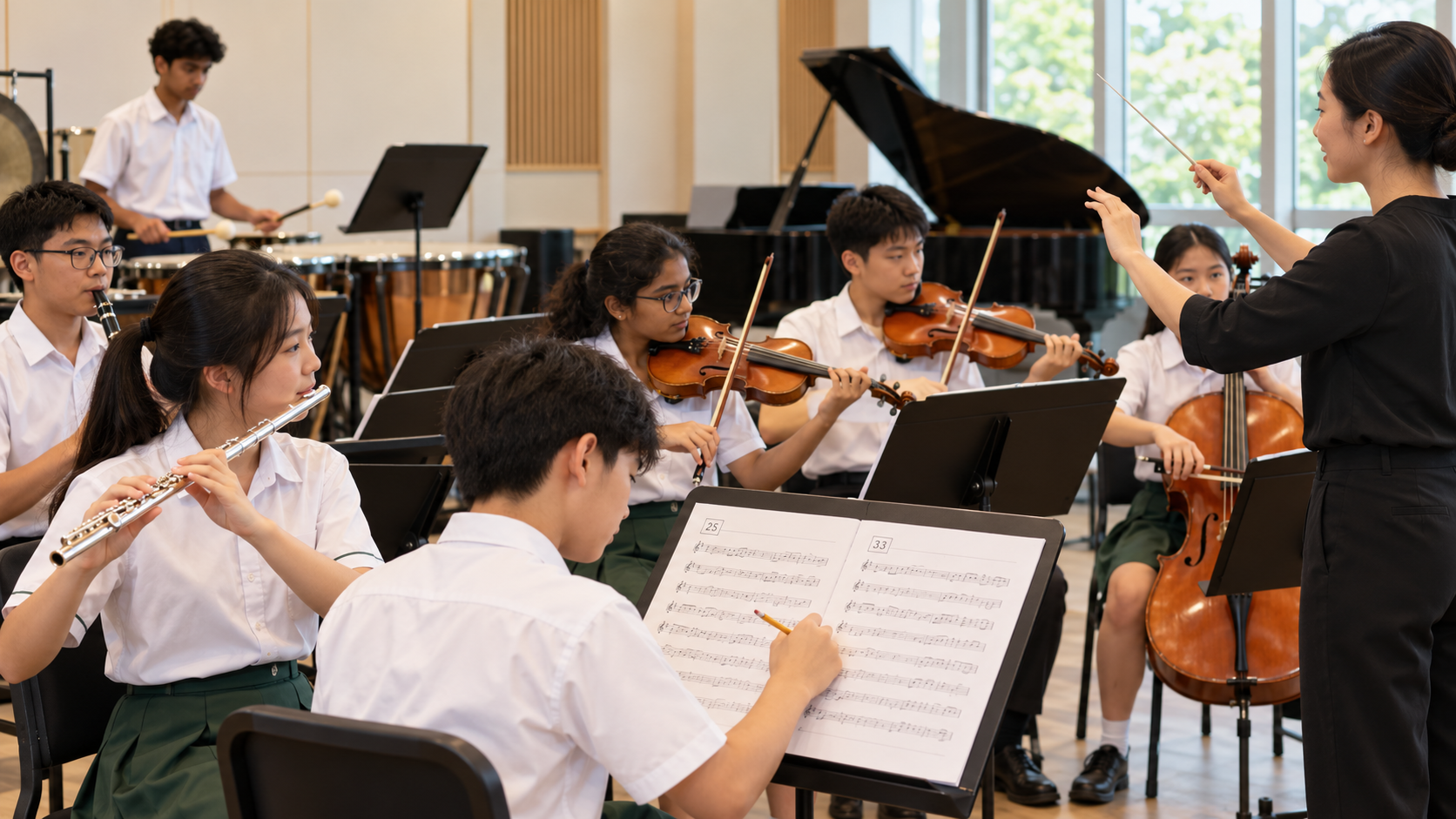
After PSLE results, if your child enjoys trumpet, clarinet, flute, trombone, saxophone, drums or performing instrumental music with a large group, first confirm the official PSLE Score and eligible PG1, PG2 or PG3 Posting Group. Then compare the actual Concert Band or Symphonic Band CCA offered by schools the child can enter. Edgefield Secondary says new Secondary 1 band members are assigned to suitable woodwind, brass or percussion sections; Hillgrove and Woodlands Ring Secondary explicitly say prior band experience is not required; Yusof Ishak Secondary lists a Concert Band with woodwind, brass and percussion; and Canberra Secondary offers a Symphonic Band. These programmes vary in instrument allocation, beginner coaching, rehearsals and school performance commitments.
Ask what instruments a newcomer can learn, whether the school provides instruments, how sections are assigned and what pupils do during ordinary rehearsals. Concert Band, Symphonic Band, a percussion ensemble, choir and music-production club are not interchangeable; Dunman Secondary’s long-running Concert Band, for example, also publishes extra Saturday or holiday practices before major events. School admission does not automatically entitle every pupil to a preferred instrument or selected performance. Compare academic teaching, physical readiness, instrument care, timetable and travel, then rank six genuinely suitable eligible schools in actual preference order with realistic historical cut-off-point alternatives.
- Confirm the S1 Option Form, official PSLE Score and selected Posting Group before school comparisons.
- Distinguish Concert Band and Symphonic Band from Choir, percussion ensemble and music production.
- Edgefield describes first-year instrument assignment; Hillgrove and Woodlands Ring welcome beginners.
- Ask how brass, woodwind and percussion sections are coached and whether a preferred instrument is guaranteed.
- Compare Canberra, Yusof Ishak, Hougang, Ang Mo Kio and Dunman current programmes.
- Check school instruments, maintenance, safe practice, uniforms, costs and section rehearsals.
- Plan for weekly sessions, selected performance seasons, possible Saturdays and transport.
- Rank six eligible schools by genuine preference, using previous COPs cautiously.
Definition lock: a Concert Band is an ensemble, not a solo lesson
A Concert Band combines different instruments to play music together under a conductor. The group commonly includes woodwind, brass and percussion sections, and members need to listen and coordinate with many other musicians. A pupil may learn an individual instrument, but the purpose of the CCA includes shared interpretation and responsibility for the whole band.
Parents should ask whether the child would enjoy practising alone and playing in a large group. A solo piano interest may not automatically transfer into band, and a child who loves percussion may be assigned a particular role rather than every instrument. The ensemble’s teaching and culture matter more than a photograph of its largest performance.
Parent action: Ask whether the child genuinely wants instrumental ensemble music.
Posting Group eligibility is not a measure of musical talent
PG1, PG2 and PG3 facilitate Secondary 1 admission under Full Subject-Based Banding. They do not measure music reading, rhythm, breath control or willingness to practise. Subject G-levels are separate academic arrangements. A young musician may have strong performance ability despite an uneven PSLE academic profile.
Start from the official S1 Option Form and shortlist eligible schools. A primary-school music certificate is not a general exemption to ordinary school posting. If there is a successful DSA-Sec music allocation, that follows its own formal commitment and should not be confused with ordinary CCA entry.
Parent action: Verify academic eligibility separately from musical experience.
Edgefield explains how new members join instrument sections
Edgefield Secondary’s August 2026 Concert Band page says Secondary 1 entrants are assigned a suitable section and learn the basics of instruments such as flute, clarinet, saxophone, trumpet, trombone, euphonium, tuba or percussion. The band also takes part in school and public performances while developing cooperation and responsibility.
This is useful because new pupils may not be guaranteed their first-choice instrument. Ask how assignment is made, what happens when a child is a complete beginner and whether changes can be considered later. A well-explained section system can help families set realistic expectations before posting.
Parent action: Ask Edgefield how section placement works for the incoming 2027 cohort.
Hillgrove explicitly welcomes pupils without prior band training
Hillgrove Secondary’s September 2026 Concert Band page says new members do not need previous instrumental experience, although they should be willing to learn and commit to regular practice. It lists Wednesday and Friday training and opportunities for camps, performances and leadership.
Parents should still check actual capacity and allocation rules, because welcoming beginners does not necessarily mean every applicant gets a place. Ask about the first term’s coaching and the school’s instrument provision. A pupil who has never read a band score may make meaningful progress when teachers introduce fundamentals gradually.
Parent action: Ask what a complete beginner learns during Hillgrove’s first few months.
Woodlands Ring also describes a beginner-friendly band
Woodlands Ring Secondary’s August 2026 Concert Band page states that prior music experience is not required. It describes varied repertoire including band classics, marches and contemporary music, as well as performances at cultural and school events. Its emphasis includes commitment and learning through shared music.
A child interested in modern tunes may enjoy that variety but should understand that group rehearsals also include technical exercises. Ask what new members do before joining major performances and whether instruments are supplied. A broad repertoire is valuable when students learn to interpret it, not just play famous melodies.
Parent action: Verify Woodlands Ring’s current first-year learning and rehearsal schedule.
Yusof Ishak’s Concert Band includes all three major sections
Yusof Ishak Secondary’s July 2026 Concert Band page describes woodwind, brass and percussion musicians working together in school events, concerts and Singapore Youth Festival. Its published Wednesday and Friday schedule also illustrates the practical time commitment of a school ensemble.
Ask how first-year members are assigned, how they receive coaching and what counts as regular participation versus selected public performance. A student might value the chance to accompany school ceremonies, while another prefers concert music. The school should remain a suitable everyday learning environment beyond the band’s reputation.
Parent action: Compare the actual instrument sections and first-year training experience.
Canberra’s Symphonic Band offers another ensemble route
Canberra Secondary’s September 2026 Symphonic Band page describes musical learning, leadership, confidence and school performances, with past SYF participation. Symphonic Band and Concert Band names may differ in usage, but families should not assume that one title guarantees a particular orchestra-style instrumentation or repertoire without checking the specific school.
Ask which instruments are available and how new members learn the programme. The word symphonic should not be treated as proof of a professional orchestral qualification. What matters to the child is the real teaching, the ensemble’s musical culture and whether there is a place for beginners.
Parent action: Ask Canberra about current instruments, newcomers and the weekly practice plan.
Dunman’s Concert Band has a long history and extra sessions
Dunman Secondary’s current Concert Band page describes an ensemble founded in 1969, bringing together brass, woodwind and percussion. It lists Tuesday and Friday rehearsals, with possible Saturday practices and holiday sessions before the Singapore Youth Festival or major performances.
Parents should treat the extra practice information seriously when comparing the school commute and study schedule. A motivated pupil may enjoy frequent rehearsal, but the family must plan for transportation and rest. A band with a long history does not guarantee one child a selected solo or a public award.
Parent action: Ask how often extra practices occur during major performance seasons.
Hougang’s Symphonic Band has varied instrument sections
Hougang Secondary’s August 2026 Symphonic Band page lists section leaders covering flutes, oboe, clarinet, saxophone, trumpet, French horn, trombone, euphonium, tuba and percussion. The list shows the variety of responsibilities a school ensemble may distribute across pupils rather than placing everyone on the same instrument.
Ask what the new cohort is likely to be assigned and how beginners are supported by instructors and older members. Senior student-leader names and instruments describe the current team; they do not predetermine next year’s allocation. A child’s instrument may be chosen for ensemble balance as well as personal preference.
Parent action: Confirm which instruments are available for first-year assignment.
Ang Mo Kio also highlights a percussion ensemble
Ang Mo Kio Secondary’s September 2026 Concert Band page includes a percussion-ensemble recognition in its 2025 SYF achievements, alongside full Concert Band participation. This illustrates that percussion can involve smaller groups or special pieces within a broader band programme.
Parents should not infer that the school operates a separate dedicated percussion CCA available to all pupils. Ask whether the child would be a full band member, a percussion-section participant or eligible for a selected ensemble performance. The distinction matters for training and expected repertoire.
Parent action: Ask what percussion participation means in the current band structure.
Woodwind instruments require sustained technical learning
Flutes, clarinets and saxophones involve breath, finger coordination, sound production and score reading. Each instrument has its own demands and maintenance. A beginner may find the first weeks very different from listening to a polished senior performance.
Ask whether coaches teach fundamental sound production and how pupils are supported when progress is slow. School provision of instruments and consumables may differ. Parents should not purchase an expensive instrument before the receiving school’s assignment and requirements are known.
Parent action: Ask how the school introduces woodwind sound production to beginners.
Brass instruments require a different kind of coordination
Trumpet, trombone, French horn, euphonium and tuba players must develop breath control, musical listening and appropriate technique. They also have different sizes and roles in an ensemble. A child may prefer a bright high instrument but be placed in a different section according to the school’s current needs.
Ask how instructors consider the pupil’s readiness and comfort when assigning brass instruments. Training should be age-appropriate and supportive rather than forcing a child to sound like an advanced senior immediately. Ensemble balance is a legitimate practical consideration.
Parent action: Ask how first-year brass players are assigned and guided.
Percussion is more than playing the loudest drum
A percussion section may include snare drum, bass drum, mallet instruments, cymbals and other appropriate instruments. Different parts require accurate timing, listening and a clear understanding of the score. The percussionist’s role is often to support the entire ensemble, not simply make the most noticeable sound.
Ask whether the band teaches several percussion techniques and how beginners develop rhythm and musical coordination. A student interested in rock drumming might enjoy some skills but should understand that concert percussion can involve a wider range of instruments and responsibilities.
Parent action: Ask which percussion instruments the child may actually learn and play.
A first instrument is not always a permanent choice
Schools may allocate a beginner according to instrument availability, ensemble balance and the child’s suitability. As students develop, the teacher or conductor may consider changes or additional instruments, but that possibility should not be promised without school confirmation.
Ask what the selection process involves and how the child can express preferences. A student who has never tried a euphonium may discover enjoyment through patient practice. Parents can help by valuing new learning rather than insisting on a specific instrument label as a measure of status.
Parent action: Record the pupil’s preferences and the school’s actual instrument assignment rules.
Band rehearsals teach listening and timing
An individual student may learn a musical line but still need to hear the conductor, other instruments and changes in tempo. Ensemble practice involves entering at the right moment, adjusting volume and interpreting musical phrasing with others. A good band should teach these skills rather than assume every new member already has them.
Ask whether the programme includes section rehearsals and full-band practice and how younger members are prepared. A pupil can improve substantially by learning to listen and respond rather than merely playing louder. This supports confidence and cooperation.
Parent action: Ask how the child learns to maintain their part within the ensemble.
Music literacy should be developed progressively
Some students enter band already able to read notation, while others are learning a score for the first time. Staff may use rhythm exercises, instrument instruction and practice with simple pieces before introducing demanding repertoire. The educational value lies in building understanding, not embarrassing beginners for what they have yet to learn.
Ask what music-reading skills are expected on entry and how the school supports pupils without private lessons. A suitable band may provide a route for novices, as Hillgrove and Woodlands Ring explicitly emphasise. The family should not invent expensive prerequisites.
Parent action: Ask what a new musician will be able to read and perform after the first term.
Band music can connect cultural appreciation and school identity
Concert bands may perform marches, concert compositions, film music and music influenced by different cultures. School ceremonies and National Day events can offer meaningful occasions to understand why pieces are selected. Yusof Ishak and Woodlands Ring describe participation in school celebrations as well as concerts.
Ask how teachers explain the music and its context. A pupil may enjoy popular music but learn to appreciate other repertoire through guided listening. A school programme should encourage respect for the sources of the music, not treat unfamiliar traditions as decoration.
Parent action: Ask what the piece communicates and why it suits the performance.
Section rehearsals and full-band rehearsals are different
A band may divide into woodwind, brass and percussion sections to practise particular passages, then combine everyone to hear how the music works as a whole. A student can play correctly when practising alone and still need work on timing and balance during the full rehearsal.
Ask how the school structures section coaching and whether beginners receive attention from instructors rather than relying solely on senior peers. A good band helps pupils understand both their own part and the group’s sound. Regular opportunities to ask questions matter more than the size of the ensemble.
Parent action: Ask what new musicians learn during sectional practice.
A conductor communicates musical choices
Band members follow a conductor who helps organise tempo, entrances, dynamics and the character of the music. A pupil may need to learn how to read cues while handling an unfamiliar instrument. This can be demanding initially, especially when many people play different parts.
Ask how instructors introduce conducting signals and help students respond together. Good teaching makes the purpose of each cue clear rather than expecting blind imitation. A student who learns to listen and adjust with the group develops a more meaningful understanding of ensemble performance.
Parent action: Ask how the child knows when to enter and how loudly to play.
Instrument size and maintenance matter
Band instruments differ in shape, weight, handling, assembly and maintenance. A beginner allocated a large instrument or one with particular cleaning needs should receive appropriate school guidance. Parents should not assume every instrument is safe to store, transport or maintain in the same way.
Ask whether the school supplies instruments, what pupils may take home and which care procedures are approved. A teacher should explain appropriate handling rather than leave a new pupil to work from an unverified internet tutorial. Responsibility for shared instruments is part of the education.
Parent action: Confirm equipment care, storage and transport before the child takes an instrument home.
Hygiene is relevant to shared or wind instruments
Woodwind and brass instruments often involve mouthpieces and other personal-contact components, while shared percussion tools need appropriate care. Schools should provide instructions concerning suitable cleaning and hygiene. A parent should not improvise chemical treatments or dismantle equipment without guidance.
Ask whether any personal item is compulsory and how school-owned instruments are handled between users. Appropriate maintenance protects both pupils and equipment. The family should follow the actual instrument assignment and instructor recommendations instead of assuming one method suits every material.
Parent action: Obtain the school’s current hygiene and maintenance instructions.
Practice at home should have a manageable routine
Learning an instrument usually requires more than attending a weekly rehearsal. The pupil may be encouraged to practise approved exercises outside CCA, but the actual expectation should be clarified with teachers and balanced against homework, neighbours and rest. A child should not be pressured into long exhausting sessions to prove commitment.
Ask how the school supports progress and whether there is access to suitable practice facilities. Short, thoughtful practice can be valuable when the student understands what to improve. Families should avoid imposing a professional musician’s schedule on a Secondary 1 beginner.
Parent action: Ask what practice is recommended and where it can reasonably happen.
Band music and music production are different pathways
A student who wants to play trumpet or clarinet with an ensemble may enjoy Concert Band, while another who wants to produce electronic beats might prefer digital music lessons. Both involve musical thinking but use different tools and performance contexts. A school with a large band does not automatically offer advanced recording or songwriting.
Ask the child whether they prefer live ensemble music, solo instrumental learning or digital creation. The school may offer more than one path across its Music curriculum and CCAs, but the family must verify actual access. Avoid ranking schools based only on a general label that says music.
Parent action: Distinguish instrumental performance from recording, songwriting and Choir.
Concert Band and marching band should not be confused
A Concert Band may perform in a concert setting or at school ceremonies, while a marching formation involves different movement and parade demands. Some schools use bands to accompany uniformed groups or events, but that does not prove every member will march or that the school has a formal competitive marching-band programme.
Ask what ordinary rehearsals and performances actually involve. Yusof Ishak describes providing live music for school celebrations, which is a different experience from entering a specialised marching competition. Families should choose the child’s real interest rather than an imagined set of duties.
Parent action: Ask whether the school band normally performs seated, standing, marching or in several formats.
A selected percussion ensemble has its own requirements
Some bands may prepare a smaller percussion ensemble for a festival. Ang Mo Kio’s 2025 recorded Percussion Ensemble result illustrates that this can exist alongside the full Concert Band. A pupil who joins as a percussionist is not automatically guaranteed selection for every additional ensemble.
Ask how percussion members are coached and what opportunities exist for beginners. A child can develop rhythm and ensemble skills through regular practice even when a specialised team is not available. Parents should not choose a school only from one award listing.
Parent action: Separate section membership from selected percussion-ensemble events.
Student leaders and section leaders are different roles
Band pages may list a band major, drum major, section leaders, quartermasters and librarians. Each responsibility can involve different organisational and musical tasks. An incoming Secondary 1 pupil usually needs time to learn the ensemble before taking on significant selected leadership work.
Ask how responsibilities are earned and whether every student has opportunities to contribute through reliable practice and care for shared materials. A leadership badge should not be the only measure of participation. Students can show responsibility without holding a formal title.
Parent action: Ask how the band develops both ordinary members and selected leaders.
SYF performance results are historical
Concert and Symphonic Bands may publish Singapore Youth Festival certificates and earlier concert achievements. These reflect particular groups and year-specific judging. They do not guarantee that every new member will perform at the next festival or that the school will receive an identical result.
Ask what pupils learn in regular rehearsals and how they receive feedback when a piece is difficult. A good music programme can be valuable without the highest certificate. Parents should prioritise the quality of instruction, wellbeing and authentic interest over a public award table.
Parent action: Compare ordinary coaching and festival achievements separately.
Performance seasons may involve Saturdays and holidays
Dunman’s published programme describes possible Saturday and holiday practice in preparation for SYF or major events. Other bands may also add rehearsals beyond their regular two afternoons. This is important for families who assume all CCA time is reflected in one weekly timetable.
Ask the school what additional commitments were typical in a recent year and how families receive notice. A motivated student may enjoy intensive preparation while still needing sleep and academic study time. A sustainable schedule should be part of the school-choice conversation.
Parent action: Compare regular weekly practice and selected major-event preparation.
Public performance can teach collaboration and stage discipline
School bands may perform at National Day events, concerts, exchange programmes or community occasions. Each event requires preparation, punctuality and respect for other performers and audiences. Some pupils may play while others help with instruments and organisation, depending on their readiness.
Ask how first-year students are introduced to public performance and whether they receive useful preparation. A school should not promise every child a featured solo or a particular concert. Group contribution can be meaningful even without individual publicity.
Parent action: Ask what a newcomer may do during the band’s first public event.
Instrument and uniform costs should be verified
Musical instruments can be expensive, and some families worry that the child must immediately purchase a personal trumpet or clarinet. A school may provide shared instruments or have specific supply arrangements. Performance uniforms, consumables and transport may also involve different costs.
Ask which expenses are compulsory and whether the school offers support through its normal channels. Do not buy an instrument based solely on a webpage before the section assignment is confirmed. A child’s ability to participate should be considered with the family’s real budget.
Parent action: Request the current instrument, uniform and maintenance requirements before shopping.
Academic foundations still matter to a musician
Concert Band may develop attention, cooperation and enjoyment, but it does not replace English, Mathematics, Science or other subjects under Full SBB. Some pupils are musically strong while needing extra academic help; others excel at schoolwork but find music reading unfamiliar. A good secondary school should support both.
Ask how CCA commitments fit around assessments and what help pupils can seek with academic topics. An appropriate music opportunity should enrich learning rather than make the family choose between constant rehearsal and necessary study. Balanced education remains the goal.
Parent action: Evaluate the ordinary academic programme alongside the band.
A longer commute can affect instrumental practice
Concert Band rehearsals often finish late in the afternoon, and additional practices may extend later. Carrying equipment or travelling after a performance can add practical demands. A school that looks acceptable for morning travel may feel far away after two rehearsal days.
Test the real route home and ask about instruments or materials the child must transport. A nearby school with supportive beginner teaching may offer a more sustainable experience than a distant prize-winning band. The decision should take daily wellbeing into account.
Parent action: Compare the ordinary and rehearsal-day journey before ranking schools.
School cut-off points and instrument access are separate uncertainties
A previous-year PSLE cut-off point records the last admitted pupil under a relevant Posting Group in a completed exercise. It may change with demand and available places. The existence of a famous band does not create a special general admissions tie-breaker, and a school place does not guarantee a preferred instrument.
MOE advises including two or three genuinely suitable schools whose previous COPs were less stringent than the child’s score among six preferences. Every option should remain acceptable even if a chosen CCA is full or a specific instrument is unavailable.
Parent action: Record school entry, band selection and section assignment independently.
The right Concert Band school develops musical confidence and belonging
Concert Band can help a pupil learn to read music, perform with others and contribute to a shared purpose. Some may pursue advanced musical education, while others will keep instrumental performance as a lifelong interest. A child does not need prior private lessons or immediate awards to benefit from a welcoming programme.
Choose among eligible schools using the real beginner pathway, teacher guidance, instrument availability, academic support and a practical commute. After posting, encourage the student to practise responsibly and make friends while adapting to secondary lessons. The best school offers meaningful musical growth within a healthy overall education.
Parent action: Select an environment where the pupil can learn an instrument, cooperate and thrive.
Frequently asked questions about Concert Band and school choice
Is Concert Band the same as Choir?
No. Concert Band involves instrumental ensemble music, while Choir focuses on singing.
Does Edgefield assign instruments to Secondary 1 pupils?
Its current Concert Band page describes assignment to suitable brass, woodwind or percussion sections.
Do Hillgrove and Woodlands Ring require prior experience?
Their 2026 descriptions say beginners can join without prior instrumental experience, subject to actual entry arrangements.
Can pupils insist on a preferred trumpet or clarinet?
Not necessarily. Assignment depends on school arrangements and ensemble needs.
Does Symphonic Band always mean a different formal qualification?
No. Check the actual band’s instrumentation, training and curriculum rather than the name alone.
Can PG1 students enjoy Concert Band?
Yes. Posting Group is not an assessment of musical potential.
Are percussion ensemble awards separate from full Concert Band?
They may be. Ask how the school assigns selected ensemble participation.
Do all bands rehearse two days a week?
No. Schedules differ and some schools add Saturday or holiday sessions.
Must families purchase a personal instrument?
Not automatically. Ask what the school supplies or requires.
Does a band membership guarantee MEP?
No. Academic Music programmes and CCAs have separate eligibility.
Are past SYF results guaranteed?
No. They describe earlier cohorts and cannot promise future outcomes.
How should the six schools be ranked?
In true eligible preference order with realistic historical alternatives.
Official Concert Band programmes and related parent guides
Edgefield Secondary Concert Band
Hillgrove Secondary Concert Band
Woodlands Ring Secondary Concert Band
Yusof Ishak Secondary Concert Band
Canberra Secondary Symphonic Band
Hougang Secondary Symphonic Band
Ang Mo Kio Secondary Concert Band
Tampines Secondary Concert Band CCA schedule
eduKateSG Music Production and Songwriting School Guide
eduKateSG Choir and Show Choir School Guide
eduKateSG PSLE Results Parent Guide Hub
Reviewed 7 November 2026. Instrument assignment, beginner admission, school band rehearsals and selected performance activities may differ for the incoming 2027 Secondary 1 cohort. Verify actual school instructions. The 2026 PSLE results date is still tentative and historical school COPs are not admission guarantees.