
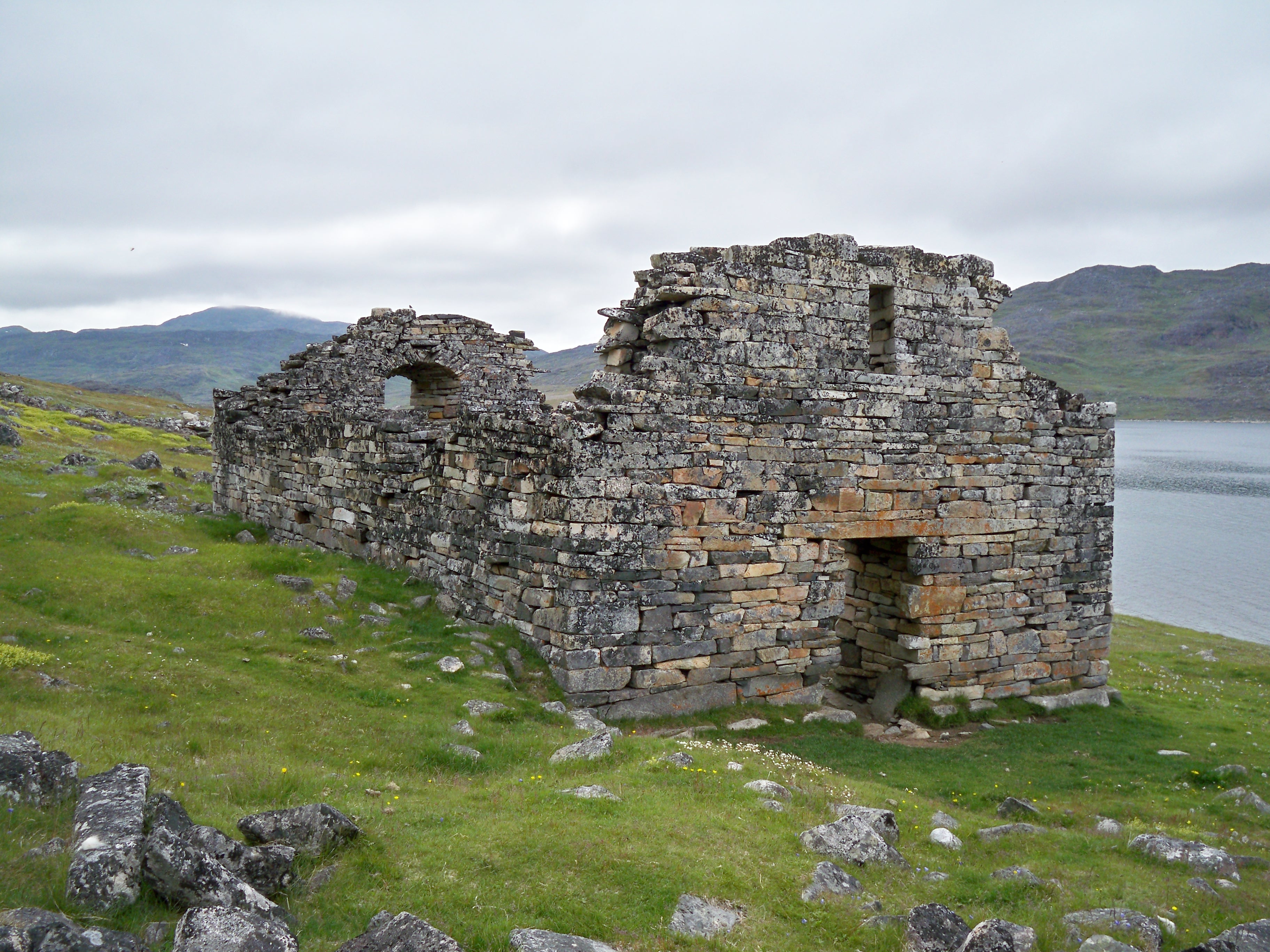
What will happen to civilisation if a remote community relies on both a difficult environment and a distant market that starts to change? Medieval Norse settlements in Greenland offer a remarkable historical case. Farming and hunting communities established themselves in the south of the island around the late tenth century. After centuries of life, their distinctive settlements ceased to function during the fifteenth century.
Did you know? The familiar answer—’Greenland grew cold, so the Vikings disappeared’—is too simple. Newer research points to drying conditions near farms, changing relative sea levels, long-distance walrus ivory trade and wider social and economic decisions. These pressures did not necessarily arrive together or affect every person equally.
This article examines why Norse Greenland settlements ended, how climate change and trade dependence interact, and what future communities can learn. Crucially, the Norse story is not the history of everyone on Greenland. Inuit communities have their own long histories, identities and continuing presence.
Norse Greenland in one minute
| Question | Quick answer |
|---|---|
| When were the Norse settlements founded? | Around 985 CE, in southern and southwestern Greenland, with a settlement history continuing into the fifteenth century. |
| What were the main livelihoods? | Livestock raising, farming in favourable niches, marine hunting and exchange. |
| Why did the settlements end? | No single certain cause; researchers examine environmental change, trade, demography and social choices. |
| Was it simply too cold? | A 2022 study near the Eastern Settlement found prolonged drying rather than a marked local cooling during occupation. |
| Did trade matter? | Ancient DNA identifies substantial Greenlandic walrus ivory exports into medieval European markets. |
| Was the island empty afterward? | No. Greenland’s Indigenous Inuit peoples and their cultures were not the vanished Norse farming settlements. |
| Can today’s climate be predicted from this story? | No. Modern communities have different institutions and technologies; the case highlights interacting vulnerabilities. |
How a North Atlantic farming settlement survived
Greenland’s south has relatively sheltered valleys and fjords where grass can grow in summer. Norse farmer-hunters developed dispersed farmsteads, grazed animals, stored winter fodder and drew on resources from the sea. The landscape was demanding, not lifeless.
The UNESCO description of Kujataa Greenland presents a landscape shaped by different Norse and Inuit histories of farming, hunting and resource use. Visible farm ruins, fields and pastures remain. Modern communities inhabit and work in parts of this landscape; the archaeological sites are not evidence that nobody can live there.
In a short growing season, an apparently modest loss of hay can matter. Cattle and sheep need stored fodder to survive winter. A farmer could improve the next year’s prospects by tending meadows or adapting the herd, but every intervention carries costs and limits.
Now add distance. A remote settlement may produce some of its food and goods locally while relying on occasional maritime connections for other materials, ideas and institutional relationships. Ships and markets are therefore more than conveniences: they affect how the settlement fits into a wider world.
Did you know? Drying may have mattered more than cooling
Researchers have debated for decades whether colder conditions linked to the late medieval climate transition made Norse Greenland less viable. A 2022 Science Advances study by Boyang Zhao and colleagues examined lake sediments near a former Norse farm in the Eastern Settlement.
The research reconstructed aspects of temperature and moisture history from environmental indicators. It found little substantial temperature change during the period of occupation at that local study site, but a persistent drying trend. That matters for grass production and the supply of fodder needed by livestock through winter.
The authors concluded that increasingly dry conditions may have been a more important pressure on this settlement than a simple story of cooling. Their results do not establish that every farm experienced identical changes or that dryness alone forced the end of Norse society.
This is a useful lesson in scientific reasoning. ‘Climate change’ does not mean only rising or falling temperature. Rainfall, soil moisture, coastal conditions, wind, sea ice and seasonal timing can have quite different effects on livelihoods.
The trade connection: walrus ivory and European markets
The Norse settlements were linked to medieval Europe through a variety of contacts, including the trade in walrus ivory. In Europe, ivory could become carved religious objects, luxury items and game pieces. Reaching walrus hunting grounds demanded expertise and travel, while obtaining value from tusks depended on buyers far from Greenland.
A 2018 study in Proceedings of the Royal Society B used ancient walrus DNA to trace the origins of ivory found in Europe. Its evidence reveals a major shift toward Greenland sources during the medieval period, showing how important this remote trade link could be.
Further 2024 research in Science Advances used high-resolution genetic sourcing to investigate walrus harvesting in the High Arctic. It also raises questions about long-range expeditions and potential interactions and exchange involving Arctic Indigenous peoples.
What might happen if the market changed? A product can bring income and political links when demand is strong; a decline in demand, changing transport conditions or rising harvesting costs can weaken the same connection. That does not establish that a fall in ivory sales single-handedly ended Norse Greenland. It demonstrates an additional economic vulnerability alongside environmental pressures.
A striking paradox emerges: the activity that once made a settlement more secure can later make it dependent on distant decisions. A community may be highly skilled at one valuable export and still be exposed when the wider market changes.
Another possibility: the coastline was changing too
The medieval Greenland coast was shaped by more than ordinary tides. Ice loading, land movement and ocean changes affected the relative position of sea and land. A 2023 PNAS study modelled relative sea-level rise around Norse settlements and concluded that coastal inundation could have contributed to their decline.
Shoreline change could affect grazing areas, transport, landing places and the usefulness of buildings. This is one of several proposed pressures. A modelled coastal hazard is not proof that each family lost its farm to the sea.
Nor should this historical result be flattened into a claim that relative sea levels always rise across Greenland. A 2026 PNAS study of future conditions around Aasiaat in western Greenland describes projected local relative sea-level fall in some scenarios. Location, period and the effects of changing ice loads matter.
The lesson is to read the geography carefully. The phrase ‘sea-level change’ must be connected to a particular coast and a particular time.
Why ‘the Vikings disappeared’ is the wrong headline
Archaeology and historical records show a distinctive Norse settlement system ending, not a fully documented account of each inhabitant’s fate. Some people may have moved elsewhere; the precise combination of demographic losses, migration and later contacts remains uncertain.
The surviving ruins are not an obituary for every person. A church building can cease to be maintained while individuals pursue other lives. The end of a settlement is an observable material process; a claim about what happened to everyone needs a different quality of evidence.
It is equally wrong to describe medieval Greenland as though only Norse people existed there. Inuit ancestors expanded across the Arctic and Greenland in changing patterns, with sophisticated marine and environmental knowledge. The histories of Norse and Inuit settlements differ, and their interactions remain subjects of scholarly study.
UNESCO’s 2025 account of Kujataa and living Inuit knowledge shows why a historical comparison must include present communities rather than use their homeland as scenery for a European disappearance story.
A cause-and-effect model: five interacting pressures
- Environmental conditions: pasture moisture, seasonal weather and coastline changes affect what farming can produce.
- Food and labour: herds depend on fodder and skilled care, making repeated bad seasons more expensive.
- Trade conditions: exports and essential maritime relationships depend on distances, demand and political contacts.
- Demographic choices: households may adjust livelihoods, seek new routes or move when prospects change.
- Institutional flexibility: shared rules, knowledge and willingness to reorganise affect how many alternatives remain.
Those arrows do not determine a single outcome. The same decline in income could be managed by one community but become existential for another. The difference might be reserves, allies, access to alternate work or willingness to change how services are provided.
What could happen to future civilisation? Three scenarios
Scenario A: a remote community diversifies its livelihood
Hypothetical. A coastal settlement depends heavily on one export. Changing markets reduce income, but community leaders, local businesses and residents develop alternative livelihoods while protecting education and essential services. Not everyone benefits equally, yet the settlement retains viable choices.
Scenario B: climate damages a narrow food base
Hypothetical. Repeated dry seasons affect grazing and stored fodder. Farmers coordinate imports and land management while adapting herds. If transport is reliable, much of the shock can be absorbed. If shipping is disrupted at the same time, the burden rises.
Scenario C: shocks compound across systems
Hypothetical. Loss of market access coincides with repeated resource shortages and damage to coastal infrastructure. Families and firms relocate, public budgets weaken and repair becomes slower. The original pressure grows into a wider crisis because alternatives were too limited.
These are examples of how to reason about futures, not estimates of their likelihood. Different modern places have different risks and degrees of autonomy.
What Norse Greenland teaches about the word ‘adaptation’
Adaptation is often presented as a moral test: an old society supposedly failed because its people refused to change. That judgement is often unearned. Archaeological evidence shows that Norse Greenlanders combined farming, marine resources and participation in trade; they were not simply frozen in one unchanging way of life.
People can adapt intelligently and still face constraints they cannot individually control: distant markets, shipping routes, land limits, disease or political changes. Conversely, moving away can sometimes be an adaptation rather than proof of failure.
A better question is: What choices were realistically available to different households, and what did each choice cost? That is also the right question to ask when modern communities weigh investments, relocation or changes in traditional livelihoods.
A practical checklist for communities with fragile dependencies
- Track the condition of essential local resources over several seasons rather than trusting one average.
- Ask whether apparently independent suppliers depend on the same port, weather window or market.
- Protect repair skills and keep records that people can use when services change.
- Evaluate alternatives without assuming that one historical livelihood must last unchanged forever.
- Give residents an informed role in decisions affecting housing, culture, land and relocation.
- Distinguish environmental evidence from unsupported claims about people’s abilities or character.
- Recognise the knowledge and rights of Indigenous communities, including the people who live on the land today.
Frequently asked questions
Why did Norse Greenland settlements disappear?
Their distinctive settlement system ended during the fifteenth century. Drought, coastline change, trade links, demographic change and other factors remain active research topics, with no universally proved single cause.
Was the Little Ice Age the only explanation?
No. A 2022 local climate reconstruction highlighted drying rather than pronounced cooling, and archaeological studies consider economic and social pressures.
Did Vikings rely only on farming?
No. Norse Greenlanders combined farming and animal husbandry with marine hunting and connections to distant markets.
Did Inuit civilisation disappear with the Norse?
No. Inuit peoples possess distinct histories and living communities in Greenland. It is inaccurate to equate the end of medieval Norse settlements with the fate of the entire island.
What is the future lesson?
Protect the diversity of viable livelihoods, study local environmental conditions carefully and preserve choices for residents when distant trade and climate change together.
Read more in the Civilisation futures series
- When Trade Networks Break: The Bronze Age Lesson.
- When Nile Floods Change: Ancient Egypt and Climate Stress.
- How Societies Rebuild After Empires Fall.
- Do Civilisations Collapse or Transform?.
Evidence and further reading
- UNESCO World Heritage Centre — Kujataa Greenland: Norse and Inuit farming landscapes.
- Zhao and colleagues, Prolonged drying trend coincident with the demise of Norse settlement in southern Greenland, Science Advances (2022).
- Star and colleagues, Ancient DNA reveals the chronology of walrus ivory trade from Norse Greenland, Proceedings of the Royal Society B (2018).
- Ruiz-Puerta and colleagues, Greenland Norse walrus exploitation deep into the Arctic, Science Advances (2024).
- Sea-level rise in Southwest Greenland as a contributor to Viking abandonment, PNAS (2023).
- UNESCO (2025) — Kujataa, Indigenous knowledge and living communities.
- Photograph of Hvalsey Church by Number 57, Wikimedia Commons, CC0 1.0 (actual modern view of Norse ruins).

Reviewed 24 October 2026. The Norse settlement history, Inuit continuity, modelled climate hazards and modern hypothetical scenarios are distinguished. Featured photo is an actual 2014 picture of Hvalsey Church by Number 57, CC0 1.0, unaltered.