
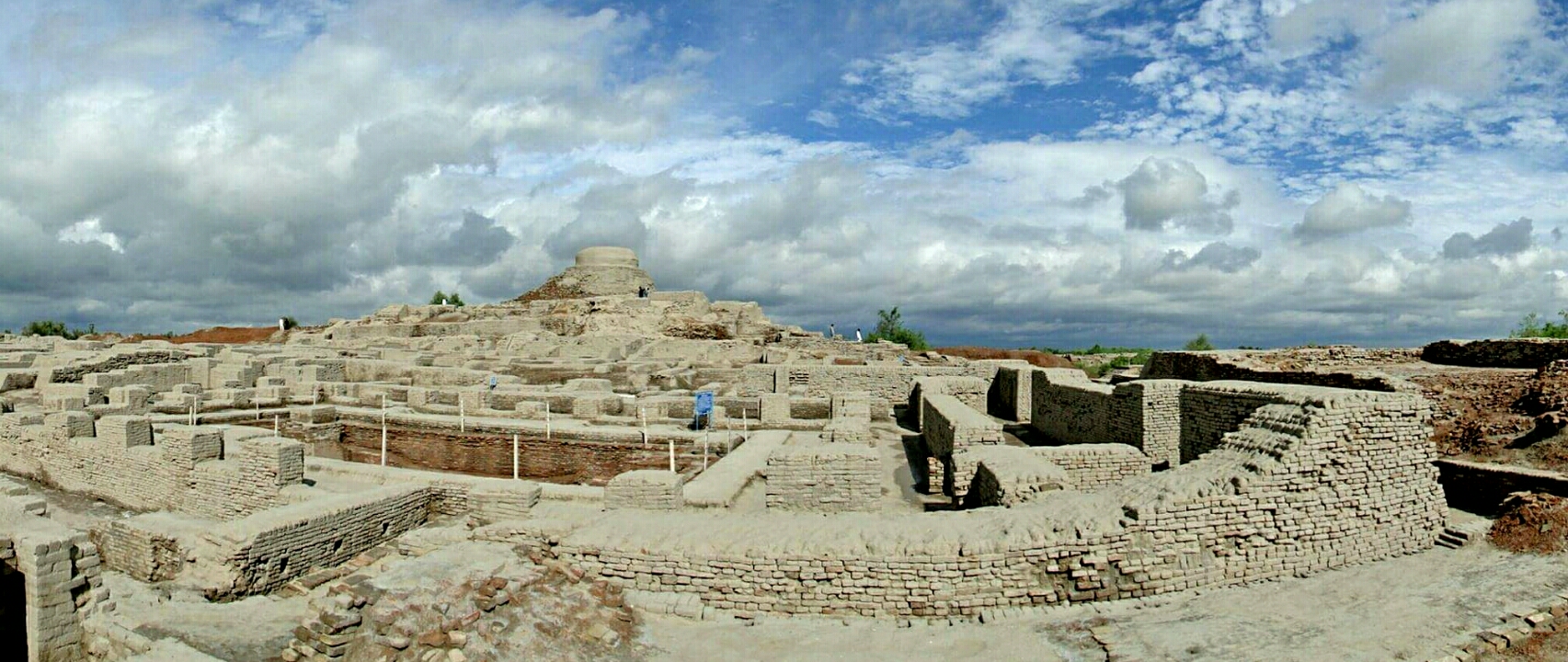
What will happen to civilisation when rainfall patterns and rivers change for generations? The Indus Valley Civilisation offers one of history’s most instructive answers. Ancient cities including Harappa and Mohenjo-daro developed impressive urban systems across parts of present-day Pakistan and northwestern India. But the large-city network transformed over centuries as communities responded to changing water conditions, livelihoods and social connections.
Did you know? The story is not necessarily one of an advanced civilisation suddenly disappearing. A major 2025 scientific study reconstructed long episodes of river drought in the Indus basin and connected those pressures with changing settlement patterns. People could respond by moving, changing crops and organising smaller settlements. Such adaptation has a different meaning from extinction.
Here is the central lesson: environmental pressure + exposure + institutional choices + household adaptation = different possible futures. We can study that chain without claiming that ancient climate research predicts the next century for every modern city.
Indus Valley civilisation in one minute: quick answers
| Question | Quick answer |
|---|---|
| Where was the Indus civilisation? | Across a broad region of South Asia, especially present-day Pakistan and northwestern India. |
| When did large Mature Harappan cities flourish? | Broadly about 2600–1900 BCE, with earlier and later regional phases. |
| What was remarkable about these cities? | Planned streets, elaborate drainage, wells, craft production, shared material practices and extensive exchange networks. |
| Did one event destroy the cities? | The evidence supports a prolonged, uneven urban transformation rather than one universally agreed sudden catastrophe. |
| Did monsoon changes matter? | Hydroclimate records and modelling indicate severe long-term water stress in parts of the Indus basin. |
| What happened to the people? | Populations and settlement practices reorganised. Ancient demographic and cultural relationships remain active research questions. |
| Can this predict the future? | It can reveal vulnerabilities and choices; it cannot fix a date or guarantee modern outcomes. |
First, imagine the daily life of an Indus city
Walk through an ancient city such as Mohenjo-daro. The ruins show the remains of organised streets, brick-built houses, wells and drainage features. Different households could share a built environment designed for repeated, everyday tasks: finding water, managing waste, moving goods and maintaining homes.
The UNESCO World Heritage Centre’s profile of Moenjodaro documents extensive town planning and sanitation features. Archaeologists study these remains alongside ceramics, seals, craft objects, weights and settlement patterns. The buildings reveal forms of coordination, but do not give us a complete constitution or a reliable translation of the Indus script, which remains undeciphered.
That uncertainty is important. It would be misleading to claim we know exactly who governed every Indus neighbourhood, how each decision was voted on or which modern language its inhabitants spoke. The impressive physical evidence deserves attention without inventing missing political details.
Urban living depends on a network of less visible activities. Potters need fuel and materials. Farmers need productive land and stable enough access to water. Builders need skilled workers and supplies. Food must travel from fields to households. A large city cannot simply survive on its architecture.
What happens when the monsoon becomes less dependable?
The South Asian monsoon has always varied. The ancient Indus region also contained different river systems, soils and climatic zones. Some places depended more directly on river water; others relied on seasonal rain or local water-management strategies.
Suppose a farming community experiences repeated years of reduced rain or river flow. Initially, households may use reserves or change their sowing decisions. With prolonged stress, they could shift crops, dig or maintain local waterworks, move closer to dependable sources or leave a large settlement for a smaller one.
A 2025 open-access paper in Communications Earth & Environment, River drought forcing of the Harappan metamorphosis, integrates palaeoclimate proxies with climate and river-flow simulations. The researchers found evidence consistent with severe and persistent river droughts between roughly 4,400 and 3,400 years before present.
The authors identify several drought periods lasting decades or longer; their results suggest declining freshwater availability influenced where people could live. These are modelled reconstructions, supported and constrained by limited palaeoclimate evidence—not daily weather observations from ancient cities.
The accompanying Nature India reporting explains how the effects could differ between the upper, middle and lower Indus basin and other areas. Some localities may have had more manageable water conditions than others. The historical pattern therefore resembles a shifting geography of opportunities rather than one simultaneous desert-wide evacuation.
Did the Indus civilisation collapse, or transform?
Around and after the later third millennium BCE, many large urban centres and shared features of Mature Harappan material culture changed. Patterns of settlement, exchange and production diversified. Archaeologists use terms such as deurbanisation, regionalisation and transformation because a large urban tradition can contract without all of its people disappearing.
No one should translate a shrinking city into a story that its population simply died. Some people may have stayed, others moved, and communities developed different regional practices. Researchers assess archaeological traces; they cannot trace every person’s route.
A long-standing debate concerns which river courses changed and when, and what those changes meant to settlements sometimes grouped with the Indus tradition. The timing and causes differ among regions. Climatic stress is a significant explanation, but agriculture, exchange networks, social decisions and changing channels also matter.
Because the script remains undeciphered, the evidence is especially dependent on material remains and environmental records. That does not make the history unknowable; it means a responsible explanation distinguishes what we can observe from what we infer.
The cause-and-effect map: from rainfall to urban change
- Climate pressure: weaker or less reliable monsoon patterns alter rainfall and river flows.
- Local exposure: some settlements are more dependent on vulnerable water sources than others.
- Production response: farmers adjust crops, seasons and land use; yields can improve or worsen according to local conditions.
- Household decisions: families assess whether to stay, combine livelihoods or move toward more dependable land and connections.
- Urban consequences: shifts in supply, exchange and population affect the viability of large cities and specialist work.
- Institutional adaptation: communities rebuild their everyday arrangements in new locations or at different scales.
Notice that the chain is not automatic. Drought does not force every household to move. A community with reserves, multiple water sources and trusted local coordination may respond differently from one already divided by conflict.
Likewise, a powerful city might survive repeated bad seasons yet be weakened by a loss of distant trade. What matters is how pressures interact. It is the same discipline we use when thinking about electricity, schools, hospitals and food supply today.
Did you know? Moving away can be a survival strategy
When people disperse from urban centres, historians sometimes describe decline. Yet for an ordinary family, moving toward better water, relatives or productive land might be an intelligent response. Smaller settlements may support different combinations of agriculture, crafts and exchange.
We should not romanticise forced movement. Relocation can involve insecurity, the loss of familiar places and unequal opportunity. But we should also avoid presenting urban concentration as the only acceptable form of civilisation. Human knowledge and relationships can persist beyond the boundary of an old capital.
One useful question is whether a society retains the capacity to transmit skills. If builders, farmers and craft workers pass on their knowledge, the story of a changing city has many chapters after the most famous monuments cease to function.
A thought experiment: two river cities, one long drought
Hypothetical, not a reconstruction of Harappa. Imagine two modern cities relying on the same broad river basin. City A has groundwater monitoring, efficient water use, diverse food sources and a trusted process for sharing scarce supplies. City B has leaking distribution, limited local storage and unresolved disputes over water allocation.
Both experience several unusually dry years. City A faces higher costs, restrictions and difficult investments, but maintains essential services. City B experiences uneven outages, reduced farm incomes and pressure on public budgets. People in its most exposed districts begin to move.
The physical pressure is similar, but human outcomes differ because the support systems are different. This is why a climate forecast alone is not a forecast of civilisational collapse. Infrastructure, institutions and fairness can change the consequences.
What might happen to future civilisation? Four conditional pathways
Scenario 1: cities adapt their water systems
A region anticipates drier conditions, protects drinking water and reshapes farming and urban consumption. Some crops and industries change, but essential services continue. Such adaptation costs money and requires cooperation; it does not eliminate all hazards.
Scenario 2: urban life spreads into smaller centres
A very large metropolitan area becomes less attractive as heat, water pressure or housing costs increase. Families and firms move toward multiple smaller cities. Education, skills and trade continue but the spatial organisation of society changes.
Scenario 3: uneven access produces social stress
Water remains available to much of the economy but some districts face repeated shortages or rising prices. Public concern and disputes intensify because vulnerability is unequal. The crisis is not only about total rainfall; it is about who has reliable access.
Scenario 4: multiple shocks outrun repairs
Severe water stress coincides with energy interruptions, poor harvests and delayed infrastructure maintenance. Responses compete for limited money and expertise. Harm can compound, but investments in backup capacity, cooperation and timely relief could interrupt the process.
None of these futures is inevitable. They demonstrate why decisions about water, land, governance and human welfare can matter as much as the original hazard.
What should communities measure before the warning becomes a crisis?
- Reliability: frequency and duration of household water interruptions, by district.
- Food-system flexibility: dependence on a few crops, seasons or transport routes.
- Groundwater and river conditions: data over multiple seasons, not one exceptional weather event.
- Repair readiness: skilled operators, replacement parts and realistic maintenance budgets.
- Health and fairness: whether people can obtain safe water without sacrificing essential needs.
- Mobility: opportunities for people who need or choose to relocate.
- Learning: whether institutions update decisions as evidence changes.
A civilisation does not possess a single ‘survival gauge’. Useful indicators identify practical problems before they become inseparable from bigger ones.
Frequently asked questions
What caused the Indus Valley civilisation to decline?
Researchers examine changing monsoons and river flows alongside economic, agricultural, settlement and social factors. A single universally accepted cause has not been established.
Did Mohenjo-daro vanish in one disaster?
There is no sound basis for presenting the entire Indus urban transformation as a single sudden catastrophe. Major centres changed across a longer period.
Were Indus cities technologically advanced?
They had sophisticated urban planning, wells, drainage systems and craft practices for their time. Calling them ‘advanced’ should refer to specific evidence, not an unsupported ranking of cultures.
What happened to the Indus people?
Population and settlement traditions continued in diverse regional forms. Precise genealogical and linguistic relationships remain complex research questions; there is no evidence that all inhabitants simply disappeared.
Will shifting monsoons force all modern cities to shrink?
No. Modern urban futures differ by geography, infrastructure, wealth, policy, technology and adaptation. The ancient Indus case is a comparison, not a calendar.
Continue exploring civilisation
- When Nile Floods Change: Ancient Egypt and Climate Stress.
- When Water Systems Fail: Lessons from Angkor.
- When Food Production Falls: Mesopotamia and Soil Salinity.
- Do Civilisations Collapse or Transform?.
- Civilisation: The Beginner’s Guide.
Evidence and further reading
- UNESCO World Heritage Centre — Archaeological Ruins at Moenjodaro, urban planning and heritage context.
- Solanki and colleagues, River drought forcing of the Harappan metamorphosis, Communications Earth & Environment, 2025.
- Nature India — Centuries of repeated droughts linked to the Indus Valley Civilisation’s decline, 29 December 2025.
- Nature Portfolio — Research summary of prolonged Indus-basin droughts, 28 November 2025.
- Mohenjo-daro heritage photograph by Nikesh chawla, 2016, CC BY-SA 4.0. Photo shows the archaeological site today, not a contemporary view of the ancient city.

Reviewed 24 October 2026. Historical findings and evidence-based interpretations are separated from hypothetical futures. Featured photograph credit: Nikesh chawla, Wikimedia Commons, CC BY-SA 4.0; image has not been artistically altered.