
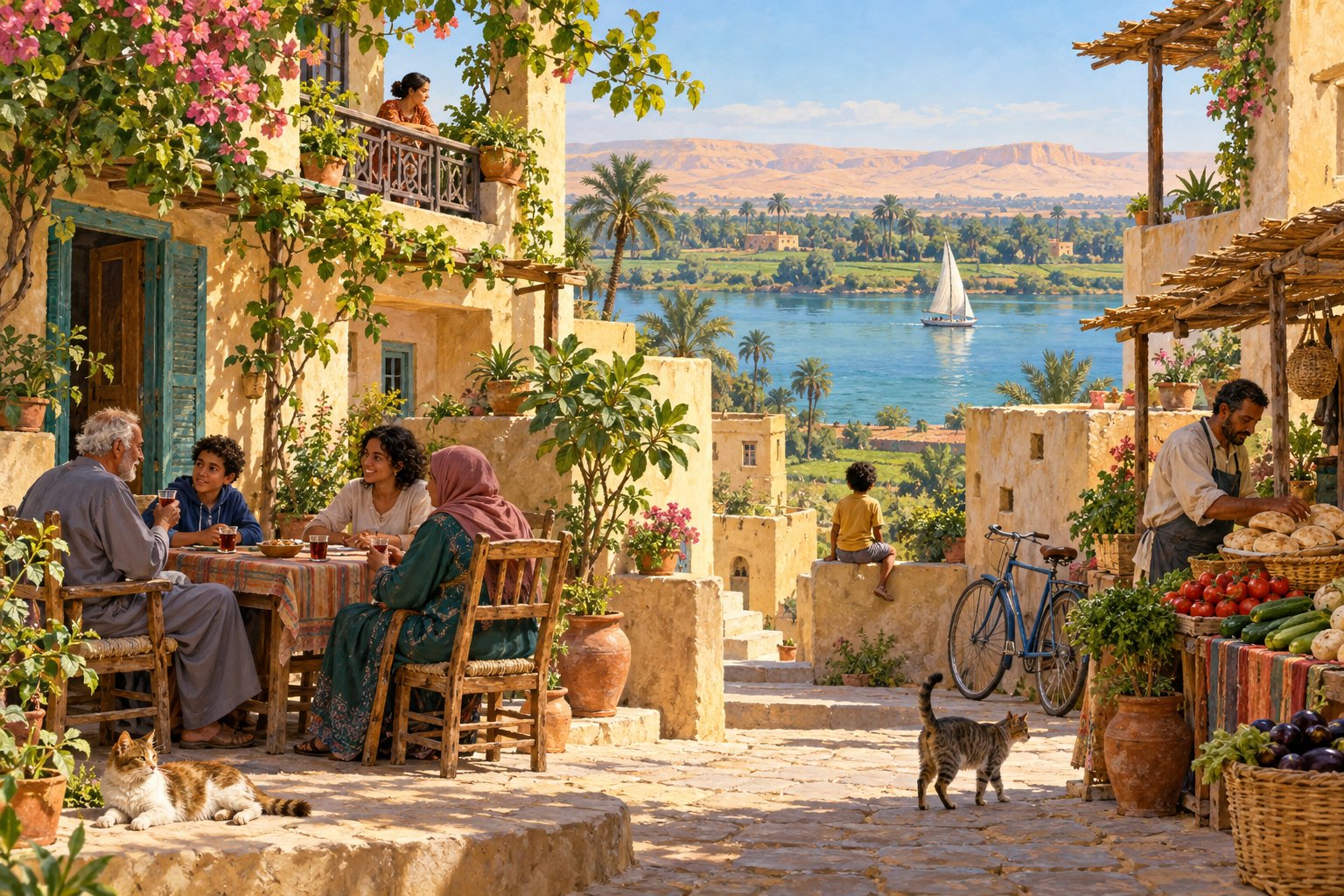
What will happen to civilisation when the river that feeds its farms no longer behaves as people expect? Ancient Egypt offers a powerful example. For many centuries, seasonal Nile flooding supported crops, settlements and institutions. When floods were unusually low or high, communities faced practical problems that could become political ones.
Did you know? The end of Egypt’s Old Kingdom, often dated to around 2200 BCE, is associated with political fragmentation and a period of environmental stress. But the Nile did not simply “turn off”, and the Egyptians did not disappear. Archaeological and historical research shows that changes in rainfall, river behaviour, government, regional power and human adaptation need to be studied together.
This article explains Egyptian Nile floods, the Old Kingdom and First Intermediate Period, crop failure, decentralisation and lessons for future civilisation through short sections, clear mechanisms and conditional scenarios. It avoids claiming that one drought caused every change.
The Nile and civilisation: one-minute answers
| Question | Quick answer |
|---|---|
| Why were Nile floods important? | Floodwaters replenished agricultural basins and helped make farming productive in an otherwise dry setting. |
| Could floods be harmful too? | Yes. Very low floods could leave fields too dry; exceptionally high floods could damage dikes, canals and settlements. |
| When did the Old Kingdom change? | Around the late third millennium BCE; historians differ somewhat in absolute chronology and causal emphasis. |
| What was the First Intermediate Period? | An era of divided regional authority after the Old Kingdom, followed eventually by political reunification and the Middle Kingdom. |
| Did Egypt disappear? | No. Egyptian communities, culture and state traditions continued and adapted. |
| Does the same future await modern river cities? | Not necessarily. River risks differ by geography, technology, institutions and current climate conditions. |
Why ancient Egypt was so dependent on one river
The Nile crossed a region where most land away from the river was extremely dry. Seasonal inundation enabled agricultural production and made a long chain of settlements possible. Cultivation drew on water, fertile sediments, local basin management, canals, dikes and the work of many households.
The annual rhythm shaped labour, harvest and storage. Water rose, spread across managed flood basins and receded, leaving fields where farmers could cultivate grain and other crops. Grain could be stored, exchanged and distributed, helping support crafts, rulers, temples, officials and workers.
Did you know that irrigation in ancient Egypt was not necessarily directed from one palace for every single field? A Journal of Economic Growth research paper describes evidence for important local coordination within Egyptian agricultural systems. That matters when explaining resilience. Central governments could be powerful, yet many daily functions still depended on local work.
A river system is more than water. It connects people who cultivate upstream and downstream, those who maintain embankments, the officials who estimate taxes, the traders who move grain and the families relying on stored harvests.
What happens when the flood is too small—or too large?
An abnormally low inundation could leave fields without enough water and reduce the crop area. Farmers facing poor yields might draw down grain reserves, sell assets or seek other work. Towns might experience higher demand for food and support.
An unusually high flood could damage protective structures, storage or housing. That is a different route to hardship, even though water is abundant. “More water” and “less water” are not opposites in terms of public risk if both exceed the system’s useful operating range.
The same river might perform very differently from year to year. A household able to survive one poor season could be overwhelmed by repeated losses, especially if stores are low and neighbouring regions are suffering at the same time.
A useful way to study history is to ask what capacity existed before the event. Were granaries full? Were canals maintained? Could residents move grain? Could local and central officials coordinate? How did wealth and power determine who received assistance?
The Old Kingdom and the 4.2-thousand-year climate event
Around 4,200 years ago, substantial environmental changes occurred in parts of North Africa and Southwest Asia. Scholars study aridity, river levels, windblown sediments, archaeological deposits and written evidence as clues to the conditions experienced near the end of Egypt’s Old Kingdom.
A 2022 African Archaeological Review synthesis connects the 4.2-thousand-year event with environmental, agricultural and political stresses in Egypt. Evidence suggests the Nile could have been unusually low during important episodes, contributing to difficult harvests and social strain.
But “climate caused the fall of the pyramids” is not a responsible summary. The end of the Old Kingdom also involved political and institutional change. Researchers disagree about which factors were most important and how they interacted. Even dates and labels are reconstructions built from multiple sources.
In a Yale News discussion with Egypt scholars, environmental stress is described as one contributor among several. The researchers also discuss evidence of local responses such as grain reserves, shifts in subsistence and movement toward towns where assistance might be available.
Historical texts about hunger must be read critically. An inscription celebrating a local official for feeding people may record a genuine response, political self-promotion or both. Sediments and settlement patterns can test some aspects of the account, but they do not explain every human decision.
Did Egypt collapse—or change its political shape?
After the Old Kingdom, authority became more regionally divided during what historians call the First Intermediate Period. Local rulers and institutions gained importance, and political contests changed the organisation of the Nile Valley.
Egypt later entered the Middle Kingdom after reunification. That historical sequence does not mean the intervening hardships were trivial. Rather, it demonstrates that the loss of a powerful central court is not identical to the disappearance of farming communities, skills, beliefs and social memory.
The 2025 research on ancient Egypt and environmental shocks analyses the relationship between floods, droughts and political organisation over long periods. Its results should be understood as evidence about mechanisms under research assumptions, not as a calculator that predicts when a modern government will fragment.
A river can affect harvest capacity, and harvest capacity can influence political competition. Conversely, political fragmentation may affect maintenance and food distribution. Cause and effect may run in both directions.
Six steps from environmental pressure to social change
- Water variability: flood volume or timing differs from what producers and institutions can easily handle.
- Agricultural exposure: some areas lose productive days, land or reliable harvests.
- Household pressure: stored food, incomes and debt determine who can adapt without hunger or displacement.
- Institutional response: officials and communities redistribute reserves, coordinate repairs, negotiate disputes—or fail to do so.
- Movement and reorganisation: people may relocate or shift their activities and affiliations.
- Long-term feedback: useful adaptations reduce exposure, while conflict or deferred repairs make the next season more difficult.
This chain is conditional. One weak Nile flood is not automatically a famine. One famine is not automatically the end of a state. The intervening decisions and unequal access to resources are central to the explanation.
What could happen to a future civilisation built around rivers?
Scenario 1: the community adapts before repeated shocks
Hypothetical. Officials and farmers use credible hydrological forecasts alongside local knowledge, review groundwater and irrigation needs, diversify crops and maintain adequate reserves. Water allocation rules are transparent. Crop losses still occur, but vulnerable households have ways to retain access to essentials.
Signs to watch include accessible forecasts, functioning storage, rural incomes, flood-defence maintenance and whether disadvantaged areas receive support early.
Scenario 2: a manageable flood becomes an unequal emergency
Hypothetical. A large flood disrupts some low-lying districts while better-protected places recover quickly. Residents with insurance, savings or transport can adapt; families with limited mobility or insecure housing experience lasting hardship. Citywide recovery figures look reassuring while local loss remains severe.
The important question is not merely whether the river rose but how exposure, housing, health, livelihoods and emergency management divided the outcome.
Scenario 3: consecutive weak harvests strain institutions
Hypothetical. Several dry years reduce yields across connected farming regions. Prices rise, rural workers relocate and public finances weaken. Political disputes over reserves delay investment. A climate problem becomes a governance problem because repeated shocks overwhelm existing arrangements.
This is a serious scenario but not an inevitable destination. Trade alternatives, investment, equitable assistance, international cooperation and better land use can change the outcome.
What ancient Egyptians teach about moving and staying
People may respond to environmental stress by staying and adapting, moving within a region or relocating much farther away. Migration is often portrayed as proof that a society has ended. History suggests that movement can also be a strategy for keeping families, skills and cultures alive.
Moving is not always freely chosen. A household may lack the money, permissions, safety or social contacts necessary to move. A community receiving newcomers may need additional water, housing, health services and schools.
This makes thoughtful planning a question of human welfare rather than a simple choice between abandoning a place and protecting it at any cost. The goal should be to preserve safety and opportunity while respecting people’s agency.
How can we judge whether a river civilisation is resilient?
- Food continuity: do poor harvests translate quickly into hunger, or do secure systems buffer people?
- Flood exposure: who lives and works in the places most likely to be inundated?
- Water reliability: are drought plans realistic under multiple dry years?
- Information quality: do residents receive understandable warnings and trustworthy evidence?
- Local capacity: can neighbourhoods and agricultural districts carry out repairs and distribute supplies?
- Cooperation: do upstream and downstream authorities coordinate essential decisions?
- Recovery: are education, health care, employment and housing restored fairly?
We cannot compress these into one “civilisation survival score”. Indicators are useful because they expose specific weaknesses that can be repaired.
The biggest misconception: history predicts a date
You may see claims that a particular river will dry up and civilisation will collapse in a specified year. Unless such a claim explains its sources, time horizon, uncertainty, engineering assumptions and human responses, it should not be treated as a dependable forecast.
Ancient Egypt survived many changes in flood regimes, dynasties and territorial authority across millennia. That does not guarantee indefinite resilience anywhere. It demonstrates that multiple outcomes are possible.
The fair historical lesson is more demanding than a prophecy: complex societies are shaped by environments and choices at the same time.
Frequently asked questions
Did the Nile stop flooding at the end of the Old Kingdom?
The evidence concerns changing flood patterns and environmental stress, not proof that the Nile simply ceased to flow. Flood conditions varied across years and regions.
Did drought alone cause the First Intermediate Period?
There is no universally accepted single cause. Climate, agricultural production, politics, regional governance and social inequality are all important topics of study.
Did Egyptian civilisation disappear after the Old Kingdom?
No. Egyptian communities and cultural traditions continued through political fragmentation and later reunification.
Can modern dams eliminate all flood and drought risks?
No single piece of infrastructure eliminates every hydrological, environmental or social risk. Outcomes depend on basin conditions, operation, maintenance and governance.
What is the most useful lesson?
Monitor water and social vulnerability together. A reliable river system requires storage, trained people, fair allocation, maintenance and the ability to adapt.
Continue exploring history and civilisational futures
- Everything About Egypt — geography, history, culture and daily life.
- When Food Production Falls: Mesopotamia and Soil Salinity.
- When Water Systems Fail: Lessons from Angkor.
- Do Civilisations Collapse or Transform?.
- Civilisation | The Beginner’s Guide.
Sources and evidence notes
- Yale News — Forever Changes: Climate Lessons from Ancient Egypt (2021), discussions with scholars of ancient Egypt.
- The 4.2 ka BP Climate Event in Egypt: Integration of Archaeological, Geoarchaeological, and Bioarchaeological Evidence, African Archaeological Review (2022).
- Floods, Droughts, and Environmental Circumscription in Early State Development: The Case of Ancient Egypt, Journal of Economic Growth (2025).
- UNESCO — Time and the River: Life in Ancient Egypt, historical context.
Reviewed 24 October 2026. The featured image is an original nonliteral Egyptian-inspired riverside illustration, not a reconstruction of the Old Kingdom Nile. All forward-looking cases above are conditional scenarios, not forecasts.