
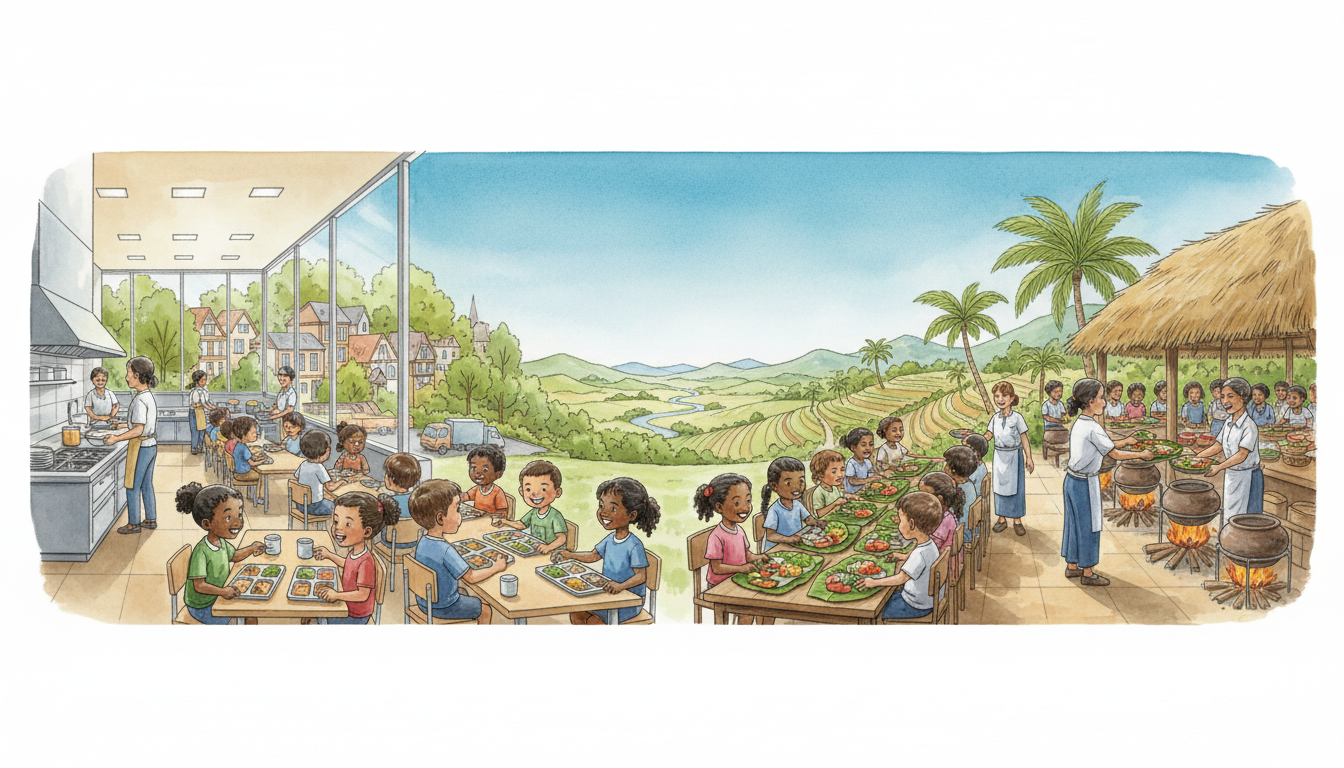
Did you know? Counting meals served is not quite the same as counting children nourished. A meal can be delivered on schedule but fail a child’s needs because of its contents, accessibility, timing or safety.
Quick answer: School-meal programmes fail when nutrition goals, budgets, suppliers, kitchen operations, distribution and inclusion do not deliver safe and useful meals consistently to the intended students. The problem may begin long before lunch.
This guide explains why school meal programmes fail, the difference between coverage and outcomes, and how practical changes can help. It draws on WFP’s 2025 publication of 2024 data, WHO’s January 2026 guidance and FAO/WFP nutrition standards.
The chain: children and nutrition needs → financing → purchasing → safe preparation → timely delivery → consumption → evidence and improvement.
Choose your reading route
- 1. What does failure of a school meal programme mean?
- 2. The complete child-to-meal chain
- 3. The difference between reach and effective benefit
- 4. Why clearly defined nutrition goals matter
- 5. A nutritious recipe is not the same as a nutritious meal served
- 6. Why children may not eat what is offered
- 7. Allergy information can be lost during substitution
- 8. Food safety is a supply-chain problem
- 9. Cold-chain interruptions can damage reliability
- 10. Why school kitchen capacity is a hidden constraint
- 11. School calendars and delivery schedules must agree
- 12. Why procurement can work legally but fail nutritionally
- 13. Local sourcing can help but must be realistic
- 14. The risk of relying on one supplier
- 15. Inflation changes what a fixed meal budget buys
- 16. Payment delays can cause interruptions
- 17. Why inclusion rules must match real school communities
- 18. Disability and accessibility affect meal delivery
- 19. Food waste is evidence—but needs careful interpretation
- 20. How school meals relate to other health services
- 21. Why school food environments matter beyond the meal
- 22. Fictional case: the district that counted trays
- 23. Fictional case: a procurement contract that ignored seasons
- 24. How to measure the programme without confusing outputs and outcomes
- 25. A practical seven-step recovery sequence
- 26. Five questions when a school-meals programme makes headlines
- Frequently asked questions
- Primary sources and further reading
What does failure of a school meal programme mean?
Did you know? A school can report that it served 500 lunches while some pupils ate little because the food was unsuitable, arrived too late or could not safely accommodate their needs. Meals served and children nourished are related, but they are not identical.,Quick answer: School meal programmes fail when funding, nutrition standards, procurement, food safety, distribution and actual access do not reliably deliver appropriate meals to the children intended to benefit. A programme can also fail through exclusion, avoidable waste, poor accountability or broken continuity.,A delayed lunch on one day is not proof that a national feeding programme has collapsed. Identify the actual harm, which pupils were affected, how often it happened and which part of the process broke.
The complete child-to-meal chain
Follow the chain: eligible children → nutrition goals → financing → food sourcing → storage → kitchen and staff → safe preparation → timely service → meal consumption → learning and health evaluation.,Every stage can look successful in isolation while the final experience fails. A supplier may deliver on time but the kitchen lacks appropriate refrigeration. A nutritious menu may be produced but the distribution schedule means pupils miss part of their class.,The central test is not whether a contract was signed or a tray was counted; it is whether children regularly receive safe, appropriate food within the actual school day.
The difference between reach and effective benefit
The World Food Programme’s State of School Feeding Worldwide 2024, published in September 2025, estimated that at least 466 million children were receiving school meals globally in 2024. That is a programme-reach estimate, not a claim that every meal was nutritionally adequate or continuously provided.,The report also describes expansion and the growing role of nationally financed programmes. Coverage still varies significantly by country and context.,Evaluate who receives meals, how often the programme operates and whether its intended educational and nutrition benefits can be examined. A big global number cannot determine the quality of a specific school.
Why clearly defined nutrition goals matter
A meal designed merely to provide calories may not meet a programme’s aim of improving dietary diversity or supporting a healthy pattern of eating. Nutrition quality also differs across ages, health needs and local circumstances.,The WHO’s January 2026 guideline on healthy school food environments includes recommendations for direct food provision, nutrition standards and changes to school food choices. FAO and WFP’s school-meal standards methodology likewise emphasises local evidence and practical implementation.,The right standard is not a single fashionable menu copied from another country. It should consider children, relevant national dietary guidance and reliable delivery.
A nutritious recipe is not the same as a nutritious meal served
A written recipe may assume exact ingredients and portions. At school level, substitutions, shortages or inconsistent serving sizes can change the meal that children actually receive.,Menus therefore need practical procurement, preparation and portion guidance. Staff also need an authorised approach when a key food is unavailable rather than making undocumented substitutions.,Monitoring should check real meals periodically, not only the menu approved months earlier. The paperwork is a starting promise, and practice is the result.
Why children may not eat what is offered
Food that looks balanced to an adult planner may be unfamiliar, poorly prepared or difficult for some children to consume. Meal timing, appetite, cultural traditions and sensory needs can affect acceptance.,Listening to pupils can improve menus while respecting nutrition and food safety goals. The solution is not to serve only the most popular item every day, nor to blame a child who struggles with an unsuitable option.,Track both what is served and what is eaten, using respectful methods that do not shame children for their food choices.
Allergy information can be lost during substitution
A food supplier may change a product or recipe while the published school menu remains unchanged. If allergen information is not updated and communicated appropriately, the consequences can be serious for affected children.,Systems need accurate ingredient information, appropriate controls and clear handoffs among suppliers, kitchen staff, schools and families. Exact legal and clinical requirements differ by location.,An allergen-free claim should never rest on a generic assumption that the kitchen is clean. Schools should follow their applicable food-safety procedures and individual medical plans where relevant.
Food safety is a supply-chain problem
Food may pass through farms, markets, warehouses, vehicles, kitchens and serving points. Improper storage, handling or separation can introduce risks at several stages.,WHO’s food-handling guidance describes principles such as cleanliness, separating raw and cooked foods, cooking appropriately and using safe water and ingredients. Specific operating temperatures and controls depend on the foods and regulations involved.,An inspection of the school kitchen cannot compensate for a contaminated or badly handled ingredient arriving earlier in the chain. Traceability and relevant supplier checks matter.
Cold-chain interruptions can damage reliability
Perishable foods may require controlled storage and transport. A school meal delivery that arrives within the contractual time but has experienced inappropriate handling is not necessarily acceptable.,Maintenance, equipment checks and communication with suppliers help prevent weak handoffs. A final temperature or packaging check must be interpreted in the context of the product and the applicable method.,The goal is consistent control from purchase to service rather than one impressive kitchen certificate.
Why school kitchen capacity is a hidden constraint
A central kitchen can prepare meals efficiently when facilities and staffing match its actual demand. But congestion, equipment faults, inadequate hygiene infrastructure or transport delays can cause failures even with good ingredients.,Changing enrolment numbers or meal types may strain a kitchen that was sized for a smaller, simpler programme. Expansion should include realistic cooking, storage, cleaning and delivery capacity.,Count the number of suitable meals the system can safely produce and deliver during actual school hours—not only the maximum number of trays that fit on a production line.
School calendars and delivery schedules must agree
Meals have to fit class timetables, staggered breaks, school holidays, examination days and attendance patterns. A route designed around average days can struggle during unusual schedules.,Accurate communication between school administrators, kitchens and transport teams helps avoid meals that arrive after pupils have left. Programmes may also have rules for school closures or disruptions.,An annual food budget does not guarantee daily availability. Measure the proportion of required service days on which intended pupils actually received their meal.
Why procurement can work legally but fail nutritionally
A tender may follow every formal purchasing rule while rewarding the lowest price for foods that do not fit the nutrition objective. Alternatively, overly narrow specifications may exclude capable suppliers.,FAO’s work on school food procurement stresses linking safe, diverse and nutritious foods with practical supply arrangements. Fair competition, appropriate standards and reliable performance all matter.,Evaluation should consider more than price per kilogram. Quality, safety, seasonal availability, delivery reliability, food waste and whole-programme costs affect what children experience.
Local sourcing can help but must be realistic
Home-grown school feeding connects schools with local farmers and food businesses. FAO explains that such arrangements may help local livelihoods and nutrition, provided appropriate purchasing frameworks and technical support are in place.,A small farm cannot always supply large quantities of the same ingredient throughout the year. Natural seasons, weather, transport and production capacity can constrain delivery.,Plan suitable procurement volumes, diversified sources and backup arrangements. Local supply should be an evidence-based partnership rather than a promise that every ingredient can always be bought nearby.
The risk of relying on one supplier
A school or district may depend heavily on one caterer, distributor or specialist ingredient source. Financial stress, equipment breakdowns or a transport disruption can then interrupt many meals at once.,Contracts should identify significant dependencies and realistic continuity options. Having a written penalty clause does not produce lunch when the only delivery vehicle breaks down.,Resilience requires supplier information, contingency planning and clear decisions about when alternative arrangements are justified under the applicable rules.
Inflation changes what a fixed meal budget buys
Rising food, fuel or labour costs can make an unchanged monetary allocation insufficient for the same number and quality of meals. Operators may respond through menu adjustments, reduced variety or unsustainable supplier terms.,Transparent budgeting should distinguish unit cost, actual child participation, inflation and nutritional outcomes. Policy choices are necessary when resources become constrained.,A rising nominal budget is not always an increase in real purchasing power; neither is a lower per-meal price proof of efficient nutrition.
Payment delays can cause interruptions
Small food producers and caterers may need prompt payment to buy ingredients, retain workers and maintain vehicles. A school authority that pays late may destabilise an otherwise competent supplier.,Public financial-management and procurement teams therefore belong in the feeding system. Clear documentation of delivered meals and timely resolution of legitimate invoices help.,An impressive tender award cannot replace working payment and reconciliation processes throughout the academic year.
Why inclusion rules must match real school communities
A programme might be universal, targeted by income, limited to certain ages or operate only in selected schools. These are different policy choices governed by specific local rules.,Complex eligibility checks may exclude pupils who qualify but lack standard records, while poorly communicated targeting can lead to embarrassment or stigma. The programme should not require children to expose private household difficulties to classmates.,Fair administration makes the criteria clear, protects personal information and provides a lawful way to correct mistakes. A pupil’s dignity is part of practical programme quality.
Disability and accessibility affect meal delivery
Some children need accessible serving spaces, help carrying trays or other reasonable adjustments. Others may have food-related medical restrictions that require coordinated support under a documented plan.,An accessible school entrance does not prove the meal-service route is workable. Queues, counter heights, seating and supervision can create additional obstacles.,Plan with actual pupils, caregivers and qualified staff as appropriate. Access should not depend on a child’s ability to navigate a crowded line more quickly than peers.
Food waste is evidence—but needs careful interpretation
Large leftovers can reveal portions that do not match appetite, unappealing menus or inaccurate attendance forecasts. Some waste is unavoidable and needs hygienic disposal, so zero waste is not a sensible universal target.,Track waste at purchasing, preparation, service and plate stages. The reasons for each type differ; excessive trimming is a different problem from meals prepared for children who are absent.,Use the data to improve menus, forecasting and procurement rather than punish pupils for food they cannot or should not consume.
How school meals relate to other health services
Food provision can be one part of a broader school health and nutrition programme that also includes appropriate nutrition education and health services. UNICEF and WFP’s 2025 regional collaboration report examines integrated approaches in several countries.,School meals cannot replace every family need or public health intervention. They can still contribute to a supportive education environment when coordinated with other services.,Evaluate the particular programme’s objectives rather than claiming that one lunch automatically resolves long-term poverty, learning difficulties or every nutrition problem.
Why school food environments matter beyond the meal
Students may also buy snacks or drinks on or near campus. A well-planned lunch programme can be undermined if the broader environment consistently encourages choices that conflict with its health goals.,WHO’s January 2026 school food guideline covers food provision, standards for foods sold or served, and interventions that promote healthier choices.,Nutrition policy should examine the complete setting, with developmentally appropriate education and realistic choices rather than simply ban a food and declare success.
Fictional case: the district that counted trays
Imagine fictional Hillford Education District reporting 12,000 meals served during a month. A review finds that some schools received deliveries after the main lunch period and that certain menu items were rarely eaten.,The recorded number of trays was accurate, but it did not capture who was nourished or how useful the service was. The district updates schedules, checks consumption and consults staff and pupils.,This is a fictional illustration of a metric failure, not a report about a real school-meal programme.
Fictional case: a procurement contract that ignored seasons
In fictional Westbridge, the meal supplier promises fresh produce at a fixed specification year-round. Regional drought and seasonal changes make one product unavailable, and there is no authorised substitute or secondary supplier.,Schools receive late deliveries while administrators debate contract penalties. The programme repairs its system by planning realistic seasonal menus and qualified alternatives that preserve nutrition objectives.,The lesson is that a nutritionally sound plan also needs a workable agricultural and logistical plan.
How to measure the programme without confusing outputs and outcomes
A useful dashboard reports eligible pupils, meals actually delivered, days of service, nutrition-standard adherence, food-safety compliance, acceptance, avoidable waste, costs and distribution equity.,Longer-run education and health outcomes require appropriately designed evaluation and careful attribution. Improved attendance can have several causes; one programme cannot automatically claim every change.,Show denominators and reference periods. When pupils are absent, do not silently count a prepared meal as one they consumed.
A practical seven-step recovery sequence
First, clarify the intended children and nutrition goals. Second, verify food and payment supply chains. Third, align kitchens, staffing and timetables with real demand. Fourth, protect food safety and allergen information. Fifth, test access and meal acceptance. Sixth, measure real service rather than trays alone. Seventh, revise procurement and financing based on evidence.,FAO and WFP’s seven-phase methodology for nutrition standards includes assessing needs, defining targets, validating them, translating standards into menus, piloting and planning evaluation. Context and continuous improvement are central.,The best repair fixes the first broken link, while protecting children during transition and avoiding promises that a single menu or supplier change will solve everything.
Five questions when a school-meals programme makes headlines
How many eligible children actually received meals, and on which days? What nutrition objective was intended? Were meals safe and accessible? Which costs and supply constraints were considered? What evidence shows that reported failures or improvements were verified?,Distinguish a documented food-safety incident, a supply interruption, an eligibility dispute and a general debate about policy. They require different remedies.,Families should follow current guidance from the responsible school and health authorities for urgent food safety or allergy concerns, rather than use a general explainer as individual medical advice.
Frequently asked questions
Does every school-meal programme provide the same type of food?
No. Menus, eligibility, funding and service models vary by country, age group and local programme.
Do meals served equal children fed?
Not necessarily. Some pupils may be absent, the meal may not reach them, or significant food may be left uneaten.
Why can a healthy menu still fail?
Ingredient availability, unsuitable preparation, food safety, access and actual consumption can all undermine the intended result.
Is home-grown school feeding always better?
It can offer local economic and nutrition benefits, but requires suitable procurement, production capacity, safety controls and contingency plans.
Can a low-cost tender be poor value?
Yes. Quality, safe handling, nutrition, reliability and waste matter alongside purchase price.
What was the latest global school-meal figure in the WFP 2025 report?
WFP’s 2025 publication estimated at least 466 million children receiving school meals in 2024; it is not a 2026 observed total.
What is the first repair after repeated meal interruptions?
Trace whether the failure lies in financing, sourcing, storage, preparation, delivery or eligibility before choosing a solution.
Primary sources and further reading
WFP’s global numbers reflect the specified survey and reporting year; country programmes differ substantially. The WHO and FAO/WFP publications present evidence and guidance that must be implemented in the relevant legal and educational context.
- WFP: State of School Feeding Worldwide 2024 (published September 2025)
- WFP: School Feeding 2024 Interactive Report
- FAO and WFP: Methodology for School Meal Nutrition Guidelines
- FAO: Inclusive School Food Procurement and Local Value Chains
- WHO: Policies for Healthy School Food Environments, January 2026
- UNICEF and WFP: Integrated School Health and Nutrition Programming, January 2025
- WHO: Five Keys to Safer Food
Related system failures
- Why Food Systems Fail | Harvest Shocks, Prices and Waste
- Why Food Inspection Systems Fail | Risk, Testing and Enforcement
- Why Public Procurement Fails | Tender Design, Contracts and Accountability
- Why Education Systems Fail | When Schooling Stops Becoming Learning
Final thought: A good school meal programme is not merely one that buys food. It reliably connects nutritious meals with the children who need them, in conditions where they can be eaten safely and with dignity.