
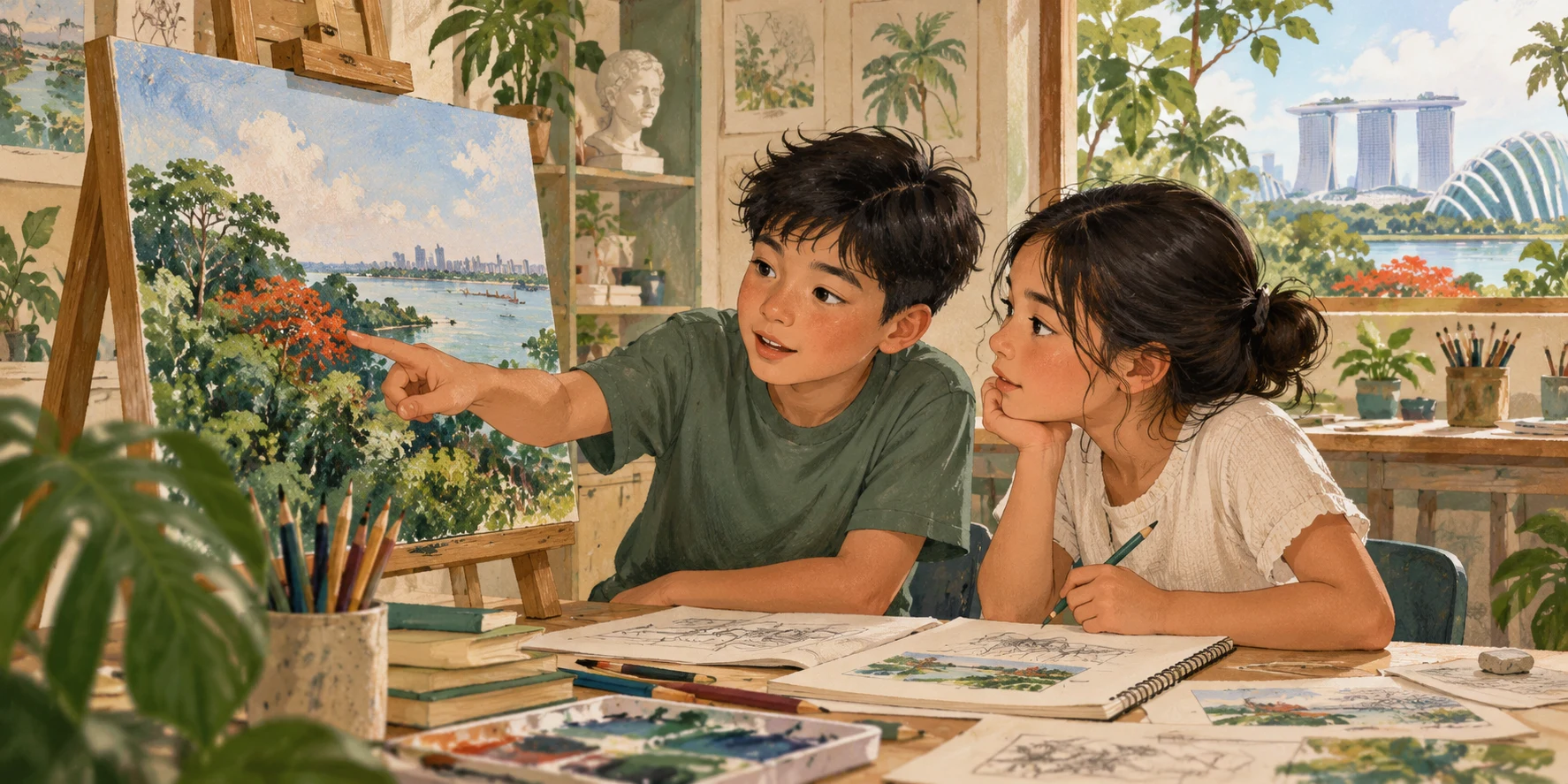
Did you know that G3 Higher Art is not simply drawing more difficult pictures? It teaches your child to observe carefully, develop ideas through different media, interpret visual information, explain artistic choices and reflect on how their work changes over time. The subject treats art as a form of thinking and communication, with a substantial requirement to document the creative process honestly.
For Singapore parents, this distinction matters. A visually polished drawing may show technical skill, but it does not automatically reveal how the student investigated an idea. Conversely, experimental sketches that appear unfinished may provide valuable evidence of genuine exploration. Higher Art asks learners to connect visual decisions with purpose, research and reflection, rather than produce a sequence of attractive final products without explanation.
This guide explains why G3 Higher Art matters under the 2027 Singapore-Cambridge Secondary Education Certificate (SEC), syllabus K348. It describes the visual-response paper, substantial digital portfolio, separately assessed Higher Art Project, syllabus aims, practical study habits, media choices, originality and how parents can support a teenager’s independent work without taking over their artwork or imposing a commercial idea of success.
The one-minute answer for parents
G3 Higher Art gives suitable students a demanding opportunity to perceive, communicate and appreciate through art. Learners investigate visual qualities, cultural contexts, different media and the relationship between concept and form. They also document exploration, explain influences and reflect on their artistic development.
For the 2027 SEC, Higher Art is K348. Paper 1 Visual Response lasts 2 hours 15 minutes and contributes 50 per cent. Paper 2 Portfolio involves 30 hours within 12 weeks and contributes another 50 per cent. Paper 3 Higher Art Project is compulsory but assessed independently, with a 12-week project window and a 1,000–1,200-word report. Parents should not add Paper 3 as a third percentage to the combined weighting of Papers 1 and 2.
The official syllabus explains why Art belongs in education
The SEAB 2027 G3 Higher Art K348 syllabus describes art as a form of human expression that helps students observe, imagine, communicate and understand the world. It includes the value of adaptability, critical visual processing and awareness of self, society and culture.
The subject’s aims include helping learners express artistic intent through visual language, think inventively, develop a personal voice and engage respectfully with diverse perspectives. It is not a guarantee that every student will become professionally creative or that Art will automatically increase marks in other subjects.
Parents can recognise the educational purpose by asking what the artwork communicates, why particular visual choices were made and what the learner discovered through experimentation.
Full Subject-Based Banding and the K348 pathway
Singapore’s Full Subject-Based Banding uses G1, G2 and G3 as subject levels and learning arrangements, not fixed descriptions of every student’s abilities. Subject choice and eligibility depend on school offerings and official conditions.
G3 Higher Art K348 is distinct from G3 Art K347. They share broad artistic foundations but do not have identical assessment requirements. Higher Art includes a third independently assessed project alongside the visual-response examination and portfolio.
Parents should check the actual subject code and the school’s programme before choosing materials or planning a portfolio. A child who enjoys Primary Art is not automatically required or prepared to take Higher Art later.
Art as visual communication
Words are one way to communicate meaning; visual images are another. Scale, framing, colour, contrast, material and spatial relationships can all affect how a viewer understands an idea.
Imagine two posters about the same environmental concern. One uses a dense paragraph, while the other places a small illustration against a large empty space. They may direct attention differently even if their factual content is similar.
Students learn to make such decisions intentionally. A strong artist can explain what the viewer is meant to notice and whether the chosen visual strategy supports that intention.
Perceive: close observation precedes interpretation
The syllabus identifies Perceive as one of three learning domains. It involves observing and analysing visual stimuli, gathering information and using that information to generate ideas.
A pupil may first notice only the central figure in a painting. On a second look, they may find that the surrounding architecture, shadows or repeated shapes change the meaning of the scene. These details can support a richer interpretation.
Parents can ask what the student noticed only after looking again. This encourages observation without demanding that every interpretation be dramatic or sophisticated.
Communicate: an image should make a deliberate point
The Communicate domain concerns how students develop and express ideas in visual or tactile form. Technical skill supports this process, but a perfectly rendered object may still fail to convey the intended idea.
For example, a student planning an artwork about isolation might experiment with scale, distance or visual barriers. Different compositions can suggest different relationships between subject and environment.
The artist should be able to explain the choices without claiming that every viewer must respond identically. Visual communication involves intention and an awareness of how the work might be read.
Appreciate: learning to discuss art responsibly
The Appreciate domain includes reflecting on one’s work, discussing others’ works and connecting artistic form with context and intent. Students learn to move beyond “I like it” or “That looks strange”.
A viewer might identify how colour contrast directs attention or how material choice supports a subject. Another viewer may respond differently, but both can discuss the visible evidence underlying their interpretations.
Parents can model curiosity rather than immediate judgement. Ask what the work seems to explore and which visual details support that response.
The syllabus encourages continual exploration
Higher Art is structured around cycles of inquiry, testing and refinement. A student may begin with one question, create experimental sketches, discover new influences and revise the original idea.
This is not evidence that the learner is disorganised. Art-making can be exploratory while still requiring purposeful documentation and critical decisions. The work becomes stronger when changes have reasons that the student can explain.
Parents should avoid demanding that the child choose a final product too early simply to make the assignment look complete. The investigation itself has educational value.
Process, product and discourse belong together
The syllabus uses an approach described through Process, Product and Discourse. Students investigate and make, produce visual outcomes, and discuss or reflect on the artistic decisions involved.
A finished artwork is one source of evidence. Sketchbooks, media tests, annotations and conversations can reveal how the idea developed. Discourse provides a language for explaining choices and examining influences.
A learner who can connect these dimensions has built more than drawing technique. They are learning to make meaning and account for the process by which it was created.
Art journalling documents genuine thinking
An art journal can preserve observations, sketches, experiments, questions and reflections. It should not be treated simply as a decorative scrapbook or a place to paste pictures copied from the internet.
The strongest entries make the student’s thinking visible. What was being investigated? Why did one material or composition work better? What new question arose after a test?
Parents can ask the child to describe one page of the journal. If the student can explain a decision and a revision, the journal is supporting genuine artistic learning.
Research influences should be acknowledged
Artists learn from other artists, cultural contexts, techniques and visual materials. Research can introduce a new way of representing movement, scale or memory, but influence is not permission to reproduce someone else’s work without acknowledgment.
The K348 syllabus explicitly includes the attribution of sources and citations. Students must distinguish their own decisions from visual material collected during research.
Parents should encourage source records from the beginning: creator, work, source and reason for studying it. Ethical authorship is easier when documentation is part of the process rather than a last-minute repair.
Drawing can be investigation rather than illustration
Drawing is a versatile research tool. It can record observations, test proportions, compare arrangements or communicate the structure of a proposed outcome. Not every exploratory drawing is intended as a finished artwork.
A student studying an old staircase might make quick sketches of perspective, shadow and repeating lines. Later, the learner might translate those observations into a work about memory or urban space.
The important distinction is purpose. Ask what the sketch helped the student discover. A visually rough study can have value when it reveals a meaningful design choice.
Visual language includes line, shape, colour and space
Artists combine visual qualities to produce form and meaning. Line, shape, colour, texture, tone and space can all influence emphasis or interpretation.
A large pale area surrounding a small dark object may create a different effect from a crowded composition with repeated forms. Neither treatment is inherently superior. The most appropriate choice depends on the idea and the relationship among elements.
Parents can invite the child to compare two versions of a study. Which communicates the intended concept more clearly, and which details explain the difference?
Composition is a series of decisions
Composition concerns how parts of an artwork are arranged. Balance, emphasis, rhythm, contrast, proportion and spatial relationships affect what a viewer encounters first and how the eye moves through the work.
A teenager might shift a central figure from the middle to the edge. That simple change can alter the viewer’s understanding of isolation, tension or movement in context.
The learner should be able to describe the intended effect and evaluate whether it was achieved. This is visual problem-solving, not merely making a picture neat.
Material choices affect meaning and method
Different media have different characteristics. Drawing, painting, collage, printmaking, sculpture, photography, digital processes and time-based work can offer different ways to explore a subject.
A fragile paper construction may communicate something different from a durable object made from another material. A series of photographs may explore time in a way a single image cannot.
Parents should not assume that the most expensive medium produces the strongest work. A carefully chosen modest material can serve a concept better than a sophisticated tool used without purpose.
Fine Art, Design and time-based practices offer different possibilities
The Higher Art portfolio requires engagement with varied art forms and media. The syllabus specifies at least three different art forms and media, including one from a Fine Art category and one from Design or Time-based categories.
This breadth encourages students to explore more than a single comfortable technique. It does not require the learner to become equally expert in every medium or buy costly professional equipment.
A good portfolio shows what the student investigated through each approach and how those investigations affected artistic intent.
Photography can be a thoughtful form of inquiry
Photography involves choices about viewpoint, framing, light, timing and selection. A photograph can record a visible moment, but artistic photography can also interpret a subject through those choices.
A student exploring ordinary urban spaces might photograph a staircase from several positions. Each image reveals or conceals different visual relationships. The learner can compare which framing supports the intended idea.
Parents can encourage ethical image-making: respect people’s privacy, obtain necessary permission and avoid presenting a manipulated image as a neutral documentary record when that distinction matters.
Digital art is not automatically superior to traditional art
Digital tools can support drawing, layering, animation, editing and experimentation. Their flexibility is useful, but it also creates the temptation to add effects without considering whether they serve the work.
A strong student should explain why a digital technique was selected and how it changed the concept. The chosen tool is one element of a larger artistic decision.
Follow school guidance on permitted devices, software and assessed work. The child should not outsource the central creative process to a tool and then present the resulting image as independent artistic development.
Time-based work introduces sequence
Time-based art can involve moving images, sound, duration and the viewer’s experience over time. A concept may emerge through repetition, pauses or a changing relationship among images.
Students can experiment with sequences of images or other school-approved forms and explain why the order matters. A work that changes over thirty seconds creates a different experience from a still image.
Parents can ask what a viewer would understand if the sequence were reversed or shortened. This connects artistic form with meaning.
Art and Singapore’s changing environment
A local street, housing block, heritage building or public artwork can provide a context for artistic inquiry. Students may consider how place, memory and identity relate, drawing on careful observation and appropriate research.
But an artwork about Singapore should not be treated as a complete historical record. If factual claims are made about a building or event, they should be verified through reliable sources.
Art is valuable precisely because it can explore a personal or imaginative response while still acknowledging the limits between artistic interpretation and factual evidence.
Cultural context enriches visual understanding
Artworks exist within particular social, cultural and historical settings. The meaning of a symbol or artistic convention may depend on information not immediately visible to a newcomer.
Students learn to seek reliable context and avoid assuming that one artwork speaks for an entire culture. Appreciating diversity means engaging with specific works and voices rather than repeating stereotypes.
Parents can ask what is known about the creator and audience, and what remains the learner’s own interpretation. This encourages respect and intellectual honesty.
Personal artistic voice develops through choices
A personal voice does not require inventing something no one in history has ever imagined. It develops as students investigate their interests, respond to influences and make intentional choices about form and meaning.
A student might return repeatedly to themes such as home, urban change or family objects. Over time, their media tests and reflections may reveal a distinctive way of exploring those concerns.
Parents can support this process by asking what matters to the learner, not what topic is most likely to impress an examiner or win an external competition.
Ambiguity can be a creative resource
Art does not always communicate a single statement with one correct response. A viewer may interpret a work differently from its maker while still responding thoughtfully to the visual evidence.
Students learn to decide when ambiguity supports their concept and when it leaves communication unnecessarily unclear. The objective is purposeful choice, not confusion as a badge of sophistication.
This develops tolerance for multiple perspectives without requiring the child to claim every interpretation is equally supported or equally relevant.
Revising a composition teaches adaptive thinking
A first idea may not work as intended. The student might discover that a focal point is too weak, a material distracts from the concept or the work creates an unintended impression.
Instead of discarding the entire effort, the learner can revise one element and compare the outcome. This creates evidence of a learning process, especially when the reason for the change is recorded.
Parents can ask what the revision improved and what limitation remains. The goal is growth in judgement rather than endless polishing of an already completed piece.
Paper 1: Visual Response
For the 2027 SEC K348, Paper 1 Visual Response lasts 2 hours 15 minutes, carries 50 raw marks and contributes 50 per cent of the assessed Paper 1–2 total. It has two sections based on an unseen visual stimulus.
Section A: Visual Analysis is worth 10 marks and involves analysis and discussion of the stimulus. Section B: Exploratory Sketching is worth 40 marks and asks for a developed visual response through sketches and annotations.
The paper tests the ability to observe, interpret and generate a meaningful response within a limited time. A pupil who memorises an artwork description cannot predict the exact unseen stimulus.
The unseen stimulus is a starting point, not a model to copy
The first task is to examine the provided visual information. What is represented, how are the elements arranged and which qualities seem important to the question?
The second task is to develop an original response that uses those observations purposefully. The work should show a sequence of exploration and culminate in a concept sketch rather than merely reproduce the stimulus without thought.
Parents can practise with a public-domain or appropriately licensed image, asking the child to note observations before inventing possible responses. This is educational practice, not completed assessed work.
Exploratory sketching is evaluated as thinking
Sketches may show how an idea develops across alternative layouts, marks or compositions. Annotations can make the intention and reasoning visible when used effectively.
A common weakness is spending nearly all the available time making one drawing visually polished without showing meaningful exploration. Another is producing many scattered sketches that never converge toward an understandable concept.
Students need to balance observation, ideation, development and clear communication. A sequence of purposeful decisions is more valuable than decorative busyness.
Paper 2: the Portfolio
Paper 2 Portfolio is a 30-hour assessment to be completed within 12 weeks. It contributes 50 per cent and carries 50 marks. It comprises a selection of visual materials and a commentary, and is assessed by schools with external moderation.
Part A is worth 30 marks and allows a maximum of 15 screens showing exploration and processes across at least three art forms and media. Part B is worth 20 marks and comprises a commentary on personal artistic growth based on three works.
A portfolio is not simply a digital gallery of the final pieces the pupil thinks are most attractive. Its purpose includes demonstrating process, experimentation, influences and growth.
Selecting evidence is part of portfolio judgement
The maximum of 15 screens forces the student to decide which materials best demonstrate the inquiry. Including every sketch may overwhelm the viewer rather than clarify the development.
A useful selection shows how an idea emerged, what was tested and what changed. A comparison between two attempts may be more informative than several near-identical finished photographs.
Parents can ask whether each screen contributes new evidence. The learner should make the final selection independently according to the school’s guidance and official assessment rules.
Portfolio breadth has specific requirements
The 2027 syllabus requires at least three different art forms and media, with representation from Fine Art and either Design or Time-based practices. This provides breadth without eliminating the opportunity for a coherent personal direction.
Students should not treat the requirement as a race to collect unrelated techniques. They need to explain how exploration across media helped them develop visual language and artistic intent.
Early planning with teachers can prevent a late discovery that the submitted work does not show the required range. Parents can support organisation but should not manufacture missing artistic experiments.
The commentary is not a biography
The Portfolio commentary is based on three works by the student and must be no more than 800 words. Where relevant images accompany it, the softcopy file must be under ten A4-sized pages.
The purpose is to articulate artistic intent, connections with other works and learning across time. An extended autobiography that never discusses visual choices may fail to explain the development of artistic practice.
A strong commentary identifies an important decision, describes evidence of growth and explains the relationship between works. The student should write it independently and cite outside influences appropriately.
Art conversations help pupils find precise language
Students may feel that art is too personal to explain. But discussing visual qualities, techniques and intent does not remove personal meaning. It can make the thinking more articulate and allow others to engage with it.
A learner might say a composition feels uncomfortable. With guidance, they may identify the tight cropping, repeated forms or lack of empty space contributing to that impression.
Parents can invite descriptions that begin with what can actually be seen and then move toward interpretation. Specific language is more educational than general declarations that a work is “nice” or “deep”.
Paper 3: Higher Art Project is independently assessed
The 2027 K348 Paper 3 Higher Art Project is compulsory but independently assessed, rather than carrying another percentage in the Paper 1–2 weighting. It lasts 12 weeks, with the project window described as February to April of the examination year.
Three project questions are set, and the candidate answers one. The submission includes a report of 1,000–1,200 words. Parents should read the full official instructions for the project requirements and timetable, rather than confuse this project with the shorter portfolio commentary.
The additional work creates significant time and planning demands. Subject suitability should account for all three components, not only the visual-response examination.
A project should begin with inquiry
An effective project starts from the stated question and develops a coherent line of investigation. The student gathers references, explores media and assesses how different approaches affect the concept.
Rushing directly to a polished final piece may leave little evidence of deliberate development. Conversely, endless experimentation without a clear direction may produce a collection of attractive fragments instead of a coherent project.
Parents can ask what the student is investigating and how each experiment addresses that inquiry. The answer helps expose whether the process remains purposeful.
Project planning needs a realistic timeline
A twelve-week window involves research, ideation, experimentation, making, reflection and preparation of the required report. Some work may take longer than expected, particularly when materials or digital methods are unfamiliar.
A schedule can reserve time for revisions and documentation rather than treating the last week as an opportunity to reconstruct the entire process from memory.
Parents can help maintain a quiet workspace and balanced timetable. They should not take over the making, research conclusions or report authorship.
Academic honesty applies to visual work too
Students must acknowledge relevant source material, artistic references and outside ideas. Copying an artwork without suitable acknowledgment is not converted into original work simply by changing a few colours.
Similarly, an adult-produced artwork, an outsourced portfolio or an undeclared generated image can conceal the child’s actual learning. Follow the school’s rules about permitted tools and assistance.
The educational value depends on genuine decisions and transparent documentation. A slightly imperfect authentic portfolio is stronger evidence of the learner’s capability than one silently completed by someone else.
Digital portfolio quality includes technical organisation
Since portfolio materials are submitted electronically, pupils must manage images, file types, file sizes, names and source information according to the official specification and school instructions.
Poor organisation can obscure an otherwise thoughtful inquiry. The student should preserve readable documentation of sketches, experiments and important revisions.
Parents can encourage early file organisation and backups while leaving creative selection and commentary to the student. Technical reliability helps the work be evaluated as intended.
How Higher Art differs from ordinary G3 Art
Both subjects value art-making and visual interpretation, but the examination structures are distinct. G3 Art K347 has its own visual-response and portfolio requirements. G3 Higher Art K348 includes the compulsory independently assessed Higher Art Project.
The difference is more than adding the word “Higher” to the same course. Parents need to understand the extra analytical and project demands and the school’s particular teaching arrangements.
A strong student in Art may be interested in the greater challenge, but subject choice should consider sustained motivation, readiness and workload rather than comparative prestige.
Higher Art and Design & Technology are not equivalent
Design & Technology focuses on addressing user needs through design investigation, materials, prototypes and practical solutions within its syllabus. Higher Art focuses on artistic inquiry, visual communication, media and reflective interpretation.
There can be overlap in sketches and problem-solving, but the criteria for successful outcomes differ. A technically functional product is not automatically a compelling artistic investigation, and an expressive artwork is not necessarily an engineered device.
Parents should explore the child’s actual interests rather than assume that all creative subjects use the same assessment methods.
A fictional student who draws beautifully but avoids exploration
Imagine Secondary 3 student Maya, whose observational drawings are accurate and polished. She finds experimentation uncomfortable and often produces one final piece without considering alternatives.
Her teacher asks her to test different compositions and media around a shared theme. Maya discovers that a rough collage conveys her idea more clearly than her first carefully rendered drawing.
The example is fictional. It shows why Higher Art values inquiry in addition to technique. Artistic growth can involve learning when to change method rather than making the same kind of work ever more detailed.
A fictional student with many ideas but weak documentation
Imagine Secondary 4 learner Daniel, who makes interesting artworks and experiments with several materials. When assembling the portfolio, however, he cannot remember why he abandoned particular approaches.
His teacher introduces concise journal entries that connect intention, material choice, result and next step. Daniel begins recording decisions during the process rather than inventing an explanation afterwards.
The improvement is not administrative paperwork alone. It makes the student’s reasoning visible and helps them learn from their own experiments.
A third fictional student who copies influences too closely
Consider a learner named Aisha who admires an artist’s use of repeated geometric forms. She reproduces nearly identical compositions and assumes that adding her signature makes the result independent.
A teacher asks Aisha to research why the forms were used, identify her own concept and experiment with different visual relationships. She records the original influence and explains what changed in her interpretation.
The lesson is that learning from others requires acknowledgment and transformation through real decisions, not concealed imitation.
When a student worries about not being talented enough
Higher Art can be demanding because pupils compare their visual results with peers who use different media or have different experiences. It is understandable to feel uncertain when a new technique is difficult.
Parents can focus on controllable learning: careful observation, research, experimentation, reflection and asking for feedback. Not everyone will achieve the same technical facility at the same pace.
Avoid telling the child that one disappointing artwork proves a lack of talent, or that passion guarantees a distinction. Progress is more credible when linked to specific, visible improvements.
Building confidence through constructive critique
Critique should explain what a visual choice achieves and where it might be strengthened. “This is bad” offers little guidance; “the intended focal point is difficult to identify because several elements compete for attention” names an actionable issue.
Students can learn to hear feedback without treating every suggestion as a command. They should evaluate whether a proposed change serves their artistic intent.
Parents can ask which feedback the learner accepted and why. This supports a mature relationship between personal voice and informed revision.
Art and mental wellbeing: avoid overclaiming
Creative work can provide meaningful expression, but an artwork is not a diagnostic instrument. Dark colours or intense imagery do not by themselves establish a child’s emotional or medical state.
Parents can listen if a pupil wants to discuss personal themes, while respecting boundaries and avoiding forced disclosure. School art instruction is not a substitute for professional care when a genuine concern arises.
The direct educational benefit is the development of visual communication, reflection and cultural engagement. Those capabilities deserve recognition without inflated psychological promises.
How Art can support critical media literacy
Advertising, social media and news images use framing, scale and colour to direct attention. Higher Art develops awareness of how visual strategies influence interpretation.
A photo may be authentic but cropped in a way that conceals relevant context. An image may be technically striking without supporting the factual claim beside it. Students can distinguish artistic expression from documentary evidence.
Parents can compare two representations of the same subject and ask how they differ. The child learns to read images actively rather than accept presentation as proof.
Artistic careers are possible, not guaranteed
Higher Art can support interests in visual arts, design, architecture, media and cultural fields, subject to later study and entry conditions. The subject may also enrich a learner who ultimately works in Science, business or another area.
Parents should not promise professional success based on a school portfolio, nor insist that Art is wasted without a creative career. Visual literacy and artistic understanding have broader educational value.
The subject decision should consider authentic interest, preparedness for sustained inquiry and the demands of all three examinations.
Secondary 3: build breadth and process habits
Early upper-secondary Art learning should include looking at a range of works, experimenting with media and documenting decisions. Students can begin developing a personal direction while exploring unfamiliar approaches.
Waiting until the examination year to begin journalling may make it harder to show genuine growth. Documentation is most useful when it records actual thinking during the learning process.
Parents can support a manageable routine of keeping records and reflecting after feedback. They should not turn the journal into an adult-designed scrapbook.
Secondary 4: align portfolio, visual response and project
The examination year brings several different demands. Paper 1 requires timed analysis and exploratory sketching. Paper 2 requires careful selection and commentary. Paper 3 involves a longer independent project.
A learner should understand which evidence belongs to each component and the correct submission requirements. The work should be organised without collapsing every artistic experience into one template.
Parents can help with calendars, file organisation and suitable workspace, leaving the interpretation, making and assessed writing to the child.
A twenty-minute home visual-inquiry session
Choose an appropriately licensed image or an object nearby. Spend five minutes observing without interpretation. Use five minutes drawing several small compositional possibilities. Spend five minutes considering which best serves one stated idea, then five minutes explaining what a further test might reveal.
This is general practice, not a replacement for an assessed Higher Art task. The child should make their own decisions and record what they discover.
No specialised studio is required for the conversation. The educational value lies in seeing, choosing and justifying.
When additional Art support may help
A learner may benefit from guidance in drawing, media handling, visual analysis, research practice or structuring reflective commentary. The most helpful support identifies which capability needs improvement.
More lessons are not automatically better. A student with excellent technical skills may need stronger conceptual investigation; another may have compelling ideas but lack control over materials.
Any support must respect originality and the school’s assessment rules. Adults can teach methods but should not produce assessed artworks, portfolio selections or commentary for the child.
Recognising meaningful Higher Art progress
Look for a pupil who observes more carefully, develops several relevant possibilities, chooses media purposefully and explains how visual decisions communicate an idea.
Progress also appears in honest documentation, recognition of sources, thoughtful revisions and the ability to discuss other artworks with evidence rather than unsupported declarations.
Examination grades matter, but these habits show that the student has gained an independent approach to artistic inquiry.
Frequently asked Singapore parent questions
Is G3 Higher Art the same as G3 Art?
No. Higher Art K348 has a distinct assessment structure, including a compulsory independently assessed Higher Art Project.
What is the 2027 SEC subject code?
K348 is the official code for G3 Higher Art.
How is the main qualification weighted?
Paper 1 Visual Response and Paper 2 Portfolio each contribute 50 per cent. Paper 3 is separately assessed as independent.
How long is Paper 1?
Visual Response lasts 2 hours 15 minutes and includes visual analysis and exploratory sketching.
How many screens can the portfolio contain?
Part A allows a maximum of 15 screens, with the specified range of art forms and media.
What is the portfolio time allocation?
The syllabus assigns 30 hours within 12 weeks to Paper 2.
How long can the commentary be?
The portfolio commentary must be no more than 800 words and, where images are included, under ten A4-sized pages.
Is Paper 3 optional?
No. The 2027 syllabus says all candidates must offer Paper 3 and answer one project question. It is independently assessed.
How long is the Higher Art Project?
It is a 12-week component with a February–April examination-year window under the specification.
Does the project require a written report?
Yes. The specified report is 1,000–1,200 words.
Can parents or AI finish the portfolio work?
Assessed work must comply with originality and school rules. The child’s artistic decisions and documentation must remain authentic.
What is the strongest sign that the subject is helping?
The learner makes purposeful visual decisions, documents inquiry honestly, evaluates feedback and can explain artistic growth independently.
The lasting reason to study G3 Higher Art
Higher Art teaches teenagers that images are not merely decorations and creativity is not merely an inborn gift. Observation, context, experimentation, visual language and reflection all contribute to making a meaningful artwork. The course challenges students to develop a personal voice while respecting evidence and influence.
For parents, the most useful support is a stable space for inquiry and a willingness to discuss process rather than judge only final appearance. When a child can explain how an idea changed, why a medium was chosen and what an artwork communicates, Higher Art is strengthening creative judgement that lasts beyond the SEC examination.
For official requirements, read the SEAB 2027 G3 Higher Art K348 syllabus and 2027 SEC G3 subject catalogue. For further eduKateSG guidance, see Learn Everything about SEC Higher Art, G3 Art versus Higher Art Portfolio and Visual Response, What Counts as an SEC Art Portfolio? and Why Study Primary Art. These distinguish foundational visual learning, course selection and the specific Higher Art requirements.