
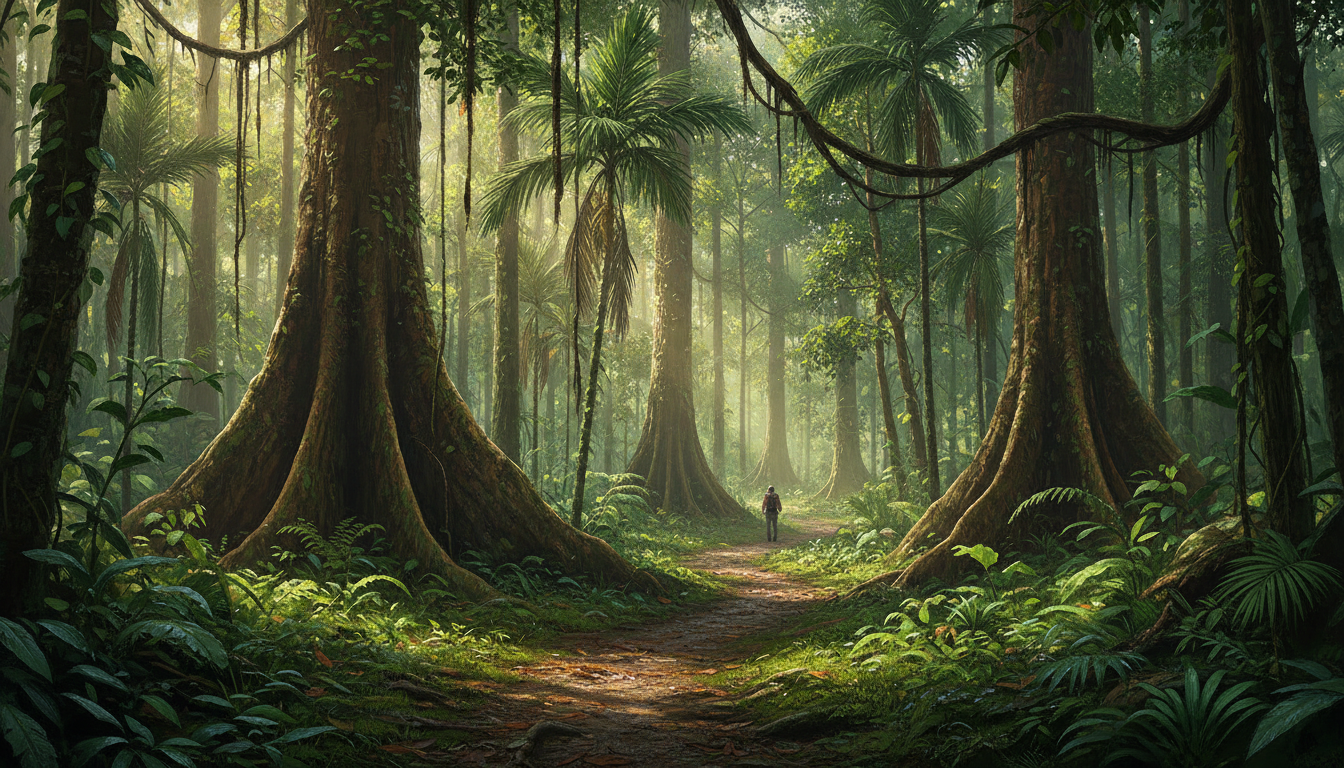
Did you know that a small group of rubber seedlings helped transform the economy of Southeast Asia? In 1877, Kew Gardens sent rubber seedlings to Singapore, where some were planted at the Botanic Gardens. Research into growing the trees and tapping latex later helped establish a large plantation industry across Malaya. The modern Singapore Botanic Gardens is therefore more than a pleasant place to walk: it is a landscape shaped by botanical experimentation, commercial crops, scientific collections and changing ideas about nature.
The Gardens at their present Tanglin site were established in 1859, although earlier experimental gardens had existed at Fort Canning. Colonial government management began in the 1870s, and an Economic Garden was developed in 1879. Henry Nicholas Ridley directed botanical work between 1888 and 1912 and became known for his persistent promotion of rubber. In 1928, Richard Eric Holttum established orchid-breeding experiments that helped develop another horticultural industry. The institution later supported urban greening, conservation and public education, culminating in its inscription on UNESCO’s World Heritage List on 4 July 2015.
Why study this History? Because a specimen planted in 1877 is not evidence that the rubber industry immediately flourished, a scientist’s achievement does not mean every worker shared the industry’s prosperity, and UNESCO recognition is not the Gardens’ founding date. Studying these distinctions teaches students how science, work, ecology, Geography, trade and public institutions develop across generations.
Explore this guide
- The direct answer: gardens can be laboratories and public spaces
- 1859 marks the establishment at Tanglin
- 1877 brought rubber seedlings from Kew
- The Economic Garden developed in 1879
- 1888 began Henry Nicholas Ridley’s directorship
- A workable tapping method mattered
- By 1920 Malaya was a major rubber producer
- 1928 brought systematic orchid-breeding research
- The 2015 UNESCO inscription was not a founding ceremony
- Worked exercise: rubber figures in 1877
- A four-week learning plan through the Botanic Gardens
- FAQ: when was the present Singapore Botanic Gardens founded?
- Official sources and connected eduKateSG learning
The direct answer: gardens can be laboratories and public spaces
A botanical garden may offer attractive paths and plant displays while also supporting research, plant collections and professional training.
These activities have different purposes, but they can occupy the same institution across time.
History asks why a garden was founded, what kinds of plants were studied and how priorities changed as society developed.
A beautiful landscape photograph can show the present garden, but not prove which scientific experiments took place there a century earlier. Students need historical records for that question.
The first botanic garden was not the present Tanglin site
The Singapore Botanic Gardens’ official chronology traces an early experimental garden to Government Hill, now Fort Canning, in 1822.
That earlier location is different from the present Gardens established in 1859.
Students should distinguish continuity of an ambition to study plants from continuity of the same physical institution and site.
This is a useful lesson about historical founding claims: a precursor and its later successor can have different beginnings.
Raffles’ 1822 experiment focused on commercial plants
The early Government Hill garden aimed to investigate plants of economic value, including nutmeg and clove.
The project reflected hopes that tropical crops could provide profitable trading opportunities.
Students should not assume the garden’s existence proves all its plantings became successful businesses.
The appropriate claim concerns the documented intention and experiments of the period. The commercial outcome requires separate cultivation and trade evidence.
The 1829 closure shows why institutional support matters
The early garden on Government Hill declined after its initial promoters departed and sustained funding failed to materialise.
NParks dates its effective closure to 1829.
Students can identify the difference between an ambitious scientific project and the continuing resources needed to maintain collections, staff and land.
The broader lesson is that an idea does not become a permanent institution simply because its first experiment attracted interest.
A smaller 1836 effort also eventually ended
An agricultural and horticultural society revived a smaller garden at Fort Canning in 1836, concentrating on crops such as nutmeg.
The NHB history describes its later abandonment as the crop’s commercial value declined.
Students should not confuse this revival with the establishment at Tanglin in 1859.
The sequence reveals how markets, scientific work and institutional support influenced the survival of early botanical projects.
Market demand does not determine every scientific value
A crop can become less profitable even while biological knowledge gained from studying it remains informative.
Students should not treat the decline of an experiment’s commercial return as proof the researchers learned nothing.
History asks which goals were economic, which concerned practical cultivation and which created knowledge useful beyond one product.
This is a thoughtful way to connect commercial history with the different kinds of results that science can produce.
1859 marks the establishment at Tanglin
The official Gardens history dates establishment of the present site to 1859 by a new Agri-Horticultural Society.
The group acquired roughly 23 hectares of former plantation land at Tanglin.
Students should not assign the 1822 Fort Canning location or its abandoned structures to the present site’s original layout.
This provides a clear example of a genuine founding milestone: it is the date of the institution occupying the location visitors recognise today.
Hoo Ah Kay helped make the new site possible
The merchant Hoo Ah Kay, also known as Whampoa, was involved in the society and the land arrangements leading to the Tanglin Gardens.
NHB’s heritage account identifies his important role.
Students should not describe him as the sole gardener or attribute the later scientific work of every botanist to him.
Historical attribution becomes stronger when donors, landholders, designers and scientists are given their documented, distinct roles.
Lawrence Niven shaped the early landscape
Lawrence Niven was engaged to lay out the Tanglin Gardens in an English landscape style, with curved paths, lawns and ornamental plantings.
The official institutional history credits him with features whose general arrangement remains recognisable.
Students should distinguish his landscape-design role from the later economic botany associated with Ridley.
A surviving path is evidence of design continuity, but its present appearance may also reflect restoration and maintenance performed in later decades.
A pleasure garden had social as well as scientific aims
The Agri-Horticultural Society organised flower shows and other gatherings to attract members and visitors.
The early Gardens were therefore recreational as well as sites of cultivation.
A published festival notice can establish what was advertised, while evidence about attendance and financial outcomes requires other records.
Students should not assume every resident of colonial Singapore enjoyed identical access to the institution simply because its landscape was attractive.
Swan Lake belongs to the early designed landscape
The lake and surrounding curving routes were part of the Gardens’ nineteenth-century landscape development.
A modern photograph of Swan Lake can show a surviving setting, but not every original planting or the exact appearance of the site in 1866.
Students should consult historical plans and the official chronology to establish early design features.
History teaches how a living landscape can preserve its overall structure while its plants and public uses continue changing.
A living garden cannot be preserved like an untouched statue
Trees grow, age and occasionally die; paths and lakes require care; display plantings change across seasons and generations.
A botanical garden may preserve historical design while replacing living material when necessary.
Students should distinguish the continuity of a landscape concept from the survival of each individual plant.
This is an important lesson about living heritage, where conservation can involve active stewardship rather than leaving every component exactly as it was at the time of founding.
Government management came in the 1870s
The society eventually struggled financially, and colonial authorities assumed responsibility during the 1874–1878 transition described in the official history.
This allowed an increasing emphasis on scientific botany and economically useful plants.
Students should not treat the transfer as the first creation of the Gardens, which already operated at Tanglin.
The change was in governance and professional focus within an existing institution.
Professional botanists expanded scientific work
The government recruited horticultural and botanical staff trained through institutions such as the Royal Botanic Gardens at Kew.
Their work included identifying plants, exchanging specimens and making collections accessible to researchers.
An appointment record shows a new staff role, but not automatically the success of every experiment undertaken afterward.
History helps explain how professional knowledge and institutions became increasingly connected across countries and regions.
Henry James Murton developed the scientific foundation
Murton became superintendent in 1875 and helped create the herbarium, library and plant-exchange arrangements.
The NParks history records his importance in transforming an ornamental park toward a scientific institution.
Students should distinguish Murton’s role from that of Ridley, who led the Gardens later.
This prevents a famous botanist from receiving credit for foundational work carried out by earlier staff.
The herbarium is a scientific archive of plants
A herbarium preserves specimens with information about their collection, identification and provenance.
Such material can help researchers compare plant forms and revise scientific knowledge over time.
A dried specimen is evidence of a recorded plant collected in a particular context, not proof that the same individual plant is alive today.
Students can use the concept to understand why scientific collections matter even when they are less visually spectacular than a public flower garden.
A specimen label must be read carefully
Labels may identify a collector, location, date and botanical name. Later experts may revise a species identification as knowledge changes.
Students should distinguish the original collection record from subsequent annotation or cataloguing.
An online specimen image can provide useful evidence, but only when its provenance is known.
This is historical source criticism closely connected with how modern Science evaluates and corrects older classifications.
Scientific libraries support work beyond field observation
Research also depends on published descriptions, earlier experiments, illustrations and access to comparative knowledge.
The Gardens’ library developed alongside its plant collections, allowing staff to study work from other institutions.
Students should not imagine that all botanical discoveries occur through one person observing a plant alone.
History reveals scholarship as an organised process of gathering, comparing and transmitting evidence across generations.
1877 brought rubber seedlings from Kew
NParks’ 2015 historical annex describes Kew sending 22 rubber seedlings in 1877.
Some were planted at the Singapore Botanic Gardens, where the trees later became important to commercial research.
Students should not claim all 22 were planted on one exact plot or that rubber plantations immediately covered the island.
The important historical event was introduction of a plant resource that subsequently became part of a much larger research and commercial network.
Eleven seedlings are associated with Singapore’s plantings
The National University of Singapore Libraries explains that eleven Para rubber seedlings were planted at the Gardens in 1877.
Students should distinguish seedlings received in the wider programme from the number documented as planted in Singapore.
This is an accessible statistical exercise: two correct figures can describe different stages or categories.
Precision about plant quantities prevents an apparently minor error from becoming part of a larger inaccurate origin story.
Para rubber originated outside Southeast Asia
The Para rubber tree, Hevea brasiliensis, originated in the Amazon region of South America.
Its introduction to the Gardens involved international botanical institutions and the movement of living plants.
Students should not describe the commercial Southeast Asian plantations as evidence that the species naturally originated there.
History and Biology together help distinguish a plant’s native range from the places where people later cultivated it for commercial reasons.
An imported seedling did not guarantee a successful industry
A tree’s ability to grow in a new environment is not enough to establish profitable cultivation.
Planters also need methods for propagation, planting, harvesting, processing, transport and sales.
History therefore traces the period between the initial 1877 plants and widespread rubber cultivation decades later.
Students should avoid using the seedling arrival as proof that a major rubber-export economy existed immediately. Technical and commercial adaptation took time.
The Economic Garden developed in 1879
Murton expanded botanical experimentation through an Economic Garden occupying additional land, where coffee, sugarcane and rubber were among the plants studied.
The official history gives 1879 as the key expansion year.
Students should not treat an experimental plot as a commercial plantation covering every acre of the site.
The garden’s purpose was to investigate useful plants and inform wider cultivation, illustrating how research and agricultural production differ.
Economic botany means studying useful plants
Economic botany investigates plants used for food, medicine, fibres, timber, trade and other practical purposes.
It can include basic scientific classification and experiments relating to cultivation or use.
Students should not treat the field as only a study of prices or profit, even though commerce often motivated the work.
The history of the Gardens shows that scientific inquiry and economic concerns sometimes develop together without becoming exactly the same activity.
Nathaniel Cantley also shaped forestry work
Cantley became superintendent in 1880 and developed nurseries, tree planting and attention to forest resources.
The National Library’s greening history describes his work, including an influential study of deforestation.
Students should not assume his forest policies were identical to contemporary biodiversity conservation. Historic concerns often included timber supply and land management.
A balanced explanation reconstructs the priorities of the period while recognising how later conservation values changed.
Reforestation does not always mean modern conservation
Planting trees to provide timber or shade can differ from protecting a diverse natural forest for wildlife and ecological reasons.
The species selected and the management rules may reflect the objective.
Students should define whether a historical project aimed at future economic use, soil protection, public amenity or biodiversity.
This is a useful lesson in careful language: green landscapes can serve several purposes, and their history should not be reduced to one present-day environmental label.
1888 began Henry Nicholas Ridley’s directorship
Henry Nicholas Ridley led the Gardens from 1888 to 1912, becoming closely associated with commercial rubber research.
The NHB historical account describes his years of botanical work, experimentation and advocacy.
Students should not call him the founder of the 1859 Tanglin Gardens or the first person to bring rubber to Singapore.
He made major contributions within an institution and research programme that had begun before his appointment.
Ridley promoted rubber when its future was uncertain
Ridley spent years encouraging planters to consider rubber, even when some preferred existing crops.
His efforts reflected the relationship between experimental evidence and commercial choices.
Students should avoid assuming his recommendations were universally accepted immediately. Plantation decisions depended on existing investments, markets and changing agricultural conditions.
History makes the later boom intelligible precisely because it did not arrive as an obvious and inevitable consequence of his appointment.
A workable tapping method mattered
Rubber trees produce latex, but careless extraction can damage the plant and reduce its productive lifespan.
Ridley helped develop and promote methods for harvesting latex in a more sustainable way, including the herringbone tapping pattern.
The NUS Libraries study describes its importance.
Students should not treat a tapping diagram as an instruction to cut a living tree without training. The educational interest is the relationship between experimentation, yield and long-term plant health.
A tapping pattern is part of applied science
The shape, depth and frequency of a cut can influence latex extraction and harm to the bark.
Historic researchers had to observe results over time rather than decide effectiveness solely by the appearance of the first cut.
Students can understand the scientific principle without recreating potentially damaging experiments.
This teaches how an applied technology may depend on careful measurement, iteration and the condition of a living organism.
A scientific idea can require patient persuasion
Ridley acquired nicknames reflecting his persistence in recommending rubber to planters.
The official biography describes his promotion of seeds and cultivation methods.
The story is not proof that every planter was unreasonable or that one person created the global rubber trade alone.
History helps students understand adoption as a social and economic process, where credible experiments still have to persuade people facing real investment risks.
Coffee disease altered agricultural incentives
Problems affecting coffee plantations contributed to interest in alternative crops during Ridley’s period.
Rubber research therefore interacted with conditions in an existing agricultural economy.
Students should not use one plant disease to explain every plantation conversion, since markets, land and labour also mattered.
This is multicausal History: a technical opportunity becomes more attractive when several conditions change, even though individual planters may make different decisions.
The rubber boom had a regional rather than purely local scale
The Gardens helped supply knowledge and seeds that supported plantation development across Malaya and other parts of Southeast Asia.
UNESCO’s World Heritage account highlights the regional significance of this scientific work.
Students should not infer that all plantations were located within Singapore or that every rubber product exported through Singapore was grown there.
The historical importance comes from the institution’s role in a wider exchange network.
Rubber exports are not the same as plantation location
A port may handle rubber grown elsewhere, while laboratories and trading institutions in Singapore influence the process.
Students must distinguish the location of cultivation, processing, commercial finance and export.
A shipping record showing rubber leaving Singapore does not alone prove every bale originated on the island.
This connects botanical History with the development of a regional trading port, revealing how several places can contribute to one product’s journey.
By 1920 Malaya was a major rubber producer
The NParks history describes Malaya producing more than half the world’s rubber by 1920.
The statistic is a regional production share for a particular year, not a count of rubber trees at the Singapore Botanic Gardens.
Students should preserve the geography and measure rather than claim the Gardens physically produced half the world’s rubber.
This is an important quantitative lesson in separating experimental institutions from the industries they helped make possible.
A famous scientist is not the whole workforce
Rubber plantations depended on workers planting, tapping, collecting and processing latex, as well as those transporting and selling the finished material.
Research into cultivation was important but did not replace human labour.
Students should seek documented work histories without inventing individual lives or assuming every worker experienced the same conditions.
A fuller account recognises both scientific leadership and the contribution of less celebrated people within a rapidly growing regional industry.
The rubber economy also changed land and migration
Plantation expansion influenced land clearing, labour demand, transport networks and settlement patterns across the region.
The significance of the crop therefore extends beyond the plants themselves.
Students should not claim every hectare was managed identically or that every migrant travelled for rubber work alone.
History and Geography combine when changes in labour and landscapes are traced through specific, dated records rather than broad generalisations.
The original Gardens were not a modern rubber factory
Botanical trials, plant propagation and seed distribution differ from large-scale commercial processing and manufacturing.
The Gardens’ important work involved scientific research and the dissemination of knowledge and plant material.
Students should distinguish where methods were developed from where a product was mass-produced.
This prevents an exaggerated story in which a research garden directly manufactured every rubber item later sold around the world.
Rubber tapping is only one chapter of the botanical institution
The Gardens also developed scientific collections, ornamental horticulture, education and conservation.
A history focused solely on rubber would omit other important roles and later institutional change.
Students can choose a specific research question while acknowledging that the institution’s work extended beyond that subject.
This illustrates how a celebrated discovery may become a public symbol without fully representing the breadth of the organisation’s activity.
Scientific names can change through research
Botanical identification and classification evolve as researchers compare physical traits and later genetic evidence.
A historic specimen label may use a name revised by subsequent specialists.
Students should not treat scientific reclassification as proof that the original object was different; it may reflect changing understanding.
The herbarium and published botanical research make this an accessible lesson in how scientific knowledge can be corrected across generations.
Agnes Joaquim contributed a famous orchid hybrid
The orchid later known as Vanda Miss Joaquim originated from the cultivation work of Agnes Joaquim, an accomplished horticulturist in Singapore.
The official history records Ridley’s 1893 scientific account of the hybrid.
Students should distinguish the woman who produced the cross from the botanist who documented it.
Accurate attribution is especially important when a famous institution becomes more familiar to the public than the individuals whose work it preserved.
1893 and 1981 are different orchid milestones
Ridley’s account of Vanda Miss Joaquim appeared in 1893, while Singapore adopted it as the national flower in 1981.
The dates refer to horticultural documentation and a much later civic decision.
Students should not assume a national symbol existed in that official role throughout the colonial period.
The story demonstrates how a plant can gain new cultural meaning long after its original breeding and naming.
A national flower is not a native-species census
The adoption of one hybrid as a national symbol reflects historical and cultural choices, not the total number or condition of all orchids living in Singapore.
Students should distinguish symbolic significance from scientific measures of native biodiversity.
The NHB account of orchid cultivation discusses wider orchid heritage and conservation.
This helps prevent a public emblem from becoming a misleading biological statistic.
1912 marked a transition in scientific leadership
Ridley’s departure was followed by the work of Isaac Henry Burkill and later directors.
The NParks chronology describes how scientific focus, collections and publications continued developing.
Students should not treat a famous director’s retirement as the end of research.
A major institution can retain knowledge and evolve through successive professional teams, even when public memory remains strongly associated with one individual.
The Economic Garden’s land was later repurposed
Parts of the earlier Economic Garden were allocated to the development of Raffles College during the early twentieth century.
The change reduced the botanical institution’s original economic-research area and encouraged different arrangements for scientific work.
Students should distinguish continuity of the Gardens at Tanglin from changes to its boundaries and research facilities.
This is another example of how land use can change while an institution survives and adapts.
A university campus and a research garden have connected histories
The land used for Raffles College helped support another form of education and research.
That does not mean the college and Gardens were the same institution or shared all facilities.
Students can trace the land-transfer chronology and identify what each organisation was intended to provide.
History connects scientific and educational development without assuming the same physical site has had one permanent function.
The herbarium became even more significant
As the Gardens’ economic-plant focus shifted, botanical collections and taxonomy remained important parts of its work.
Researchers needed specimens, references and specialist expertise to identify and compare tropical plants.
Students should not regard preserved specimens as less useful than spectacular outdoor displays.
A scientific archive can continue contributing to knowledge long after its original collector has died, provided the material and provenance are maintained.
1928 brought systematic orchid-breeding research
Richard Eric Holttum developed laboratory work and experiments in orchid breeding during 1928.
The official Gardens chronology describes how the programme helped develop the orchid industry.
The year marks an institutional research development, not the first appearance of every orchid in Singapore.
Students should separate earlier individual hybridisation from the later systematic programme run within the botanical institution.
Orchid cultivation connected research with commerce
Hybridisation and propagation could create plants with horticultural qualities valued by growers, gardeners and commercial nurseries.
An experimental plant’s successful flowering does not automatically establish mass production or profitability.
Students should trace scientific technique, nursery practice and trade evidence as related but distinct stages.
This is a useful example of how applied botanical research may support a new industry without guaranteeing every subsequent business outcome.
The first Holttum-era laboratory hybrid flowered in 1931
A 2025 scholarly history identifies Spathoglottis Primrose as the Gardens’ first hybrid from its laboratory programme to flower in 1931.
This does not contradict the existence of Vanda Miss Joaquim in 1893, which originated from earlier private horticultural work.
Students should attach first to the correct programme and event.
Chronology becomes trustworthy when institutional and individual milestones are carefully distinguished.
Scientific horticulture also supported urban planting
Research into suitable flowering plants and trees helped inform later landscaping of streets and public spaces.
The Gardens’ history includes work on Bougainvillea, Plumeria and other ornamentals associated with tropical urban planting.
Students should not claim that every roadside tree or flower originated within the Gardens.
The institution contributed expertise and plant material to a wider network of agencies, nurseries and workers.
The Garden City programme added another public role
Singapore’s greening initiatives during the 1960s increased the demand for suitable trees, plants and trained horticultural staff.
The NParks historical annex explains how the Gardens supported the Garden City vision.
Students should not assume the ornamental landscape of 1859 and the municipal programmes of the 1960s had identical objectives.
History reveals an institution taking on changing public responsibilities while retaining scientific and recreational functions.
1972 brought a horticultural training milestone
The Gardens established a School of Ornamental Horticulture in 1972, helping train staff for Singapore’s growing public-landscaping work.
Training was needed for plant selection, maintenance and other practical tasks.
Students should not treat the school’s founding as evidence every worker was fully qualified that day.
The example shows how expanding public infrastructure can require institutions that teach people the skills needed to operate and maintain it.
Public greening depends on skilled labour
Tree planting, nursery work, pruning, plant health and landscaping require trained workers and ongoing care.
A picture of a flower-lined road may display a beautiful outcome while concealing the human work behind it.
Students can seek dated institutional accounts rather than invent stories for unnamed gardeners.
History becomes more complete when it acknowledges technical and manual labour alongside celebrated scientists and public leaders.
Forest reserves and cultivated gardens are different
A botanical garden contains deliberately arranged plant collections, while a nature reserve may protect naturally occurring ecosystems under different rules.
Both can contribute to conservation and public learning, but they are not identical kinds of landscapes.
Students should distinguish curated specimens from wild populations when discussing biodiversity.
The history of forestry and later ecological conservation reveals changing objectives rather than one unchanging definition of protecting nature.
The Gardens preserved a remnant of rainforest
The present grounds include a small area of original tropical rainforest that survived changes in surrounding land use.
The scholarly institutional history describes its significance.
Students should not infer the entire landscaped park is unaltered primary rainforest.
This is an important distinction between a protected remnant ecosystem and designed lawns or ornamental planting areas within the same institution.
A native species and an introduced ornamental are different
Some trees or flowers displayed at a botanical garden naturally occur in the region, while others were introduced from elsewhere for research or horticulture.
A plant growing successfully in Singapore does not automatically establish that its wild origin is local.
Students should check botanical records for species and provenance.
This reinforces a key Biology and History method: present location, original distribution and human movement of plants are separate kinds of information.
Conservation concerns changed through generations
Earlier botanical work sometimes focused on commercial crops or timber, while later programmes emphasised scientific conservation and biodiversity in new ways.
The same institution could contribute to both at different times.
Students should avoid projecting current environmental goals onto every nineteenth-century scientist, or assuming older work had no lasting ecological importance.
Historical context helps explain changing priorities without making the past a simple story of ignorance followed by wisdom.
Orchid conservation requires more than attractive flowers
Wild orchid species face questions about habitat, ecological relationships and survival, while cultivated hybrids may be selected for different characteristics.
A popular hybrid does not by itself prove native wild orchids are secure.
The NHB orchid heritage account distinguishes cultivation and knowledge from the status of wild species.
History and Ecology complement one another when the subject of conservation is clearly identified.
A garden’s visitor count does not measure scientific impact
Many people may visit the grounds for exercise, family outings or photography.
Those visits can be meaningful, but attendance alone does not establish the number of useful scientific discoveries or conservation achievements.
Students should use research publications, collection records and appropriate programme evaluations for those questions.
This is a useful quantitative lesson: popularity, learning and scientific contribution are different outcomes.
Heritage architecture reflects successive eras
Ridley Hall, Burkill Hall and other historic buildings preserve different stages of the institution’s development.
The URA conservation portal documents buildings and structures protected during several rounds of conservation decisions.
Students should not assume every old-looking structure was built in 1859 or that all current equipment dates to the same period.
The physical site is a historical record made of several layers.
Ridley Hall is connected with scientific work
Ridley Hall served as a workplace associated with botanical administration and research.
Its architectural form belongs to a particular period, while the activities carried out inside it changed with different staff.
Students should use building records for material claims and scientific publications for actual research findings.
This prevents the common mistake of treating the survival of a laboratory building as direct proof of every experiment allegedly conducted there.
A modern heritage museum presents later interpretations
The Gardens’ heritage displays use documents, objects and explanations to make its history accessible.
A modern exhibit label is written for present visitors, even when it accurately describes nineteenth-century events.
Students should distinguish original specimens or documents from reconstructions and later curatorial interpretation.
This is historical source awareness in a setting where authentic material and teaching displays are intentionally presented together.
Gardens are living places where visitors make memories
Families may remember walks, school excursions or meeting friends at Swan Lake or under old trees.
Such personal memories illustrate individual experiences, but cannot establish the feelings of every visitor in a generation.
Students should attribute oral accounts and use dated public records for opening or conservation milestones.
History respects the emotional importance of a place while preserving evidence-based limits.
A historic tree may have uncertain planting dates
A very large tree can be associated with a period through records or estimates, but its appearance alone cannot establish an exact planting year.
Students should identify whether the source gives a documented date, an approximate age or a later heritage designation.
A tree may survive while its surroundings change substantially.
This is another reminder that living historical evidence often has different uncertainties from a dated letter or construction plaque.
The 2015 UNESCO inscription was not a founding ceremony
The UNESCO World Heritage listing records the Gardens’ inscription on 4 July 2015.
The recognition concerned its outstanding historical development, scientific work, cultural landscape and continuity of purpose.
Students should not claim UNESCO founded the Gardens or that the designation guarantees every species’ future.
Heritage recognition is a later public assessment of a much older institution.
The heritage listing has defined criteria
UNESCO discusses the Gardens’ influence on exchanging botanical knowledge, particularly rubber cultivation, and preservation of the historic landscape.
The recognition is not a generic award for having the most flowers or visitors.
Students should read the stated reasons rather than substitute any appealing description of the site.
This teaches accurate interpretation of international designations and prevents a familiar badge from becoming an unlimited factual claim.
World Heritage and botanical conservation are connected but distinct
Protecting a historic cultural landscape can preserve buildings, designs and important plantings.
Conserving wild species and habitats involves additional ecological programmes and scientific measures.
Students should not interpret World Heritage status as a direct measure of every wild population within the grounds.
History helps students understand the institution and public significance, while Biology evaluates relevant ecological results.
The Gardens’ present identity reflects several missions
Today the Singapore Botanic Gardens combines public recreation, horticultural display, scientific collections, education and conservation.
These missions developed across many decades, not all in one founding year.
Students should map when particular programmes entered the institution’s work and how they related to earlier priorities.
This makes a more accurate history than a timeless summary claiming the Gardens have always done exactly the same things in exactly the same way.
Rubber’s commercial success does not describe everyone’s prosperity
An industry may generate substantial exports while wages, ownership and working conditions vary among plantations and workers.
Students need labour and economic evidence to explain those effects, rather than treating a botanical discovery as proof that every family benefited equally.
A balanced account recognises the significance of Ridley’s work and the different consequences of plantation expansion.
History gives science its proper context within societies and economies.
Scientific discoveries often build on international cooperation
The rubber seedlings travelled through Kew, while Singapore’s Gardens contributed cultivation knowledge and propagation work.
Other researchers, growers and commercial participants helped spread techniques across the region.
Students should not call the achievement entirely the work of one country or one individual, even when an institutional landmark becomes closely associated with it.
The historical chain demonstrates the importance of scientific exchange, skilled labour and long-term experimentation.
A photograph of Ridley is not a complete research record
An archive image showing Ridley beside a rubber tree can document a person, plant and location if its provenance is secure.
It does not establish the dates, results or procedures of every experiment he undertook.
Students should use published research and reliable histories for those questions.
The photograph is most useful when paired with documentary evidence, rather than treated as an all-purpose proof of the rubber industry’s development.
A botanical illustration can be useful without being a photograph
Scientific drawings may emphasise leaves, flowers or other diagnostic plant features more clearly than a general scenic photograph.
They are a kind of visual interpretation with their own maker, date and purpose.
Students should not present an illustration as an unaltered photo of a specific individual plant.
This is valuable source criticism for History and Science alike: the medium shapes the kind of evidence available.
Research journals provide a more detailed source
Public heritage histories introduce major developments, while specialist botanical publications can provide methods, dates, results and debates.
A student investigating a narrow scientific claim may need the relevant journal or historical laboratory account.
Simply repeating a promotional summary does not provide independent corroboration.
History teaches learners to choose a source that is detailed enough for the claim they wish to make without overloading an introductory essay with unsupported technical statements.
A landscape map needs its own date
The Gardens expanded, lost some land and added new facilities through successive periods.
An 1879 plan cannot automatically show every public route open today, while a present map may omit former Economic Garden plots.
Students should compare properly dated plans and identify real changes separately from differences of scale or cartographic purpose.
This connects botanical History with broader urban geographical reasoning.
An old research building may now have a different use
A building once associated with scientific work can later become an exhibition, educational or visitor facility.
The physical structure may survive even as equipment and staff functions change.
Students can identify original construction, later conservation and current use through separate records.
This is continuity and change at the level of one building, mirroring the wider development of the Gardens.
Public access to research collections is not always unrestricted
Some collections, libraries or workrooms support specialist researchers and have access arrangements different from public pathways.
Students should not assume every plant specimen or herbarium cabinet is freely available to handle.
Authorised online resources and public displays often provide enough evidence for school enquiry.
Historical curiosity is most responsible when it respects the conditions necessary to preserve fragile scientific material.
A rubber tapping demonstration should not damage living trees
Historical descriptions of latex tapping explain why bark preservation mattered to long-term plantation production.
They are not instructions for untrained visitors to cut trees in parks or nature reserves.
Students can study drawings, official descriptions and the scientific principle without carrying out invasive experiments.
This is an appropriate boundary between learning how a technology developed and performing a real operation requiring expertise and permission.
Orchid breeding is a scientific process, not simply a colourful result
Hybridisation involves selected parent plants, pollination, propagation and observation over time.
The appearance of an attractive flower does not by itself reveal its recorded parentage or the date of the original cross.
Students should distinguish a documented hybrid’s origin from later cultivation or public naming.
History and Biology become stronger together when provenance and botanical methods are treated accurately.
An individual scientist’s story has limits
Murton, Cantley, Ridley, Holttum and many others contributed to different phases of the Gardens.
Public accounts often focus on a few prominent names because their work is well documented.
Students should recognise contributions by staff and gardeners whose personal records may be less accessible, without inventing their biographies.
A careful history respects both documented leadership and the collective work sustaining the institution.
The present grounds are not a snapshot of 1859
Modern gardens may include expanded attractions, improved visitor facilities and conserved heritage features alongside older pathways.
A current photograph of an orchid house or rainforest trail should be captioned according to its actual period.
Students should avoid describing every present feature as an original nineteenth-century design.
This simple habit prevents attractive contemporary imagery from distorting a long history of physical and institutional change.
A garden can support education outside formal classrooms
School groups may study plant diversity, adaptation, scientific collections or heritage while visiting the Gardens.
Such programmes offer opportunities for learning but their existence cannot prove every participant mastered the same concepts.
Students should use educational evaluation for outcomes and institutional histories for dates and aims.
This connects the Gardens’ scientific mission with the broader history of how knowledge is shared across generations.
A UNESCO label does not make every visitor a scientist
World Heritage recognition can attract public interest and contribute to a site’s civic identity.
Some visitors may learn about botany, while others come for recreation or family gatherings.
Students should not equate the presence of a heritage designation with measured scientific literacy among the public.
This reinforces the difference between institutional opportunity and individual outcome.
Why botanical heritage matters beyond Singapore
The Gardens’ research on useful tropical plants influenced cultivation and knowledge exchange across Southeast Asia.
The institution’s significance therefore extends beyond the size of its grounds or the number of local visitors.
Students can identify the documented regional processes while avoiding unsupported claims that all later rubber production came directly from one set of trees.
This is History on the scale of scientific and economic networks.
A crop’s native range differs from where it transforms an economy
Rubber originated in South America but became economically important across Southeast Asia through human introduction and cultivation.
Students should distinguish original biodiversity from later agricultural distribution.
The case helps explain how organisms move through global networks and why their social significance can be very different in their new locations.
This is a direct connection between Biology, Geography and History.
A worked exercise: three different botanical founding dates
Give learners 1822, 1836 and 1859.
They identify the first Fort Canning experimental garden, its smaller revival and the establishment of today’s Tanglin site.
The final answer should explain why the early projects do not make the present site physically identical to Government Hill.
This develops accurate chronology and a clear understanding of institutional precursors.
Worked exercise: rubber figures in 1877
Use the official account of 22 seedlings sent from Kew and NUS Libraries’ description of eleven planted in Singapore.
Students identify what each number counts and why they should not be silently substituted for one another.
The exercise then asks which further evidence would establish later commercial yield.
This builds quantitative source literacy through a genuine episode in botanical research.
Worked exercise: Ridley versus the first seedlings
Give students the 1877 rubber arrival and Ridley’s 1888–1912 directorship.
Ask why Ridley should not be credited with personally importing the original seedlings to the Gardens in 1877.
Students can describe his later work on tapping and propagation through the correct evidence.
This is a practice in historical attribution and the distinction between founding resources and later innovation.
Worked exercise: two orchid histories
Compare Agnes Joaquim’s hybrid documented in 1893 with Holttum’s formal orchid-breeding programme begun in 1928.
Students identify individual horticultural work and the later scientific programme as different milestones.
They should also distinguish the 1981 adoption of Vanda Miss Joaquim as a national flower.
This shows how a species or hybrid can have several meaningful dates without any one of them explaining the entire story.
Worked exercise: an old economic-garden map
Provide a dated map of the nineteenth-century Economic Garden and a present map of the Botanic Gardens.
Students should identify what can be established about land use and boundaries, checking scale and provenance.
They must not infer every physical difference was caused by one documented redevelopment decision.
The exercise combines map reading, scientific history and careful interpretation of urban change.
Worked exercise: a tree photograph and a scientific claim
Use a properly attributed photograph of a historic rubber tree and the institutional account of rubber research.
Students state what the image shows and which scientific claims require the documentary record.
The response should avoid inventing the exact date of each tree’s planting unless the source supplies it.
This reinforces the evidence limits of visual material.
Worked exercise: interpret UNESCO’s exact claim
Give learners the official UNESCO statement of outstanding universal value.
Ask whether it recognises the Gardens’ scientific and cultural landscape history or simply the number of flowers displayed.
Students should identify the stated criteria and explain why a 2015 inscription differs from the 1859 founding.
This is a practical lesson in institutional literacy and reading official designations carefully.
A four-week learning plan through the Botanic Gardens
Week one establishes the chronology from Fort Canning precursors through Tanglin’s 1859 founding and the 1870s scientific transition.
Week two investigates rubber introduction, Ridley and the Economic Garden, keeping experimental and commercial milestones distinct.
Week three studies orchid breeding, the herbarium and conservation, identifying changes in scientific priorities.
Week four compares present heritage displays and UNESCO recognition with original sources. Students produce a short referenced account including one meaningful limitation.
Progress means independent reasoning, not merely memorising the names of famous botanists.
Common mistakes and how to repair them
First, students describe today’s Tanglin Gardens as the exact site founded on Fort Canning in 1822. Second, they credit Ridley with planting the 1877 seedlings before his 1888 appointment.
Third, they confuse the number sent from Kew with the number planted in Singapore. Fourth, they treat the Economic Garden as a commercial factory.
Fifth, they confuse Agnes Joaquim’s orchid with Holttum’s later breeding programme. Sixth, they call UNESCO’s 2015 inscription the founding date.
Each repair requires the right date, institution, scientific role and source.
Parents can study the Gardens without disturbing its collections
A family can use official NParks information, UNESCO’s history and public heritage signs to create a small research timeline.
Ask which part of the garden is an older landscape design, which is a specialist scientific collection and which exhibit reflects later education.
Avoid removing plants, cutting trees or entering restricted research spaces for a school assignment.
A short source-based explanation is more useful than a dramatic but unsupported story about a plant or scientist.
FAQ: when was the present Singapore Botanic Gardens founded?
The Gardens at Tanglin were established in 1859.
Earlier experimental gardens were created at Fort Canning in 1822 and revived in smaller form in 1836, but those were different projects and locations.
FAQ: why did rubber research at the Gardens matter?
Rubber seedlings arrived through international botanical exchanges in 1877. Later work on propagation and sustainable latex tapping helped support wider commercial cultivation across Malaya.
The resulting industry developed over decades rather than beginning at full scale when the first seedlings were planted.
FAQ: did Henry Ridley bring the original rubber seedlings?
Ridley became director in 1888, after rubber seedlings had been planted at the Gardens in 1877.
His major later contributions concerned cultivation, tapping methods and promotion of rubber among planters. The distinction ensures accurate attribution.
FAQ: why did orchid breeding become important?
The Gardens developed systematic orchid-breeding research from 1928 under Richard Eric Holttum, supporting horticultural knowledge and an ornamental-flower industry.
This programme followed earlier individual work, including Agnes Joaquim’s famous hybrid documented in 1893.
FAQ: when did the Gardens become a World Heritage Site?
UNESCO inscribed Singapore Botanic Gardens on 4 July 2015, recognising its historical landscape and role in botanical science.
The designation came more than 150 years after the present site’s establishment in 1859.
Official sources and connected eduKateSG learning
Read the Singapore Botanic Gardens’ official history, UNESCO World Heritage listing, NHB’s Living and Growing Heritage account, NLB’s History of Singapore’s Greening, NUS Libraries on Ridley’s rubber research, URA’s conserved Gardens architecture and the scholarly botanical history.
Within eduKateSG, continue with Singapore’s changing agricultural industries, parks and community memory, scientific evidence and changing ideas, material evidence from earlier Singapore, technology and work and evaluating sources. The SEC History guide supports school History skills.
The Singapore Botanic Gardens shows how a living landscape can become a research institution, a centre of commercial-plant experimentation, a public garden and a recognised part of world heritage. Studying its history carefully reveals the long human work behind scientific knowledge and why individual discoveries only make sense within the institutions and societies that developed around them.