
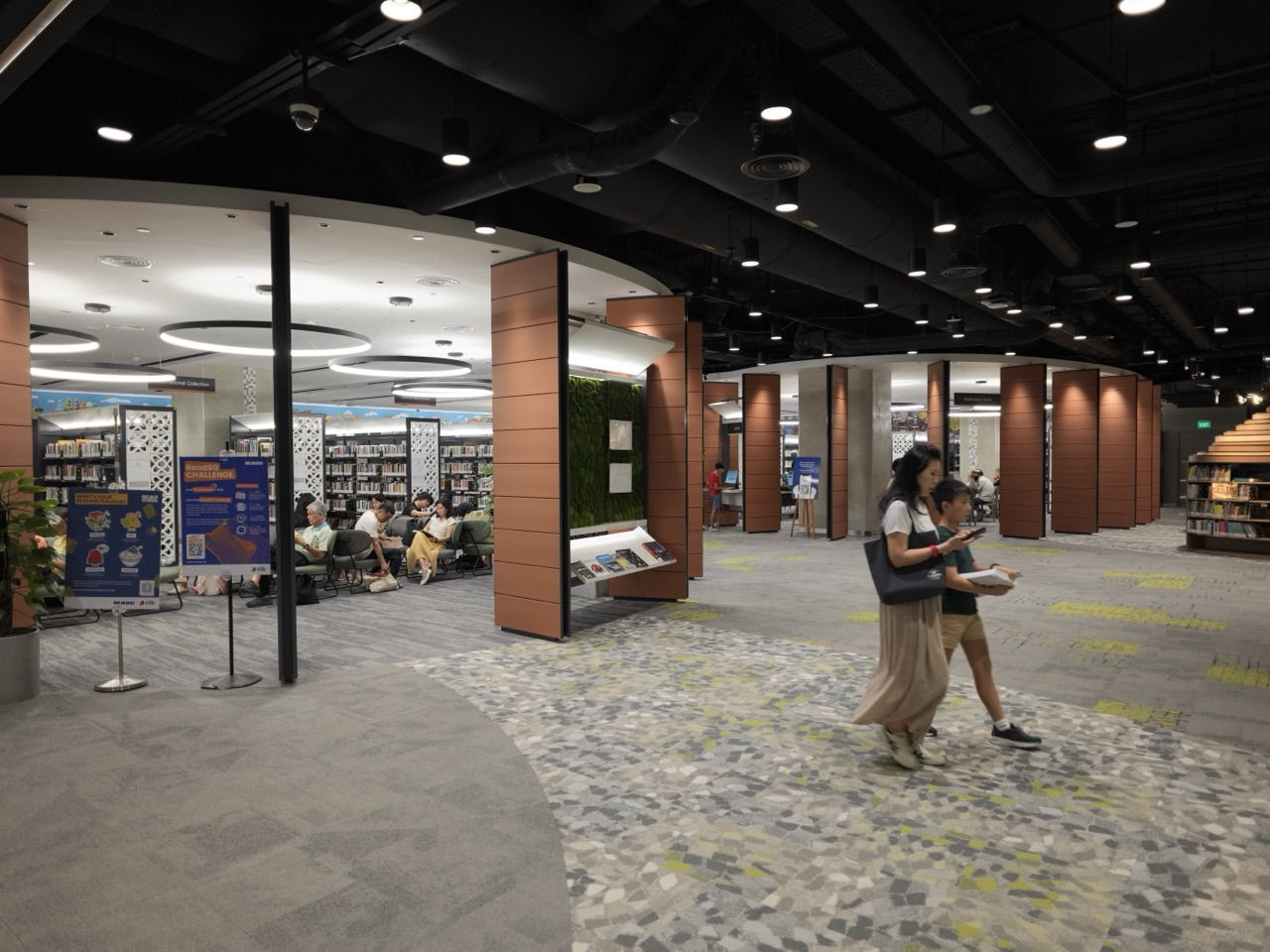
Why study History when a public library seems as familiar as any other community service? Because access to books, information and research has been shaped by decisions about education, membership, language, location, technology and the people a library should serve. The quiet shelves we encounter today conceal a long history of changing institutions, collections and expectations.
Singapore’s library story offers concrete milestones. An early institutional library developed alongside the Singapore Institution in 1823; the Raffles Library and Museum occupied a purpose-built Stamford Road building from 1887; the National Library’s iconic red-brick building opened on 12 November 1960; the National Library Board was established in 1995; and the present National Library Building on Victoria Street opened to readers in 2005. These dates are useful, but they cannot alone tell us which children could borrow books, how people living far from a branch gained access or how a catalogue changed research.
History teaches students to investigate those questions, not assume the library has always operated as it does now. They learn to distinguish the act of collecting books from making them accessible, a new building from the services offered inside it, and digital availability from reliable information. Libraries become a window into education, social development, technology and the careful preservation of a society’s memory.
At a glance
- The central reason to study libraries: knowledge access has a history
- The 1823 origins require precise wording
- Why the 1960 National Library became an important civic place
- 1 September 1995 marks a governance milestone
- A four-week learning plan using library History
- FAQ: Why is 1995 important for libraries?
- Primary resources and connected eduKateSG study
The central reason to study libraries: knowledge access has a history
A library is a place and an organised service. Its role depends on acquiring material, cataloguing it, preserving it and establishing practical ways for readers to use it.
Those functions change with technology and the needs of communities. An early institutional collection could serve a narrower audience than a modern neighbourhood library, but the distinction must be demonstrated through historical rules and records.
History helps students ask specific questions. Who could borrow? What languages were represented? How far did people need to travel? Which groups received special attention? These are empirical matters, not facts revealed by a grand building alone.
Studying the answers shows that a society’s ability to learn is partly shaped by infrastructure and institutional choices.
An old library building does not reveal all its users
Architecture can suggest the scale and intended function of a library. A large reading room may preserve evidence of how study space was organised at one moment.
The building does not establish who entered it, how frequently, what they read or whether everyone felt welcome. Those questions need membership rules, lending records, visitor accounts and descriptions of public services.
Students can practise by examining a historic photograph and listing what is directly visible. They then identify claims that would need other documents.
The exercise is a useful lesson in source criticism: even a familiar building is a partial record of the past.
The 1823 origins require precise wording
The National Library’s historical account traces early library roots to the Singapore Institution established in 1823.
This should not be confused with the founding of the modern National Library Board or with the date every resident received public borrowing services. The earliest institutional library and later nationwide public network were very different arrangements.
A sound History answer names the kind of institution being discussed. The date of an early school-associated collection is a starting point in a long development, not proof that the present system already existed.
This is the sort of distinction that turns memorised milestones into historical understanding.
The names of a library can reflect changing institutions
Collections and services associated with the Singapore Institution later developed through names such as Singapore Library and Raffles Library. Those changes occurred across changing political and organisational contexts.
NLB’s detailed institutional history explains how the institution evolved and later served the new nation.
Students should not assume that every name change meant all books moved into a new building or that every service changed on the same day. The event needs the appropriate documentary evidence.
Tracing the library’s changing names teaches children to read institutions as histories of decisions, not just labels fixed on signs.
The 1887 Raffles Library and Museum building is a milestone, not an origin myth
The National Heritage Board’s record of the Raffles Library and Museum identifies the opening of the purpose-built Stamford Road complex on 12 October 1887.
The same account describes later extensions as collections grew. Students should distinguish this opening from the earlier development of the library’s collections and from subsequent moves.
The building’s location and scale provide one chapter in the history of knowledge institutions. It would be inaccurate to claim that Singapore had no library before 1887.
This comparison helps learners separate institutional origin, relocation, construction and expansion—four events that often get compressed into one date.
Libraries and museums once shared institutional space
The history of the Raffles Library and Museum shows that public collections could be organised together even though later institutions developed specialised roles.
The heritage record describes the museum and library in a common building. This is evidence of an institutional arrangement, not proof that their collections were interchangeable.
A student can ask why books, natural-history specimens and historical objects were collected, how they were catalogued and how visitors used the spaces.
The exercise teaches that today’s familiar separation between a library, museum and archive has its own history. Institutions divide or reorganise functions in response to changing aims and resources.
Who could access a collection is a different question from how many books it held
An old report might proudly count thousands of volumes. The total is evidence of collection size under the report’s definition, but not necessarily the reach of library service.
Useful questions concern opening hours, fees, membership restrictions, language, circulation and travel distance. Some users might be able to consult books inside the building but not borrow them.
Students should avoid claiming that a growing collection automatically means broader public access. These are related but separately measurable outcomes.
History improves educational thinking by requiring the researcher to define the difference between information being present and information being usable.
Why the 1960 National Library became an important civic place
NLB’s Bras Basah history identifies the red-brick National Library building at 91 Stamford Road as officially opened on 12 November 1960.
Its facilities included adult lending, children’s reading and other spaces. Such design choices show that the institution was planned to serve several uses, not only hold rare books.
A building record documents intentions and physical provision. Evaluating how families actually used those facilities would require visitor accounts or operational records.
Students should distinguish the symbolic importance of an opening ceremony from the daily work of providing books and study space.
The library’s post-independence identity continued to develop
The change from Raffles National Library to National Library in 1960 illustrates a shift in institutional naming during a period of political transformation.
NLB’s 2025 historical essay distinguishes the building’s official opening from the subsequent renaming of the institution.
Students should take care not to conflate the institution’s national name with the independence date of 1965. Chronology is essential for understanding the transition to self-government and later nationhood.
The lesson is that a familiar word such as “national” can carry a changing institutional meaning; its date and legal context need verification.
A children’s library is part of the history of education
When a public library provides books and spaces for children, it extends learning beyond the classroom. Yet the existence of a children’s section does not establish that every child in the city used it.
Researchers can investigate programming, school visits, membership and outreach records to understand how a service developed. Oral histories can illuminate individual memories of reading but cannot stand for all pupils.
This is a strong connection between History and educational opportunity. Public learning depends on services, transport, family time and the material people can actually reach.
Students who study the change begin to see education as an ecosystem rather than a school timetable alone.
Why neighbourhood branches can change access
A central library may hold many books while still being inconvenient for readers who live far away. Branches can bring services closer to residential communities.
The National Library’s branch-library history records the development of part-time branches and later full-time community libraries.
A branch opening date establishes the arrival of a service at a location. A claim that local reading ability improved because of it would require separate evidence.
This distinction makes historical explanation stronger. New infrastructure changes possibilities; actual use and outcomes need to be investigated.
The first part-time branch opened at Upper Serangoon
The NLB history identifies an Upper Serangoon part-time branch opening in 1953, followed by other part-time branches in the 1950s.
These facts show that extending library services beyond one central site was considered before the construction of a modern nationwide network. They also remind us that part-time service and a full regional library are different institutions.
Students can investigate the local context and identify what hours or collections a part-time branch offered, if records are available.
A good History answer does not treat all branches as having identical size, staffing or service. The type of branch matters.
Mobile libraries demonstrate that books can travel to readers
Historical library provision was not limited to permanent buildings. The NLB account records mobile library services developing in the 1960s to serve areas that were harder to reach.
A vehicle could bring materials closer to readers, but the actual reach depended on routes, scheduling, collections and operational arrangements. The existence of a mobile service is not proof that it visited every residential area.
Students could examine a historical timetable or route description and ask who could realistically use it. Maps and records should be compared, not assumed to tell a complete story.
This is an especially accessible example of History as the study of practical solutions to unequal geography.
Why mobile services could stop and later return
The NLB branch-library chronology records the ending of earlier mobile services in 1991 after declining borrowing. A new mobile library service, Molly, was introduced in 2008.
Students should not treat these programmes as exactly the same operation merely because both used vehicles. Their contexts, aims and technologies differed.
A comparison asks what problem each service was meant to solve and what evidence is available about participation. Later revival does not automatically prove the earlier closure was mistaken.
History teaches that institutions can revisit an idea in changed circumstances without simply repeating the past.
The 1994 Tampines library was a different scale of branch
NLB’s branch history dates the opening of Tampines Regional Library to 3 December 1994 and identifies it as Singapore’s first regional library.
A regional library and a part-time branch do not necessarily offer identical collections or facilities. That distinction matters when comparing what became available to readers.
Students can compare the intended functions described in opening materials, but they should avoid claiming that every visitor had the same experience.
The broader lesson is that public-service design changes not only through the number of buildings but also through the roles assigned to different kinds of facilities.
The Library 2000 report is a source about planned change
In 1994, the Library 2000 report laid out recommendations for Singapore’s library system. It envisioned new arrangements for a national and public library network.
NLB’s institutional history explains how the review led to a new statutory board.
A report demonstrates the problems and aims identified by its authors. It does not prove every recommendation was implemented immediately or exactly as proposed.
Students should learn to compare a proposal with later operating records, identifying which plans became services and which changed. That is a central habit of studying institutional History.
1 September 1995 marks a governance milestone
The National Library Board was formed on 1 September 1995. This date identifies a new organisational arrangement for managing library services.
The NLB history links the board’s formation to the earlier Library 2000 review and identifies statutory responsibilities including developing publicly funded libraries and preserving Singapore publications.
Students should distinguish the formation of an organisation from the opening of an individual branch. Neither event means the whole service network changed overnight.
The value of History lies in reconstructing how a public goal becomes an institution and then a series of operational activities.
A library catalogue is a technology with a history
Finding a book relies on a system of descriptions and indexes. Catalogues organise records so readers can locate material without knowing exactly where it sits.
The shift from manual to computerised systems changed the methods by which books could be discovered and borrowed. NLB’s history describes technological developments associated with the reorganisation of services.
A new search terminal is not proof that every document became fully digitised. Searching a catalogue, reading an electronic book and viewing a scan of an archival manuscript are different activities.
Students who understand this become more careful researchers: information being indexed is not the same as the information being available in full.
RFID changed the way routine borrowing could be organised
NLB’s 2025 history explains that automated borrowing and returning using radio-frequency identification technology was introduced in 1998.
The technological milestone is meaningful because it addresses a practical service: identifying and processing physical items. It does not prove that books were replaced by computers or that human librarians ceased to be necessary.
Staff continue to perform collection, reference, outreach and preservation functions that are not reducible to book checkout.
This case links the history of technology to the history of public institutions. An innovation affects specific tasks and workflows; its wider consequences require evidence.
The 2005 National Library Building is another different milestone
NLB’s historical chronology records that the National Library Building at Victoria Street opened to readers on 22 July 2005 and was officially opened in November.
A student should distinguish reader access from the formal ceremony, just as they should distinguish the 1960 Stamford Road building from the 2005 site.
This does not mean the collections or traditions of the earlier library vanished. Physical locations can change while institutional functions and archived material continue.
A useful comparison includes building photographs, descriptions of facilities and the reasons recorded for relocation. The goal is a historical account of continuity and change, not an automatic judgement about which building people preferred.
The loss of a building and the survival of an institution are different histories
A remembered physical library can hold emotional significance even after the institution moves. Families may associate the place with study sessions, childhood outings or a personal turning point.
Those memories matter, but an individual recollection cannot establish a universal public view of a relocation. A formal planning account answers a different question from an interview with a former reader.
History can hold both: the chronology of decisions and the diversity of personal memory.
This is a reason to study heritage critically. A place’s social meaning is not identical to the official function of the service it housed.
Digital access changes what it means to visit a library
Readers may use online catalogues, digital lending and reference services without entering a building. Yet digital convenience does not guarantee that every person has an appropriate device, connectivity or confidence using the interface.
Historical inquiry asks when services became available, how access rules developed and which measures show participation. A website launch is a milestone, not a measure of universal usability.
The lesson is especially relevant for parents and educators who want children to understand the difference between easy access to search results and reliable use of information.
Library history shows that public learning has depended on both material infrastructure and skills across multiple technological periods.
Libraries preserve information, but preservation requires decisions
Collection development involves deciding what to acquire, catalogue and retain. Those choices are shaped by budgets, mandates, expert judgement and the materials that survive.
The National Library’s institutional history describes its role as a memory institution as well as a lending service.
A historian should not treat the absence of a book or document as proof that no one ever wrote about a subject. Materials can be lost, unavailable or outside a collection’s scope.
Students develop a more mature relationship to research when they understand that archives and libraries make knowledge visible through processes that can be investigated.
Legal deposit is not the same as a lending book
National library systems may have legal responsibilities to receive published material. Such collections help preserve a record of a country’s output.
NLB’s history describes its legal-deposit functions and the connection to earlier legislation.
A legally deposited publication may be preserved or made available under different conditions from a popular lending copy. Students should not assume that the catalogue entry always means unrestricted borrowing.
This distinction is an important lesson in historical literacy: availability, discoverability, preservation and permission to reuse are different issues.
Readers need to evaluate sources, not just locate them
A library can provide access to books, newspapers, journals and websites, but readers still need to judge which source supports a claim.
History teaches provenance, context and corroboration. An encyclopedia entry may provide orientation, while a dated primary document is needed for a narrow inquiry about an original decision. An old newspaper may record contemporary opinion but not necessarily the final facts.
Libraries provide the tools to discover these sources; historical method guides responsible use.
This complementary relationship is a reason to study History even for students who prefer Mathematics or Science. Every discipline benefits from locating and interpreting evidence correctly.
A public library can serve many ages without serving them identically
Children may seek reading material, students may use study tables, job-seekers may need reference resources and older adults may attend learning activities. A library can design different services for these needs.
The 2013 NLB overview of public libraries discusses children’s programmes and services for elderly readers and other groups.
Students should not assume the existence of a programme proves equal participation by all people in that age group. Evidence about attendance and access requires separate records.
History invites questions about the groups public institutions tried to reach and how the idea of public service developed over time.
Why library membership numbers need careful interpretation
A report of growing membership may suggest wider registration, but it does not automatically measure reading ability or the number of books read.
Definitions matter. A system might count registered users, active borrowers, visits, loans or digital accesses. These measure different behaviours and are not interchangeable.
Students should compare only figures with compatible dates and definitions. If categories have changed, the comparison needs a qualification.
This is an important connection between History and Statistics. A number does not stop being a historical source simply because it appears in a table; its construction still needs investigation.
Local languages are part of the history of public reading
A collection’s language choices can influence which readers are able to use it, and which literature becomes visible to a community.
An institutional report may specify language collections, while a reader’s account may describe how particular books mattered. The sources should be used for the kinds of claim they can establish.
Students should avoid assuming that every member of a language community reads the same works or prefers the same format.
Studying libraries historically can reveal how public institutions responded to changing linguistic needs without reducing people to stereotypes.
A library can be a research site for the history of its own neighbourhood
Local history research might begin with maps, newspapers, directories and photographs held by a library or archive. A present-day branch can also preserve information about places that have changed.
A student could choose one street and compare a dated directory entry with a present-day photograph. The challenge is to identify what the sources support and where additional material is needed.
This method makes neighbourhood history more rigorous than a collection of nostalgic anecdotes.
The important outcome is a traceable argument: readers should be able to follow the source trail and see why the student reached the conclusion.
Worked example: a child using a 1960 library versus a child today
Create two evidence sets: historical descriptions of the children’s library in the 1960 Stamford Road building and a current description of library facilities. Both must be properly dated.
Ask students to compare available services, not imaginary personal experiences. A historic facilities list may show a children’s room and books; a modern site may show additional search or learning options.
The sources do not prove that one period’s children were more curious or more capable. Those judgements require very different research.
The exercise teaches the difference between access to educational resources and claims about actual educational outcomes.
Worked example: a library branch’s opening versus its effect
Give a student an official report confirming the opening date of a library branch and a later account of its programmes.
The student should identify the first source as evidence of institutional action and the second as evidence of later service description. Both are useful, but neither automatically proves that local reading performance improved.
Ask what would be needed to evaluate that broader claim: participation records, carefully designed studies or other relevant evidence.
This exercise builds evidence discipline through a public service that the student can easily understand.
Worked example: searching a catalogue without overclaiming
Present a simulated catalogue entry for a historic newspaper article. Label the entry as fictional classroom material if it is invented.
Ask what it tells the researcher: title, date, publication and possibly an abstract. Then ask whether the entry proves the full article’s contents or factual accuracy.
The student should answer that the catalogue helps identify and locate the item. The actual article must still be read and evaluated in context.
This small task teaches information literacy and the fundamental historical difference between finding evidence and interpreting it.
A four-week learning plan using library History
Week one builds a short chronology: early institutional roots, 1887 Raffles Library and Museum, 1960 National Library building, 1995 NLB and 2005 Victoria Street building.
Week two compares primary and secondary sources, such as a dated library photograph, institutional report and later historical essay. Students identify what each can establish.
Week three asks a causal question: why did an institution expand branches or introduce a new borrowing technology? Learners distinguish intent, implementation and outcome.
Week four is an independent inquiry into another public service, with one clear claim, two sources and a stated limitation. Improvement appears in the strength of the reasoning, not the length of copied notes.
Common mistakes about libraries and access
First, students confuse a library’s early origin with formation of the modern National Library Board. Keep the dates separate. Second, they treat the 1887 building as the start of all libraries in Singapore. Read the earlier history.
Third, they assume collection growth means universal borrowing access. Seek membership and service records. Fourth, they mistake a catalogue entry for a full digitised text.
Fifth, they claim mobile services always operated continuously. Compare the periods. Sixth, they assume new technology removed all human library work.
Each correction trains a broader historical skill: identify the actual event, source, population and mechanism before drawing a conclusion.
Parents can turn an ordinary library visit into inquiry
On a visit, ask the child to choose one feature—book drop, catalogue terminal, reading room or children’s section—and find out when that type of service developed.
An authoritative library history can provide a date, while an old photograph may show a historical version. Ask what each source proves and what remains unknown.
The exercise need not become a major school assignment. A few careful questions make public learning infrastructure visible and encourage children to check rather than repeat appealing facts.
Most importantly, model the willingness to revise a claim when the source shows a different date or context.
FAQ: Did Singapore’s National Library begin in 1960?
The 1960 red-brick building was a major milestone, but the institution’s roots reach back to earlier libraries associated with the Singapore Institution and Raffles Library.
A student should distinguish founding histories from the opening of a particular building and from the establishment of the modern National Library Board in 1995.
FAQ: Why is 1995 important for libraries?
The National Library Board was established on 1 September 1995 after the Library 2000 review.
This marked an organisational change in how library services were developed and managed. It does not mean every public library building opened in that year.
FAQ: Can a library catalogue prove that a historical claim is true?
No. A catalogue can help locate a document and supply metadata such as publication date and author. The document’s content and claims still need examination.
History teaches how to evaluate provenance, context, corroboration and the limits of an individual source.
FAQ: Why study library History if students can search online?
Online search increases access to many forms of information, but does not remove the need to examine source origin and evidence quality. Library institutions also preserve materials that may not appear freely on ordinary websites.
Historical inquiry helps students use both physical and digital sources intelligently and understand how access developed over time.
Primary resources and connected eduKateSG study
Start with NLB’s short history of the National Library, history of branch libraries, history of the National Library Board, and the Bras Basah library narrative. The National Heritage Board’s Raffles Library and Museum record offers a different institutional perspective.
Within eduKateSG, explore the changing history of schools and childhood, oral history and overlooked lives, and how to evaluate sources. Companion articles address public transport and access and why scientific explanations develop. For subject requirements, use the SEC History guide.
The reason to study the history of libraries is to understand that knowledge does not become accessible simply because a book exists. People and institutions build the routes through which the next generation can find, evaluate and use it.