
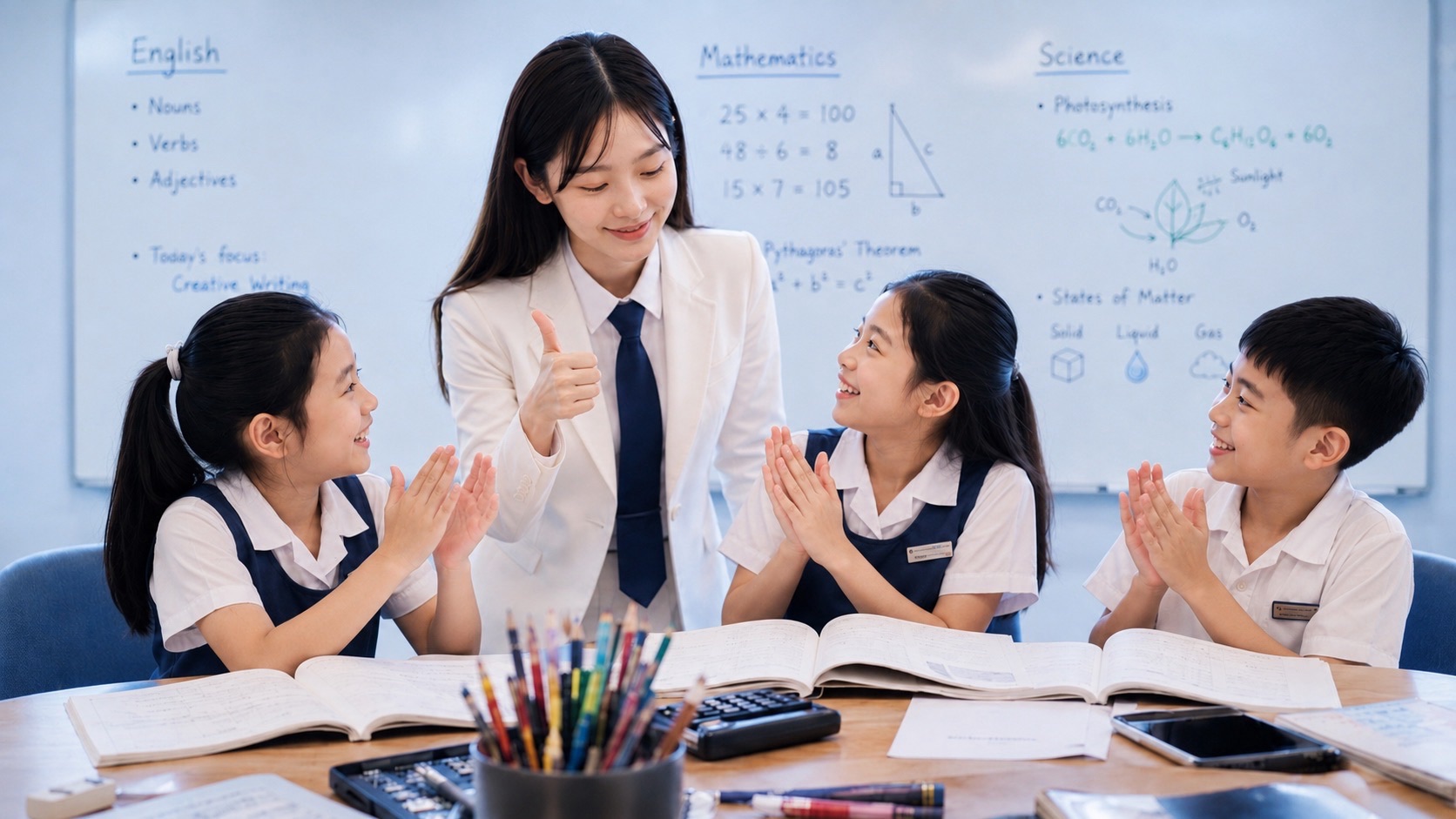
Primary 6 Science is not just about remembering facts.
It is about explaining the world clearly.
By Primary 6, a child is no longer only learning what happens in Science.
They must explain why it happens.
They must connect cause and effect.
They must apply concepts to unfamiliar situations.
They must read experiments, interpret data, use keywords correctly, and write answers that make scientific sense.
That is where many students begin to struggle.
They may know the topic.
They may recognise the diagram.
They may even say the right words at home.
But when the PSLE-style question appears, the marks do not come.
The answer is too vague.
The keyword is missing.
The comparison is incomplete.
The cause and effect is not clearly shown.
The child knows something, but cannot turn that knowledge into a proper Science answer.
This is the difficult part of P6 Science.
It is not only a memory subject.
It is a thinking-and-explaining subject.
At eduKate Punggol, our P6 Science tuition helps students from Punggol, Sengkang and nearby North-East families build the clarity, confidence and answering discipline needed for PSLE Science.
We help students understand concepts properly, repair weak foundations, practise open-ended answers, and become calmer when facing difficult Science questions.
Because a child who can explain Science clearly is not only preparing for an examination.
They are learning how to observe the world, think carefully, use evidence, and communicate with precision.
That is education doing its proper work.
P6 Science Is Where Understanding Must Become Explanation
Many children enter Primary 6 with a common problem.
They have studied Science for years, but their understanding is uneven.
Some topics are clear.
Some are half-remembered.
Some are memorised.
Some were never fully understood.
This becomes dangerous in Primary 6.
PSLE Science does not only ask students to recall facts.
It asks them to use Science.
A question about heat may involve material, temperature change, conduction and fair testing.
A question about plants may involve photosynthesis, transport systems, light, carbon dioxide, water and energy.
A question about forces may involve motion, friction, gravity, mass and surface conditions.
A question about electricity may require the child to understand circuits, bulbs, batteries, switches, brightness, current flow and connection paths.
The child must not only know the topic.
The child must know how the topic behaves.
This is why our P6 Science tutor approach begins with understanding.
We do not want students to collect notes without control.
We want them to know what the idea means, how it works, where it appears, and how to explain it when the question changes shape.
Science becomes easier when the child can see the system behind the question.
The Problem Is Usually Not Effort
Many parents come to us because their child is already working hard.
The child revises.
The child memorises notes.
The child does worksheets.
The child attends school lessons.
The child may even say, “I studied this already.”
But the results remain unstable.
This can be very frustrating.
For the parent, it feels like effort is going into the subject, but marks are leaking out somewhere.
For the child, it feels unfair.
They tried.
So why is the answer still wrong?
Very often, the issue is not effort.
The issue is the learning loop.
The child may be memorising without understanding.
The child may be practising without diagnosis.
The child may be writing answers without knowing what the examiner needs.
The child may be repeating old mistakes without correction.
The child may be reading the question too quickly and answering the topic instead of the task.
This is where tuition must be useful.
Good P6 Science tuition should not simply add more work.
It should make the problem visible.
At eduKate Punggol, we look for the real source of the difficulty.
Is the concept weak?
Is the child unable to explain cause and effect?
Is the answer missing keywords?
Is the student copying model answers without understanding them?
Is the question being misread?
Is the child unable to apply a familiar concept to a new situation?
Is exam pressure causing careless mistakes?
Once we know what is breaking, we can begin to repair it.
Science Tuition for Sengkang Families Who Need Clarity
For many Sengkang families, Punggol is close enough to be practical, but different enough to feel like a proper learning space.
A child leaves school, homework, noise and routine behind, and enters a tutorial where the purpose is clear.
Learn the concept.
Ask questions.
Correct mistakes.
Practise the answer.
Build confidence.
Prepare properly.
That matters.
Children do not improve just because they sit in another classroom.
They improve when the lesson is structured, the explanation is clear, the correction is close, and the child knows what to do next.
Our P6 Science tuition is built for that.
We help students from Punggol, Sengkang and nearby estates approach Science with better control.
Not by frightening them.
Not by drowning them in worksheets.
Not by making Science feel like a list of dead facts.
But by teaching Science as a living subject.
Why does the object move?
Why does the plant grow better here?
Why does the bulb become dimmer?
Why does water evaporate faster?
Why does a material conduct heat?
Why does the shadow change?
Why does one setup give a different result from another?
Science begins when a child asks why.
PSLE Science improves when the child can answer why properly.
Open-Ended Questions Are Where Marks Are Won or Lost
Many students can survive multiple-choice questions with recognition.
They see the options.
They eliminate one or two.
They remember something from class.
They make a reasonable guess.
Open-ended questions are different.
There is no hiding.
The student must produce the answer.
This is where weak understanding appears.
A child may know the idea but cannot phrase it.
A child may write one correct sentence but miss the comparison.
A child may use the keyword but not explain the process.
A child may describe what happened but not explain why it happened.
A child may answer in everyday language when scientific language is needed.
This is why open-ended Science training must be deliberate.
At eduKate Punggol, we teach students how to write answers that are clear, complete and tied to the question.
We train them to identify what the question is asking.
Is it asking for a reason?
A comparison?
A relationship?
A trend?
A conclusion?
A variable?
A fair test?
An explanation of cause and effect?
Once the student knows the task, the answer becomes more controlled.
Then we teach answer structure.
Use the correct concept.
Use the correct keyword.
Refer to the setup.
Compare where needed.
Explain the cause.
Explain the effect.
Do not write vague statements.
Do not throw in memorised phrases blindly.
This is how students become more accurate.
Not by writing longer answers.
By writing better answers.
P6 Science Requires Keywords, But Keywords Are Not Magic
Many students are told to memorise keywords.
That is partly useful.
Science has language.
Words like evaporate, condense, photosynthesis, friction, gravity, adaptation, conduct, insulate, circuit, current, force, energy, variable and heat transfer matter.
But keywords alone are not enough.
A keyword placed wrongly does not earn understanding.
A child may write “heat gained” or “heat lost” without explaining what gained heat, what lost heat, and why the change happened.
A child may write “friction” without explaining how the surface affected motion.
A child may write “photosynthesis” without mentioning the role of light, carbon dioxide, water or food production.
A child may write “adaptation” without explaining how the feature helps the organism survive.
So we teach keywords with meaning.
Students must know what the word does.
What does it explain?
When should it be used?
What must come before it?
What must come after it?
What does the question need in order for the keyword to become useful?
This is how Science answers improve.
The child moves from word-collecting to explanation.
We Repair Misconceptions Early
Science misconceptions are dangerous because they often sound reasonable.
A child may think heavier objects always fall faster.
A child may think coldness moves from one object to another.
A child may think plants get food from the soil.
A child may think a bigger battery always makes every circuit brighter.
A child may think a shadow changes because the object changes size.
A child may think evaporation only happens when water is boiling.
These ideas are understandable.
Children build explanations from what they see.
But Science requires more precise explanation.
So we correct misconceptions patiently.
We do not shame the child for having the wrong idea.
We use the misconception as a doorway.
Why did you think that?
What did you observe?
What is missing from that explanation?
What does the experiment show?
What does the data prove?
How can we say this more scientifically?
That is how the child learns.
Mistakes become information.
Confusion becomes a map.
And slowly, the student begins to understand that Science is not about guessing what the teacher wants.
It is about explaining reality properly.
The eduKate P6 Science Learning Loop
Our P6 Science tuition follows a practical learning loop.
First, we diagnose.
We find out which topics are weak, which answer types are unstable, and which habits are causing marks to leak.
Then we rebuild.
We explain the concept from the ground up so the student knows what is really happening.
Then we apply.
Students practise questions where the same concept appears in different forms.
Then we write.
Students learn how to turn understanding into proper open-ended answers.
Then we review.
Mistakes are corrected line by line.
Then we repeat.
Because Science mastery is not built in one dramatic lesson.
It is built through many small corrections.
A clearer concept.
A better sentence.
A sharper keyword.
A more accurate comparison.
A stronger explanation.
A calmer attempt at a hard question.
These small improvements compound.
At first, they may look quiet.
Then the child begins to answer with more confidence.
Then the parent notices less panic.
Then the schoolwork becomes more manageable.
Then the student begins to believe, “I can do Science.”
That belief matters.
Small-Group Tuition Helps Students Stay Visible
In a large class, a child can hide.
They can nod.
They can copy.
They can stay quiet.
They can leave with the same confusion they entered with.
In a small-group tutorial, the student is visible.
The tutor can see whether the child really understands.
The tutor can check the answer.
The tutor can ask follow-up questions.
The tutor can spot weak phrasing.
The tutor can correct misconceptions before they become habits.
This is important for P6 Science.
A Science answer can look acceptable at first glance, but still lose marks.
It may be too general.
It may not compare properly.
It may not answer the question directly.
It may be missing the mechanism.
It may use the right word in the wrong way.
Close correction helps students sharpen their answers.
That is why our tutorials focus not only on content, but also on the child’s actual working, actual writing and actual thinking.
The student must not only watch the tutor solve the problem.
The student must learn how to solve, explain and correct it.
Science Builds the Mind for the Future
Science education is one of civilisation’s great engines.
It teaches children that the world is not random.
Things have causes.
Systems have patterns.
Evidence matters.
Good explanations must be tested.
Better answers come from better observation.
A child who learns Science properly becomes more careful with truth.
They learn not to accept the first answer blindly.
They learn to ask what caused the result.
They learn to compare conditions.
They learn to notice variables.
They learn to separate observation from assumption.
These are not only PSLE skills.
These are life skills.
A future engineer needs them.
A future doctor needs them.
A future designer needs them.
A future entrepreneur needs them.
A future citizen needs them.
A better civilisation is built by people who can think clearly, explain carefully, and solve problems with evidence.
That begins early.
It begins when a Primary 6 child learns that “because it is like that” is not enough.
They must explain.
And when they learn to explain well, they become stronger.
For Parents: When Should You Get Help?
You do not need to wait until the final months before PSLE.
In P6 Science, early correction is powerful.
Look out for these signs.
Your child can memorise notes but cannot answer open-ended questions.
Your child writes answers that are too short or too vague.
Your child keeps losing marks despite knowing the topic.
Your child struggles with experimental questions.
Your child cannot explain cause and effect clearly.
Your child panics when the question looks unfamiliar.
Your child makes repeated mistakes in the same topics.
Your child’s Science marks are unstable.
These are not signs that the child cannot do Science.
They are signs that the learning system needs repair.
With proper instruction, the child can improve.
The concept can be clarified.
The answer can be sharpened.
The weak topic can be rebuilt.
The exam habit can be trained.
The confidence can return.
That is what our P6 Science tutor support is designed to do.
Helping P6 Students Catch Up, Keep Up and Move Ahead
Some students come to us because they need to catch up.
They have weak foundations from Primary 3 to Primary 5.
They missed important ideas.
They memorised too much without understanding.
They now need repair before PSLE pressure grows heavier.
Some students need to keep up.
They are managing school, but the pace is fast.
They need regular support, weekly correction and clearer explanations to stay stable.
Some students are ready to move ahead.
They understand the basics, but need stronger open-ended answers, higher-order application, timed practice and examination confidence.
All three students need tuition.
But they do not need the same tuition.
That is why our teaching must be attentive.
We help the child in front of us.
Not the imaginary perfect student.
Not the average student on paper.
Not the child who can already do everything.
The actual child.
The child with gaps.
The child with fear.
The child with careless mistakes.
The child with potential.
The child who can improve when taught properly.
Punggol P6 Science Tutor for Sengkang Families
For Sengkang parents looking for P6 Science tuition, eduKate Punggol offers a practical, focused and caring option nearby.
Our goal is simple.
Help your child understand Science.
Help your child answer Science.
Help your child face PSLE Science with more confidence.
We teach concepts clearly.
We repair misconceptions.
We train open-ended answering.
We guide students through application questions.
We review mistakes carefully.
We build calm exam readiness.
Because the child does not need more panic.
The child needs a path.
And when learning has a path, the home becomes calmer.
The parent knows what is being worked on.
The student knows what to improve.
The tutor knows where the weak points are.
The subject becomes less frightening.
This is how good tuition helps.
It turns confusion into clarity.
The eduKate Belief
At eduKate, we believe education should build more than marks.
It should build capability.
A properly taught child becomes more confident.
A properly taught child becomes more observant.
A properly taught child becomes more disciplined.
A properly taught child becomes more willing to try hard things.
That is why we care about clear instruction.
Every corrected Science answer matters.
Every repaired misconception matters.
Every moment where a child says, “Oh, now I understand,” matters.
These are small lights.
But small lights add up.
A better future is not built only by grand speeches and large machines.
It is built by children who are taught properly, one lesson at a time.
If your child is struggling with P6 Science, come to us.
If the marks are not moving, come to us.
If open-ended answers keep losing marks, come to us.
If the child studies but still feels unsure, come to us.
We will help make the problem visible.
Then we will teach, correct, rebuild and prepare.
P6 Science can be difficult.
But difficulty is not the end.
With clear guidance, steady practice and patient correction, your child can learn to understand Science more deeply, answer more accurately, and walk into the PSLE with greater calm.
That is the work.
That is the promise.
And that is how education helps build a better world.
Here’s a point-form guide for Punggol | P6 Science Tutor – Science Tuition for Sengkang
Who We Help (Punggol & Sengkang)
- Primary 6 students preparing for PSLE who need Science Tuition to close gaps fast.
- Strong students aiming for AL1 who want targeted Science Tuition to polish exam technique.
- Learners moving from factual recall to explanation-level answers with structured Science Tuition.
Core Outcomes of Our Science Tuition
- Master PSLE Science keywords, concepts, and examiner expectations through focused Science Tuition.
- Convert everyday observations into scientific explanations (cause–effect) during Science Tuition practice.
- Build speed and accuracy for data-based questions with drill-and-reflect Science Tuition cycles.
What Our P6 Science Tutor Covers
- Themes & Topics (PSLE scope) via Science Tuition
- Diversity, Cycles, Systems, Energy, Interactions—sequenced in Science Tuition to reinforce links.
- Core Skills via Science Tuition
- Interpreting tables/graphs, identifying variables, constructing fair tests, and evaluating conclusions.
- Open-ended answers: using key terms, comparison frames, and “because/therefore” logic in Science Tuition.
Signature Science Tuition Methods
- Fencing Method (stepwise build-up) in Science Tuition: start simple (concept), add detail (keywords), apply (exam-style Q).
- Concrete → Representational → Abstract progression embedded in Science Tuition experiments and visuals.
- Retrieval + Spaced Practice within our weekly Science Tuition timetable to lock in long-term memory.
- Error-Analysis Loops: every Science Tuition session ends with “why the mistake happened” + fix.
Exam Technique Training (Science Tuition Focus)
- OEQ Framework in Science Tuition:
- Identify concept → state relationship → apply to scenario → conclude with consequence.
- Annotation habits taught in Science Tuition: underline variables, circle conditions, bracket constraints.
- Marks-per-minute discipline: timed Science Tuition sprints for Paper Booklet B answers.
Practical Work & Thinking Routines
- Mini-investigations during Science Tuition to practise fair test design (change/measure/keep-constant).
- CER (Claim–Evidence–Reasoning) writing drills in Science Tuition for data-driven questions.
- Real-world links around Punggol/Sengkang during Science Tuition (water cycle near waterways, energy conversions in daily appliances).
Personalised Science Tuition Roadmap
- Diagnostic check → custom Science Tuition plan (topic gaps + skill gaps).
- Weekly micro-targets in Science Tuition (e.g., forces graphs, adaptation reasoning).
- Progress trackers shared with parents after Science Tuition milestones.
Resources You’ll Get with Our Science Tuition
- Topic-by-topic Science Tuition notes with must-know keywords and model answers.
- Mixed-topic testlets for interleaving during Science Tuition (simulates PSLE unpredictability).
- Bite-size reflection prompts to do between Science Tuition sessions.
Common P6 Pain Points We Fix in Science Tuition
- Vague answers → Science Tuition trains precise, cause-linked phrasing.
- Misread variables → Science Tuition builds a pre-answer checklist.
- Memorising facts without application → scenario drills in Science Tuition every week.
Weekly Structure (Typical Science Tuition Plan)
- Week 1–3: Systems & Interactions refresh via Science Tuition (process flows + graphs).
- Week 4–6: Energy & Cycles with Science Tuition investigations (heat/light, plant/animal cycles).
- Week 7–8: Diversity & classification reasoning in Science Tuition (keys, observable traits).
- Weeks 9+: Full papers, error logs, targeted Science Tuition clinics for weak strands.
What Makes eduKateSG.com’s Science Tuition Different
- 3-pax small groups: high-touch Science Tuition feedback each session.
- First-principles teaching: we rebuild understanding, not just answers, through Science Tuition.
- Local context: examples and field-of-view thinking tied to Punggol/Sengkang life in Science Tuition.
Call to Action
- Book a P6 Science Tuition consultation in Punggol/Sengkang—secure a 3-pax slot and get a free diagnostic.
- Bring recent papers; we’ll map a Science Tuition plan to your child’s goals and timeline.
Nurturing Young Scientific Thinkers with eduKateSG.com
In Singapore’s fast-paced education landscape, Primary 6 Science marks a crucial milestone. As Science Tuition students prepare for the PSLE Science Examination, they not only face increasing content depth but also the need for higher-order thinking skills. That’s where Science Tuition in Punggol, guided by experienced tutors near Punggol MRT, plays a pivotal role.
At eduKateSG.com, our P6 Science Tutor team in Punggol and Sengkang empowers students to master scientific principles through understanding, application, and curiosity. With over 20 years of experience teaching the MOE Primary Science syllabus, we ensure every Science Tuition student learns the right strategies to achieve excellence in PSLE Science — and beyond.
Why P6 Science Matters
The Primary 6 Science year is not just about exam preparation — it’s about developing analytical minds ready for the challenges of secondary education. The PSLE Science paper assesses Science Tuition students’ ability to apply concepts in new contexts, interpret data, and reason scientifically.
Students are tested on two key skills:
- Core Content Knowledge – Life Cycles, Energy, Forces, Systems, Diversity, Interactions, etc.
- Process Skills – Observing, inferring, predicting, analysing, evaluating, and hypothesising.
The challenge? Most Science Tuition students struggle not because they don’t study, but because they haven’t learned how to apply Science in real-world contexts. That’s where our Science Tuition in Punggol bridges the gap — transforming rote learning into genuine scientific understanding.
The eduKate Approach to P6 Science Tuition Punggol
1. Building Strong Conceptual Understanding
Our Science Tutors in Punggol start from first principles. We ensure that students grasp every concept at its core before moving to complex applications. Lessons are designed around the MOE Primary Science Syllabus, ensuring alignment with PSLE standards (MOE Primary Curriculum).
For instance:
- When learning about Photosynthesis, students explore how energy from the sun is transformed into chemical energy.
- When studying Forces, they see how friction and gravity interact through simple experiments.
This hands-on, inquiry-based learning builds not only retention but curiosity — the foundation of scientific thinking.
2. Application Through the Fencing Method
eduKate’s signature Fencing Method helps P6 students move from basic recall to full application. Here’s how it works:
- Learn with Fencing Method and AI: Start with simple, well-structured concepts.
- Understand: Break down PSLE questions and link them to real-world science.
- Memorise: Reinforce knowledge through concise summary sheets and visuals.
- Test: Practise with PSLE-style questions under timed conditions.
This method enables students to see Science as a connected web of knowledge — a system, not a list of facts.
3. Small Group Science Tuition for Punggol and Sengkang
Our P6 Science Tuition classes near Punggol MRT are conducted in small groups of 3 students, ensuring each learner receives personalised attention.
- Focused Learning: Tutors identify weaknesses immediately and guide targeted correction.
- Peer Interaction: Students discuss, hypothesise, and debate — mirroring the real scientific process.
- Comfortable Pace: Small groups allow flexibility, ensuring every child progresses confidently.
Located conveniently near Punggol MRT, our Science Tuition Centre attracts students from both Punggol and Sengkang, serving as a hub of academic growth and collaboration.
4. Inquiry-Based Learning and Real-World Science
Our P6 Science Tutors believe that Science is best learned through curiosity. Science Tuition Lessons frequently include demonstrations, models, and real examples.
For example:
- To understand Evaporation and Condensation, students replicate the water cycle using heat lamps and beakers.
- To explore Electricity, they build simple circuits and measure voltage differences.
This approach aligns with MOE’s inquiry-based learning framework, encouraging Science Tuition students to question, observe, and discover — essential skills for PSLE excellence.
5. Strengthening PSLE Answering Techniques
PSLE Science is not only about knowing the content; it’s about expressing scientific reasoning clearly. Our Science Tuition Punggol classes include structured answering strategies such as:
- Using CAUSAL LINKING (cause → process → effect) in open-ended questions.
- Mastering data interpretation in experiment-based questions.
- Employing key scientific terms precisely (e.g., “heat energy gained” vs. “temperature increased”).
Our Science tutors mark and review every written response, helping Science Tuition students understand where they lost marks and how to improve.
What Makes Our Science Tutors in Punggol Exceptional
1. Experienced Educators
Our Science tutors bring over two decades of experience teaching Science in Punggol and Sengkang, combining strong subject mastery with patient guidance. Each Science Tutor is trained to identify misconceptions quickly and use multiple teaching styles to address them.
2. Aligned with MOE SEAB PSLE Standards
Every Science Tutorials follows the MOE Primary Science Syllabus and the SEAB PSLE Examination Format (SEAB PSLE Science). This ensures content accuracy, question familiarity, and confidence during exams.
3. Proven Results
Our Science Tuition students consistently achieve AL1–AL3 grades in PSLE Science. Many go on to top secondary schools, having built a foundation of analytical skills that serve them well in Secondary 1 Science.
4. Holistic Development
We believe in nurturing curiosity and confidence, not just grades. Science Tuition Students are encouraged to ask questions, express opinions, and enjoy the process of learning Science.
Sample Learning Modules at eduKate Punggol
| Week | Topic | Learning Objective | Skills Focus |
|---|---|---|---|
| Week 1–2 | Diversity of Living Things | Classify organisms by observable characteristics. | Observation, Comparison |
| Week 3–4 | Energy and Its Forms | Identify types of energy and their transformations. | Analysis, Explanation |
| Week 5–6 | Forces | Understand balanced and unbalanced forces. | Application, Prediction |
| Week 7–8 | Water and Its Changes of State | Explain evaporation and condensation. | Reasoning, Experimentation |
| Week 9–10 | Reproduction in Plants and Animals | Describe reproductive processes. | Communication, Inference |
Each module concludes with a mini-assessment, reinforcing understanding through short answer and open-ended questions.
Why Parents in Punggol and Sengkang Choose eduKate
- Small Group Focus (3 Pax Limit): Personalised attention ensures no student is left behind.
- Comprehensive Notes & Worksheets: Designed in-house by experienced Science Tutors.
- Regular Feedback: Parents receive updates on progress after each session.
- WhatsApp Tutor Support: Students can ask follow-up questions anytime.
- Convenient Location: Easily accessible from Punggol MRT, Compass One, and Sengkang West.
Parents appreciate our structured system — a blend of professionalism, warmth, and academic precision.
Building Scientific Confidence for PSLE
Science at Primary 6 is more than memorising facts. It’s about building a scientific mindset — curiosity, perseverance, and logical reasoning.
Our Science Tuition in Punggol teaches students to:
- Connect classroom concepts with real-world phenomena.
- Use scientific vocabulary confidently in PSLE answers.
- Think critically about experiments, data, and outcomes.
- Approach problems with creativity and accuracy.
By the time they sit for their PSLE Science examination, students are not just prepared — they’re empowered learners.
Testimonials from Punggol & Sengkang Parents
“My son improved from AL5 to AL2 within two terms. The small-group format and detailed feedback made all the difference.”
— Mrs Tan, Parent from Sengkang“The Science Tutor explained difficult topics like photosynthesis and forces so clearly that my daughter started enjoying Science for the first time.”
— Mr Lim, Punggol Field Walk“What impressed me most is how they teach application — not memorising model answers but truly understanding concepts.”
— Mdm Ong, Punggol Central
From Punggol to Secondary School Success
Our goal is not limited to PSLE. The foundation built in Primary 6 Science Tuition prepares students for Secondary Science, where the demands grow in Physics, Chemistry, and Biology.
At eduKateSG.com, we ensure students transition smoothly by reinforcing:
- Scientific thinking and experimental design.
- Data interpretation skills.
- Explanatory writing with precision.
Science Tuition Students who have gone through our Science Tuition in Punggol consistently report confidence when entering Secondary 1 — a crucial advantage for future success.
Enrol in Science Tuition Punggol Today
Located conveniently near Punggol MRT, our Science tuition centre welcomes students from Punggol, Sengkang, and nearby estates.
Join us to experience:
- Expert P6 Science Tutors with years of experience.
- A structured, MOE-aligned curriculum.
- Personalised attention in a supportive environment.
- Proven strategies that produce top PSLE results.
Contact Us
Visit eduKateSG.com or our partner sites Edukate Punggol and Edukate Singapore for consultation and class availability.
📍 Location: Near Punggol MRT
📞 Contact: WhatsApp/SMS for available class slots
🕓 Class Duration: 1.5 hours per session
👩🏫 Group Size: 3 pax per class
Final Thoughts
At eduKateSG.com, our P6 Science Tutors in Punggol and Sengkang go beyond exam preparation — we ignite a lifelong love for learning. Science becomes more than a subject; it becomes a way to see the world logically and creatively.
With structured teaching, engaging experiments, and personalised guidance, every child learns to think like a scientist — ready not only for the PSLE but also for the challenges that lie ahead in their academic journey.
References
- Ministry of Education – Primary Science Curriculum
- Singapore Examinations and Assessment Board – PSLE Science Format
- EdukateSG.com
- Edukate Punggol
- Edukate Singapore
