
eduKateSG · SECONDARY 3 CHEMISTRY · PHASE 4 LEARNING PAGE
Secondary 3 Chemistry Is Where the Invisible World Becomes the Working World.
At Lower Secondary, students meet matter, particles, energy and reactions as parts of general Science. In Secondary 3, Chemistry asks them to operate those ideas as a coherent system: what we observe in the laboratory must connect to particles we cannot see, symbols we write on paper and quantities we can calculate.
That transition is why a student can appear comfortable with Science in Secondary 2 and then feel suddenly uncertain when Chemistry begins. The problem is not always that the content is harder. Often, the student is being asked to coordinate several representations at once.
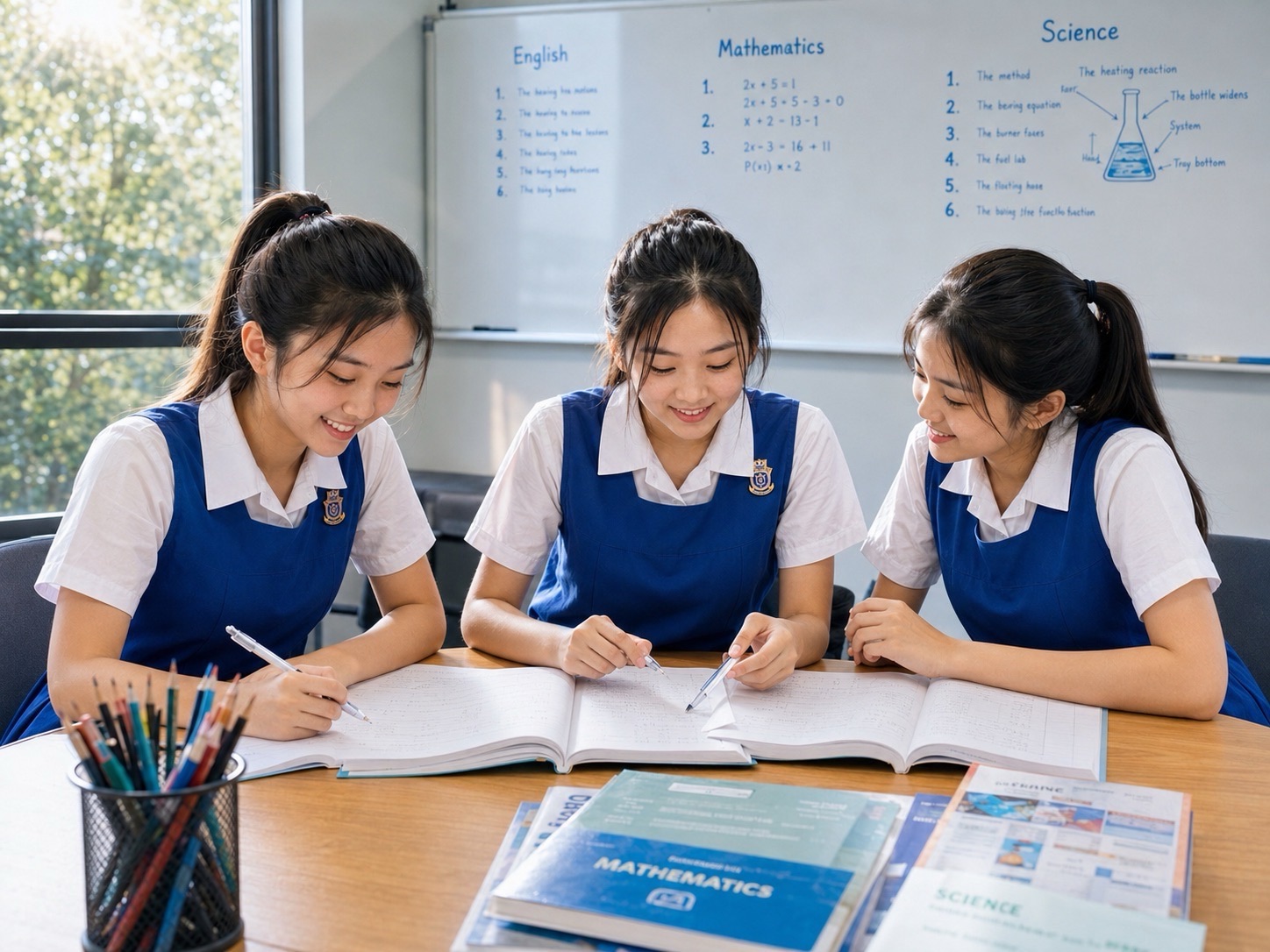
At eduKateSG, Secondary 3 Chemistry tuition is built around that transition. We teach in premium 3-pax small groups so that a tutor can see not only whether an answer is wrong, but where the chemical reasoning changed direction.
What This Page Owns
This is the Secondary 3 Chemistry transition page. Its job is to explain how a learner moves from Lower Secondary Science into upper-secondary Chemistry and how we build the first stable Chemistry system.
It does not try to duplicate every examination route. Students taking Chemistry at different subject levels and combinations should also use the dedicated SEC G2 Chemistry route or SEC G3 Chemistry route. For the wider discipline, return to the Science Learning Hub.
Why Secondary 3 Chemistry Feels Different
Chemistry is unusual because students must learn to move between several versions of the same event. A strip of magnesium burns with a bright light. That is the observable event. The explanation may involve particles, electron arrangements, bonding and energy. The same event can then be represented by words, formulae, a balanced chemical equation, a mole ratio and experimental data.
Each representation keeps something useful and leaves something out. A chemical equation is wonderfully compact, but it does not show the appearance of the reactants, the sound of a reaction, the temperature change, the particle motion or every intermediate interaction. A particle diagram shows arrangement but may hide quantity. A graph can show a rate pattern while concealing the actual particles that produced it.
A strong Chemistry student therefore learns a deeper habit:
Observe the world → choose the right model → represent it correctly → reason from the representation → return to the world and check whether the answer makes sense.
Students who skip this habit often memorise disconnected facts. They may know that an ionic compound has a high melting point, yet struggle to explain why. They may remember a salt-preparation procedure but be unable to choose the correct method when the substances change. They may balance a familiar equation but lose control when a reaction is described in words.
Secondary 3 is the best time to stop that fragmentation before it hardens into an examination problem.
The Four Languages of Chemistry
1. The macroscopic world
This is what the student can observe or measure: colour, state, precipitate formation, gas production, mass, volume, temperature, pH, time and changes during an experiment. Good Chemistry begins by separating observation from explanation. “The solution turned blue” is an observation. “Copper(II) ions formed” is an interpretation that must be supported by chemical knowledge.
2. The particle world
Atoms, ions, molecules and electrons are not visible in a school experiment, yet many explanations depend on them. The learner must be able to imagine arrangement, movement, attractions, collisions and electron transfer without treating a model as a literal photograph of matter.
3. The symbolic world
Element symbols, chemical formulae, ionic charges, equations and state symbols compress chemical relationships into a small space. This is powerful only when the symbols carry meaning. A student who mechanically writes formulae without understanding charge balance will eventually meet a case that the memorised pattern does not cover.
4. The quantitative world
Chemistry also asks “how much?”. Relative masses, amount of substance, concentration, gas volume and reacting ratios turn the symbolic equation into a quantitative model. Here, weak Mathematics can appear as a Chemistry problem. Units, ratios, proportional reasoning and algebraic rearrangement must stay stable while the student also remembers what the chemical quantities represent.
We deliberately train movement between these four languages. The goal is not merely to recognise each one. It is to translate between them without losing the chemistry.
Secondary 3 Under Full Subject-Based Banding and the 2027 SEC
There is no longer one useful assumption that every Secondary 3 Chemistry learner is following exactly the same route. Under Full Subject-Based Banding, students may take Science at different subject levels, and the 2027 Singapore-Cambridge Secondary Education Certificate distinguishes G2 and G3 Science pathways.
For 2027 school candidates, SEAB lists G2 Science (Physics, Chemistry) as K223 and Science (Chemistry, Biology) as K225. At G3, Chemistry may appear inside Science (Physics, Chemistry) K326 or Science (Chemistry, Biology) K328, while pure Chemistry is K324.
That means “Secondary 3 Chemistry” is a learning stage, not a complete description of the examination route. We first establish which syllabus the student is actually taking, what the school has taught and what the next assessment expects. Then the tuition programme is aligned to that route.
Official references: SEAB 2027 G2 syllabuses and SEAB 2027 G3 syllabuses.
The page you are reading therefore owns the transition into Chemistry. The exact examination architecture is handled by the dedicated G2 and G3 pages so we do not confuse level, year and syllabus.
The Secondary 3 Chemistry Spine
Schools can sequence topics differently, and the exact depth depends on the student’s syllabus. We therefore do not pretend that one generic chapter order fits every learner. What we protect is the conceptual spine that later topics depend on.
Experimental chemistry and measurement
Students must know what an experiment can legitimately tell them. Apparatus, measurements, observations, variables, sources of error and data are not a separate “practical chapter”. They are the way chemistry touches reality. We train students to distinguish precision from accuracy, observation from inference and evidence from assumption.
Kinetic particle ideas
The particle model becomes a reusable engine. It helps explain states of matter, diffusion, changes in rate, gas behaviour and parts of solution chemistry. Students should not merely draw circles in boxes. They should be able to say what the particles are doing, what changes and what remains invariant.
Atomic structure and the Periodic Table
Protons, neutrons and electrons become useful when they explain identity, isotopes, ions, electronic structure and periodic behaviour. The Periodic Table is not a poster to memorise row by row. It is an organised map that lets a student infer likely patterns from structure.
Bonding and structure–property reasoning
Ionic, covalent and metallic bonding are often where memorised Chemistry reveals itself. Students may reproduce a stock phrase such as “strong forces need a lot of energy to overcome” but apply it to the wrong particles. We insist on identifying the actual structure, the relevant attractive forces, the mobile or fixed charge carriers and the physical process being explained.
Formulae and equations
A formula encodes composition. An equation encodes conservation and reacting proportions. Students learn to write formulae from ionic charges, balance equations by conserving atoms and read state symbols as information rather than decoration. The aim is to remove guesswork early.
Quantitative chemistry
The mole is one of the major transition points. Students who treat it as a bag of formulas often become unstable when a question changes form. We connect amount of substance to particles, mass, equations, concentration and gas quantities so that each calculation begins with a chemical relationship, not a memorised button sequence.
Reaction families and chemical behaviour
Acid-base behaviour, salt formation, redox, metals, energy changes and rates become much easier when students see families of mechanisms rather than isolated recipes. Instead of “this is the method for this question”, we ask: what species are present, what can change, which driving relationship matters and what evidence would we expect to observe?
Why Students Lose Marks While Saying “I Know This Topic”
| Visible problem | Likely hidden problem | First repair |
|---|---|---|
| Can recite notes but cannot answer a new question | Stored example instead of transferable model | Vary the context while preserving the same mechanism |
| Formulae keep changing incorrectly | Ionic charge and composition are not stable | Rebuild charge reasoning before more equation practice |
| Equations will not balance | Conservation is being treated as a visual puzzle | Track atoms explicitly, then compress the process |
| Mole questions feel random | Quantity relationships are disconnected | Return to amount → ratio → required quantity |
| Explanations are vague | Particle-level cause is missing | Identify entity, interaction, change and observable effect |
| Practical questions are weak | Procedure memorised without experimental purpose | Ask what is measured, compared, controlled and concluded |
| Good homework, poor tests | Retrieval or execution collapses under time | Short timed mixed sets plus error classification |
The important move is diagnosis. Ten more worksheets may create volume without repairing the mechanism that keeps producing the same mistake.
Why 3-Pax Chemistry Tutorials Change What the Tutor Can See
Three students is not simply a smaller version of a large class. It changes the information available to the tutor. In Chemistry, a wrong final answer can be produced by very different causes: the particle model may be wrong, the equation may be unbalanced, the ratio may be misread, the arithmetic may fail, the unit may be omitted or the student may have answered a different command word from the one asked.
In a 3-pax lesson, we can ask the student to explain the move while it is happening. That gives us access to the reasoning before it disappears behind a final mark.
- Frequent questioning instead of passive note-copying
- Immediate inspection of formulae, equations and calculations
- Different prompts for students at different readiness levels
- Enough peer comparison for students to hear another valid explanation
- Fast correction when a misconception appears
- Closer control of pace before school weighted assessments
- Room to test transfer with unfamiliar contexts rather than only drill routine examples
The group is kept small by design. The point is not luxury for its own sake. The point is observability.
How We Teach a Difficult Chemistry Idea
Start with the phenomenon
Where possible, begin from something that could be observed: a substance dissolves, a gas forms, a temperature changes, a metal displaces another ion, a precipitate appears or a reaction speeds up. This gives the explanation a reality anchor.
Expose the model
We then ask which entities and interactions are needed to explain the observation. If the student says “the particles want to react”, the language is repaired. Particles do not have intentions. Chemistry needs a mechanism.
Fence the difficulty
We use the eduKate Fencing Method: stabilise the core relationship inside a controlled boundary before adding complexity. A student may first work with one clear ionic compound, then several ions, then formula writing, then equations, then an unfamiliar context. Complexity is introduced deliberately instead of arriving as noise all at once.
Change the representation
The same idea may be shown as words, a particle diagram, a chemical equation, a table or a calculation. If understanding survives the change of representation, it is more likely to be real understanding rather than recognition of a familiar worksheet format.
Remove the supports
Prompts are faded. The student must eventually decide what matters without being told which chapter the question belongs to. That is the beginning of transfer.
A Typical 90-Minute Secondary 3 Chemistry Lesson
Retrieval and readiness check
Short questions reactivate prerequisite knowledge and reveal whether an older idea has decayed. If today’s bonding work depends on electronic structure, we check that foundation before pretending the new lesson can proceed normally.
Concept instruction
The central mechanism is taught with careful language and multiple representations. We emphasise what must remain invariant when the surface form of a question changes.
Guided application
Students attempt questions while the tutor inspects the reasoning. The objective is not to rescue every difficulty instantly. It is to give enough support for the student to perform the next valid move.
Independent transfer
The same concept is placed inside a less familiar wrapper. Tables, experimental descriptions, diagrams and worded situations are used so the student must recognise the chemistry rather than the worksheet pattern.
Error review and focused continuation
Errors are classified, repaired and revisited. Home practice is purposeful: enough to consolidate and retrieve, not an indiscriminate stack designed to make the lesson look busy.
The Mole Problem: Why We Repair Meaning Before Speed
Quantitative Chemistry is a common place for students to build fragile shortcuts. They memorise a triangle, a formula list or a fixed sequence of steps. That can work while the question looks familiar. It fails when the same relationship is embedded inside percentage purity, concentration, limiting quantities, gas volume or a multi-step reaction.
We teach the mole as a bridge between the microscopic and measurable worlds. A chemical equation gives a ratio of reacting amounts. Mass, concentration or gas volume then allows the student to enter or leave that amount-of-substance layer.
A stable calculation therefore asks:
- What chemical relationship does the equation provide?
- What quantity has been given?
- How does that quantity connect to amount of substance?
- What mole ratio is required?
- What final quantity does the question actually ask for?
- Are the units and magnitude reasonable?
This structure is slower than guessing for the first few lessons. It becomes faster because the student is no longer reinventing the method for every new wrapper.
Students who need more support with algebra and proportional reasoning can also use Why Additional Mathematics Matters for Chemistry as a cross-subject route. Chemistry does not require A-Math for every calculation, but mathematical fluency reduces cognitive load when quantities become layered.
Chemistry Has a Vocabulary Interface
Many students understand more Chemistry than their answers reveal. The failure occurs when scientific distinctions disappear in language.
Describe is not explain. State is not deduce. An observation is not automatically a conclusion. “Particles expand” is not an acceptable replacement for particles moving further apart. “Bonds are broken” is incomplete if the question requires identifying which bonds and why the energy balance matters.
We therefore teach Chemistry vocabulary in use. The student must attach words to models, not memorise a glossary in isolation. When language itself is the bottleneck, students can move into the Vocabulary Master or English Learning Hub.
Three Secondary 3 Chemistry Student Pathways
1. Rebuild
The student is already confused by particles, formulae, equations or basic calculations. We reduce complexity, locate the earliest unstable relationship and rebuild from there. More advanced worksheets are postponed until the foundation can carry them.
2. Stabilise
The student generally understands class teaching but makes recurring mistakes, forgets earlier topics or struggles with unfamiliar questions. We strengthen retrieval, representation switching, error checking and mixed practice so performance becomes less volatile.
3. Extend
The student is coping comfortably and needs greater depth. We use harder transfer questions, richer experimental reasoning and connections across topics. Extension does not mean rushing through the entire syllabus. It means making the existing model more powerful.
Practical Chemistry Is Not a Side Chapter
Students sometimes separate “theory” from “practical” as though the laboratory were an optional annex. That creates a weak scientific model. Chemistry earns its claims by connecting representations to observations and measurements.
From Secondary 3, we train the habits that later practical assessment requires: selecting apparatus for a purpose, recognising variables, recording measurements properly, observing precisely, presenting data, drawing supported conclusions and evaluating procedures.
For G3 pure Chemistry, the 2027 K324 syllabus includes a formal practical paper assessing planning; manipulation, measurement and observation; presentation of data and observations; and analysis, conclusions and evaluation. Those skills should not be introduced only when Secondary 4 practical revision begins. They grow from ordinary Chemistry lessons.
Official reference: SEAB 2027 K324 G3 Chemistry syllabus.
What Progress Should Look Like by the End of Secondary 3
A stronger student is not merely one who has completed more chapters. We look for changes in how the student operates.
- Formulae are written from chemical relationships rather than guesses.
- Balanced equations are checked by conservation.
- Particle explanations identify the correct entities and interactions.
- Definitions become precise enough to use in unfamiliar contexts.
- Mole calculations follow a stable quantity chain.
- Old topics can be retrieved after a delay.
- Experimental questions are answered from purpose and evidence.
- Students can explain why an answer is chemically reasonable.
- Errors begin to cluster less often around the same root cause.
- School tests feel less like a collection of surprise tricks.
Marks matter, but the most useful early sign is reduced fragility. The student can lose the familiar worksheet and still reconstruct the chemistry.
Frequently Asked Questions
Is Secondary 3 Chemistry much harder than Secondary 2 Science?
It is more specialised and more representational. Students must coordinate particles, symbols, equations, quantities and experimental evidence. A learner with good Lower Secondary foundations can adjust well, but the transition should be taught explicitly.
Does every Secondary 3 student take the same Chemistry?
No. The student’s subject level and Science combination matter. For the 2027 SEC, Chemistry can appear in G2 combined Science, G3 combined Science or G3 pure Chemistry. We confirm the actual school syllabus before aligning tuition.
Should my child memorise model answers?
Useful phrasing can be learned, but a model answer should be treated as evidence of a reasoning structure, not as a script to paste everywhere. We teach the chemical cause first, then the precise language that communicates it.
What if Mathematics is the main problem?
We separate chemical understanding from calculation execution. Sometimes the Chemistry is sound but ratio, algebra, units or arithmetic causes the loss. That component can be repaired directly without reteaching every chemical topic.
Do you teach ahead of school?
Where useful, yes, but not by racing. A quiet first encounter can make the later school lesson easier to decode. We only teach ahead when prerequisite ideas are stable enough to support the new topic.
What if my child has already failed the first Chemistry test?
We diagnose the paper rather than reacting only to the mark. We look for missing knowledge, weak particle models, formula/equation errors, language problems, quantitative errors, practical reasoning and time-pressure effects. The repair begins at the earliest repeated failure.
How large are the classes?
Our premium tutorials are designed around three students. This allows frequent interaction and close inspection of each learner’s working while preserving useful peer comparison.
How long is a lesson?
Lessons are typically 1.5 hours weekly, with focused continuation work and adjustments around school assessments. The exact lesson emphasis changes with the student’s school sequence and current needs.
Is the goal only examination performance?
No. Examination performance is an important test of retrieval, transfer and execution, but good Chemistry tuition should also leave the student with a more accurate model of matter and change. Strong understanding and strong exam performance should reinforce each other.
Continue Through the Chemistry Route
- Secondary 4 Chemistry — consolidation, examination transfer and final-year stability
- SEC G2 Chemistry — Chemistry inside the G2 combined-Science routes
- SEC G3 Chemistry — pure and combined G3 Chemistry routes
- O-Level Chemistry OS — existing technical examination-support page
- Science Learning Hub — Primary → Secondary → advanced Science
- Lower Secondary Science Bridge — how general Science becomes Biology, Chemistry and Physics
Secondary 3 Chemistry Tuition at eduKateSG
Secondary 3 is the year to build Chemistry properly before examination pressure becomes dominant. The student is learning a new disciplinary language, a new set of representations and a new level of quantitative precision.
For a student who is behind, we rebuild the earliest unstable model. For a student who is coping, we stabilise retrieval and transfer. For a student who is ready, we extend the chemistry without sacrificing foundations.
The objective is not a student who has seen more Chemistry. It is a student who can make Chemistry work.
eduKateSG · 8 Fourth Avenue · Singapore 268674 · Near Sixth Avenue MRT · Premium 3-pax small-group tutorials.
Arrange a parent–student consultation with eduKate Singapore