
Summary
Secondary 4 Mathematics is the year where everything becomes visible.
The weak algebra from Sec 2.
The careless habits from Sec 3.
The topics that were “sort of understood”.
The formulas memorised but not properly owned.
The exam fear that appears when the question looks different from the worksheet.
In Secondary 4, Mathematics stops being only about learning chapters.
It becomes about execution.
Can the student read the question accurately?
Can the student choose the correct method?
Can the student show working clearly?
Can the student recover when stuck?
Can the student finish the paper under time pressure?
Can the student avoid giving marks away through small, repeated errors?
That is what Secondary 4 Math Tuition in Punggol must address.
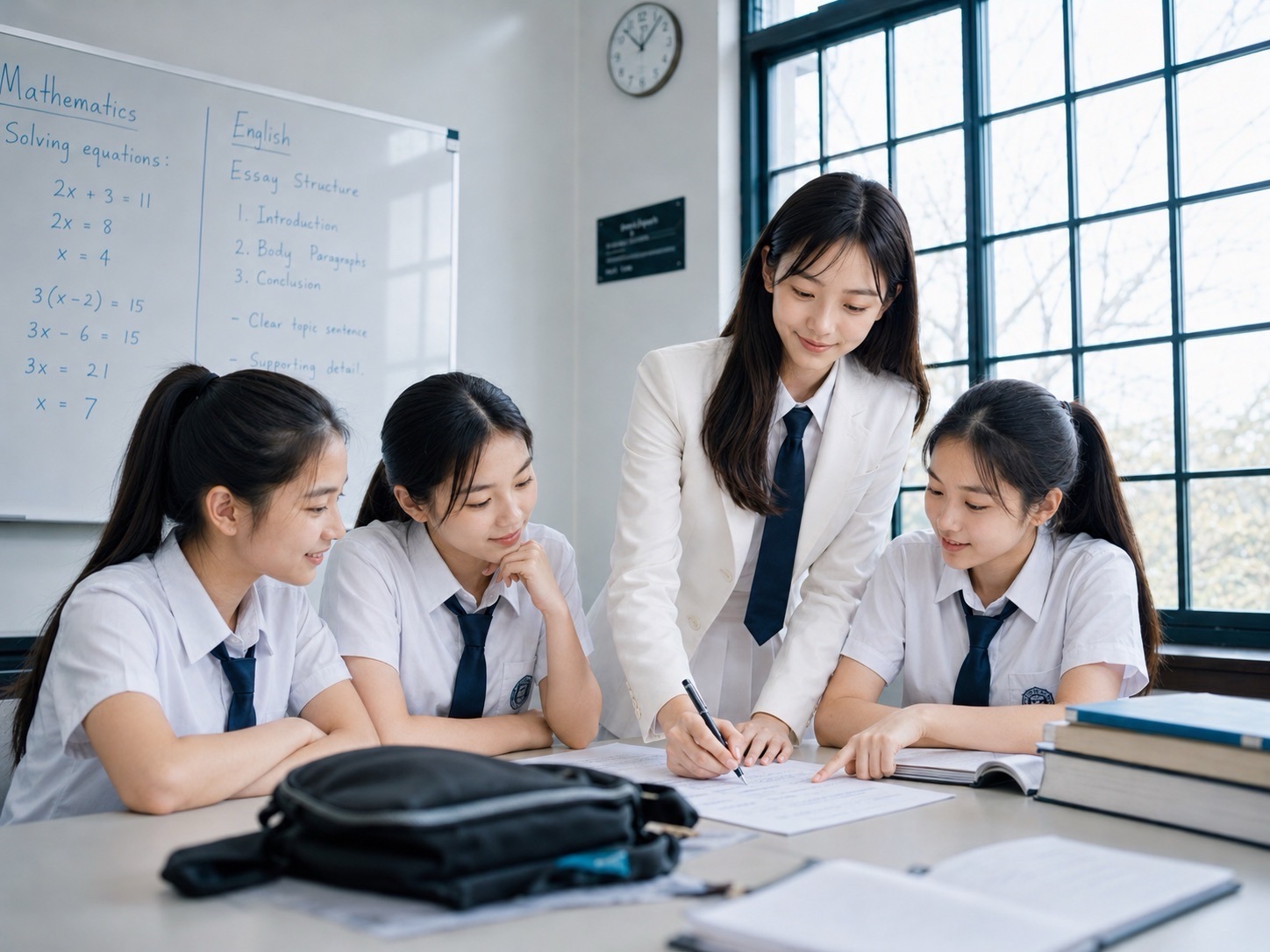
At eduKate Punggol, our Secondary 4 Math tuition helps students move from scattered knowledge into exam-ready control. We repair weak foundations, strengthen key topics, train problem-solving habits, correct careless errors, and prepare students for school examinations and national examination demands with clarity, structure and hope.
Because Secondary 4 is not the year to panic.
It is the year to organise.
Secondary 4 Mathematics Is the Final Assembly Year
By Secondary 4, the student has already met many of the major mathematical ideas needed for the examination.
But meeting a topic is not the same as mastering it.
A student may have “done” algebra, but still make sign errors.
A student may have “covered” graphs, but still struggle to interpret gradients, turning points and equations.
A student may have “learnt” trigonometry, but still freeze when a question mixes bearings, angles of elevation, sine rule and cosine rule.
A student may have “practised” statistics, but still misread cumulative frequency, box plots or probability language.
Secondary 4 is where these pieces must be assembled.
It is no longer enough to learn chapter by chapter.
The examination does not always respect the student’s comfort zone.
A question can move from geometry into algebra.
A real-world context can require proportion, graphs, rates, units and interpretation.
A Paper 2 question can test whether the student can hold several pieces of information in mind and decide what matters.
This is why Secondary 4 Math tuition must become more strategic.
Not merely more worksheets.
Not merely more homework.
Not merely “try harder”.
The student needs a system.
They need to know what they are weak in, what they are losing marks to, what topics are still unstable, and what habits must change before the examination.
A good Punggol Math Tutor helps make that system visible.
What Actually Happens in Secondary 4 Math Tuition?
In good Secondary 4 Math tuition, the lesson is not random.
It is built around a clear purpose.
A student comes in with school topics, test results, homework issues, confidence problems and exam worries. The tutor must turn all of this into a workable plan.
At eduKate Punggol, a Secondary 4 Math lesson usually works through four major layers.
First, we identify the leak.
Where are the marks escaping?
Is it algebra?
Is it careless calculation?
Is it poor question reading?
Is it weak formula recall?
Is it inability to start?
Is it time pressure?
Is it a problem with diagrams?
Is it a problem with explaining final answers in context?
Second, we repair the concept.
The student must understand what the topic means. A formula without meaning is fragile. It works only when the question looks familiar.
Third, we practise the execution.
Students need to write clear working, use correct notation, sequence their steps properly and finish questions without unnecessary confusion.
Fourth, we review the mistake.
This is where many students improve.
Not from doing ten more questions blindly, but from understanding exactly why the previous question failed.
A mistake must become information.
Once the mistake is understood, the student can build a better habit.
The First Job: Find the Real Problem
Many parents say, “My child is careless.”
Sometimes that is true.
But in Secondary 4 Mathematics, “careless” can mean many things.
It can mean the child is rushing.
It can mean the child does not check signs.
It can mean the child does not write enough working.
It can mean the child is weak in algebra.
It can mean the child panics when the question is long.
It can mean the child does not understand the topic deeply enough, so every step feels uncertain.
A good tutor does not stop at the word “careless”.
We classify the error.
There are concept errors.
The student does not understand what is being tested.
There are method errors.
The student understands the topic but chooses the wrong route.
There are execution errors.
The student knows the method but makes a sign, bracket, substitution, calculator or copying mistake.
There are interpretation errors.
The student solves something, but does not answer the question asked.
There are time-management errors.
The student spends too long on one question and loses marks elsewhere.
Each type of error requires a different correction.
That is why close attention matters.
In a small-group setting, the tutor can look at the student’s working and see the pattern. The final answer is only the ending. The real story is in the steps.
Why Sec 4 Math Tuition Cannot Be Only “Topic Teaching”
Topic teaching is important.
Students still need to revise algebra, equations, inequalities, functions, graphs, geometry, trigonometry, mensuration, vectors, matrices, probability and statistics.
But Secondary 4 tuition must go beyond topic coverage.
By Sec 4, the real question is:
Can the student use the topic under examination conditions?
A student may understand quadratic equations during a lesson but fail when the question is hidden inside a graph problem.
A student may know the sine rule but fail when the diagram is not drawn for them.
A student may know compound interest but fail when the question is placed inside a long real-world scenario.
A student may know how to calculate the mean but fail to explain what a change in distribution means.
This is why we train transfer.
Transfer means the student can take knowledge from one form and use it in another.
From words to equation.
From graph to gradient.
From diagram to angle relationship.
From data to conclusion.
From formula to decision.
From calculation to final interpretation.
This is the skill that separates a student who has practised from a student who is exam-ready.
Paper 1: Speed, Accuracy and Breadth
Paper 1 rewards breadth, speed and accuracy.
Students need to move through many short-answer questions with calm control.
This paper punishes weak basics.
It exposes poor algebra.
It exposes careless arithmetic.
It exposes weak formula recall.
It exposes slow working.
It exposes students who cannot decide quickly.
In tuition, Paper 1 training is not simply about doing fast questions.
It is about building reliable habits.
Students must learn to read the command word.
They must identify the topic quickly.
They must write enough working to secure method marks.
They must avoid skipping essential steps.
They must know when to use a calculator and when mental structure is faster.
They must check units, angles, signs and rounding.
The goal is not frantic speed.
The goal is controlled speed.
A strong Sec 4 student does not rush.
They move efficiently because the method is clear.
Paper 2: Strategy, Stamina and Real-World Thinking
Paper 2 is different.
The questions are longer.
The marks are larger.
The thinking is more layered.
The student must often manage more information at once.
Paper 2 rewards students who can organise.
They must break down the question.
They must decide which information is relevant.
They must connect topics.
They must show reasoning.
They must interpret answers in context.
This is where many students lose confidence.
They see a long question and think, “I don’t know what to do.”
But long questions are not monsters.
They are systems.
In tuition, we teach students to slow down at the correct moment.
Circle the key information.
Label the diagram.
Write down the known values.
Identify the unknown.
Translate words into mathematics.
Look for topic clues.
Start with a smaller step.
Do not try to solve the whole question in the head.
Good Paper 2 training teaches students to enter the problem.
Once they can enter, they can move.
Once they can move, they can earn marks.
The Importance of Algebra Control
Algebra is the engine of Secondary Mathematics.
If algebra is weak, everything becomes heavier.
Equations become slow.
Graphs become confusing.
Functions become unstable.
Geometry questions with unknowns become painful.
Trigonometry becomes messy.
Word problems become difficult to translate.
Even statistics and probability can become awkward when expressions are involved.
In Secondary 4 Math tuition, algebra repair is often one of the highest-value improvements.
We look at expansion, factorisation, algebraic fractions, changing the subject of a formula, simultaneous equations, quadratic equations, inequalities and substitution.
But we do not teach algebra as a mechanical ritual.
We teach students to understand form.
Why is this expression written this way?
Can it be factorised?
Is there a common factor?
Is the denominator important?
Can this equation be simplified?
What is the safest next step?
Will this expansion create unnecessary work?
Is the student preserving equality correctly?
Once students gain algebra control, Mathematics feels less chaotic.
The paper becomes more manageable.
Geometry and Trigonometry: Seeing the Diagram Properly
Many students struggle with geometry not because they cannot calculate, but because they cannot see.
They do not see parallel lines.
They do not see similar triangles.
They do not see circle properties.
They do not see which angle is connected to which.
They do not see how a diagram can be extended or labelled.
They do not see where trigonometry enters.
So tuition must train the eye.
Students learn to mark equal angles.
Students learn to annotate diagrams.
Students learn to recognise hidden right triangles.
Students learn to connect angle properties with algebra.
Students learn to use sine rule, cosine rule and area formula with care.
Students learn to check whether the answer makes sense.
Geometry and trigonometry reward disciplined observation.
A student who scribbles randomly will struggle.
A student who labels clearly begins to see the route.
Statistics and Probability: Reading Before Calculating
Statistics and probability are not only about calculation.
They are about language.
Students must understand what the data represents.
They must know whether a question is asking for probability, expected outcome, comparison, interpretation or conclusion.
They must read tables and graphs carefully.
They must avoid assuming what the data does not say.
In tuition, we train students to slow down before pressing the calculator.
What is the population?
What is the sample?
What is the event?
Is the question asking for “at least”, “at most”, “more than”, “less than”, or “exactly”?
Is replacement involved?
Are the events mutually exclusive?
Is the student comparing averages without considering spread?
Good Mathematics is not just calculation.
It is careful thinking.
Secondary 4 students must learn that reading accurately is part of mathematical ability.
Real-World Context Questions: Why They Matter
Real-world context questions test whether Mathematics can leave the textbook and still remain useful.
This is important.
Mathematics is not only a school subject.
It is a language for decisions.
Travel plans.
Rates.
Finance.
Bills.
Measurement.
Charts.
Time.
Distance.
Scale.
Risk.
Comparison.
Efficiency.
These are not artificial skills.
They are civilisation skills.
A society works better when its people can read numbers properly, understand evidence, compare options, calculate cost, question assumptions and make clear decisions.
This is why real-world questions matter.
They train students to use Mathematics as thinking.
In our tuition, we help students approach these questions without panic.
Read the story.
Find the mathematics.
Ignore unnecessary noise.
Convert units carefully.
Represent information clearly.
Solve step by step.
Interpret the answer in the real situation.
The final line matters.
The answer must make sense in the world of the question.
Why Small-Group Tuition Helps Sec 4 Students
Secondary 4 students need attention.
Not vague encouragement.
Real attention.
Someone must see how they think.
Someone must catch the repeated mistakes.
Someone must explain clearly when a school lesson moved too quickly.
Someone must help them prepare before panic becomes the main emotion.
In a 3-pax small group, students receive closer correction while still benefiting from the rhythm of a class.
They hear other students’ questions.
They learn from shared mistakes.
They see that they are not the only one struggling.
They gain confidence when they can explain a method.
They receive more direct guidance than in a large group.
For Sec 4, this is powerful.
The year is short.
Every correction must count.
What Parents Usually Notice First
Parents often notice small changes before big marks appear.
The child becomes less avoidant.
Homework becomes less dramatic.
The child can explain what went wrong.
The child starts asking better questions.
The child checks working more carefully.
The child stops saying “I don’t know everything” and starts saying “I need to fix this topic.”
The child becomes calmer before tests.
These are important signs.
Confidence does not always arrive as loud excitement.
Sometimes confidence arrives quietly.
A student sits down, opens the paper and starts.
That is progress.
What Students Learn Beyond Mathematics
Secondary 4 Mathematics tuition should prepare students for examinations.
But it should also prepare them for life.
A student who learns Mathematics properly learns how to face difficulty.
They learn that confusion can be investigated.
They learn that mistakes can be corrected.
They learn that speed must be built on accuracy.
They learn that clear working protects them.
They learn that panic is not a strategy.
They learn that hard problems can be broken into smaller steps.
This matters beyond Sec 4.
The world our children enter will not become simpler.
They will need to think.
They will need to adapt.
They will need to learn new systems.
They will need to solve problems that do not arrive in neat textbook chapters.
Mathematics is one of the training grounds for that future.
Properly taught children become clearer thinkers.
Clearer thinkers build better families, better schools, better workplaces and better communities.
This is why we teach carefully.
Not only for the next exam.
For the next version of the child.
When Should a Sec 4 Student Start Math Tuition?
The best time is before the marks collapse.
Secondary 4 moves quickly.
Once school prelims arrive, the student has less time to rebuild foundations slowly. It is still possible to improve, but the repair becomes more urgent.
Parents should consider tuition when the student:
- struggles with algebra manipulation
- loses marks despite “knowing the topic”
- cannot finish papers on time
- makes repeated careless mistakes
- performs well in homework but poorly in tests
- panics during long questions
- cannot explain why an answer is wrong
- avoids Mathematics revision
- has weak Sec 2 or Sec 3 foundations
- wants to move from pass to stronger grades, or from good to distinction-level control
Tuition is not only for students who are failing.
It is also for students who need structure, acceleration and exam discipline.
What Happens at eduKate Punggol
At eduKate Punggol, Secondary 4 Math tuition is built around clear teaching and steady correction.
We teach the concept.
We practise the method.
We correct the mistake.
We strengthen the habit.
We prepare for school tests.
We train examination execution.
We help students understand what to do next.
The aim is not to overwhelm the child with more noise.
The aim is clarity.
A student who understands clearly becomes calmer.
A calmer student practises better.
A student who practises properly becomes more accurate.
An accurate student gains confidence.
A confident student is more willing to face harder questions.
This is the improvement cycle.
Not magic.
Good teaching.
Good correction.
Good practice.
Good habits.
Repeated patiently.
Secondary 4 Is Not the End. It Is a Launch Point.
Secondary 4 can feel like a final battle.
But it is also a launch point.
The habits a student builds now will follow them into post-secondary education, polytechnic, junior college, ITE, future training, future work and future decision-making.
Mathematics teaches more than answers.
It teaches disciplined thought.
At eduKate Punggol, we believe every child can become stronger with the right support.
Some need repair.
Some need confidence.
Some need exam strategy.
Some need a tutor to slow the problem down and make the method visible.
Some need to be reminded that difficulty does not mean defeat.
If your child is struggling with Secondary 4 Mathematics, do not wait for panic to become the plan.
Come and let us help.
We will find the weak spots.
We will rebuild the foundations.
We will prepare the examination skills.
We will teach your child how to think more clearly, calculate more accurately and face the paper with better control.
Secondary 4 Mathematics is difficult.
But difficult things can be taught.
Difficult things can be practised.
Difficult things can be solved.
And when a child learns that, the lesson becomes bigger than Mathematics.
Punggol Math Tutor for Secondary 4 Students
Secondary 4 Math Tuition in Punggol helps students prepare for school examinations and national examination demands through focused teaching, close correction and exam-ready practice.
At eduKate Punggol, our small-group tutorials give students the attention they need to repair mistakes early, strengthen core topics, and build confidence before the examination season becomes too heavy.
If your child needs clearer explanations, better habits and stronger Mathematics control, message us to check class availability.
Skip & WhatsApp Us.
Latest Secondary 4 Math News for 2026
- Final Year for Traditional O-Level Math Exams in 2026: As announced by the Ministry of Education (MOE), 2026 marks the last assessment year for the current Singapore-Cambridge GCE O-Level format, including Mathematics (Syllabus 4052) and Additional Mathematics (Syllabus 4049), before transitioning to the new Singapore-Cambridge Secondary Education Certificate (SEC) in 2027. For students seeking Punggol Sec 4 Math Tuition, centers like eduKate Singapore are ramping up targeted revision programs to align with this pivotal year’s syllabus, emphasizing proof-based questions and real-world applications to secure A1 distinctions.
- Updated O-Level Math Syllabuses Released for 2026 Private Candidates: The Singapore Examinations and Assessment Board (SEAB) has published the 2026 GCE O-Level Mathematics syllabuses for private candidates, including specimen papers for revised topics in algebra, geometry, and calculus. Punggol Sec 4 Math Tuition providers, such as RMSS and BlueTree Education, are incorporating these updates into their curricula, offering small-group sessions to help students master geometrical instruments and formula application ahead of the exams.
- Full Subject-Based Banding (SBB) Impacts Sec 4 Math Pathways: With the removal of Express, Normal (Academic), and Normal (Technical) streams starting from the 2024 Sec 1 cohort, the 2026 Sec 4 students will experience mixed-ability classrooms, allowing flexible subject levels in Math. In response, Punggol Sec 4 Math Tuition at centers like secmathtuition.com is adapting with differentiated instruction, bridging foundational gaps for G1, G2, and G3 levels to optimize O-Level performance.
- Smoother Primary-to-Secondary Math Transitions for 2026 Cohort: Changes in the primary syllabus, such as delaying ‘Speed’ to Sec 1, aim to ease the jump for the 2026 Sec 4 students who entered secondary in 2023. Punggol Sec 4 Math Tuition experts at eduKate Punggol are focusing on these linkages, providing holiday intensives in November 2025 to reinforce topics like ratios and averages shifted from P5 to P6.
- Critiques on O-Level Math Syllabus Relevance Spark Discussions: Recent online forums, including Reddit, highlight concerns over the outdated nature of the O-Level Math syllabus, such as inaccuracies in Additional Math topics, prompting calls for modernization before the 2026 exams. Punggol Sec 4 Math Tuition tutors at Dawn’s Math Corner are addressing this by integrating contemporary real-life examples, like data analytics in statistics, to make lessons more engaging and relevant.
- Cambridge O-Level Math Syllabus Revisions for 2025-2027: International updates to the Cambridge O-Level Mathematics (Syllabus D) 4024, effective through 2027, include minor changes in assessment formats, influencing Singapore’s aligned curriculum. For Punggol Sec 4 Math Tuition, this means enhanced focus on sequences and integration techniques at places like The Hess Academy, preparing students for potential specimen paper variations.
- Increased Emphasis on Holistic Math Education in 2026: MOE’s push for inclusive education under Full SBB encourages schools to offer Math at varying levels, reducing stress and promoting equity for the 2026 cohort. Punggol Sec 4 Math Tuition at Punggol Secondary School-linked programs is incorporating life skills and metacognition, with tutors providing 24/7 support via WhatsApp for doubt clearance.
- P5/P6 Syllabus Shifts Affecting Future Sec 4 Math Readiness: Topics like Ratio and Average moved to P6 in 2026 will better prepare incoming secondary students, indirectly benefiting the 2026 Sec 4 group through stronger foundational cohorts. Punggol Sec 4 Math Tuition centers, including ManyTutors listings, are offering bridging workshops to align with these changes, ensuring seamless progression to O-Level topics.
- SEC Certificate Rollout Post-2026 Influences Math Prep Strategies: While 2026 remains under O-Levels, the impending 2027 SEC exam introduces a common national certification, prompting early adaptations in Math teaching. In Punggol Sec 4 Math Tuition at RMSS Punggol, tutors are future-proofing lessons with skills like critical thinking for the new format, alongside traditional TYS practice.
- Holiday Boosters and Intensives for 2026 O-Level Math: As of October 2025, tuition centers are announcing November-December programs for Sec 4 Math revision, focusing on exam dates and key topics like vectors and probability. Punggol Sec 4 Math Tuition at eduKateSengkang.com features immersive workshops, small-group dynamics, and personalized error logs to elevate scores in the lead-up to 2026 exams.
Contact us for our latest Sec 4 Math Tutorials

In the competitive landscape of Singapore’s education system, where O-Level examinations determine pathways to junior colleges, polytechnics, or integrated programs, Secondary 4 marks a pivotal year for mathematics mastery.
For students in Punggol, navigating the rigors of Elementary Mathematics (E-Math, Syllabus 4052) and Additional Mathematics (A-Math, Syllabus 4049) can be daunting, with topics spanning algebra, geometry, trigonometry, calculus, and statistics demanding not just rote learning but deep conceptual understanding and problem-solving prowess.
At eduKate Singapore, a trusted Punggol tuition centre specializing in small-group English, Mathematics, and Science tuition, Secondary 4 Math Tuition transforms this challenge into an opportunity for excellence. With experienced tutors who are aligned to the Ministry of Education (MOE) syllabus, sessions are designed to build confidence, clarify doubts, and propel students toward distinctions (A1 grades) in their O-Levels.
But what exactly unfolds in these 1.5-hour sessions? Drawing from proven pedagogical approaches like the Concrete-Pictorial-Abstract (C-P-A) method endorsed by Singapore’s curriculum, and backed by research on tuition effectiveness, this comprehensive guide explores the inner workings of Punggol Math Tuition at eduKateSG.
Whether you’re a parent seeking insights or a student aiming for top-tier results, discover how personalized, small-group (up to 3 students) learning fosters academic growth and holistic development in Punggol’s vibrant community.
The Foundation: Understanding Secondary 4 Math Challenges and Why Tuition Matters
Secondary 4 mathematics in Singapore isn’t merely about equations—it’s a gateway to critical thinking and real-world applications. Under the MOE’s Mathematics Framework, students tackle advanced topics to develop problem-solving skills, with E-Math focusing on practical tools like statistics for data analysis and A-Math delving into calculus for modeling change.
However, with class sizes in schools often exceeding 30, individual attention is limited, leading to unresolved doubts and performance gaps. Research from the National Institute of Education (NIE) highlights that supplementary tuition significantly boosts achievement, with studies showing 0.4-0.6 standard deviation improvements in math scores for secondary students who receive targeted support.
At eduKateSG’s Punggol centre, tuition addresses these by starting sessions with a diagnostic review. Tutors, boasting years of experience and top qualifications, assess each student’s strengths—perhaps fluency in quadratic equations—and weaknesses, like trigonometry proofs, using tools aligned to SEAB assessment objectives.
This personalized baseline ensures lessons are proactive, teaching ahead of school curricula to build anticipation and reduce exam stress. Parents often note in reviews how this approach turns “math anxiety” into enthusiasm, with one testimonial praising the “inclusive environment” that makes complex topics like vectors accessible.
Step-by-Step: A Typical Session Breakdown in Punggol Secondary 4 Math Tuition
What transpires in a 1.5-hour session at eduKateSG? It’s a structured yet flexible journey emphasizing understanding over memorization, inspired by Singapore’s renowned math pedagogy. Sessions begin with a 10-15 minute warm-up:
Retrieval practice quizzes on prior topics, such as differentiating functions or solving inequalities, to reinforce retention via the spacing effect—a technique proven to enhance long-term memory by 20-30% in math learning.
Next, the core instruction (30-40 minutes) introduces new concepts from scratch. For instance, in A-Math, tutors might use manipulatives or visuals to explain integration as “area under curves,” transitioning from concrete models (e.g., shading graphs) to abstract formulas, per the C-P-A framework. In small groups of 3, interactions are dynamic—students collaborate on problems, with Math tutors facilitating discussions to uncover misconceptions. This peer learning aligns with Vygotsky’s Zone of Proximal Development, where scaffolding from knowledgeable others accelerates mastery.
The session intensifies with guided practice (20-30 minutes): Students tackle commonly examined questions, like O-Level-style proofs or data interpretation, under tutor guidance. EduKateSG’s tutors emphasize marking schemes, teaching how to secure method marks—crucial for distinctions, as per SEAB guidelines. Doubts are cleared on-the-spot, fostering a safe space for questions. As exams near, revision papers from past Ten-Year Series (TYS) are integrated, with tutors providing tricks for efficiency, such as shortcut methods for binomial expansions.
Wrapping up (10 minutes), reflections encourage metacognition: “How does this link to real life?”—perhaps tying probability to risk assessment in finance. Homework is assigned thoughtfully, with 24/7 support via WhatsApp for urgent queries, ensuring continuous progress.
Innovative Teaching Methods: Personalized and Holistic Approaches at EduKate Punggol
EduKateSG stands out with customized methods tailored to individual learning styles, as recommended by NIE’s research on differentiated instruction. Tutors adapt pacing—slower for foundational gaps in E-Math mensuration, faster for A-Math calculus whizzes—while integrating life skills like resilience through challenging sums. This holistic ethos, blending academics with enrichment, mirrors Singapore’s curriculum goals for well-rounded citizens.
Technology enhances engagement: Apps like GeoGebra for graphing parabolas or Desmos for interactive simulations bring abstract concepts to life, aligning with MOE’s e-pedagogy guidelines. Small-group dynamics promote social learning, reducing isolation and boosting motivation, as evidenced by studies showing group tuition improves outcomes by fostering collaboration.
For exam prep, tutors dissect question patterns, teaching strategic approaches like back-substitution for equations or model drawing for ratios—hallmarks of Singapore Math’s bar model method. This not only targets A1s but equips students for post-secondary pursuits in STEM.
Syllabus Alignment and Customization: Bridging E-Math and A-Math in Punggol
EduKateSG’s curriculum strictly adheres to MOE syllabi, ensuring seamless school integration. For E-Math (4052), sessions cover number/algebra, geometry/trigonometry, measure, and statistics—e.g., using histograms for data trends. A-Math (4049) dives deeper into calculus, vectors, and probability, with proofs emphasizing logical reasoning.
Customization shines: Tutors identify weaknesses via progress trackers, offering extra drills for underperformers. This targeted intervention, supported by research on private tutoring’s positive effects during key periods like O-Levels, yields tangible gains. In Punggol, where community demand for quality tuition is high, eduKateSG’s air-conditioned, supportive space enhances focus.
Student Outcomes and Testimonials: Proven Success in Punggol Math Tuition
The proof is in the results: EduKateSG students achieve distinctions, with alumni from schools like Raffles Institution and Yusoff Ishak crediting the program for their success. A parent review highlights: “The small group setting bridged gaps, leading to an A1 in A-Math.” Longitudinal studies affirm tuition’s role in elevating math performance, with participants outperforming peers by up to 72.5% in achievement metrics.
Beyond grades, students gain confidence and skills for life—problem-solving for careers, judgment for decisions. In Punggol, eduKateSG’s 94.7% transition rate from E to A-Math underscores its impact.
Your 12-Week Roadmap to O-Level Success with EduKate Punggol Math Tutor
Embark on a structured path:
| Week | Focus Area | Key Activities | Outcomes |
|---|---|---|---|
| 1-2 | Diagnostics & Foundations | Quizzes, algebra review | Identify gaps, 80% recall |
| 3-4 | Core Concepts | Trigonometry drills, group discussions | Conceptual mastery, doubt clearance |
| 5-6 | Application Building | Calculus applications, real-world links | Problem-solving fluency |
| 7-8 | Advanced Topics | Vectors, statistics practice | Proof skills, 90% accuracy |
| 9-10 | Exam Strategies | TYS papers, marking scheme focus | Strategic answering |
| 11-12 | Full Revisions | Mock exams, reflections | A1 readiness, confidence boost |
This blueprint, rooted in Singapore’s best practices, ensures exponential growth.
Why Choose EduKateSG for Secondary 4 Math Tuition in Punggol?
With dedicated tutors, small groups, and a track record of excellence, eduKateSG isn’t just tuition—it’s a partnership for success. Enrol today at edukatesg.com and unlock your child’s potential. What’s your first step toward O-Level mastery? Contact us on for our latest Math schedule here
Recommended Internal Links (Spine)
Start Here For Mathematics OS Articles:
- https://edukatesg.com/math-worksheets/
- https://edukatesg.com/mathos-interstellarcore-v0-1-explanation/
- https://edukatesg.com/mathos-registry-method-corridors-v0-1/
- https://edukatesg.com/mathos-registry-binds-v0-1/
- https://edukatesg.com/mathos-runtime-mega-pack-v0-1/
- https://edukatesg.com/infinite-series-why-1-2-3-is-not-minus-one-over-twelve/
- https://edukatesg.com/math-games/
- https://edukatesg.com/how-mathematics-works-pdf/
- https://edukatesg.com/mathematics-definitions-by-mathematicians/
- https://edukatesg.com/pure-vs-applied-mathematics/
- https://edukatesg.com/three-types-of-mathematics/
- https://edukatesg.com/what-is-a-mathematics-degree-vs-course/
- https://edukatesg.com/what-is-mathematics-essay-template/
- https://edukatesg.com/history-of-mathematics-why-it-exists/
- https://edukatesg.com/pccs-to-wccs-math-flight/
- https://edukatesg.com/math-threshold-why-societies-suddenly-scale/
- https://edukatesg.com/math-as-simulation-language/
- https://edukatesg.com/seven-millennium-problems-explained-simply/
- https://edukatesg.com/the-math-transfer-test-same-structure-different-skin-the-fastest-way-to-find-real-ability/
- https://edukatesg.com/math-phase-slip-why-students-panic/
- https://edukatesg.com/math-fenceos-stop-loss-for-exam-mistakes/
- https://edukatesg.com/math-truncation-and-stitching-recovery-protocol/
- https://edukatesg.com/math-jokes-and-patterns-for-students/
- https://edukatesg.com/math-architect-training-pack-12-week/
- https://edukatesg.com/avoo-mathematics-role-lattice/
- https://edukatesg.com/mathematics-symmetry-breaking-1-0-negatives-decimals-calculus/
- https://edukatesg.com/how-mathematics-works-mechanism/
- https://edukatesg.com/math-as-mindos/
- https://edukatesg.com/math-as-productionos/
- https://edukatesg.com/what-is-mathematics-almost-code/
- https://edukatesg.com/math-architect-corridors-representation-invariant-reduction/
- https://edukatesg.com/history-of-mathematics-flight-mechanics/
- https://edukatesg.com/how-math-works-vorderman-what-it-teaches/
- https://edukatesg.com/mathos-runtime-control-tower-v0-1/
- https://edukatesg.com/mathos-fenceos-threshold-table-v0-1/
- https://edukatesg.com/mathos-sensors-pack-v0-1/
- https://edukatesg.com/mathos-failure-atlas-v0-1/
- https://edukatesg.com/mathos-recovery-corridors-p0-to-p3/
- https://edukatesg.com/mathos-data-adapter-spec-v0-1/
- https://edukatesg.com/mathos-in-12-lines/
- https://edukatesg.com/mathos-master-diagram-v0-1/
- https://edukatesg.com/mathos-registry-error-taxonomy-v0-1/
- https://edukatesg.com/mathos-registry-skill-nodes-v0-1/
- https://edukatesg.com/mathos-registry-concept-nodes-v0-1/
- https://edukatesg.com/mathos-registry-binds-v0-1/
- https://edukatesg.com/mathos-registry-method-corridors-v0-1/
- https://edukatesg.com/mathos-registry-transfer-packs-v0-1/
Start Here for Lattice Infrastructure Connectors
- https://edukatesg.com/singapore-international-os-level-0/
- https://edukatesg.com/singapore-city-os/
- https://edukatesg.com/singapore-parliament-house-os/
- https://edukatesg.com/smrt-os/
- https://edukatesg.com/singapore-port-containers-os/
- https://edukatesg.com/changi-airport-os/
- https://edukatesg.com/tan-tock-seng-hospital-os-ttsh-os/
- https://edukatesg.com/bukit-timah-os/
- https://edukatesg.com/bukit-timah-schools-os/
- https://edukatesg.com/bukit-timah-tuition-os/
- https://edukatesg.com/family-os-level-0-root-node/
- https://bukittimahtutor.com
- https://edukatesg.com/punggol-os/
- https://edukatesg.com/tuas-industry-hub-os/
- https://edukatesg.com/shenton-way-banking-finance-hub-os/
- https://edukatesg.com/singapore-museum-smu-arts-school-district-os/
- https://edukatesg.com/orchard-road-shopping-district-os/
- https://edukatesg.com/singapore-integrated-sports-hub-national-stadium-os/
- Sholpan Upgrade Training Lattice (SholpUTL): https://edukatesg.com/sholpan-upgrade-training-lattice-sholputl/
- https://edukatesg.com/human-regenerative-lattice-3d-geometry-of-civilisation/
- https://edukatesg.com/new-york-z2-institutional-lattice-civos-index-page-master-hub/
- https://edukatesg.com/civilisation-lattice/
- https://edukatesg.com/civ-os-classification/
- https://edukatesg.com/civos-classification-systems/
- https://edukatesg.com/how-civilization-works/
- https://edukatesg.com/civos-lattice-coordinates-of-students-worldwide/
- https://edukatesg.com/civos-worldwide-student-lattice-case-articles-part-1/
- https://edukatesg.com/new-york-z2-institutional-lattice-civos-index-page-master-hub/
- https://edukatesg.com/advantages-of-using-civos-start-here-stack-z0-z3-for-humans-ai/
- Education OS (How Education Works): https://edukatesg.com/education-os-how-education-works-the-regenerative-machine-behind-learning/
- Tuition OS: https://edukatesg.com/tuition-os-edukateos-civos/
- Civilisation OS kernel: https://edukatesg.com/civilisation-os/
- Root definition: What is Civilisation?
- Control mechanism: Civilisation as a Control System
- First principles index: Index: First Principles of Civilisation
- Regeneration Engine: The Full Education OS Map
- The Civilisation OS Instrument Panel (Sensors & Metrics) + Weekly Scan + Recovery Schedule (30 / 90 / 365)
- Inversion Atlas Super Index: Full Inversion CivOS Inversion
- https://edukatesg.com/civos-runtime-control-tower-compiled-master-spec/
- https://edukatesg.com/government-os-general-government-lane-almost-code-canonical/
- https://edukatesg.com/healthcare-os-general-healthcare-lane-almost-code-canonical/
- https://edukatesg.com/education-os-general-education-lane-almost-code-canonical/
- https://edukatesg.com/finance-os-general-finance-banking-lane-almost-code-canonical/
- https://edukatesg.com/transport-os-general-transport-transit-lane-almost-code-canonical/
- https://edukatesg.com/food-os-general-food-supply-chain-lane-almost-code-canonical/
- https://edukatesg.com/security-os-general-security-justice-rule-of-law-lane-almost-code-canonical/
- https://edukatesg.com/housing-os-general-housing-urban-operations-lane-almost-code-canonical/
- https://edukatesg.com/community-os-general-community-third-places-social-cohesion-lane-almost-code-canonical/
- https://edukatesg.com/energy-os-general-energy-power-grid-lane-almost-code-canonical/
- https://edukatesg.com/community-os-general-community-third-places-social-cohesion-lane-almost-code-canonical/
- https://edukatesg.com/water-os-general-water-wastewater-lane-almost-code-canonical/
- https://edukatesg.com/communications-os-general-telecom-internet-information-transport-lane-almost-code-canonical/
- https://edukatesg.com/media-os-general-media-information-integrity-narrative-coordination-lane-almost-code-canonical/
- https://edukatesg.com/waste-os-general-waste-sanitation-public-cleanliness-lane-almost-code-canonical/
- https://edukatesg.com/manufacturing-os-general-manufacturing-production-systems-lane-almost-code-canonical/
- https://edukatesg.com/logistics-os-general-logistics-warehousing-supply-routing-lane-almost-code-canonical/
- https://edukatesg.com/construction-os-general-construction-built-environment-delivery-lane-almost-code-canonical/
- https://edukatesg.com/science-os-general-science-rd-knowledge-production-lane-almost-code-canonical/
- https://edukatesg.com/religion-os-general-religion-meaning-systems-moral-coordination-lane-almost-code-canonical/
- https://edukatesg.com/finance-os-general-finance-money-credit-coordination-lane-almost-code-canonical/
- https://edukatesg.com/family-os-general-family-household-regenerative-unit-almost-code-canonical/
- https://edukatesg.com/top-100-vocabulary-list-for-primary-1-intermediate/
- https://edukatesg.com/top-100-vocabulary-list-for-primary-2-intermediate-psle-distinction/
- https://edukatesg.com/top-100-vocabulary-list-for-primary-3-al1-grade-advanced/
- https://edukatesg.com/2023/04/02/top-100-psle-primary-4-vocabulary-list-level-intermediate/
- https://edukatesg.com/top-100-vocabulary-list-for-primary-5-al1-grade-advanced/
- https://edukatesg.com/2023/03/31/top-100-psle-primary-6-vocabulary-list-level-intermediate/
- https://edukatesg.com/2023/03/31/top-100-psle-primary-6-vocabulary-list-level-advanced/
- https://edukatesg.com/2023/07/19/top-100-vocabulary-words-for-secondary-1-english-tutorial/
- https://edukatesg.com/top-100-vocabulary-list-secondary-2-grade-a1/
- https://edukatesg.com/2024/11/07/top-100-vocabulary-list-secondary-3-grade-a1/
- https://edukatesg.com/2023/03/30/top-100-secondary-4-vocabulary-list-with-meanings-and-examples-level-advanced/
eduKateSG Learning Systems:
- https://edukatesg.com/the-edukate-mathematics-learning-system/
- https://edukatesg.com/additional-mathematics-a-math-in-singapore-secondary-3-4-a-math-tutor/
- https://edukatesg.com/additional-mathematics-101-everything-you-need-to-know/
- https://edukatesg.com/secondary-3-additional-mathematics-sec-3-a-math-tutor-singapore/
- https://edukatesg.com/secondary-4-additional-mathematics-sec-4-a-math-tutor-singapore/
- https://edukatesg.com/learning-english-system-fence-by-edukatesg/
- https://edukatesingapore.com/edukate-vocabulary-learning-system/
