
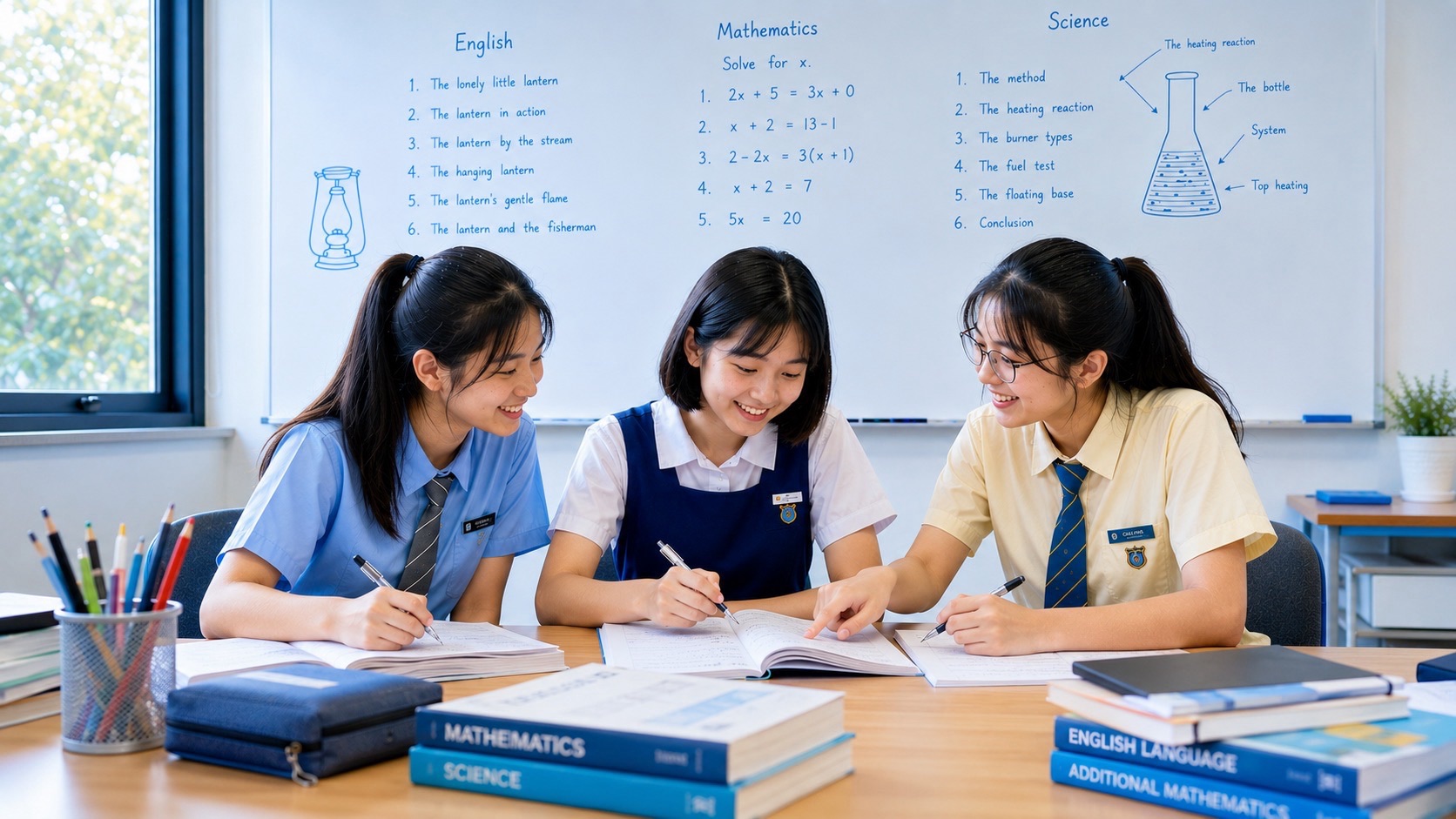
Secondary Mathematics Tuition Thomson | 3-Pax Route to Sixth Avenue
For a Thomson family, the useful question is not whether tuition is “near enough”. It is whether the learning value is strong enough to justify the weekly travel.
eduKateSG does not operate a Thomson centre. Our Mathematics classes are conducted at 8 Fourth Avenue, near Sixth Avenue MRT. Students coming from Upper Thomson can travel on the Thomson-East Coast Line to Stevens, transfer to the Downtown Line, and continue to Sixth Avenue. This is a one-transfer rail route, not a direct train ride.
That distinction matters because this page is not trying to turn geography into a teaching claim. A longer journey does not make Mathematics better. A nearby class does not automatically make Mathematics worse. The decision should combine instructional fit, travel friction, student energy, schedule sustainability and evidence of progress.
Quick Read for Thomson Parents
- eduKateSG Mathematics tuition is at Sixth Avenue, not Thomson.
- From Upper Thomson MRT, the rail route is TEL → Stevens interchange → DTL → Sixth Avenue.
- The commute is worthwhile only if the teaching solves a problem that a closer option is not solving.
- Our Secondary Mathematics format is 3-pax, typically 1.5 hours weekly.
- The value of three students is close observation of working, targeted correction, route comparison and gradual independence.
- A student who is already learning independently may not need to travel for tuition at all.
- A family should count the full weekly cost: lesson time, travel time, transition time, homework load and student fatigue.
- The best evidence is not a marketing promise. It is whether the student becomes more independent, accurate, transferable and stable under school assessment conditions.
The Route: Thomson-East Coast Line to Downtown Line
Upper Thomson MRT sits on the Thomson-East Coast Line. Stevens is an interchange between the Thomson-East Coast Line and the Downtown Line. Sixth Avenue is on the Downtown Line.
For families starting near Upper Thomson MRT, the simple rail logic is therefore:
Upper Thomson → Stevens → transfer from TEL to DTL → Sixth Avenue.
Land Transport Authority information identifies Upper Thomson as a Thomson-East Coast Line station and Stevens as a TEL–DTL interchange. LTA’s Downtown Line information covers the Bukit Timah stretch that includes Sixth Avenue. Families should use current journey planners for live travel times, service changes and the best first/last-mile connection from home.
Official references: LTA Thomson-East Coast Line and LTA Downtown Line.
We do not publish a fixed door-to-door travel-time promise because the real journey depends on where the student starts, walking or bus connections, waiting time and operating conditions.
A Commute Should Buy Something Specific
Parents sometimes compare tuition as if distance were the only cost and reputation were the only benefit.
A better comparison asks what the additional journey is buying.
- Does the class identify the student’s real weak link rather than repeat school?
- Can the tutor inspect working closely enough to see where reasoning fails?
- Is the class size genuinely small?
- Does practice move beyond familiar worksheets into variation and transfer?
- Are errors classified and retested?
- Does the tutor understand the student’s present G1, G2 or G3 subject level?
- Is support reduced as the student improves?
- Does the student leave with a clearer, more independent mathematical system?
If the answer to those questions is no, a longer commute has little justification. A local option that solves the problem well is usually the more efficient choice.
If the answer is yes—and the student’s present difficulty genuinely requires that level of diagnosis—the travel may be a rational trade-off.
Why Three Students Can Make the Journey More Valuable
The purpose of our 3-pax model is to make individual mathematical working visible.
Secondary Mathematics problems leave a trail. A student chooses a formula, rearranges an equation, draws a diagram, substitutes values, manipulates algebra, reads a graph, enters a calculator expression and decides whether to check the answer.
The tutor needs to see where that trail first changes direction.
In a three-student room, the tutor can usually observe each learner closely enough to distinguish:
- a concept gap from a calculation error;
- a weak prerequisite from a new-topic problem;
- a retrieval problem from a recognition problem;
- a route-selection error from an execution error;
- a time-pressure failure from a genuine lack of understanding; and
- a student who needs help from a student who needs the tutor to stop helping.
That last distinction is important. A student travelling for a premium small-group lesson should not spend the session being carried through every difficult question. The goal is greater independence.
The Travel Test: Is This a Teaching Problem or a Convenience Problem?
Before travelling across neighbourhoods for tuition, separate two questions.
Question 1: Does the student actually need additional teaching?
A student who understands school lessons, completes work independently, corrects errors intelligently and performs reliably may not need tuition. A family should not create a commute simply because Secondary Mathematics feels important.
Question 2: If support is needed, what function is missing locally?
The student may need close error diagnosis, a quieter class, a stronger algebra bridge, mixed-topic practice, A-Math dependency repair or full-paper conversion. If a nearby option provides that function well, proximity is an advantage.
The Sixth Avenue route makes more sense when the family has identified a specific teaching fit rather than a general belief that travelling farther must mean receiving better tuition.
What Makes a Weekly Journey Sustainable?
A theoretically excellent class can still be the wrong choice if the weekly operating cost is too high.
Parents should consider:
- school dismissal time;
- CCA commitments;
- meal timing;
- travel before and after tuition;
- homework that remains after the lesson;
- sleep;
- other subjects;
- the student’s ability to travel independently where appropriate; and
- whether the arrangement can be maintained during assessment-heavy weeks.
Consistency matters in Mathematics because learning is cumulative. A class that is frequently missed due to an unrealistic timetable is less useful than a closer class that the student can attend and use properly.
The Energy Budget Matters as Much as the Travel Time
Two journeys of the same duration can impose different costs.
A student travelling calmly after a manageable school day may arrive ready to think. The same student travelling after CCA, carrying unfinished homework and missing dinner may arrive with little useful cognitive capacity left.
Parents should therefore observe the state on arrival, not only the minutes on a map.
- Does the student arrive alert enough to engage?
- Is the return journey pushing bedtime too late?
- Does tuition remove unproductive homework time or add another layer of work?
- Can the student still retrieve the lesson the next day?
- Does the routine remain stable during test periods?
A good tuition decision is operational, not aspirational.
What We Would Want to See Before Recommending the Commute
We would rather see evidence than rely on a broad description such as “my child is weak in Math”.
Useful material includes:
- a recent school test;
- marked homework or topical worksheets;
- unfinished questions;
- the school’s present topic sequence;
- the student’s subject level;
- teacher feedback where relevant;
- upcoming weighted assessments; and
- examples of mistakes that keep returning.
We then look beneath the mark.
A 55% can mean the student is missing core concepts. It can also mean the student understands most of the paper but loses marks through signs, reading, incomplete working and time control. Those states require different teaching and different amounts of support.
Secondary 1: When Travel May Be Worthwhile
Secondary 1 is a language transition. Students move from Primary-school arithmetic and familiar models into more symbolic work involving negative numbers, algebraic notation, equations, graphs and formal multi-step reasoning.
A Thomson student may benefit from the 3-pax route when the transition is already exposing a specific gap:
- fractions or percentages remain unstable;
- negative signs are repeatedly lost;
- algebraic notation feels opaque;
- the student copies procedures without understanding balance;
- school homework requires excessive parental rescue; or
- the student understands a worked example but cannot begin a changed question.
If the child is adapting comfortably, there may be no reason to add a weekly commute merely to “stay ahead”.
Secondary 2: The Audit Year
Secondary 2 is a useful time to ask whether the foundation is genuinely stable before upper-secondary demands increase.
Some students continue to pass through pattern recognition while algebra, graph interpretation or problem representation remains fragile. The weaknesses become more expensive in Secondary 3 because more topics begin depending on them.
A high-resolution small group can be useful here because the tutor can inspect the gap before the student enters a denser upper-secondary programme.
Secondary 3: Separate the Visible Chapter from the Real Weak Link
Secondary 3 is where many families first feel that Mathematics has “suddenly become hard”.
The difficulty may be genuinely new. But it may also be an older dependency exposed by new abstraction.
For students taking Additional Mathematics, this is especially important. A student can appear weak in functions, logarithms, trigonometry or calculus while the first useful repair is still algebra.
Travelling for tuition makes more sense when the class is capable of performing that upstream diagnosis rather than simply adding more questions from the current chapter.
Secondary 4: The Commute Must Convert into Paper Performance
By Secondary 4, time becomes more valuable.
The student may know most of the syllabus but still lose marks because knowledge is not integrated. Mixed questions, retrieval delays, incomplete working, route hesitation and poor paper pacing begin to matter more.
For a Thomson family, the weekly trip should therefore produce visible examination conversion:
- faster recognition of question structure;
- more reliable retrieval of older topics;
- fewer repeated error types;
- better timed-section control;
- clearer working;
- better recovery after a difficult question; and
- more stable complete-paper performance.
If the commute is consuming time without improving those functions, the arrangement should be reconsidered.
Current Full SBB and SEC Context
Full Subject-Based Banding has been fully implemented since 2024. From 2027, the Singapore-Cambridge Secondary Education Certificate replaces the N- and O-Level certificates, with students sitting subjects at G1, G2 or G3.
SEAB’s 2027 listings identify Mathematics as K110 at G1, K210 at G2 and K310 at G3, with Additional Mathematics offered as K232 at G2 and K341 at G3. MOE has stated that the move to the SEC does not itself change examination format; SEAB states there is no change in overall examination standards.
For a tuition decision, the important point is not the new certificate name. It is that the student must be taught according to the actual subject level, syllabus and school sequence currently being taken.
Official references: SEAB SEC syllabuses and MOE Full SBB / SEC information.
What Happens in a Typical 1.5-Hour Lesson
Our Secondary Mathematics lessons are typically 1.5 hours. A lesson may include:
- retrieval from earlier learning;
- diagnosis of the present weak link;
- first-principles explanation of the missing relationship;
- guided practice with prompts;
- independent attempts after prompts are reduced;
- variation that changes notation, representation or neighbouring topics;
- error review to classify what failed; and
- return testing of earlier repaired weaknesses.
The student should leave with more than completed work. The learner should have a clearer mathematical representation, a better route and evidence about what can now be done independently.
What We Do Not Use to Justify the Journey
We do not justify a Thomson-to-Sixth-Avenue commute with unsupported grade statistics, invented student stories, guaranteed distinctions or claims that travelling farther automatically produces better results.
We also do not publish a permanent timetable, fee comparison or seat-count claim inside an evergreen article when those details can change. Families should ask directly for the current arrangement.
The case for the journey must come from fit.
A Parent Decision Checklist
- What is my child’s actual Mathematics problem?
- Can a closer option solve it well?
- Does my child need close inspection of working?
- Is the 3-pax group compatible with my child’s subject level and pace?
- Can the weekly route remain sustainable during CCA and assessment periods?
- Will my child arrive with enough energy to use the lesson?
- What specific progress should we expect to observe before the next school assessment?
- How will the tutor reduce support as the student improves?
- When would we decide the commute is no longer worth it?
That final question is healthy. Tuition should remain accountable to the student’s real return.
What Progress Should Make the Travel Feel Smaller
A good learning system reduces friction elsewhere.
If tuition is working, parents may notice that school Mathematics requires less rescue, homework becomes more efficient, repeated errors decline and test preparation becomes more focused. The student may need fewer emergency revision sessions because the underlying system is becoming more stable.
In that sense, a useful commute can give time back elsewhere.
The opposite is also true. If tuition adds travel, more worksheets, more exhaustion and more dependence without improving school performance or independent control, it is creating load rather than removing it.
The Thomson-to-Sixth-Avenue Decision Rule
Travel only when the teaching fit solves a real learning problem, the weekly routine is sustainable, and the student is becoming more independent.
That is the standard we would use for our own decision.
For the national explanation of the format, read Secondary Mathematics Tuition Singapore | Why 3-Pax Small Groups Work. For the underlying teaching method, see What Real Mathematics Teaching Looks Like.
Arrange a Parent–Student Consultation
eduKateSG
8 Fourth Avenue, Singapore 268674
Near Sixth Avenue MRT, Downtown Line
3-pax Secondary Mathematics tuition
Typical lesson: 1.5 hours weekly
By appointment
Bring recent school papers and your child’s current timetable. We can discuss both sides of the decision: the mathematical fit and whether the weekly travel is operationally sensible.