
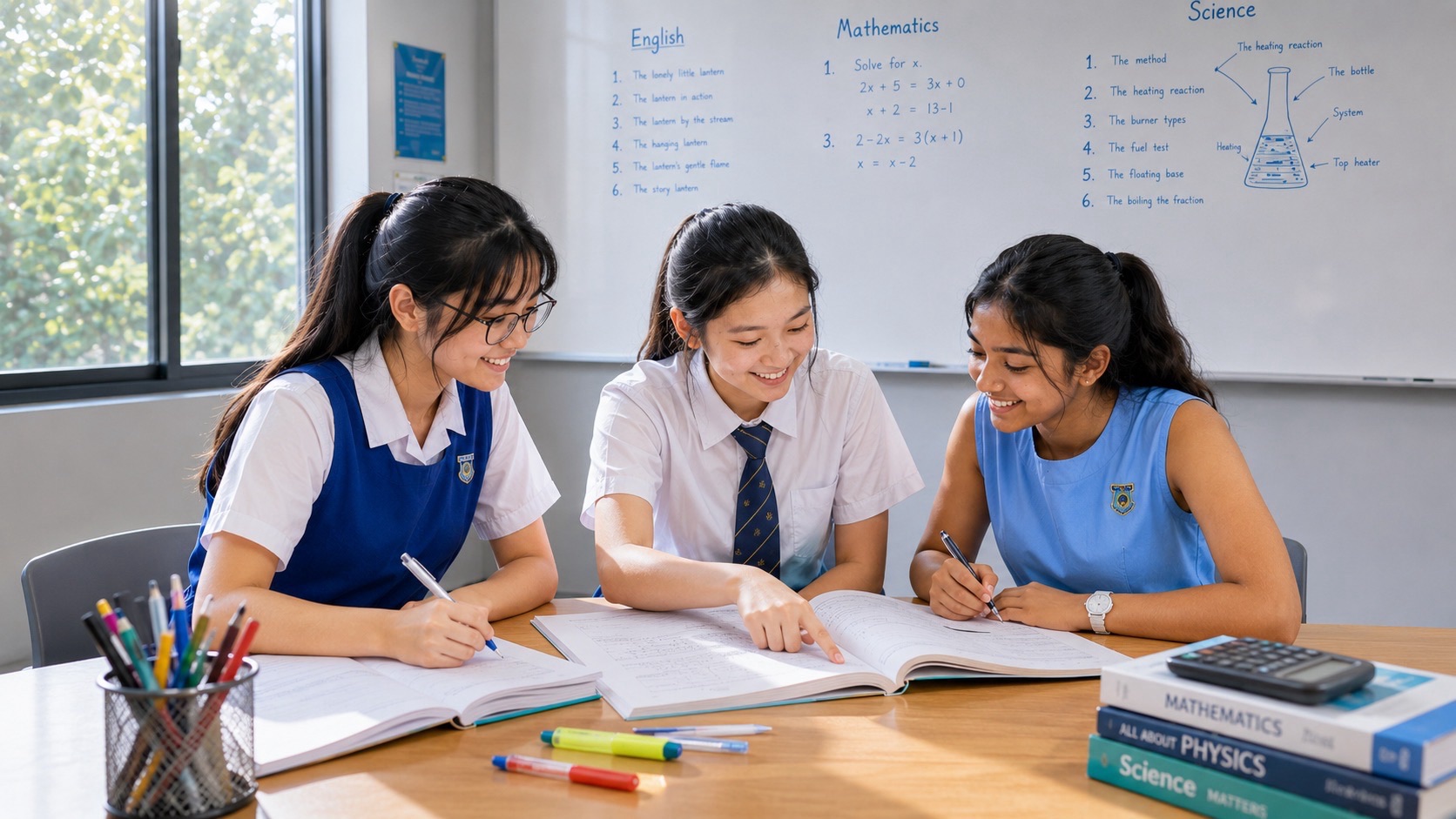
(Load / Buffer / Drift Mechanics for A-Levels Reliability)
Scope & Disclaimer
This page instantiates Singapore Junior College (JC) as a Z3 runtime module inside Singapore EducationOS.
- Not an official MOE/SEAB policy document
- Not a subject guide
- Not “study motivation advice”
This is a stability mechanics page: why JC is hard, how failure actually happens, and what repairs restore reliability without lowering standards.
Z3 Module Record (Almost-Code)
[MODULE]Place: SGPZoom: Z3 (Pipeline Module)Lane: EDU.JCSystem: EducationOSName: JC Runtime ModulePrimary Outcome: A-Level reliability under time pressure + noveltyPrimitives: Phase(P0–P3), Load, Buffer, Drift, RepairExports: Verified readiness for University-level synthesis + self-directed learning[/MODULE]
What JC Is (Functional Definition)
JC is a high-coupling load regime.
It is not “hard” mainly because topics are hard.
It is hard because many pipelines run in parallel with shared time and attention:
- 3–4 H2 subjects (plus possibly H1/H3)
- GP
- PW
- CCAs / commitments
- Tests with time pressure and novelty
So the system fails by coupling + congestion, not by one weak chapter.
The JC Load Shape (Why It Feels Brutal)
JC load is not a single peak. It’s an extended high plateau with repeated collision points:
- weekly tutorials + lectures
- recurring quizzes/tests
- periodic “compressed revision” periods
- cumulative backlog risk
When Load stays high long enough, Buffer goes to zero — and then drift appears.
The Core Law (JC Stability)
JC performance is a rate inequality problem:
If incoming task load + recovery demands exceed processing + integration capacity, stability collapses.
So success is not “do more”.
Success is shape the work so the system can integrate and transfer.
The 5 JC Master Sensors (Use These Weekly)
1) Phase Sensor (P0–P3)
- P0: can follow worked solutions but cannot adapt
- P1: stable in normal conditions, breaks under variation
- P2: working hard but inconsistent, drift signatures appearing
- P3: avoidance/freezing, panic cycles, shutdown
2) Load Sensor
- Green: work fits into planned blocks
- Red: work spills into sleep/meals or becomes endless catching up
3) Buffer Sensor
JC requires a minimum buffer to prevent cascade failures.
Buffer rule (canonical):
- ≥ 12 hours slack/week for integration + recovery
If buffer = 0, collapse is structural.
4) Drift Sensor (the early warning)
Drift is a protective regression pattern when load exceeds capacity.
5) Repair Confirmation Sensor
After repair, work should feel lighter, not heavier, within 7–10 days.
Dominant JC Drift Signatures (Singapore-specific)
Drift D1 — Template Regression (A-Level Essay / GP / Humanities)
What it looks like:
- memorised frames
- generic examples
- “safe paragraphs” that don’t answer the question
Meaning: under pressure, cognition retreats to rehearsed shells.
Repair: thesis-lock + argument dependency map + 1 synthesis move per paragraph
Drift D2 — Rote Drift (Math/Science)
What it looks like:
- can do familiar question types
- breaks when conditions change
- loses marks on “twist” items
Meaning: P0/P1 fragility; transfer not verified.
Repair: transfer checks + first principles + “one-condition-changed” drills
Drift D3 — Compression Failure (All Subjects)
What it looks like:
- notes are long but unusable
- “I studied” but cannot retrieve or apply
- revision becomes rereading
Meaning: integration not happening; knowledge not becoming stable objects.
Repair: Compression Ladder (Quote→Paraphrase→Abstract→Use)
Drift D4 — Buffer Collapse (Burnout Cycle)
What it looks like:
- spikes of work then crash
- illness / exhaustion patterns
- last-minute panic and avoidance
Meaning: system has no slack; recovery debt is accumulating.
Repair: restore buffer first; reduce inputs 20–30%; protect sleep; consolidate
Canonical JC Failure Trace (Required Insert)
Trace:
High coupling (multi-subject) → sustained load plateau → buffer erosion → drift signatures emerge → Phase 2 plateau → late-term crash near high-stakes exams
JC failure is typically late, after weeks of “trying harder”.
EducationOS exists to detect the precursors.
JC Repair Protocols (Paste-Ready)
Protocol A — Workload Shaping (Immediate)
Use when Load >85% for 2 consecutive weeks.
- cut non-core tasks
- reduce new input volume 20–30% for one week
- replace with consolidation tasks
- enforce buffer ≥12h/week
Goal: stop backlog growth (decongest the pipeline)
Protocol B — Consolidation Week (Stability Reset)
Use once per term or whenever buffer = 0.
- 1 week: minimal new content
- focus: compression + transfer + weak-topic repair
- build an “integration spine” per subject
This prevents the “I covered everything but nothing is stable” failure.
Protocol C — Transfer Gate (P0→P1 Upgrade)
Use for Math/Science when students rely on templates.
For any topic:
- solve one standard question
- then change one condition and solve again
- explain why the method still works
If they can’t, the topic is not online yet.
Protocol D — Essay Spine Constraint (GP/Humanities)
Before writing:
- one-sentence thesis
- 3 claims that depend on thesis
- counterclaim that changes the final stance
Stops template regression and forces synthesis.
JC Exports (What JC Must Produce)
JC is not just “A-Level scores”.
It must export:
- reliability under time pressure
- transfer across question variation
- independent learning buffer (self-directed capability)
- readiness for university synthesis and compression load
Canonical Link Hooks (for later pages)
/singapore-educationos-z5-national-runtime-index/(this page)/singapore-jc-runtime-load-buffer-drift-module/(next)/singapore-a-levels-verification-os-jc-to-university/(next)/nus-learning-stability-dashboard-educationos//ntu-learning-stability-dashboard-educationos-Z4//smu-seminar-participation-stability-dashboard-educationos//student-repair-router-z0-singapore-educationos/
Recommended Internal Links (Spine)
Start Here for Lattice Infrastructure Connectors
- https://edukatesg.com/singapore-international-os-level-0/
- https://edukatesg.com/singapore-city-os/
- https://edukatesg.com/singapore-parliament-house-os/
- https://edukatesg.com/smrt-os/
- https://edukatesg.com/singapore-port-containers-os/
- https://edukatesg.com/changi-airport-os/
- https://edukatesg.com/tan-tock-seng-hospital-os-ttsh-os/
- https://edukatesg.com/bukit-timah-os/
- https://edukatesg.com/bukit-timah-schools-os/
- https://edukatesg.com/bukit-timah-tuition-os/
- https://edukatesg.com/family-os-level-0-root-node/
- https://bukittimahtutor.com
- https://edukatesg.com/punggol-os/
- https://edukatesg.com/tuas-industry-hub-os/
- https://edukatesg.com/shenton-way-banking-finance-hub-os/
- https://edukatesg.com/singapore-museum-smu-arts-school-district-os/
- https://edukatesg.com/orchard-road-shopping-district-os/
- https://edukatesg.com/singapore-integrated-sports-hub-national-stadium-os/
- Sholpan Upgrade Training Lattice (SholpUTL): https://edukatesg.com/sholpan-upgrade-training-lattice-sholputl/
- https://edukatesg.com/human-regenerative-lattice-3d-geometry-of-civilisation/
- https://edukatesg.com/new-york-z2-institutional-lattice-civos-index-page-master-hub/
- https://edukatesg.com/civilisation-lattice/
- https://edukatesg.com/civ-os-classification/
- https://edukatesg.com/civos-classification-systems/
- https://edukatesg.com/how-civilization-works/
- https://edukatesg.com/civos-lattice-coordinates-of-students-worldwide/
- https://edukatesg.com/civos-worldwide-student-lattice-case-articles-part-1/
- https://edukatesg.com/new-york-z2-institutional-lattice-civos-index-page-master-hub/
- https://edukatesg.com/advantages-of-using-civos-start-here-stack-z0-z3-for-humans-ai/
- Education OS (How Education Works): https://edukatesg.com/education-os-how-education-works-the-regenerative-machine-behind-learning/
- Tuition OS: https://edukatesg.com/tuition-os-edukateos-civos/
- Civilisation OS kernel: https://edukatesg.com/civilisation-os/
- Root definition: What is Civilisation?
- Control mechanism: Civilisation as a Control System
- First principles index: Index: First Principles of Civilisation
- Regeneration Engine: The Full Education OS Map
- The Civilisation OS Instrument Panel (Sensors & Metrics) + Weekly Scan + Recovery Schedule (30 / 90 / 365)
- Inversion Atlas Super Index: Full Inversion CivOS Inversion
- https://edukatesg.com/government-os-general-government-lane-almost-code-canonical/
- https://edukatesg.com/healthcare-os-general-healthcare-lane-almost-code-canonical/
- https://edukatesg.com/education-os-general-education-lane-almost-code-canonical/
- https://edukatesg.com/finance-os-general-finance-banking-lane-almost-code-canonical/
- https://edukatesg.com/transport-os-general-transport-transit-lane-almost-code-canonical/
- https://edukatesg.com/food-os-general-food-supply-chain-lane-almost-code-canonical/
- https://edukatesg.com/security-os-general-security-justice-rule-of-law-lane-almost-code-canonical/
- https://edukatesg.com/housing-os-general-housing-urban-operations-lane-almost-code-canonical/
- https://edukatesg.com/community-os-general-community-third-places-social-cohesion-lane-almost-code-canonical/
- https://edukatesg.com/energy-os-general-energy-power-grid-lane-almost-code-canonical/
- https://edukatesg.com/community-os-general-community-third-places-social-cohesion-lane-almost-code-canonical/
- https://edukatesg.com/water-os-general-water-wastewater-lane-almost-code-canonical/
- https://edukatesg.com/communications-os-general-telecom-internet-information-transport-lane-almost-code-canonical/
- https://edukatesg.com/media-os-general-media-information-integrity-narrative-coordination-lane-almost-code-canonical/
- https://edukatesg.com/waste-os-general-waste-sanitation-public-cleanliness-lane-almost-code-canonical/
- https://edukatesg.com/manufacturing-os-general-manufacturing-production-systems-lane-almost-code-canonical/
- https://edukatesg.com/logistics-os-general-logistics-warehousing-supply-routing-lane-almost-code-canonical/
- https://edukatesg.com/construction-os-general-construction-built-environment-delivery-lane-almost-code-canonical/
- https://edukatesg.com/science-os-general-science-rd-knowledge-production-lane-almost-code-canonical/
- https://edukatesg.com/religion-os-general-religion-meaning-systems-moral-coordination-lane-almost-code-canonical/
- https://edukatesg.com/finance-os-general-finance-money-credit-coordination-lane-almost-code-canonical/
- https://edukatesg.com/family-os-general-family-household-regenerative-unit-almost-code-canonical/