
Guide 17 · Civilisation Building
Previous guide: Invention, Experiments and Useful Innovation
Time, calendars and long-term coordination help a civilisation connect present work with future commitments. This Civilisation Building guide gives children, parents and tutors a practical way to examine durations, shared calendars, repeating tasks, changing schedules and the responsibilities that continue after an opening day.
Through the fictional Riverbend Time House, learners use paper timelines, task cards and invented rounds to make timing assumptions visible. They ask when an event occurs, how long an activity takes, which tasks depend on earlier work and whose opportunity disappears when a timetable changes. A clear schedule needs more than a row of dates.
The forty chapters provide five reading routes, worked mathematics, classroom activities and a final coordination portfolio. Parents and tutors can choose one short exercise at a time. Younger children can order event cards and mark intervals; older learners can reconcile recurring commitments, resource conflicts and decisions that span several model periods.
Civilisation Building series · Previous learning stage · Civilisation hub
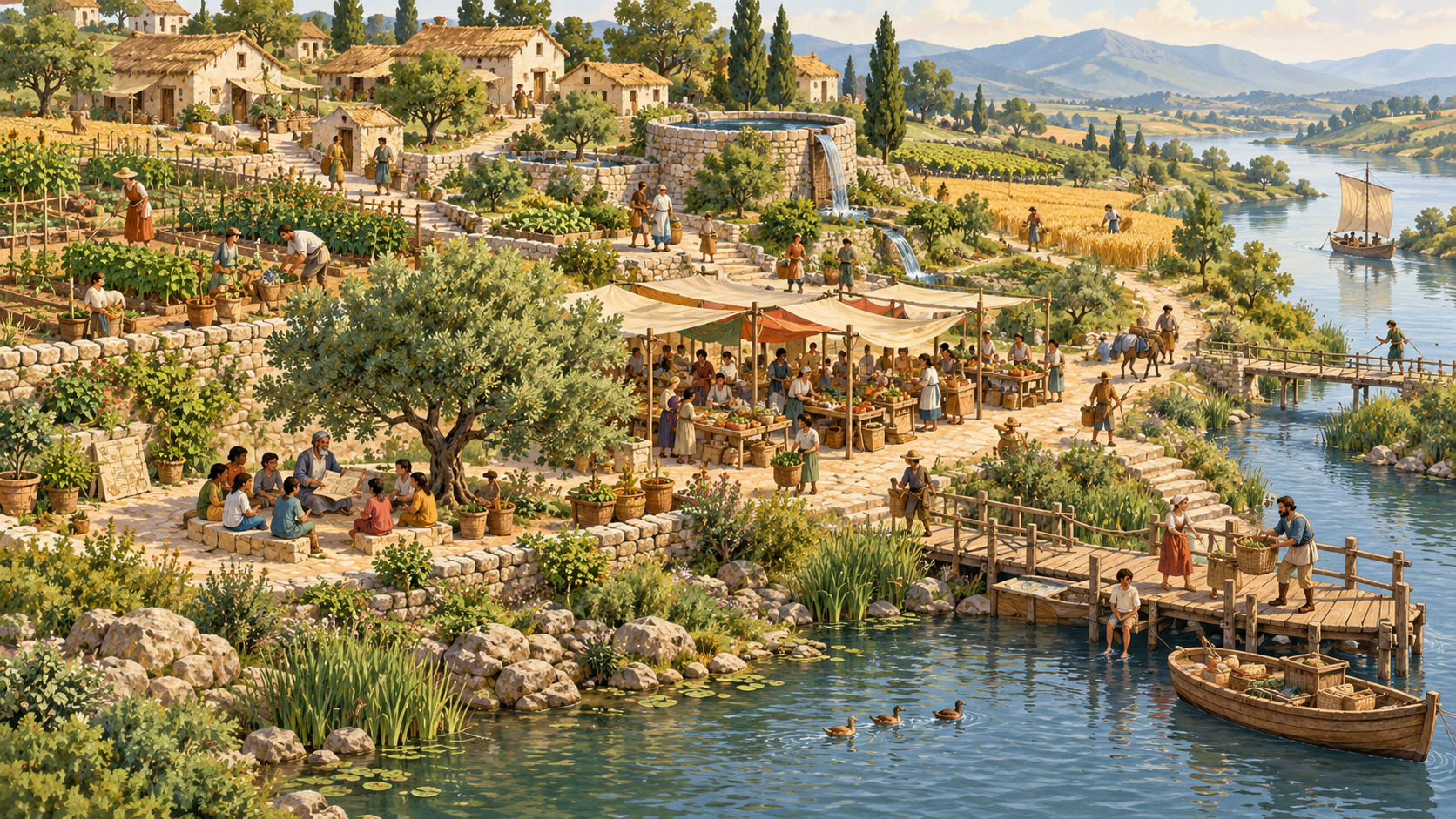
Series cover: AI-generated conceptual illustration of Riverbend, the starting community in these guides. It is not a literal depiction of every scenario, a historical reconstruction or an engineering plan.
Choose your next learning question
Follow one route, try a worked activity and return when the learner is ready for another layer.
Full chapter index · Capstone project · Wider civilisation reading
Every clock, calendar, duration, resource allowance and numerical dataset in this guide is invented. The activities take place on paper or a tabletop. They do not describe real astronomical calendars or prescribe actual staffing, engineering, travel or safety arrangements. No child needs to collect private family schedules or organise a real public activity.
This stage follows invention, experiments and useful innovation. A promising change needs time for preparation, support, review and possible revision. The Time House helps learners connect those activities without assuming that a later promise can use resources already committed elsewhere or that a completed demonstration settles every future obligation.
The adult can adapt the reading and arithmetic while preserving the reasoning. Ask the learner to explain an event boundary, a dependency or a choice in their own words. The aim is a timetable and decision record that another person can inspect, question and continue using when the original planner is absent.
Full chapter index
Chapters 1–8: Define the time convention
- 1. Ask what people need to coordinate before drawing a timetable
- 2. Distinguish an event from the interval it begins or ends
- 3. Preserve order without inventing a cause
- 4. Build a shared round from an explicit reference interval
- 5. Convert time units while preserving the interval
- 6. Invent a calendar whose labels can be reconstructed
- 7. Specify when a repeating task first occurs
- 8. Compare phases before assuming repeating activities will meet
Chapters 9–16: Compare intervals and schedules
- 9. Write dates and deadlines that another reader can identify
- 10. Count included rounds separately from elapsed boundaries
- 11. Separate elapsed time from the work added across tasks
- 12. Make time records comparable before combining them
- 13. Show what must happen before the next task can begin
- 14. Place shared resources on the schedule explicitly
- 15. Separate a task's duration from its deadline
- 16. Count work and elapsed time in their own units
Chapters 17–24: Coordinate continuing work
- 17. Reserve recurring windows for keeping the model usable
- 18. Use buffers without spending the same minutes twice
- 19. Revise a plan from the point actually reached
- 20. Coordinate activities when access periods differ
- 21. Make a handover a scheduled task with a usable result
- 22. Give review cycles a question and a decision point
- 23. Combine a session plan without hiding its assumptions
- 24. Carry a shared project across several classroom periods
Chapters 25–32: Examine future commitments
- 25. Connect the next classroom round to a longer purpose
- 26. Choose a planning horizon that matches the question
- 27. Describe promises that future role holders can understand
- 28. Keep useful options open at a stated cost
- 29. Notice who bears the burden of waiting
- 30. Share scarce periods across a whole cycle
- 31. Combine regular review dates with evidence that should prompt attention
- 32. Stage decisions when later evidence can still matter
Chapters 33–40: Reconcile and hand over the plan
- 33. Preserve the reason behind a dated decision
- 34. Build an institution that can revisit its own promises
- 35. Explain a changed schedule to the people who relied on it
- 36. Teach long-term coordination through four classroom sessions
- 37. Reconcile two calendars before treating their dates as a conflict
- 38. Separate the work account from the completion timeline
- 39. Count recurring responsibilities across a stated horizon
- 40. Build the Time House coordination portfolio
CHAPTER 1 OF 40 · Define the time convention
1. Ask what people need to coordinate before drawing a timetable
Riverbend's Time House receives three different questions. The Learning Room wants two groups to use one paper display without arriving together. The Map Room wants to preserve the order of changes to a fictional route. The Idea Workshop wants to know whether two tasks can finish before a review. Each question involves time, but the information required differs. Learners begin by identifying the relationship they need to coordinate rather than filling an attractive calendar with unexplained labels.
All activities in this guide take place through paper strips, counters, invented records and tabletop role play. Riverbend's rounds, clocks, dates and calendars are classroom conventions. They do not describe actual astronomy, historical calendars or professional scheduling systems. A counter moving between numbered marks represents a supplied interval within the model. Parents and tutors can use these materials to explore reasoning without arranging real travel, operating equipment or making commitments for actual services.
Give a child three purpose cards. One asks which group uses the display first. Another asks how long a preparation task lasts. A third asks whether the display and a teacher card are available during the same model period. An ordering list may answer the first without supplying durations. A duration strip may answer the second without naming a calendar date. The third needs an overlap between two availability records. The class should select a representation because of its question, not assume every time problem requires the same table.
Examine the relationship and its conditions
A practical brief names the participants as fictional roles, the activity, the relevant model horizon and the outcome the plan should make possible. The horizon might cover twelve rounds rather than the whole imagined future of Riverbend. The brief also identifies what is supplied and what remains a proposal. A room booking printed on a draft does not become an accepted arrangement merely because the child has placed it neatly inside a square.
For a starting example, the Time House has one display and two groups. Group A requires three consecutive rounds, and Group B requires two. Both become available at the beginning of round one, and neither can share the display during a round. With no transition interval required in this first model, A can use rounds one through three and B rounds four and five. The combined display use is five rounds. Another valid order puts B in rounds one and two and A in rounds three through five.
The class cannot choose between those orders from durations alone. A later supplied condition might give one group an earlier deadline or a fixed availability window. Children should write that missing decision information instead of inventing a reason to favour the first letter in the alphabet. A mathematically fitting plan can remain only one option until the purpose and conditions establish which option is appropriate.
Apply, explain and check understanding
Parents can ask a younger learner to arrange five counters on a strip and label who uses each position. An older learner can explain the assumptions hidden by the simple total: uninterrupted use, common starting availability, no sharing and no transition time. Adding a condition later should lead to an explicit revision. The earlier calculation can remain correct for its original scenario while no longer answering the revised question.
The Time House keeps the purpose card beside its first schedule. It will become a reference when later chapters introduce calendar names, repeating tasks and parallel work. Riverbend's learners are not trying to command time through tidy boxes. They are building a shared account of who needs what relationship between events, so another person can examine the plan and understand which conditions make it workable within the paper model.
CHAPTER 2 OF 40 · Define the time convention
2. Distinguish an event from the interval it begins or ends
The Time House records that a paper folder was opened at mark two and closed at mark seven. One child calls opening a five-unit event. Another calls the whole activity a moment. The class needs language that distinguishes a boundary event from the interval between boundaries. This distinction makes later duration calculations and deadline statements easier to inspect without requiring children to treat every ordinary sentence as a technical definition.
In this model, an event is represented by a point on a numbered strip. A duration describes the length of an interval between two specified points. Opening at two is one event; closing at seven is another. The interval from opening to closing lasts five model time units because seven minus two is five. The labels two and seven identify positions; five expresses the separation between them. These numbers answer different questions.
Place counters at marks two and seven, then lay five unit strips between them. Count the spaces rather than all the labelled marks. Marks two, three, four, five, six and seven give six boundary labels but only five unit intervals. Younger children can trace each space with a finger while a parent names its beginning and end. This physical separation prepares them for later questions about inclusive date counts and elapsed duration.
Examine the relationship and its conditions
Now supply a preparation event at mark one, activity start at mark two, activity end at mark seven and return of materials at mark nine. The activity interval is five units, while preparation-event to return-event is eight. Activity-end to return-event is two. A report stating the task lasted eight may be useful if its task boundary includes preparation and return. It should not be presented as the same quantity as activity duration without explaining the broader interval.
A worked comparison gives three fictional activities. Their starts and ends are one to four, three to eight and eight to ten. Durations are three, five and two units. The sum is ten activity-time units if the question adds the durations of all activities. The earliest start to latest end spans nine elapsed units, from one to ten. The activities overlap between three and four, so the summed duration exceeds the overall elapsed span. Children will revisit this distinction when work can occur in parallel.
Parents can ask learners to make two sentences for each record: an event occurred at this mark, and this interval lasted this many units. A child who confuses at seven with for seven units needs a different explanation from a child who subtracts incorrectly. The adult can identify the kind of misunderstanding through the sentence before adding more calculations.
Apply, explain and check understanding
Introduce an unknown boundary. The model records an activity ending at eight but supplies no start. Its duration is not established by the end label alone. If a separate card says it began no earlier than five and no later than six, its duration lies between two and three units. The shortest interval runs six to eight; the longest runs five to eight. Choosing a midpoint start would create a scenario, not recover a missing observation.
The chapter ends with a small event ledger whose columns identify event, model mark and source card. Duration calculations refer to pairs of ledger entries and name their endpoints. Riverbend can now keep a clear distinction between something happening, the label assigned to its position and the amount of time between it and another event. That clarity prevents a persuasive narrative from quietly substituting one interval for another.
CHAPTER 3 OF 40 · Define the time convention
3. Preserve order without inventing a cause
The Map Room's fictional record says that a new label appeared before a queue shortened. The Time House can place the two events in order, but the class cannot conclude from that order alone that the label caused the change. Perhaps the model also changed the request volume or added another tray. Learners now separate chronology from explanation, keeping sequence useful without turning every earlier event into the reason for what followed.
Give the class four event cards: a label proposal at mark two, approval at mark four, display at mark six and a recorded queue check at mark nine. The supplied ordering places proposal before approval, approval before display and display before the check. The interval from display to check is three time units. Those relationships can be established from the cards under the model's shared reference. The cards do not alone show what the queue was before display or why it had its later size.
Add a baseline queue record of eight cards at mark five and a later record of four at mark nine. The recorded queue decreases by four cards, or 50% relative to eight. A separate supplied card states that arrivals also fell from six per round to two. The observed sequence contains more than one changing condition. A report can say the queue was smaller after the label appeared, while preserving the arrival change as a relevant alternative explanation.
Examine the relationship and its conditions
A tutor can offer three conclusions for discussion. The first says the label was displayed before the later check. The second says the label alone caused the queue to halve. The third says the supplied record shows a lower queue alongside a label change and a change in arrivals. Children identify which statements describe the sequence and which add an unsupported causal claim. They can suggest a further paper comparison without claiming it has already been performed.
Sometimes the record supports only a partial order. A preparation note says that cards were printed before the trays were filled. Another says the room map was checked before the trays were filled. Nothing states whether printing preceded map checking. Children can draw two arrows pointing into tray filling without drawing an extra arrow between the earlier tasks. The absence of that arrow preserves an unresolved relationship instead of forcing every event into one imagined sequence.
Parents can make this concrete with three envelopes. Two can be opened in either order, but both contain pieces required for the third task. Ask the learner to give two valid sequences and name what both share. The activity demonstrates a dependency within the game, not an inference about real-world causes. The third task requires the supplied pieces because the rule says so; the first two tasks need not depend on each other.
Apply, explain and check understanding
Older learners can examine a date assigned retrospectively. A note created at mark twelve describes a change said to have occurred at mark six. The creation event and described event occupy different positions. Keeping them separate helps the class identify whether an account was written before or after another development. It does not automatically establish that a later account is wrong or that a contemporary one is complete.
Finish with a short timeline accompanied by two sentences: what the sequence establishes and what explanation remains open. Riverbend's learners can now use before, after and alongside more carefully. A civilisation benefits from records that preserve order, yet useful understanding also requires recognising when the order of events is insufficient to explain why something changed.
CHAPTER 4 OF 40 · Define the time convention
4. Build a shared round from an explicit reference interval
The Time House asks two groups to complete a paper check within one round. One group treats a round as the time needed to read a card; another treats it as the time needed to sort an entire tray. The shared word has hidden incompatible intervals. The class needs a reference convention so each group can interpret a duration in the same tabletop system, even when the tasks themselves take different amounts of model time.
For this exercise, one round consists of four equal model ticks. A supplied reference strip shows marks zero through four, with each adjacent pair separated by one tick. The class does not claim that hand movement or spoken counting creates a perfect real clock. It uses the strip as a defined representation of time within a paper game. Events occur at stated marks according to the supplied scenario cards.
A task beginning at tick two and ending at tick ten lasts eight ticks, or two rounds. Another beginning at tick five and ending at tick eight lasts three ticks, or three quarters of a round. A third lasting six ticks takes one and a half rounds. These conversions follow from four ticks per round. The tick labels identify positions, while the converted durations describe intervals between positions.
Examine the relationship and its conditions
Now supply two classroom clocks with different origins. Clock A reads zero when the project begins. Clock B reads three at that same event. Both advance one displayed tick per model tick under the exercise rule. At A's reading eight, B reads eleven. The readings differ by three, yet a task from A four to A ten lasts six ticks and appears from B seven to B thirteen, also six. Changing the origin does not change elapsed duration when the rate convention remains the same.
A parent can place two numbered strips side by side, shifted by three positions. The child marks the same start and end events on both. Ask what remains equal and what changes. This makes a reference offset visible without invoking real time zones or technical clock systems. The classroom should keep its invented convention explicit rather than borrow a real-world term that suggests rules the model has not supplied.
An additional card introduces Clock C, which displays one step for every two model ticks. A duration of eight model ticks spans four C steps. This is a different scale, not merely a different origin. To compare readings, learners need the relationship and starting reference. If C begins at zero alongside A, A's mark ten corresponds to C's mark five. If C's starting reading is unspecified, the absolute corresponding mark is not established even though duration conversions remain possible.
Apply, explain and check understanding
A single matching reading does not establish a matching scale. Suppose two paper clocks both display zero at the project start, but one advances one step per reference tick and the other advances two. After four ticks they read four and eight. Their initial agreement established an anchor, not equal rates. Conversely, clocks with equal rates can retain different readings because their origins differ. Ask the child to sort a start-reference card and a rate-reference card into the questions each can answer. This separates two kinds of information that a confident phrase such as the clocks agree might otherwise conceal.
Older learners can identify the information needed for a shared timestamp: named reference system, origin, unit relationship and event meaning. A bare number such as eleven could belong to B's reading for A eight or to A's later reading. Writing the clock identifier prevents a predictable ambiguity. The class can choose one common reference for a combined table while retaining original readings for traceability.
End with a reference card explaining what a round means in this project and how each displayed strip relates to it. The Time House has not made the model world more dependable by giving its clock an impressive appearance. It has made the comparison inspectable through clear agreements. Children can now coordinate intervals across several representations because another learner can recover the unit, origin and relationship behind each number.
| Time question | What to state |
|---|---|
| Event | Which boundary or occurrence? |
| Duration | How many intervals between stated boundaries? |
| Convention | Which calendar, origin and unit? |
| Scope | Which model period and assumptions apply? |
CHAPTER 5 OF 40 · Define the time convention
5. Convert time units while preserving the interval
Riverbend's schedule lists an activity lasting twelve ticks. Another worksheet calls the same interval three rounds. A learner thinks the second version gives less time because three is smaller than twelve. The Time House returns to its definition of four ticks per round. The two expressions describe the same supplied interval through different units, and comparing the bare numerals would confuse expression with quantity.
Extend the fictional convention: one work block contains three rounds, and each round contains four ticks. A work block therefore contains twelve ticks. These are invented units for this paper project. Learners should keep the definition card available and avoid assuming that a block in another classroom exercise has the same meaning. Familiar names do not guarantee shared relationships across models.
A task lasting two and a half blocks lasts seven and a half rounds, or thirty ticks. The calculation multiplies by three and then four. A task lasting eighteen ticks lasts four and a half rounds or one and a half blocks. To compare them, use a common unit: thirty minus eighteen gives twelve ticks, equivalent to three rounds or one block. The duration difference remains the same through each expression.
Examine the relationship and its conditions
Now consider a rate. A fictional team checks twenty-four cards over two blocks, giving twelve cards per block on average. Two blocks equal six rounds, so the same total gives four cards per round. They also equal twenty-four ticks, giving one card per tick across that interval. These rates describe averages under the supplied work definition. They do not establish that every tick contains one completed card or that the work can be divided arbitrarily into smaller tasks.
A worked sequence makes this limitation visible. The team completes zero, eight, four, zero, six and six cards across its six rounds. The total is twenty-four, matching four per round on average. A recipient needing eight cards by the end of the first round receives none under this sequence. Converting the average into ticks does not change the timing of completions. The class should preserve the sequence when the deadline question depends on it.
Parents can give a younger learner twelve tick cards and ask them to make groups of four, then a group of three rounds. An older learner can write a conversion route and reverse it. Thirty ticks divided by four gives seven and a half rounds; dividing by three gives two and a half blocks. A correct round trip checks arithmetic against the chosen relationships, though it cannot establish that the definition card was appropriate for a different project.
Apply, explain and check understanding
Introduce a deliberately mismatched report. Another fictional workshop defines a block as two rounds while retaining four ticks per round. Its two blocks equal sixteen ticks, rather than twenty-four. The class can compare the workshops only after naming which block convention each uses. It should convert through ticks or another common supplied unit, not combine block counts as though the name itself established equivalence.
The final report keeps the original duration, unit definition and converted value together. Ask learners to explain why a larger numeral can represent the same interval in smaller units. This foundation will support later calendar and scheduling questions without giving conversion more power than it has. Unit changes can make records comparable, but they cannot recover missing event boundaries or turn an average work rate into a promise about a particular completion time.
CHAPTER 6 OF 40 · Define the time convention
6. Invent a calendar whose labels can be reconstructed
The Time House decides to group its rounds into named cycles so a long paper schedule is easier to read. A child proposes a calendar with charming names but no written order. Another group cannot tell whether Reed comes before Lantern or whether the same date label occurs more than once. A useful invented calendar needs a repeatable structure and a reference point, not merely memorable labels.
For this project, one cycle contains six rounds named Reed, Bridge, Lantern, Garden, Story and Square, in that order. Cycles are numbered one, two, three and onward. The first project round is Cycle One, Reed. The second is Cycle One, Bridge, and the sixth is Cycle One, Square. The seventh is Cycle Two, Reed. These conventions have no claim to represent a real calendar or astronomical relationship.
Give each learner a strip of eighteen rounds and ask them to build three cycles. A date needs both the cycle number and round name if the task spans several cycles. Lantern alone identifies a phase repeated in each cycle, not one unique project round. Cycle Two, Lantern identifies project round nine because six rounds precede Cycle Two and Lantern is its third round. Children should explain this relationship with the strip before relying on a formula.
Examine the relationship and its conditions
For older learners, the project-round number is six times one less than the cycle number, plus the position within the cycle. Cycle Four, Garden is six times three plus four, or round twenty-two. Conversely, project round seventeen lies in Cycle Three, Story: twelve rounds fill the first two cycles, leaving position five in the third. A remainder of zero requires careful treatment, since round eighteen is Cycle Three, Square, not Cycle Four with no named round.
Now distinguish a date from a duration. Cycle Two, Lantern is a label for a round in this system. Three rounds is an interval length. A notice saying the activity lasts Lantern does not supply a duration unless the model adds another definition. Similarly, saying three cycles after a date could mean an interval of eighteen rounds or a repeated phase three cycle numbers later. The class should state the intended interpretation rather than rely on a phrase that different readers could reasonably apply differently.
Parents can make calendar cards that children arrange without seeing the full reference strip. Ask a partner to find the next date after Cycle Two, Square and the previous date before Cycle Three, Reed. Both questions concern the same boundary. The next is Cycle Three, Reed; the previous is Cycle Two, Square. The exercise makes rollover explicit and reveals whether the child has treated each cycle as a separate disconnected list.
Apply, explain and check understanding
A historical display within the fiction may need an earlier calendar convention. Perhaps a supplied old record grouped four rounds per cycle. Keep that convention attached to its dates and translate only when a common reference is supplied. The old Cycle Three, second round would be project round ten under a four-round definition, whereas Cycle Three, Bridge in the new six-round calendar is round fourteen. Similar labels can name different positions.
End with a calendar key listing order, cycle length, starting reference and complete date format. A successor should be able to reconstruct dates beyond the portion already drawn. Riverbend now has a naming system that can support longer coordination while keeping its invented rules visible. The calendar helps readers locate events, but it does not itself establish that the events occurred or that every proposed appointment has been accepted.
CHAPTER 7 OF 40 · Define the time convention
7. Specify when a repeating task first occurs
Riverbend's paper display needs a review every four rounds. One learner places reviews at rounds one, five and nine. Another places them at four, eight and twelve. Both sequences have four-round gaps, but their starting positions differ. A repeating interval does not establish the first occurrence by itself. The Time House needs an anchor as well as a frequency if another group is to reconstruct the schedule.
Begin with an explicit rule: the first review occurs at the end of round one, and later reviews occur every four rounds. Within rounds one through twelve inclusive, the reviews occur at the ends of one, five and nine. The next is at the end of round thirteen, outside that stated horizon. A different rule with the first review at the end of round four produces another sequence. Learners should not blend the two because both contain the number four.
Give children twelve round cards and three review counters. Ask them to explain each gap by counting from one end boundary to the next, rather than including both labelled rounds as separate elapsed intervals. End of one to end of five spans four complete rounds. The round labels one, two, three, four and five contain five names, but the boundary-to-boundary separation remains four. A later chapter will inspect this counting distinction more closely.
Examine the relationship and its conditions
A worked workload example assigns two model work tokens to each scheduled review. Three reviews in the twelve-round horizon require six tokens. If an organiser separately requires a closing review at the end of round twelve, that is a fourth event and the total becomes eight tokens. The closing requirement should be written explicitly. It does not appear automatically from the phrase every four rounds under the original end-of-one rule.
Now change the rule so the review occurs whenever four full rounds of use have accumulated. If the display is unused during rounds three and seven, elapsed calendar rounds and use rounds diverge. Supply use in rounds one, two, four, five, six, eight, nine and ten. The fourth use round is five, and the eighth is ten. Reviews after those use rounds occur at the ends of five and ten under this new rule. The class should not retain the old dates while claiming it has adopted a use-based schedule.
Parents can represent use with coloured counters and non-use with blank cards. The child advances a use counter only when the supplied card records use. This makes the trigger condition visible. The activity is not a real maintenance recommendation; it examines how different definitions of every four affect an invented routine. A suitable schedule for actual equipment would require information outside the classroom model.
Apply, explain and check understanding
Older learners can compare three statements: review every four calendar rounds, review after four use rounds and review four times per cycle. The first two specify intervals tied to different clocks. The third gives a count within a cycle but does not establish spacing. Four reviews could cluster early unless another rule distributes them. The learner should identify which additional information would answer a question about the longest gap between reviews.
End with a repeat-task card naming first occurrence, interval or trigger, event boundary and model horizon. Include the treatment of a final closing event if required. Riverbend's routine can now be passed to another group without relying on the original organiser to remember the first date. Repetition becomes a shared system when its starting point and counting basis are visible, rather than an attractive pattern that each reader must complete by guesswork.
CHAPTER 8 OF 40 · Define the time convention
8. Compare phases before assuming repeating activities will meet
The Learning Room sends a paper packet every four rounds. The Story Circle holds a collection activity every six. A pupil assumes the packet and collection will meet often because both repeat. The Time House asks where each pattern begins. The intervals matter, but their phases determine which specific rounds coincide. Children will compare supplied patterns on a strip without treating repetition as a guarantee of useful coordination.
In the first model, packet preparation occurs at the starts of rounds one, five, nine, thirteen, seventeen and twenty-one. Collection occurs at the starts of rounds three, nine, fifteen and twenty-one. Within rounds one through twenty-four inclusive, the patterns coincide at nine and twenty-one. Their shared occurrences are twelve rounds apart. The first overlap is nine under these starting positions; twelve is the gap between overlaps, not the label of the first one.
Place the two rows of counters on separate strips, then align the round numbers. A younger child can identify columns containing both colours. An older learner can explain why six packet events and four collection events produce eight distinct event-rounds when two rounds contain both: six plus four minus two equals eight. This is a count of round positions with at least one event, not a count of the ten individual activities.
Examine the relationship and its conditions
Whether coincidence helps depends on the event order. Suppose a packet prepared during a round is available only at that round's end, while collection occurs at the start. Preparation at the start of round nine does not supply the collection at that same start. If the model provides storage, the packet prepared in round five may be available for collection at nine. The date coincidence alone is insufficient to establish an exchange; the boundaries and availability rules must be supplied.
For a separate arrangement, preparation occurs at the ends of rounds two, six, ten and fourteen. Collection occurs at the starts of rounds three, nine and fifteen. With one prepared packet per preparation event, no expiry and storage permitted, the collections can take packets prepared at two, six and fourteen respectively. The packet from ten remains after the collection at fifteen if those choices are used. Another allocation can be valid; the class should record which packet supplies which collection rather than infer the inventory from dates alone.
Parents can enact these rules with envelopes placed in a storage tray only after the end boundary. The collector card cannot take an envelope still being prepared. This is a paper timing rule, not an instruction about real supply handling. The child's explanation should name the event order that makes a packet available. A mistaken allocation becomes an opportunity to clarify the model rather than a reason to rush the activity.
Apply, explain and check understanding
Now supply a request to shift the collection pattern by one round. The class can draw the changed pattern and count overlaps again, but it should not assume the shift is authorised or possible for every fictional participant. A pattern that looks mathematically convenient may conflict with a role card's stated availability. The schedule should distinguish a proposed phase change from an accepted one and preserve the reason for its recommendation.
Finish with a phase comparison showing the two anchors, intervals, horizon and overlap rule. Learners can now explain why the same repeating intervals can produce different meeting dates after an offset changes. Riverbend's Time House has made coordination more than a search for common numbers: it includes the timing of availability, the meaning of an overlap and the agreement needed before a visually tidy pattern becomes a usable plan.
CHAPTER 9 OF 40 · Compare intervals and schedules
9. Write dates and deadlines that another reader can identify
A Time House notice says bring the paper plan next Garden. Riverbend's invented calendar includes a Garden round in every six-round cycle. One reader sees the notice before this cycle's Garden, another after it, and a third receives a copied extract in a later cycle. The words rely on context that no longer travels with them. Learners now make date references usable across readers without assuming the writer and recipient share the same moment.
Return to the six-round calendar: Reed, Bridge, Lantern, Garden, Story and Square. A complete date contains a cycle number and a round name. Add a boundary when the task requires one. Submit by the end of Cycle Three, Garden is different from submit before that round begins. Cycle Three, Garden is project round sixteen, because twelve rounds precede the cycle and Garden occupies position four. The complete label anchors the request in the shared system.
For a worked task, a paper review takes three full rounds. It must finish by the end of project round sixteen, and it can begin only at the start of a round. Starting at the beginning of round fourteen allows work during fourteen, fifteen and sixteen, finishing at the required end. Starting at fifteen would finish at the end of seventeen under the same rule. The latest permitted start is fourteen, or Cycle Three, Bridge, if no additional dependency is supplied.
Examine the relationship and its conditions
A learner subtracts three from sixteen and chooses round thirteen. That could be the correct start boundary if sixteen named a point on a tick line and the duration extended to that point. Here, sixteen names a round interval and the deadline is its end. The class must translate the labels into boundaries before subtracting. Draw start-of-fourteen and end-of-sixteen on a strip to show the three included intervals.
Now add a requirement that the review begin only after a supplied source card arrives at the end of round fourteen. The first possible start becomes the beginning of fifteen, so the original three-round review cannot meet the end-of-sixteen deadline unchanged. The answer is a conflict to resolve within the model. Children can propose a changed scope or deadline, but neither becomes accepted until the scenario supplies the necessary decision.
Parents can give a child three notices: next Garden, Cycle Three Garden and by the end of Cycle Three Garden. Ask what each establishes and what remains ambiguous. The second identifies a round but may still need an event boundary. The third supplies a deadline boundary, though the recipient still needs to know which activity or version it concerns. Adding a date does not repair an unrelated missing instruction.
Apply, explain and check understanding
Older learners can inspect versioned schedules. A draft requires submission at Cycle Three, Garden; an approved update moves it to Cycle Three, Square. The active notice should state the changed date and retain a reference to the earlier version. A copied extract with no status needs checking. A larger revision number does not by itself establish authority, so the fictional approval card belongs in the source packet.
End with a deadline test using another group. Can its members locate the date, mark the relevant boundary and work back to a conditional latest start under the supplied duration? Record any clarification needed. Riverbend's learners have made schedule language more portable by replacing assumptions about next, before and by with references another person can reconstruct, while preserving the distinction between a proposed change and an accepted commitment.
CHAPTER 10 OF 40 · Compare intervals and schedules
10. Count included rounds separately from elapsed boundaries
The Time House records an exhibition running from round four through round seven, including both. One child counts four rounds: four, five, six and seven. Another subtracts four from seven and obtains three. The apparent disagreement disappears when the class names the quantity. Counting included round intervals differs from measuring separation between two numbered start boundaries. Both calculations can be valid for different questions.
Define the exhibition as opening at the start of round four and closing at the end of round seven. It occupies four full rounds. The start of round four to the start of round seven spans three rounds, but the exhibition continues through round seven. The end boundary lies at the start of round eight in this model, where consecutive rounds meet with no gap. Start of four to start of eight spans four.
A practical activity uses seven adjacent paper boxes with shared boundaries. Children label the interiors as rounds and the boundary lines as starts. They place an opening counter at start-of-four and a closing counter at start-of-eight. The adult asks the learner to count occupied boxes, then boundary-to-boundary gaps. The answer agrees once both methods refer to the same endpoints. Counting every written numeral without naming its role is what produced the earlier confusion.
Examine the relationship and its conditions
For a worked inventory of opening events, a notice station opens at marks zero, three, six and nine. Four opening events occur within the closed interval from zero through nine inclusive. The elapsed interval lasts nine time units, and the gap between consecutive openings is three. Four events do not imply twelve elapsed units between the first and last, because there are only three intervening gaps. If a final closing interval of three is part of another question, it must be added explicitly.
Now compare event counts in different windows. Including both marks zero and nine gives four openings. Counting openings strictly after zero and up to nine gives three. Counting from zero up to but excluding nine also gives three, but it excludes a different event. The class can use plain language rather than special mathematical notation, provided it states which endpoints are included. This matters when combining adjacent reporting periods so a boundary event is not counted twice.
Parents can split a record at mark six. If the first report includes zero through six and the second includes six through twelve, an event at six appears in both. A shared rule can assign the boundary to one period or identify the overlap before combining counts. For example, include the opening boundary and exclude the closing boundary for each equal-length report. This is an invented reporting convention, not a claim that every calendar system must use it.
Apply, explain and check understanding
Older learners can inspect a ledger with tasks ending and beginning at the same boundary. Under the supplied no-transition rule, one task ending at mark five and another beginning at five do not overlap in duration. If the model requires a one-unit reset between them, the second cannot begin until six. The reset is an additional interval; it should not be invented or erased by an argument over whether five is counted twice.
Finish with two questions beside every timeline: which event boundaries define the interval, and which events or rounds are being counted? Riverbend's learners can now explain why subtraction, inclusive counting and event tallying sometimes produce different numbers without contradiction. The Time House preserves a shared meaning by connecting the operation to its endpoints, rather than relying on a familiar formula applied to labels whose roles remain unclear.
CHAPTER 11 OF 40 · Compare intervals and schedules
11. Separate elapsed time from the work added across tasks
The Idea Workshop needs two paper preparations before a final check. One lasts four model time units and the other six. A learner adds them and promises a ten-unit preparation interval. Another says six because the preparations can run together. The correct model answer depends on dependencies and available fictional roles. The Time House now distinguishes total work duration from elapsed completion time under an explicitly supplied arrangement.
In the first scenario, two suitable role cards are available at mark zero. Task A takes four units, Task B takes six, and neither depends on the other. Each role can perform one task at a time. A starts at zero and ends at four; B starts at zero and ends at six. Both are complete at six. Their combined work is ten task-time units, while elapsed time from the common start to both completions is six.
A final Task C requires both outputs and takes two units using the role that performed A. It starts at six and ends at eight. Combined work across A, B and C is twelve units. Elapsed time is eight. The first role works four units on A, waits two and works two on C. The second works six on B and then has no assigned work during the final two units. Waiting and unassigned time are not included in the twelve units of active task work under this definition.
Examine the relationship and its conditions
Across two roles and eight elapsed units, the scenario contains sixteen available role-time units if both remain available throughout. Twelve are used for active task work and four are not: two waiting before C and two unassigned after B. This bookkeeping does not measure actual effort, fairness or the value of waiting. It simply reconciles the supplied activity intervals with the stated availability. The unit should be called role-time units, rather than silently compared with a single clock duration.
Now supply only one suitable role for all three tasks. A and B must occur sequentially in either permitted order, followed by C. Elapsed completion becomes twelve units, matching combined work under the no-gap rule. The task durations did not change. The resource condition changed. A child should explain that relationship instead of treating one schedule as an arithmetic correction to the other.
Parents can enact the parallel case with two rows of paper boxes and one counter per role. A joining line before C shows that both earlier outputs are required. The child advances along elapsed columns while counting occupied boxes separately. This helps make parallelism visible without requiring fast movement or real performance trials. All durations remain supplied values in the tabletop model.
Apply, explain and check understanding
Older learners can add a one-unit coordination activity before A and B start. If one role performs it while the other waits, A and B begin at one and finish at five and seven. C finishes at nine. Active work becomes thirteen task-time units and elapsed time nine. If the coordination activity instead requires both roles for that unit, elapsed time remains nine but combined role-time work becomes fourteen. The record must state which quantity it sums and how many roles each activity occupies.
End with a short comparison naming dependencies, roles, active work and elapsed completion. Riverbend's learners can now resist a common simplification: adding all task lengths does not always give the finish time, and choosing the longest task does not always include later dependencies. A useful schedule connects duration with sequence and availability, leaving another learner able to reconstruct why the proposed endpoint follows from the supplied model.
CHAPTER 12 OF 40 · Compare intervals and schedules
12. Make time records comparable before combining them
The Time House receives three logs about the same fictional review. One uses clock marks, one names calendar rounds and one gives only a duration. A combined report could easily mix unlike numbers. The final opening task is to make a time record another group can interpret, compare and revise without guessing which reference system or event boundary the writer intended.
Begin with a complete event pair. Log A records a review starting at reference tick four and ending at twelve. Its duration is eight ticks, or two rounds under the four-tick definition. Log B uses a clock that begins at reading five when the reference clock is zero and advances two displayed steps per reference tick. The same start appears at thirteen and the same end at twenty-nine: five plus twice four, and five plus twice twelve. Its sixteen displayed steps correspond to eight reference ticks.
Log B's larger numbers do not establish a longer review. The origin and scale both differ. Learners should retain the original readings, clock identifier and conversion relationship while adding common-reference values in separate fields. Replacing every original entry with a converted number would make later checking harder if the conversion itself were questioned. A shared table can preserve both comparability and traceability.
Examine the relationship and its conditions
Log C says the review lasted two rounds but supplies no start. It agrees with the duration of A under the stated unit convention, yet it cannot establish whether it describes the same event. Two distinct reviews could have equal durations. The class needs an event identifier or other supplied relationship before treating C as another account of this particular review. Matching quantities alone do not establish identity.
A worked record audit contains twenty logs. Twelve include event identity, reference system, start and end. Five include an event identity and duration but no complete event pair. Three lack a clear unit. Twelve out of twenty, or 60%, support direct endpoint reconstruction under the audit rule. Seventeen identify an event and a stated duration or endpoints, but the five duration-only logs cannot answer every date question. The audit examines documentation, not whether the underlying activities actually happened as described.
Now allocate ten fictional work slots to improve the handover. Clarifying the three unit gaps requires three slots, linking the five duration-only records to available source cards requires five and checking the common-reference table requires two. The plan uses ten exactly. The linking step may discover that some start boundaries remain unavailable. Completing the allocated work does not guarantee that every log becomes fully reconstructable; the result should state what the check found.
Apply, explain and check understanding
Parents can give a learner the packet and ask three targeted questions: how long was the identified review, when did it begin in the common reference and which log cannot establish its own start? An older learner can explain how a changed conversion rule would affect derived values without changing the original records. Record any hints supplied so the handover test does not confuse supported reconstruction with independent use.
Finish with a successor note naming the current calendar convention, clock relationships, event definitions and unresolved records. Another group should be able to locate one supported interval, one uncertain boundary and one scheduling proposal that still needs approval. Riverbend's opening Time House project has made time portable as a shared account. Children can now order events, convert durations, inspect repeating patterns and distinguish work from elapsed time, while leaving the information needed for later coordination and responsible revision attached to every claim.
For a broader teaching connection, explore How Education Works.
CHAPTER 13 OF 40 · Compare intervals and schedules
13. Show what must happen before the next task can begin
Riverbend's fictional Time House is helping children arrange a tabletop exhibition of paper stories. The class has a list of jobs, but a list alone does not explain their order. A display label cannot be checked against the selected story until the story has been selected. A folder cannot be declared complete before its required pages are present. Learners begin by identifying prerequisites: conditions or tasks that must be satisfied before another task can start as described. The whole exhibition exists on paper within the lesson.
Give the group four task cards. Selecting the story takes four model minutes, preparing its label takes six, checking the label takes three, and placing the checked label on the display takes two. The supplied rule makes them sequential: each begins after the previous task ends. Starting at model minute zero, selection ends at minute four, preparation at ten, checking at thirteen and placement at fifteen. The complete sequence occupies fifteen elapsed model minutes, with no additional gaps under the stated assumptions.
Ask why each arrow exists. Selection precedes label preparation because the label includes the selected story's title. Preparation precedes checking because there must be a label to examine. Checking precedes placement because the classroom agreement requires a checked label on the display. These reasons differ. One depends on information, one on the existence of an item, and one on an agreed acceptance condition. Children should be able to describe the reason instead of treating every arrow as a natural law that cannot be discussed.
Examine the relationship and its conditions
Now introduce a background card that describes the exhibition's general purpose. Preparing it takes five model minutes and does not require the story selection. It may happen alongside the four-task sequence if another fictional worker and the necessary paper are available as the tutor supplies. The background card adds five minutes of task work, bringing total work to twenty model worker-minutes. It need not extend the fifteen-minute elapsed plan. Parallel work requires a stated arrangement, not merely two tasks drawn beside each other.
A parent can ask the child to remove one prerequisite arrow and explain what becomes possible. If label preparation begins before selection, the maker could prepare a blank outline but could not complete the selected title. That may be a useful revised task, provided it is described separately. The original six-minute preparation task should not be treated as fully complete before its necessary information exists. Splitting a task can reveal legitimate overlap without pretending that a prerequisite has ceased to matter.
Use paper tokens for completed conditions. When selection finishes, place a title token beside the preparation card. When checking finishes, place a checked-status token beside placement. The movement makes readiness visible. A task can have its own materials and an available worker yet still lack the information required to start. Conversely, a completed prerequisite does not guarantee an immediate start if a shared table remains in use elsewhere.
Apply, explain and check understanding
For a final diagnostic, provide a task labelled finish the display and ask learners to replace it with observable steps. They might identify selecting, preparing, checking and placing, while retaining the reasons for the order. A schedule becomes more useful when another group can recognise what has finished and what is ready next. Children are learning to represent relationships between activities, so that cooperation depends less on one organiser remembering every hidden condition in the fictional exhibition.
Introduce a prerequisite that is a decision rather than a production task. The fictional exhibition organiser must choose whether labels name authors or only story titles. Until that choice is supplied, a completed blank outline does not settle the wording. Ask learners to identify who provides the decision and where it will be recorded, instead of assigning an invented preparation duration to an unresolved choice.
CHAPTER 14 OF 40 · Compare intervals and schedules
14. Place shared resources on the schedule explicitly
Two paper-workshop groups can have independent tasks and still compete for the same classroom resource in the model. Riverbend's Time House receives a request from the Story Table and another from the Map Table. Each needs the single fictional checking desk. Their papers are unrelated, but the desk cannot support both assigned checking activities at once under the exercise rules. A schedule must represent that shared constraint as clearly as it represents prerequisites.
The Story Table needs the desk for eight model minutes, and the Map Table needs it for six. Each can begin at model minute zero if given the desk. With one desk and no changeover requirement in this first scenario, Story can use minutes zero through eight, followed by Map from eight through fourteen. The reverse order also ends at fourteen. Their combined desk occupation is fourteen minutes. Neither ordering allows both tasks to be completed by minute eight under the supplied single-desk rule.
Be precise about boundaries. A task ending at minute eight may be followed immediately by another starting at minute eight in this model. The point marks a handoff; it does not give both tasks an extra minute of occupation. A tutor can draw adjacent rectangles on a paper timeline and let their edges meet. This avoids the mistaken count that comes from treating every printed minute number as a separate full interval.
Examine the relationship and its conditions
Now supply a two-minute changeover task between different groups. Story checking for eight, changeover for two and Map checking for six require sixteen elapsed minutes in that order. The desk is occupied by useful checking for fourteen and by changeover for two. If the class reserves a sixteen-minute window, none remains unassigned. The changeover is not a delay discovered after the schedule is complete; it is an explicit requirement of this revised paper exercise.
Ask whether a second desk would solve every timing problem. With two equivalent desks, enough fictional checkers and no other constraints, the eight- and six-minute tasks could run alongside one another and both would finish by minute eight. But supplying another desk alone does not establish that a second checker is available. The tutor should either provide that condition or leave the proposal unresolved. Learners should request the missing assumption instead of silently creating an entire second checking arrangement from one new object.
For a parent activity, give children a resource token that must sit on whichever task currently uses the desk. They can move the token only after the task ends and any required changeover occurs. Ask them to find a conflict in a deliberately impossible timeline where both groups claim minutes four through six. The conflict is about the defined use of a shared resource, not about one group's purpose being less important.
Apply, explain and check understanding
A resource schedule also helps the class find alternatives. Perhaps one group can prepare its cards before the desk becomes available, or perhaps a supplied task can use an ordinary table instead. Those changes need a clear description and any revised durations. The lesson is not that every conflict requires more resources. It is that the proposed arrangement should state who uses what and when, making the actual choice visible enough for another group to check.
A resource token should identify the capability required, not merely the object borrowed. If one checking desk has the current reference sheet and another lacks it, they are not equivalent for a task that depends on that reference. The class can prepare the second reference as an additional stated task. It should then include the task's duration and prerequisite before claiming the extra station is ready.
CHAPTER 15 OF 40 · Compare intervals and schedules
15. Separate a task's duration from its deadline
A duration describes how long an activity takes under the model's assumptions. A deadline identifies when a required result must be available. Riverbend's paper exhibition has a label that takes nine model minutes to prepare and three to check. Its deadline is the end of model minute twenty. Those facts do not mean preparation should begin at minute twenty, nor that the task occupies twenty minutes. Children work backwards from the required result to find a feasible start.
Preparation and checking are sequential in this exercise. Together they require twelve elapsed model minutes if there is no gap between them. To finish by minute twenty, preparation must start no later than minute eight under those assumptions. Starting at minute six finishes at eighteen and leaves two minutes before the deadline. Starting at ten finishes at twenty-two and misses the deadline by two. Each statement should name the result required at the deadline: a checked label, rather than merely a label that has been drafted.
Now reveal that the checking desk is unavailable until minute eighteen. A label prepared from eight to seventeen can wait for checking, but checking from eighteen to twenty-one misses the minute-twenty deadline by one. The original twelve-minute duration has not changed. The available placement of the checking task has changed. This is why a correct addition of durations does not by itself establish a feasible schedule when resources have restricted windows.
Examine the relationship and its conditions
A child can propose several responses, each requiring an explicit condition. The checking window might be changed, another equivalent checker might be supplied, the task might be reduced under a revised brief, or the deadline might move. Announcing that the group will work faster is not a revised schedule unless the exercise provides a defensible new duration. Parents can ask which assumption the proposal changes and whether that assumption is actually available for the fictional organiser to change.
Use two different deadline types. One card is needed by minute twenty because the display-reading activity begins then. Another has a preferred completion at twenty but may move to twenty-four without affecting a supplied task. The arithmetic can describe both, but the consequences differ. Mark required deadlines and preferences separately. A class should not create false urgency by labelling every preference immovable, nor treat a genuine prerequisite deadline as optional because another task's deadline is flexible.
For a tutor exercise, give the child a finish requirement and the task durations without a start time. Ask for a latest feasible start, then add one resource restriction and request a revised answer. Let the learner draw a timeline instead of calculating mentally if that makes the reasoning clearer. The important explanation identifies the full required sequence and the condition that prevents it from fitting, rather than merely stating that the schedule is busy.
Apply, explain and check understanding
Close the case by asking what a truthful progress report would say at minute seventeen. If drafting is complete but checking has not begun, the report should say that the label is drafted and awaits the defined check. It should not say the deadline has been met because most work is finished. A deadline concerns an agreed state of readiness, and shared coordination becomes clearer when that state is named before the countdown begins.
Have learners rewrite the deadline in an observable sentence: the checked label must be available on the display before the reading activity starts. Compare this with a vague instruction to finish early. The observable wording lets another group inspect readiness at the boundary. It also prevents an organiser from changing the meaning of finished after discovering that only the drafting portion can meet the time stated.
CHAPTER 16 OF 40 · Compare intervals and schedules
16. Count work and elapsed time in their own units
The Time House's next task is to prepare two different paper guides for the same exhibition. One takes ten model minutes of work, the other fourteen, and a combined review takes six after both are ready. The class must distinguish the total work from the time between the beginning and the finished review. Those quantities can be related without being identical. A timetable that uses only one number labelled time can hide the distinction.
With one fictional preparer doing both guides sequentially, preparation takes twenty-four elapsed minutes. The review then takes six, giving thirty elapsed minutes for the complete sequence. If the review uses one worker, total task work is also thirty worker-minutes. The equality occurs because the stated activities use one worker at a time with no gaps. It is a feature of this arrangement, not a universal rule that work and elapsed duration are interchangeable.
Now supply two preparers, each able to make one guide independently, with separate materials and tables. The ten- and fourteen-minute tasks can begin together at minute zero. Both guides are ready at minute fourteen, and the six-minute review ends at minute twenty. Total work remains ten plus fourteen plus six, or thirty worker-minutes, while elapsed time becomes twenty model minutes. The extra preparer has changed the arrangement of work without reducing the stated work content.
Examine the relationship and its conditions
Add a support requirement to the review. In a revised scenario, both preparers must attend the six-minute review. Preparation still contributes twenty-four worker-minutes, but review now contributes twelve, giving thirty-six worker-minutes in total. Elapsed time remains twenty minutes. Children should explain why the review has one six-minute interval on the timeline and two six-minute contributions to worker attendance. Neither count is an error when its unit and purpose are stated.
A parent can represent people with two coloured tokens and work intervals with paper strips. Place one token on each parallel preparation strip, then both on the review strip. Ask the child to count minutes along the timeline and person-minutes by token occupation. The physical arrangement supports learners who understand the relationships before they are comfortable with the term worker-minute. The token represents a fictional role, not a demand that a real child or adult follow the schedule.
Test an unsupported shortcut. A learner suggests that two workers can make the fourteen-minute guide in seven minutes. That does not follow from the supplied information. The task might contain a sequence that cannot be divided, or it might allow a stated split with additional coordination. The class can ask for a model of the divided task. It should not assume perfect division merely because twice as many people are present.
Apply, explain and check understanding
This distinction matters when evaluating a proposed plan. A plan can finish sooner while using more total work, as the two-person review example shows. It can also leave one role waiting for a prerequisite without reducing another task's duration. Ask learners to report at least the elapsed finish and the total defined work for the arrangement they recommend. Giving both quantities helps another group understand whether the proposal seeks an earlier result, lower effort, different participation or some combination of those purposes.
Consider an explicit break between preparation and review. If the two-person preparation finishes at fourteen but the reviewer cannot begin until eighteen, the review ends at twenty-four. The four-minute interval increases elapsed time from twenty to twenty-four under that scenario. It does not increase the thirty worker-minutes of the one-person-review arrangement unless the exercise separately assigns work or required attendance during the interval.
| Planning quantity | Meaning |
|---|---|
| Elapsed duration | Time from stated start to finish |
| Combined work | Sum of all defined work commitments |
| Dependency | Information or task needed before another begins |
| Resource slot | When a stated suitable role or material is available |
CHAPTER 17 OF 40 · Coordinate continuing work
17. Reserve recurring windows for keeping the model usable
Riverbend's exhibition folder is used repeatedly across fictional classroom rounds. Between uses, the activity cards need a defined check and the guide list may need updating. The Time House gives that continuing work a recurring window instead of assuming it will happen somewhere between more visible activities. This chapter concerns a paper model of maintenance and review. It does not prescribe real staffing, equipment inspections or operational safety routines.
The tutor defines a thirty-minute model round. The folder activity occupies the first twenty minutes, a contents check occupies the next six and a record update occupies the final four. The three intervals total thirty. The next round starts after the update, using the state recorded at the end of the previous one. Under this arrangement there is no unassigned time within the round. A learner who adds a five-minute presentation must explain which requirement changes or why the round becomes thirty-five minutes.
Across four identical rounds, the activity occupies eighty elapsed minutes, checking twenty-four and updates sixteen, making one hundred and twenty in total. The forty minutes of checking and updating are not automatically waste. They perform stated functions that support later use. The class can question whether the tasks are proportionate to the model's purpose, but should not describe them as absent simply because the exhibition visitors see only the activity interval.
Examine the relationship and its conditions
Now change the update pattern. The proposed alternative keeps the six-minute contents check every round but carries out an eight-minute record update after every second round instead of four minutes after each. Over four rounds the update total remains sixteen. Its placement changes: rounds one and three use twenty-six minutes of the stated work, while rounds two and four use thirty-four. Equal totals across the whole exercise do not establish that each round fits its thirty-minute window.
The class may move some work into an explicitly available period or revise the round structure. It cannot solve the placement problem merely by averaging the thirty-four- and twenty-six-minute rounds to thirty. An average describes the four-round total but does not create a missing four-minute interval in the longer rounds. A tutor can make this visible with four separate paper boxes, each with a fixed thirty-minute width, and task strips that must fit inside their assigned box.
Ask what happens if a contents check is skipped. The model should not automatically predict a failure. It should state that the planned evidence of folder readiness for the next activity is missing. The next group then needs an appropriate response within the exercise, such as completing the check before treating the folder as ready. This preserves a distinction between an omitted task, an unknown state and an observed problem with the materials.
Apply, explain and check understanding
For a parent activity, have the child design a repeating schedule for a supplied three-round paper workshop. Give each continuing task a purpose and duration, then ask which recurrence serves the stated need. A task performed every round and a task performed only after a change may belong in different places. The useful result is a calendar arrangement that makes continuing responsibilities visible, including the condition that starts them and the result needed before the next shared activity proceeds.
An update triggered by a changed activity list differs from one triggered by a calendar boundary. If no list changes, the first rule may call for no update while the second still reserves its stated review. Ask the learner which rule the schedule uses. A clear trigger helps the next group distinguish an omitted task from a task that was never required under the present conditions.
CHAPTER 18 OF 40 · Coordinate continuing work
18. Use buffers without spending the same minutes twice
A buffer is time deliberately left available for a stated uncertainty or adjustment. At the Time House, the class builds a little flexibility into its paper exhibition schedule. The buffer is not another task completed in advance, and it is not a guarantee that every possible disruption will fit. Children need to identify where it sits, which uncertainty it is intended to absorb and what changes when part of it is used.
The initial schedule begins at minute zero and must finish by minute forty. Its required sequence is eight minutes of selection, twelve of preparation, six of checking and four of placement. These tasks total thirty. The class leaves ten minutes unassigned before the deadline. It may call those ten a finish buffer under this stated plan. The buffer does not add ten minutes to the forty-minute window; it occupies the difference between thirty minutes of required work and the available forty.
Suppose preparation takes sixteen instead of twelve model minutes while the other tasks keep their stated durations. The sequence then totals thirty-four and leaves six before the deadline. Four buffer minutes have been used. The class should not still report ten available minutes merely because ten were reserved originally. A schedule record should show the remaining margin after known changes, rather than repeat the initial allowance as if it could be spent again.
Examine the relationship and its conditions
Now propose a five-minute optional introduction. If it is added to the revised thirty-four-minute sequence, the total becomes thirty-nine, leaving one minute. The introduction can fit under those assumptions, but it uses five of the six remaining minutes. The plan cannot describe a six-minute buffer and a five-minute introduction as separate commitments within the same remaining six-minute space. This is the central double-counting problem: two labels do not create two supplies of time.
A tutor can use a strip with forty equal spaces. Required task strips occupy thirty initially, and a different coloured strip marks the ten unassigned spaces. Replace preparation with its longer strip and physically shorten the buffer. Then add the introduction. The child should be able to point to the one remaining space. The activity makes the arithmetic visible without treating buffer time as idle behaviour by a person. It is an allocation in a fictional plan.
Buffers can also appear between tasks. If a three-minute gap follows preparation and another three-minute gap follows checking, the required sequence plus gaps occupies thirty-six minutes under the original task durations. Four minutes remain before the deadline, not ten in addition to both internal gaps. The class may describe six internal buffer minutes and four at the end, totaling ten. It should not count ten at the end and six internally unless the available window is changed accordingly.
Apply, explain and check understanding
Ask learners to name a scenario that exceeds the buffer. A twelve-minute increase in the original thirty-minute task sequence would end at forty-two, missing the deadline by two. The response then needs a changed task, resource arrangement or deadline under the classroom rules. A well-described buffer supports a limited range of changes. Its usefulness comes from knowing what remains available and what action follows when that margin is insufficient, rather than from treating the word buffer as a promise that the plan cannot be disrupted.
A buffer assigned to one branch is not automatically available to another branch at the same moment. A spare interval before one role begins may occur while the shared checking desk is fully occupied. Ask children to place the proposed extra task, its worker and its required resource together. Available clock space becomes usable only when the other stated conditions of the task are also satisfied.
CHAPTER 19 OF 40 · Coordinate continuing work
19. Revise a plan from the point actually reached
A schedule is a proposal about work that has not yet happened. Once the fictional workshop begins, some tasks become completed facts, others are partly done and some remain untouched. Riverbend's Time House teaches children to revise the remaining plan from that actual state. Reprinting the original timetable with a new date does not account for what has changed. The class uses paper state cards rather than operating a real workshop.
The original plan contains selection for five model minutes, preparation for ten, checking for four and placement for three. The tasks are sequential and total twenty-two minutes. At model minute twelve, selection is complete and the record states that preparation still requires six minutes of work. Under the current conditions, preparation will finish at eighteen, checking at twenty-two and placement at twenty-five. The remaining thirteen minutes are six plus four plus three. The revised finish is twenty-five, not the original twenty-two.
Do not infer remaining work from the clock alone. Seven minutes have passed since selection ended at five, but the supplied record says six preparation minutes remain. Perhaps some of the interval was spent clarifying the title, or the work estimate changed. The class should use the stated observed condition and record the reason if supplied. It should not force the remaining duration to equal three merely because the original ten-minute preparation began seven elapsed minutes earlier.
Examine the relationship and its conditions
Now give the checker an availability window from minute twenty through twenty-six. Preparation finishes at eighteen, so checking waits until twenty and runs to twenty-four. Placement then ends at twenty-seven. The resource window adds two elapsed waiting minutes to the remaining schedule. It does not add two worker-minutes of checking. Children should mark the waiting interval separately and explain which role or resource, if any, is occupied during it under the model's assumptions.
A parent can ask for a progress report with three parts: completed conditions, remaining tasks and constraints on the next start. This is more useful than a statement that the group is running late. Another learner should be able to rebuild the revised timeline from the report. If the report does not say how much preparation remains or when checking is possible, the next organiser lacks the information needed to calculate a finish.
Changing a future decision is different from changing a completed event. If the story has already been selected and the class chooses another, new preparation work may be required. The original selection is not erased from the learning record, even if the current plan uses a new selection. The class should identify the tasks made obsolete, the material that remains useful and the work introduced by the change. This prevents a revised schedule from disguising discarded effort as work that never occurred.
Apply, explain and check understanding
For a diagnostic exercise, offer two proposed updates. One says all tasks move three minutes later. The other uses the actual completion state and the checker window. Ask which update can be justified from the supplied facts. A simple shift may be valid in some cases, but this case needs a new arrangement because remaining work and availability are stated separately. The useful habit is to ask where the work stands now before calculating where it can go next.
The revised plan can retain the original finish as a comparison mark, clearly labelled as the earlier proposal. Draw the current finish in a different style and explain the difference. This allows the class to learn from the change without confusing an old target with a present prediction. An honest schedule history shows both what was intended and what the currently supplied conditions support.
CHAPTER 20 OF 40 · Coordinate continuing work
20. Coordinate activities when access periods differ
The fictional communities do not all have access to the Time House's shared table during the same model periods. Riverbend can prepare cards early, Hillstead can review them later, and Bayhaven's representative joins only during a particular discussion window. Children examine whether the activity really needs simultaneous participation or whether a clear handover can connect separate periods. The exercise concerns prepared roles and paper windows, not the actual availability of families or staff.
Give Riverbend an access interval from model minute zero to twelve and Hillstead an interval from eight to twenty. Their shared interval is from eight to twelve, lasting four minutes. Adding twelve and twelve would describe the sum of their individual access durations, twenty-four role-minutes. It would not describe their common meeting time. The overlap is a relationship between the intervals, and a timeline is often the clearest way to calculate it.
A discussion requiring six continuous minutes with both groups cannot fit inside that four-minute overlap. The class might shorten the supplied discussion under a revised brief, change an access window if the tutor allows, or replace part of the discussion with an exchanged record. It should not announce that the meeting fits because both groups individually have twelve minutes. Each needs to be present at the same time for the stated simultaneous activity.
Examine the relationship and its conditions
Now supply a sequential alternative. Riverbend can prepare a proposal in six minutes and write a two-minute handover during its access period. Hillstead then needs five minutes to review the proposal and three to record a response. If Riverbend starts at zero, its pack is ready at eight. Hillstead can begin then and finishes at sixteen, within its interval. The sequence totals sixteen elapsed minutes, with eight minutes of work for each role. It does not require a six-minute shared discussion, but it may support a different kind of exchange.
Ask what the sequential alternative cannot provide. A written response may leave a question that would have been clarified immediately in a joint conversation. The class should name that limitation rather than declare the new arrangement equivalent in every respect. It can schedule a later clarification window or provide prepared question categories if the exercise supports them. An alternative becomes useful when its particular strengths and unresolved needs are visible.
Add Bayhaven's role, available from minute fourteen to eighteen. It overlaps Hillstead from fourteen to eighteen for four minutes and has no overlap with Riverbend's zero-to-twelve interval. There is no time when all three stated windows overlap. A learner can show this without concluding that cooperation is impossible. A record can move between roles, or the tutor can supply a changed arrangement. The important point is to distinguish absence of a simultaneous window from absence of every possible route to shared understanding.
Apply, explain and check understanding
For a parent exercise, draw three transparent or coloured interval strips and ask the child to identify pairwise overlaps, then a common overlap. Afterwards, give a task that needs only two roles and another that needs all three. The required participants change the relevant calculation. A schedule designed around differing access periods should describe whose participation is essential to each activity and what record connects those who contribute at different times.
An exchanged record needs time to be prepared and read. If the class adds a two-minute clarification response after Hillstead's review, it should locate that interval and name who receives it. Merely choosing an asynchronous arrangement does not remove communication work. The record supports coordination because someone produces a usable result and someone else interprets it within a stated access period.
CHAPTER 21 OF 40 · Coordinate continuing work
21. Make a handover a scheduled task with a usable result
At Riverbend's paper workshop, one group leaves the exhibition model before the next arrives. The two groups have no conversation window. Their handover must therefore carry the information needed for continuing work. The Time House puts preparing and checking that handover on the schedule. It is not enough to reserve a box labelled handover if nobody knows what the next group needs from it.
The outgoing group has a twenty-five-minute model session. Selecting materials takes four, preparing the display cards takes eleven, checking them takes five and writing the handover takes three. The total is twenty-three minutes, leaving two. If a final count and location check takes the remaining two, the whole session is allocated. A new four-minute improvement cannot be added without changing the plan. Dropping the handover would transfer uncertainty to the next group rather than make the continuing task disappear.
Define the handover's output. It identifies the current display version, the number and location of checked cards, the unfinished tasks and the next required decision. A statement that most cards are ready is too vague to support the next start. Suppose eight cards are checked, three await a title correction and one is still blank. The twelve-card stock has three distinct states. The incoming group can use that record to choose the appropriate task rather than repeat the entire previous check or assume every card is ready.
Examine the relationship and its conditions
Use a continuation calculation. The three corrections require two model minutes each, the blank card requires four to prepare, and a final combined check takes three after both preparation tasks are done. With one preparer working sequentially, the remaining sequence takes six plus four plus three, or thirteen elapsed minutes. With two independent preparers and separate materials, corrections and blank-card preparation can run alongside one another. Their branches take six and four minutes, followed by the three-minute check, giving nine elapsed minutes under those conditions.
The handover should not promise the nine-minute arrangement unless the next group actually has the supplied second preparer and materials. It can state both scenarios, attaching the conditions to each. This makes the timing useful even if the incoming group differs from the outgoing one. The result also shows why an earlier team's quick performance cannot automatically become a duration assigned to a later team with a different arrangement.
For a tutor activity, let a learner write the handover, then give it to someone who has not watched the workshop. Ask the receiver to identify the next task, its prerequisite and the materials needed. The receiver should not be forced to guess whether a card is blank because it was forgotten or because it awaits an undecided title. If the next decision remains open, the handover should say so and identify who can provide the required information within the fictional activity.
Apply, explain and check understanding
A scheduled handover creates continuity across time. Its value is visible when the next group can act from the recorded state and preserve the distinction between completed work and proposals. Ask children to keep the initial plan, the outgoing state and the incoming plan as separate sheets. Comparing them shows how a shared project passes between people without pretending that everyone worked at the same time or that a change of group resets the materials to their original condition.
Ask the incoming group to identify a task it should avoid repeating. If the title selection is already accepted and clearly recorded, selecting it again would change the work rather than continue it. Repetition may be justified if the record is unclear, but the group should say why. A handover saves uncertainty by preserving decisions as well as by counting the papers left on the table.
CHAPTER 22 OF 40 · Coordinate continuing work
22. Give review cycles a question and a decision point
The Time House reviews the tabletop exhibition after several rounds. A review cycle is a planned opportunity to examine evidence and decide whether the current arrangement should continue, change or end. It differs from a recurring contents check, which may simply establish whether a folder meets a defined description. Children should name what the review is meant to decide. Otherwise a repeated meeting can occupy time without improving the next plan.
The fictional activity has six rounds. Each round takes twenty model minutes of exhibition work, and a ten-minute review follows rounds three and six. The total exhibition duration is one hundred and twenty minutes, with twenty review minutes, giving one hundred and forty elapsed minutes if everything occurs sequentially. There is no review after every round in this stated plan. A learner who multiplies thirty by six has assigned sixty review minutes instead of the supplied twenty.
Place review points after evidence becomes available but before the next relevant commitment. The first review examines the three completed rounds and informs rounds four through six. The second can inform a later proposed series, if one is being considered. Neither review can change the actual events of the rounds already completed. It can revise their interpretation or correct the record, but the schedule should preserve the difference between learning about the past and choosing future action.
Examine the relationship and its conditions
Use an invented review pack. Across the first three rounds, the prepared records show two, one and three requests for title clarification. The total is six. Each round issued ten labels, so the combined thirty-label pack has six recorded clarification requests, or twenty per cent. This does not establish the share of unclear labels unless the model says each request concerns a distinct label and that every unclear label generated a request. The review should identify what the count represents before choosing a response.
A tutor can supply a recurring pattern: all six requests concern the same abbreviation used on different prepared labels. That observation gives the class a specific revision question. It still does not prove that changing the abbreviation will remove every difficulty. The review can choose a small trial of an expanded label during the next round, with a record of the conditions. Its decision should connect the observation with a testable next action rather than treat a meeting as a place for confident guesses.
Budget the review itself. Within ten minutes, two are assigned to checking the supplied record, three to discussing the question, three to choosing and recording an action and two to explaining the result to the next workshop. The intervals total ten. If the discussion needs five instead of three, the plan requires twelve unless another allocation changes. Calling the review brief does not create extra time, and cutting the explanation may leave the next group unaware of the decision.
Apply, explain and check understanding
For a parent activity, ask the child to write a review question that can be answered from a supplied pack and another that cannot. Then choose a reasonable next piece of evidence for the unresolved question. The cycle is useful when it preserves both a decision and its limits. Children can see how long projects learn at defined moments, while avoiding the idea that every observation demands an immediate change or that a scheduled review automatically settles every uncertainty.
Set a review trigger beside the recurring review date. A missing current guide may require a specific clarification before the next activity even when the broader review is scheduled later. Conversely, one unfamiliar but answerable question need not automatically reopen every agreed decision. The class can discuss proportionate responses by naming what must be established now and what can usefully await the defined review question.
CHAPTER 23 OF 40 · Coordinate continuing work
23. Combine a session plan without hiding its assumptions
Riverbend's Time House now receives several pieces of a paper-workshop schedule and must combine them into one session. This is where individually correct estimates can create an impossible whole. Two tasks may assume the same helper, a review may depend on a card not yet prepared, or a buffer may have been allocated twice. Learners examine the complete arrangement rather than simply add a set of attractive partial plans.
The session has forty-eight model minutes. Opening and role assignment take five. Two independent preparation branches then take twelve and seventeen minutes. A combined check takes six after both branches finish, placing the complete set takes four, and the closing handover takes five. With the supplied separate preparers and materials, elapsed duration is five plus seventeen plus six plus four plus five, or thirty-seven minutes. Eleven minutes remain before the session ends. These minutes are not additional completed work.
If the opening uses one organiser, preparation uses one person per branch, checking uses one, placement uses one and handover uses one, the stated task work totals five plus twelve plus seventeen plus six plus four plus five, or forty-nine worker-minutes. Elapsed duration remains thirty-seven. The class should not label the forty-nine as the session's clock length. It represents the sum of work across the defined roles, including work that overlaps during preparation.
Examine the relationship and its conditions
Now supply a constraint: both preparation branches require the same one-person marking station for their full durations. They cannot overlap under that rule. Their sequential preparation takes twenty-nine minutes, and the complete session becomes five plus twenty-nine plus six plus four plus five, or forty-nine elapsed minutes. The plan misses the forty-eight-minute limit by one. A schedule that still shows an eleven-minute buffer has retained a margin from an arrangement whose resource assumption is no longer true.
The class can ask whether the branches really need the station throughout. If the tutor supplies a revised task breakdown, some overlap may become possible. Without that information, it should retain the stated full-duration constraint. This teaches a useful discipline: questioning an assumption is appropriate, but replacing it with a convenient unprovided fact is not. A learner can write the question and offer a conditional alternative while keeping the present plan's shortfall visible.
For a parent exercise, provide two schedules, each correct under a different resource condition, and ask the child to match conditions to outcomes. The child should point to the preparation interval where the arrangements differ. Then ask for a progress statement at the end of opening. The next task is not simply everything starts; it depends on whether one or two suitable stations exist in the chosen model.
Apply, explain and check understanding
A combined plan should carry a short assumptions note alongside the timeline. It names the available roles, resources, prerequisite results and any permitted overlap. Another group can then understand why the finish is thirty-seven in one scenario and forty-nine in another. The purpose of combining a schedule is to make dependencies and constraints agree within one coherent account, so that spare time is calculated from the arrangement actually proposed rather than inherited from an easier version of the exercise.
A timetable can be internally coherent and still omit a required output. Give the learners a plan that fits forty-eight minutes but contains no closing state record, although the fictional brief requires one. Ask whether fitting the available window makes the plan complete. The missing task needs a duration and placement before the class can claim that the whole brief fits, rather than merely the subset already drawn.
CHAPTER 24 OF 40 · Coordinate continuing work
24. Carry a shared project across several classroom periods
The exhibition project extends beyond one fictional session. The Time House needs a plan that connects periods while preserving the state reached at each boundary. Children must know which work can pause, what information crosses the break and what has to be ready when the next period begins. This final workshop case brings together prerequisites, resource windows, access, buffers and handovers without assuming that a project restarts from nothing every time the clock moves to a new session.
The tutor supplies three classroom periods of thirty model minutes each. The project requires twenty minutes of selection and preparation, fifteen of checking and correction, ten of placement, eight of reader introduction and seven of final record work. These tasks are sequential as initially defined, totaling sixty minutes. Across ninety available minutes there are thirty unassigned. That total alone does not show where the tasks fit, especially if a required resource appears only in a particular period.
The first period can complete the twenty-minute preparation and use ten remaining minutes for an agreed handover and organisation, if those supporting tasks are supplied as ten minutes in this scenario. The checking desk is available during the first fifteen minutes of period two, so checking and correction fit there. Placement takes the next ten, leaving five unassigned within period two. Introduction and final record work take fifteen minutes in period three. The stated task and supporting-work total is seventy, leaving twenty across the full three-period arrangement.
Examine the relationship and its conditions
Keep the difference between the original sixty-minute core sequence and the seventy-minute complete plan visible. Adding handover and organisation has used ten of the original thirty unassigned minutes. The twenty remaining consist of five in period two and fifteen in period three. There is no longer an additional thirty-minute buffer to spend. A tutor can ask learners to reconcile the whole ninety-minute supply by pointing to each task and each unassigned interval on separate period sheets.
Now reveal that the fictional readers attend only the first ten minutes of period three. The eight-minute introduction fits, provided placement is complete beforehand. If placement instead slips to the first five minutes of period three, the introduction could not finish until minute thirteen of that period, outside the readers' window. The total work might still fit within ninety minutes, but the required relationship with attendance would fail. The class should identify the specific deadline rather than announce that the overall project has plenty of time.
For a parent or tutor activity, let the child move task strips among the three period sheets while respecting the supplied sequence and desk window. Add a state slip at each break: what is complete, what remains and where the materials are located. A second learner takes over using only the slips and the current plan. This tests whether the project survives a change of organiser, not merely whether its original maker can remember the intended sequence.
Apply, explain and check understanding
Ask each learner to explain one schedule revision with its consequence. Moving a task may change a resource conflict, reduce a buffer or miss an access window elsewhere. A useful explanation follows that consequence through the plan and preserves the unchanged completed facts. By carrying a modest paper exhibition across several periods, children practise a civilisation's wider coordination problem: connect separate contributions over time with clear conditions, truthful records and enough shared understanding for another person to continue the work.
Have the receiving learner check the state slip against one visible example before continuing. A slip describing all labels as checked should agree with the defined checked marks on the papers. A discrepancy becomes a question to resolve, not a reason to invent the missing event. This small comparison keeps the time plan connected with its materials, so that a neatly placed future task does not rest on an unsupported past condition.
Extend the cooperation question through How Teamwork Works.
CHAPTER 25 OF 40 · Examine future commitments
25. Connect the next classroom round to a longer purpose
Riverbend’s Time House has a calendar covered with attractive activities. The next classroom round offers a paper festival, a catalogue repair and preparation for a later exchange with Hillstead. Every activity has a reason, but their reasons reach different distances into the fictional future. Children now examine how a civilisation connects immediate attention with continuing purposes. All dates, roles, resources and future events in these chapters belong to an invented tabletop model. Nobody needs to make promises about an actual child’s future or change a real household timetable. Paper calendars give the group room to examine choices without pretending to predict real lives.
Place three purpose cards above the proposed activities. The festival supports enjoyment and meeting unfamiliar roles now. The catalogue repair keeps instructions available for later workshops. Exchange preparation makes a future shared activity possible. Ask learners to connect each task to its purpose with a thread or drawn line. Some tasks serve more than one purpose. The festival might introduce a Hillstead role, while repairing the catalogue might help current readers as well as future ones. A task’s date does not fully describe the period over which it matters. Children should explain those connections instead of assuming that anything happening soon is necessarily short-sighted.
The current round contains eighteen effort counters. Preparing the festival costs eight, repairing the catalogue costs six and preparing the exchange costs seven. Together they require twenty-one, exceeding the capacity by three. Any pair fits: festival plus repair costs fourteen and leaves four; festival plus exchange costs fifteen and leaves three; repair plus exchange costs thirteen and leaves five. The uncommitted counters in each pair do not fund the omitted task at its stated cost. Let learners arrange the cards physically and check each total. The comparison makes a real choice visible rather than promising all three tasks because their purposes sound worthwhile.
Examine the relationship and its conditions
Now supply a limited alternative: a smaller festival costs five and still meets a stated minimum purpose of introducing the fictional roles, although it omits the decorative display. Smaller festival, repair and exchange preparation together cost eighteen. This option fits the round, but it changes what is being offered. The group should not describe it as the full eight-counter festival. A parent or tutor can ask whether the reduced activity preserves the purpose that mattered, and which benefit is lost. The answer may justify the smaller event or reveal that another combination is preferable. Feasibility opens discussion; it does not end it.
Introduce the idea of a horizon, meaning the span of the fictional future included in a decision. Over one round, the catalogue repair looks like work without a new event. Over four rounds, it may support repeated use of the instructions. The tutor can supply that each unrepaired catalogue would require two extra effort counters of clarification per round. Repairing at six counters avoids eight counters of clarification over four rounds, if the supplied relationship continues. Over only two rounds it avoids four. These different comparisons explain why the chosen horizon matters without turning longer into a synonym for better in every situation.
Ask learners to write a recommendation with a visible horizon: “For this four-round sequence, we choose…” Include a near benefit, a later benefit and one assumption about the future. A useful response might support the smaller festival while preserving the exchange preparation, but another can reasonably support a different set if its purpose and arithmetic fit. The important distinction is between forgetting later consequences and deliberately choosing an immediate benefit after considering them. A shared calendar becomes a tool for civilisation building when it carries an explanation of what the group is trying to sustain, not merely a list of occasions it hopes to enjoy.
CHAPTER 26 OF 40 · Examine future commitments
26. Choose a planning horizon that matches the question
Hillstead sends Riverbend a fictional proposal for a six-round learning exchange. The Time House has usually planned two rounds at a time. Extending its calendar might reveal supporting work that the shorter view misses, but it could also give a misleading impression that distant details are settled. Children investigate how far ahead a plan needs to look for a particular question. A horizon is a boundary of attention, not a promise that everything inside it will happen. The exercise uses invented future cards, including cards marked uncertain, so that a long calendar can remain honest about the information available.
Give the class a choice between two paper instruction arrangements. The first needs two preparation counters initially and four maintenance counters per round. The second needs ten initially and two per round. Over two rounds, the first costs ten and the second fourteen. Over four rounds, both cost eighteen. Over six rounds, the first costs twenty-six and the second twenty-two. These are effort-counter totals for the specified arrangements, with no financial meaning. The comparison shows that a choice can change when the period changes. It does not establish that the second arrangement should always replace the first, because the expected length of use remains part of the question.
Draw a timeline with six round boxes. Place the initial work before the first box and the recurring work inside each box. This physical arrangement helps learners avoid charging the initial cost in every round or leaving it out altogether. Ask one learner to describe the two-round comparison while another describes the six-round comparison. Both can be correct. If they disagree about the preferred arrangement, first check whether they are answering the same time question. A disagreement about the horizon can masquerade as a disagreement about arithmetic when the chosen period remains unstated.
Examine the relationship and its conditions
The tutor now supplies a review after round three, because the exchange partners have not yet decided whether later activities use the same instruction format. Through three rounds, the first arrangement costs fourteen counters and the second sixteen. A six-round saving is conditional on continued use. Children can adopt the first for the early phase, investigate compatibility or prepare a staged decision. They must not combine the first arrangement’s low initial cost with the second’s low recurring cost unless an actual transition option is supplied. Imagining an attractive hybrid is a proposal that needs its own tasks and costs.
Offer a different planning question: how many blank calendar sheets should the Time House prepare for the full six-round possibility? A longer view may be useful for reserving the paper even when detailed activity assignments remain open. The group can distinguish resource provision, tentative sequence and confirmed commitment using different card borders. A distant round can contain an uncertainty marker rather than an invented activity. This is more informative than leaving the future blank and more honest than filling every space with a confident instruction. Planning can reserve room for learning without deciding everything in advance.
For an exercise, give three questions and ask learners to choose a suitable horizon with reasons. One concerns tomorrow’s fictional handover, another the four-round instruction cost comparison and the third a possible six-round partnership. There is no single longest horizon that answers all three most efficiently. Learners should identify the latest consequence relevant to each question and the earliest point at which new evidence is expected. A clear plan says where its reliable detail ends, what lies beyond as a possibility and when the group intends to look again. That structure supports foresight without pretending that distance itself supplies knowledge.
CHAPTER 27 OF 40 · Examine future commitments
27. Describe promises that future role holders can understand
Riverbend’s current Time House team promises to keep a learning archive available for three later classroom groups. Its members will not be the fictional keepers when the final group arrives. The promise therefore crosses a change of role holders. Children explore what must accompany a commitment if people who did not make it are expected to continue it. This classroom enquiry concerns invented responsibilities and counters, not actual contracts or legal duties. Its purpose is to make promises understandable, supportable and reviewable rather than decorate the calendar with ambitious words whose practical meaning disappears when the original team leaves.
Begin with a weak promise card: “We will preserve the archive for everyone.” Ask what a later keeper needs to know. Which archive version is included? What does available mean in the model? Who supplies updates? Which activities depend on it? The class can rewrite the promise to cover a defined folder, three named future rounds and a stated instruction route. Narrowing the wording does not necessarily weaken the commitment. It can make the difference between a statement that sounds generous and an arrangement another role can actually carry out. Children should retain any broader aspiration separately from the funded commitment.
The supplied upkeep requires three effort counters per round for six rounds. The total is eighteen. The current team can set aside twelve counters, leaving six of the stated future requirement unsupported. The class must distinguish the promise from the provision. Twelve counters cover four rounds at three each, assuming those counters remain assigned and the task definition does not change. They do not cover six rounds merely because a keeper has written six dates on the calendar. Ask learners to show the unsupported portion visibly rather than hiding it in a vague note saying that later teams will manage somehow.
Examine the relationship and its conditions
There are several possible responses within the game. The present team can reduce the commitment to four funded rounds, seek an explicit additional six-counter contribution or negotiate a smaller service costing two counters per round. The smaller service would cost twelve over six rounds, but it is available only if the tutor supplies an actual two-counter arrangement and explains what it omits. Children should not reduce a task’s cost by rewriting its number alone. For example, the smaller arrangement might keep the existing archive readable while postponing new additions. That difference matters to future learners and belongs in the promise description.
Give a future-group role card a voice in the discussion. It does not know what later learners will prefer, but it can ask that the promise preserve a way to request change. A future group might want a clearer explanation or a different exchange format. Current keepers can preserve reasons, resources and an agreed review route without claiming authority over every later preference. Ask learners to identify which features must remain stable for continuity and which can be reconsidered. A commitment across generations of fictional roles should carry its purpose forward, not merely the original team’s exact handwriting and favourite design.
Create a handover envelope containing the promise, the allocated counters, the upkeep description and the review route. A learner who did not help write it should explain what it provides and what it does not. This test is more useful than asking the original authors whether their intention was clear. The words succession, provision, scope and renewal can help the discussion, but the practical outcome is a record another keeper can act on. A continuing institution earns coherence by making inherited promises legible and revisiting them openly when their supporting conditions change, instead of treating the oldest statement as a substitute for present responsibility.
CHAPTER 28 OF 40 · Examine future commitments
28. Keep useful options open at a stated cost
The Time House can fill every future activity space now or preserve some spaces until the fictional exchange partners have responded. Filling the calendar makes it look organised, but it can remove choices that later information would improve. Keeping space open can support adaptation, while also delaying other worthwhile activities. Children examine option preservation as a specific task with a specific cost. They do not need to assume that flexibility is always desirable or that firm commitments are always unwise. The classroom question is which choices matter enough to preserve, for how long and at whose expense.
Prepare a calendar with twelve meeting slots across four rounds. Eight are already committed to supplied core activities. Four remain available. Riverbend can reserve two for a possible Hillstead exchange and allocate the other two to local workshops. Alternatively, it can allocate all four locally, or reserve only one exchange slot. The tutor states that a full exchange needs two slots, while a one-slot introductory meeting is a different, smaller activity. Learners should distinguish these options. Reserving one slot does not preserve the full two-slot exchange merely because it leaves some empty space on the sheet.
Maintaining the two-slot exchange option costs three preparation counters for holding the materials and keeping the contact card current. If the exchange proceeds, it needs nine additional counters, making twelve in total. If it does not proceed, the three have still been used to preserve the option. They are not automatically wasted: the group paid for a choice it considered worthwhile, although it can later review whether that judgement made sense. Do not average the proceed and do-not-proceed totals into a forecast without supplied probabilities. Children can describe the two outcomes accurately while leaving their likelihood unresolved.
Examine the relationship and its conditions
Now give a local workshop a timing need. Its paper exhibition can use the reserved slots only if they are released before the end of round two. Hillstead’s response is expected at the start of round three in the model. Keeping the full exchange option until the reply therefore prevents the exhibition from using those slots. The burden is more than three preparation counters. It includes the local activity that loses a usable time. Ask learners to name that opportunity explicitly. A decision to remain flexible for one group can be a decision to withhold certainty from another.
The communities can negotiate a response arrangement. Hillstead might provide an earlier indication, the local exhibition might accept a smaller format or the Time House might reserve one slot for an introductory exchange while confirming the exhibition’s other slot. Each alternative changes the purposes served. A child should explain the reduced benefit rather than calling every compromise equivalent. The tutor may also leave the conflict unresolved for one round. A record saying that a choice remains open, with a stated decision date and affected roles, is preferable to two incompatible promises that each assume access to the same space.
For a practical activity, give pairs differently coloured commitment and reservation cards. Ask a third learner to identify which activities can confidently prepare and which depend on a later response. If the learner cannot tell, improve the calendar legend. Finish by writing an option record with four fields: choice preserved, capacity held, cost of holding and release condition. The release condition can be a date, evidence or a combination of both. This record makes flexibility visible as a designed arrangement, allowing later role holders to understand why an apparently empty calendar space was reserved rather than neglected.
| Future commitment | Question to preserve |
|---|---|
| Horizon | Which closing boundary is included? |
| Continuing work | What repeats and at which phase? |
| Review condition | What could justify changing the plan? |
| Responsibility | Who carries the stated next check? |
CHAPTER 29 OF 40 · Examine future commitments
29. Notice who bears the burden of waiting
Riverbend’s fictional planning group postpones a shared explanation session by one round. The calendar change looks small: one card moves from the second box to the third. Its effects are not equally small for every prepared role. An experienced keeper already has the instructions, while a newcomer needs the session before joining another activity. Children explore waiting as an unevenly distributed burden. All roles and consequences are supplied by the tabletop exercise. The enquiry does not require children to disclose actual experiences of exclusion or to judge how patiently a real person ought to wait.
Give three role cards different relationships to the explanation. Role A can continue its task independently. Role B can complete a partial task while waiting. Role C cannot begin the supplied task until it receives the explanation. A one-round postponement applies to all three dates, but it does not produce identical consequences. Ask learners to draw an action path for each role. Mark what remains possible during the extra round and what becomes unavailable. This method makes the burden visible without assuming that every inconvenience can be converted into a single score or compared as though people were interchangeable units.
The tutor supplies an effort model for temporary support. Role A needs no additional support, Role B needs two counters for a partial-task guide and Role C needs five for a separate explanation. Total extra support is seven counters. If a shared session could have been kept at its original date by using four rescheduling counters elsewhere, the class can compare four with seven. The later date is not automatically cheaper merely because the shared explanation’s own cost remains unchanged. Timing decisions can move work outside the line where the original event was budgeted. Learners should trace those consequences before describing the move as a saving.
Examine the relationship and its conditions
Do not conclude from the larger support figure that postponement is always wrong. The tutor may supply a reason the earlier date is unavailable, such as an essential fictional instruction not arriving until the next round. The comparison then identifies a need rather than an avoidable mistake. The group can provide temporary support, change the dependent activity or explain the limitation honestly. A useful response names the affected role and the practical adjustment. Saying that everyone must wait equally ignores that one role can continue while another cannot. Equal calendar treatment and equivalent opportunity are different questions.
Introduce a limited support budget of six counters. The seven-counter temporary plan exceeds it by one. Learners can ask whether the two-counter partial guide can also meet part of Role C’s need, but they cannot assume that it does. If the tutor supplies a combined guide costing six that serves both prepared tasks, the revised plan fits. If not, a gap remains. Ask children to write what is known and what requires clarification. This protects the exercise from convenient inventions that make every fairness problem disappear as soon as its arithmetic becomes uncomfortable.
A parent or tutor can act as the calendar keeper and read a proposed postponement aloud. Other learners speak from the role cards, using the sentence “During the extra round, this role can…” before requesting an adjustment. They should describe effects rather than accuse another role of caring less. The final decision record includes the reason for the move, the burdens identified, the support funded and one unresolved effect. The lesson is that a calendar distributes access to action as well as dates. People who depend on a shared event need their dependency represented when the event is moved.
CHAPTER 30 OF 40 · Examine future commitments
30. Share scarce periods across a whole cycle
The Time House receives requests for a popular tabletop room. Six meeting periods are available in each fictional cycle, and three communities want access. Assigning the same two periods to each community gives an equal count, but the periods have different uses in the supplied role cards. Some permit exchange preparation before a deadline; others occur afterwards. Children investigate fairness across a sequence rather than treating a single calendar snapshot as a complete answer. The room exists only on paper, and its periods are invented labels rather than actual school times or real booking arrangements.
Lay out six periods in order. The shared exchange preparation must be completed by the end of period four. Periods five and six cannot serve that preparation in the current cycle. Give Riverbend periods one and two, Hillstead three and four and Bayhaven five and six. Each has two periods, but Bayhaven has none before the stated deadline. Counting equal allocations conceals unequal suitability for that task. Ask learners to identify which feature of the calendar creates the difference. The issue is not that later periods have no value; they fail a specific requirement that earlier periods can meet.
One alternative gives each community at least one period before the deadline within its two-period allocation. Riverbend receives one and five, Hillstead two and six, and Bayhaven three and four. All three now have at least one pre-deadline period, although Bayhaven has two. If the task needs only one, this meets the supplied minimum for each. If every community needs two, the four suitable periods cannot meet a total demand of six. The shortfall is two suitable periods. Changing names on the calendar cannot create them. Learners must change the task, add supported capacity or acknowledge that the current plan cannot provide the stated access.
Examine the relationship and its conditions
Explore rotation over three cycles when the minimum is one suitable period per community. Label the two additional later periods as desirable for a separate reflection task. Rotate which community receives the pair of pre-deadline periods: Bayhaven in the first cycle, Riverbend in the second and Hillstead in the third. Across three cycles there are twelve pre-deadline periods. Each community receives four under that rotation. This is equality of count over the supplied sequence, not proof that every role experiences the same benefit. Children should keep any remaining differences, such as preparation effort or a changed deadline, visible in the record.
The tutor then changes the third cycle’s deadline to the end of period three. The previous rotation no longer supplies four suitable periods in every cycle. There are now four plus four plus three, or eleven, across the sequence. A plan copied from earlier rounds needs review because a relevant condition changed. Ask learners to revisit the minimum before adjusting the rotation. If each of three communities needs one suitable period in each cycle, nine suitable allocations are required overall and the revised total of eleven is sufficient in count. The exact calendar still needs to show that each cycle’s requirements are met.
Use a fairness ledger with columns for cycle, allocated period, suitability for the stated task and reason for any exception. The ledger should support discussion, not become a score of community worth. A group may receive an extra suitable period because a supplied joint activity needs it; that exception can be explained without pretending that all counts remain equal. Invite another learner to challenge the plan from a prepared absent-role card. The strongest response will point to the sequence and purpose, identify any genuine shortfall and distinguish a reviewable reason from an unexplained preference for familiar participants.
CHAPTER 31 OF 40 · Examine future commitments
31. Combine regular review dates with evidence that should prompt attention
A calendar can ensure that a shared promise is revisited, but an important change may occur before the next planned meeting. Riverbend’s fictional archive agreement has a review at the end of round four. In round two, the instruction format changes. Waiting until round four might leave later users with an unclear promise, while reopening the whole agreement every time someone asks a question would consume the classroom. Children design a review arrangement that combines predictable dates with specific evidence triggers. These are procedures inside a paper model, not instructions for actual institutional or professional oversight.
Distinguish three actions: note a concern, investigate a question and revise a commitment. A trigger does not have to move directly from concern to revision. The format change may trigger a check of compatibility. The check may show that the archive still works, that a small explanation is needed or that the promise’s scope must be reconsidered. Ask learners to make these intermediate steps visible. Automatic revision without understanding could create unnecessary disruption. Ignoring the concern because the scheduled date has not arrived would treat the calendar as a barrier to learning rather than an aid to coordination.
Use a workload plan with five effort counters for each scheduled review at the end of rounds three and six. Scheduled review work totals ten counters. The tutor supplies two earlier trigger events, each needing a two-counter preliminary check. If both occur, total review-related work is fourteen. If only one occurs, it is twelve. A budget of thirteen covers one supplied check but not both; the two-check case exceeds it by one. Children should not describe the budget as fully prepared for both events. They can reserve more, simplify a defined task or identify an escalation route if the second check becomes necessary.
Examine the relationship and its conditions
A useful trigger describes an observable condition and an assigned response. “If the new instruction cannot be matched to the retained archive example, the keeper prepares a comparison card before the next use.” This is more specific than “review when needed.” It is also narrower than “change the promise whenever a new version appears.” The observable condition connects to the purpose of the archive. Learners can test it with prepared cards and identify whether the response actually addresses the issue. A trigger that relies on an unspecified feeling may leave a future keeper unsure whether it has been reached.
Now give a reviewer three cards. The first shows a decorative border change with no altered information. The second shows a changed instruction order. The third contains a reported concern with no example attached. Ask what action each warrants under the supplied agreement. The decorative change may require only a note; the changed order may require a compatibility check; the incomplete report may require clarification. These are possible responses for this model, not universal rules. Learners should cite the agreement and purpose rather than decide solely on whether the card appears dramatic or mundane.
Create a two-layer review calendar. Fixed dates occupy the main line, while trigger-response cards sit below it and connect to the commitment they concern. Another learner should be able to see both the predictable meeting and the route for earlier attention. End by recording one condition that would justify no change after review. This matters because review is not a performance that must always produce a new rule. It is an opportunity to examine evidence and give a reasoned response, including retaining an arrangement whose purpose and supporting conditions remain intact in the fictional exercise.
CHAPTER 32 OF 40 · Examine future commitments
32. Stage decisions when later evidence can still matter
The Time House considers permanently filling a paper display with a six-round activity plan. In this classroom model, a permanently attached card cannot be moved without replacing its display sheet. A removable card can be repositioned. These are invented rules for paper pieces, not advice about real construction or equipment. Children examine whether a decision should be made all at once or in stages. The key question is whether useful information will arrive after the first commitment and whether preserving the ability to respond is worth its stated cost.
The complete fixed display costs twelve preparation counters and two checking counters, making fourteen. A staged display costs six initially, then five at each of two later decision points, making sixteen preparation counters in total. It also requires one check at each of its three stages, for three additional counters and a total of nineteen. If no changes are needed, staging costs five more than the fixed arrangement. Learners should state that difference plainly. Flexibility is not free in this scenario, and a plan that preserves options needs to explain what information those options are intended to accommodate.
The tutor supplies a possible change after the first stage. If Hillstead requests a different sequence, replacing the fixed display costs nine additional counters, bringing that path to twenty-three. The staged display can incorporate the sequence within its already stated later-stage tasks, remaining nineteen under the supplied definition. Staging would then use four fewer counters. These are two conditional paths: no change and a change of the described kind. There is no supplied probability for either path. Children can compare fourteen with nineteen and twenty-three with nineteen without declaring one expected total or pretending that the future has already selected a path.
Examine the relationship and its conditions
Investigate what becomes difficult to reverse. In the fixed plan, the display sheet is the replaced object, but the underlying activity cards may remain reusable. In another supplied plan, changing the order would also invalidate a printed explanation pack. The class should identify the specific consequence rather than label the entire project irreversible. Degrees of reversibility matter because they determine the work required to respond. Ask learners to draw a before-and-after inventory of what is retained, altered and replaced. This makes a broad adjective into a practical account of the options still available.
Introduce a decision point at the end of round two, when Hillstead’s response is expected. The staged plan should not commit the later sequence before that response merely because the calendar has room for it. Equally, it cannot leave every early task undecided if preparation must happen now. Children separate a first-stage commitment from a later-stage possibility. The tutor can provide a minimum common activity that either future sequence needs. Preparing that common activity may support progress while preserving the later choice, provided its costs are included and its usefulness under both paths has actually been supplied.
For a practical lesson, let one pair build a fixed paper plan and another a removable one using the stated counter costs. Reveal the possible sequence change only after the first stage. Compare the two responses and the materials each keeps. The exercise is not designed to make staging win every time; repeat with no change and let the fixed plan retain its lower cost. A well-reasoned recommendation says which uncertainty matters, when evidence arrives, what becomes committed now and what can wait. That explanation prepares children to choose deliberate stages without treating postponement itself as proof of wisdom.
CHAPTER 33 OF 40 · Reconcile and hand over the plan
33. Preserve the reason behind a dated decision
A later Riverbend team finds a calendar space marked “keep open until round three.” Nobody remembers why it was reserved. A learner suggests filling it immediately because an empty space looks inefficient. Another suggests preserving it forever because an earlier team must have had a good reason. Neither response uses evidence about the actual decision. Children investigate how a record can carry reasons across time so that later keepers can review them intelligently. The fictional calendar becomes an archive of choices, with enough explanation to prevent both accidental cancellation and unquestioning obedience to a forgotten instruction.
Prepare three versions of the same record. The first contains only the reservation date. The second adds the name of the person who wrote it. The third explains that two slots are held for a Hillstead reply expected before round three, identifies the local exhibition affected and states a release condition. Ask learners what each record allows a later keeper to do. The author’s name may support a clarification route, but it does not explain the choice by itself. The reasoned record connects the date to a purpose and a condition. It allows a newcomer to judge whether the original situation still applies.
An invented decision folder contains twenty-four entries. Ten identify a date and a reason, six identify a date without a reason, five identify a reason without a review point and three have neither. Sixteen contain a date, or two thirds of the folder. Fifteen contain a reason, or 62.5%. Ten contain both, or approximately 41.7%. The categories describe the supplied folder and are distinct as stated. Adding sixteen and fifteen gives thirty-one appearances of properties, not thirty-one separate entries. Children can sort the cards physically to see how the ten complete entries belong to both property counts.
Examine the relationship and its conditions
For this activity, the tutor treats a date as the review point named in the exercise. In a later design, a review point might instead be an evidence trigger, so the record would need a broader description. Ask learners to notice that the checking rule shapes what is counted as complete. A folder should not be judged against a requirement its authors were never told to meet without acknowledging the change. Conversely, discovering a useful missing field can justify improving the future record. The group can preserve the earlier entries while adding clearly marked later explanations rather than rewriting history as though the reasons had always been present.
Give a pair an incomplete record and a separate evidence pack. The task is to reconstruct only what the pack supports. If the pack says that Hillstead had not replied, the pair may record that uncertainty. If it does not say why the local exhibition was postponed, the pair should mark the reason unresolved. A plausible story is not a recovered fact. Children can distinguish an original note, a later interpretation and a proposed next action using separate labels. This protects the calendar from becoming a confident narrative assembled out of guesses whenever its early record is untidy.
A useful reason record can be brief: purpose, alternatives considered, consequence accepted and review condition. It should mention a serious objection accurately, especially if a future role might otherwise assume that everyone benefited equally. Invite a learner to test the record by asking whether a changed condition would alter its recommendation. If no condition could ever matter, the explanation may be too vague or absolute. Preserving reasons gives later groups a way to inherit commitments thoughtfully. They can maintain the original purpose, revise its method or explain why it no longer fits, while keeping the chain of reasoning visible to those who follow.
CHAPTER 34 OF 40 · Reconcile and hand over the plan
34. Build an institution that can revisit its own promises
The Time House is more than the group currently holding the calendar pen. In the classroom fiction, it is a continuing set of roles, records and review practices that survives changes of keeper. Children explore how such an institution can maintain commitments without treating every inherited promise as unchangeable. A promise needs continuity so that others can rely on it. It also needs a route for examining changed conditions. The challenge is to make both possible. Rewriting a promise quietly undermines understanding; refusing to consider any revision can preserve wording after the supporting arrangement has disappeared.
Give the Time House three roles: a keeper who maintains the commitment record, a listener who gathers prepared concern cards and a reviewer who convenes the stated discussion. One child may play more than one role in a small lesson, but the functions should remain distinct on paper. The keeper does not acquire permission to cancel a promise merely by editing its record. The listener does not have to settle every concern personally. The reviewer should identify which decision the meeting can make. Clear functions allow later learners to step into the arrangement without reconstructing its authority from personalities.
The institution has eighteen effort counters for a six-round sequence. Routine commitment recording costs one counter per round, using six. Preparing two scheduled review packs costs three each, using another six. Four counters are reserved for responding to a significant change. The stated allocation totals sixteen and leaves two uncommitted. If a later team proposes two additional three-counter meetings, the whole plan becomes twenty-two and exceeds the available eighteen by four. The existence of a review role does not create unlimited capacity. Children need to identify what the new meetings would establish and whether their tasks overlap with work already funded.
Examine the relationship and its conditions
Supply a proposed revision: the archive availability promise will shrink from six rounds to four because upkeep was not fully funded. Before deciding, the reviewer asks who relied on the six-round statement and what alternatives exist. The exercise gives a future learning group a prepared concern card, even though that fictional group is not present as a current maker. This does not let the present class speak for every future preference. It ensures that a known dependency enters the discussion. A reasonable decision might revise the scope, secure support or phase a change so that an already prepared activity is not silently stranded.
Ask learners to write the revision as a visible addition to the original record. It should state what changes, when the change begins, why it was chosen, who was informed and which obligation continues. A promise need not be treated as either completely intact or completely erased. The archive might remain readable for six rounds while accepting new additions only for four. That is a different service requiring a supplied upkeep description. Children should request its costs and feasibility before calling it a solution. Precise language allows partial continuity without disguising a reduction in what is offered.
Run a succession exercise in which a new learner receives only the role descriptions and commitment folder. The outgoing keeper remains silent while the incoming team identifies its next actions. Questions reveal whether the institution depends on private memory. Improve the record where needed, but preserve genuine undecided matters as questions for review. The goal is not a folder so large that nobody can use it. It is a dependable path from an inherited promise to a current responsibility and a reasoned revision. That path lets a fictional civilisation carry commitments through changing people while remaining capable of learning.
CHAPTER 35 OF 40 · Reconcile and hand over the plan
35. Explain a changed schedule to the people who relied on it
A schedule change is not complete when the keeper moves the card. In Riverbend’s fictional exchange, several roles have already prepared for the earlier date. Children examine the communication needed to make a change understandable and actionable. The exercise uses invented recipient identifiers, paper notices and prepared acknowledgement cards. It involves no real contact details or messages to actual people. The central question is whether those who rely on a commitment receive a clear account of what changed and what they should do next, rather than discovering the new date only when their preparation no longer fits.
The original exchange notice reached thirty-six distinct fictional role identifiers. A revised notice travels through two classroom routes. The workshop route confirms delivery to twenty-four identifiers; the partner route confirms delivery to eighteen. Ten identifiers appear in both sets. The confirmed union is twenty-four plus eighteen minus ten, or thirty-two. Four of the original thirty-six have no confirmed revised delivery. Thirty-two divided by thirty-six is approximately 88.9%. Adding the raw route counts gives forty-two deliveries, not forty-two distinct informed roles. The overlap must be removed before comparing reach with the original recipient set.
Keep the claim about delivery narrow. A revised notice arriving at a role’s paper station does not establish that its meaning was understood or that the role can meet the new date. The tutor supplies twenty-eight acknowledgement cards among the thirty-two confirmed recipients. Of those, twenty-three correctly identify the new date and five state a question. Four confirmed recipients have no acknowledgement. The group can report these categories without describing the four as uncooperative or the five as failed readers. A question may reveal a real ambiguity, and absence of acknowledgement has several possible explanations within the model.
Examine the relationship and its conditions
A clear change notice names the earlier date, the new date, the reason for the move and the action requested. If materials should be retained rather than remade, say so. If a role’s preparation is no longer needed, acknowledge that consequence rather than allowing the calendar change to erase it. Give learners an intentionally vague notice saying “the exchange is later” and ask which practical decisions remain unresolved. Later than what, by how much, and does the preparation deadline also move? Each missing detail can affect a different dependent task. A good notice distinguishes the event date from the dates of supporting work.
The communication budget contains twelve effort counters. Preparing the revised notice costs three, checking the two route lists costs four and following up the four unconfirmed identifiers costs one each. Total cost is eleven, leaving one. Answering the five supplied questions at one counter each would bring the full plan to sixteen, exceeding the budget by four. Learners must record that additional need. They might prepare one shared clarification if the tutor states that all five concern the same ambiguity and supplies its cost. They cannot assume that five different questions vanish into a one-counter general message simply because the budget is tight.
For a role-play, one learner writes the notice while another plays a prepared recipient with an already completed task. A third checks whether the requested action is clear. The recipient should be able to explain both the new event date and what happens to the earlier preparation. Close with a reach record, an understanding record and an unresolved-question list kept as separate evidence. This separation gives the next keeper a practical picture of the change. It also shows why accountability for time includes the consequences of altered expectations, not only accuracy in copying a new date onto the shared calendar.
CHAPTER 36 OF 40 · Reconcile and hand over the plan
36. Teach long-term coordination through four classroom sessions
Parents and tutors can organise these chapters as four linked sessions in Riverbend’s fictional Time House. Prepare a four- or six-round paper calendar, commitment cards, invented role descriptions and effort counters. Learners should understand that a round is a unit inside the model and that none of the plans predicts their actual future. The teaching purpose is to connect dates with reasons, capacity, access and review. A learner can demonstrate understanding by challenging an unsupported promise or identifying an affected role, even if another learner produces a more elaborate calendar. The quality of the reasoning matters more than a full-looking timetable.
In the first session, compare immediate tasks and planning horizons. Use the eighteen-counter round with festival eight, catalogue repair six and exchange preparation seven. Their full total is twenty-one. The supplied smaller festival costs five, allowing all three revised tasks to fit eighteen. Ask what purpose the smaller event preserves and what it loses. Then compare the instruction arrangements costing two initially plus four per round and ten initially plus two per round. Over two rounds the totals are ten and fourteen; over four both are eighteen; over six they are twenty-six and twenty-two. Require every recommendation to name its horizon and an assumption about continued use.
In the second session, examine promises and waiting. The archive’s six-round upkeep at three counters per round costs eighteen, while only twelve are provided. Learners should identify the six-counter gap and compare a smaller funded scope with an explicitly supplied alternative service. Follow with the delayed explanation role cards: no extra support for A, two counters for B and five for C. The total burden is seven, although each waits one additional round. Ask why equal postponement does not imply equal effects. The group’s response should name what a role can still do and what support or rescheduling is actually funded.
Examine the relationship and its conditions
In the third session, organise fair access and review. Place the six room periods beside the deadline at the end of period four. Equal two-period allocations do not ensure pre-deadline access. Ask learners to prepare a sequence that meets the supplied minimum of one suitable period per community, then examine the rotation giving each four suitable periods over three unchanged cycles. Change the final deadline to period three and recalculate the suitable total as eleven. Add the scheduled reviews costing ten counters and up to two preliminary checks at two each. A thirteen-counter budget covers one check but leaves a one-counter gap if both occur.
In the fourth session, connect staged decisions with inherited reasons. Compare the fixed display costing fourteen and the staged display costing nineteen, then reveal the supplied change that adds nine to the fixed path. Learners should explain both conditional comparisons without assigning invented probabilities. Give a later keeper the reservation record and ask whether its reason, release condition and affected local activity are clear. End with the revised-notice example: twenty-four and eighteen confirmed recipient sets overlap by ten, reaching thirty-two of the original thirty-six identifiers. Ask learners to distinguish reach from understanding and to preserve the four unconfirmed identifiers as an unfinished communication task.
Before the later capstone, assemble a small coordination folder. It should contain one costed calendar, one promise with provision, an affected-role map, a review trigger and a record of a changed decision. Include an alternative not chosen and a condition under which it would deserve reconsideration. Younger learners may dictate explanations or move counters, while others can calculate percentages and audit overlapping records. Invite one final challenge from a prepared future-keeper role. The folder is ready when another learner can identify what is settled, what remains possible and what should prompt attention. That practical distinction lets a civilisation coordinate over time while keeping its commitments understandable and its future open to informed revision.
CHAPTER 37 OF 40 · Reconcile and hand over the plan
37. Reconcile two calendars before treating their dates as a conflict
Riverbend and Hillstead send invitations for a fictional paper exhibition. Riverbend's invitation says Round 8; Hillstead's says Local Round 6. The Time House should inspect the calendar relationship before declaring that the communities disagree. A date has meaning within a stated convention, and different labels can refer to the same event position.
The exercise supplies the conversion rule: Hillstead Local Round 1 corresponds to Riverbend Round 3, and both calendars use equal-duration consecutive rounds. Under this rule, a Hillstead label is two below the corresponding Riverbend label. Hillstead Local Round 6 therefore corresponds to Riverbend Round 8. The invitations can describe the same round despite their different numbers.
Write the relationship in both directions. Add two to a Hillstead label to obtain the Riverbend label; subtract two from a Riverbend label to obtain Hillstead's. These rules apply within the supplied calendar range and assumptions. They do not describe real time zones or historical calendars, and the class should not extend them to another model without checking its convention.
Examine the relationship and its conditions
Now distinguish a round label from a duration. Three consecutive Hillstead rounds have the same total duration as three Riverbend rounds under this model. Adding two to a three-round duration would be an error: the offset changes labels, not interval length. A younger learner can align two numbered paper strips to see that equal spans retain their length while their endpoint labels differ.
A supplied task begins at the start of Riverbend Round 5 and ends at the start of Round 9. Its duration is four rounds. The corresponding Hillstead boundaries are the starts of Local Rounds 3 and 7, also four rounds apart. Counting the five labels from five through nine would count boundary marks rather than the four intervals between them.
For an activity, give pairs six invitation cards using the two conventions. They sort cards into confirmed same round, confirmed different round and not enough information. One card lacks a calendar name. It belongs in the unresolved group even if its number happens to match another. The next useful action is to recover the convention, not guess which organiser probably wrote it.
Apply, explain and check understanding
Older learners can examine a changed calendar. A second Hillstead sheet uses a different origin introduced later in the classroom story. The earlier two-unit offset may no longer apply. A version note should identify the convention used by each invitation and preserve the relationship between old and revised records. A familiar community name does not guarantee an unchanged numbering system.
The invitations also need an applicable version of the event arrangement. Matching round labels does not prove that the room or participation conditions agree. The Time House should compare the relevant fields and source cards separately. Converting a date is one useful check within a larger coordination task, not a certificate that the whole invitation is current.
End with a shared event card carrying both calendar labels, the conversion rule, the applicable convention version and any unresolved field. Another learner should be able to reproduce the alignment without a private explanation. A civilisation coordinates more clearly when the relationships behind dates travel with the invitations rather than remain in the memory of one organiser.
CHAPTER 38 OF 40 · Reconcile and hand over the plan
38. Separate the work account from the completion timeline
The exhibition team needs two independent reading tasks before it can compare their findings. One takes four model intervals and the other six. A comparison then takes three intervals after both are complete. These are supplied tabletop task durations. They do not predict actual reading speed or suitable teaching time.
With two suitable readers, separate materials and simultaneous starts, the two readings finish after six elapsed intervals. The comparison finishes after three more, giving nine. Combined work is four plus six plus three, or thirteen reader-work units, assuming one suitable reader performs the comparison. The shorter elapsed timeline has not removed four units of required work.
With one reader performing both readings and the comparison sequentially, the same stated work takes thirteen elapsed intervals. This comparison preserves the task requirements while changing suitable capacity. It does not establish that more participants always improve a real activity, because shared materials, coordination and support can change the conditions.
Examine the relationship and its conditions
Now add a two-interval setup involving both readers before their parallel readings. Setup uses four reader-work units but only two elapsed intervals. The parallel plan now takes eleven elapsed intervals and seventeen combined work units. Keep this revised scenario separate from the earlier one. A report that includes setup on the timeline but omits it from work would compare incomplete accounts.
The model supplies a shared map that only one reading task may use at a time. Under that new restriction, the readings cannot overlap as previously drawn. After the two-reader setup, serial readings take ten elapsed intervals and the comparison three, giving fifteen overall. Combined stated work remains seventeen because the setup still uses four and the task work thirteen; waiting time is not counted as reader-work under this exercise's definition.
Ask learners to draw three timelines: the original parallel plan, the revised parallel plan with setup and the shared-map plan. Label the assumptions beside each drawing. The aim is to understand why the totals differ. An attractive row of overlapping strips cannot create another map or remove a prerequisite that the exercise explicitly supplies.
Apply, explain and check understanding
A separate deadline card allows twelve elapsed intervals from the common start. The original nine-interval plan fits, and the eleven-interval setup plan fits. The fifteen-interval shared-map plan does not; it exceeds the allowance by three. This statement concerns elapsed duration. Comparing the seventeen work units directly with the twelve elapsed intervals would mix different quantities.
The classroom can consider a supplied suitable copy of the map as a possible revision, but its preparation work and availability need to be stated. A proposal is not an existing resource. If the exercise supplies no way to create the copy within the deadline, the learner should record the unresolved timing conflict rather than draw the copy into existence.
Finish with two report lines: total stated work and earliest completion under the chosen conditions. Add one sentence naming the condition on which overlap depends. The Time House now holds an account another planner can inspect. A civilisation gains useful coordination when people know both what must be done and when its result can become available.
| Scenario | Elapsed intervals | Reader-work units |
|---|---|---|
| Independent readings and comparison | 9 | 13 |
| Same plan with two-reader setup | 11 | 17 |
| Setup plus shared-map restriction | 15 | 17 |
Continue developing precise explanations with How Vocabulary Works.
CHAPTER 39 OF 40 · Reconcile and hand over the plan
39. Count recurring responsibilities across a stated horizon
The Time House plans a small paper archive service over twelve model rounds. A recurring check is scheduled at the ends of Rounds 3, 6, 9 and 12. The boundaries matter. A planner who stops counting just before the end of Round 12 would produce a different commitment from one whose programme includes that closing check.
State the horizon explicitly: the activity starts at the beginning of Round 1 and includes the end of Round 12. Four checks occur within that window. At five work tokens per check, they require twenty tokens. The schedule should show those four events rather than rely on the phrase every third round without naming its starting phase.
A second service checks at the ends of Rounds 2, 5, 8 and 11. It also performs four checks and uses twenty tokens under the same per-check cost. Its timing differs even though its total matches. Equal recurring totals do not establish that the two services offer the same support at each point in the programme.
Examine the relationship and its conditions
Now both services need the same checking table. Their stated rounds do not overlap, so the listed checks do not conflict at round level. This does not establish that every within-round detail is suitable; the model has not supplied it. A conclusion should say that no shared-table conflict appears in these round-level event lists, rather than claim complete operational adequacy.
Introduce a third service with checks at the ends of Rounds 6 and 12. Under a rule permitting only one service check at each round-end table slot, it conflicts with the first service twice. A larger annual-style work budget does not remove this local timing conflict. The class needs a supplied suitable alternative slot, another suitable resource or a revised commitment.
For a child-friendly activity, place event counters on a twelve-round strip and use different labelled shapes for each service. The adult asks where totals agree and where timing differs. A child can explain a conflict by pointing before doing arithmetic. Older learners can record event count, per-event cost and resource slot as separate columns.
Apply, explain and check understanding
Extend the first service by one round, through the end of Round 13. No additional third-round check occurs under its stated sequence. Its check count remains four. Extending through Round 15 adds a fifth check and five more work tokens. A longer horizon does not always add a recurring event immediately; the event sequence determines when the next commitment appears.
The extension may still create other work not represented by that check sequence. Ordinary access or record upkeep could need support every round. If the exercise supplies those responsibilities, include them separately. The absence of another scheduled check is not evidence that all continuing work is free during the added rounds.
Close with a horizon statement attached to the budget. It identifies the first and last included boundaries, the recurrence phase, the events counted and the responsibilities outside this particular account. A civilisation can make longer commitments more understandable when a future organiser can see exactly which events the total includes and where the next obligation will arise.
CHAPTER 40 OF 40 · Reconcile and hand over the plan
40. Build the Time House coordination portfolio
The final project prepares a fictional exhibition and its follow-up review. Learners create a shared calendar card, a prerequisite timeline, a recurring-support schedule, a work ledger and a handover note. Everything remains on paper. The portfolio is intended to make an agreement understandable, not organise an actual event or certify a real schedule.
The project question is whether the supplied preparation plan can finish within twelve elapsed model intervals while preserving its stated support commitments. Use the two-reader plan from Chapter 38 with its two-interval shared setup, independent four- and six-interval readings and three-interval comparison. With suitable separate maps, it takes eleven elapsed intervals and seventeen reader-work units.
The comparison result must be available before a one-interval notice-preparation task begins. One suitable participant carries that task, using one additional reader-work unit. The complete preparation plan therefore takes twelve elapsed intervals and eighteen combined reader-work units. It fits the elapsed allowance exactly under the supplied conditions, leaving no additional elapsed headroom before the stated deadline.
Examine the relationship and its conditions
Do not add an uncounted review task while preserving that finish claim. If a new two-interval review must follow the notice, the complete sequence becomes fourteen elapsed intervals and twenty work units. It exceeds the original deadline by two. The learner needs a suitable supplied revision, a changed deadline explicitly agreed within the exercise or an honest statement that the unchanged plan does not fit.
The exercise provides an alternative: the review can replace the earlier three-interval comparison with a combined four-interval compare-and-review task that meets both purposes under a supplied check card. The preparation sequence becomes two setup intervals, six for parallel readings, four for the combined task and one for the notice, totalling thirteen. This improves on fourteen but still exceeds twelve by one.
A second supplied option permits notice preparation to occur during the final interval of the combined task, because the activity card states that all information required for the notice is fixed before that interval begins. A separate suitable notice preparer and materials are available. The last interval can overlap under those explicit conditions, reducing elapsed completion to twelve. Without that supplied dependency condition, the overlap would be unjustified.
Apply, explain and check understanding
Combined work for this revised plan is four setup units, ten reading units, four combined-task units and one notice unit, or nineteen reader-work units. Overlap changes elapsed placement but does not remove the notice-preparation work. The learner should show the work ledger and timeline together so another group can inspect both accounts.
The project separately reserves forty classroom support tokens for the twelve-round exhibition programme after preparation. These support tokens are not reader-work units and must not be added to them. Four recurring checks at five support tokens each use twenty. Orientation uses eight and the closing handover six, making thirty-four and leaving six uncommitted support tokens.
A proposed five-token access-format update fits this allowance, bringing support commitments to thirty-nine and leaving one. Preparing that update does not prove it serves every recipient; the exercise still needs its supplied suitability check. Keep the work commitment and evidence of useful provision as separate records.
Now extend the programme through Round 15. The recurring sequence adds one five-token check. The unchanged support plan becomes forty-four tokens, exceeding the forty-token allowance by four. The preparation deadline and reader-work account do not automatically change with this support extension; they concern a different phase and different units.
Worked capstone and review
The decision card offers two bounded choices: retain the twelve-round programme within its current support allowance, or extend only when an additional four support tokens are explicitly supplied and the continuing responsibilities are confirmed. The learner should identify which choice is being recommended and when its condition must be met. A hoped-for future resource is not a current commitment that can already be spent.
Include the calendar conversion from Chapter 37 on the exhibition invitation. Riverbend Round 8 corresponds to Hillstead Local Round 6 under the supplied offset rule. The invitation should name the relevant calendar convention and event version. Matching date labels does not replace checking the room and participation information.
For the handover test, another group identifies the preparation finish, combined work, support horizon, next recurring check and unresolved extension decision. If it cannot recover those relationships, revise the portfolio. The original maker should avoid rescuing every unclear line with an unofficial explanation, because that would hide what the documents fail to carry.
Younger learners can use shorter timelines and two recurring events with quantities adjusted consistently. Older learners can examine the justified overlap, distinguish the two resource categories and compare the twelve- and fifteen-round support commitments. The purpose is a transparent chain from time convention to schedule to responsibility, rather than a crowded timetable that only its maker can interpret.
The Time House portfolio completes this stage of civilisation building. Shared calendars and long-term plans become useful when people can reconstruct their meanings, dependencies and continuing obligations. Children have practised leaving that reconstruction possible: another learner can see what is promised, what is supported and which future condition still needs a decision.
| Support commitment | Tokens |
|---|---|
| Four recurring checks | 20 |
| Orientation | 8 |
| Closing handover | 6 |
| Access-format update | 5 |
| Twelve-round total | 39 |
| Available allowance | 40 |
| Added Round15 check | 5 |
| Fifteen-round total | 44 |
Contents · Previous chapter · Continue in the civilisation hub
Continue through the civilisation learning routes
Revisit an established learning stage:
- How to Build a Civilisation
- From Settlement to a Reliable Town
- Connected Cities and Specialised Production
- Scientific Thinking and Knowledge Institutions
- Reliable Infrastructure and Energy Systems
- Governing Complex Civilisations
- Advanced Civilisations and Long-Term Resilience
- Complex Technologies and Responsible Automation
- Ecological Stewardship and Resource Renewal
- Cooperation Between Civilisations
- Designing and Testing an Advanced Civilisation
- Culture, Memory and Education Across Generations
- Exploration, Maps and New Frontiers
- Communication Networks and Shared Understanding
- Standards, Measurement and Shared Systems
- Invention, Experiments and Useful Innovation
For the established wider route, use What is Civilisation?, Civilisation, Society and Culture or the Civilisation Further Reading Index.