
Quick answer: Mobile and pastoral civilisations organise livelihoods, learning, exchange and relationships partly around livestock and seasonal changes. Their knowledge can include forage, water points, animal care, routes, markets and ecological observations. Some households move regularly; others practise seasonal transhumance, combine livestock with cultivation or live in towns while animals move. Mobility is a strategy, not evidence that people lack knowledge, institutions or technology.
Did you know? An experienced herder may hold a mental map of grass, weather, water, routes, resting locations, hazards and social agreements that an outsider cannot read from the terrain. A permanent building makes an easy photograph, but a community’s transferable skills and institutions may be equally intricate. We will learn to make that coordination visible without judging people by the height of their buildings.
This guide continues the Types of a Civilisation series after How to Build a Civilisation, River-Valley and Agricultural Networks, Maritime and Port Networks, and Dryland and Oasis Networks. This article teaches families how a mobile social system can support health, education, animal wellbeing, fair rights, trade and long-term repair across seasons.
Our imaginary learning region is called Meadowlink. The evidence reviewer is the child-friendly explanation and fairness guide. The assumption checker draws maps, checks assumptions and introduces changes. The lesson facilitator is the imagined classroom mixing board for five questions: Life, Knowledge, Trust, Systems and Repair. They are fictional teaching characters inside the classroom activity, not real historical authorities or autonomous decision makers.
Respect is central. Pastoral, transhumant, nomadic and agropastoral are related but distinct analytical labels. A pastoralist may use contemporary communications alongside knowledge learned from elders. A mobile family may have highly developed social institutions and commercial relationships. Do not teach children that a sedentary lifestyle is inherently superior. Equally, do not romanticise any lifestyle as perfectly sustainable without investigating actual environmental and social conditions.
A parent-friendly reading route
- Read Meadowlink’s opening scene before assigning any long section.
- Primary learners can draw three fictional seasonal pastures, then explain an alternative when one route is unavailable.
- Secondary learners can calculate livestock forage needs, assess assumptions and compare fair access proposals.
- Tutors can use the ten-session sequence and rubric rather than assigning the entire article at once.
- Historical learners can read the source-grounded case files before making claims about named cultures.
- Advanced students can complete the 16 learning missions and retain a traceable revision log.
Meadowlink: the classroom activity’s first seasonal map
The children begin with a broad grassland, a cool upper valley, a shallow river, a small market town and a route toward a distant clinic. One group draws every home and all livestock beside the river. It looks neat, but the assumption checker changes the weather card: the seasonal grass distribution has shifted and the route to the upper valley has become difficult. The evidence reviewer introduces an older resident, a caregiver with a child, a mobile family and a maintenance worker. The group must protect each person’s access to essentials rather than merely move the herd arrow.
The assumption checker supplies an invented classroom model: one grazing zone offers 400 forage tokens for a defined period, while the herd’s planned use is 80 tokens each day. The nominal duration is five days under those assumptions. The children learn that actual forage cannot be estimated reliably from green colour in a picture, and that a grazing decision must also consider animal needs, soil, water, access rights and seasonal conditions. These are learning tokens, not real feeding advice.
The evidence reviewer then asks whether the second grazing zone belongs to someone else, contains a protected ecological area or is used by another group. A dotted line on a map does not settle real land rights. The children write a transparent fictional agreement, invite affected voices and create an appeal route. They may have to redesign their preferred route after consultation. This is the moment they learn that a moving social system needs governance just as much as a permanent city does.
Finally, the school programme must continue while the family moves. The children propose a portable book kit, continuity in lesson records, communication with qualified teachers and an inclusive arrangement for pupils whose needs differ. The same reasoning applies to access to health care and information. A good society adapts institutions to people without calling them lesser because their geography of work changes with seasons.
What pastoralism, transhumance and mobility mean
The Food and Agriculture Organization’s pastoralism resource explains how livestock mobility and access to rangelands can support responses to environmental variation. Pastoralism broadly concerns livelihoods based on livestock care; mobility is common but is not identical for all people and places.
Transhumance refers to seasonal livestock movement between areas. UNESCO inscribed a multinational transhumance heritage element in 2023 and describes knowledge, rituals, craft and intergenerational learning associated with it. A family can live in a settled town and still be part of a transhumant livestock system. Other arrangements include mobile households and agropastoral farming-and-herding combinations.
Rangeland is an ecological land-use term, not a description of empty or unused space. People may rely on it for grazing, biodiversity, ecosystem functions, routes and knowledge. Some grazing practices can support habitats in particular contexts, while poorly matched stocking, land degradation, conflicting claims or climate changes can create harm. We use evidence-based assessment instead of declaring every activity sustainable or unsustainable by definition.
The six foundations of a humane pastoral civilisation
- Life: dependable food, appropriate safe water, animal welfare, health services and emergency communication.
- Ecology: knowledge of seasonal forage, soils, habitats, water and uncertain climatic conditions.
- Education: practical skills, records, stories and schooling designed to remain accessible as circumstances change.
- Trust: fair access arrangements, consultation, rights, peaceful conflict resolution and accountability.
- Systems: links to markets, rural services, veterinarians, skilled maintainers and other communities.
- Repair: observing weak links, verifying problems, improving arrangements and training future generations.
These foundations are not a universal score of real peoples. They help students test whether their fictional designs answer practical human needs, support care and preserve knowledge. A calculation that balances while a vulnerable household loses care is not complete. A beautiful route map that ignores legal access or animal welfare is not complete. A high-tech monitoring device with no one able to interpret it is not complete.
Sixteen Meadowlink missions
- Mission 01 — Map the seasons and livestock movements
- Mission 02 — Protect water access and animal welfare
- Mission 03 — Measure pasture use without false certainty
- Mission 04 — Design fair land-use agreements
- Mission 05 — Study health care and responsible veterinary support
- Mission 06 — Keep children’s learning continuous across movement
- Mission 07 — Understand shelters, materials and repair skills
- Mission 08 — Build trade, market records and useful standards
- Mission 09 — Read weather and environmental evidence carefully
- Mission 10 — Understand rangeland ecology and regeneration
- Mission 11 — Protect cultural memory, language and identity
- Mission 12 — Support accountable governance and shared resources
- Mission 13 — Test drought, blocked routes and emergencies
- Mission 14 — Use communications and science responsibly
- Mission 15 — Design a resilient hybrid future
- Mission 16 — Transfer insights across civilisation types
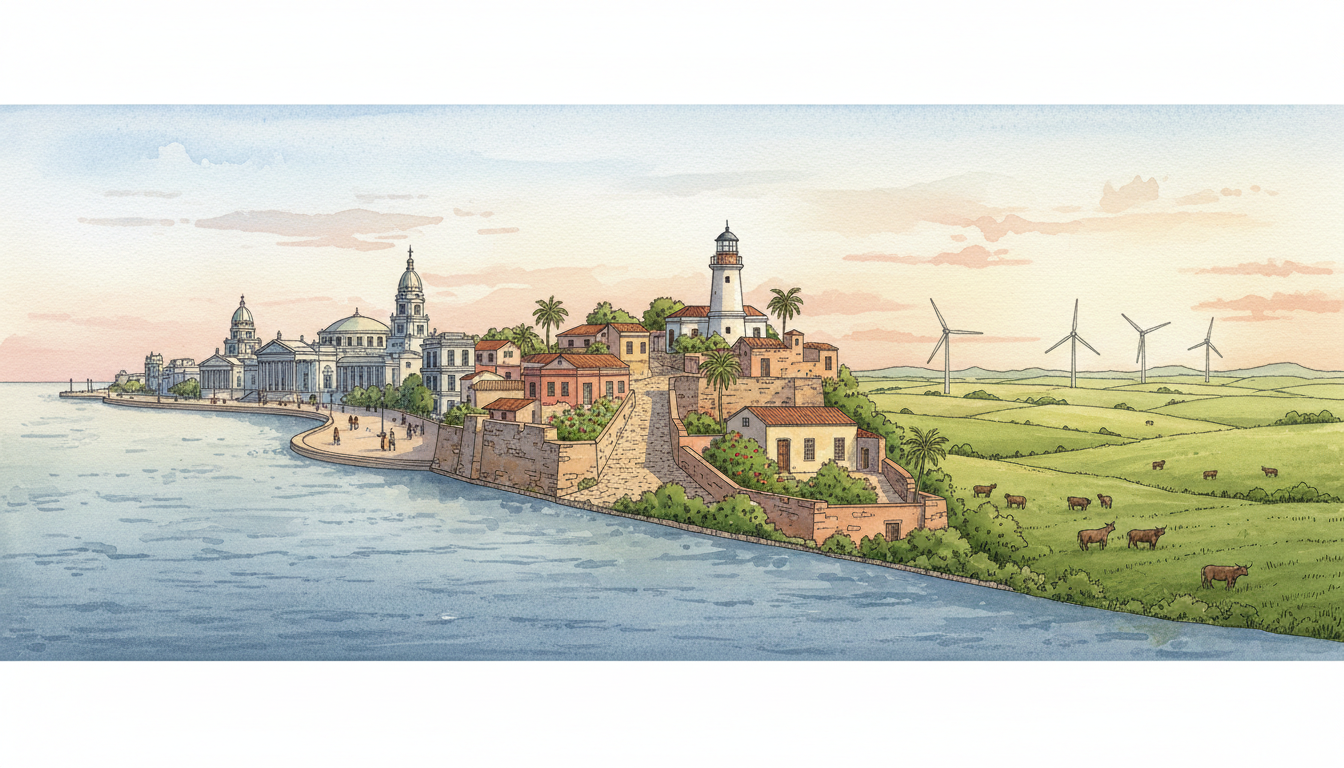
The featured image for this article is an existing eduKate 16:9 symbolic illustration of Uruguay that includes grazing cattle and grassland as one component. It is not a photograph, a map of Meadowlink, or a representation of all pastoral cultures. The media attribution identifies a conceptual editorial composite. The article’s historical cases, fictional exercises and images must remain clearly distinguished.
Mission 01 — Map seasons, pasture routes and settlement connections
classroom activity scene: Meadowlink appears on a board as four seasonal regions. Some pupils immediately call the route from south to north a migration that must happen every year. The assumption checker asks what was actually observed: the map is fictional and no seasonal information has been supplied. The evidence reviewer gives the group story cards from a family, a market worker and an elder who knows where plants recover. Suddenly the route is a research question rather than an arrow drawn for decoration.
Understand the mechanism before choosing a solution
Seasonal movements can be organised around forage, water, altitude, weather, animal needs and relationships with other communities. A grazing area useful at one time may be less suitable at another. These patterns vary by region, species, land tenure and climatic conditions, so a tutor should not invent one universal spring and autumn calendar. Routes can also be shaped by government boundaries, roads, conservation rules and the availability of health and education services.
The teacher should keep the distinction between a historical or modern case and the imaginary Meadowlink exercise visible. A real-world conclusion requires dated observations, credible sources and appropriate local expertise. A fictional map helps learners reason but cannot resolve actual land tenure, veterinary welfare or environmental safety. The point is to practise how a question becomes testable and what uncertainty remains.
Build the service and its responsibilities
Draw four seasonal zones but leave their use undecided. Create separate layers for observed vegetation, claimed water access, recognised use rights, roads, schools and market links. Ask children to write a question beside every uncertain item. Then choose a route only for the stated classroom conditions and show an alternative if one section cannot be used. The team must explain which decisions require genuine local knowledge or professional advice in real life.
Each arrow should have a source, destination and meaning: forage, water, movement, goods, information or authority. A student who says that the system just works has not yet explained it. Ask who maintains the route or record, who checks that a promise is being kept, and who receives the update if it is not. In this way children learn why the daily work of pastoral communities is part of a complex civilisation, not an absence of one.
Mathematics lab: quantify without exaggerating
In a paper exercise the east route measures 28 imaginary map kilometres, while the west route measures 35. The difference is seven, or 25 per cent of the east route’s length. It does not establish that the east path is quicker, safer or more lawful. The shorter path could be unsuitable at the chosen season or inaccessible to a family member. Give the learner two additional criteria and invite them to revise their choice.
Have learners underline the units and assumptions. Then ask which change in the invented data would most alter their proposed choice. A neat number can be useful for comparing scenarios, but it cannot replace a condition that was never measured. A Primary pupil can use counters or bar diagrams; a Secondary pupil can write a ratio or sensitivity check and make one clear statement about uncertainty.
The assumption checker introduces a new constraint
A new fence cuts across one dotted migration corridor. The market town says the fence protects crops; herders say the corridor is needed for lawful seasonal movement. The children cannot solve the conflict by pretending nobody else has rights.
The first group simply draws a new arrow through the fence. The second group invents a forced removal of another family. The evidence reviewer rejects both as a humane design. The assumption checker asks the team to check lawful access, consult affected neighbours and test a negotiated alternative. Their revised map must state unresolved claims rather than announce a winner without evidence.
At the lesson facilitator, the response follows five steps: explain the problem, distinguish verified information from rumour, protect immediate essential needs through responsible adults, propose an evidence-based adjustment, and say how the outcome will be checked. The children are not rewarded for a dramatic promise that everything can be repaired instantly. Sound planning takes uncertainty and the roles of qualified people seriously.
The evidence reviewer asks who was left out
Mobility planning should account for people who are elderly, have disabilities, care for young children or need regular health services. Their needs differ from a generic able-bodied traveller. In the history lesson, do not assume all pastoral households move together or at the same frequency. Some people may be settled, others mobile, and movement can be shared among household or community members in different ways.
Rotate the student who speaks for a service user, maintainer, affected neighbour and evidence reviewer. Do not assign ‘wise’ and ‘backward’ cultures as classroom roles. Respectful enquiry describes particular decisions and effects while allowing for disagreement. The child should be able to name a potential hidden cost and a fair process by which the people carrying that cost might raise concerns.
Family practice and tutor extension
At home: Use coloured strings between four paper locations. Ask the child to explain what each seasonal route depends on, then remove one string and request a revised, fair plan.
With a tutor: Primary pupils practise map keys and words such as corridor, seasonal, highland and lowland. Secondary pupils use distance percentages, evidence categories and consultation questions. Ask an older learner to defend a claim that a route is useful without equating short distance with sound policy.
Ask learners to draw their first idea in pencil, make a correction after the shock and explain why the changed design is more reliable. An imperfect first model is useful evidence of learning when the second model includes an honest improvement. The strongest explanation makes sense to a new child without elaborate jargon and is modest about what cannot be inferred.
A transferable idea to keep
A route map is an evolving model of ecology and social agreement, not an invitation to regard land as empty until a powerful planner draws lines across it.
See UNESCO: Transhumance, the seasonal droving of livestock for a relevant institutional or heritage perspective. Before moving on, ask what part of this system would also matter in a river town, oasis or maritime port, and which details would change with the geography and rights of the people involved.
Mission 02 — Protect water access, care and animal welfare
classroom activity scene: In the second classroom activity round, a child draws a single blue well at the centre of Meadowlink. The map declares the water problem solved. The evidence reviewer asks whether a caregiver can reach it, whether the water is safely approved for use and whether a qualified veterinarian has assessed the animals’ requirements. The assumption checker adds a season with a different demand and asks why a circle on paper was mistaken for a functioning supply system.
Understand the mechanism before choosing a solution
Water sources, safe access, quality, storage, distribution and seasonal reliability are separate questions. Livestock species have differing physiological needs that depend on their condition, age, climate, forage and other factors; classroom numbers must never be used as animal-care instructions. People need safe drinking water, hygiene and healthcare, and animal welfare needs competent veterinary support. Movement across a map does not resolve any of these problems automatically.
The teacher should keep the distinction between a historical or modern case and the imaginary Meadowlink exercise visible. A real-world conclusion requires dated observations, credible sources and appropriate local expertise. A fictional map helps learners reason but cannot resolve actual land tenure, veterinary welfare or environmental safety. The point is to practise how a question becomes testable and what uncertainty remains.
Build the service and its responsibilities
Create one map for people and a separate one for the animals rather than assuming their needs are identical. Mark known safe public supplies in the fictional world, access routes, possible reserve points and who may report a problem. The team adds a qualified professional support card rather than improvising treatment for sick animals. They must also provide a way for a child or visitor to understand where to find help when the usual location is unavailable.
Each arrow should have a source, destination and meaning: forage, water, movement, goods, information or authority. A student who says that the system just works has not yet explained it. Ask who maintains the route or record, who checks that a promise is being kept, and who receives the update if it is not. In this way children learn why the daily work of pastoral communities is part of a complex civilisation, not an absence of one.
Mathematics lab: quantify without exaggerating
The exercise has 240 imaginary service tokens for human and animal-support tasks, with 90 reserved for essential household service, 60 for community facilities and 70 for other model uses. The total planned use is 220, leaving 20. A twenty-token shortfall in future supply cannot be solved by claiming that all sources are interchangeable: quality, purpose and authority still matter. Ask learners to write a second plan for only 200 available tokens.
Have learners underline the units and assumptions. Then ask which change in the invented data would most alter their proposed choice. A neat number can be useful for comparing scenarios, but it cannot replace a condition that was never measured. A Primary pupil can use counters or bar diagrams; a Secondary pupil can write a ratio or sensitivity check and make one clear statement about uncertainty.
The assumption checker introduces a new constraint
A fictional water-access path is closed while a rumour claims a nearby puddle is definitely safe for people and livestock. The team must not use appearance as a safety test.
A poor proposal tells families to use any water that looks clear. A responsible classroom response follows competent public-health and veterinary guidance, communicates what is unknown, and identifies verified alternatives. The assumption checker checks assumptions about source and route. The evidence reviewer tests whether the notice can be understood by someone who is new to Meadowlink.
At the lesson facilitator, the response follows five steps: explain the problem, distinguish verified information from rumour, protect immediate essential needs through responsible adults, propose an evidence-based adjustment, and say how the outcome will be checked. The children are not rewarded for a dramatic promise that everything can be repaired instantly. Sound planning takes uncertainty and the roles of qualified people seriously.
The evidence reviewer asks who was left out
Some children and carers may find it more difficult to collect water, and a person with limited mobility may rely on delivery or assisted access. A pastoral system should not make health support conditional on having a permanent address or being physically strong. The classroom asks how services adapt while acknowledging that actual public policies and care arrangements vary.
Rotate the student who speaks for a service user, maintainer, affected neighbour and evidence reviewer. Do not assign ‘wise’ and ‘backward’ cultures as classroom roles. Respectful enquiry describes particular decisions and effects while allowing for disagreement. The child should be able to name a potential hidden cost and a fair process by which the people carrying that cost might raise concerns.
Family practice and tutor extension
At home: Draw five cards: source, approved safety check, distribution, user and backup. Ask which one is missing from a flawed diagram and how to repair the plan without guessing about potability.
With a tutor: Use addition, shortages and interpretation of quantities. Older students should explain why a public-water total is not the same as the safely delivered amount and why the same invented token cannot stand for a real person and a real animal.
Ask learners to draw their first idea in pencil, make a correction after the shock and explain why the changed design is more reliable. An imperfect first model is useful evidence of learning when the second model includes an honest improvement. The strongest explanation makes sense to a new child without elaborate jargon and is modest about what cannot be inferred.
A transferable idea to keep
A dependable pastoral civilisation treats safe access and care as continuing responsibilities, not a blue symbol on a map.
See FAO: Pastoralism and family farming systems for a relevant institutional or heritage perspective. Before moving on, ask what part of this system would also matter in a river town, oasis or maritime port, and which details would change with the geography and rights of the people involved.
Mission 03 — Model forage and pasture use without false certainty
classroom activity scene: The assumption checker places a green card over one part of the Meadowlink map, and the children declare it abundant pasture. The evidence reviewer asks how they know whether the forage is actually available, suitable and accessible to the animals. The pupils realise that the colour green is a picture property, not a measured feeding resource. They are offered an imaginary pasture ledger and must choose which uncertainty to investigate first.
Understand the mechanism before choosing a solution
Pasture condition varies with rainfall, plant communities, terrain, grazing history, soils, animals and season. A single carrying-capacity number can be misleading when those conditions change substantially. Rangelands may contain ecological, social and economic values beyond forage production. A practical discussion should separate a simplified classroom model from scientific assessment and professional animal management, and avoid claiming that pastoral mobility is always beneficial or always damaging.
The teacher should keep the distinction between a historical or modern case and the imaginary Meadowlink exercise visible. A real-world conclusion requires dated observations, credible sources and appropriate local expertise. A fictional map helps learners reason but cannot resolve actual land tenure, veterinary welfare or environmental safety. The point is to practise how a question becomes testable and what uncertainty remains.
Build the service and its responsibilities
Draw three pasture zones and mark two as possibly recovering after recent use. Create a ledger of imaginary forage tokens, the days they could support a hypothetical demand, and uncertainty cards that change the available amount. The children must choose a possible sequence of zones while preserving rest and lawful access. They should explain how soil care, animal wellbeing, biodiversity and community agreements might alter a plan based purely on the number of tokens.
Each arrow should have a source, destination and meaning: forage, water, movement, goods, information or authority. A student who says that the system just works has not yet explained it. Ask who maintains the route or record, who checks that a promise is being kept, and who receives the update if it is not. In this way children learn why the daily work of pastoral communities is part of a complex civilisation, not an absence of one.
Mathematics lab: quantify without exaggerating
Pasture A has 600 forage tokens in the model, and the hypothetical herd uses 100 each day, suggesting six days. If only 70 per cent is assumed usable under a new scenario, the amount falls to 420 tokens, or 4.2 days. No real grazing rule follows from this arithmetic. Ask whether the change represents less forage, reduced access, a new assumption or a mixture of factors, and how a researcher could find out.
Have learners underline the units and assumptions. Then ask which change in the invented data would most alter their proposed choice. A neat number can be useful for comparing scenarios, but it cannot replace a condition that was never measured. A Primary pupil can use counters or bar diagrams; a Secondary pupil can write a ratio or sensitivity check and make one clear statement about uncertainty.
The assumption checker introduces a new constraint
A prolonged dry period changes the simulated amount of forage. One student proposes keeping the herd there until every plant is used, while another proposes immediate movement through land without permission.
The team must compare available evidence, realistic professional advice, animal welfare, access agreements and ecological impacts. The evidence reviewer asks how affected people could be consulted. The assumption checker refuses to score either unchecked depletion or unlawful movement as an automatic improvement. A useful plan names a safer investigation and the information still missing.
At the lesson facilitator, the response follows five steps: explain the problem, distinguish verified information from rumour, protect immediate essential needs through responsible adults, propose an evidence-based adjustment, and say how the outcome will be checked. The children are not rewarded for a dramatic promise that everything can be repaired instantly. Sound planning takes uncertainty and the roles of qualified people seriously.
The evidence reviewer asks who was left out
A centralised pasture model may ignore households that depend on access but have less political influence. A policy restricting movement may also alter livelihoods and markets. Conversely, a community may raise legitimate concerns about crops, protected environments or access to shared water. The children must learn to represent different interests without stereotyping either herders or farmers.
Rotate the student who speaks for a service user, maintainer, affected neighbour and evidence reviewer. Do not assign ‘wise’ and ‘backward’ cultures as classroom roles. Respectful enquiry describes particular decisions and effects while allowing for disagreement. The child should be able to name a potential hidden cost and a fair process by which the people carrying that cost might raise concerns.
Family practice and tutor extension
At home: Use three paper pasture cards with counters and a fictional daily consumption rate. Change the amount remaining and ask the child to compute the new duration and explain why the number is not a real feeding instruction.
With a tutor: Teach division, proportion and sensitivity analysis. Older pupils should compare a fixed deterministic capacity with a scenario-based range and explain what data would justify narrowing uncertainty.
Ask learners to draw their first idea in pencil, make a correction after the shock and explain why the changed design is more reliable. An imperfect first model is useful evidence of learning when the second model includes an honest improvement. The strongest explanation makes sense to a new child without elaborate jargon and is modest about what cannot be inferred.
A transferable idea to keep
Responsible rangeland reasoning tests assumptions and examines ecology and rights rather than treating a pasture’s colour as proof of unlimited capacity.
See FAO: Pastoralism and natural resource governance for a relevant institutional or heritage perspective. Before moving on, ask what part of this system would also matter in a river town, oasis or maritime port, and which details would change with the geography and rights of the people involved.
Mission 04 — Create fair land-use agreements and peaceful appeal routes
classroom activity scene: Two fictional communities reach the same narrow passage between a field and a grazing area. A farmer worries about damage to crops, while a herder says a seasonal path is important for animals to reach authorised grazing. The children initially debate which occupation matters more. The evidence reviewer asks them to restate both concerns without insults. The assumption checker draws the route, the field, a shared water point and the legal uncertainty, and asks which questions have factual answers.
Understand the mechanism before choosing a solution
Shared landscapes require institutions that identify access, responsibilities, boundaries, mediation, lawful rights and revision when circumstances change. Rules can be formal or customary in varied combinations. Mobility may connect many local communities and jurisdictions. An agreement is not made fair merely by being written; affected parties need meaningful opportunities to understand it and challenge mistakes. History shows diverse arrangements, so a classroom should avoid pretending that any one pastoral culture had a universal land law.
The teacher should keep the distinction between a historical or modern case and the imaginary Meadowlink exercise visible. A real-world conclusion requires dated observations, credible sources and appropriate local expertise. A fictional map helps learners reason but cannot resolve actual land tenure, veterinary welfare or environmental safety. The point is to practise how a question becomes testable and what uncertainty remains.
Build the service and its responsibilities
Create a simple role-play using four cards: herding household, farming household, public mediator and ecological observer. Each explains one concern and one piece of missing information. The group draws a proposed route with a realistic fictional inspection and grievance process. Add a maintenance responsibility for gates or paths where appropriate and a procedure for reviewing the arrangement after a dry season. Do not make children impersonate a real ethnic group or enact conflict stereotypes.
Each arrow should have a source, destination and meaning: forage, water, movement, goods, information or authority. A student who says that the system just works has not yet explained it. Ask who maintains the route or record, who checks that a promise is being kept, and who receives the update if it is not. In this way children learn why the daily work of pastoral communities is part of a complex civilisation, not an absence of one.
Mathematics lab: quantify without exaggerating
An invented landscape has 50 access tokens distributed across three uses: 20 for a grazing route, 15 for a field-maintenance path and 10 for a protected ecological buffer. The total planned allocation is 45, leaving five. If a new plan asks for 12 additional tokens, demand reaches 57 and exceeds supply by seven. Ask learners to compare a proportional cut with a negotiated redesign; either way, the constraint must be visible and the rights of those affected considered.
Have learners underline the units and assumptions. Then ask which change in the invented data would most alter their proposed choice. A neat number can be useful for comparing scenarios, but it cannot replace a condition that was never measured. A Primary pupil can use counters or bar diagrams; a Secondary pupil can write a ratio or sensitivity check and make one clear statement about uncertainty.
The assumption checker introduces a new constraint
One side hears a rumour that the other has violated an agreement, but the source is an undated photograph that may show an unrelated place. The group must avoid turning an ambiguous image into an accusation.
A rushed plan imposes penalties based on rumour. A fairer plan checks the claim with appropriate authorities and directly affected parties, protects safety and records a reviewed resolution. The evidence reviewer asks whether the message invites peaceful dialogue. The assumption checker distinguishes a map label from verified evidence about actual use.
At the lesson facilitator, the response follows five steps: explain the problem, distinguish verified information from rumour, protect immediate essential needs through responsible adults, propose an evidence-based adjustment, and say how the outcome will be checked. The children are not rewarded for a dramatic promise that everything can be repaired instantly. Sound planning takes uncertainty and the roles of qualified people seriously.
The evidence reviewer asks who was left out
Pastoralists are not a homogeneous group, and farmers do not all share the same resources or authority. Women, younger people and households without powerful connections may be poorly represented in some processes. The simulation should explicitly create a respectful hearing and identify which constraints can be improved without coercion or displacement.
Rotate the student who speaks for a service user, maintainer, affected neighbour and evidence reviewer. Do not assign ‘wise’ and ‘backward’ cultures as classroom roles. Respectful enquiry describes particular decisions and effects while allowing for disagreement. The child should be able to name a potential hidden cost and a fair process by which the people carrying that cost might raise concerns.
Family practice and tutor extension
At home: Using coloured paper, invent two neighbouring land uses and a shared route. Let each family member voice a concern, then write an agreement and a calm appeal process.
With a tutor: English and Social Studies: compare a claim, a source and an inference. Mathematics: allocate limited tokens. Secondary Geography: consider ecological pressure, boundaries and effects across seasons.
Ask learners to draw their first idea in pencil, make a correction after the shock and explain why the changed design is more reliable. An imperfect first model is useful evidence of learning when the second model includes an honest improvement. The strongest explanation makes sense to a new child without elaborate jargon and is modest about what cannot be inferred.
A transferable idea to keep
Civilisation depends on ways to cooperate across difference. Peaceful, inspectable agreements are infrastructure just as much as a road or a gate.
See FAO: mobility, tenure and pastoral livelihoods for a relevant institutional or heritage perspective. Before moving on, ask what part of this system would also matter in a river town, oasis or maritime port, and which details would change with the geography and rights of the people involved.
Mission 05 — Understand livestock health and responsible veterinary support
Opening in Meadowlink: A Meadowlink child notices a fictional animal is no longer moving with the imagined herd. Two pupils immediately suggest a treatment they remember from a story. The evidence reviewer asks how they know what is wrong. The assumption checker reminds the group that symptoms can have many causes and that no paper game qualifies a student to diagnose an animal. The mission changes into a lesson about responsible observation, welfare, records and access to competent help.
Mechanisms worth understanding
Animal wellbeing depends on species, life stage, condition, weather, nutrition, husbandry, disease control and skilled care. Veterinary knowledge may interact with community experience, but a story about an old remedy is not enough to establish its safety or effectiveness. Mobile livelihoods can face difficulty reaching services, so reliable systems may require communication, planned access, trusted local professionals and appropriately maintained records. A tutor should avoid giving real feeding, medication or treatment instructions in a children’s civilisation article.
A tutor can remind pupils that today’s reading is not evidence that all pastoral societies use the same customs or technologies. A source about a particular community should retain its authorship, place and date; a hypothetical number should be marked as such. Sound comparison uses shared human questions while preserving the cultural and ecological differences that make each case interesting.
Design the activity as a working system
Give the team a fictional herd-health card without a diagnosis. It records the date of an observation, an anonymous animal identifier and a need to seek appropriate expertise. Draw paths to a qualified veterinary provider and a process for conveying accurate information while protecting the safety of people and animals. Add responsibilities for routine checks and training without inventing technical thresholds or clinical procedures.
Now show the inputs, outputs and responsibilities. A service is not reliable if it is visible on a drawing but nobody checks it, can explain how it works or has access to correct it. The assumption checker asks whether the most important part depends on one absent specialist, one unusable road or one stale record. The evidence reviewer asks whether a child, caregiver or new visitor can use the instruction and where an appeal is possible.
A number with a meaningful interpretation
In a classroom record 48 livestock cards are being checked for completeness. Thirty-nine have both a date and location, while nine are missing at least one field. The fraction requiring record correction is 9/48 = 18.75 per cent. This measures documentation completeness, not animal illness prevalence. Ask learners why a complete record does not automatically mean the underlying care is adequate, and why missing information should trigger a check rather than an accusation.
After solving the numerical task, the learner should say which units were used and why the result does or does not answer the social decision. A total is different from the distribution among households. A completed record is different from proof that the real service worked. Correct mathematics is most valuable when it clarifies a question without pretending to remove uncertainty that has not been measured.
The disruption card
The usual communication channel to a qualified animal-care specialist stops working. Another pupil suggests waiting indefinitely because the animal cannot talk. The group must consider responsibility and alternative trusted contact routes in their paper model.
The evidence reviewer asks for a calm report using only observed facts. The assumption checker checks whether the fallback communication route is actually distinct from the first and whether its contact details are kept current. The children cannot award themselves a completed repair until someone in the fictional scenario has verified that appropriate care support can be reached.
The classroom activity repair loop requires an honest observation, a safe immediate response led by responsible qualified people, a proposed longer-term improvement, and a check that the improvement has been completed. A learner is allowed to state that the evidence is insufficient. An invented confident assertion about health, rights or structural safety is not a successful substitute for expertise.
Dignity and fair access
Smaller households may have less money, transport or flexible labour for obtaining help. Animal welfare and human livelihoods may be linked, and losses can have different impacts across families. Policies designed with only large operators in mind may overlook people with fewer resources. Do not reduce care obligations to economic value alone.
Rotate the students among roles representing a user, maintainer, affected neighbour and evidence reviewer. Ask the reviewer to identify whose story the first proposal omits. Avoid assigning whole ethnic cultures as simplistic characters; the roles concern practical services and decision procedures in an invented society. The point is to practise fairness without pretending to speak on behalf of real communities.
Home and tutor worksheet
At home: Create a paper animal-care record with blank observations, date and an ‘ask a qualified adult or professional’ field. Practise describing evidence rather than diagnosing anything.
For tutors: Use percentages and classification of observation versus inference. In Science, discuss why symptoms do not uniquely identify a cause; in English, practise writing a concise, factual assistance request without unsupported medical claims.
The learner finishes with a labelled drawing, a short explanation of a choice, one data check and a visible correction. Younger children can explain in plain English or use a few carefully chosen labels. Older students should distinguish the source-grounded statement from the imaginative model and add one limitation. Neither group should be asked to memorise a long list of cultural stereotypes.
Carry the idea to the next question
Advanced capability begins when a community knows what it can and cannot safely decide, and preserves a dependable route to expertise. Continue through FAO: Pastoralism, then ask which idea transfers to a port, oasis or river valley and what changes when local ecology and rights differ.
Mission 06 — Keep children’s education and healthcare accessible across movement
Opening in Meadowlink: The Meadowlink school announces that every child must attend the same fixed classroom all year. A child’s family follows a seasonal livestock livelihood, and the schedule creates difficulties. The evidence reviewer asks whether the system could preserve educational continuity without labelling the child unreliable. The assumption checker adds a map of communications, recorded progress, travel access and qualified teachers. The class discovers that learning can be organised across locations, but not by simply abandoning the obligation to provide suitable education and safeguarding.
Mechanisms worth understanding
A community’s ability to teach is broader than the presence of a single building. Children need age-appropriate formal learning, social connection, continuity, safeguarding and suitable support, while families can transmit complex practical knowledge through observation and apprenticeship. Actual school arrangements depend on law, location and resources; a fictional proposal cannot substitute for a child’s real educational entitlements. Public healthcare also requires reliable continuity and appropriate professional oversight, not a classroom assumption that every settlement has identical facilities.
A tutor can remind pupils that today’s reading is not evidence that all pastoral societies use the same customs or technologies. A source about a particular community should retain its authorship, place and date; a hypothetical number should be marked as such. Sound comparison uses shared human questions while preserving the cultural and ecological differences that make each case interesting.
Design the activity as a working system
Prepare a learning passport for a completely fictional student containing topics understood, a reading goal, a planned check-in and the next teacher’s instructions. Do not include personal real-world student data. Draw a route between a community teaching site, market town and public service point, then plan for missed connectivity. The group must show how the learner can ask questions, retrieve knowledge and receive corrective feedback despite a changing place of residence.
Now show the inputs, outputs and responsibilities. A service is not reliable if it is visible on a drawing but nobody checks it, can explain how it works or has access to correct it. The assumption checker asks whether the most important part depends on one absent specialist, one unusable road or one stale record. The evidence reviewer asks whether a child, caregiver or new visitor can use the instruction and where an appeal is possible.
A number with a meaningful interpretation
A fictional programme includes twelve learning checkpoints in a term. A learner completes eight with a tutor before the family changes location and four through an agreed continuation. The total is twelve, but completion alone does not show understanding. Ask for a short demonstration in a new context, a retrieval check and a correction where needed. The lesson distinguishes administrative progress from real learning quality.
After solving the numerical task, the learner should say which units were used and why the result does or does not answer the social decision. A total is different from the distribution among households. A completed record is different from proof that the real service worked. Correct mathematics is most valuable when it clarifies a question without pretending to remove uncertainty that has not been measured.
The disruption card
During the imagined move, the portable book kit is misplaced and the communication service is unavailable. The child’s next tutor cannot tell which subjects have been taught.
The evidence reviewer asks for a clear, privacy-respecting learning summary and a humane alternative while access is restored. The assumption checker tests whether a second copy of essential instructions would actually be available in the scenario. The group revises the continuity plan rather than blaming the family for moving.
The classroom activity repair loop requires an honest observation, a safe immediate response led by responsible qualified people, a proposed longer-term improvement, and a check that the improvement has been completed. A learner is allowed to state that the evidence is insufficient. An invented confident assertion about health, rights or structural safety is not a successful substitute for expertise.
Dignity and fair access
Children with disabilities, special educational needs or different language backgrounds may require additional support. Do not make the school’s success conditional on a family owning a smartphone or constantly travelling to a distant town. Equitable planning accounts for actual obligations and the diversity of learners, with professional and legal guidance where needed.
Rotate the students among roles representing a user, maintainer, affected neighbour and evidence reviewer. Ask the reviewer to identify whose story the first proposal omits. Avoid assigning whole ethnic cultures as simplistic characters; the roles concern practical services and decision procedures in an invented society. The point is to practise fairness without pretending to speak on behalf of real communities.
Home and tutor worksheet
At home: Write a one-page imaginary lesson passport for a toy student: three skills learned, one skill to practise, a next check and an emergency contact field that contains no real personal information.
For tutors: Use the learning framework loop: target, practice, output, test, feedback, repair and retest. Ask students to distinguish a completed worksheet from transferable knowledge, and connect this with a fictional geographic continuity challenge.
The learner finishes with a labelled drawing, a short explanation of a choice, one data check and a visible correction. Younger children can explain in plain English or use a few carefully chosen labels. Older students should distinguish the source-grounded statement from the imaginative model and add one limitation. Neither group should be asked to memorise a long list of cultural stereotypes.
Carry the idea to the next question
A moving livelihood does not make children unable to learn. A humane learning framework maintains accountability for outcomes while adapting delivery and safeguards. Continue through eduKate learning framework, then ask which idea transfers to a port, oasis or river valley and what changes when local ecology and rights differ.
Mission 07 — Understand mobile dwellings, material skills and repair
Opening in Meadowlink: The children admire a beautifully drawn mobile shelter in Meadowlink. One child declares that a permanent stone house must be ‘more advanced’. The assumption checker asks what each structure is designed to do; the evidence reviewer asks whether it keeps a family safe in its own environment and can be repaired and maintained responsibly. They examine a UNESCO description of Mongol ger craftsmanship, which emphasises specialised material knowledge and the transmission of skills. The discussion turns from prestige to function.
Mechanisms worth understanding
A mobile dwelling can be an engineered response to specific needs for assembly, transport, weather protection and family life. Traditional craftsmanship of the Mongol ger is recognised by UNESCO as intangible cultural heritage. That recognition does not imply that every pastoral family uses a ger or that children’s cardboard models can establish structural safety. Materials, cultural meaning, decoration and practical know-how may be inseparable; a specific design belongs to communities with their own history and naming.
A tutor can remind pupils that today’s reading is not evidence that all pastoral societies use the same customs or technologies. A source about a particular community should retain its authorship, place and date; a hypothetical number should be marked as such. Sound comparison uses shared human questions while preserving the cultural and ecological differences that make each case interesting.
Design the activity as a working system
Give students paper cards for a generic fictional shelter’s functions: weather protection, privacy, storage, access, repairability and transport. Ask them to draw two designs for different stated scenarios, rather than copy a sacred or community-specific ornament. Record which requirement each feature addresses and which feature introduces a new trade-off. Real assembly of load-bearing shelters is not an unsupervised school activity.
Now show the inputs, outputs and responsibilities. A service is not reliable if it is visible on a drawing but nobody checks it, can explain how it works or has access to correct it. The assumption checker asks whether the most important part depends on one absent specialist, one unusable road or one stale record. The evidence reviewer asks whether a child, caregiver or new visitor can use the instruction and where an appeal is possible.
A number with a meaningful interpretation
A fictional kit contains 24 panels, six support markers and twelve fastening cards. When the team checks the inventory, it finds 22 panels, six supports and ten fasteners. Two panels and two fasteners are missing. Learners must make a clear packing ledger, check the count and name which planned task cannot proceed. These are paper components and do not describe real ger construction or structural specifications.
After solving the numerical task, the learner should say which units were used and why the result does or does not answer the social decision. A total is different from the distribution among households. A completed record is different from proof that the real service worked. Correct mathematics is most valuable when it clarifies a question without pretending to remove uncertainty that has not been measured.
The disruption card
The Meadowlink shelter is to be moved after an imagined storm, but its maintenance notes were held by one person who is now unavailable.
The evidence reviewer asks whether the instructions can be explained to a learner without assuming that expertise is unimportant. The assumption checker checks which materials and skills need qualified craftworkers. The class creates a plain-language repair log and identifies who would verify any real structural work in a professional setting.
The classroom activity repair loop requires an honest observation, a safe immediate response led by responsible qualified people, a proposed longer-term improvement, and a check that the improvement has been completed. A learner is allowed to state that the evidence is insufficient. An invented confident assertion about health, rights or structural safety is not a successful substitute for expertise.
Dignity and fair access
Respect a living tradition without turning it into a museum stereotype. Modern mobile families may combine heritage forms with contemporary homes or other facilities. The right comparison is between requirements and evidence in context, not a judgement that portable structures represent an earlier rung of human development.
Rotate the students among roles representing a user, maintainer, affected neighbour and evidence reviewer. Ask the reviewer to identify whose story the first proposal omits. Avoid assigning whole ethnic cultures as simplistic characters; the roles concern practical services and decision procedures in an invented society. The point is to practise fairness without pretending to speak on behalf of real communities.
Home and tutor worksheet
At home: Design a paper model using rectangles and triangles, explain which functions are intended and how a lost paper part changes the design. Do not treat the model as an engineering plan.
For tutors: Mathematics: count materials and compare ratios; Science: distinguish material properties from safety certification; Art and History: research the source community of a craft without copying or misattributing restricted symbols.
The learner finishes with a labelled drawing, a short explanation of a choice, one data check and a visible correction. Younger children can explain in plain English or use a few carefully chosen labels. Older students should distinguish the source-grounded statement from the imaginative model and add one limitation. Neither group should be asked to memorise a long list of cultural stereotypes.
Carry the idea to the next question
A civilisation’s technology includes accumulated practical knowledge and the capacity to maintain it, whether or not the result is permanent and monumental. Continue through UNESCO: Traditional craftsmanship of the Mongol ger, then ask which idea transfers to a port, oasis or river valley and what changes when local ecology and rights differ.
Mission 08 — Build trade, market records and fair measurement
Opening in Meadowlink: A Meadowlink group trades fibre, milk products represented by paper cards, tools and school materials with a nearby town. At first it counts all parcels as equivalent, even though the labels show different types and quantities. The evidence reviewer asks the traders to agree on what a packet means, while the assumption checker checks the routes and paperwork. The children see how a community whose livelihood involves movement can still have complex commercial standards and enduring market relationships.
Mechanisms worth understanding
Pastoral livelihoods can link rural regions with farmers, craftworkers, service centres and international markets. Livestock and related products may be exchanged or sold under arrangements that vary by region and period. A market depends on trustworthy measurements, records, transport conditions and fair institutions. A simplified graph of prices cannot capture every livelihood cost, especially work, animal welfare, ecological limits and barriers faced by smaller producers.
A tutor can remind pupils that today’s reading is not evidence that all pastoral societies use the same customs or technologies. A source about a particular community should retain its authorship, place and date; a hypothetical number should be marked as such. Sound comparison uses shared human questions while preserving the cultural and ecological differences that make each case interesting.
Design the activity as a working system
Make a fictional seasonal market with cards for fibre, food, tools and education resources. Every transaction receives a description, quantity, unit, date, destination and a plan for correcting discrepancies. Ask the group to identify items that require qualified safe handling and to exclude them from real classroom handling. The learning exercise is about information and cooperation rather than actual animal product commerce.
Now show the inputs, outputs and responsibilities. A service is not reliable if it is visible on a drawing but nobody checks it, can explain how it works or has access to correct it. The assumption checker asks whether the most important part depends on one absent specialist, one unusable road or one stale record. The evidence reviewer asks whether a child, caregiver or new visitor can use the instruction and where an appeal is possible.
A number with a meaningful interpretation
Seller A has 12 paper bundles marked 250 grams each, totalling 3,000 grams. Seller B has eight bundles marked 400 grams each, totalling 3,200 grams. More bundles do not necessarily mean more total mass, and neither total alone reveals price, condition or fairness. Ask learners to compare units and write which information is still needed before deciding on a purchase.
After solving the numerical task, the learner should say which units were used and why the result does or does not answer the social decision. A total is different from the distribution among households. A completed record is different from proof that the real service worked. Correct mathematics is most valuable when it clarifies a question without pretending to remove uncertainty that has not been measured.
The disruption card
A market receipt is copied with a missing unit and the delivery route is delayed. One trader blames the other without checking which document was altered.
The evidence reviewer asks for a bilingual-friendly correction that protects trust without hiding the error. The assumption checker reconciles the original record, checked stock and route status. The group creates a simple grievance process so disputes can be resolved on evidence rather than stereotypes about mobile traders.
The classroom activity repair loop requires an honest observation, a safe immediate response led by responsible qualified people, a proposed longer-term improvement, and a check that the improvement has been completed. A learner is allowed to state that the evidence is insufficient. An invented confident assertion about health, rights or structural safety is not a successful substitute for expertise.
Dignity and fair access
Commercial networks may treat participants very differently. A small household can lack bargaining power, while some services require distant travel. A fair design considers access to price information, consent, safe labour and the right to question an unexplained deduction. Recognise that actual historical trade systems have varied and may include exploitation; do not describe exchange as invariably peaceful.
Rotate the students among roles representing a user, maintainer, affected neighbour and evidence reviewer. Ask the reviewer to identify whose story the first proposal omits. Avoid assigning whole ethnic cultures as simplistic characters; the roles concern practical services and decision procedures in an invented society. The point is to practise fairness without pretending to speak on behalf of real communities.
Home and tutor worksheet
At home: Run a pretend market with dry paper bundles and standard units. Exchange mock receipts, deliberately leave one unit blank and repair the record through a clarifying question.
For tutors: Teach mass conversions, honest labels, critical interpretation of data and persuasive explanation. Older students can analyse why improved price transparency is useful but does not alone guarantee equal bargaining power.
The learner finishes with a labelled drawing, a short explanation of a choice, one data check and a visible correction. Younger children can explain in plain English or use a few carefully chosen labels. Older students should distinguish the source-grounded statement from the imaginative model and add one limitation. Neither group should be asked to memorise a long list of cultural stereotypes.
Carry the idea to the next question
Movement and market participation can coexist with detailed institutions. The strength of exchange lies in verifiable agreements, respectful negotiation and reliable access. Continue through How Ancient Markets Connected Everyday Life, then ask which idea transfers to a port, oasis or river valley and what changes when local ecology and rights differ.
Mission 09 — Read weather and environmental evidence carefully
classroom activity story: Meadowlink’s children draw the same rain cloud on each month’s map because the last two seasons were favourable. The assumption checker replaces one cloud with a low-rainfall card, and the evidence reviewer asks whether the original map represented an observation or merely hope. The group explores how experience, forecasts, seasonal records and uncertainty can be brought together without claiming that any individual can guarantee the next season.
Understand the mechanism and its limits
Weather describes conditions in particular times and places, whereas climate describes longer-term patterns and variability. Pastoral communities can use environmental observations and local knowledge in decisions, and trusted weather services provide important additional information. Neither a remembered season nor a forecast is a perfect promise. Children should learn the limits of each source rather than setting local expertise and science in a simplistic competition. An entire landscape’s climate cannot be established from one rainy afternoon.
When students compare a real culture with Meadowlink, require them to identify the kind of evidence used. A named historical case has dates and specific circumstances; the classroom narrative has invented quantities and simplified rules. These are not interchangeable. The point is to use an intelligible model to generate better questions while respecting the real people whose history may be studied separately.
Build an accountable system
Create a calendar with a series of invented observations and a separate column for predictions. Label who recorded each observation, its date and which geographic area it concerns. Add a third column for unanswered questions. The children must write a backup plan for a season that differs from the expected pattern and demonstrate how the updated public notice reaches households without relying on one phone application.
Every useful plan should show an input, output, responsible person and a way to detect or report trouble. The children should not assume that a function is complete merely because a line is drawn. In the lesson facilitator review, the assumption checker asks which parts rely on one fragile route or one expert, and the evidence reviewer asks who cannot access the service or the explanation.
Maths that must be interpreted
Three imagined annual rainfall totals are 120, 80 and 100 units. Their mean is 100. Add a fourth year of 40 and the new mean becomes 85. The result does not prove the fifth year will contain 85 units. Ask a pupil to name the sample size and the observed range before claiming that the expected pattern is fixed.
Have learners state the units, the time period and the assumption behind a numerical conclusion. A mean, proportion or total may be mathematically correct while failing to establish a forecast, ecological assessment or ethical decision. The stronger response names the missing evidence and proposes a credible next observation instead of masking uncertainty with false precision.
Introduce a change and test the repair loop
A popular speaker announces certain rainfall based on the first three figures. When the paper weather card changes, the community must correct the exaggerated message and protect people from decisions founded on false certainty. The assumption checker checks the dates; the evidence reviewer asks the class to explain uncertainty in plain English without spreading panic.
The team should preserve essential wellbeing, ask for qualified help where necessary, investigate responsibly and communicate what is known. It should then state how to verify the proposed improvement. A fictional emergency does not license practical navigation, animal-care or medical instructions. In real circumstances the responsible people and public authorities make those decisions.
Human rights and environmental consequences
A misleading forecast may burden families differently. Households with fewer buffers or limited access to information can be especially exposed when planning assumptions fail. A responsible warning has a clear source, date, scope and review point. It does not blame residents for an unexpected event or assign supernatural certainty to any technology.
Give each child a rotating role: user, maintainer, affected neighbour and evidence reviewer. Those roles must not be caricatures of real cultures. They help students discover whose experience and interests were not represented in the initial drawing. The next version should show a respectful hearing and a correction that addresses the overlooked issue.
Family task, tutor extension and teach-back
Home activity: Draw four fictional seasonal cards, compute their mean and explain why the mean cannot promise next year’s weather. Ask the child to write a correction when one card changes.
Tutor activity: Mathematics: mean and range. Geography: weather versus climate. English: distinguish predicted, observed, likely and certain. Older pupils can compare claims without inventing an official forecast.
A good exit ticket is simple: ‘We noticed…’, ‘We chose…’, ‘We checked…’, and ‘We changed…’. If a young learner can communicate that sequence accurately, their understanding is becoming useful. Older students can add one source, one alternative interpretation and a stated limitation. A coherent correction is more valuable than a polished poster without a test.
Carry this forward
Weather literacy means making decisions under acknowledged uncertainty and knowing when new observations should change the plan. Continue through FAO: Pastoralism in Africa’s Drylands. Ask whether the same underlying principle applies to a river town, coastal port or oasis, and how local institutions and ecology would change the design.
Mission 10 — Understand rangeland ecology and recovery
classroom activity story: The Meadowlink students paint a hillside green and mark it ‘available forever’. The assumption checker introduces an ecological observation from the imagined previous season, which suggests that some areas need assessment before further use. The evidence reviewer asks who has a say when livestock livelihoods, other land users and wildlife all depend on the same landscape. The children must distinguish a living ecosystem from unlimited empty space.
Understand the mechanism and its limits
Rangelands can support diverse plants, animals, soils and human livelihoods. Grazing effects depend on site conditions, species, timing, amount and management. In some settings appropriate grazing can maintain particular landscapes; in others inappropriate pressure can harm vegetation or soil. Mobility may be relevant to managing variability, yet movement alone does not guarantee healthy ecology. A credible assessment requires measured indicators, context and consultation rather than a blanket slogan for or against pastoralism.
When students compare a real culture with Meadowlink, require them to identify the kind of evidence used. A named historical case has dates and specific circumstances; the classroom narrative has invented quantities and simplified rules. These are not interchangeable. The point is to use an intelligible model to generate better questions while respecting the real people whose history may be studied separately.
Build an accountable system
Draw three fictional habitat zones and record what the team knows about each: plant condition, water, use history, access rights and uncertainty. Some squares are designated for observation rather than immediate use. The children must propose a monitoring question and show how the plan could be altered after expert assessment. No classroom token is a real stocking-rate recommendation.
Every useful plan should show an input, output, responsible person and a way to detect or report trouble. The children should not assume that a function is complete merely because a line is drawn. In the lesson facilitator review, the assumption checker asks which parts rely on one fragile route or one expert, and the evidence reviewer asks who cannot access the service or the explanation.
Maths that must be interpreted
Of 300 imaginary landscape squares, 75 are marked as requiring further assessment. That is 25 per cent. The remaining 225 squares cannot automatically be assumed suitable for grazing: the map lacks evidence. A student who concludes that 75 per cent is safely usable has confused ‘not yet flagged’ with ‘verified safe’.
Have learners state the units, the time period and the assumption behind a numerical conclusion. A mean, proportion or total may be mathematically correct while failing to establish a forecast, ecological assessment or ethical decision. The stronger response names the missing evidence and proposes a credible next observation instead of masking uncertainty with false precision.
Introduce a change and test the repair loop
A proposed market road would reduce a hypothetical transport route but cut through a sensitive landscape feature. The first team counts only the travel benefit. A second team asks whether the ecological effects and community access have been evaluated. The assumption checker requires evidence; the evidence reviewer asks who bears the less visible costs.
The team should preserve essential wellbeing, ask for qualified help where necessary, investigate responsibly and communicate what is known. It should then state how to verify the proposed improvement. A fictional emergency does not license practical navigation, animal-care or medical instructions. In real circumstances the responsible people and public authorities make those decisions.
Human rights and environmental consequences
Ecological protection should include the needs and lawful rights of communities as well as wildlife, and should not erase local expertise. Neither conservation nor trade goals provide a licence to disregard people. Children should investigate alternative proposals and learn that an environmental claim needs an appropriate metric and a way to test it.
Give each child a rotating role: user, maintainer, affected neighbour and evidence reviewer. Those roles must not be caricatures of real cultures. They help students discover whose experience and interests were not represented in the initial drawing. The next version should show a respectful hearing and a correction that addresses the overlooked issue.
Family task, tutor extension and teach-back
Home activity: Draw a three-zone habitat map, remove one connection and identify two questions the child would ask a scientist or knowledgeable local resident before approving a change.
Tutor activity: Science: ecosystems and evidence. Mathematics: percentages and interpretation limits. Social Studies: balancing several legitimate interests with transparent review. Do not turn a paper ecology diagram into live wildlife-handling instructions.
A good exit ticket is simple: ‘We noticed…’, ‘We chose…’, ‘We checked…’, and ‘We changed…’. If a young learner can communicate that sequence accurately, their understanding is becoming useful. Older students can add one source, one alternative interpretation and a stated limitation. A coherent correction is more valuable than a polished poster without a test.
Carry this forward
Stewardship is an ongoing relationship of observation, rights and correction, not a one-time declaration that land is either useful or useless. Continue through FAO: Pastoralism. Ask whether the same underlying principle applies to a river town, coastal port or oasis, and how local institutions and ecology would change the design.
Mission 11 — Preserve cultural memory, language and practical knowledge
classroom activity story: At the start of a new Meadowlink lesson, the child who drew the best seasonal map is absent. No one remembers why some lines were dashed or which information was confidential. The evidence reviewer asks the group to explain what should be shared, what must be verified and what should remain private. The assumption checker introduces a dated learning record so the next students can continue the work without inventing its missing reasons.
Understand the mechanism and its limits
Community knowledge can travel through oral accounts, demonstrations, apprenticeship, writing, maps, songs and contemporary communications. Some knowledge is public and some belongs to people or groups who should control how it is shared. UNESCO’s Mongol nomad migration and traditional ger craftsmanship entries describe intergenerational transmission of practices, but they do not make all pastoral societies interchangeable. Respecting cultural context and consent is part of literacy.
When students compare a real culture with Meadowlink, require them to identify the kind of evidence used. A named historical case has dates and specific circumstances; the classroom narrative has invented quantities and simplified rules. These are not interchangeable. The point is to use an intelligible model to generate better questions while respecting the real people whose history may be studied separately.
Build an accountable system
Create a one-page Meadowlink field notebook that a younger student can read. Include a map key, two verified fictional observations, one procedure for seeking appropriate adult help and an explicit unanswered question. Have another child use it to explain the process back to the team. For the privacy lesson, do not include actual family health data, sacred knowledge or personal addresses.
Every useful plan should show an input, output, responsible person and a way to detect or report trouble. The children should not assume that a function is complete merely because a line is drawn. In the lesson facilitator review, the assumption checker asks which parts rely on one fragile route or one expert, and the evidence reviewer asks who cannot access the service or the explanation.
Maths that must be interpreted
An imaginary learner receives scores of 4, 3, 2, 4, 1 and 3 on six 0–5 learning probes. The total is 17, but the smallest score points to a skill needing attention. A total score must not conceal which ability is weak; and a learning probe for an individual is not an index of a people’s intelligence.
Have learners state the units, the time period and the assumption behind a numerical conclusion. A mean, proportion or total may be mathematically correct while failing to establish a forecast, ecological assessment or ethical decision. The stronger response names the missing evidence and proposes a credible next observation instead of masking uncertainty with false precision.
Introduce a change and test the repair loop
An experienced maker who taught a skill through demonstration is not available. A pupil tries to reconstruct the method from a photograph, but important details are absent. Rather than invent a procedure, the evidence reviewer asks for a trained teacher and the assumption checker records what remains unknown.
The team should preserve essential wellbeing, ask for qualified help where necessary, investigate responsibly and communicate what is known. It should then state how to verify the proposed improvement. A fictional emergency does not license practical navigation, animal-care or medical instructions. In real circumstances the responsible people and public authorities make those decisions.
Human rights and environmental consequences
Traditional knowledge is not a free repository for outsiders to scrape without consent. A respectful educational page identifies the communities, credits sources and avoids misrepresenting one practice as a universal human blueprint. Oral transmission may be sophisticated and systematic even where the original knowledge is not written down.
Give each child a rotating role: user, maintainer, affected neighbour and evidence reviewer. Those roles must not be caricatures of real cultures. They help students discover whose experience and interests were not represented in the initial drawing. The next version should show a respectful hearing and a correction that addresses the overlooked issue.
Family task, tutor extension and teach-back
Home activity: Give a child a simple paper-folding task with written instructions, then ask them to test the instructions on another person and improve the wording. Discuss what information should never be published without permission.
Tutor activity: English: precise procedural explanation. History: attribution and provenance. learning framework: retrieval and transfer. Mathematics: interpret the low component of an aggregate score and justify a targeted repair.
A good exit ticket is simple: ‘We noticed…’, ‘We chose…’, ‘We checked…’, and ‘We changed…’. If a young learner can communicate that sequence accurately, their understanding is becoming useful. Older students can add one source, one alternative interpretation and a stated limitation. A coherent correction is more valuable than a polished poster without a test.
Carry this forward
A civilisation passes on capability when learners can understand, use, test and correct knowledge across generations. Continue through UNESCO: Mongol nomad migration and associated practices. Ask whether the same underlying principle applies to a river town, coastal port or oasis, and how local institutions and ecology would change the design.
Mission 12 — Make governance and shared resources accountable
classroom activity story: Three Meadowlink districts share a corridor. The children mark a route across them and announce that everyone agrees. The evidence reviewer asks whether the actual parties have been consulted, and the assumption checker reveals that the districts have different rules for the shared water point. The class discovers that cross-regional cooperation requires actual processes, not confident labels on a map.
Understand the mechanism and its limits
Pastoral governance can combine customary institutions, local agreements and state law in ways that differ by place and era. Public decisions affect mobility, livestock welfare, trade, livelihoods and ecological responsibilities. FAO resources discuss the significance of tenure, rights and policy in pastoral systems. A paper classroom agreement cannot confer real land rights, and no single model should be taught as the legal arrangement of every mobile community.
When students compare a real culture with Meadowlink, require them to identify the kind of evidence used. A named historical case has dates and specific circumstances; the classroom narrative has invented quantities and simplified rules. These are not interchangeable. The point is to use an intelligible model to generate better questions while respecting the real people whose history may be studied separately.
Build an accountable system
Give each of three fictional district councils a clear role: one maintains a passage, another monitors a water point and the third coordinates shared public information. Affected residents propose a rule, identify missing evidence and agree on a peaceful appeal process. The children must publish the revised agreement so a new traveller can understand its scope. After a fictional dry season, the team is required to reopen the decision rather than regard it as permanent.
Every useful plan should show an input, output, responsible person and a way to detect or report trouble. The children should not assume that a function is complete merely because a line is drawn. In the lesson facilitator review, the assumption checker asks which parts rely on one fragile route or one expert, and the evidence reviewer asks who cannot access the service or the explanation.
Maths that must be interpreted
Three districts promise 18, 24 and 30 service tokens, for a total of 72. A new repair would require 12 additional tokens. Dividing the extra cost equally adds four each, but equal contributions are not automatically equitable if populations, means and benefits differ. What information is needed to justify a better distribution?
Have learners state the units, the time period and the assumption behind a numerical conclusion. A mean, proportion or total may be mathematically correct while failing to establish a forecast, ecological assessment or ethical decision. The stronger response names the missing evidence and proposes a credible next observation instead of masking uncertainty with false precision.
Introduce a change and test the repair loop
One district changes a route rule but does not update the shared notice. Travellers receive contradictory instructions. The evidence reviewer asks for a public correction without demonising the households affected. The assumption checker checks which records are dated and credible before revising the map.
The team should preserve essential wellbeing, ask for qualified help where necessary, investigate responsibly and communicate what is known. It should then state how to verify the proposed improvement. A fictional emergency does not license practical navigation, animal-care or medical instructions. In real circumstances the responsible people and public authorities make those decisions.
Human rights and environmental consequences
Procedural fairness requires access for people with less political influence, including those who are frequently away from a fixed meeting place. Students should not romanticise customary institutions as always just or dismiss them as automatically defective. The right historical answer relies on evidence for a particular context.
Give each child a rotating role: user, maintainer, affected neighbour and evidence reviewer. Those roles must not be caricatures of real cultures. They help students discover whose experience and interests were not represented in the initial drawing. The next version should show a respectful hearing and a correction that addresses the overlooked issue.
Family task, tutor extension and teach-back
Home activity: Hold an imaginary council using three paper neighbourhoods. Each person proposes a shared rule and an appeal. Change one constraint and ask them to renegotiate without insults.
Tutor activity: Mathematics: proportional and equal contributions. Social Studies: rights, responsibilities and dispute resolution. English: plain-language public notices and fact versus allegation.
A good exit ticket is simple: ‘We noticed…’, ‘We chose…’, ‘We checked…’, and ‘We changed…’. If a young learner can communicate that sequence accurately, their understanding is becoming useful. Older students can add one source, one alternative interpretation and a stated limitation. A coherent correction is more valuable than a polished poster without a test.
Carry this forward
Accountable rules are part of the infrastructure of a mobile society because they allow cooperation and correction across distance. Continue through FAO: Pastoralism and tenure systems. Ask whether the same underlying principle applies to a river town, coastal port or oasis, and how local institutions and ecology would change the design.
Mission 13 — Test drought, blocked routes and overlapping failures
Meadowlink scenario: The assumption checker introduces a dry season in Meadowlink, a closed crossing and an unavailable communication link during the same fictional round. The children first propose adding another road. But the new road passes the same crossing, so it is not independent of the original. The evidence reviewer asks which families would struggle to obtain medical support and verified information, and which animal-care responsibilities cannot be paused simply because the market is busy. A system is not resilient merely because its map contains many lines.
What the system must really accomplish
Resilience includes preparedness, alternatives, capacity to adapt, recovery and learning after disruption. A pastoral network can depend simultaneously on forage, water, transport, market access, health services and information. An interruption in one can cause difficulties elsewhere, and two backups can share a hidden single point of failure. In some regions severe winter conditions can compound grazing difficulties; a United Nations 2024 Mongolia response plan discusses impacts of dzud on herder livelihoods. The classroom should not attempt to predict or simulate real clinical or emergency thresholds.
The child should know where the model ends. Actual historical communities and modern people have diverse knowledge, institutions and rights that cannot be replaced by an invented diagram. Where a question concerns health, navigation, land law or environmental management, only competent people and reliable context-specific evidence can support a real-world operational choice. This classroom activity develops judgement rather than issuing instructions for practice.
Build the accountable design
Create nine paper nodes: three seasonal pastures, two water-access arrangements, a market, a health support centre, a school and a communication point. Draw directed arrows only where a dependency is explained. Another learner then removes one route and traces the consequences for services. The first team must add an alternative that does not rely on the same broken link, and identify who is authorised to provide help when a situation involves real animal or human safety.
Ask children to name who is responsible for operation, how failures are detected, where information is recorded and who may question the result. Each apparent improvement also creates demands for maintenance and learning. If the team cannot explain a function to a younger child or pass the procedure to someone else, it should revise the instructions before adding another visually impressive feature.
The numerical exercise and its blind spots
The imaginary community has 1,800 supply tokens in a protected reserve. Normal use is 300 per day, suggesting six days. During a disruption it rises to 360 per day, reducing nominal duration to five. If a delivery is delayed beyond that period, the arithmetic reveals a gap but does not justify depriving vulnerable residents. The students propose responsibly authorised alternatives and a truthful public update.
A number is useful only to the extent that it measures what the student claims. Check the denominator, units and source. A higher total can conceal a weak dimension, a mean may not capture uneven access, and a neat percentage can still rest on invented data. The right response names both what the calculation shows and what would require more evidence.
Stress test: what breaks when conditions change?
Both the original and the so-called alternate route cross the same damaged pass, so the public message stating that two independent routes remain is incorrect. Some households cannot access the information service to ask for clarification.
The evidence reviewer helps the team issue an accessible correction that names uncertainty and the support available through responsible authorities. The assumption checker reviews the map and asks the pupils to distinguish route count from independent route capacity. The group adds a new verification check before declaring the correction complete. Their second model may still have constraints; those should be documented rather than concealed.
the lesson facilitator repair loop is evidence before confidence: identify the interruption, protect essential needs, seek authorised support, test a change, verify its effect and teach the lesson. The evidence reviewer checks that the language is fair and understandable. The assumption checker checks that the proposed backup does not share the original fault. A residual risk should be stated honestly rather than hidden.
Who benefits and who bears the costs?
Families have different ability to obtain private transport, store resources and navigate bureaucratic services. A crisis plan that relies on everyone’s personal wealth is not a complete public system. Proper arrangements must also consider the safety of animals and the environment without treating them as interchangeable with human household needs. Do not invent real medical or veterinary treatment instructions.
The design is strongest when it respects human dignity and ecological responsibilities simultaneously. Ask which people are unheard, what rights or consent might be involved and whether future generations can correct a decision. An apparently efficient solution that shifts risk invisibly to a less powerful group should not be accepted without scrutiny.
Family project and tutor assessment
At home: Draw a network of paper locations and remove a critical link. Ask the child to identify the first service affected and whether a second line shares the same weakness.
In a tutorial: Use rate and duration calculations, directed dependency graphs and careful public information. Older students should distinguish planning assumptions from confirmed current service availability and draft a correction notice.
The lesson ends with a short teach-back and a visible revision. An older learner may create two alternative explanations and say which source would distinguish them. A younger learner may show the revision by moving paper cards and narrating the reason. Both are engaging in the same closed loop of target, attempt, feedback and correction.
Carry forward
Resilience is the ability to protect essentials, know one’s actual alternatives and learn from disruption, not a claim that nothing can fail. See United Nations: Mongolia Dzud Early Action and Response Plan (2024) for a connected eduKate route, but keep the Meadowlink numbers and scenarios labelled as fiction.
Mission 14 — Use scientific and digital tools responsibly
Meadowlink scenario: The Meadowlink council buys a fictional satellite monitoring dashboard and announces that local knowledge is no longer necessary. The assumption checker asks how the dashboard receives data, how old the latest observation is and what happens when the signal fails. The evidence reviewer asks whether elderly residents and people without devices can still understand a route decision. Suddenly the impressive screen is one part of a broader system that needs human understanding, maintenance and accountability.
What the system must really accomplish
Digital maps, weather services, remote sensing, messaging and record keeping can support decisions in contemporary pastoral systems. They may help compare environmental conditions or coordinate public services, but their outputs depend on source quality, scale, algorithms, connectivity and interpretation. No satellite picture alone establishes property rights, animal welfare or the exact safe route for a household. Good technology respects existing expertise, protects privacy and retains useful offline capacity.
The child should know where the model ends. Actual historical communities and modern people have diverse knowledge, institutions and rights that cannot be replaced by an invented diagram. Where a question concerns health, navigation, land law or environmental management, only competent people and reliable context-specific evidence can support a real-world operational choice. This classroom activity develops judgement rather than issuing instructions for practice.
Build the accountable design
Add a digital-information layer to Meadowlink: a publicly explained source, date of update, scope and known limits. Draw a human check next to every automated claim. Create a paper fallback for essential route notices and learning records. The class should explicitly distinguish an observation from a prediction, and neither should be allowed to become a promise of safety without qualified confirmation.
Ask children to name who is responsible for operation, how failures are detected, where information is recorded and who may question the result. Each apparent improvement also creates demands for maintenance and learning. If the team cannot explain a function to a younger child or pass the procedure to someone else, it should revise the instructions before adding another visually impressive feature.
The numerical exercise and its blind spots
A school sends notices to 90 households by message and 60 by paper. Forty households receive both. If the lists refer to the same fictional population, 90 + 60 − 40 = 110 households received at least one notice. Without knowing the total households, the group cannot calculate the percentage reached. Ask learners why adding 90 and 60 would double-count people in both groups.
A number is useful only to the extent that it measures what the student claims. Check the denominator, units and source. A higher total can conceal a weak dimension, a mean may not capture uneven access, and a neat percentage can still rest on invented data. The right response names both what the calculation shows and what would require more evidence.
Stress test: what breaks when conditions change?
A dashboard displays a green marker based on last week’s observation. An outdated notice is forwarded without its timestamp, and families receive conflicting messages. The children must correct the claim without using the classroom exercise to direct any real movement or travel.
The evidence reviewer rewrites the public text to identify its date, source and uncertainty. The assumption checker asks for a current trustworthy check and records which conclusions cannot be drawn from the old data. The group designs an offline alternative and a method for correcting obsolete copies. A successful digital system makes human judgement better informed, not passive.
the lesson facilitator repair loop is evidence before confidence: identify the interruption, protect essential needs, seek authorised support, test a change, verify its effect and teach the lesson. The evidence reviewer checks that the language is fair and understandable. The assumption checker checks that the proposed backup does not share the original fault. A residual risk should be stated honestly rather than hidden.
Who benefits and who bears the costs?
Technology costs can exclude poorer or older residents and can shift control of information away from affected communities. Data collection may raise privacy or cultural sensitivities. Students must not assume that all geolocation information is safe to publish or that external systems automatically understand community agreements. Participation and accountability remain important.
The design is strongest when it respects human dignity and ecological responsibilities simultaneously. Ask which people are unheard, what rights or consent might be involved and whether future generations can correct a decision. An apparently efficient solution that shifts risk invisibly to a less powerful group should not be accepted without scrutiny.
Family project and tutor assessment
At home: Write one mock notice with a date and another without. Ask which is safer to rely on and what else needs checking before acting. Do not use real emergency conditions as the exercise.
In a tutorial: Teach set overlap, provenance, data freshness and accessibility. Advanced students can compare digital convenience with governance requirements and formulate a careful algorithmic-accountability question.
The lesson ends with a short teach-back and a visible revision. An older learner may create two alternative explanations and say which source would distinguish them. A younger learner may show the revision by moving paper cards and narrating the reason. Both are engaging in the same closed loop of target, attempt, feedback and correction.
Carry forward
Technology improves civilisation when it augments knowledge, remains explainable and preserves a humane alternative when it fails. See Complex Technologies and Responsible Automation for a connected eduKate route, but keep the Meadowlink numbers and scenarios labelled as fiction.
Mission 15 — Design an inclusive hybrid future for pastoral livelihoods
Meadowlink scenario: At the lesson facilitator the children unlock sustainable building materials, a community school, accessible services, scientific monitoring and better market connections. A pupil declares Meadowlink finally modern because it resembles a city. The evidence reviewer asks whether it still respects seasonal livelihood choices. The assumption checker checks whether the new systems depend on too much energy, money or one specialist whose departure would make everything stop. The team’s ambition shifts from visual modernity to dependable human capability.
What the system must really accomplish
A hybrid system can combine mobility and settlement, local knowledge and research, conventional crafts and modern communications, and ecological livelihoods with other economic options. No pathway is universally correct for all communities. Development policies should be evaluated through human welfare, environmental sustainability, accessible services and meaningful participation, rather than assuming that ending mobility is progress. Real-world viability depends on laws, climate, resources, markets and people’s own choices.
The child should know where the model ends. Actual historical communities and modern people have diverse knowledge, institutions and rights that cannot be replaced by an invented diagram. Where a question concerns health, navigation, land law or environmental management, only competent people and reliable context-specific evidence can support a real-world operational choice. This classroom activity develops judgement rather than issuing instructions for practice.
Build the accountable design
Draw two linked maps for Meadowlink fifty fictional years apart. The new version should preserve legitimate mobility and community knowledge while showing dependable health, schooling, markets, information and maintenance. Every innovation must include a testable benefit, a known dependency, an accessible route to assistance and a repair plan. Invite students to identify one older practice worth retaining and another that should change because evidence shows a problem.
Ask children to name who is responsible for operation, how failures are detected, where information is recorded and who may question the result. Each apparent improvement also creates demands for maintenance and learning. If the team cannot explain a function to a younger child or pass the procedure to someone else, it should revise the instructions before adding another visually impressive feature.
The numerical exercise and its blind spots
The lesson facilitator uses five classroom scores from 0 to 4. A proposal scores Life 4, Knowledge 4, Trust 3, Systems 4 and Repair 1, totalling 16. Another scores 3 in every category, totalling 15. The first has the larger sum but a weak Repair function. The class should explain why a minimum threshold can matter more than a total score when an essential capability fails. These are teaching rubric values, not rankings of real cultures.
A number is useful only to the extent that it measures what the student claims. Check the denominator, units and source. A higher total can conceal a weak dimension, a mean may not capture uneven access, and a neat percentage can still rest on invented data. The right response names both what the calculation shows and what would require more evidence.
Stress test: what breaks when conditions change?
The imagined school network depends on one privately controlled data platform. It stops operating, and the town cannot recover learning records or communication arrangements. The supposedly advanced design has created a new single point of failure.
The evidence reviewer asks how the school and families continue learning without exposing private records. The assumption checker identifies the common dependencies and the missing manual procedure. The group designs a legitimate backup and a way to test it. The final explanation must say which risk remains, not simply praise the new technology.
the lesson facilitator repair loop is evidence before confidence: identify the interruption, protect essential needs, seek authorised support, test a change, verify its effect and teach the lesson. The evidence reviewer checks that the language is fair and understandable. The assumption checker checks that the proposed backup does not share the original fault. A residual risk should be stated honestly rather than hidden.
Who benefits and who bears the costs?
A future system must include people who have fewer devices, need disability accommodations, or choose different livelihood patterns. Welfare should not be made conditional on abandoning a culture. At the same time, a respectful discussion can examine genuine health, environmental or rights concerns rather than pretending every customary practice is beyond critique. Evidence and human dignity both matter.
The design is strongest when it respects human dignity and ecological responsibilities simultaneously. Ask which people are unheard, what rights or consent might be involved and whether future generations can correct a decision. An apparently efficient solution that shifts risk invisibly to a less powerful group should not be accepted without scrutiny.
Family project and tutor assessment
At home: Ask the child to invent a useful modern feature for Meadowlink and then remove its power supply in a paper simulation. Which basic service survives, and which human skill remains important?
In a tutorial: Mathematics: why averages can conceal a safety-critical low score. English: write a balanced evaluation of ‘progress’. Social Studies: participatory decision making. learning framework: test learning transfer to a new context.
The lesson ends with a short teach-back and a visible revision. An older learner may create two alternative explanations and say which source would distinguish them. A younger learner may show the revision by moving paper cards and narrating the reason. Both are engaging in the same closed loop of target, attempt, feedback and correction.
Carry forward
An advanced civilisation is one that increases humane, reliable and correctable capabilities—not one that replaces mobility with tall buildings by definition. See Designing and Testing an Advanced Civilisation for a connected eduKate route, but keep the Meadowlink numbers and scenarios labelled as fiction.
Mission 16 — Teach the next generation and transfer to other civilisation types
Meadowlink scenario: In the final classroom activity round the original group leaves Meadowlink. A new set of children receives only the maps, learning records and public rules. Can they identify where help is available, which seasonal routes are assumed and what to do when a claim is uncertain? The evidence reviewer watches whether the explanations make sense to someone who has never met the designer. The assumption checker introduces a different geographic setting and asks which principles still work. The civilisation succeeds only when useful knowledge outlives its first enthusiastic builder.
What the system must really accomplish
The transfer test distinguishes isolated knowledge from capability. A learner may remember a definition of transhumance yet struggle to design a fair seasonal access agreement. They may know how to calculate a mean yet misinterpret it as a forecast. Teaching must therefore connect understanding, practice, outputs, feedback and revisions. The same principles of life safety, trustworthy information, lawful access, ecological care and repair can apply across contexts, while the particular routes, institutions and technologies will differ.
The child should know where the model ends. Actual historical communities and modern people have diverse knowledge, institutions and rights that cannot be replaced by an invented diagram. Where a question concerns health, navigation, land law or environmental management, only competent people and reliable context-specific evidence can support a real-world operational choice. This classroom activity develops judgement rather than issuing instructions for practice.
Build the accountable design
Give the new team three documents: a map with a date and legend, a simple supply ledger and a fair-rule card. With no spoken explanation from the original designers, they must answer a question about daily life, identify a missing piece of evidence and propose a safe route for requesting qualified advice. After the test, compare their understanding with the intended instructions. Repair the documents and repeat. This is a learning system that improves by being tested rather than admired.
Ask children to name who is responsible for operation, how failures are detected, where information is recorded and who may question the result. Each apparent improvement also creates demands for maintenance and learning. If the team cannot explain a function to a younger child or pass the procedure to someone else, it should revise the instructions before adding another visually impressive feature.
The numerical exercise and its blind spots
A fictional learner completes a three-probe sequence: five correct definitions, three accurate explanations of mechanisms and only one successful novel-context application. The definitions and explanations show strengths, but the transfer probe identifies a need for further work. The tutor should not call the learner unintelligent; instead, use the evidence to create a more varied practice problem and retest.
A number is useful only to the extent that it measures what the student claims. Check the denominator, units and source. A higher total can conceal a weak dimension, a mean may not capture uneven access, and a neat percentage can still rest on invented data. The right response names both what the calculation shows and what would require more evidence.
Stress test: what breaks when conditions change?
The new students place an imaginary mobile livelihood inside a maritime archipelago and reuse the same grazing routes without considering water crossings. The assumption checker asks why the direct transfer fails. The evidence reviewer asks them to preserve the useful general principle—safe, fair access during changing conditions—while redesigning its implementation for islands.
The team corrects its map, notes what was portable and what was context-specific, and creates a new scenario to test the revised idea. A solution that worked in Meadowlink should not be transplanted as a rigid recipe for every place. Good education prepares students to recognise an underlying problem and adapt their method to a different constraint.
the lesson facilitator repair loop is evidence before confidence: identify the interruption, protect essential needs, seek authorised support, test a change, verify its effect and teach the lesson. The evidence reviewer checks that the language is fair and understandable. The assumption checker checks that the proposed backup does not share the original fault. A residual risk should be stated honestly rather than hidden.
Who benefits and who bears the costs?
The next generation inherits both the benefits and the mistakes of previous decisions. A respectful civilisation education avoids myths of superior peoples and treats critique as a means of correction. Learners should credit the communities whose knowledge inspired historical examples and keep the fictional game clearly separate from any claim to speak for them.
The design is strongest when it respects human dignity and ecological responsibilities simultaneously. Ask which people are unheard, what rights or consent might be involved and whether future generations can correct a decision. An apparently efficient solution that shifts risk invisibly to a less powerful group should not be accepted without scrutiny.
Family project and tutor assessment
At home: Ask the child to teach a family member how Meadowlink’s route and water systems work, then invite one question and visibly improve the explanation.
In a tutorial: Run Depth, Load and Transfer probes for the same concept: explain the mechanism, use it under a time-constrained scenario, then adapt to a new environment. Repair the first identified weakness and retest.
The lesson ends with a short teach-back and a visible revision. An older learner may create two alternative explanations and say which source would distinguish them. A younger learner may show the revision by moving paper cards and narrating the reason. Both are engaging in the same closed loop of target, attempt, feedback and correction.
Carry forward
The highest value of a civilisation-building lesson is a person who can protect others, reason across change and pass forward the tools of correction. See eduKate learning framework for a connected eduKate route, but keep the Meadowlink numbers and scenarios labelled as fiction.
Six source-grounded pastoral case files for history and Social Studies
The fictional Meadowlink map is a teaching device. The case files below are not fictional. They draw on identified UNESCO and FAO materials and require students to separate source-grounded observations, cautious inferences and unrelated classroom arithmetic. Communities do not freeze at the date of a heritage listing. Their livelihoods and institutions can change, and any claim about a contemporary policy needs current context.
The files intentionally span different climates and cultural regions: Mongolia, Europe, northern Sweden, Tanzania, Kenya and the Arabian Peninsula. They demonstrate variety, not a hierarchy. The student’s task is to learn an analytical mechanism while still giving real people control over how their knowledge and histories are represented.
Case 1 — Mongol nomad migration and its associated practices
UNESCO inscribed Mongol nomad migration and its associated practices on its Representative List in 2024. The description emphasises the relationship among herders, livestock and pastures, and describes how families plan movement according to grass availability, climate, geography and season. It also addresses rituals, preparation and the passing on of practical skills. This offers a strong example of mobility as an organised knowledge system, not a lack of institutions or a random journey. Research source: UNESCO Intangible Cultural Heritage: Mongol nomad migration.
Start with an inquiry question
Question: What kinds of observation, training and collective coordination can make seasonal movement possible? Which practices are specific to the participating Mongolian communities, and which ideas can be compared more broadly without claiming they are identical everywhere?
This is a history and geography lesson, not an invitation to find which group is ‘ahead’. Ask which feature is documented, the geographic area and period involved, and what a credible source does not establish. An educational website becomes more useful when readers can test a claim against the actual heritage or research record instead of trusting a dramatic narrative by default.
A careful reading of the evidence
An intangible heritage entry documents a living practice and the reasons it is valued. It is not a technical grazing manual, a survey of every contemporary Mongolian family, or evidence that all herders follow an unchanged custom. The significance of rituals and the involvement of family members must be understood in cultural context. Do not substitute a fabricated Meadowlink scenario for the words or consent of real knowledge bearers.
Different kinds of sources answer different questions. A heritage listing may document why a practice deserves recognition; a dated photograph may describe a scene; a household interview may illuminate some lived experiences; an ecological study may measure specified indicators. None is a complete account of every member of a society. The tutor should show children how to name limitations without treating all reliable research as doubtful.
An ordinary-life connection
A pupil can explore the idea of packing, learning, route records and respect for the conditions of animals without imitating ceremonies. A child’s field guide can label the information needed before a move, the roles of experienced adults and a process for checking whether a previous pasture needs time to recover. The outcome is an understanding of coordination rather than a performance pretending to be a Mongolian household.
Ask what a child or caregiver might need in the illustrative setting: safe access, understandable information, education, health services and fair treatment. An imagined family’s perspective is a tool for empathy but is not a direct testimony from a real person. Encourage learners to say ‘In our model…’ instead of ‘The real people definitely…’ whenever the scene was constructed for the class.
A small numerical exercise, clearly fictional
For a fictional map, Zone A is 30 distance units away and Zone B is 42. Zone B is 40 per cent farther than A when compared with A’s distance. This tells us nothing about forage, weather, rights or suitability. Ask which additional measurements and community agreements would make a real decision informed.
A good Maths explanation provides the operation, unit and a statement about the limit of the conclusion. Made-up figures can teach reasoning but cannot establish facts about livestock numbers, migration distances, household wealth or animal welfare. If the student later wants a real figure, the next step is to find a credible dataset with an appropriate date and definition.
The two-guide audit
The evidence reviewer asks the learner to explain why a child in a mobile household can gain complex knowledge through observation and mentoring, and why this does not remove the responsibility of formal education to support the child. She checks that the learner uses specific language rather than generalising every Mongolian person as nomadic.
The assumption checker asks the class to draw a map key for grass condition, uncertainty, water information and lawful routes, and to label every number in the map as invented for teaching. The student must avoid suggesting a specific itinerary based on the heritage description.
Pastoralism and cultural heritage cannot be treated as costumes for outsiders to borrow. Respect the rights and voices of the participating communities. The meaningful lesson is interdependence among people, animals, landscape and inherited skill.
Family or tutor activity
Make a seasonal packing-and-learning checklist for the invented Meadowlink family, then remove one skilled person from the plan. Ask what instruction must be preserved for the next generation.
The exit ticket has three parts: one fact supported by the cited source, one question that remains open, and one transferable principle illustrated in Meadowlink. A child who can make that distinction is practising historical reasoning, respectful cultural literacy and systems thinking at the same time.
Case 2 — UNESCO transhumance: seasonal livestock movement across European regions
UNESCO’s multinational transhumance entry, inscribed in 2023, describes seasonal movement of herders and livestock between geographic or climatic regions. It emphasises route knowledge, animal care, associated traditions and the social and economic relationships that connect communities along the paths. The recognition involves multiple countries and regions; it does not mean every village has the same calendar or livestock species. Research source: UNESCO Intangible Cultural Heritage: Transhumance.
Start with an inquiry question
Question: How can a traditional route involve more than the people travelling on it? How might residents of market towns, farmers, craftworkers and schools all participate in or be affected by seasonal movement?
This is a history and geography lesson, not an invitation to find which group is ‘ahead’. Ask which feature is documented, the geographic area and period involved, and what a credible source does not establish. An educational website becomes more useful when readers can test a claim against the actual heritage or research record instead of trusting a dramatic narrative by default.
A careful reading of the evidence
The UNESCO description presents a cultural practice and associated knowledge, not a single mapped journey or universal proof that every historical movement was peaceful or ecologically ideal. Teachers should distinguish the multinational heritage summary from a study of a specific locality, date and family. A route may have ceremonial meaning as well as practical importance.
Different kinds of sources answer different questions. A heritage listing may document why a practice deserves recognition; a dated photograph may describe a scene; a household interview may illuminate some lived experiences; an ecological study may measure specified indicators. None is a complete account of every member of a society. The tutor should show children how to name limitations without treating all reliable research as doubtful.
An ordinary-life connection
Children can imagine that a market prepares for an annual livestock movement, but they should not invent detailed rituals for a named culture. In the classroom, they build a noticeboard for a fictional seasonal event: a dated route notice, a public path, a place for animals under proper adult oversight, and information about which services remain available to other residents. The emphasis is coordination and respectful communication.
Ask what a child or caregiver might need in the illustrative setting: safe access, understandable information, education, health services and fair treatment. An imagined family’s perspective is a tool for empathy but is not a direct testimony from a real person. Encourage learners to say ‘In our model…’ instead of ‘The real people definitely…’ whenever the scene was constructed for the class.
A small numerical exercise, clearly fictional
A hypothetical settlement holds a four-day cultural programme with 20, 25, 30 and 25 visitors registered per day. The sum is 100 registrations, not necessarily 100 unique individuals, because one person might attend on several days. The child should explain why total registrations cannot establish unique attendance without additional data.
A good Maths explanation provides the operation, unit and a statement about the limit of the conclusion. Made-up figures can teach reasoning but cannot establish facts about livestock numbers, migration distances, household wealth or animal welfare. If the student later wants a real figure, the next step is to find a credible dataset with an appropriate date and definition.
The two-guide audit
The evidence reviewer asks how an unfamiliar visitor would understand a notice and whether the community’s story credits its own knowledge bearers. She checks that no student calls transhumance a quaint leftover that must disappear to make the society modern.
The assumption checker checks the geographical claim: a seasonal movement between areas may be influenced by altitude, pasture, climate and agreements. It does not follow that every group moved north in summer or used the same dates and distances.
A route may be living cultural heritage with rights and responsibilities. Protecting an event’s meaning also requires respecting those who use the landscape for other purposes. The classroom should discuss cooperation with evidence rather than romanticising or condemning an entire practice.
Family or tutor activity
Put two fictional seasonal pasture cards at opposite sides of a sheet. Ask children to create a public notice suitable for a market town whose activities must coordinate with the planned movement.
The exit ticket has three parts: one fact supported by the cited source, one question that remains open, and one transferable principle illustrated in Meadowlink. A child who can make that distinction is practising historical reasoning, respectful cultural literacy and systems thinking at the same time.
Case 3 — The Laponian Area: Sámi reindeer herding and the northern landscape
UNESCO describes the Laponian Area in northern Sweden as a living cultural landscape associated with Sámi reindeer herding and seasonal movement. The World Heritage designation recognises both outstanding natural values and the area’s cultural significance. It provides an example of pastoralism within a northern environment shaped by mountains, lakes, forests, rivers and seasonal conditions, rather than the assumption that pastoralism belongs only in hot deserts or grasslands. Research source: UNESCO World Heritage Centre: Laponian Area.
Start with an inquiry question
Question: Why do altitude, snow, ecological conditions and customary rights change what a seasonal movement system needs? How can a World Heritage landscape be both a place of conservation and a lived home for people with legitimate cultural and livelihood rights?
This is a history and geography lesson, not an invitation to find which group is ‘ahead’. Ask which feature is documented, the geographic area and period involved, and what a credible source does not establish. An educational website becomes more useful when readers can test a claim against the actual heritage or research record instead of trusting a dramatic narrative by default.
A careful reading of the evidence
The UNESCO description combines heritage, ecology and management. It should not be simplified into a photograph of one reindeer herd or a statement that all Sámi communities have the same occupation. The Sámi live across several states and have diverse contemporary lives. A protected landscape’s management is also not identical to a universal school exercise about ‘wilderness’.
Different kinds of sources answer different questions. A heritage listing may document why a practice deserves recognition; a dated photograph may describe a scene; a household interview may illuminate some lived experiences; an ecological study may measure specified indicators. None is a complete account of every member of a society. The tutor should show children how to name limitations without treating all reliable research as doubtful.
An ordinary-life connection
Invite children to compare the need for appropriate shelter, verified travel information, schooling, health care and public services in a northern setting with those in Meadowlink’s fictional temperate landscape. Do not supply real route or animal-care instructions. The student should notice that the same capability—safe, informed movement—requires different geographical observations and legitimate community input.
Ask what a child or caregiver might need in the illustrative setting: safe access, understandable information, education, health services and fair treatment. An imagined family’s perspective is a tool for empathy but is not a direct testimony from a real person. Encourage learners to say ‘In our model…’ instead of ‘The real people definitely…’ whenever the scene was constructed for the class.
A small numerical exercise, clearly fictional
On an invented grid, 60 squares represent highland zones, 40 forest and 20 lakes. Highlands are 50 per cent of the total 120 squares. This classification does not prove that half the area is suitable for reindeer grazing, nor that lake squares are simply useless. The exercise tests map interpretation, not actual Laponian land cover.
A good Maths explanation provides the operation, unit and a statement about the limit of the conclusion. Made-up figures can teach reasoning but cannot establish facts about livestock numbers, migration distances, household wealth or animal welfare. If the student later wants a real figure, the next step is to find a credible dataset with an appropriate date and definition.
The two-guide audit
The evidence reviewer asks whose voice is being heard when outsiders discuss the landscape. She encourages learners to use the name Sámi respectfully and to avoid treating indigenous people as museum displays or using their symbols without permission.
The assumption checker separates recorded land cover from inferred suitability and asks how a research source might describe seasonal conditions and rights. The answer should not invent boundaries or migrations absent from the heritage description.
Cultural continuity and ecological responsibilities can coexist, and decisions affecting a living landscape need knowledgeable participants. Modern tools may assist people without making their traditional knowledge or rights irrelevant.
Family or tutor activity
Make two seasonal maps of a fictional northern landscape, then ask which roads, information services and school arrangements need to adapt. Mark each historical statement as sourced or hypothetical.
The exit ticket has three parts: one fact supported by the cited source, one question that remains open, and one transferable principle illustrated in Meadowlink. A child who can make that distinction is practising historical reasoning, respectful cultural literacy and systems thinking at the same time.
Case 4 — Engaresero Maasai Pastoralist Heritage Area in Tanzania
The Food and Agriculture Organization describes Engaresero in northern Tanzania as a Maasai agropastoral heritage area with long experience adapting livestock and farming livelihoods to an environmentally constrained region. FAO’s Globally Important Agricultural Heritage Systems account highlights local knowledge of water, grazing, animals and relationships with wildlife and communities. It also notes pressures associated with changing access and resource conditions. The account supports a more complex picture than ‘herders just follow animals’. Research source: FAO: Engaresero Maasai Pastoralist Heritage Area.
Start with an inquiry question
Question: How do animal care, crops, local institutions and conservation connect? What can a student infer from the FAO description, and which claims require more specific ecological or ethnographic data?
This is a history and geography lesson, not an invitation to find which group is ‘ahead’. Ask which feature is documented, the geographic area and period involved, and what a credible source does not establish. An educational website becomes more useful when readers can test a claim against the actual heritage or research record instead of trusting a dramatic narrative by default.
A careful reading of the evidence
A heritage programme’s recognition is evidence of identified agricultural and cultural significance, not an endorsement of every practice or a precise statement that all residents have equal access to land. Students should learn to read institutional descriptions critically: whose contributions are credited, what vulnerabilities are identified and what sources would support a conclusion about current outcomes?
Different kinds of sources answer different questions. A heritage listing may document why a practice deserves recognition; a dated photograph may describe a scene; a household interview may illuminate some lived experiences; an ecological study may measure specified indicators. None is a complete account of every member of a society. The tutor should show children how to name limitations without treating all reliable research as doubtful.
An ordinary-life connection
Create a fictional Meadowlink village that combines livestock care, local cultivation and exchange with nearby towns. Include more than the obvious tasks: childcare, public health, water knowledge, market records, environmental observation and conflict resolution. Give each function a responsible role and a way to retain knowledge if people or animals shift between areas. Do not impersonate real Maasai ceremonies.
Ask what a child or caregiver might need in the illustrative setting: safe access, understandable information, education, health services and fair treatment. An imagined family’s perspective is a tool for empathy but is not a direct testimony from a real person. Encourage learners to say ‘In our model…’ instead of ‘The real people definitely…’ whenever the scene was constructed for the class.
A small numerical exercise, clearly fictional
An invented household produces 90 food units from a crop plot and 60 from other supplies, totalling 150. If 12 are lost in storage, usable supply is 138. This is a model of stock accounting, not a claim about Maasai diet or productivity. The problem invites learners to ask who receives the food and how much remains available over time.
A good Maths explanation provides the operation, unit and a statement about the limit of the conclusion. Made-up figures can teach reasoning but cannot establish facts about livestock numbers, migration distances, household wealth or animal welfare. If the student later wants a real figure, the next step is to find a credible dataset with an appropriate date and definition.
The two-guide audit
The evidence reviewer checks that the students recognise Maasai agency and the role of knowledge, not portray the community as helpless or timeless. She also asks whether the fictional map accounts for the different experiences of children, carers and households with fewer resources.
The assumption checker asks which statements FAO directly supports and whether a specific ecological benefit needs measurement rather than repetition. He reminds the children that a diagram of wildlife and livestock together does not quantify ecological effects.
A respectful lesson neither glorifies all tradition nor dismisses locally developed expertise. It includes land rights, ecological constraints and evidence of changing conditions without reducing a living community to a stereotype.
Family or tutor activity
Draw a fictional shared landscape with a farm, village, grazing area and wildlife habitat. Discuss how a land-use change would affect more than one group, then write a fair consultation question.
The exit ticket has three parts: one fact supported by the cited source, one question that remains open, and one transferable principle illustrated in Meadowlink. A child who can make that distinction is practising historical reasoning, respectful cultural literacy and systems thinking at the same time.
Case 5 — Oldonyonokie/Olkeri Maasai pastoral heritage in Kenya
FAO identifies Oldonyonokie/Olkeri in southern Kenya as a designated Maasai pastoral heritage system, with agro-pastoral livelihoods developed in response to local water, grazing and environmental conditions. The public programme summary emphasises adaptation and relationships with wildlife and surrounding communities. This case is distinct from Engaresero in Tanzania even where they share broad cultural and livelihood connections. Research source: FAO GIAHS: Oldonyonokie/Olkeri Maasai Pastoralist Heritage.
Start with an inquiry question
Question: Why is a named case study better than a statement about ‘all Maasai’ or ‘all African pastoralists’? What can a short institutional summary tell us about an area, and which questions cannot be answered from that summary alone?
This is a history and geography lesson, not an invitation to find which group is ‘ahead’. Ask which feature is documented, the geographic area and period involved, and what a credible source does not establish. An educational website becomes more useful when readers can test a claim against the actual heritage or research record instead of trusting a dramatic narrative by default.
A careful reading of the evidence
A FAO designation offers an evidence-based starting point, but readers should not infer the current condition of every household, route or institution from a brief listing. Political, economic and environmental changes may alter the system. Additional local research, dated community accounts and official information would be needed for a current policy analysis.
Different kinds of sources answer different questions. A heritage listing may document why a practice deserves recognition; a dated photograph may describe a scene; a household interview may illuminate some lived experiences; an ecological study may measure specified indicators. None is a complete account of every member of a society. The tutor should show children how to name limitations without treating all reliable research as doubtful.
An ordinary-life connection
For a tutor, the classroom can compare an agropastoral route with a hypothetical permanent market connection. The exercise asks which services remain available as livelihoods change, which rights are implicated and who decides when land-use plans are reviewed. It should not attempt to speak as a present-day community member or assign ethnic identities to children in a role-play.
Ask what a child or caregiver might need in the illustrative setting: safe access, understandable information, education, health services and fair treatment. An imagined family’s perspective is a tool for empathy but is not a direct testimony from a real person. Encourage learners to say ‘In our model…’ instead of ‘The real people definitely…’ whenever the scene was constructed for the class.
A small numerical exercise, clearly fictional
The fictional learning map has 50 households, 35 represented at a meeting and 15 absent. Attendance is 70 per cent. A majority vote among attendees does not automatically establish that absent households had a meaningful chance to be heard. Ask the learner to design outreach before declaring a decision legitimate.
A good Maths explanation provides the operation, unit and a statement about the limit of the conclusion. Made-up figures can teach reasoning but cannot establish facts about livestock numbers, migration distances, household wealth or animal welfare. If the student later wants a real figure, the next step is to find a credible dataset with an appropriate date and definition.
The two-guide audit
The evidence reviewer asks whether an inaccessible meeting location or a complicated notice caused exclusion. The child should describe a responsible correction without presuming that real Maasai institutions use the invented classroom procedure.
The assumption checker checks map and source boundaries: the Kenya and Tanzania case files are separate places. One FAO summary does not verify a precise grazing route, rainfall quantity or contemporary service schedule.
The lesson teaches the value of naming places correctly, crediting local knowledge and recognising power differences within any society rather than assigning a single personality to an entire people.
Family or tutor activity
Run a fictional meeting for a 50-household town with paper attendance cards. Discuss why the class must seek missing voices and check whether a rule can be understood by those absent.
The exit ticket has three parts: one fact supported by the cited source, one question that remains open, and one transferable principle illustrated in Meadowlink. A child who can make that distinction is practising historical reasoning, respectful cultural literacy and systems thinking at the same time.
Case 6 — Alheda’a: oral communication between camel herders and their animals
UNESCO inscribed Alheda’a in 2022 as intangible cultural heritage associated with herders’ oral expressions, gestures or instruments used to communicate with camels. Its description emphasises trained animal responses and intergenerational transmission within participating communities in the Arabian Peninsula. The case shows that communication, skilled practice and relationships with animals can be important cultural and livelihood technologies in pastoral settings. Research source: UNESCO: Alheda’a, oral traditions of calling camel flocks.
Start with an inquiry question
Question: Why can a technology be knowledge transmitted through sound, practice and relationships rather than an electronic device? What evidence would be needed to distinguish a particular heritage practice from a generic story about any animal’s behaviour?
This is a history and geography lesson, not an invitation to find which group is ‘ahead’. Ask which feature is documented, the geographic area and period involved, and what a credible source does not establish. An educational website becomes more useful when readers can test a claim against the actual heritage or research record instead of trusting a dramatic narrative by default.
A careful reading of the evidence
The UNESCO entry documents a specific living tradition and does not authorise outsiders to imitate it without cultural understanding or animal-handling expertise. Do not use the heritage description as a manual for commanding camels, treating animals or reproducing a ceremony. A child’s safe alternative is a discussion about how clear messages and feedback work in human organisations.
Different kinds of sources answer different questions. A heritage listing may document why a practice deserves recognition; a dated photograph may describe a scene; a household interview may illuminate some lived experiences; an ecological study may measure specified indicators. None is a complete account of every member of a society. The tutor should show children how to name limitations without treating all reliable research as doubtful.
An ordinary-life connection
Children can compare the idea of an agreed signal in a classroom team with the much more specialised and context-bound tradition UNESCO describes. The comparison should be limited: a school hand signal is not Alheda’a, and the heritage practice involves people whose training, histories and consent matter.
Ask what a child or caregiver might need in the illustrative setting: safe access, understandable information, education, health services and fair treatment. An imagined family’s perspective is a tool for empathy but is not a direct testimony from a real person. Encourage learners to say ‘In our model…’ instead of ‘The real people definitely…’ whenever the scene was constructed for the class.
A small numerical exercise, clearly fictional
A fictional signal-card exercise offers four messages: stop, wait, check and ask for help. Out of twenty classroom attempts, sixteen are interpreted as intended, a rate of 80 per cent. This is a measure of paper-card communication in Meadowlink, not an estimate of an animal’s learning or the effectiveness of Alheda’a. Ask which changes could make instructions clearer.
A good Maths explanation provides the operation, unit and a statement about the limit of the conclusion. Made-up figures can teach reasoning but cannot establish facts about livestock numbers, migration distances, household wealth or animal welfare. If the student later wants a real figure, the next step is to find a credible dataset with an appropriate date and definition.
The two-guide audit
The evidence reviewer encourages pupils to describe the participating communities as skilled knowledge bearers rather than turn their practices into an exotic spectacle. A child can admire the role of sound and cultural memory while knowing the limits of their own evidence.
The assumption checker asks which line of the UNESCO description establishes what the heritage element is and which claims about physiology or training would require scientific research. The classroom should not invent detailed animal instructions.
Cultural heritage needs attribution, permission and context. The purpose of this case file is to broaden the idea of technology and language, not to appropriate a practice as entertainment or teach unsupervised livestock handling.
Family or tutor activity
Invent four safe hand signals for a paper-card teamwork task between family members. Practise asking for clarification, correcting a misunderstanding and giving credit for the source of the comparison.
The exit ticket has three parts: one fact supported by the cited source, one question that remains open, and one transferable principle illustrated in Meadowlink. A child who can make that distinction is practising historical reasoning, respectful cultural literacy and systems thinking at the same time.
Ten short teaching sessions for families and tutors
This reference article is deliberately long, but a child need not read its full length in one sitting. Each session can begin with a short story from Meadowlink and end with one visible improvement in the student’s design. Five minutes of explanation, ten minutes of drawing, ten minutes of Mathematics or source checking, ten minutes of changed circumstances, and five minutes of teach-back is a flexible forty-minute pattern. Adjust pace for age, ability and wellbeing rather than treating the schedule as a fixed requirement.
| Session | Evidence of learning | Curriculum link |
|---|---|---|
| 1 — Geography and seasons | Four-zone map with assumptions, a legend and a corrected route | Maps, scale, climate and communication |
| 2 — Life and public access | Water, school and health-support route diagram | Science and accessibility |
| 3 — Pasture and animal welfare | A fictional forage ledger with appropriate limits | Ratios, data and ethical reasoning |
| 4 — Shared rights | A fair access rule with a peaceful appeal process | Social Studies and explanation |
| 5 — Skills and craft | A maintenance record that another learner can understand | English, materials and practical knowledge |
| 6 — Markets and movement | A receipt, a quantity check and a revised supply plan | Mathematics, trade and information |
| 7 — Weather and ecology | A dated observation log and a careful claim | Science, Geography and inference |
| 8 — Cultural evidence | Three columns for documented, inferred and fictional claims | History, provenance and media literacy |
| 9 — Shock and repair | A dependency graph with a tested alternative | Systems thinking and uncertainty |
| 10 — Future transfer | A complete Meadowlink map adapted to another environment | Integrated assessment and learning transfer |
A group of three pupils can rotate the builder, affected resident and evidence reviewer roles. The tutor asks the student to explain how the plan works and why one new detail changes the decision. No child should be required to perform live animal care, real navigational work or technical environmental sampling. Paper counters, maps, short descriptions, and source reading are enough to develop the underlying reasoning.
A fair assessment rubric for the learner’s design
Use a classroom scale of 0–4: 0 means the idea is absent; 1 names the idea; 2 explains a plausible mechanism; 3 shows appropriate evidence or a meaningful test; and 4 can also identify limitations and improve the plan under a new condition. Do not turn this rubric into a ranking of actual cultures or peoples. It measures the student’s ability to design and explain an imaginary system.
| Dimension | What it means in Meadowlink | Strong evidence |
|---|---|---|
| Life | Humans can reach essential help; animal welfare has competent support | Accessible routes, clear limits and suitable backups |
| Ecology | Seasonal decisions acknowledge living landscapes | Measurable questions and explicit uncertainties |
| Knowledge | Skills and information survive the original learner’s absence | A new child can use the instructions and explain them back |
| Trust | Rules are transparent, respectful and reviewable | Meaningful representation, records and appeals |
| Systems | Inputs, outputs, hand-offs and dependencies are visible | No hidden reliance on one unchecked route |
| Repair | The team notices, investigates, changes and verifies | Dated revision that resolves a demonstrated weakness |
A high sum is not sufficient if a life-critical dimension is very weak. A student may design an aesthetically beautiful settlement but be unable to explain its water access or health-support arrangements. Rather than mark the whole project as failure, the tutor finds the first specific weakness, uses a smaller practice task and retests. This aligns with eduKate’s learning framework approach to real output and corrective feedback.
Weekly questions that separate understanding from memorisation
- What is the difference between pastoralism, transhumance, mobile households and agropastoral livelihoods?
- Why might people move seasonally without being disorganised or less technologically capable?
- What can a seasonal route map show, and what can it not establish without further evidence?
- How is a known water source different from a verified safe public water service?
- Why is a fixed carrying-capacity figure sometimes misleading in variable rangelands?
- Who needs to be consulted when a proposed route affects other communities?
- What happens to education, health care and public notices when a family changes location?
- Why should people not turn cultural knowledge into social-media content without permission?
- What is one instance in which a mathematical average hides a vulnerable group?
- Why are two routes not truly independent when they rely on the same crossing?
- How should a learner respond to a compelling but undated claim on a screen?
- Which improvement in your own Meadowlink design can you now justify with evidence?
A child who answers in ordinary language should be invited to show one of the statements on the map. If the answer is vague, ask for a smaller example rather than a longer memorised paragraph. For more confident learners, demand a source, a counterexample or a clearly stated limitation. Retrieval and transfer make the idea stronger when they produce a correction, not just a rehearsed definition.
Frequently asked questions from parents
Are all pastoral people nomadic?
No. Pastoralism concerns livestock-based livelihoods. Mobility varies greatly; households may be settled, seasonally mobile, agropastoral or connected to towns. Classify specific patterns rather than everyone using one label.
Is transhumance the same as random wandering?
No. Transhumance involves seasonal movement between areas, typically involving experience, arrangements and knowledge of the landscape. It is not a synonym for having no route or rules.
Does a mobile society need education?
Yes. Children have learning, wellbeing and safeguarding needs. An equitable education system should deliver appropriate continuity and qualified support rather than assume mobility prevents learning.
Does pastoralism always damage grasslands?
No universal answer is scientifically sound. Grazing effects vary by ecosystem, stocking patterns, seasons, management and other factors. Both stewardship opportunities and genuine risks should be studied using context-specific evidence.
Is local knowledge less valuable than modern sensors?
They may provide different insights. Both deserve appropriate evaluation: sensors have data and design limits, while experience must be considered in its proper context. Neither alone automatically establishes a legal right or safe decision.
Are a ger and every mobile dwelling identical?
No. The Mongol ger has its own distinctive heritage and craftsmanship. Portable or seasonal dwellings in other regions have different histories, forms and cultural meanings.
Can we calculate how many animals a real pasture supports from this article?
No. The forage tokens are fictional Mathematics exercises. Real animal welfare and rangeland management require qualified, location-specific guidance and measurements.
How should I use the six case files?
Ask your child to identify the named source, one supported fact and one unresolved question. Keep the fictional Meadowlink activities in a separate column so they are not mistaken for historical testimony.
Why are rights and governance included in a livestock lesson?
Because routes, water, schools, trade and ecology involve people who share or contest access. An operating system includes understandable rules, legitimate responsibilities and a means of correction.
What does an advanced pastoral civilisation look like?
There is no universal appearance. In this series, a stronger system protects human dignity, animal welfare, ecological conditions, access to services, knowledge transmission and the ability to adapt and repair. Technology can support those goals without determining a culture’s value.
Glossary: essential words for civilisation, Geography and English
| Word | Plain-English meaning |
|---|---|
| Pastoralism | Livelihoods centred on caring for or raising livestock |
| Transhumance | Seasonal movement with livestock between geographic or climatic areas |
| Nomadic | Describing forms of life involving movement, with patterns differing by community |
| Agropastoral | Combining crop cultivation with livestock-based activities |
| Rangeland | Extensive land with grazing and other ecological functions |
| Forage | Plant material available as food for grazing or browsing livestock |
| Grazing | Animals feeding on vegetation in a landscape |
| Herd | A group of animals managed or moving together |
| Pasture | Land used or available for grazing |
| Corridor | A connecting area or route between places |
| Tenure | The arrangements and rights governing access or use of land or resources |
| Seasonality | Changes associated with different times in an annual cycle |
| Variability | Differences in conditions across time or space |
| Carrying capacity | A context-dependent concept about what a system can support under assumptions |
| Ecosystem | Organisms and their physical environment interacting together |
| Stewardship | Responsible care and management over time |
| Apprenticeship | Learning skills through guided practice and experience |
| Provenance | Information about where a source or claim came from |
| Observation | Information noticed or measured under specified conditions |
| Inference | A conclusion drawn from evidence rather than directly observed |
| Distribution | How resources or services are allocated across people or places |
| Equity | Attention to fairness in needs, opportunities and burdens |
| Appeal | A process for seeking review of a decision |
| Redundancy | Additional independent means of delivering an essential function |
| Resilience | The capacity to prepare, adapt, protect essentials and recover |
| Repair loop | Observe, respond, check the result and preserve the lesson |
| Teach-back | A learner explaining a concept in their own words to demonstrate understanding |
Compare this type with the rest of the civilisation series
A pastoral network teaches that mobility and coordination can be a sophisticated response to varying conditions. A river-valley civilisation may focus on floodplain farming and water infrastructure; a maritime network may use ship and port routes; an oasis may organise its activities around scarce water; a highland settlement may work with steep terrain. Many societies combine these types. No single classification determines moral worth or a universal historical order.
Continue through How to Build a Civilisation, Why Types Are Not Levels, and Advanced Civilisations and Long-Term Resilience. The next dedicated type can examine highland and terraced communities, where altitude, slope, soil, movement and long-term maintenance change the design problem.
Research sources and image transparency
- FAO: Pastoralism and policy
- FAO: Pastoralism and family farming
- UNESCO: Mongol nomad migration
- UNESCO: Transhumance
- UNESCO: Laponian Area
- FAO: Engaresero Maasai Pastoralist Heritage Area
- FAO: Oldonyonokie/Olkeri Maasai Pastoralist Heritage
- UNESCO: Alheda’a oral traditions
- Google Search Central: Image SEO best practices
Image disclosure: the WordPress featured image reused for this page is an existing 16:9 original eduKate editorial illustration representing several Uruguayan landscapes, including grazing cattle. It is a symbolic composite and not a photograph of the fictional Meadowlink, a historic pastoral route or a universal picture of mobile communities. The existing media record provides descriptive alt text and an editorial caption. No new AI-generated image was produced for this page. The case files use properly identified source links rather than unsupported image-based historical claims.
Evidence disclaimer: every Meadowlink figure, route, stock ledger, population, response and dialogue is a fictional educational simplification. Real land tenure, water safety, livestock health, school obligations and emergency decisions require current local information and appropriate professional or legal authority. Pastoral cultures are living, changing and internally diverse. The purpose of this article is to teach respectful evidence-based reasoning, not to rank or regulate those cultures.
Final classroom activity question: If the original Meadowlink designers moved away, would their successors still know how to protect people, care for animals, respect other land users, continue children’s education, assess changing pasture and correct mistakes? A civilisation has a future when those abilities survive its first generation, not merely when its map becomes impressive.