
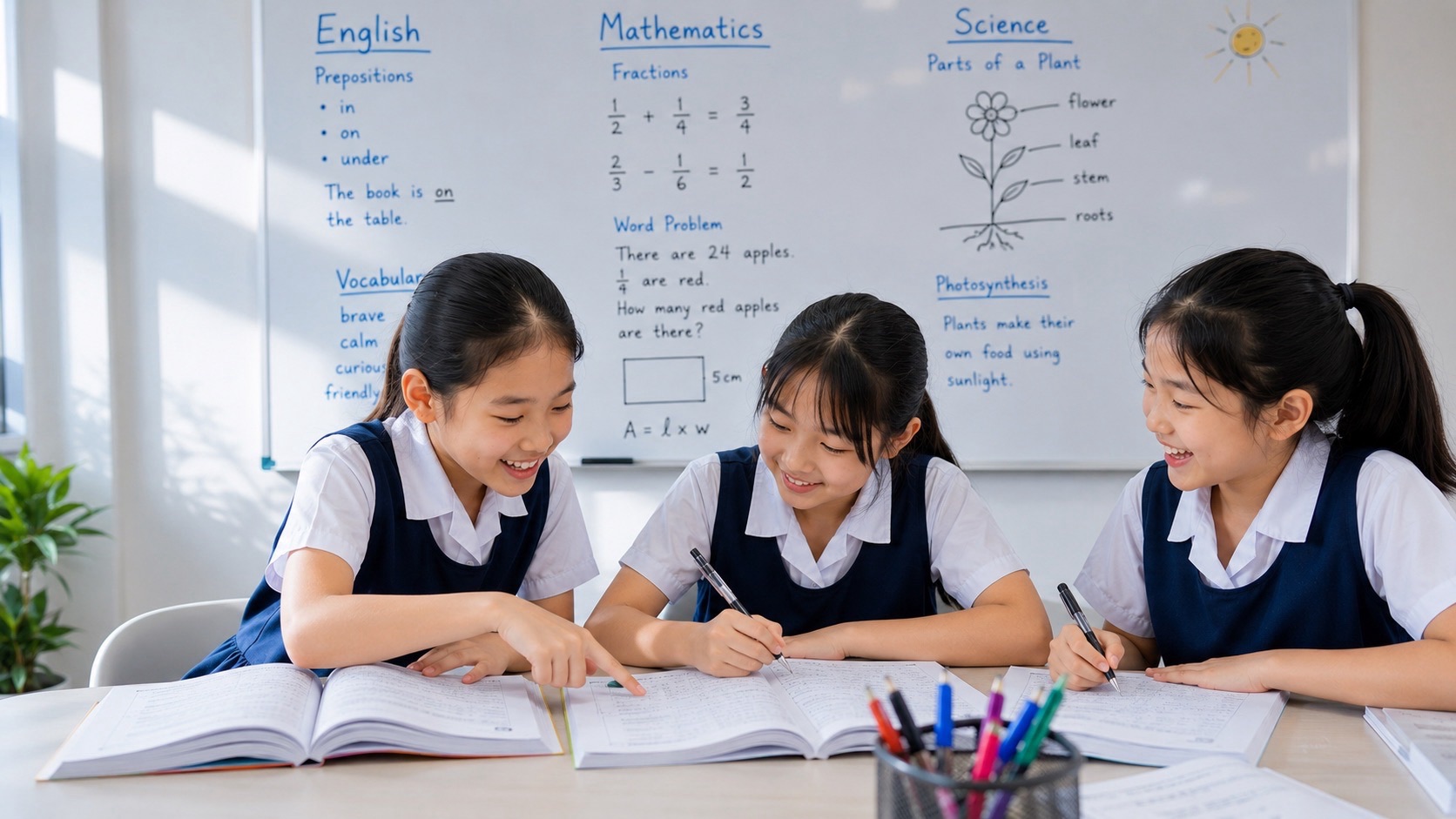
Year 1 Essential Word Pack: 200 words and meanings
Start with these 200 useful words for Year 1 classroom life, reading, listening and everyday communication. Each entry gives one working meaning, a natural phrase and an original example. This independent learning pack is not an official examination word list; school Year and Cambridge Stage labels may differ.
School and examination requirements · Practice and learning guide
1–20: Actions that help a child join a lesson
Use these words with a real action, a picture or a classroom instruction.
| No. | Word and form | Meaning | Natural use and example |
|---|---|---|---|
| 1 | listen verb | To pay attention to a sound or to what someone says. | listen to a question Listen to the question before you choose a picture. |
| 2 | look verb | To direct your eyes towards something so that you can see it. | look at a picture Look at the picture of the rabbit beside the tree. |
| 3 | point verb | To show a place or thing by directing your finger towards it. | point to the door Point to the door that leads into our classroom. |
| 4 | touch verb | To put your hand or another body part against something. | touch the fabric Touch the fabric gently and tell me how it feels. |
| 5 | pick verb | To choose one thing from the things that are available. | pick a card Pick a card and say the animal's name aloud. |
| 6 | put verb | To move something into a particular place or position. | put in a tray Put your finished picture in the tray by my desk. |
| 7 | move verb | To change where someone or something is positioned. | move a chair Move the chair a little closer to the table. |
| 8 | sit verb | To rest your body with your bottom on a seat or surface. | sit on the mat Sit on the mat where you can see the book. |
| 9 | stand verb | To be upright with your body supported by your feet. | stand beside a chair Stand beside your chair when you are ready to begin. |
| 10 | line verb | To arrange people or things in a row, often using up. | line up We line up outside the hall before the doors open. |
| 11 | wait verb | To stay until something happens or someone is ready. | wait for a turn Wait for your turn while your partner uses the glue. |
| 12 | begin verb | To start doing an action or activity. | begin a game We can begin the game when everyone has a card. |
| 13 | finish verb | To complete an activity or the part you are doing. | finish a picture Finish your picture before you put the crayons away. |
| 14 | repeat verb | To say or do something again. | repeat a word Repeat the word slowly so that I can hear it. |
| 15 | match verb | To put things together because they belong together or are alike. | match a word Match the word cat to the picture of a cat. |
| 16 | sort verb | To put things into groups according to a chosen feature. | sort by colour Sort the buttons by colour, with all the blue ones together. |
| 17 | count verb | To find how many things there are by saying numbers in order. | count the blocks Count the blocks once, touching each one as you say its number. |
| 18 | circle verb | To draw a round line around something to mark your choice. | circle the answer Circle the picture that shows a child washing their hands. |
| 19 | colour verb | To add colour to a picture using crayons, pencils or paint. | colour a shape Colour the large square green and leave the small square white. |
| 20 | check verb | To look again to see whether something is right or ready. | check your work Check that your name is on the back of the page. |
21–40: Things that make learning visible
Point to the object before asking the child to read its name.
| No. | Word and form | Meaning | Natural use and example |
|---|---|---|---|
| 21 | page noun | One side of a sheet in a book or notebook. | turn a page Turn the page carefully so that the paper does not tear. |
| 22 | cover noun | The outside part that protects the pages of a book. | a book cover The book cover shows a boat sailing past an island. |
| 23 | picture noun | An image that shows a person, thing, place or idea. | draw a picture I drew a picture of the plant beside our window. |
| 24 | letter noun | A written sign used with other signs to make words. | a capital letter My name begins with the capital letter M on my card. |
| 25 | sound noun | Something that you can hear with your ears. | a beginning sound Listen for the beginning sound in the word sun. |
| 26 | word noun | A unit of language that has meaning when spoken or written. | read a word I can read the word stop on the red sign. |
| 27 | name noun | The word or words used to identify a person or thing. | write your name Write your name so that we know which drawing is yours. |
| 28 | number noun | A word or symbol that shows an amount or position, or identifies something. | a bus number The number on this bus is the same as on our ticket. |
| 29 | mark noun | A line, dot or other visible sign on a surface. | make a mark Make a small mark beside each item you have counted. |
| 30 | label noun | A short piece of writing that tells what something is. | a name label The name label on the drawer tells me where my books go. |
| 31 | list noun | Names or items written one after another. | a shopping list Our shopping list has milk, rice and apples on it. |
| 32 | card noun | A small piece of thick paper used for information or an activity. | a picture card I held up the picture card that showed a yellow bird. |
| 33 | pencil noun | A writing or drawing tool that makes marks which can usually be rubbed out. | a sharp pencil I used a sharp pencil to draw the tiny windows. |
| 34 | crayon noun | A coloured stick used for drawing and colouring. | a wax crayon The wax crayon made a bright orange line on my paper. |
| 35 | ruler noun | A straight tool used to measure or draw straight lines. | use a ruler Use a ruler to draw the straight side of your house. |
| 36 | rubber noun | A small object used to remove pencil marks from paper. | use a rubber I used a rubber to remove the extra pencil line. |
| 37 | glue noun | A sticky substance used to join materials together. | a little glue A little glue holds the paper leaf on the card. |
| 38 | scissors plural noun | A cutting tool with two joined blades and handles. | a pair of scissors An adult gave me a safe pair of scissors for the paper. |
| 39 | desk noun | A table used for reading, writing or other work. | a clear desk We need a clear desk before we spread out the map. |
| 40 | tray noun | A shallow container used to carry or hold several things. | a classroom tray The classroom tray holds our finished paintings while they dry. |
41–60: Finding places and following directions
Move a toy as you say the position word, then change the position.
| No. | Word and form | Meaning | Natural use and example |
|---|---|---|---|
| 41 | on preposition | Resting against and supported by the upper surface of something. | on the table The empty cup is on the table beside the jug. |
| 42 | in preposition | Within a place, space or container. | in the box All the small wooden blocks are in the yellow box. |
| 43 | under preposition | In a position lower than something, often directly beneath it. | under the chair The red ball rolled under the chair near the door. |
| 44 | over preposition | Across something from one side to the other, passing above it. | over the line The child stepped over the line drawn on the playground. |
| 45 | beside preposition | At the side of someone or something. | beside the sink Please put the clean towel beside the sink for later. |
| 46 | behind preposition | At the back of someone or something. | behind the curtain A small toy bear was hiding behind the curtain. |
| 47 | between preposition | In the space that separates two things or people. | between two books My bookmark is between the blue book and the green book. |
| 48 | above preposition | At a higher position than something else. | above the board The classroom clock hangs above the board where everyone can see it. |
| 49 | below preposition | At a lower position than something else. | below the picture Write the animal's name below the picture of its body. |
| 50 | inside preposition | In the inner space of a place or thing. | inside the bag The snack box is inside the bag with the water bottle. |
| 51 | outside preposition | Beyond the outer edge or walls of a place. | outside the classroom Our wet umbrellas are outside the classroom by the door. |
| 52 | left noun | The side direction opposite to right. | on the left With us facing the board, the windows are on the left. |
| 53 | right noun | The side direction opposite to left. | on the right With us facing the board, the classroom door is on the right. |
| 54 | top noun | The highest part or upper end of something. | at the top Put a small star at the top of your page. |
| 55 | bottom noun | The lowest part or lower end of something. | at the bottom The heavy books belong at the bottom of this stack. |
| 56 | front noun | The side or part that faces forwards or comes first. | at the front The driver sits at the front of the bus. |
| 57 | back noun | The rear part of something, opposite its front. | at the back Our coats hang at the back of the classroom. |
| 58 | centre noun | The middle part of a place, shape or object. | in the centre Put one yellow dot in the centre of the circle. |
| 59 | edge noun | The line or narrow area where a surface ends. | near the edge Move the cup away from the edge of the table. |
| 60 | across preposition | From one side of an area to the other side. | across the room A strip of blue paper reaches across the room like a river. |
61–80: Amounts, groups and simple shapes
Use counters, paper shapes and everyday objects to make these meanings concrete.
| No. | Word and form | Meaning | Natural use and example |
|---|---|---|---|
| 61 | all determiner | The complete number or amount of the things being discussed. | all the pieces All the puzzle pieces are now back inside the box. |
| 62 | some determiner | An amount or number without saying exactly how many. | some paper We need some paper for the signs beside our models. |
| 63 | none pronoun | Not one of the people or things being discussed. | none of the cups None of the cups on this tray contains any water. |
| 64 | each determiner | Every individual person or thing considered separately. | each child Each child chose one colour for the group picture. |
| 65 | pair noun | Two things that belong together or are used together. | a pair of socks I found a matching pair of socks in the drawer. |
| 66 | group noun | Several people or things considered together. | a small group A small group of children helped to tidy the reading corner. |
| 67 | more determiner | A larger amount or number than before or than another amount. | more blocks We need more blocks to make the wall reach the corner. |
| 68 | fewer determiner | A smaller number of separate things than another number. | fewer apples This bowl has fewer apples than the bowl beside it. |
| 69 | enough determiner | As much or as many as are needed. | enough chairs We have enough chairs because every child has a seat. |
| 70 | equal adjective | The same in number, amount or value. | equal groups We made two equal groups with four counters in each. |
| 71 | same adjective | Exactly alike in the feature being compared. | the same colour These two cups are the same colour, but one is taller. |
| 72 | different adjective | Not the same in one or more ways. | different shapes The cards show different shapes, including a circle and a triangle. |
| 73 | round adjective | Shaped like a circle or ball, without sharp corners. | a round lid The round lid fits the round opening of the pot. |
| 74 | square adjective | Shaped with four equal straight sides and four right angles. | a square tile I used a square tile as the floor of my model. |
| 75 | flat adjective | Having an even surface rather than one that curves inwards or outwards. | a flat surface Place the board on a flat surface before building your tower. |
| 76 | thick adjective | Having a large distance between opposite surfaces. | thick card The thick card stands upright more easily than the thin paper. |
| 77 | thin adjective | Having a small distance between opposite surfaces. | thin paper The thin paper bends easily when I fold it in half. |
| 78 | whole adjective | Complete, with no part missing or taken away. | a whole apple The picture shows a whole apple beside an apple cut open. |
| 79 | half noun | One of two equal parts of something. | half of a sandwich Half of the sandwich is on my plate; the other half is yours. |
| 80 | part noun | One piece or section of a larger whole. | part of a picture This part of the picture shows the animals beside the pond. |
81–100: Useful things at home and school
Name the object and explain its job in one short sentence.
| No. | Word and form | Meaning | Natural use and example |
|---|---|---|---|
| 81 | cup noun | A small open container used for drinking. | a cup of water I placed a cup of water beside my lunch plate. |
| 82 | spoon noun | A tool with a small bowl and handle for eating or serving. | a soup spoon Use the soup spoon to lift the soup from your bowl. |
| 83 | bowl noun | A deep round dish used to hold food or other things. | a bowl of rice A bowl of rice stood in the centre of the table. |
| 84 | towel noun | A piece of cloth used for drying something. | a clean towel I dried my wet hands on a clean towel. |
| 85 | soap noun | A substance used with water to wash things. | wash with soap We wash our hands with soap before we prepare our snack. |
| 86 | tap noun | A device that controls water coming from a pipe. | turn off the tap Turn off the tap when you have finished using the water. |
| 87 | sink noun | A bowl fixed in place for washing, with a drain. | the kitchen sink The empty cups are beside the kitchen sink, ready to wash. |
| 88 | brush noun | A tool with many bristles used for cleaning or arranging hair. | a washing brush The washing brush helped to clean mud from the boots. |
| 89 | comb noun | A tool with a row of teeth used to arrange hair. | a wide comb I used a wide comb to untangle my doll's hair. |
| 90 | sock noun | A soft piece of clothing worn on the foot inside a shoe. | a missing sock The missing sock was underneath my bed near the wall. |
| 91 | pocket noun | A small space sewn into clothing for carrying things. | a coat pocket My bus card is safe inside the zipped coat pocket. |
| 92 | zip noun | A fastener with two rows of teeth joined by a sliding part. | close a zip I closed the zip on my bag before picking it up. |
| 93 | button noun | A small fastener that passes through a hole to hold clothing closed. | a coat button One coat button came loose, so an adult sewed it back on. |
| 94 | lid noun | A cover that closes the top of a container. | a tight lid The tight lid stops the beads from falling out of the jar. |
| 95 | handle noun | The part of an object designed to be held. | a door handle I held the door handle and gently pulled the door open. |
| 96 | wheel noun | A round part that turns to help something move. | a bicycle wheel The bicycle wheel turned as the child pushed the bike along. |
| 97 | shelf noun | A flat board used to hold or display things. | a low shelf The picture books are on a low shelf that children can reach. |
| 98 | drawer noun | An open-topped container that slides into a piece of furniture. | a desk drawer The spare pencils are inside the desk drawer beside the ruler. |
| 99 | bin noun | A container used for things that are being thrown away. | a rubbish bin I put the used tissue in the rubbish bin. |
| 100 | mat noun | A small piece of material placed on a floor or other surface. | a door mat We wiped the mud from our shoes on the door mat. |
101–120: Noticing plants, animals and the weather
Use these words during reading, a window observation or a supervised walk.
| No. | Word and form | Meaning | Natural use and example |
|---|---|---|---|
| 101 | plant noun | A living thing such as a flower, grass or tree. | a small plant We placed the small plant where it could receive daylight. |
| 102 | seed noun | A part of a plant from which a new plant can grow. | plant a seed We put one seed into the soil in each small pot. |
| 103 | leaf noun | A usually flat part of a plant that grows from a stem. | a green leaf A green leaf grew beside the older leaf on our plant. |
| 104 | stem noun | The main supporting part of a small plant above the ground. | a straight stem The plant has a straight stem with three leaves attached. |
| 105 | flower noun | The part of some plants that makes seeds, often with coloured petals. | a yellow flower We drew the yellow flower without pulling it off the plant. |
| 106 | grass noun | A plant with narrow green leaves, often covering the ground. | a patch of grass A patch of grass grows beside the path to the gate. |
| 107 | tree noun | A large plant with a woody trunk and branches. | a shady tree We rested beneath a shady tree after walking around the park. |
| 108 | soil noun | The loose material on the ground in which many plants grow. | damp soil The damp soil felt cool when we touched a small amount. |
| 109 | stone noun | A small piece of rock. | a smooth stone I found a smooth stone beside the garden path. |
| 110 | sand noun | Very small loose grains of rock often found on beaches. | wet sand The wet sand held its shape when I lifted the bucket. |
| 111 | rain noun | Water that falls from clouds in drops. | heavy rain Heavy rain tapped against the classroom windows during our lesson. |
| 112 | cloud noun | A visible mass of tiny water droplets or ice in the sky. | a grey cloud A grey cloud covered the sun as we walked indoors. |
| 113 | wind noun | Air moving naturally outside. | a strong wind A strong wind pushed the leaves along the school path. |
| 114 | sun noun | The star that gives Earth light and warmth. | the morning sun The morning sun lit the wall beside our classroom window. |
| 115 | sky noun | The space above the ground where clouds and the sun appear. | a clear sky We saw two birds against the clear sky above the playground. |
| 116 | bird noun | An animal with feathers, a beak and two wings. | a small bird A small bird landed on the fence beside the garden. |
| 117 | wing noun | A body part that helps many birds and insects fly. | a bird's wing The picture shows the feathers along the bird's wing. |
| 118 | nest noun | A place made or used by an animal to hold its eggs or young. | a bird's nest We watched the bird's nest from far away without touching it. |
| 119 | insect noun | A small animal with six legs and three main body sections. | a tiny insect We saw a tiny insect walking slowly across the leaf. |
| 120 | pet noun | An animal that a person keeps and cares for as a companion. | a family pet Our family pet has a bowl of water beside its bed. |
121–140: Talking about the body and needs
Practise words that let a child explain a need and ask for help.
| No. | Word and form | Meaning | Natural use and example |
|---|---|---|---|
| 121 | hand noun | The part at the end of an arm with fingers and a thumb. | raise a hand Raise a hand if you would like to ask a question. |
| 122 | finger noun | One of the long movable parts at the end of a hand. | point with a finger I used one finger to point to each word as I read. |
| 123 | thumb noun | The short, thick digit at the side of a hand. | a thumb print My thumb print made a small oval on the paper. |
| 124 | foot noun | The body part at the end of a leg that supports standing. | one foot I balanced on one foot while holding an adult's hand. |
| 125 | knee noun | The joint in the middle of a leg that allows it to bend. | bend a knee I bent one knee as I stepped onto the low platform. |
| 126 | elbow noun | The joint where an arm bends in the middle. | bend an elbow I bent my elbow to bring the cup towards my mouth. |
| 127 | shoulder noun | The body part where an arm joins the upper body. | a bag on a shoulder The strap held the light bag on my shoulder. |
| 128 | head noun | The upper body part that contains the brain, eyes, ears and mouth. | turn your head Turn your head towards the person who is speaking to you. |
| 129 | eye noun | A body part used for seeing. | an eye in a drawing I added one eye to the side view of my bird. |
| 130 | ear noun | A body part used for hearing. | an ear on a toy One ear on the toy rabbit is longer than the other. |
| 131 | nose noun | The part of the face used for smelling and breathing. | a rabbit's nose The rabbit's nose moved as it sniffed near the grass. |
| 132 | mouth noun | The opening in the face used for eating and speaking. | open your mouth Open your mouth a little when you say the sound clearly. |
| 133 | teeth plural noun | The hard parts inside the mouth used for biting and chewing. | brush your teeth I brush my teeth using my own toothbrush at home. |
| 134 | skin noun | The outer covering of a person's or animal's body. | skin on a hand The skin on my hand felt wet after washing. |
| 135 | breath noun | The air taken into or sent out of the lungs. | take a breath I took a breath before saying my sentence to the group. |
| 136 | hungry adjective | Feeling that you need or want to eat. | feel hungry I felt hungry when it was nearly time for lunch. |
| 137 | thirsty adjective | Feeling that you need or want a drink. | feel thirsty I felt thirsty after the game and asked for water. |
| 138 | tired adjective | Feeling that you need rest or sleep. | feel tired The child felt tired after walking a long way. |
| 139 | hurt verb | To feel pain in part of the body. | my foot hurts My foot hurts, so I will tell the adult with me. |
| 140 | rest noun | A period when you stop being active to relax or recover. | have a rest We had a rest on the bench before walking home. |
141–160: Taking care of belongings and daily tasks
Give one useful instruction and let the learner show what it means.
| No. | Word and form | Meaning | Natural use and example |
|---|---|---|---|
| 141 | eat verb | To take food into the mouth, chew it and swallow it. | eat a snack We eat our snack at the table after washing our hands. |
| 142 | drink verb | To take liquid into the mouth and swallow it. | drink some water I drink some water when I come back from playing. |
| 143 | wash verb | To clean something using water, often with soap. | wash a cup We wash the cup after using it for our drink. |
| 144 | dry verb | To remove water or other moisture from something. | dry your hands Dry your hands with the towel beside the sink. |
| 145 | wipe verb | To clean or dry a surface by moving a cloth across it. | wipe the table I wiped the table where a little water had spilled. |
| 146 | wear verb | To have clothing or an accessory on your body. | wear a hat I wear a hat when we go outside in the sunshine. |
| 147 | take verb | To carry something away from a place or towards another place. | take a book home I can take this library book home until next week. |
| 148 | bring verb | To carry something towards the speaker or the place being discussed. | bring your folder Please bring your folder to my desk so I can see it. |
| 149 | give verb | To pass something to another person for them to have or use. | give a card I gave a card to each person playing the game. |
| 150 | receive verb | To get something that someone gives or sends you. | receive a message Our class received a message from the teacher in the next room. |
| 151 | borrow verb | To use something belonging to someone else and return it later. | borrow a ruler May I borrow your ruler and return it after drawing this line? |
| 152 | return verb | To give or take something back to its earlier place or owner. | return a book I returned the book to the shelf after looking at it. |
| 153 | clean verb | To remove dirt or unwanted marks from something. | clean the tray We cleaned the tray after using it for the muddy pots. |
| 154 | tidy verb | To put things into their proper places. | tidy the shelf We tidied the shelf by putting each book back upright. |
| 155 | fold verb | To bend paper or cloth so that one part covers another. | fold a towel Fold the towel once so that it fits on the shelf. |
| 156 | pour verb | To make liquid flow from a container into another place. | pour some water With help, I poured some water from the jug into the cup. |
| 157 | fill verb | To put something into a container until it has the required amount. | fill a bottle Fill the bottle to the line marked near its top. |
| 158 | empty verb | To remove everything from inside a container. | empty a bag Empty your bag onto the table so we can find the missing card. |
| 159 | pack verb | To put things into a bag or container for carrying or storing. | pack a school bag I pack my school bag after checking the list beside it. |
| 160 | unpack verb | To take things out of a bag or other container. | unpack your lunch Unpack your lunch and put the empty bag beneath your chair. |
161–180: Joining in and asking for what you need
Practise polite language without making a child hide discomfort or agree unwillingly.
| No. | Word and form | Meaning | Natural use and example |
|---|---|---|---|
| 161 | please adverb | A word used to make a request more polite. | please help me Please help me open the lid on this container. |
| 162 | thanks interjection | A friendly expression used to show that you appreciate something. | thanks for helping Thanks for helping me find the missing piece of my puzzle. |
| 163 | hello interjection | A greeting used when you meet someone or begin speaking. | say hello I said hello to the new pupil sitting beside me. |
| 164 | goodbye interjection | A word said when people leave or finish a conversation. | say goodbye We said goodbye to our visitors before they left the classroom. |
| 165 | welcome interjection | A greeting that shows pleasure when someone arrives. | welcome to our class Welcome to our class; there is a seat beside me. |
| 166 | sorry adjective | Feeling regret about something you did or sadness about a situation. | feel sorry I felt sorry that I had knocked over your model. |
| 167 | ask verb | To say a question or request to someone. | ask for help I can ask for help when I do not understand the task. |
| 168 | answer verb | To respond to a question with words or another clear response. | answer a question I answered the question by pointing to the correct picture. |
| 169 | tell verb | To give someone information using words. | tell an adult Tell an adult if you cannot find the person collecting you. |
| 170 | show verb | To let someone see something or how something is done. | show your partner Show your partner how you joined the two pieces of paper. |
| 171 | share verb | To let others use or have part of something. | share the crayons We shared the crayons so that both pictures could have blue skies. |
| 172 | join verb | To become part of a group or activity. | join a game I asked whether I could join the game in the playground. |
| 173 | invite verb | To ask someone to come somewhere or take part in something. | invite a friend We invited a friend to sit with us during lunch. |
| 174 | help verb | To make a task or situation easier for someone. | help with a task I helped with the task by carrying the empty trays. |
| 175 | choose verb | To decide which thing or action you want from the available options. | choose a book You can choose a book from the shelf near the window. |
| 176 | agree verb | To have the same opinion or accept a suggested plan. | agree on a game We agreed on a game that both of us wanted to play. |
| 177 | safe adjective | Protected from danger or unlikely to cause harm in that situation. | a safe place An adult helped us choose a safe place to wait. |
| 178 | gentle adjective | Using care and little force so that someone or something is not hurt. | a gentle touch Use a gentle touch when you handle the paper butterfly. |
| 179 | fair adjective | Giving people a reasonable chance and taking their needs into account. | a fair turn Everyone had a fair turn because each child played once. |
| 180 | ready adjective | Prepared to do something or for something to happen. | ready to leave I am ready to leave because my bag and coat are here. |
181–200: Talking about time and what happens next
Connect these words to the child’s actual day rather than asking for definitions alone.
| No. | Word and form | Meaning | Natural use and example |
|---|---|---|---|
| 181 | now adverb | At this present time. | do it now We can put the books away now because reading time has finished. |
| 182 | today adverb | On the day that is happening at present. | read today We read the new picture book today during our class lesson. |
| 183 | tomorrow adverb | On the day after today. | visit tomorrow We will visit the school garden tomorrow if our teacher agrees. |
| 184 | yesterday adverb | On the day before today. | painted yesterday The picture we painted yesterday is dry enough to display. |
| 185 | morning noun | The part of the day before midday. | this morning This morning we counted the leaves on our classroom plant. |
| 186 | afternoon noun | The part of the day after midday and before evening. | this afternoon This afternoon we will put our finished models on the shelf. |
| 187 | evening noun | The later part of the day before night. | in the evening In the evening, I helped to put the cups away. |
| 188 | night noun | The dark part of the day when the sun is below the horizon. | at night The street lights outside our home shine at night. |
| 189 | before preposition | Earlier than a particular time, event or action. | before lunch We put the painting materials away before lunch. |
| 190 | after preposition | Later than a particular time, event or action. | after school I will return the borrowed book after school today. |
| 191 | next adjective | Coming immediately after the present thing in time or order. | the next page The next page shows what happens after the bird leaves its nest. |
| 192 | first adverb | Before all the other actions or events in a sequence. | wash first Wash your hands first, and then sit down for your snack. |
| 193 | last adverb | After all the other actions or people in a sequence. | put it on last Put the lid on last, after all the pieces are inside. |
| 194 | soon adverb | After a short time, without saying exactly when. | coming soon The teacher is coming soon, so we will wait here. |
| 195 | later adverb | At a time after the present time or another mentioned time. | finish later We can finish the picture later when the paint is dry. |
| 196 | again adverb | One more time after something has already happened. | try again I will try again after checking which way the puzzle piece faces. |
| 197 | stop verb | To end an action or movement. | stop at the line Stop at the line and wait for the teacher's next instruction. |
| 198 | start verb | To begin an action or activity. | start a task I can start the task after I understand what to do. |
| 199 | change verb | To make something different or become different. | change your choice You may change your choice before we begin the game. |
| 200 | remember verb | To bring something learned or experienced back into your mind. | remember a name I remembered my partner's name when I saw their name card. |
Choose your next learning step
Start with the task that is useful today. The practice passages and model answers are original teaching examples, not predicted examination questions.
Return to a word group
- 1–20: Actions that help a child join a lesson
- 21–40: Things that make learning visible
- 41–60: Finding places and following directions
- 61–80: Amounts, groups and simple shapes
- 81–100: Useful things at home and school
- 101–120: Noticing plants, animals and the weather
- 121–140: Talking about the body and needs
- 141–160: Taking care of belongings and daily tasks
- 161–180: Joining in and asking for what you need
- 181–200: Talking about time and what happens next
Practise and check your understanding
- What does Year 1 need for school and examinations?
- How to use the pack with an early reader
- The Fencing Method: make one useful addition at a time
- Read or listen: the class planting tray
- Listen, ask and make the instruction clearer
- Small differences that change the message
- Twelve short practice tasks
- Answers and explanations
- A flexible routine for using the words again
- Frequently asked questions
- Sources and companion reading
- Essential Word Packs for other years
What does Year 1 need for school and examinations?
Year 1 is an early learning stage in this collection. It is not a level of the IGCSE examination. The useful aim is a child who can understand a short instruction, name a need, talk about a picture and make a small message that someone else understands. The 200 words are a teaching selection, not an official required list or a test to pass in one sitting.
Cambridge Primary English 0058 brings together reading, writing, speaking and listening. A child therefore needs opportunities to use words in conversation and action as well as on paper. Some schools follow a different English curriculum or an English as a Second Language route. Check the child’s actual programme before matching this pack to a school target.
The Cambridge guidance on stages and ages allows schools to adapt the timing of stages. A school label such as Year 1 does not prove that every pupil is following Cambridge Stage 1. Cambridge’s Primary assessment information places Progression Tests at Stages 3–6 and Checkpoint at the end of Stage 6. Those are later assessment points, not a reason to give an early learner a secondary examination vocabulary drill.
For this pack, look for three observable successes: the child follows an instruction containing a familiar word; explains or shows its meaning; and uses it in another situation. A child who understands under during a toy game but cannot yet read it independently has shown useful understanding. Record the reading need separately.
Contents · Previous section · Next section
How to use the pack with an early reader
Start with a small cluster that solves something in the child’s day. If belongings keep getting lost, choose pocket, drawer, shelf, inside and return. Show each place or action. Say the word, let the child point or act, and then use it in a short spoken message. Five new words may be enough; two may be a better starting point for another child.
Keep meaning, reading and spelling separate
Ask three different questions. Can the child show what the word means? Can they recognise it in print? Can they write it from memory? These are different tasks. A child may understand scissors and use the word accurately long before spelling it independently. Let the adult read unfamiliar entries aloud. Continue the school’s phonics teaching rather than asking the child to memorise the shape of every word.
Read a table row as a miniature lesson. The meaning explains the chosen sense. The natural phrase shows neighbouring words, such as listen to and ask for. The example puts that phrase to work. Do not demand that the child recite the printed definition. “It means I give it back” shows useful understanding of return.
Use a real choice
Place a spoon in a cup and a pencil beside it. Say, “Show me what is in the cup.” Then ask the child to make a different arrangement and give you an instruction. Changing the speaker matters: repeating your sentence alone does not show that the child can choose the position word.
For a child ready to stretch, ask a follow-up that requires precision: “Is the pencil inside the cup, or beside it?” For a child who needs support, offer the two objects and accept pointing before expecting speech. In either case, the same practical meaning remains the target.
Contents · Previous section · Next section
The Fencing Method: make one useful addition at a time
The eduKate Fencing Method develops a secure sentence through controlled additions and a change of context. In Year 1, the child can speak the sentences while an adult writes. The aim is to keep the word meaningful and the message understandable. A longer sentence is not automatically a better one.
A worked fence with borrow
- Safe base: “May I borrow a pencil?” The learner requests temporary use.
- Useful detail: “May I borrow your blue pencil?” Now the listener knows which pencil.
- Tone: “May I please borrow your blue pencil?” The request is polite; the owner may still say no.
- Reason and return: “May I please borrow your blue pencil to colour the sky? I will give it back when I finish.” Two short sentences keep the message manageable.
- New context: “May I borrow this library book to read at home?” The object changes, but temporary use remains the meaning.
Ask what would make borrow unsuitable. If a friend gives a pencil as a present to keep, the child has received a gift, not borrowed it. This small contrast checks meaning more effectively than adding more adjectives to the original request.
A fence that can be acted out
Begin with “Put the card in the tray.” Add one distinguishing detail: “Put the red card in the tray.” Add a helpful purpose: “Put the red card in the tray so that we can find it.” Then move to a new task: “Put the spoon in the drawer.” The child carries out the instruction and explains which word tells the object and which words tell the place.
If the learner loses the message after an addition, return to the shorter version. An adult can model, pause and let the child try. Keep the new context genuinely different; changing only the name of the child provides less evidence of flexible use.
Contents · Previous section · Next section
Read or listen: the class planting tray
An adult may read this original passage aloud. Before starting, show a seed, a pot or a picture if those objects are unfamiliar. The first task is understanding the message; independent decoding can be practised with a shorter sentence afterwards.
Our class put six small pots on a tray. Each pot had soil inside. Noor placed one seed in each pot. Ben made a label for every pot. He wrote a name on each label. The teacher poured a little water into the pots. Then we put the tray on a shelf near the window. One empty pot stayed on the desk. We will use it tomorrow.
Talk before answering
Ask the child to tell you one thing they remember. Accept an accurate short answer such as “There were seeds.” Then return to the passage for more exact information. The adult can point to the relevant sentence without supplying the answer. A child who changes an answer after checking the text is using a valuable checking habit.
- How many pots were on the tray?
- What was inside those pots before the seeds went in?
- What did Ben make?
- Where did the class put the tray?
- Was the extra empty pot on the shelf or on the desk?
- What does tomorrow tell us about using the empty pot?
Answers with a reason
1. Six. The first sentence gives the number. 2. Soil. The second sentence says what each pot contained. 3. Labels. He then wrote names on them; he did not make the pots. 4. On a shelf near the window. Both the shelf and its location are stated. 5. On the desk. The passage separates this pot from the six on the tray. 6. It will be used on the next day. Tomorrow does not tell us a clock time.
For a small transfer, place three objects in front of the learner. Ask for a spoken description using each, inside or empty. Check the actual arrangement: do not praise a complete sentence if the word describes something different from what is there.
Contents · Previous section · Next section
Listen, ask and make the instruction clearer
The two-step tray game
Use a cup, a spoon, a card and a tray. Say, “Put the spoon in the cup. Put the card beside the tray.” Pause between the instructions. The child acts, then describes one completed action. Swap roles so that the child gives an instruction and watches whether the adult understands it.
When the adult deliberately puts the card inside the tray, ask the child to repair the message: “Beside the tray, please.” The correction is a successful use of vocabulary. Avoid making the activity about catching the child out. The shared aim is an arrangement that matches the spoken words.
Teach a useful clarification sentence
Give an unclear instruction: “Put it there.” With two objects and two possible places, the listener lacks information. Model “Which thing?” and “Where should I put it?” A fuller instruction might be “Put the blue card in the tray.” These questions help a learner seek missing information instead of guessing silently.
For a learner who speaks softly, sit nearby and reduce competing noise. For a confident learner, add a genuine choice: “Put one card beside the cup and return the other card to me.” If there are too many actions to remember, shorten the message. Difficulty holding a long sequence in mind is not proof that the child does not know beside.
Express a need plainly
Practise “I am thirsty. May I have some water?” and “My foot hurts. I need help.” These are useful messages, not performances to embellish. Polite language supports everyday cooperation, but a child should not be made to wait for perfect wording before an adult responds to discomfort or a need for help.
Contents · Previous section · Next section
Small differences that change the message
Borrow, give and return
Borrow means temporary use of someone else’s item. Give describes passing something to another person and may need context to show whether it is a gift or temporary handover. Return means taking or giving it back. Act out the sequence with a book. Ask who owns the book before and after the borrowing. Ownership need not change.
Empty can describe or name an action
The list teaches empty as an action: “Empty the bag.” In “The bag is empty,” it describes the bag. Show both by taking out the objects and then looking inside. The child need not memorise the terms verb and adjective yet, but hearing the two sentence patterns helps prevent “I empty bag is.”
Enough depends on the job
Three chairs are enough for three children to sit at once. The same three chairs are not enough for four children to sit at once. The number has not changed; the need has. Ask “Enough for what?” before deciding. This is a useful bridge between vocabulary and a small counting task.
Hand, hands; foot, feet
One hand becomes two hands, but one foot becomes two feet. One tooth becomes many teeth. Use real movements and a picture to practise these forms in a sentence: “Both feet are on the mat.” Correct one form gently and let the learner use it again. Do not turn every conversation into a spelling test.
Left and right need a viewpoint
Stand beside the child and face the same way when introducing these directions. Your left and the child’s left then point the same way. If you face each other, that relationship changes. A mistaken response may come from the viewpoint rather than a missing word meaning. Position words become clearer when the speaker and listener agree where they are facing.
Contents · Previous section · Next section
Twelve short practice tasks
Choose a few tasks at a time. Read the sentences aloud when necessary. For Tasks 1–8, the information gives a clear answer. Tasks 9–12 allow different sensible responses.
- The pencil is touching the upper surface of the desk. Is it on or under the desk?
- A cup contains no water and nothing else. Complete the sentence: “The cup is ___.”
- You want to use a friend’s ruler and give it back. Would you ask to borrow it or to keep it?
- There are four children and four chairs, one for each child. Are there enough chairs for everyone to sit at once?
- Your teacher says, “Circle the bird.” Should you draw a line around the bird or colour its whole body?
- A box has two red cards and three blue cards. Which colour has fewer cards?
- You read a book on the day before today. Did you read it yesterday or tomorrow?
- Choose the correct form: “My two foot / feet are on the mat.”
- Give a partner an instruction using beside. Use two objects that are actually in front of you.
- Ask to borrow one classroom item. Include what you will do when you finish.
- An adult says, “Put it there,” but you do not know the object or place. Ask a useful question.
- Use return in a new situation involving an item from home or school.
Contents · Previous section · Next section
Answers and explanations
- On. The surface is supporting the pencil. Under would put it in a lower position.
- Empty. In this sentence the word describes a cup with nothing inside.
- Borrow. The promise to give the ruler back makes temporary use clear. Keeping it would be a different request.
- Yes. Each of the four children can use one of the four chairs. The answer depends on both numbers.
- Draw a line around the bird. Circle is the action in this instruction. Colour would ask for a different action.
- Red. Two is a smaller number than three, so there are fewer red cards.
- Yesterday. It names the day before today. Tomorrow names the day after today.
- Feet. The plural of foot changes its spelling instead of simply adding s.
- Possible answer: “Put the spoon beside the cup.” Check that the partner places it at the side of the cup, not inside.
- Possible answer: “May I borrow your rubber? I will give it back when I finish.” A different item and polite wording are acceptable.
- Possible answers: “Which thing should I put away?” or “Where should it go?” Either identifies missing information; asking both resolves both gaps.
- Possible answer: “I will return the library book tomorrow.” Check that the item goes back to an earlier place or its owner.
Give feedback on the part that matters. “You chose borrow because you will give it back” explains success. If the child chooses the wrong position word, move the object and model the contrast. A mark alone does not tell the child which meaning needs repair.
Contents · Previous section · Next section
A flexible routine for using the words again
Use a short cycle that fits the child, rather than a race through 200 entries. On the first day, choose three to five useful words and act them out. On the next occasion, show an object or situation and let the child supply the word without first hearing it. Later in the week, use one of the words during a different activity. Reduce the number when the meanings are still uncertain.
A simple record has three notes: understands with an object, uses in a message, and recognises in print. These are teacher or parent observations, not official assessment grades. Write a helpful next step such as “Use between with new objects.” Avoid a global label such as “weak vocabulary” when the actual difficulty is one relationship.
Support route
Use objects, pictures, gestures and the child’s other languages to establish meaning. Accept a response by pointing, then model a short English phrase. Revisit words during routines already happening, such as packing a bag. If the child knows the object in another language, that knowledge is a starting point for learning its English name.
Stretch route
Ask the learner to teach one word through a game, spot an unclear instruction or explain why an example does not fit. “Borrow the biscuit and eat it” is a useful mismatch: once eaten, the same biscuit cannot be returned. The challenge is explaining the meaning, not collecting an unusually difficult word.
The Cambridge Primary English guide illustrates speaking before writing in early progression. Use that idea practically: rehearse a useful sentence, write one manageable version, and read it back to see whether the message still makes sense.
Contents · Previous section · Next section
Frequently asked questions
Does my child have to master all 200 words before moving on?
No. The list is a bank to choose from. Start with words that matter in the child’s reading, play and classroom routines. Revisit familiar words in new situations instead of making every session introduce something new.
Why are ordinary words such as put and each included?
They carry important instructions and relationships. A child may know the names of many objects but misunderstand which object to move or whether every pot needs a seed. Useful vocabulary includes these small, powerful words.
Should Year 1 children write an essay with the words?
No. A spoken instruction, a caption, a label or a short message can be an appropriate product. This pack builds language for participation and understanding. Formal examination essays belong to a later phase of learning.
What if my child cannot read a long definition?
The adult can read it, demonstrate the meaning and simplify the explanation orally. Ask the child to use or show the word, rather than decode a sentence that is currently too difficult. Keep independent reading tasks at a manageable level.
Do correct spoken answers count if spelling is still developing?
They show useful spoken understanding. Record that success and teach the spelling separately through the school’s approach. Do not erase evidence of meaning simply because a word such as scissors is difficult to spell.
Will learning this pack guarantee high examination grades later?
No word list can guarantee a grade. Accurate, flexible word use supports later learning, while reading, subject knowledge, reasoning and many other skills also develop. At this stage, the immediate goal is a child who can understand and communicate more clearly.
Contents · Previous section · Next section
Sources and companion reading
The word selection, meanings, sentences, passages and activities are independent eduKate teaching material. The sources below support the examination context and specific learning guidance; they do not prescribe this 200-word sequence or guarantee an outcome.
- Cambridge Primary English 0058 — Official curriculum overview and language skills.
- Cambridge Primary assessment — Optional Progression Tests and Primary Checkpoint stages.
- A guide to Cambridge Primary English — Examples of progression in reading, writing and classroom communication.
- Cambridge Primary stages and starting ages — Why school Year and Cambridge Stage should be checked locally.
- The eduKate Fencing Method for Vocabulary — The controlled sentence-expansion approach used in original activities here.
For extended composition and essay practice, continue with the Year 1 Words for Essay Writing guide. For the broader collection that inspired this format, see 200 vocabulary words for a 12-year-old.
Explore the Years 1–13 Essential Word Packs
Choose the closest learning stage, then adapt the pace to the learner. Years 1–9 build foundations, Years 10–11 support the usual IGCSE stage, and Years 12–13 continue into pre-university learning. School structures differ.
- Year 1: this Essential Word Pack
- Year 2 Essential Word Pack
- Year 3 Essential Word Pack
- Year 4 Essential Word Pack
- Year 5 Essential Word Pack
- Year 6 Essential Word Pack
- Year 7 Essential Word Pack
- Year 8 Essential Word Pack
- Year 9 Essential Word Pack
- Year 10 Essential Word Pack
- Year 11 Essential Word Pack
- Year 12 Essential Word Pack
- Year 13 Essential Word Pack