
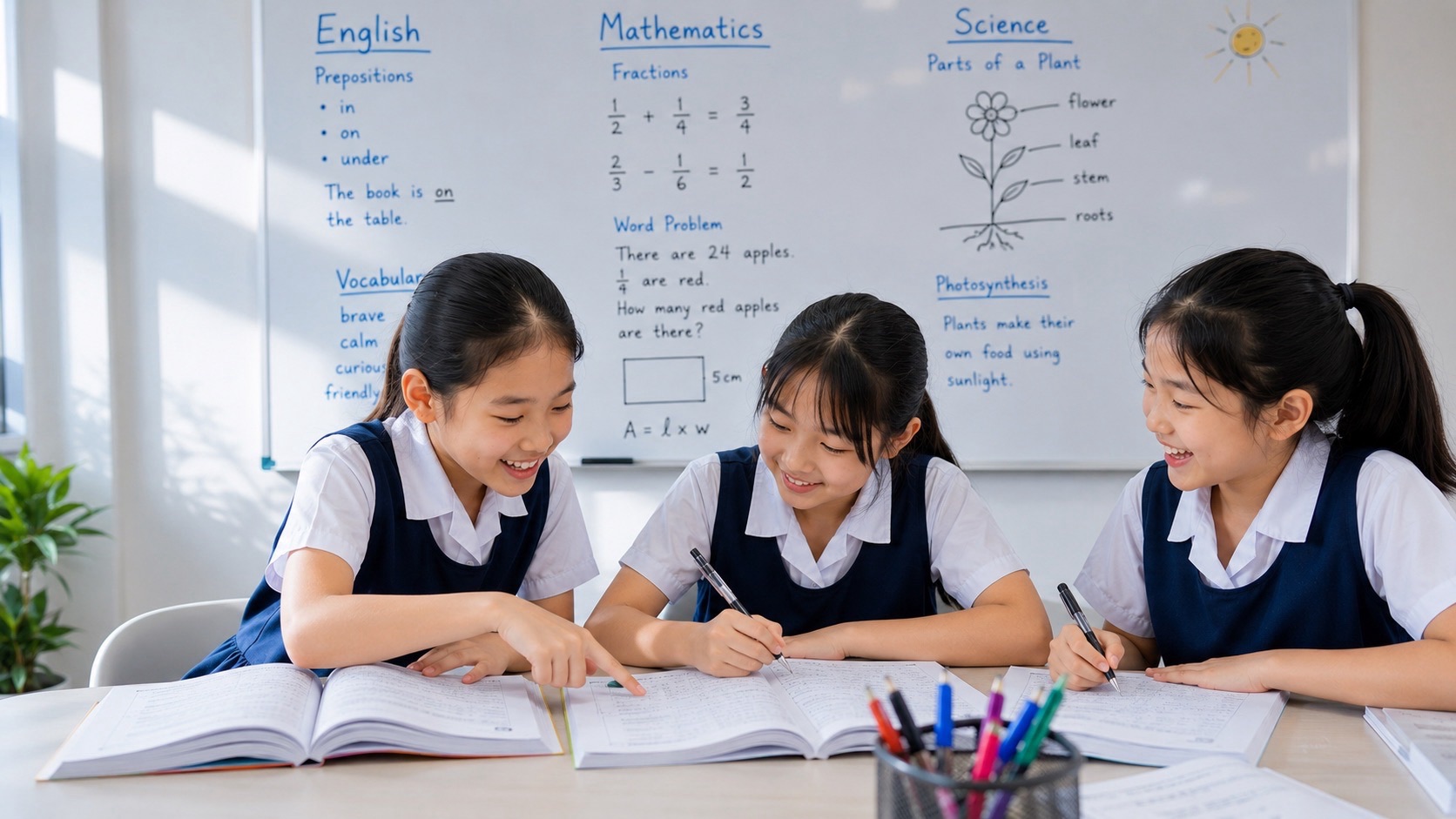
Year 3 Essential Word Pack: 200 words and meanings
Start with 200 useful Year 3 words for instructions, reading, observations, discussion and learning across subjects. Each entry explains one sense with a natural phrase and original example. This independent teaching pack is not an examination word list; match it to the learner’s actual school stage.
School and examination requirements · Practice and learning guide
1–20: Understanding the task and choosing an approach
The action word tells you what kind of response is needed.
| No. | Word and form | Meaning | Natural use and example |
|---|---|---|---|
| 1 | identify verb | To recognise something and say or show what it is. | identify a feature Identify the feature on the map that represents the railway station. |
| 2 | distinguish verb | To recognise or explain how one thing differs from another. | distinguish two materials We distinguished the two materials by looking through them towards the light. |
| 3 | classify verb | To place things into groups using a stated rule or feature. | classify by material Classify the objects by material, with wooden objects in one group. |
| 4 | organise verb | To arrange things or activities so that they can be used effectively. | organise information We organised the information under headings for food, shelter and movement. |
| 5 | record verb | To keep information in writing, pictures, sound or another lasting form. | record a measurement Record the measurement immediately so that you do not have to remember it. |
| 6 | observe verb | To watch or examine something carefully to find out about it. | observe a change We observed the water level each afternoon and noted any change. |
| 7 | investigate verb | To examine a question or problem carefully to find out more. | investigate a question Our group investigated which of the supplied materials absorbed the most water. |
| 8 | predict verb | To say what you think will happen, using available information. | predict a result I predicted a shorter journey because the new route had fewer stops. |
| 9 | infer verb | To work out something that is not directly stated by using clues. | infer a feeling We inferred that the character was worried from the repeated checking of the clock. |
| 10 | explain verb | To make an idea, action or event clear by giving reasons or details. | explain a process Explain how you sorted the objects so another group can repeat it. |
| 11 | summarise verb | To give the main points without including every detail. | summarise a message I summarised the message by naming the new place and meeting time. |
| 12 | describe verb | To give information about the features or qualities of something. | describe a surface Describe the surface you can feel without guessing what the object is. |
| 13 | compare verb | To examine two or more things for similarities and differences. | compare two methods We compared the two methods by counting their steps and checking the results. |
| 14 | contrast verb | To focus on the differences between things. | contrast two settings Contrast the two settings by describing how busy each place is. |
| 15 | calculate verb | To find an answer by using numbers and mathematical operations. | calculate a total Calculate the total cost of the two notebooks using the stated prices. |
| 16 | locate verb | To find the position of someone or something. | locate a place Locate the museum on the map before planning the walking route. |
| 17 | trace verb | To follow the course, development or outline of something carefully. | trace a route Trace the route from the source of the river to the coast. |
| 18 | outline verb | To give the main parts of a plan or idea briefly. | outline a plan Outline your plan before collecting the materials for the model. |
| 19 | review verb | To look back over something to assess it or check understanding. | review the instructions Review the instructions before deciding which part of the model needs changing. |
| 20 | revise verb | To change work after reviewing it in order to improve it. | revise a message I revised the message because the original version did not name the room. |
21–40: Finding information in a text
Choose the feature that helps answer the question you actually have.
| No. | Word and form | Meaning | Natural use and example |
|---|---|---|---|
| 21 | contents plural noun | A list near the start of a book showing sections and page numbers. | the contents page The contents page shows where the chapter about habitats begins. |
| 22 | index noun | An alphabetical list of subjects and the pages where they are mentioned. | use the index Use the index to find every page that mentions otters. |
| 23 | glossary noun | A list explaining particular words used in a text or subject. | a subject glossary The subject glossary explains the meaning of erosion near the end of the book. |
| 24 | diagram noun | A simplified drawing that explains parts or relationships. | a labelled diagram The labelled diagram shows where the roots join the stem. |
| 25 | illustration noun | A picture included to explain or decorate a text. | a page illustration The page illustration helps us imagine the street described in the story. |
| 26 | chart noun | A display that organises information so patterns or comparisons can be seen. | a weather chart Our weather chart shows which days had rain during the week. |
| 27 | table noun | Information arranged in rows and columns. | a results table The results table lists each material beside the amount of water it absorbed. |
| 28 | column noun | A vertical set of entries in a table or arrangement. | the first column The first column contains the names of the objects we measured. |
| 29 | row noun | A horizontal line of entries in a table or arrangement. | the second row The second row gives all the measurements for the blue container. |
| 30 | paragraph noun | A group of related sentences separated from other groups in a text. | a short paragraph The short paragraph explains why the class changed its meeting place. |
| 31 | section noun | A distinct part of a larger text, object or place. | the final section The final section gives instructions for returning the borrowed materials. |
| 32 | chapter noun | One of the main divisions of a book. | a new chapter A new chapter begins when the family arrives at the next village. |
| 33 | keyword noun | A word that is especially useful for finding or understanding information. | choose a keyword Choose a keyword such as habitat when looking for the animal's natural home. |
| 34 | definition noun | An explanation of what a word or expression means. | a clear definition A clear definition of waterproof tells us that water does not pass through it. |
| 35 | example noun | A particular case used to show what a general idea means. | give an example Give an example of a reusable object that you have used this week. |
| 36 | detail noun | A small specific piece of information within a larger account. | a useful detail The useful detail tells us that the entrance is beside the library. |
| 37 | topic noun | The subject being discussed, studied or written about. | a lesson topic Our lesson topic is how different materials behave when they become wet. |
| 38 | fact noun | Something that is true and can be checked using suitable evidence. | check a fact We checked the fact about the museum's location against its printed map. |
| 39 | opinion noun | A person's view or judgement, which may differ from another person's. | support an opinion I supported my opinion about the book by describing a scene I enjoyed. |
| 40 | source noun | The place, person or material from which information comes. | name a source Name the source of the fact so another reader can check it. |
41–60: Explaining an investigation accurately
Use the chosen scientific sense rather than an everyday meaning that changes the explanation.
| No. | Word and form | Meaning | Natural use and example |
|---|---|---|---|
| 41 | experiment noun | A planned test used to investigate a question or idea. | a simple experiment The simple experiment compared how far the same toy car travelled on two surfaces. |
| 42 | method noun | An ordered way of doing a task or investigation. | follow a method Follow the method so that each group uses the materials in the same way. |
| 43 | equipment noun | The tools or other items needed for an activity. | check the equipment Check the equipment list before starting the classroom investigation. |
| 44 | sample noun | A small part chosen to examine or represent a larger amount. | a soil sample We examined a soil sample from one marked area of the garden. |
| 45 | result noun | What happens or is found after an action, test or event. | record a result Record the result even when it differs from your prediction. |
| 46 | evidence noun | Information that helps support or question an explanation or claim. | use the evidence Use the evidence from the measurements when explaining which tower is taller. |
| 47 | variable noun | A feature or quantity that can change in an investigation. | change one variable The surface was the variable we changed while using the same toy car. |
| 48 | surface noun | The outside or upper layer of something. | a smooth surface The smooth surface felt different from the rough card beside it. |
| 49 | texture noun | The way a surface feels or looks, such as smooth or rough. | describe a texture Describe the texture of the cloth using words that match what you notice. |
| 50 | transparent adjective | Allowing light through so that objects behind can be seen clearly. | a transparent sheet We could read the label through the transparent sheet. |
| 51 | opaque adjective | Not allowing light to pass through. | an opaque card The opaque card blocked our view of the picture behind it. |
| 52 | flexible adjective | Able to bend without breaking easily. | a flexible strip The flexible strip bent around the curved edge of the model. |
| 53 | rigid adjective | Stiff and not easily bent or changed in shape. | a rigid frame The rigid frame kept the model upright when we moved it. |
| 54 | waterproof adjective | Preventing water from passing through under the conditions it is designed for. | a waterproof cover The waterproof cover kept the paper dry during our brief water test. |
| 55 | magnetic adjective | Attracted by a magnet in the sense used in this classroom test. | a magnetic object The iron paperclip was a magnetic object and moved towards the magnet. |
| 56 | dissolve verb | To mix into a liquid to form a solution, without remaining as separate visible pieces. | dissolve in water A small amount of sugar dissolved in the water when we stirred it. |
| 57 | evaporate verb | To change from liquid into gas at the liquid's surface. | water can evaporate Some water evaporated from the open dish while it stood in the room. |
| 58 | condense verb | To change from a gas into a liquid. | water vapour can condense Water vapour condensed into droplets on the outside of the cold glass. |
| 59 | force noun | A push or pull that can change movement or shape. | apply a force We applied a small force to move the toy car forwards. |
| 60 | friction noun | A force that resists surfaces sliding or trying to slide over each other. | friction between surfaces Friction between the block and the table made the block harder to slide. |
61–80: Living things and caring for environments
Connect a word to a specific organism, place or action rather than a vague environmental slogan.
| No. | Word and form | Meaning | Natural use and example |
|---|---|---|---|
| 61 | organism noun | An individual living thing, such as a plant, animal or fungus. | a living organism The tiny plant is a living organism even though it does not walk. |
| 62 | habitat noun | The natural place where an organism lives. | a suitable habitat The pond provides a suitable habitat for the animals described in our book. |
| 63 | shelter noun | Protection from weather or danger, or a place providing that protection. | find shelter The story's animals found shelter beneath the thick roots during the storm. |
| 64 | predator noun | An animal that hunts and eats other animals. | a hunting predator The owl is a predator that hunts small animals for food. |
| 65 | prey noun | An animal hunted and eaten by another animal. | catch prey The photograph shows a bird carrying the prey it has caught. |
| 66 | pollinate verb | To transfer pollen to a plant's female reproductive part, allowing fertilisation to become possible. | pollinate a flower A bee can pollinate a flower when it carries pollen onto the stigma. |
| 67 | germinate verb | To begin growing from a seed, in the sense used here. | seeds germinate We watched the seeds germinate and recorded when the first roots appeared. |
| 68 | decay verb | To break down naturally through processes that include the action of living organisms. | leaves decay Fallen leaves decay over time instead of remaining unchanged on the ground. |
| 69 | compost noun | Decayed organic material used to improve soil. | add compost The gardener added compost to the soil before planting the seedlings. |
| 70 | recycle verb | To process used materials so they can become materials for new products. | recycle paper The project explains how a factory can recycle paper into new paper products. |
| 71 | reuse verb | To use an item again instead of discarding it after one use. | reuse a container We reused the clean container to hold our collection of buttons. |
| 72 | litter noun | Rubbish left in a place where it does not belong. | collect litter The supervised group collected litter from the safe area beside the path. |
| 73 | pollution noun | Harmful substances or other harmful changes introduced into the environment. | water pollution The information page describes water pollution caused by waste entering a stream. |
| 74 | conserve verb | To protect something from loss or avoid using more of it than necessary. | conserve water The class discussed how to conserve water during its daily routines. |
| 75 | resource noun | Something available that can be used to meet a need or complete a task. | a shared resource The library is a shared resource that provides books for many pupils. |
| 76 | drought noun | A prolonged period with much less rainfall than usual for a place. | a long drought The account describes a long drought during which the stream became very shallow. |
| 77 | flood noun | Water covering land that is normally dry. | a river flood The map marks the areas covered by the river flood. |
| 78 | soil noun | The mixture of minerals, organic material, water and air in which many plants grow. | examine soil We examined the soil and noticed small stones and pieces of old leaves. |
| 79 | erosion noun | The removal and movement of rock or soil by processes such as water, wind or gravity. | soil erosion The model shows soil erosion when flowing water carries loose soil downhill. |
| 80 | vegetation noun | The plants growing in a particular place. | thick vegetation Thick vegetation covered the hillside shown in the photograph. |
81–100: Places and community life
Use these words to read maps, describe places and understand local services.
| No. | Word and form | Meaning | Natural use and example |
|---|---|---|---|
| 81 | neighbourhood noun | The area around a person's home and the people living there. | a local neighbourhood Our local neighbourhood has a park, a library and several shops. |
| 82 | district noun | An area of a town or country identified for a particular purpose. | a named district The map divides the city into districts with different names. |
| 83 | region noun | A large area identified by location or shared features. | a coastal region The coastal region includes several towns beside the sea. |
| 84 | boundary noun | A real or imagined line separating areas. | a school boundary The fence marks the school boundary beside the public path. |
| 85 | coast noun | The land next to the sea. | near the coast The town is near the coast, so the map shows the sea beside it. |
| 86 | island noun | An area of land surrounded by water. | a small island The boat travelled around the small island in the lake. |
| 87 | valley noun | A low area of land between hills or mountains. | a river valley The river valley contains fields and a narrow road beside the water. |
| 88 | slope noun | A surface or piece of land that rises or falls at an angle. | a gentle slope The path follows a gentle slope towards the lower field. |
| 89 | plain noun | A large area of flat or gently rolling land. | an open plain The picture shows an open plain stretching towards distant hills. |
| 90 | summit noun | The highest point of a hill or mountain. | reach the summit The account describes the walkers reaching the summit before returning. |
| 91 | inland adverb | Away from the coast and towards the interior of the land. | travel inland The family travelled inland after spending two days beside the sea. |
| 92 | rural adjective | Connected with the countryside rather than towns and cities. | a rural area The photograph shows a rural area with fields around a village. |
| 93 | urban adjective | Connected with a town or city. | an urban area The urban area has many closely spaced buildings and busy roads. |
| 94 | transport noun | Ways of moving people or goods from one place to another. | public transport The information leaflet explains which public transport reaches the museum. |
| 95 | pedestrian noun | A person travelling on foot, especially beside or across roads. | a pedestrian A pedestrian followed the path through the park towards the station. |
| 96 | resident noun | A person who lives in a particular place. | a local resident A local resident explained how the old playground had changed. |
| 97 | facility noun | A place, building or piece of equipment provided for a particular use. | a sports facility The sports facility includes a swimming pool and indoor courts. |
| 98 | service noun | Work or help provided for people or a community. | a library service The library service allows residents to borrow books and use reading spaces. |
| 99 | council noun | A group of people chosen to discuss or make decisions for an organisation or area. | a student council The student council asked pupils for ideas about the shared reading area. |
| 100 | community noun | A group of people connected by a place, interest or shared life. | a school community The school community worked together to prepare the open day. |
101–120: Quantities, measurements and useful data
Name the quantity and unit before making a comparison.
| No. | Word and form | Meaning | Natural use and example |
|---|---|---|---|
| 101 | quantity noun | An amount or number of something. | a measured quantity We used a measured quantity of water in each container. |
| 102 | value noun | The numerical worth or amount represented by a number or symbol. | place value The digit five has a value of fifty in the number fifty-two. |
| 103 | digit noun | One of the symbols used to write numbers. | a single digit The number forty-seven is written using the digits four and seven. |
| 104 | fraction noun | A number representing a part of a whole or a division of quantities. | a fraction of a whole Each equal piece of the divided paper represents a fraction of the whole. |
| 105 | quarter noun | One of four equal parts of a whole. | a quarter of a shape A quarter of the square is shaded, leaving three equal parts unshaded. |
| 106 | third noun | One of three equal parts of a whole. | a third of the cards A third of the twelve cards means four cards in this set. |
| 107 | decimal noun | A number written using place value with a decimal point when needed. | write a decimal We wrote one and a half as the decimal 1.5. |
| 108 | scale noun | A sequence of marks showing measurement units on a tool or display. | read a scale Read the scale on the measuring jug before recording the amount. |
| 109 | interval noun | The difference or space between neighbouring points, marks or events. | equal intervals The number line has equal intervals of two between its marked numbers. |
| 110 | capacity noun | The maximum amount a container can hold. | a bottle's capacity The bottle's capacity is one litre, even when it is only half full. |
| 111 | volume noun | The amount of three-dimensional space occupied by something. | the volume of a block We compared the volume of the blocks by counting equal cubes. |
| 112 | mass noun | The amount of matter in an object. | measure mass We measured the mass of the parcel in grams using a balance. |
| 113 | area noun | The amount of surface inside a boundary, measured in square units. | the area of a rectangle We found the area of the rectangle by counting the square tiles covering it. |
| 114 | perimeter noun | The total distance around the outside boundary of a shape. | find the perimeter Find the perimeter by adding the lengths of all the outer sides. |
| 115 | average noun | Here, the mean: the total of the values divided by how many values there are. | calculate the average The average of six, eight and ten is eight. |
| 116 | difference noun | The amount by which one number or quantity is greater or smaller than another. | find the difference The difference between twelve and seven is five. |
| 117 | increase noun | A change that makes an amount, number or level greater. | an increase in height There was an increase in height from ten to twelve centimetres. |
| 118 | decrease noun | A change that makes an amount, number or level smaller. | a decrease in volume The decrease in water volume was ten millilitres during the observation period. |
| 119 | balance noun | A tool used to compare or measure mass. | use a balance We used a balance to compare the masses of the two parcels. |
| 120 | proportion noun | A part considered in relation to the whole amount or group. | a larger proportion Six of eight cards is a larger proportion than two of eight cards. |
121–140: Time, history and change
Keep the date or context clear when using words about the past.
| No. | Word and form | Meaning | Natural use and example |
|---|---|---|---|
| 121 | period noun | A length of time with a particular beginning and end or shared feature. | a short period We observed the plant over a short period of five school days. |
| 122 | decade noun | A period of ten years. | a decade later The timeline shows a new bridge opening a decade later. |
| 123 | century noun | A period of one hundred years. | over a century The museum display describes changes that happened over a century. |
| 124 | ancient adjective | Belonging to a very long time ago, especially an early historical period. | an ancient settlement The information board describes an ancient settlement near the river. |
| 125 | modern adjective | Connected with the present or relatively recent times. | a modern building A modern building stands beside the older station in the photograph. |
| 126 | past noun | The time before the present. | learn about the past Old photographs help the class learn about the past. |
| 127 | present noun | The time happening now. | the past and present We compared pictures of the street in the past and the present. |
| 128 | future noun | The time that has not happened yet. | plan for the future The council display asks residents to suggest ideas for the future. |
| 129 | timeline noun | A display that places events in time order. | draw a timeline Draw a timeline to show when the three school buildings opened. |
| 130 | chronological adjective | Arranged in the order in which events happened. | chronological order We put the dated photographs into chronological order, starting with the oldest. |
| 131 | generation noun | People born and living at about the same period of time. | an older generation An older generation of residents remembered the street before the new station. |
| 132 | ancestor noun | A person in your family from an earlier generation, such as a grandparent or someone further back. | a family ancestor The family record names an ancestor who lived in the village long ago. |
| 133 | tradition noun | A belief or activity passed from people in one generation to later generations. | a family tradition The family tradition is to share a particular meal at the annual gathering. |
| 134 | custom noun | A usual way of behaving within a particular group or society. | a local custom The guide explains a local custom that visitors should understand. |
| 135 | artefact noun | An object made or used by people, often studied to learn about the past. | a museum artefact The museum artefact is a clay pot used for storing food. |
| 136 | archive noun | A collection of records kept because they may be useful or important. | a school archive The school archive contains old photographs, letters and attendance records. |
| 137 | origin noun | The place, time or situation in which something begins. | the origin of a name We used an old map to investigate the origin of the street's name. |
| 138 | develop verb | To grow or change over time, often becoming more complex or advanced. | develop a skill We developed the skill of reading a map through several different activities. |
| 139 | invent verb | To create a new device, method or idea. | invent a game Our group invented a game using cards and a simple set of rules. |
| 140 | discover verb | To find or learn something that was previously unknown to the person finding it. | discover a detail I discovered a detail about the old bridge in the museum display. |
141–160: Communication that makes shared work possible
Use an exact request, a clear response and a reason when it helps.
| No. | Word and form | Meaning | Natural use and example |
|---|---|---|---|
| 141 | clarify verb | To make something clearer or easier to understand. | clarify an instruction Please clarify which table the finished models should go on. |
| 142 | respond verb | To answer or react to something said or done. | respond to a question I responded to the question by pointing to the relevant row. |
| 143 | mention verb | To refer briefly to something without giving a long explanation. | mention a change The message mentioned a change to the afternoon meeting place. |
| 144 | refer verb | To direct attention to someone, something or a source of information. | refer to a diagram Refer to the diagram when explaining where the water flows. |
| 145 | consult verb | To seek information or advice from a person or source. | consult a map We consulted a map before choosing the shortest marked route. |
| 146 | enquire verb | To ask for information. | enquire about a visit We enquired about the visit time at the information desk. |
| 147 | inform verb | To give someone information that they need or should know. | inform the teacher Inform the teacher if the instructions do not match the materials provided. |
| 148 | notify verb | To tell someone officially or clearly about an event or change. | notify the group The organiser notified the group that the meeting had moved indoors. |
| 149 | persuade verb | To get someone to believe or do something by giving reasons. | persuade with reasons I tried to persuade the group to reuse the boxes by explaining their usefulness. |
| 150 | recommend verb | To suggest something as a suitable choice based on reasons. | recommend a book Recommend a book by explaining who might enjoy it and why. |
| 151 | demonstrate verb | To show clearly how something is done or how it works. | demonstrate a method The teacher demonstrated the method before we tried it ourselves. |
| 152 | report verb | To give an account of something observed, learned or completed. | report a result Report the result accurately, even if it was not what you expected. |
| 153 | interview noun | A planned conversation in which someone asks questions to learn information. | conduct an interview We conducted an interview with the librarian about how books are organised. |
| 154 | audience noun | The people who listen to, watch or read a message or performance. | know your audience Our audience is the younger class, so we explain unfamiliar words simply. |
| 155 | permission noun | Approval from someone who has authority to allow an action. | obtain permission We obtained permission before moving the display into the hallway. |
| 156 | consent noun | Agreement to something that affects you or involves your participation. | ask for consent We asked for consent before including a pupil's drawing in the display. |
| 157 | agreement noun | A shared decision or understanding between people. | reach an agreement We reached an agreement about who would collect each set of materials. |
| 158 | disagreement noun | A situation in which people hold different views or choices. | discuss a disagreement We discussed the disagreement before deciding which route met our needs. |
| 159 | compromise noun | An agreement in which people adjust some of their wishes to find an acceptable solution. | find a compromise Our compromise gave each group part of the display space. |
| 160 | feedback noun | Information about work or performance that can help someone improve. | use feedback I used the feedback to add the missing meeting time to my message. |
161–180: Working independently and with others
Describe a behaviour or feeling through the situation that supports it.
| No. | Word and form | Meaning | Natural use and example |
|---|---|---|---|
| 161 | reliable adjective | Able to be depended on to do what is expected or provide trustworthy information. | a reliable helper The reliable helper returned the materials at the agreed time each day. |
| 162 | responsible adjective | Expected to look after a task, person or thing properly. | responsible for a task Our group is responsible for checking that the display labels are attached. |
| 163 | independent adjective | Able to do something without needing another person to direct every step. | an independent attempt The child made an independent attempt before asking for help with one instruction. |
| 164 | cooperative adjective | Willing to work with others towards a shared purpose. | a cooperative group The cooperative group shared the equipment and listened to different suggestions. |
| 165 | considerate adjective | Thinking about other people's needs and feelings when choosing an action. | a considerate choice Leaving space for the next group was a considerate choice. |
| 166 | respectful adjective | Showing care for another person's dignity, views or rights. | a respectful disagreement We had a respectful disagreement and listened without making fun of anyone. |
| 167 | patient adjective | Able to wait or face difficulty without becoming quickly angry or upset. | a patient explanation The adult gave a patient explanation when the learner needed another example. |
| 168 | persistent adjective | Continuing to work towards something despite difficulty or an unsuccessful attempt. | a persistent learner The persistent learner tried a new method after the first one failed. |
| 169 | cautious adjective | Taking care because there may be a risk or uncertainty. | a cautious approach We took a cautious approach and checked the unfamiliar instruction first. |
| 170 | confident adjective | Feeling sure enough of your ability or knowledge to act or speak. | confident about a method I felt confident about the method after explaining each step correctly. |
| 171 | uncertain adjective | Not sure about an answer, outcome or decision. | uncertain about a detail I was uncertain about the date, so I checked the notice again. |
| 172 | frustrated adjective | Annoyed because something prevents you from doing what you want. | frustrated by a problem The child felt frustrated when the puzzle pieces repeatedly slipped apart. |
| 173 | reassured adjective | Feeling less worried after receiving help, information or support. | reassured by an explanation I felt reassured when the teacher explained where we would meet. |
| 174 | embarrassed adjective | Feeling uncomfortable or self-conscious about something that happened. | embarrassed about a mistake The learner felt embarrassed about the mistake, so we corrected it quietly. |
| 175 | grateful adjective | Feeling appreciative of something someone has done or given. | grateful for help We were grateful for the librarian's help in finding a suitable source. |
| 176 | included adjective | Made part of a group or activity. | feel included The new pupil felt included when the group asked for their idea. |
| 177 | excluded adjective | Left out of a group or activity. | feel excluded The child felt excluded when nobody told them where the group was meeting. |
| 178 | effort noun | The physical or mental work used to do something. | make an effort I made an effort to listen to the full explanation before replying. |
| 179 | contribution noun | Something given or done to help a shared activity. | a useful contribution Her useful contribution was a clear map for the class display. |
| 180 | progress noun | Movement towards better understanding, skill or completion. | notice progress We noticed progress when the learner could explain the method without prompts. |
181–200: Reasons, choices and the strength of a statement
Use these words to say how ideas connect and how far a claim can go.
| No. | Word and form | Meaning | Natural use and example |
|---|---|---|---|
| 181 | cause noun | Something that makes an event or change happen. | find a cause The broken wheel was the cause of the cart's difficulty moving. |
| 182 | effect noun | A change or result produced by a cause. | notice an effect One effect of closing the curtain was a darker classroom. |
| 183 | reason noun | An explanation for an action, belief or event. | give a reason Give a reason for choosing that material rather than just naming it. |
| 184 | purpose noun | The aim or intended job of something. | the purpose of a sign The purpose of the sign is to help visitors find the entrance. |
| 185 | option noun | One of the possible things that can be chosen. | consider an option We considered the indoor option because rain was likely that afternoon. |
| 186 | choice noun | An act of selecting, or the thing selected, from available possibilities. | make a choice We made a choice after comparing the routes shown on the map. |
| 187 | consequence noun | Something that follows as a result of an action or event. | consider a consequence One consequence of forgetting the label was that nobody knew whose model it was. |
| 188 | advantage noun | A feature that makes an option helpful or better for a particular purpose. | a practical advantage A practical advantage of the smaller box is that it fits on the shelf. |
| 189 | disadvantage noun | A feature that makes an option less helpful for a particular purpose. | a possible disadvantage A possible disadvantage of the smaller box is that fewer books fit inside. |
| 190 | priority noun | Something treated as more important or needing attention before other things. | set a priority Our first priority is to make the instructions clear enough to follow. |
| 191 | condition noun | Something that must be true or happen for another action or result to apply. | meet a condition One condition of borrowing the equipment is that it is returned after the lesson. |
| 192 | exception noun | A case that does not follow a general rule or pattern. | an exception to a rule The notice gives an exception to the usual opening time on Friday. |
| 193 | similar adjective | Alike in some ways but not necessarily exactly the same. | similar shapes The leaves have similar shapes, although one is much larger. |
| 194 | different adjective | Not the same in one or more relevant ways. | different results The groups obtained different results, so we checked their methods. |
| 195 | common adjective | Happening or found often in the context being discussed. | a common feature A map key is a common feature in the maps we use at school. |
| 196 | rare adjective | Not found or happening often in a particular context. | a rare sight The bird was a rare sight in that garden, according to the local record. |
| 197 | relevant adjective | Connected to the question or purpose being considered. | a relevant detail The route length is a relevant detail when comparing walking distances. |
| 198 | accurate adjective | Correct and close to the facts or true measurement. | an accurate label An accurate label gives the same date as the original record. |
| 199 | possible adjective | Able to happen or be true, without saying how likely it is. | a possible explanation A loose lid is one possible explanation for the spilled water. |
| 200 | likely adjective | Expected to happen or be true, though not certain. | a likely result A longer queue is a likely result if only one desk remains open. |
Choose your next learning step
Start with the task that is useful today. The practice passages and model answers are original teaching examples, not predicted examination questions.
Return to a word group
- 1–20: Understanding the task and choosing an approach
- 21–40: Finding information in a text
- 41–60: Explaining an investigation accurately
- 61–80: Living things and caring for environments
- 81–100: Places and community life
- 101–120: Quantities, measurements and useful data
- 121–140: Time, history and change
- 141–160: Communication that makes shared work possible
- 161–180: Working independently and with others
- 181–200: Reasons, choices and the strength of a statement
Practise and check your understanding
- What does Year 3 need for school and examinations?
- Turn vocabulary into a useful explanation
- The Fencing Method: keep observation and inference separate
- Read an observation log and check a claim
- Explain a diagram and ask a focused follow-up
- Five distinctions that prevent avoidable errors
- Twelve practice tasks across school subjects
- Answers and explanations
- A routine for accurate, independent use
- Frequently asked questions
- Sources and companion reading
- Essential Word Packs for other years
What does Year 3 need for school and examinations?
This pack develops language for reading instructions, explaining observations and working with information. The Year 3 label is a learning route within the IGCSE pathway series. It does not mean that a primary pupil is currently taking an IGCSE examination, and the 200 headwords are not an official prescribed list.
Cambridge Primary English 0058 develops reading, writing, speaking and listening. Vocabulary is useful when it lets a pupil understand a text, explain an idea or respond to another person’s question. Knowing a definition without being able to use the word in one of these tasks is only a beginning.
If the school teaches Cambridge Stage 3, it may use school-marked Progression Tests. Cambridge lists these tests for Stages 3–6, with Primary Checkpoint at the end of Stage 6. Schools choose their assessment arrangements. Check the child’s actual stage because Cambridge stage timing can vary by context. A Year 3 title alone cannot tell you which test, if any, applies.
Practical targets in this pack include locating a detail, distinguishing a fact from an opinion, using an observation as evidence, following a method and asking for clarification. These are independent teaching tasks. A practice score here is not an official examination grade or a prediction of later results.
Contents · Previous section · Next section
Turn vocabulary into a useful explanation
Select a group that fits current classwork. A measurement activity may need scale, interval, unit from earlier learning, record and accurate. A community study may need resident, facility, service, source and interview. Use a few words accurately before adding the next group.
Ask what job the word is doing
In “Record the result in the table,” record tells the learner what to do, result names the information, and table names where it belongs. Underline those three roles before answering. If the learner writes a prediction instead, the main problem is the type of information chosen, not the length of the answer.
Learn a natural phrase with the headword. Useful examples include refer to a diagram, responsible for a task and an increase in height. Then change the subject while keeping the grammar sound: an increase in rainfall, an increase in the number of visitors. Do not assume that every word can fit the same sentence frame.
Keep knowledge and English language needs visible
A child may understand halves and quarters but be unfamiliar with the English word fraction. Another may read the word easily without understanding equal parts. Ask the child to show the concept with a drawing or objects. This tells you whether to teach the concept, the English label or both.
For support, supply a sentence opening and the facts needed to finish it. For stretch, ask the learner to explain why a tempting alternative word does not fit. For example, likely says more about expected probability than possible. A learner should be able to explain why the available information supports the stronger claim.
Contents · Previous section · Next section
The Fencing Method: keep observation and inference separate
The eduKate Fencing Method builds control through useful sentence additions and transfer to a different context. This original example uses observe. The important boundary is between what the learner actually noticed and what they think might explain it.
- Base: “We observed a change.” This is grammatical but gives little information.
- Detail: “We observed a lower water level in the open dish.” The change and object are named.
- Purpose: “While checking for change, we observed a lower water level in the open dish.” The sentence now explains the investigation’s aim.
- Evidence and interpretation: “While checking for change, we observed a lower water level in the open dish after two days. Evaporation is one possible explanation, but we should also check whether water was spilled.” The observation and possible explanation are separated.
- Transfer: “We observed that more pupils used the library on Tuesday than on Monday.” The new context still requires something actually noticed or recorded.
A mature answer is not one that sounds completely certain. “The level fell, so evaporation definitely caused all the loss” goes further than the supplied observation. The careful version names a possible explanation and a check. The scientific meaning of evaporation is supported by the USGS explanation of liquid water changing into water vapour; the classroom facts still need to be investigated.
Transfer without copying a whole sentence
Ask the learner to use observe during a story discussion: “I observed that the character looked at the door three times.” They may infer worry, impatience or expectation, depending on other clues. They should not report a feeling as a direct observation unless the text actually states it. The same distinction helps in science and reading.
Contents · Previous section · Next section
Read an observation log and check a claim
This original classroom account supplies all the information needed for the questions. The quantities are practice data, not a report of a real study.
Our group wanted to find out which of two paper towels would absorb more water in our test. We cut one equal-sized piece from each towel. We put each piece in ten millilitres of water for the same length of time. After lifting the pieces out in the same way, we measured the water left in each tray. Four millilitres remained in Tray A and seven millilitres remained in Tray B. We recorded the results once. Leila said, “Towel A absorbed more in this test, but we should repeat it before deciding that it always does.”
Questions
- What question did the group investigate?
- Name two things the group kept the same.
- Which tray had less water remaining?
- Using the supplied measurements, how much water was no longer in Tray A? How much was no longer in Tray B?
- Why is “in this test” a useful part of Leila’s statement?
- What does the account not yet show about repeated tests?
Answers: 1. Which towel absorbed more water under the described conditions. 2. Any two of piece size, starting water amount, time in water or lifting method. 3. Tray A: four millilitres is less than seven. 4. Six millilitres for A and three for B, found by subtracting each remainder from ten. 5. It limits the claim to the observation actually made. 6. The group recorded one result for each towel, so it has not shown whether the pattern repeats.
A careful result sentence
“Towel A was better” is incomplete because better needs a purpose. “In this test, less water remained after Towel A was lifted out” is directly tied to the measurement. For the classroom activity, that difference is treated as evidence about absorption. In a real investigation, spills and water dripping during removal would also need controlling before attributing every missing millilitre to absorption.
Ask the learner to underline the recorded facts and circle a suggested next action. Repeat the test is a next action; it is not a result that has already happened. This distinction prevents a plan from being reported as evidence.
Contents · Previous section · Next section
Explain a diagram and ask a focused follow-up
Build an explanation the listener can follow
Draw a simple plan with a gate, library, playground and garden. Put the library directly beside the gate, the playground beyond the library, and the garden beside the playground. The speaker sees the plan; the listener sees the four names on separate cards. The speaker explains the arrangement, and the listener places the cards accordingly.
A useful start is “Locate the gate first. Put the library beside it.” A follow-up might be “Which side of the gate?” If that detail is not shown, the speaker should say so or add it clearly. Pretending the map contains an unstated direction does not improve the explanation. The pair can agree a viewpoint and revise the plan together.
Use feedback that identifies a repair
Instead of “That was confusing,” the listener can say, “You named the playground but did not say where it goes.” The speaker responds: “It is beyond the library when you enter through the gate.” Feedback becomes useful because it identifies a missing relationship and produces a checkable revision.
A small interview
Interview a classmate about a reading choice. Ask “Which book did you choose?” followed by “What made it suitable for you?” Record the answer faithfully. If the pupil says they liked the pictures, do not report that the story was exciting unless they also said so. Ask permission before displaying their name or drawing.
For support, provide two question stems and allow notes in pictures. For stretch, ask the learner to summarise the response in one sentence and then check with the speaker that the summary is fair. This checks listening and meaning, rather than confidence alone.
Contents · Previous section · Next section
Five distinctions that prevent avoidable errors
Classify and describe
“The object is smooth and transparent” describes it. “Put transparent objects in this group” classifies according to a feature. Before sorting, state the rule. If one pupil sorts by colour and another by material, their groups may differ without either pupil misunderstanding the objects.
Capacity and current volume
A bottle with a capacity of one litre does not always contain one litre. It may be half full or empty. Ask what the question wants: the maximum it can hold or the amount currently inside. A label stating the capacity cannot by itself tell you the present contents.
Discover and invent
You may discover an old photograph in an archive; you did not create it. You may invent a new card game; you created its method or rules. Discovery is relative to the person or group finding out, so “I discovered a useful fact” does not claim nobody else knew it before.
Erosion and a change in place
The British Geological Survey distinguishes erosion from weathering by the movement of material. For this vocabulary check, describe soil being carried downhill, rather than saying only that a rock looks older. The latter observation does not establish that material has moved.
Reuse and recycle
Putting pencils into a cleaned jar is reuse: the jar is used again. Processing used glass into material for a new product is recycling. Both can be relevant to a classroom project, but they name different actions. A poster should describe the actual action it asks people to take.
Word families also need care. Observe becomes observation; contribute becomes contribution; accurate becomes accuracy. Try a short sentence with each new form. “We made an accurate measurement” uses an adjective; “We checked its accuracy” uses a noun. A related spelling does not make the forms interchangeable.
Contents · Previous section · Next section
Twelve practice tasks across school subjects
- You need the page numbers on which the book mentions bees. Would an index or a single picture caption be the more useful starting point?
- A class puts all wooden objects together and all metal objects together. Is it classifying or merely listing the objects?
- A clear sheet allows the print behind it to be read. Choose transparent or opaque.
- A bottle can hold one litre but currently contains half a litre. What is its capacity?
- The numbers are six, eight and ten. Calculate the average using the mean definition in this pack.
- Twenty counters are divided into four equal groups. How many counters are in a quarter of the set?
- Repair the phrase: “Refer the diagram when you explain.”
- A pupil writes, “The library is the best room in school.” Is this a fact or an opinion as written?
- Water carries loose soil down a slope. Which word names the removal and movement: erosion or invention?
- A pupil says a shorter route is definitely faster, but one route has a long queue at a gate. Give a careful alternative claim.
- Use feedback to suggest a specific improvement to a message that says only “Meet tomorrow” and omits the place and time.
- Write or say one observation and one possible inference from this fact: a story character checks the clock three times while waiting by the door.
Contents · Previous section · Next section
Answers and explanations
- Index. It directs the reader to page locations for a subject. The caption explains only its associated picture.
- Classifying. The objects are grouped by a stated feature: the material from which they are made.
- Transparent. The print can be seen clearly through the sheet. An opaque sheet would block the view.
- One litre. Capacity describes the maximum amount, not the amount present at that moment.
- Eight. Add six, eight and ten to obtain twenty-four, then divide by the three values.
- Five. One quarter is one of four equal parts; twenty divided by four gives five.
- “Refer to the diagram when you explain.” The natural pattern in this sense is refer to something.
- An opinion. Best is a judgement unless a specific measurable criterion is provided. Reasons can support the opinion.
- Erosion. Material is being moved from its earlier position by flowing water.
- Possible answer: “The shorter route may be faster, but we need to consider the queue.” This recognises another relevant factor and avoids certainty unsupported by the facts.
- Possible feedback: “Add the meeting place and the time so the reader knows where and when to arrive.” It names missing information and tells the writer how to repair it.
- Observation: The character checks the clock three times. Possible inference: The character may be worried about time or impatient for someone to arrive. The feeling is plausible, not certain from this clue alone.
For open tasks, compare the meaning with the facts rather than comparing every word with the model. A different answer can be strong if it is clear and properly limited. An impressive word does not rescue an answer that invents evidence.
Contents · Previous section · Next section
A routine for accurate, independent use
Choose a manageable set for the week and use it in several small tasks. Begin with an object or short text, then ask for an explanation without the definition in view. On another day, use the same words in a different subject. Record can apply to a measurement, an interview answer or an observation of library use.
Keep four small notes for a target word: meaning in this context, natural phrase, my example, and a correction I made. A correction is evidence of useful learning when the pupil can explain it. The notebook need not become a copied dictionary. Include only the sense and phrase that the learner is actually practising.
Support the next step
If reading the passage uses all the learner’s attention, read it aloud first and discuss its meaning. If the subject concept is unfamiliar, demonstrate it. If the learner can explain orally but cannot organise the written answer, write brief notes before forming a sentence. These responses address different barriers rather than prescribing more vocabulary for every difficulty.
Stretch through accuracy
Give two apparently sensible claims and ask which the evidence supports. “Towel A absorbed more in our test” and “Towel A always absorbs more” differ in scope. Let the learner identify the word that changes the claim. This is more demanding than adding a long adjective to the same sentence.
The Cambridge Primary English guide illustrates progression towards planning and recording main ideas. Apply that in a practical way: jot the relevant facts, choose a clear order, explain, then check the explanation against the source. Suggested routines and self-checks are flexible teaching tools, not official assessment rules.
Contents · Previous section · Next section
Frequently asked questions
Why does an English word pack contain words from science and mathematics?
Students use English to understand and explain ideas across subjects. Words such as record, capacity and evidence can affect whether a pupil understands the task. Teach each specialist meaning with the relevant concept and follow the school’s subject sequence.
Are all 200 words expected from every Year 3 pupil?
No. This is a selection with core and stretch possibilities, not an official age checklist. Choose words that match the learner’s reading and lessons. Some concepts may need adult demonstration before the child can use the English term confidently.
Is an inference just a guess?
An inference should be based on clues. It may still be uncertain, so explain which evidence supports it and avoid claiming more than the text shows. A guess made without considering relevant clues gives the reader less reason to accept it.
Should we replace simple words with the most advanced entry?
No. Choose the word that expresses the intended meaning naturally. Show can be clearer than demonstrate in a simple request. A precise short sentence is more useful than a complicated sentence that changes or hides the message.
How can a parent check progress without giving a large test?
Ask the child to explain a familiar task, read a short notice or correct an unclear instruction. Notice whether the word is used independently and whether the explanation fits the facts. Return to one uncertain relationship rather than retesting the whole list.
What should a learner do when a word has two meanings?
Read the surrounding sentence and identify the subject. A table can be furniture or an arrangement of information. This pack states one chosen sense for each entry. Add another sense later with a separate example instead of mixing both into one unclear definition.
Contents · Previous section · Next section
Sources and companion reading
The word selection, meanings, sentences, passages and activities are independent eduKate teaching material. The sources below support the examination context and specific learning guidance; they do not prescribe this 200-word sequence or guarantee an outcome.
- Cambridge Primary English 0058 — Official curriculum overview and language skills.
- Cambridge Primary assessment — Optional Progression Tests and Primary Checkpoint stages.
- A guide to Cambridge Primary English — Examples of progression in reading, writing and classroom communication.
- Cambridge Primary stages and starting ages — Why school Year and Cambridge Stage should be checked locally.
- The eduKate Fencing Method for Vocabulary — The controlled sentence-expansion approach used in original activities here.
- USGS Water Science School: evaporation — Scientific meaning used in the original observation activity.
- USGS Water Science School: condensation — Gas-to-liquid change in the vocabulary entry.
- British Geological Survey: erosion — Removal and movement of material, distinguished from weathering.
- Royal Horticultural Society: what is a flower? — Plant structures and pollination terminology.
- American Chemical Society: using dissolving to identify substances — Dissolving and controlled comparison terminology; not a Year 3 curriculum requirement.
For extended composition and essay practice, continue with the Year 3 Words for Essay Writing guide. For the broader collection that inspired this format, see 200 vocabulary words for a 12-year-old.
Explore the Years 1–13 Essential Word Packs
For all 26 vocabulary guides, help choosing a level and a practical study routine, open the Years 1–13 Vocabulary Study Guide.
Choose the closest learning stage, then adapt the pace to the learner. Years 1–9 build foundations, Years 10–11 support the usual IGCSE stage, and Years 12–13 continue into pre-university learning. School structures differ.
- Year 1 Essential Word Pack
- Year 2 Essential Word Pack
- Year 3: this Essential Word Pack
- Year 4 Essential Word Pack
- Year 5 Essential Word Pack
- Year 6 Essential Word Pack
- Year 7 Essential Word Pack
- Year 8 Essential Word Pack
- Year 9 Essential Word Pack
- Year 10 Essential Word Pack
- Year 11 Essential Word Pack
- Year 12 Essential Word Pack
- Year 13 Essential Word Pack