
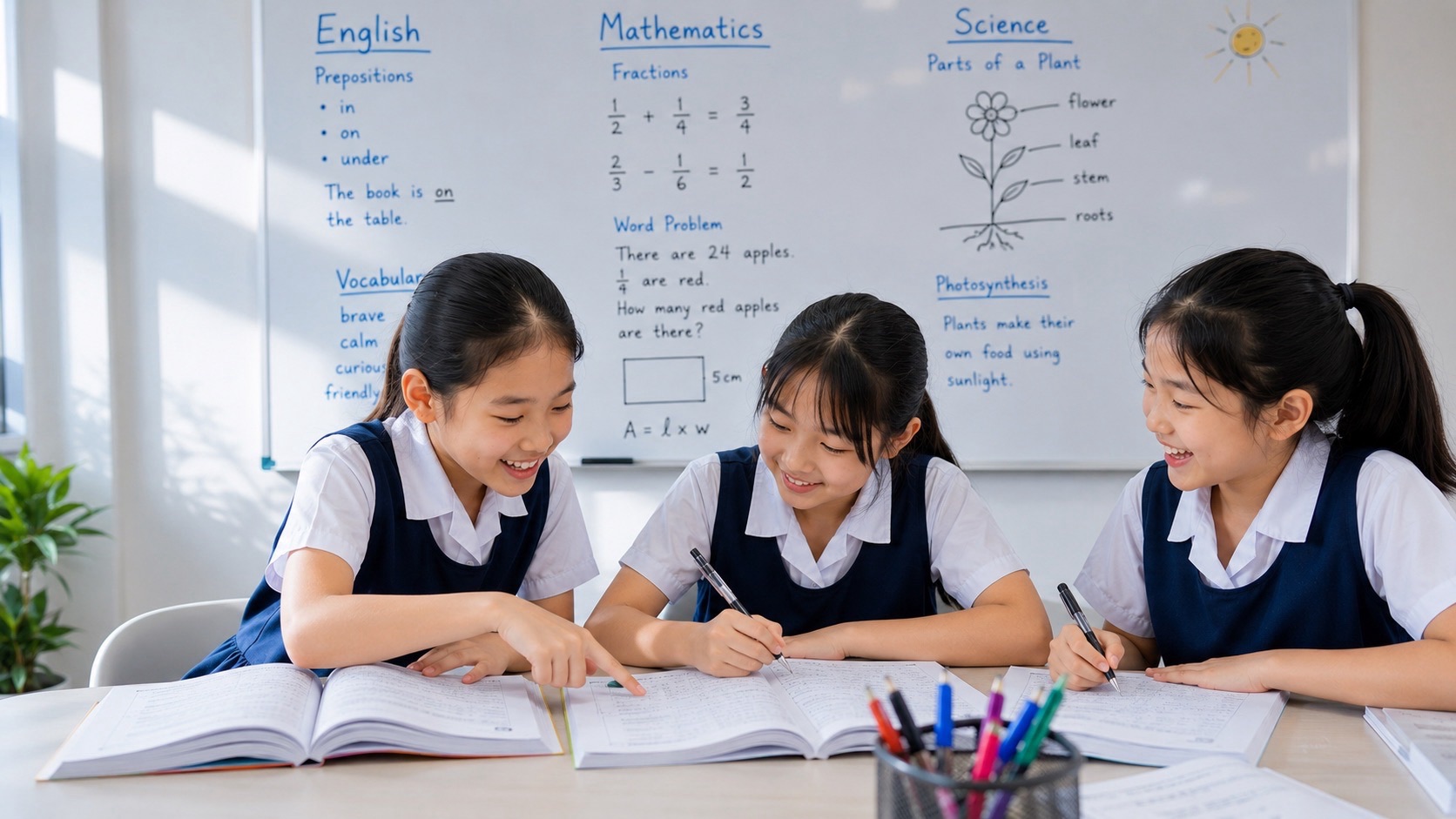
Year 2 Essential Word Pack: 200 words and meanings
These 200 words help Year 2 learners understand instructions, read useful information, discuss observations and handle everyday tasks. Each has an original meaning, natural phrase and example. This is an independent teaching pack, not a prescribed examination list; school Year and Cambridge Stage labels may differ.
School and examination requirements · Practice and learning guide
1–20: Understanding what a learning task asks
Practise the action as well as reading the instruction word.
| No. | Word and form | Meaning | Natural use and example |
|---|---|---|---|
| 1 | notice verb | To become aware of something through looking, listening or paying attention. | notice a change We noticed a new leaf on the plant beside the window. |
| 2 | follow verb | To do what instructions say, in the way they describe. | follow instructions Follow the instructions on the card before adding another piece. |
| 3 | collect verb | To bring things together from different places. | collect the cards Please collect the cards from each table after the game. |
| 4 | arrange verb | To put things in a planned order or position. | arrange by size Arrange the bottles by size, with the smallest at the front. |
| 5 | select verb | To choose a particular person or thing from a group. | select a picture Select a picture that shows the place described in the sentence. |
| 6 | connect verb | To join or link two or more things. | connect the dots Connect the numbered dots with lines to reveal the shape. |
| 7 | separate verb | To move things apart or keep them in different groups. | separate the materials Separate the paper from the fabric before we begin sorting. |
| 8 | include verb | To make someone or something part of a group or whole. | include a name Include your name on the label so the model can be returned. |
| 9 | remove verb | To take something away from a place or position. | remove the lid Remove the lid carefully before taking a card from the box. |
| 10 | complete verb | To finish all the parts that are needed for something. | complete a pattern Complete the pattern by choosing the shape that should come next. |
| 11 | practise verb | To do something repeatedly while working to improve a skill. | practise a greeting We practise a greeting before welcoming visitors to our classroom. |
| 12 | improve verb | To make something better or become better at it. | improve an explanation I improved my explanation by naming the two objects I compared. |
| 13 | correct verb | To change something that is wrong so that it becomes right. | correct an answer I corrected my answer after counting the counters again. |
| 14 | explain verb | To make something clear by telling how or why it happens. | explain your choice Explain your choice so your partner knows why you selected that card. |
| 15 | describe verb | To say or write what someone or something is like. | describe a shell Describe the shell's colour and shape without showing it to me. |
| 16 | compare verb | To look for ways in which two or more things are alike or different. | compare two leaves Compare the two leaves by looking at their shapes and edges. |
| 17 | measure verb | To find a size or amount using a tool or chosen unit. | measure a line Measure the line with a ruler and write its length. |
| 18 | estimate verb | To make a sensible rough judgement about a number or amount. | estimate the length Estimate the length of the table before checking it with a ruler. |
| 19 | guess verb | To give an answer without knowing for certain that it is correct. | guess the animal Guess the animal from the first clue, then listen for another clue. |
| 20 | solve verb | To find an answer to a problem or puzzle. | solve a problem We solved the problem by moving the blocks into equal groups. |
21–40: Finding meaning in books and messages
Look for these features in real texts rather than learning the names alone.
| No. | Word and form | Meaning | Natural use and example |
|---|---|---|---|
| 21 | title noun | The name given to a book, story or other piece of work. | a story title The story title helped us predict that the book was about a journey. |
| 22 | heading noun | Words at the start of a section that tell its subject. | a clear heading The heading Food tells us where to find facts about a rabbit's meals. |
| 23 | caption noun | A short piece of writing that explains a picture. | a picture caption The picture caption tells us which animal is sleeping in the tree. |
| 24 | sentence noun | A group of words that expresses a complete statement, question or other message. | a full sentence The sentence tells us where the class should meet after lunch. |
| 25 | question noun | Words used to ask for information or an answer. | ask a question I asked a question because the instructions did not name the place. |
| 26 | reply noun | An answer given to something that someone says or writes. | a short reply Her short reply told me that the library was still open. |
| 27 | instruction noun | Information telling someone what to do or how to do it. | a clear instruction The instruction says to fold the paper before drawing the windows. |
| 28 | message noun | Information sent or passed from one person to another. | leave a message I left a message asking my partner to bring the blue folder. |
| 29 | note noun | A short written message or reminder. | a reminder note The reminder note says to return the borrowed book on Friday. |
| 30 | story noun | An account of events, which may be imagined or based on real events. | tell a story The child told a story about a lost hat and a helpful neighbour. |
| 31 | poem noun | A piece of writing arranged to create effects through language, sound or rhythm. | read a poem We read a poem about rain and listened to its repeated sounds. |
| 32 | rhyme noun | A similarity between the ending sounds of words. | find a rhyme We found a rhyme when we said the words boat and coat. |
| 33 | author noun | The person who writes a book or other text. | the book's author The book's author wrote a short message at the end for readers. |
| 34 | character noun | A person or other figure taking part in a story. | a main character The main character is a rabbit who cannot find its way home. |
| 35 | setting noun | The place and time in which a story's events happen. | a story setting The story setting is a quiet village on a winter evening. |
| 36 | beginning noun | The first part of something, before its later parts. | the beginning of a story At the beginning of the story, the child finds a sealed envelope. |
| 37 | middle noun | The part between the beginning and the end. | the middle of a page The map is in the middle of the page beneath the title. |
| 38 | ending noun | The final part of a story, activity or other thing. | a story ending The story ending shows the friends returning the lost toy. |
| 39 | alphabet noun | The letters of a language arranged in their usual order. | the English alphabet We used the order of the English alphabet to arrange the name cards. |
| 40 | dictionary noun | A book or digital resource that explains words and often their pronunciation. | use a dictionary We used a dictionary to check the meaning of an unfamiliar word. |
41–60: Reading and doing everyday jobs
Connect these words to labels, routines and objects at home or school.
| No. | Word and form | Meaning | Natural use and example |
|---|---|---|---|
| 41 | container noun | An object used to hold or store things. | a food container The food container has a lid that closes before it goes in my bag. |
| 42 | packet noun | A small wrapped package holding a particular amount of something. | a packet of seeds The packet of seeds shows a picture of the flowers that may grow. |
| 43 | carton noun | A box or container, often made from strong paper or card. | a milk carton The empty milk carton went into the collection box after lunch. |
| 44 | envelope noun | A flat paper container used to hold a letter or card. | an addressed envelope We placed the invitation inside the addressed envelope before sealing it. |
| 45 | address noun | Details that identify where a person, building or place can be found. | a postal address The postal address tells the delivery worker where the letter should go. |
| 46 | stamp noun | A small label that shows payment for sending an item by post. | a postage stamp The postage stamp goes near the corner of the envelope. |
| 47 | calendar noun | A chart or system that shows days, weeks and months. | a classroom calendar We marked the class visit on the classroom calendar. |
| 48 | timetable noun | A plan showing the times when activities or journeys happen. | a weekly timetable The weekly timetable shows that our library lesson is on Tuesday. |
| 49 | appointment noun | An arrangement to meet someone at an agreed time. | a booked appointment The note reminds the family of a booked appointment tomorrow afternoon. |
| 50 | chore noun | A small job that needs to be done regularly. | a household chore Putting clean cups away is one household chore I can help with. |
| 51 | laundry noun | Clothes or other fabric items that need washing or have been washed. | clean laundry We sorted the clean laundry into shirts, socks and towels. |
| 52 | detergent noun | A substance used for cleaning, especially washing clothes or dishes. | a detergent label An adult read the detergent label before putting the bottle away safely. |
| 53 | sponge noun | A soft material with small holes that can hold liquid. | a damp sponge We used a damp sponge to wipe the washable paint from the tray. |
| 54 | cloth noun | A piece of woven or knitted material, often used for wiping. | a cleaning cloth The cleaning cloth was dry before we used it on the wet table. |
| 55 | cushion noun | A soft padded object used to make sitting or resting more comfortable. | a seat cushion The seat cushion made the wooden chair more comfortable to sit on. |
| 56 | blanket noun | A large piece of thick cloth used to keep someone warm. | a warm blanket The story shows a child resting beneath a warm blanket. |
| 57 | curtain noun | A piece of fabric hung over a window or opening. | close a curtain We closed the curtain to keep the bright light off the screen. |
| 58 | cupboard noun | A piece of furniture with doors and shelves for storing things. | a classroom cupboard The classroom cupboard holds spare paper and boxes of crayons. |
| 59 | kettle noun | A container used to heat water until it boils. | an electric kettle An adult used the electric kettle while the children stayed clear. |
| 60 | basket noun | A container, often made from woven material, used for carrying or storing. | a laundry basket The laundry basket held the dry towels ready to be folded. |
61–80: Finding a route and understanding a journey
Use a toy map or a supervised walk to practise the meanings.
| No. | Word and form | Meaning | Natural use and example |
|---|---|---|---|
| 61 | entrance noun | The place through which people go into a building or area. | the main entrance We met our teacher at the main entrance to the museum. |
| 62 | exit noun | The place through which people leave a building or area. | an exit sign The exit sign points towards the door leading out of the hall. |
| 63 | gate noun | A movable barrier that opens or closes an entrance in a fence or wall. | a garden gate The garden gate was closed after the visitors came inside. |
| 64 | fence noun | A barrier around or between areas, often made from wood or wire. | a low fence A low fence separates the flower beds from the walking path. |
| 65 | pavement noun | A raised or marked path beside a road for people walking. | walk on the pavement We walked on the pavement with our teacher beside us. |
| 66 | crossing noun | A place where people can cross a road or other route. | a pedestrian crossing The group waited with an adult at the pedestrian crossing. |
| 67 | junction noun | A place where roads or paths meet. | a road junction The map shows a road junction beside the public library. |
| 68 | traffic noun | Vehicles moving along a road or through an area. | heavy traffic Heavy traffic made the bus journey slower than usual. |
| 69 | passenger noun | A person travelling in a vehicle without driving it. | a bus passenger The bus passenger placed a bag beneath the seat. |
| 70 | driver noun | A person who controls a car, bus or other road vehicle. | a bus driver The bus driver stopped at the correct stop near the school. |
| 71 | ticket noun | A paper or digital item showing permission or payment for entry or travel. | a train ticket The train ticket showed the station where our journey would begin. |
| 72 | station noun | A place where trains or other public transport stop for passengers. | a railway station We waited inside the railway station until our train was announced. |
| 73 | platform noun | The raised area beside a railway track where passengers wait. | a station platform The class waited with their teacher on the station platform. |
| 74 | route noun | The path or series of roads used to reach a place. | a walking route Our walking route goes past the pond before reaching the visitor centre. |
| 75 | map noun | A drawing or display showing where places or features are located. | read a map We read the map to find the path from the gate to the pond. |
| 76 | symbol noun | A sign or picture that represents something else. | a map symbol The map symbol shaped like a cup marks the café. |
| 77 | direction noun | The way towards which someone or something moves or points. | the correct direction The arrow showed the correct direction to the exhibition hall. |
| 78 | destination noun | The place someone intends to reach at the end of a journey. | our final destination Our final destination was the park beside the river. |
| 79 | journey noun | Travel from one place to another. | a short journey The short journey from school to the museum took us through the town. |
| 80 | distance noun | The amount of space between two places or things. | a short distance There is only a short distance between the gate and the classroom. |
81–100: Looking closely at the natural world
Use the exact part or place name when you explain what you notice.
| No. | Word and form | Meaning | Natural use and example |
|---|---|---|---|
| 81 | root noun | The part of a plant that usually grows underground and takes in water. | a plant root The picture shows a plant root spreading through the soil. |
| 82 | branch noun | A woody part that grows out from a tree's trunk or another branch. | a low branch A small bird rested on a low branch above the path. |
| 83 | trunk noun | The main woody stem of a tree. | a tree trunk The tree trunk is much thicker than the branches near its top. |
| 84 | bark noun | The outer covering of a tree's trunk and branches. | rough bark We looked closely at the rough bark without pulling pieces off. |
| 85 | bud noun | A small developing part of a plant that can become a leaf or flower. | a flower bud A flower bud appeared beside the open flower on our plant. |
| 86 | petal noun | One of the usually coloured parts around the centre of a flower. | a fallen petal A fallen petal lay on the path beside the plant pot. |
| 87 | fruit noun | The part of a flowering plant that develops around its seeds. | a ripe fruit We cut the ripe fruit open with an adult to see its seeds. |
| 88 | vegetable noun | A plant or part of a plant used as food, usually in savoury dishes. | a leafy vegetable The leafy vegetable was washed before the adult prepared it for lunch. |
| 89 | shell noun | A hard outer covering that protects some animals or their eggs. | an empty shell We drew the pattern on the empty shell in our classroom collection. |
| 90 | feather noun | One of the light structures covering a bird's body. | a soft feather The photograph shows a soft feather near the bird's wing. |
| 91 | fur noun | The thick hair covering the bodies of some animals. | a rabbit's fur The rabbit's fur looks shorter around its face than on its body. |
| 92 | habitat noun | The natural place where an animal or plant lives. | a pond habitat A pond habitat can provide homes for several kinds of small animals. |
| 93 | pond noun | A small area of water surrounded by land. | a garden pond We watched the garden pond from the path beside its fence. |
| 94 | stream noun | A small natural flow of water across the land. | a narrow stream A narrow stream flowed beneath the bridge in the story. |
| 95 | shore noun | The land along the edge of a sea, lake or other large body of water. | a rocky shore The picture shows waves reaching a rocky shore. |
| 96 | weather noun | The conditions outside, such as rain, wind or sunshine, at a particular time. | changeable weather The weather changed from sunshine to rain during our lesson. |
| 97 | temperature noun | A measure of how hot or cold something is. | air temperature We recorded the air temperature shown on the classroom weather display. |
| 98 | season noun | One of the main periods of the year with a usual weather pattern. | a rainy season The book describes a rainy season when the river becomes fuller. |
| 99 | shade noun | An area where something blocks direct light from the sun. | sit in the shade We sat in the shade of the shelter while waiting. |
| 100 | shelter noun | A place or structure that offers protection from weather or danger. | a bus shelter We waited beneath the bus shelter while the rain fell. |
101–120: Materials and actions in a simple investigation
Use safe classroom materials and describe what actually happens.
| No. | Word and form | Meaning | Natural use and example |
|---|---|---|---|
| 101 | material noun | The substance from which something is made. | a suitable material We chose a suitable material for a flag that needed to bend. |
| 102 | fabric noun | Material made by weaving, knitting or joining fibres together. | a piece of fabric A piece of fabric covered the top of our model bed. |
| 103 | metal noun | A type of material such as iron or copper, often hard and shiny. | a metal spoon The metal spoon felt cooler than the wooden spoon beside it. |
| 104 | plastic noun | A manufactured material that can be shaped into many kinds of objects. | a plastic ruler The plastic ruler bent slightly when the teacher demonstrated its flexibility. |
| 105 | glass noun | A hard material that is often transparent and can break into sharp pieces. | a glass window We looked through the glass window at the rain outside. |
| 106 | wood noun | The hard material forming the trunk and branches of trees. | a piece of wood The smooth piece of wood became the base of our model. |
| 107 | paper noun | Thin material used for writing, printing, drawing or wrapping. | a sheet of paper We folded a sheet of paper to make a small fan. |
| 108 | solid noun | Matter that has its own shape and takes up a fixed amount of space under given conditions. | a solid object The wooden block is a solid, even though we can move it. |
| 109 | liquid noun | Matter that flows and takes the shape of the container holding it. | a clear liquid The clear liquid spread across the bottom of the empty cup. |
| 110 | absorb verb | To take in liquid or another substance through a surface. | absorb water The dry sponge absorbed some of the water from the tray. |
| 111 | float verb | To stay on or near the surface of a liquid without sinking to the bottom. | float on water The cork floated on the water during our classroom observation. |
| 112 | sink verb | To move down below the surface of a liquid. | sink to the bottom The small stone sank to the bottom of the water tray. |
| 113 | stretch verb | To pull something so that it becomes longer or wider. | stretch a band The teacher stretched the soft band and then let it relax. |
| 114 | bend verb | To change something from straight to curved or angled. | bend a strip We bent the paper strip to make an arch for our model. |
| 115 | twist verb | To turn part of something around while another part stays in place. | twist a cloth The adult twisted the wet cloth over the sink. |
| 116 | squeeze verb | To press something firmly from different sides. | squeeze a sponge We squeezed the sponge over the tray to release the water. |
| 117 | mix verb | To combine different things so that they are together. | mix two colours We mixed two colours of paint to see the new colour. |
| 118 | melt verb | To change from a solid into a liquid through heating. | ice begins to melt The ice began to melt while it stood in the warm room. |
| 119 | freeze verb | To become solid because the temperature becomes low enough. | water can freeze The picture sequence shows water freezing into ice in a freezer. |
| 120 | soak verb | To leave something in liquid so that it becomes thoroughly wet. | soak a cloth We soaked the cloth in water before testing how much it held. |
121–140: Comparing numbers and measurements
Always say what you counted or measured and which things you compared.
| No. | Word and form | Meaning | Natural use and example |
|---|---|---|---|
| 121 | total noun | The complete number or amount after the parts are added together. | the total number The total number of counters is eight: five red and three blue. |
| 122 | amount noun | How much of something there is. | an amount of water Each container held the same amount of water for our comparison. |
| 123 | length noun | The measurement from one end of something to the other. | the length of a line We measured the length of the line from its start to its end. |
| 124 | height noun | The measurement from the bottom of something to its top. | the height of a tower The height of our block tower increased when we added another block. |
| 125 | width noun | The measurement across something from one side to the other. | the width of a door We measured the width of the door to see whether the box would fit. |
| 126 | weight noun | How heavy something is, expressed using a suitable measurement in everyday use. | the weight of a bag We compared the weight of the two bags before deciding which was heavier. |
| 127 | full adjective | Containing as much as something can hold. | a full container The full container could not hold any more blocks without overflowing. |
| 128 | empty adjective | Containing nothing inside. | an empty bottle The empty bottle had no liquid left inside it. |
| 129 | equal adjective | The same in number, amount, size or value being compared. | equal amounts We poured equal amounts into identical cups, stopping at the same marked line. |
| 130 | unequal adjective | Different in number, amount, size or value being compared. | unequal groups The groups are unequal because one has three counters and the other has five. |
| 131 | double adjective | Twice the number or amount of something. | double the amount Eight is double the number of counters in a group of four. |
| 132 | extra adjective | Added beyond the amount already present or needed. | an extra chair We brought an extra chair because another visitor had arrived. |
| 133 | several determiner | More than two but not a very large number. | several leaves Several leaves had fallen onto the path beside the school gate. |
| 134 | fewer determiner | A smaller number of separate items than another number. | fewer buttons The green tray contains fewer buttons than the red tray. |
| 135 | least determiner | The smallest amount of something among the amounts being compared. | the least water The first cup has the least water of the three cups. |
| 136 | most determiner | The largest amount or number among those being compared. | the most counters This group has the most counters because twelve is larger than eight or nine. |
| 137 | nearly adverb | Almost, but not completely or not quite reaching a number or point. | nearly full The bottle is nearly full, with a little space below the top. |
| 138 | exactly adverb | Precisely, without being more, less or different from what is stated. | exactly ten There are exactly ten cards in the packet after we count them. |
| 139 | unit noun | An agreed amount used for counting or measuring. | a measuring unit We used centimetres as the measuring unit for the short line. |
| 140 | pattern noun | An arrangement in which features repeat or follow a recognisable rule. | a repeating pattern The repeating pattern goes red, blue, red, blue along the strip. |
141–160: Time, frequency and order
Connect clock and calendar language to an actual plan or sequence.
| No. | Word and form | Meaning | Natural use and example |
|---|---|---|---|
| 141 | minute noun | A unit of time equal to sixty seconds. | one minute We watched the timer for one minute before checking our work. |
| 142 | hour noun | A unit of time equal to sixty minutes. | half an hour The activity lasted half an hour before we changed to reading. |
| 143 | week noun | A period of seven days. | next week Our class will visit the library again next week. |
| 144 | month noun | One of the twelve named periods into which a year is divided. | this month The calendar shows two class celebrations during this month. |
| 145 | year noun | A period of twelve months. | a calendar year A calendar year begins in January and ends in December. |
| 146 | date noun | The day, month and sometimes year when something happens. | the visit date The visit date is written on the letter sent home. |
| 147 | weekend noun | The part of a week commonly set aside from the usual working or school days. | at the weekend The family plans to visit the park at the weekend. |
| 148 | early adverb | Before the expected or usual time. | arrive early We arrived early and had time to find the entrance. |
| 149 | late adverb | After the expected or agreed time. | arrive late The bus arrived late because traffic had slowed the journey. |
| 150 | daily adverb | Every day or on each day being discussed. | check daily We checked the classroom plant daily during the school week. |
| 151 | weekly adverb | Once every week or each week being discussed. | meet weekly Our reading group meets weekly to talk about a book. |
| 152 | regular adjective | Happening repeatedly in a steady or usual pattern. | a regular routine A regular routine helps us know which materials to bring for the lesson. |
| 153 | once adverb | One time. | read once Read the instruction once, then tell your partner what to do. |
| 154 | twice adverb | Two times. | check twice We checked the total twice because our first answers were different. |
| 155 | already adverb | Before now or before the time being discussed. | already finished I have already finished the first task and put it in the tray. |
| 156 | still adverb | Continuing at the time being discussed. | still waiting We are still waiting because the classroom door has not opened. |
| 157 | until conjunction | Up to the time when something happens. | wait until Wait until your partner has finished before collecting the cards. |
| 158 | during preposition | At some time within a period or while an event is happening. | during the lesson We recorded the weather during the lesson after lunch. |
| 159 | afterwards adverb | At a later time, following the event just mentioned. | wash afterwards We painted the model and washed the brushes afterwards. |
| 160 | finally adverb | After the earlier actions or stages in a sequence. | finally add the label First fold the card, then draw the picture, and finally add the label. |
161–180: People, responsibilities and feelings
Link feelings to a situation and explain what a person can do next.
| No. | Word and form | Meaning | Natural use and example |
|---|---|---|---|
| 161 | neighbour noun | A person who lives near another person. | a helpful neighbour A helpful neighbour brought back the ball that had rolled through the gate. |
| 162 | visitor noun | Someone who comes to a place for a limited time. | a school visitor The school visitor told our class about caring for the community garden. |
| 163 | partner noun | Someone who works or takes part in an activity with another person. | a reading partner My reading partner listened while I explained the picture caption. |
| 164 | member noun | A person who belongs to a group. | a team member Each team member carried one item to the activity table. |
| 165 | leader noun | A person who guides a group or helps it organise its work. | a group leader The group leader checked that everyone understood the next step. |
| 166 | customer noun | A person who buys goods or services from a business. | a shop customer The shop customer asked where to find the notebooks. |
| 167 | librarian noun | A person whose work includes organising books and helping library users. | ask a librarian We asked a librarian where to find books about insects. |
| 168 | nurse noun | A trained person whose work includes caring for people who are ill or injured. | a school nurse The school nurse listened while the child explained where their arm hurt. |
| 169 | coach noun | A person who teaches or guides people in a sport or other skill. | a team coach The team coach demonstrated the movement before asking us to try. |
| 170 | volunteer noun | A person who chooses to help with a task, usually without payment. | a garden volunteer A garden volunteer helped the children label their plant pots. |
| 171 | curious adjective | Wanting to find out more about something. | curious about a sound I was curious about the sound coming from the closed box. |
| 172 | puzzled adjective | Unable to understand something at first. | a puzzled expression The child looked puzzled because the instruction mentioned a missing picture. |
| 173 | pleased adjective | Feeling happy or satisfied about something. | pleased with the result We were pleased with the result when the tower stood upright. |
| 174 | nervous adjective | Worried or uneasy about what may happen. | nervous before speaking I felt nervous before speaking to the visitors for the first time. |
| 175 | relieved adjective | Feeling better because a worry or difficulty has ended. | relieved to find it I was relieved to find my missing bus card in my pocket. |
| 176 | disappointed adjective | Unhappy because something hoped for did not happen. | disappointed by a change We were disappointed when rain meant the outdoor game had to be cancelled. |
| 177 | proud adjective | Feeling pleased about something you or someone else has achieved. | proud of an effort The child was proud of learning to explain the game independently. |
| 178 | patient adjective | Able to wait or deal with difficulty without becoming quickly upset. | a patient listener My patient listener let me finish the sentence before helping with a word. |
| 179 | honest adjective | Telling the truth and not trying to deceive others. | an honest answer An honest answer was to say that I had not counted the cards yet. |
| 180 | responsible adjective | Trusted or expected to take proper care of a task or duty. | responsible for the tray I am responsible for returning the tray after our group finishes. |
181–200: Working and talking with other people
Practise short exchanges in which the listener has a real choice or missing information.
| No. | Word and form | Meaning | Natural use and example |
|---|---|---|---|
| 181 | greet verb | To speak or act in a friendly way when meeting someone. | greet a visitor We greeted the visitor and showed them where to sit. |
| 182 | introduce verb | To tell people someone's name when they meet. | introduce a partner I introduced my partner to the new member of our group. |
| 183 | request noun | A polite or formal act of asking for something. | a clear request My request named the book I wanted to borrow from the library. |
| 184 | offer verb | To say that you are willing to give something or help. | offer to help I offered to help carry the empty boxes to the cupboard. |
| 185 | accept verb | To agree to take something that is offered. | accept an invitation We accepted the invitation to visit the class next door. |
| 186 | refuse verb | To say that you will not do or accept something. | refuse politely I refused politely because I did not want to join that game. |
| 187 | suggest verb | To put forward an idea for someone to consider. | suggest a plan I suggested a plan that gave each person a turn with the map. |
| 188 | discuss verb | To talk about a subject by sharing ideas and listening to others. | discuss a choice We discussed which materials would be useful for our model. |
| 189 | interrupt verb | To stop someone speaking or doing something by speaking or acting yourself. | interrupt a speaker I waited for a pause so I would not interrupt the speaker. |
| 190 | apologise verb | To say that you are sorry for something you did. | apologise for a mistake I apologised for moving my partner's picture without asking. |
| 191 | thank verb | To tell someone that you appreciate something they did or gave. | thank a helper We thanked the helper for showing us where the books belonged. |
| 192 | remind verb | To help someone remember something they may have forgotten. | remind a partner I reminded my partner to bring the label with the model. |
| 193 | warn verb | To tell someone about a possible danger or difficulty before it happens. | warn about a spill The adult warned us that the floor was wet near the sink. |
| 194 | promise verb | To tell someone firmly that you will do something. | promise to return I promised to return the borrowed card after the lesson. |
| 195 | allow verb | To let someone do something or permit something to happen. | allow extra time The teacher allowed extra time for us to check the labels. |
| 196 | permission noun | Agreement from someone who has the right to let something happen. | ask permission We asked permission before moving the books from their usual shelf. |
| 197 | rule noun | A statement that tells people what they may or should do. | a game rule One game rule says that each player chooses only one card. |
| 198 | turn noun | An opportunity to do something when people do it one after another. | take a turn Each child took a turn reading a question from the card. |
| 199 | team noun | A group of people working or playing together for a shared purpose. | a helpful team Our team put the materials away before the next group arrived. |
| 200 | cooperate verb | To work with other people towards a shared task or aim. | cooperate on a task We cooperated on the task by sharing the materials and listening to suggestions. |
Choose your next learning step
Start with the task that is useful today. The practice passages and model answers are original teaching examples, not predicted examination questions.
Return to a word group
- 1–20: Understanding what a learning task asks
- 21–40: Finding meaning in books and messages
- 41–60: Reading and doing everyday jobs
- 61–80: Finding a route and understanding a journey
- 81–100: Looking closely at the natural world
- 101–120: Materials and actions in a simple investigation
- 121–140: Comparing numbers and measurements
- 141–160: Time, frequency and order
- 161–180: People, responsibilities and feelings
- 181–200: Working and talking with other people
Practise and check your understanding
- What does Year 2 need for school and examinations?
- Use the words to complete a real job
- The Fencing Method: explain a comparison clearly
- Read a notice, then use the information
- Speaking and listening: run a small information desk
- Choose the exact meaning and natural word partner
- Twelve tasks to test meaning in use
- Answers and explanations
- Build a small routine that includes transfer
- Frequently asked questions
- Sources and companion reading
- Essential Word Packs for other years
What does Year 2 need for school and examinations?
This Year 2 pack helps a learner follow a classroom task, read useful information and explain something to another person. It is part of an IGCSE pathway collection, but Year 2 is not an IGCSE examination stage. This is eduKate’s own teaching selection, not a prescribed Cambridge examination word list.
Cambridge Primary English 0058 includes reading, writing, speaking and listening for different purposes. In practical terms, a learner needs to understand a label as well as a story, and a spoken instruction as well as a written question. These entries support those activities; they do not replace the school’s curriculum or its reading programme.
Check the actual stage being taught. Cambridge explains that schools may adjust stage timing, so Year 2 and Stage 2 are not guaranteed to match. Primary Progression Tests cover Stages 3–6; Primary Checkpoint is used at the end of Stage 6. A Year 2 vocabulary session should not be treated as preparation for a current IGCSE paper.
Helpful evidence of progress includes following two clear steps, locating a stated detail in a short text, asking when information is missing and explaining a comparison with an example. These are suggested classroom checks. They are not official grade boundaries, and completing the pack does not predict a distinction.
Contents · Previous section · Next section
Use the words to complete a real job
Choose a task first and a small set of words second. For packing a reading bag, useful choices might be timetable, include, remove, check from familiar earlier learning, and complete. For a plant observation, choose bud, leaf, root, notice and measure. Words make more sense when the child can see what they help to accomplish.
Read a row in three passes
First explain the meaning with an object, action or quick drawing. Next say the natural phrase: responsible for, curious about, compare two leaves. Finally read the example and ask the learner for a different example. The new example need not be longer. “I am responsible for the cards” is useful if that is the child’s actual task.
Check whether the obstacle is meaning, reading or memory for instructions. If a child can describe a container but cannot read the printed word, the meaning is already partly secure. If they understand two separate instructions but miss one when both are spoken quickly, reduce the load and try again. Do not treat every incorrect action as proof of a vocabulary gap.
A useful explanation has a reference point
“This has fewer” leaves the listener wondering what is being compared. “The blue tray has fewer counters than the red tray” gives both groups and the feature. Ask the learner to point to them. If the blue tray contains six and the red tray contains four, the grammar is correct but the meaning does not fit the facts. Accuracy comes before praise for a complete sentence.
For support, give two possible words and a visible situation. For stretch, let the child create an instruction that another person can successfully follow. Keep a few familiar words in each session so the learner can begin with something they already understand.
Contents · Previous section · Next section
The Fencing Method: explain a comparison clearly
The eduKate Fencing Method uses controlled sentence development followed by a change of context. In this pack, each added detail must help the listener understand the task. The following original sequence uses compare, a word that is useful in reading, mathematics and observation.
- Base: “We compare two leaves.” The objects and action are present.
- Detail: “We compare the edges of two leaves.” The feature is now clear.
- Intention: “We compare the edges of two leaves to find a difference.” The listener knows the purpose.
- Evidence: “We compare the edges of two leaves to find a difference. One edge is smooth, while the other has small points.” The second sentence supplies the observation.
- Transfer: “We compare two routes by counting the squares along each route on our map.” The context changes, but there are still objects and a feature to compare.
Do not add an emotion merely because a stage mentions tone. In a factual observation, a neutral tone is suitable. A learner can also say “I am curious about the difference,” provided that the feeling belongs to the speaker and is relevant. The method is a teaching scaffold, not a fixed sentence that every answer must resemble.
A second fence for a polite request
Start with “Please explain.” Add the missing object: “Please explain the instruction.” Then identify the gap: “Please explain where the label should go.” Finally give the reason: “Please explain where the label should go because the picture does not show its position.” Transfer the pattern to a new need: “Please explain which platform we are using.” An adult would manage an actual journey; the classroom task practises the language.
After building a sentence, shorten it if necessary. “Where should the label go, please?” may be the clearest final request. Control means choosing an effective message, not keeping every word from every practice step.
Contents · Previous section · Next section
Read a notice, then use the information
This original notice is designed for practice. All information needed for the questions appears in it. Read it aloud if independent reading is still developing.
Our class visit to the garden
We will leave the classroom at nine o’clock on Wednesday morning. Bring a water bottle and a hat. The route goes through the main gate and past the pond. We will stop at the covered shelter to draw a plant. Each pair will share one clipboard. Please return the clipboard to the teacher before we leave the garden. We will come back to school before lunch. If it rains heavily, we will stay in the classroom and draw the plants from photographs.
Find a detail, then explain a condition
- Which two personal items does the notice ask pupils to bring?
- What time will the class leave the classroom?
- Will the class pass the pond before or after leaving through the main gate?
- Where will the class stop to draw?
- Does every child receive a separate clipboard?
- What changes if there is heavy rain?
Answers: 1. A water bottle and a hat. A clipboard is shared, not named as something each child must bring. 2. Nine o’clock on Wednesday morning. 3. After the main gate; the route is given in that order. 4. At the covered shelter. 5. No: one clipboard is shared by each pair. 6. The class stays in the classroom and draws from photographs.
Turn reading into an action
Give the learner a bottle, a hat, a toy car and an empty bag. Ask them to pack only the personal items requested in the notice. Then ask what would need checking before leaving. A useful answer is the weather condition or the time. “Bring everything just in case” does not follow the instruction to select the named items.
The notice does not say how long the walk takes or the names of the plants. “It does not tell us” is an accurate response to those questions. Encourage the child to distinguish missing information from something they have simply not found yet. They can reread before deciding.
Contents · Previous section · Next section
Speaking and listening: run a small information desk
Give the speaker information the listener needs
Create three places with cards: library, classroom and garden. Write or say a simple fact for each: the library is beside the classroom; the garden is beyond the gate; the book return box is inside the library. One child is the visitor, and another is the helper. The visitor asks for a place without seeing the helper’s information card.
A useful exchange is: “Where do I return this book?” “Use the return box inside the library.” “Is the library beside the classroom?” “Yes.” The helper has supplied a destination and checked the visitor’s understanding. A reply such as “Over there” may work when pointing is clear, but it fails if the visitor cannot see the gesture. Ask for words that solve that particular gap.
Offer, accept and refuse are different actions
Model “Would you like help carrying the tray?” The listener may say “Yes, please” or “No, thank you; I can manage.” The first response accepts the offer; the second refuses it politely. Do not teach cooperation as agreeing to every request. A learner can cooperate with a shared task while explaining that one proposed action is unsuitable.
A short listening check
Read this message once at a comfortable pace: “Collect the blue folder from the shelf. Leave the red folder there. Bring the blue folder to the reading table.” Ask which folder moves, which stays and where the moved folder goes. The answers are blue, red and the reading table. Repeat the message if needed, then check the meaning of collect and leave separately.
For an extra challenge, have the learner retell the message accurately to another person. Changing the words is fine when the instructions stay the same. A longer retelling that accidentally moves both folders is less useful than a short, faithful one.
Contents · Previous section · Next section
Choose the exact meaning and natural word partner
Guess and estimate
A guess is an answer made without certainty. An estimate is a rough judgement informed by something useful, such as a known length or a smaller counted group. If a strip looks about twice as long as a ten-centimetre strip, estimating twenty centimetres has a basis. Measuring afterwards allows the learner to compare the estimate with the measured result.
Nearly and exactly
If a box holds ten counters and currently contains nine, it is nearly full. It does not contain exactly ten. Ask the learner which claim can be checked by counting. These words should not be added because they sound mature: each changes the amount of certainty or completeness being claimed.
Materials, objects and properties
Metal names a material; spoon names an object; hard describes a property. One object can be made from different materials, and one material can be used for many objects. Sort actual or pictured spoons by material. Avoid “All spoons are metal” when a wooden or plastic spoon is visible.
The liquid did not disappear
When a sponge absorbs water, some water enters the sponge. Saying that it disappears can hide what happened. Squeezing the sponge over a tray gives the learner another observation to describe. Keep the account limited to what the activity shows; one observation with one sponge does not prove how every fabric behaves.
Word families do not all follow one spelling rule
In British English, practise is the verb: “We practise our explanation.” Practice is the noun: “This practice helps us improve.” Also compare describe with description and explain with explanation. Hear the useful sentence first. The child does not need to generate every related form in order to use the original word well.
Contents · Previous section · Next section
Twelve tasks to test meaning in use
Use objects where they would make the task clearer. For open questions, accept another answer when its meaning fits the supplied situation.
- A picture has the words “The butterfly’s wing” beneath it. Are those words a caption or a timetable?
- You put six red counters with two blue counters. What is the total number?
- A ten-space tray holds nine counters. Is it nearly full or completely full?
- Choose the natural phrase: “I am responsible for / at returning the tray.”
- A child says a strip is about twenty centimetres long because it looks twice as long as a ten-centimetre ruler. Is this an estimate or an exact measurement?
- A cork stays on the surface of water. Does it float or sink?
- Which word describes the main woody stem of a tree: trunk or petal?
- Repair the form: “We practice our reading aloud.” Use the British English verb spelling.
- A partner cannot find the library. Give a useful reply using this fact: the library is beside the classroom.
- You are offered help but can manage the task. Refuse the offer politely.
- Compare two groups: one has four cards, and the other has seven. Use fewer and name both groups clearly.
- Explain a new use of label from earlier learning using at least one word from this pack, such as container, instruction or include.
Contents · Previous section · Next section
Answers and explanations
- A caption. It gives information about the picture. A timetable would organise activities or journeys by time.
- Eight. The total combines both groups: six plus two. The word asks for the whole number.
- Nearly full. There is space for one more counter. Completely full would leave no space for another.
- For. The useful pattern is responsible for a task or item. Keep the phrase together when practising.
- An estimate. The child used a reference length to make a rough judgement. The strip has not yet been measured directly.
- Float. The described cork remains on the surface instead of moving down through the water.
- Trunk. A petal is part of a flower. Naming the correct plant part makes the description accurate.
- “We practise our reading aloud.” Practise is the verb in this sentence. Practice is used as a noun in British English.
- Possible reply: “The library is beside the classroom.” Pointing may help, but the words now identify the relationship.
- Possible reply: “No, thank you. I can carry this myself.” Another respectful refusal is acceptable; it should not accidentally accept the offer.
- Possible answer: “The group of four has fewer cards than the group of seven.” The comparison names both groups and keeps the numbers correct.
- Possible answer: “Include a name on the container’s label so its owner can find it.” Check that the label identifies or explains something rather than being an unrelated decoration.
If the learner selects the right word but cannot explain why, return to a concrete example. If they explain the meaning accurately but misspell the word, praise the meaning and teach that spelling separately. Feedback should identify the next small action, such as checking which preposition follows responsible.
Contents · Previous section · Next section
Build a small routine that includes transfer
Choose four or five entries for a useful weekly theme, then adjust that number to the learner. For a journey theme, try route, map, destination, passenger and ticket. Introduce the meanings with a drawing or familiar trip. On a later day, let the child explain the drawing without reading the definitions first. Then change the destination and ask what stays the same about each word’s meaning.
Add a short reading task and a short spoken task. A child might read a two-sentence notice, pack the correct items and tell a partner where the group is going. The writing can be one accurate label or message. The same vocabulary is doing several jobs, rather than appearing only in a spelling column.
When the task is too hard
Reduce the number of unfamiliar words in the instruction. Demonstrate the action, supply a picture and allow the child to answer orally. Check comprehension in the child’s other language when helpful. Learning a new English label should build on a concept the child already understands where possible.
When the task is secure
Ask the learner to repair a deliberately unclear notice or explain why two near choices differ. For example, a notice saying “Bring it tomorrow” lacks the object. “We will leave soon” gives less precise timing than “We will leave at nine.” The aim is greater accuracy, not unnecessary formality.
The Cambridge Primary English guide shows increasing control of sequence and spoken explanation across stages. Keep a small record of practical evidence: what the child could explain independently, what needed a prompt, and what to try next. No score on this homemade record should be presented as an examination prediction.
Contents · Previous section · Next section
Frequently asked questions
Is this the same as the Year 2 essay vocabulary guide?
No. This pack centres on broad everyday and classroom use: instructions, information texts, discussion, materials, journeys and practical tasks. Some essential words recur because they serve several purposes, but the examples and learning activities are designed for this pack.
Should a Year 2 learner know scientific words such as liquid?
Use the word when a concrete experience makes its meaning clear. A learner can compare water and a wooden block without memorising a formal scientific definition. Select entries to suit the child’s lessons; the full list is not a compulsory age test.
How many words should we learn in one session?
Enough to practise meaning and use without rushing. A small group of two to five may suit many activities, but this is a planning suggestion, not a rule. Reduce the number when meanings remain uncertain and revisit useful familiar words.
Does every correct answer need a complete written sentence?
No. Pointing, acting, speaking or giving a short answer can demonstrate the target skill. Use complete written sentences when writing is the task. Do not let difficult handwriting prevent you from finding out what the child understands.
Can the learner use another language to explain a meaning?
Yes. That can show whether the concept is already understood. Then connect it to a useful English phrase and a real situation. A word-for-word translation may not carry every meaning, so check the example rather than assuming a perfect match.
What helps a learner progress towards stronger later results?
Look for accurate choices, independent use, clear explanations and the willingness to check a source. Keep reading and discussion varied. Memorising the list alone cannot guarantee a grade, but using words to understand and complete real tasks makes the learning more useful.
Contents · Previous section · Next section
Sources and companion reading
The word selection, meanings, sentences, passages and activities are independent eduKate teaching material. The sources below support the examination context and specific learning guidance; they do not prescribe this 200-word sequence or guarantee an outcome.
- Cambridge Primary English 0058 — Official curriculum overview and language skills.
- Cambridge Primary assessment — Optional Progression Tests and Primary Checkpoint stages.
- A guide to Cambridge Primary English — Examples of progression in reading, writing and classroom communication.
- Cambridge Primary stages and starting ages — Why school Year and Cambridge Stage should be checked locally.
- The eduKate Fencing Method for Vocabulary — The controlled sentence-expansion approach used in original activities here.
For extended composition and essay practice, continue with the Year 2 Words for Essay Writing guide. For the broader collection that inspired this format, see 200 vocabulary words for a 12-year-old.
Explore the Years 1–13 Essential Word Packs
For all 26 vocabulary guides, help choosing a level and a practical study routine, open the Years 1–13 Vocabulary Study Guide.
Choose the closest learning stage, then adapt the pace to the learner. Years 1–9 build foundations, Years 10–11 support the usual IGCSE stage, and Years 12–13 continue into pre-university learning. School structures differ.
- Year 1 Essential Word Pack
- Year 2: this Essential Word Pack
- Year 3 Essential Word Pack
- Year 4 Essential Word Pack
- Year 5 Essential Word Pack
- Year 6 Essential Word Pack
- Year 7 Essential Word Pack
- Year 8 Essential Word Pack
- Year 9 Essential Word Pack
- Year 10 Essential Word Pack
- Year 11 Essential Word Pack
- Year 12 Essential Word Pack
- Year 13 Essential Word Pack